Spandidos Publications Logo
  • About
    • About Spandidos
    • Aims and Scopes
    • Abstracting and Indexing
    • Editorial Policies
    • Reprints and Permissions
    • Job Opportunities
    • Terms and Conditions
    • Contact
  • Journals
    • All Journals
    • Oncology Letters
      • Oncology Letters
      • Information for Authors
      • Editorial Policies
      • Editorial Board
      • Aims and Scope
      • Abstracting and Indexing
      • Bibliographic Information
      • Archive
    • International Journal of Oncology
      • International Journal of Oncology
      • Information for Authors
      • Editorial Policies
      • Editorial Board
      • Aims and Scope
      • Abstracting and Indexing
      • Bibliographic Information
      • Archive
    • Molecular and Clinical Oncology
      • Molecular and Clinical Oncology
      • Information for Authors
      • Editorial Policies
      • Editorial Board
      • Aims and Scope
      • Abstracting and Indexing
      • Bibliographic Information
      • Archive
    • Experimental and Therapeutic Medicine
      • Experimental and Therapeutic Medicine
      • Information for Authors
      • Editorial Policies
      • Editorial Board
      • Aims and Scope
      • Abstracting and Indexing
      • Bibliographic Information
      • Archive
    • International Journal of Molecular Medicine
      • International Journal of Molecular Medicine
      • Information for Authors
      • Editorial Policies
      • Editorial Board
      • Aims and Scope
      • Abstracting and Indexing
      • Bibliographic Information
      • Archive
    • Biomedical Reports
      • Biomedical Reports
      • Information for Authors
      • Editorial Policies
      • Editorial Board
      • Aims and Scope
      • Abstracting and Indexing
      • Bibliographic Information
      • Archive
    • Oncology Reports
      • Oncology Reports
      • Information for Authors
      • Editorial Policies
      • Editorial Board
      • Aims and Scope
      • Abstracting and Indexing
      • Bibliographic Information
      • Archive
    • Molecular Medicine Reports
      • Molecular Medicine Reports
      • Information for Authors
      • Editorial Policies
      • Editorial Board
      • Aims and Scope
      • Abstracting and Indexing
      • Bibliographic Information
      • Archive
    • World Academy of Sciences Journal
      • World Academy of Sciences Journal
      • Information for Authors
      • Editorial Policies
      • Editorial Board
      • Aims and Scope
      • Abstracting and Indexing
      • Bibliographic Information
      • Archive
    • International Journal of Functional Nutrition
      • International Journal of Functional Nutrition
      • Information for Authors
      • Editorial Policies
      • Editorial Board
      • Aims and Scope
      • Abstracting and Indexing
      • Bibliographic Information
      • Archive
    • International Journal of Epigenetics
      • International Journal of Epigenetics
      • Information for Authors
      • Editorial Policies
      • Editorial Board
      • Aims and Scope
      • Abstracting and Indexing
      • Bibliographic Information
      • Archive
    • Medicine International
      • Medicine International
      • Information for Authors
      • Editorial Policies
      • Editorial Board
      • Aims and Scope
      • Abstracting and Indexing
      • Bibliographic Information
      • Archive
  • Articles
  • Information
    • Information for Authors
    • Information for Reviewers
    • Information for Librarians
    • Information for Advertisers
    • Conferences
  • Language Editing
Spandidos Publications Logo
  • About
    • About Spandidos
    • Aims and Scopes
    • Abstracting and Indexing
    • Editorial Policies
    • Reprints and Permissions
    • Job Opportunities
    • Terms and Conditions
    • Contact
  • Journals
    • All Journals
    • Biomedical Reports
      • Information for Authors
      • Editorial Policies
      • Editorial Board
      • Aims and Scope
      • Abstracting and Indexing
      • Bibliographic Information
      • Archive
    • Experimental and Therapeutic Medicine
      • Information for Authors
      • Editorial Policies
      • Editorial Board
      • Aims and Scope
      • Abstracting and Indexing
      • Bibliographic Information
      • Archive
    • International Journal of Epigenetics
      • Information for Authors
      • Editorial Policies
      • Editorial Board
      • Aims and Scope
      • Abstracting and Indexing
      • Bibliographic Information
      • Archive
    • International Journal of Functional Nutrition
      • Information for Authors
      • Editorial Policies
      • Editorial Board
      • Aims and Scope
      • Abstracting and Indexing
      • Bibliographic Information
      • Archive
    • International Journal of Molecular Medicine
      • Information for Authors
      • Editorial Policies
      • Editorial Board
      • Aims and Scope
      • Abstracting and Indexing
      • Bibliographic Information
      • Archive
    • International Journal of Oncology
      • Information for Authors
      • Editorial Policies
      • Editorial Board
      • Aims and Scope
      • Abstracting and Indexing
      • Bibliographic Information
      • Archive
    • Medicine International
      • Information for Authors
      • Editorial Policies
      • Editorial Board
      • Aims and Scope
      • Abstracting and Indexing
      • Bibliographic Information
      • Archive
    • Molecular and Clinical Oncology
      • Information for Authors
      • Editorial Policies
      • Editorial Board
      • Aims and Scope
      • Abstracting and Indexing
      • Bibliographic Information
      • Archive
    • Molecular Medicine Reports
      • Information for Authors
      • Editorial Policies
      • Editorial Board
      • Aims and Scope
      • Abstracting and Indexing
      • Bibliographic Information
      • Archive
    • Oncology Letters
      • Information for Authors
      • Editorial Policies
      • Editorial Board
      • Aims and Scope
      • Abstracting and Indexing
      • Bibliographic Information
      • Archive
    • Oncology Reports
      • Information for Authors
      • Editorial Policies
      • Editorial Board
      • Aims and Scope
      • Abstracting and Indexing
      • Bibliographic Information
      • Archive
    • World Academy of Sciences Journal
      • Information for Authors
      • Editorial Policies
      • Editorial Board
      • Aims and Scope
      • Abstracting and Indexing
      • Bibliographic Information
      • Archive
  • Articles
  • Information
    • For Authors
    • For Reviewers
    • For Librarians
    • For Advertisers
    • Conferences
  • Language Editing
Login Register Submit
  • This site uses cookies
  • You can change your cookie settings at any time by following the instructions in our Cookie Policy. To find out more, you may read our Privacy Policy.

    I agree
Search articles by DOI, keyword, author or affiliation
Search
Advanced Search
presentation
Molecular and Clinical Oncology
Join Editorial Board Propose a Special Issue
Print ISSN: 2049-9450 Online ISSN: 2049-9469
Journal Cover
March-2017 Volume 6 Issue 3

Full Size Image

Sign up for eToc alerts
Recommend to Library

Journals

International Journal of Molecular Medicine

International Journal of Molecular Medicine

International Journal of Molecular Medicine is an international journal devoted to molecular mechanisms of human disease.

International Journal of Oncology

International Journal of Oncology

International Journal of Oncology is an international journal devoted to oncology research and cancer treatment.

Molecular Medicine Reports

Molecular Medicine Reports

Covers molecular medicine topics such as pharmacology, pathology, genetics, neuroscience, infectious diseases, molecular cardiology, and molecular surgery.

Oncology Reports

Oncology Reports

Oncology Reports is an international journal devoted to fundamental and applied research in Oncology.

Experimental and Therapeutic Medicine

Experimental and Therapeutic Medicine

Experimental and Therapeutic Medicine is an international journal devoted to laboratory and clinical medicine.

Oncology Letters

Oncology Letters

Oncology Letters is an international journal devoted to Experimental and Clinical Oncology.

Biomedical Reports

Biomedical Reports

Explores a wide range of biological and medical fields, including pharmacology, genetics, microbiology, neuroscience, and molecular cardiology.

Molecular and Clinical Oncology

Molecular and Clinical Oncology

International journal addressing all aspects of oncology research, from tumorigenesis and oncogenes to chemotherapy and metastasis.

World Academy of Sciences Journal

World Academy of Sciences Journal

Multidisciplinary open-access journal spanning biochemistry, genetics, neuroscience, environmental health, and synthetic biology.

International Journal of Functional Nutrition

International Journal of Functional Nutrition

Open-access journal combining biochemistry, pharmacology, immunology, and genetics to advance health through functional nutrition.

International Journal of Epigenetics

International Journal of Epigenetics

Publishes open-access research on using epigenetics to advance understanding and treatment of human disease.

Medicine International

Medicine International

An International Open Access Journal Devoted to General Medicine.

Journal Cover
March-2017 Volume 6 Issue 3

Full Size Image

Sign up for eToc alerts
Recommend to Library

  • Article
  • Citations
    • Cite This Article
    • Download Citation
    • Create Citation Alert
    • Remove Citation Alert
    • Cited By
  • Similar Articles
    • Related Articles (in Spandidos Publications)
    • Similar Articles (Google Scholar)
    • Similar Articles (PubMed)
  • Download PDF
  • Download XML
  • View XML
Article Open Access

In vivo detection of desmoplastic reaction using endocytoscopy: A new diagnostic marker of submucosal or more extensive invasion in colorectal carcinoma

  • Authors:
    • Yuusaku Sugihara
    • Shin‑Ei Kudo
    • Hideyuki Miyachi
    • Kunihiko Wakamura
    • Yuichi Mori
    • Masashi Misawa
    • Tomokazu Hisayuki
    • Toyoki Kudo
    • Takemasa Hayashi
    • Shigeharu Hamatani
    • Shogo Okoshi
    • Hiroyuki Okada
  • View Affiliations / Copyright

    Affiliations: Digestive Disease Center, Showa University Northern Yokohama Hospital, Yokohama, Kanagawa 224‑0032, Japan, Department of Pathology, The Jikei University School of Medicine, Tokyo 105‑8461, Japan, Department of Internal Medicine, School of Life Dentistry at Niigata, The Nippon Dental University, Niigata 951‑1500, Japan, Department of Gastroenterology and Hepatology, Okayama University Graduate School of Medicine, Dentistry and Pharmaceutical Sciences, Okayama 700‑8558, Japan
    Copyright: © Sugihara et al. This is an open access article distributed under the terms of Creative Commons Attribution License.
  • Pages: 291-295
    |
    Published online on: January 23, 2017
       https://doi.org/10.3892/mco.2017.1138
  • Expand metrics +
Metrics: Total Views: 0 (Spandidos Publications: | PMC Statistics: )
Metrics: Total PDF Downloads: 0 (Spandidos Publications: | PMC Statistics: )
Cited By (CrossRef): 0 citations Loading Articles...

This article is mentioned in:


Abstract

The pathological determination of desmoplastic reaction (DR) in colorectal carcinoma is useful for predicting extensive submucosal invasion. The aim of the present study was to determine the usefulness of endocytoscopy (EC) in detecting DR. A total of 72 cases of colorectal cancer with submucosal invasion (EC classification, EC3b) were evaluated. The utility of fine granular structure (FGS) observed via EC for the prediction of the presence of DR in the most superficial tumor layers was assessed. Of the 72 lesions, 26 were positive for FGS, and the majority of these lesions (23/26, 88.5%) exhibited a DR, indicating a significant association. The overall accuracy of the identification of FGS via EC that was predictive of a DR was 87.3%. The presence of FGS detected by EC was significantly associated with the presence of a DR, suggesting the clinical usefulness of EC in planning treatment for colon cancer with submucosal invasion.

Introduction

The development of the magnifying scope is associated with major benefits regarding diagnosis of early colon cancer by enabling in vivo observation of the pit patterns on the tumor surface (1,2). Recently, the invention of ultramagnifying endocytoscopy (EC) has enabled observation at a 400-fold magnification. As the EC findings correspond well with the pathological findings, it is possible to detect living tumor cells and micro vessels in vivo (3–5) and obtain a pathological image by simply applying the scope to the target mucosa during an endoscopic examination, which serves as a mode of on-site ‘optical biopsy’ (6,7).

However, a desmoplastic reaction (DR), characterized by stromal myofibroblast infiltration of the outermost layers of the tumor (8), is considered to be a response to the invasion of carcinoma cells beyond the muscularis mucosae into the submucosa (SM) or deeper layers (9). Detection of a DR may be useful for predicting massive SM invasion by colorectal carcinoma (10). The fibrotic deposition of the cancer cells is caused by stromal cells, principally myofibroblasts and activated fibroblasts (11). These fibroblasts synthesize collagen, namely types I, III and IV, and proteoglycans that constitute the bulk of the DR. These collagens accumulate around the tumor and directly affect the growth and invasion of cancer cells. This process is considered to be a host defense mechanism intended to confine the developing tumor. However, DR has been associated with tumor progression and poor prognosis in colorectal carcinoma (12).

The non-structural pit pattern V (type VN pit pattern), which lacks a superficial microstructure, has been associated with a superficial DR that reflects deeply invasive submucosal components (an exposing DR) (13). However, to the best of our knowledge, in vivo assessment of DR using EC has not been reported to date.

EC enables the visualization of cellular membrane structures and nuclear morphology. Therefore, the aim of the present study was to identify specific EC findings that may be used to detect DR histopathologically. Furthermore, we examined whether EC enabled detection of DRs indicative of invasive tumors. To the best of our knowledge, no previous study has described EC imaging findings with regards to superficial DRs in colorectal cancer to date.

Materials and methods

Patients and clinical data

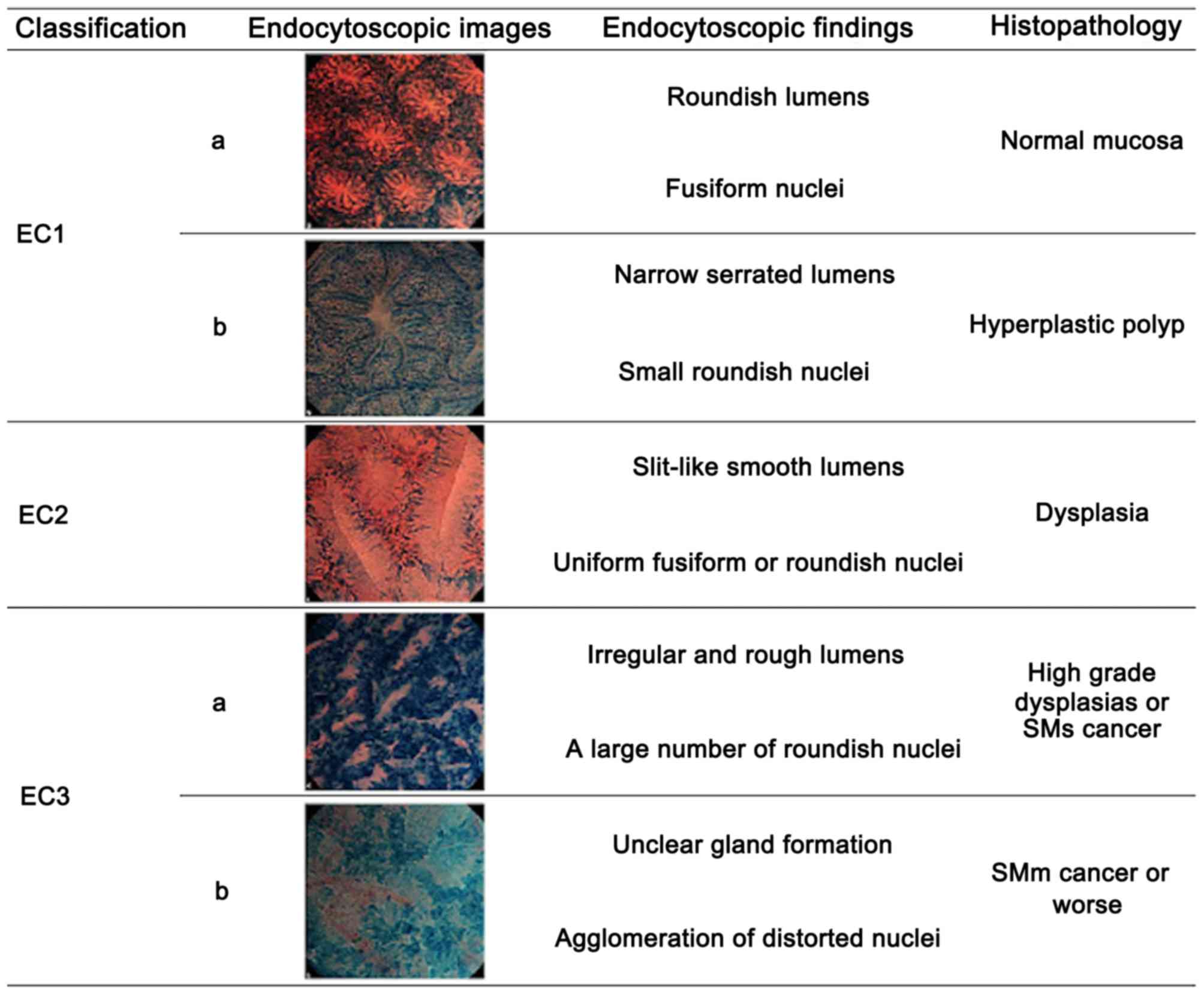
A total of 49,990 patients underwent colonoscopy at the Digestive Disease Center, Showa University Northern Yokohama Hospital (Yokohama, Japan) between May, 2005 and August, 2013, and a total of 17,331 lesions were detected. Patients with familial adenomatous polyposis, tumor-related inflammatory bowel disease or a history of chemotherapy were excluded. Of all included lesions, 502 were identified using EC, with 72 diagnosed as EC3b according to the EC classification (6), suggesting invasion of the SM or deeper layers (Fig. 1). All the lesions were treated with endoscopic mucosal resection/endoscopic submucosal dissection or surgical resection. This study was granted ethical approval by the local Ethics Review Committee (approval no. 1410-07) and informed consent was obtained from all the participants prior to enrollment in this clinical trial.

Figure 1.

Definitions of endocytoscopic classification. EC1a: Roundish lumina and regular pattern of uniformly sized fusiform nuclei. EC1b: Narrow serrated lumina and dense pattern of small roundish nodules. EC2: Slit-like smooth lumina and regular pattern of fusiform or roundish nuclei. EC3a: Irregular and rough lumina and a large number of roundish nuclei strongly stained with methylene blue. EC3b: Unclear gland formation and agglomeration of distorted nuclei strongly stained with methylene blue. EC, endocytoscopy; SMs, slightly invasive submucosal cancer; SMm, massively invasive submucosal cancer.

Evaluation of EC

All examinations were performed with an integrated-type endocytoscope (XCF-260EC1; Olympus Co., Tokyo, Japan). All endoscopic procedures were performed by any one of four experienced endoscopists (Y.S., Y.M., M.M. and H.M.) who have performed >100 EC procedures over a period of 2 years.

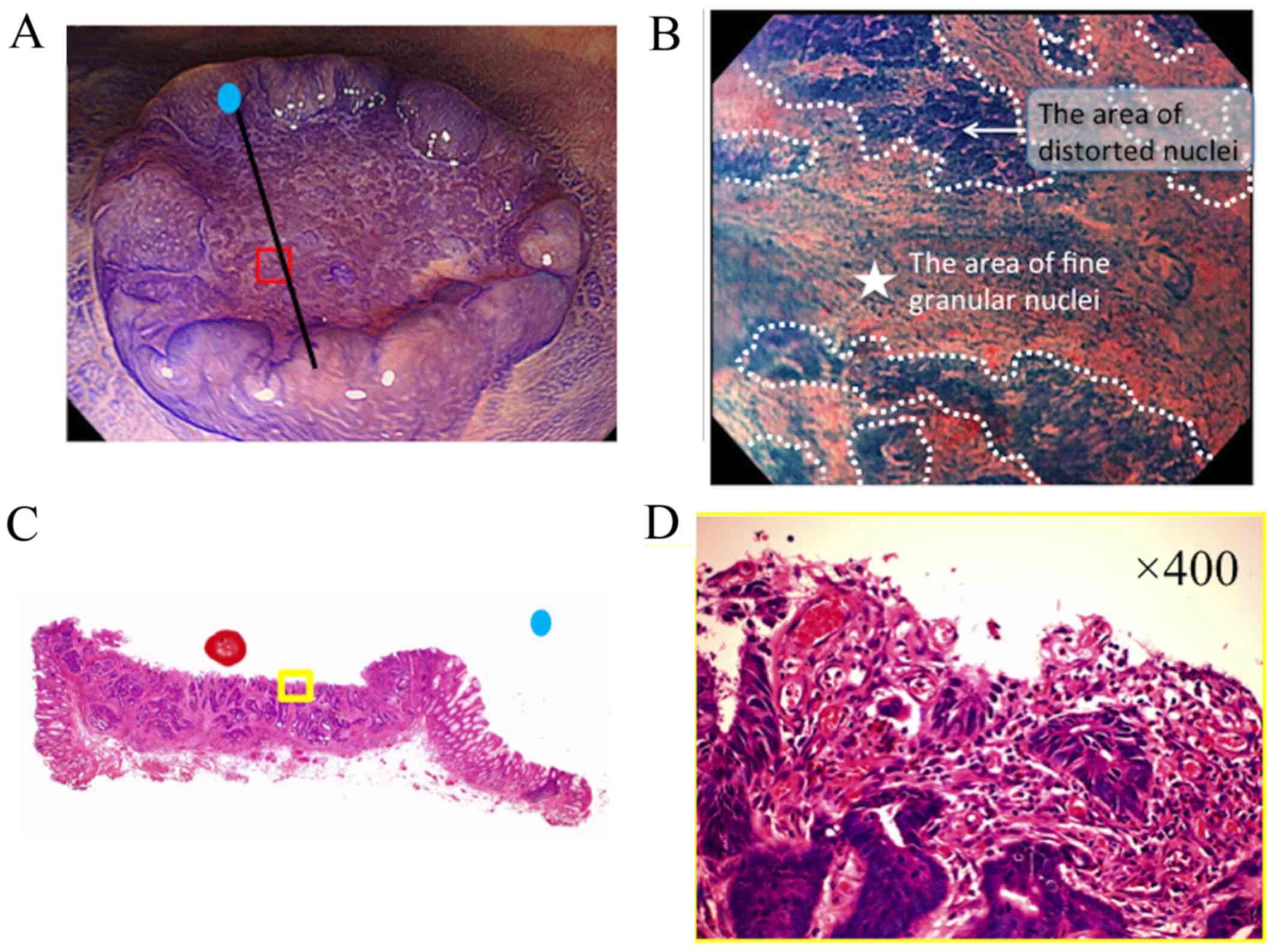
It was hypothesized that the presence of a fine granular structure (FGS) may be a reliable indicator of DR (Fig. 2). FGS identified via EC was defined according to the following criteria: i) Presence of distorted nuclei, indicative of cancer cells, around the FGS; and ii) increased granularity of the FGS nuclei compared with the surrounding cancer cells, indicative of myofibroblasts or inflammatory cells. To ensure objectivity of the FGS findings, independent external reviewers blinded to the patient information calculated the interobserver agreement index regarding the assessment of FGS on the basis of the EC histological evaluations.

Figure 2.

Correlation of FGS and histological findings in sigmoid colon carcinoma. (A) Depressed-type early sigmoid colon carcinoma stained with crystal violet. (B) EC image. The area denoted by the white star indicates FGS. FGS was defined according to the following criteria: i) Distorted nuclei adjacent to the FGS (white arrow) and ii) more granular nuclei in the FGS compared with the adjacent distorted nuclei. (C) Representative example of a DR in a hematoxylin and eosin-stained specimen. (D) The yellow square outlines a 400-fold magnified image. Inflammatory cells, but not cancer cells, are observed on the tumor surface. The DR is clearly demonstrated. The red square in (A) outlines a magnified view of the lesion on the EC image. The black bar represents the specimen section used for pathological examination in (C and D). FGS, fine granular structure; DR, desmoplastic reaction; EC, endocytoscopy.

Histological evaluation

Each endoscopically or surgically resected specimen was fixed in 10% formalin and embedded in paraffin wax. The tissue specimens were then sliced into 2-mm sections and stained with hematoxylin and eosin. All the specimens were routinely evaluated to establish a pathological diagnosis. An experienced gastrointestinal pathologist evaluated all the specimens and assessed the presence of DR in the superficial layers of the tumor according to the following criteria reported by Kimura et al (14): i) Presence of carcinoma is required for the detection of an exposing DR; and ii) a DR involves an area of collagen fiber accumulation, myofibroblast proliferation and inflammatory infiltration.

Statistical analysis

All analyses were performed using STATA software, version 11.2 (StataCorp, College Station, TX, USA). The sensitivity, specificity, positive predictive value (PPV), negative predictive value (NPV) and overall accuracy of identifying DRs in the superficial layer of the tumors were estimated. P-values <0.05 were considered to indicate statistically significant differences.

Validation study for FGS

Interobserver agreement was assessed using κ statistics and interpreted as proposed by Landis and Koch (15). A κ value of 0 demonstrated the absence of agreement; <0.20, slight agreement; 0.21–0.40, fair agreement; 0.41–0.60; moderate agreement; 0.61–0.80, substantial agreement; and >0.81, almost perfect agreement.

Results

Patient characteristics

A total of 72 consecutive patients diagnosed with EC3b colorectal carcinoma by EC were enrolled in this study (median age, 65 years; range, 40–85 years). Of the 72 patients, 46 were men. The clinical and pathological characteristics are summarized in Table I.

Table I.

Patient and tumor characteristics.

Table I.

Patient and tumor characteristics.

Characteristicsn (%)
Patients72 (100.0)
Median age, years (range)65 (40–85)
Median tumor size, mm (range)21 (4–94)
Gender
  Male/female46 (64.0)/26 (36.0)
Location
  Cecum2 (2.8)
  Ascending colon13 (18.1)
  Transverse colon5 (6.9)
  Descending colon3 (4.2)
  Sigmoid colon23 (31.9)
  Rectum27 (37.5)
Morphology
  Pedunculated5 (6.9)
  Nonpedunculated67 (93.1)
Histological appearance
  Well-/moderately differentiated52 (72.2)
  Poorly differentiated20 (27.8)
Comparison of tumor invasion depth between superficial exposing DRs and FGS

A comparison of the depth of tumor invasion among lesions with a superficial exposing DR and FGS detected via EC is shown in Table II. A close association with tumor invasion depth was observed for DR-positive and FGS-positive findings. Of the 72 lesions, 26 were FGS-positive. As shown in Table III, the majority of these lesions (23/26; 88.5%) exhibited an exposing DR detected by the presence of FGS on EC, which indicates a significant association. The overall accuracy, sensitivity, specificity, PPV and NPV for the utility of FGS on EC imaging for the detection of an exposing DR was 87.3, 91.9, 76.7, 90.1 and 80.2%, respectively.

Table II.

Comparison of tumor invasion depth between the superficial exposing DRs and FGS detected on endocytoscopy.

Table II.

Comparison of tumor invasion depth between the superficial exposing DRs and FGS detected on endocytoscopy.

Superficial exposing DREndocytoscopy


Depth of invasionSuperficial exposure (+), n (%) (n=30)Superficial exposure (−), n (%) (n=42)FGS (+), n (%) (n=26)FGS (−), n (%) (n=46)
M0 (0.0)  3 (7.1)0 (0.0)3 (6.5)
SM23 (76.7)34 (80.1)19 (73.1)39 (84.8)
MP1 (3.3)  2 (4.8)1 (3.8)2 (4.3)
SS5 (16.7)  1 (2.4)  5 (19.2)7 (15.2)
SE1 (3.3)  0 (0.0)1 (3.8)2 (4.3)

[i] DR, desmoplastic reaction; FGS, fine granular structure; SM, submucosa; MP, muscularis propria; SS, subserosa; SE, serosal exposure.

Table III.

Correlation between the presence of FGS and superficial exposing DR.

Table III.

Correlation between the presence of FGS and superficial exposing DR.

FGS

DR exposurePositiveNegativeTotal
Positive23 (31.9)7 (9.7)30 (41.7)
Negative3 (4.17)39 (54.1)42 (58.3)
Total26 (36.1)46 (63.9)72 (100.0)

[i] Values are presented as n (%). DR, desmoplastic reaction; FGS, fine granular structure. P<0.0001, κ=0.708738, standard deviation=0.084723.

The mean κ score for interobserver agreement between the two independent reviewers was 0.720, indicating that the observers' evaluation of the FGS had substantial accuracy. The mean sensitivity, specificity, PPV and NPV for the detection of an FGS predictive of DR histopathology was 85.5, 73.6, 93.1 and 75.4%, respectively.

Discussion

To the best of our knowledge, no previous study has reported EC imaging findings that may be used to detect a superficial exposing DR in colorectal cancer. In the present study, we observed that the presence of FGS on the EC image was a reliable marker of a DR, without the need for pathological examination. Thus, EC may have the potential to be a ‘one-step’ diagnostic tool for detecting superficial exposing DRs in colorectal cancer based on FGS findings.

The detection of DRs in pretreatment biopsy specimens has been reported to be useful for the prediction of early colorectal cancer invading the SM; therefore, DR status in a pathology report allows patients to be directed towards appropriate therapy, such as endoscopic mucosal resection/endoscopic submucosal dissection treatment or surgical resection (10).

Invasive carcinoma is characterized by the interruption of normal cellular compartments. The invasion field between pre-existing epithelial and stromal compartments is a critical interface in carcinogenesis. Stromal fibroblasts in a DR are critical in the development of digestive tract cancers (16). Accordingly, we hypothesized that there are several promising clinical implications of stromal fibroblast research for the prevention, diagnosis and management of digestive tract cancers. The presence of FGS detected via EC may be easily confirmed in one step, and this may significantly contribute to the future of this line of research.

A limitation of the present study was that the evaluation of FGS was subjective; however, an interobserver agreement index was obtained from multiple independent specialists. Although the obtained index value was significant (0.720), it is not adequate to provide sufficient objectiveness for the evaluation of the presence of FGS. Further studies are required to validate these findings and minimize interobserver variations. Prospective randomized studies, comparing the efficacy of identifying FGS by using EC with the histopathological assessment of DR as a diagnostic tool used for predicting treatment and patient outcomes after endoscopic or surgical resection may confirm the usefulness of EC. These future studies may improve the diagnosis of colorectal cancer and support the utility of ‘one-step’ diagnosis without the need for biopsy.

In conclusion, histological evaluation of biopsy specimens remains the standard approach for identifying DR. However, the presence of FGS identified on EC is likely to indicate an exposing DR. A DR is of vital importance to cancer cell migration and invasiveness. We consider that EC may improve the diagnosis of colorectal cancer and become the gold standard approach in the future, replacing the combination of conventional endoscopy and biopsy.

Acknowledgements

The authors express their gratitude to all the staff members at the Digestive Disease Center and the Department of Pathology, Showa University Northern Yokohama Hospital, for their excellent assistance.

Glossary

Abbreviations

Abbreviations:

DR

desmoplastic reaction

EC

endocytoscopy

FGS

fine granular structure

NPV

negative predictive value

PPV

positive predictive value

SM

submucosa

References

1 

Kudo S, Hirota S, Nakajima T, Hosobe S, Kusaka H, Kobayashi T, Himori M and Yagyuu A: Colorectal tumors and pit pattern. J Clin Pathol. 47:880–885. 1994. View Article : Google Scholar : PubMed/NCBI

2 

Kudo S, Rubio CA, Teixeira CR, Kashida H and Kogure E: Pit pattern in colorectal neoplasia: Endoscopic magnifying view. Endoscopy. 33:367–373. 2001. View Article : Google Scholar : PubMed/NCBI

3 

Inoue H, Kazawa T, Sato Y, Satodate H, Sasajima K, Kudo SE and Shiokawa A: In vivo observation of living cancer cells in the esophagus, stomach, and colon using catheter-type contact endoscope, ‘Endo-Cytoscopy system’. Gastrointest Endosc Clin N Am. 14:589–594, x-xi. 2004. View Article : Google Scholar : PubMed/NCBI

4 

Sasajima K, Kudo SE, Inoue H, Takeuchi T, Kashida H, Hidaka E, Kawachi H, Sakashita M, Tanaka J and Shiokawa A: Real-time in vivo virtual histology of colorectal lesions when using the endocytoscopy system. Gastrointest Endosc. 63:1010–1017. 2006. View Article : Google Scholar : PubMed/NCBI

5 

Kudo SE, Misawa M, Wada Y, Nakamura H, Kataoka S, Maeda Y, Toyoshima N, Hayashi S, Kutsukawa M, Oikawa H, et al: Endocytoscopic microvasculature evaluation is a reliable new diagnostic method for colorectal lesions (with video). Gastrointest Endosc. 82:912–923. 2015. View Article : Google Scholar : PubMed/NCBI

6 

Mori Y, Kudo S, Ikehara N, Wakamura K, Wada Y, Kutsukawa M, Misawa M, Kudo T, Kobayashi Y, Miyachi H, et al: Comprehensive diagnostic ability of endocytoscopy compared with biopsy for colorectal neoplasms: A prospective randomized noninferiority trial. Endoscopy. 45:98–105. 2013. View Article : Google Scholar : PubMed/NCBI

7 

Kudo SE, Wakamura K, Ikehara N, Mori Y, Inoue H and Hamatani S: Diagnosis of colorectal lesions with a novel endocytoscopic classification-a pilot study. Endoscopy. 43:869–875. 2011. View Article : Google Scholar : PubMed/NCBI

8 

Martin M, Pujuguet P and Martin F: Role of stromal myofibroblasts infiltrating colon cancer in tumor invasion. Pathol Res Pract. 192:712–717. 1996. View Article : Google Scholar : PubMed/NCBI

9 

Hirose M, Fukui H, Igarashi Y, Fujimori Y, Katake Y, Sekikawa A, Ichikawa K, Tomita S, Imura J, Ajioka Y, et al: Detection of desmoplastic reaction in biopsy specimens is useful for predicting the depth of invasion of early colorectal cancer: A Japanese collaborative study. J Gastroenterol. 45:1212–1218. 2010. View Article : Google Scholar : PubMed/NCBI

10 

Okamoto Y, Fujimori T, Ohkura Y, Sugai T, Arai T, Watanabe G, Wada R, Ueno H, Togashi K, Yao T, et al: Histological assessment of intra- and inter-institutional reliabilities in detection of desmoplastic reaction in biopsy specimens of early colorectal carcinomas. Pathol Int. 63:539–545. 2013. View Article : Google Scholar : PubMed/NCBI

11 

Kunz LA and Knuechel R: Tumor-associated fibroblasts (part I): Active stromal participants in tumor development and progression? Histol Histopathol. 17:599–621. 2002.PubMed/NCBI

12 

Angeli F, Koumakis G, Chen MC, Kumar S and Delinassios JG: Role of stromal fibroblasts in cancer: Promoting or impeding? Tumour Biol. 30:109–120. 2009. View Article : Google Scholar : PubMed/NCBI

13 

Kudo SE, Sugihara Y, Kida H, Ishida F, Miyachi H, Mori Y, Misawa M, Hisayuki T, Kodama K, Wakamura K, et al: Depressed-type colonic lesions and ‘de novo’ cancer in familial adenomatous polyposis: A colonoscopist's viewpoint. ISRN Gastroenterol. 2013:8381342013. View Article : Google Scholar : PubMed/NCBI

14 

Kimura R, Fujimori T, Ichikawa K, Ajioka Y, Ueno H, Ohkura Y, Kashida H, Togashi K, Yao T, Wada R, et al: Desmoplastic reaction in biopsy specimens of early colorectal cancer: A Japanese prospective multicenter study. Pathol Int. 62:525–531. 2012. View Article : Google Scholar : PubMed/NCBI

15 

Landis JR and Koch GG: The measurement of observer agreement for categorical data. Biometrics. 33:159–174. 1977. View Article : Google Scholar : PubMed/NCBI

16 

Worthley DL, Giraud AS and Wang TC: Stromal fibroblasts in digestive cancer. Cancer Microenviron. 3:117–125. 2010. View Article : Google Scholar : PubMed/NCBI

Related Articles

  • Abstract
  • View
  • Download
  • Twitter
Copy and paste a formatted citation
Spandidos Publications style
Sugihara Y, Kudo SE, Miyachi H, Wakamura K, Mori Y, Misawa M, Hisayuki T, Kudo T, Hayashi T, Hamatani S, Hamatani S, et al: In vivo detection of desmoplastic reaction using endocytoscopy: A new diagnostic marker of submucosal or more extensive invasion in colorectal carcinoma. Mol Clin Oncol 6: 291-295, 2017.
APA
Sugihara, Y., Kudo, S., Miyachi, H., Wakamura, K., Mori, Y., Misawa, M. ... Okada, H. (2017). In vivo detection of desmoplastic reaction using endocytoscopy: A new diagnostic marker of submucosal or more extensive invasion in colorectal carcinoma. Molecular and Clinical Oncology, 6, 291-295. https://doi.org/10.3892/mco.2017.1138
MLA
Sugihara, Y., Kudo, S., Miyachi, H., Wakamura, K., Mori, Y., Misawa, M., Hisayuki, T., Kudo, T., Hayashi, T., Hamatani, S., Okoshi, S., Okada, H."In vivo detection of desmoplastic reaction using endocytoscopy: A new diagnostic marker of submucosal or more extensive invasion in colorectal carcinoma". Molecular and Clinical Oncology 6.3 (2017): 291-295.
Chicago
Sugihara, Y., Kudo, S., Miyachi, H., Wakamura, K., Mori, Y., Misawa, M., Hisayuki, T., Kudo, T., Hayashi, T., Hamatani, S., Okoshi, S., Okada, H."In vivo detection of desmoplastic reaction using endocytoscopy: A new diagnostic marker of submucosal or more extensive invasion in colorectal carcinoma". Molecular and Clinical Oncology 6, no. 3 (2017): 291-295. https://doi.org/10.3892/mco.2017.1138
Copy and paste a formatted citation
x
Spandidos Publications style
Sugihara Y, Kudo SE, Miyachi H, Wakamura K, Mori Y, Misawa M, Hisayuki T, Kudo T, Hayashi T, Hamatani S, Hamatani S, et al: In vivo detection of desmoplastic reaction using endocytoscopy: A new diagnostic marker of submucosal or more extensive invasion in colorectal carcinoma. Mol Clin Oncol 6: 291-295, 2017.
APA
Sugihara, Y., Kudo, S., Miyachi, H., Wakamura, K., Mori, Y., Misawa, M. ... Okada, H. (2017). In vivo detection of desmoplastic reaction using endocytoscopy: A new diagnostic marker of submucosal or more extensive invasion in colorectal carcinoma. Molecular and Clinical Oncology, 6, 291-295. https://doi.org/10.3892/mco.2017.1138
MLA
Sugihara, Y., Kudo, S., Miyachi, H., Wakamura, K., Mori, Y., Misawa, M., Hisayuki, T., Kudo, T., Hayashi, T., Hamatani, S., Okoshi, S., Okada, H."In vivo detection of desmoplastic reaction using endocytoscopy: A new diagnostic marker of submucosal or more extensive invasion in colorectal carcinoma". Molecular and Clinical Oncology 6.3 (2017): 291-295.
Chicago
Sugihara, Y., Kudo, S., Miyachi, H., Wakamura, K., Mori, Y., Misawa, M., Hisayuki, T., Kudo, T., Hayashi, T., Hamatani, S., Okoshi, S., Okada, H."In vivo detection of desmoplastic reaction using endocytoscopy: A new diagnostic marker of submucosal or more extensive invasion in colorectal carcinoma". Molecular and Clinical Oncology 6, no. 3 (2017): 291-295. https://doi.org/10.3892/mco.2017.1138
Follow us
  • Twitter
  • LinkedIn
  • Facebook
About
  • Spandidos Publications
  • Careers
  • Cookie Policy
  • Privacy Policy
How can we help?
  • Help
  • Live Chat
  • Contact
  • Email to our Support Team