Spandidos Publications Logo
  • About
    • About Spandidos
    • Aims and Scopes
    • Abstracting and Indexing
    • Editorial Policies
    • Reprints and Permissions
    • Job Opportunities
    • Terms and Conditions
    • Contact
  • Journals
    • All Journals
    • Oncology Letters
      • Oncology Letters
      • Information for Authors
      • Editorial Policies
      • Editorial Board
      • Aims and Scope
      • Abstracting and Indexing
      • Bibliographic Information
      • Archive
    • International Journal of Oncology
      • International Journal of Oncology
      • Information for Authors
      • Editorial Policies
      • Editorial Board
      • Aims and Scope
      • Abstracting and Indexing
      • Bibliographic Information
      • Archive
    • Molecular and Clinical Oncology
      • Molecular and Clinical Oncology
      • Information for Authors
      • Editorial Policies
      • Editorial Board
      • Aims and Scope
      • Abstracting and Indexing
      • Bibliographic Information
      • Archive
    • Experimental and Therapeutic Medicine
      • Experimental and Therapeutic Medicine
      • Information for Authors
      • Editorial Policies
      • Editorial Board
      • Aims and Scope
      • Abstracting and Indexing
      • Bibliographic Information
      • Archive
    • International Journal of Molecular Medicine
      • International Journal of Molecular Medicine
      • Information for Authors
      • Editorial Policies
      • Editorial Board
      • Aims and Scope
      • Abstracting and Indexing
      • Bibliographic Information
      • Archive
    • Biomedical Reports
      • Biomedical Reports
      • Information for Authors
      • Editorial Policies
      • Editorial Board
      • Aims and Scope
      • Abstracting and Indexing
      • Bibliographic Information
      • Archive
    • Oncology Reports
      • Oncology Reports
      • Information for Authors
      • Editorial Policies
      • Editorial Board
      • Aims and Scope
      • Abstracting and Indexing
      • Bibliographic Information
      • Archive
    • Molecular Medicine Reports
      • Molecular Medicine Reports
      • Information for Authors
      • Editorial Policies
      • Editorial Board
      • Aims and Scope
      • Abstracting and Indexing
      • Bibliographic Information
      • Archive
    • World Academy of Sciences Journal
      • World Academy of Sciences Journal
      • Information for Authors
      • Editorial Policies
      • Editorial Board
      • Aims and Scope
      • Abstracting and Indexing
      • Bibliographic Information
      • Archive
    • International Journal of Functional Nutrition
      • International Journal of Functional Nutrition
      • Information for Authors
      • Editorial Policies
      • Editorial Board
      • Aims and Scope
      • Abstracting and Indexing
      • Bibliographic Information
      • Archive
    • International Journal of Epigenetics
      • International Journal of Epigenetics
      • Information for Authors
      • Editorial Policies
      • Editorial Board
      • Aims and Scope
      • Abstracting and Indexing
      • Bibliographic Information
      • Archive
    • Medicine International
      • Medicine International
      • Information for Authors
      • Editorial Policies
      • Editorial Board
      • Aims and Scope
      • Abstracting and Indexing
      • Bibliographic Information
      • Archive
  • Articles
  • Information
    • Information for Authors
    • Information for Reviewers
    • Information for Librarians
    • Information for Advertisers
    • Conferences
  • Language Editing
Spandidos Publications Logo
  • About
    • About Spandidos
    • Aims and Scopes
    • Abstracting and Indexing
    • Editorial Policies
    • Reprints and Permissions
    • Job Opportunities
    • Terms and Conditions
    • Contact
  • Journals
    • All Journals
    • Biomedical Reports
      • Information for Authors
      • Editorial Policies
      • Editorial Board
      • Aims and Scope
      • Abstracting and Indexing
      • Bibliographic Information
      • Archive
    • Experimental and Therapeutic Medicine
      • Information for Authors
      • Editorial Policies
      • Editorial Board
      • Aims and Scope
      • Abstracting and Indexing
      • Bibliographic Information
      • Archive
    • International Journal of Epigenetics
      • Information for Authors
      • Editorial Policies
      • Editorial Board
      • Aims and Scope
      • Abstracting and Indexing
      • Bibliographic Information
      • Archive
    • International Journal of Functional Nutrition
      • Information for Authors
      • Editorial Policies
      • Editorial Board
      • Aims and Scope
      • Abstracting and Indexing
      • Bibliographic Information
      • Archive
    • International Journal of Molecular Medicine
      • Information for Authors
      • Editorial Policies
      • Editorial Board
      • Aims and Scope
      • Abstracting and Indexing
      • Bibliographic Information
      • Archive
    • International Journal of Oncology
      • Information for Authors
      • Editorial Policies
      • Editorial Board
      • Aims and Scope
      • Abstracting and Indexing
      • Bibliographic Information
      • Archive
    • Medicine International
      • Information for Authors
      • Editorial Policies
      • Editorial Board
      • Aims and Scope
      • Abstracting and Indexing
      • Bibliographic Information
      • Archive
    • Molecular and Clinical Oncology
      • Information for Authors
      • Editorial Policies
      • Editorial Board
      • Aims and Scope
      • Abstracting and Indexing
      • Bibliographic Information
      • Archive
    • Molecular Medicine Reports
      • Information for Authors
      • Editorial Policies
      • Editorial Board
      • Aims and Scope
      • Abstracting and Indexing
      • Bibliographic Information
      • Archive
    • Oncology Letters
      • Information for Authors
      • Editorial Policies
      • Editorial Board
      • Aims and Scope
      • Abstracting and Indexing
      • Bibliographic Information
      • Archive
    • Oncology Reports
      • Information for Authors
      • Editorial Policies
      • Editorial Board
      • Aims and Scope
      • Abstracting and Indexing
      • Bibliographic Information
      • Archive
    • World Academy of Sciences Journal
      • Information for Authors
      • Editorial Policies
      • Editorial Board
      • Aims and Scope
      • Abstracting and Indexing
      • Bibliographic Information
      • Archive
  • Articles
  • Information
    • For Authors
    • For Reviewers
    • For Librarians
    • For Advertisers
    • Conferences
  • Language Editing
Login Register Submit
  • This site uses cookies
  • You can change your cookie settings at any time by following the instructions in our Cookie Policy. To find out more, you may read our Privacy Policy.

    I agree
Search articles by DOI, keyword, author or affiliation
Search
Advanced Search
presentation
Molecular and Clinical Oncology
Join Editorial Board Propose a Special Issue
Print ISSN: 2049-9450 Online ISSN: 2049-9469
Journal Cover
June-2017 Volume 6 Issue 6

Full Size Image

Sign up for eToc alerts
Recommend to Library

Journals

International Journal of Molecular Medicine

International Journal of Molecular Medicine

International Journal of Molecular Medicine is an international journal devoted to molecular mechanisms of human disease.

International Journal of Oncology

International Journal of Oncology

International Journal of Oncology is an international journal devoted to oncology research and cancer treatment.

Molecular Medicine Reports

Molecular Medicine Reports

Covers molecular medicine topics such as pharmacology, pathology, genetics, neuroscience, infectious diseases, molecular cardiology, and molecular surgery.

Oncology Reports

Oncology Reports

Oncology Reports is an international journal devoted to fundamental and applied research in Oncology.

Experimental and Therapeutic Medicine

Experimental and Therapeutic Medicine

Experimental and Therapeutic Medicine is an international journal devoted to laboratory and clinical medicine.

Oncology Letters

Oncology Letters

Oncology Letters is an international journal devoted to Experimental and Clinical Oncology.

Biomedical Reports

Biomedical Reports

Explores a wide range of biological and medical fields, including pharmacology, genetics, microbiology, neuroscience, and molecular cardiology.

Molecular and Clinical Oncology

Molecular and Clinical Oncology

International journal addressing all aspects of oncology research, from tumorigenesis and oncogenes to chemotherapy and metastasis.

World Academy of Sciences Journal

World Academy of Sciences Journal

Multidisciplinary open-access journal spanning biochemistry, genetics, neuroscience, environmental health, and synthetic biology.

International Journal of Functional Nutrition

International Journal of Functional Nutrition

Open-access journal combining biochemistry, pharmacology, immunology, and genetics to advance health through functional nutrition.

International Journal of Epigenetics

International Journal of Epigenetics

Publishes open-access research on using epigenetics to advance understanding and treatment of human disease.

Medicine International

Medicine International

An International Open Access Journal Devoted to General Medicine.

Journal Cover
June-2017 Volume 6 Issue 6

Full Size Image

Sign up for eToc alerts
Recommend to Library

  • Article
  • Citations
    • Cite This Article
    • Download Citation
    • Create Citation Alert
    • Remove Citation Alert
    • Cited By
  • Similar Articles
    • Related Articles (in Spandidos Publications)
    • Similar Articles (Google Scholar)
    • Similar Articles (PubMed)
  • Download PDF
  • Download XML
  • View XML
Case Report Open Access

Management of infusion reactions associated with cetuximab treatment: A case report

  • Authors:
    • Naohiro Ohshita
    • Yuri Ichimaru
    • Shoko Gamoh
    • Kaname Tsuji
    • Naotaka Kishimoto
    • Yasuo M. Tsutsumi
    • Yoshihiro Momota
  • View Affiliations / Copyright

    Affiliations: Department of Anesthesiology, Osaka Dental University, Osaka 540-0008, Japan, Department of Oral Radiology, Osaka Dental University, Osaka 540-0008, Japan, First Department of Oral and Maxillofacial Surgery, Osaka Dental University, Osaka 540-0008, Japan, Department of Anesthesiology, Faculty of Medicine, Tokushima University, Tokushima 770-8503, Japan
    Copyright: © Ohshita et al. This is an open access article distributed under the terms of Creative Commons Attribution License.
  • Pages: 853-855
    |
    Published online on: May 5, 2017
       https://doi.org/10.3892/mco.2017.1242
  • Expand metrics +
Metrics: Total Views: 0 (Spandidos Publications: | PMC Statistics: )
Metrics: Total PDF Downloads: 0 (Spandidos Publications: | PMC Statistics: )
Cited By (CrossRef): 0 citations Loading Articles...

This article is mentioned in:


Abstract

Cetuximab is a drug targeting the epidermal growth factor receptor, which is indicated for the treatment of unresectable advanced or recurrent head and neck or colorectal cancer. Cetuximab also enhances the cytotoxic effects of radiation in squamous cell carcinoma. The severity of infusion reactions (IR) is categorized from grade 1 to 5; grades 3 and 4 are associated with life-threatening reactions (anaphylaxis), whereas grade 5 indicates death. The incidence of grade 3‑4 IR with premedication is reported to be 1.1%. We herein describe a case of a 77-year-old man who developed IR during intravenous administration of cetuximab. The patient developed grade 3-4 anaphylaxis with pruritus, rash and urticaria, followed by hypotension and bradycardia. The timely diagnosis and treatment with intravenous infusion of a vasopressor drug and Ringer's acetate solution proved to be effective. The case presented herein demonstrated an unfeatured aspect of cetuximab‑related IR as dermatological reactions over the entire body followed by circulatory collapse.

Introduction

In Japan, cetuximab has been established as a non-surgical treatment option for head and neck cancer in combination with radiotherapy since December, 2012. Cetuximab is expected to be effective in the long-term management of patients with recurrent or metastatic head and neck cancer; however, adverse reactions such as sudden death, arrhythmia, degeneration of interstitial pneumonia and hypomagnesaemia are commonly observed (1). Therefore, it is crucial to identify and address those symptoms in the early stages. We herein present a case of infusion reactions (IR) induced by cetuximab (Erbitux®) from an anesthesiologist's viewpoint. The patient was treated for the IR by administration of ephedrine alone, which is an uncommon method for treating IR (2). The difficulties of diagnosing and managing IR are also discussed, with a brief review of the literature.

Case report

The patient was a 77-year-old man (160 cm in height, 57 kg in weight, body surface area 1.591 m2). The patient had previously undergone tracheotomy, resection of the left part of the tongue, left radical neck dissection and reconstructive surgery with pectoralis major myocutaneous flaps for the treatment of left-sided tongue cancer, and had received 3 cycles of chemotherapy with cisplatin and TS-1. A lymph node metastasis was found in the right neck within 6 months after the surgery, and intravenous infusion of cetuximab in the outpatient clinic was planned. The patient had been medicated with voglibose, glimepiride and clopidogrel for diabetes (HbA1c 6.0) and atherosclerosis obliterans of the lower extremities.

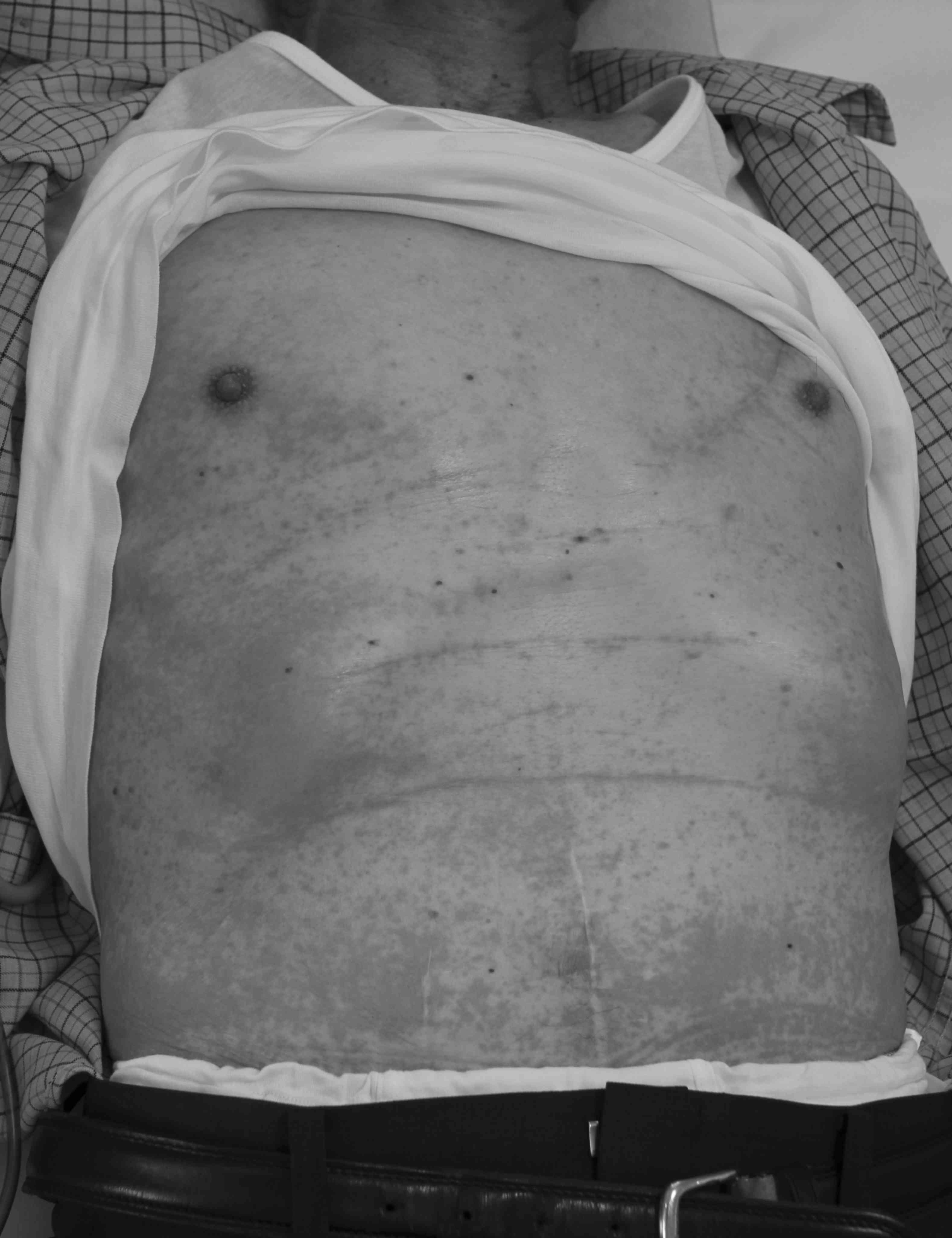
Upon arrival at the outpatient clinic, the patient's blood pressure (BP) was 140/76 mmHg, the heart rate (HR) was 60 bpm and the blood oxygen saturation (SpO2) was 96%. Peripheral venous access was obtained with an 22G indwelling needle on the forearm, and D-chlorpheniramine maleate 5 mg, dexamethasone sodium phosphate 13.2 mg and azasetron hydrochloride 10 mg were infused intravenously over 1 h. The infusion of cetuximab 600 mg, which represents the loading dose of 400 mg/m2, was then initiated at a rate of 5 mg/min. Ten minutes after starting the infusion, facial flushing developed and the patient complained of pruritus on the abdomen. The vital signs were stable (BP, 124/68 mmHg; HR, 75 bpm; and SpO2, 96%). According to the instruction manual, cetuximab infusion was continued at a reduced rate of 2 mg/min. A few minutes later, diaphoresis developed and the pruritus worsened, with severe erythema and raised rash on the trunk and extremities (Fig. 1). The BP had decreased to 62/36 mmHg and the HR to 48 bpm; therefore, an anaphylactoid reaction was suspected. Cetuximab infusion was discontinued immediately, and the infusion solution was replaced with Ringer's acetate solution. A total of 16 mg methylephedrine was administered. The patient was sufficiently lucid to breath normally without nausea. Although no decrease in SpO2 was noted, he was administered oxygen through a Polymask at 6 l/min to prevent hypoxia. After methylephedrine hydrochloride administration and rapid fluid infusion of 500 ml, the patient recovered from the circulatory collapse with a BP of 119/63 mmHg and a HR of 63 bpm. The vital signs were stabilized (BP, 122–148/66-78 mmHg; HR, 62–76 bpm; SpO2, 99% in room air), and the patient was hospitalized at the Osaka Dental University Hospital (Osaka, Japan), whereas a dermatologist at an affiliated hospital was consulted. In addition to prescription of olopatadine hydrochloride and betamethasone butyrate propionate, the patient received an intravenous infusion of 250 mg methylprednisolone sodium succinate. During hospitalization, mild erythema persisted on the back, foreneck and chest, but the raised rash had disappeared before discharge on the following day.

Figure 1.

Pruritus, rash and urticaria were observed on the patient's skin during cetuximab infusion.

Discussion

Our case presented two interesting clinical points: Methylephedrine may be useful for the treatment of anaphylactoid reactions when administered alone, and the patient's living environment is significantly associated with the incidence of IR.

This case provided us with a valuable opportunity to determine whether ephedrine hydrochloride administration was effective to reverse the grade 3–4 IR, as epinephrine, rather than ephedrine, has been commonly used for the treatment of IR. Ephedrine is a vasoconstrictor generally used to restore the BP to normal levels. The incidence of IR has been reported to be 15% for all grades of IR, and 3% for IR of grade ≥3 (3). Pre-treatment with antihistamines and corticosteroids is often performed as a standard method to reduce the risk of IR associated with cetuximab treatment; in colorectal cancer patients, the incidence of grade 3–4 IR was found to be lower, namely 1.1% (4). However, symptoms associated with IR may occur despite prophylaxis, as this patient developed a reaction to cetuximab despite premedication. As regards the development of IR, previous reports suggested that IR developed within 1 h after starting the cetuximab infusion, particularly within the first 15 min (4). The patient in the present case experienced the development of IR within 20 min after treatment initiation. The treatment of IR depends on the severity, and grade ≥3 symptoms require treatment similar to that for anaphylaxis (1,4). In this case, the severity of the symptoms increased even after reducing the infusion rate of cetuximab according to the instruction manual. It was crucial that the surgeon as well as the dental anesthesiologist carefully observed the patient in order to assess the situation in the early stage. The key charateristic was circulatory collapse following dermatological reactions. Respiratory events, such as airway obstruction and edema, were not evident. Ephedrine, which was ready for emergency use, was initially administered, and the BP and HR gradually increased following additional dosage of ephedrine with rapid infusion of acetate Ringer's solution. The vital signs were stabilized by administering a total dose of 16 mg ephedrine. D-chlorpheniramine and dexamethasone as prophylaxis may be helpful in restoring BP and HR, enhancing the vasopressor effect of ephedrine. In case the BP and HR were unresponsive to ephedrine, a different vasopressor would have to be considered; an α- and β-stimulator, such as epinephrine, is considered to be a safe method for controlling respiratory events.

This case also suggested a correlation between the patient's living environment and high incidence of IR. Certain factors in the living environment may act as antigen towards cetuximab, eventually increasing the risk of IR by sensitizing the patient. For example, reports from the United States have described that the prevalence of anti-cetuximab IgE antibodies varies in different geographical areas, and hypothesized that the incidence of allergic reactions to cetuximab may be related to the incidence of allergic reactions to red meat and Rocky Mountain spotted fever, and the habit distribution of ticks carrying Rickettsia rickettsii, the bacterium causing Rocky Mountan spotted fever (5). It has been reported that IgE antibodies against galactose-α-1, 3-galactose (α-gal) elicit anaphylaxis in patients receiving cetuximab (5,6). The fact that patients who develop IR during the first infusion of cetuximab were found to have IgE antibodies specific to cetuximab, indicates that they had been previously exposed to sensitizers (5,6); α-gal is present in cows and pigs, and is believed to cause late-onset urticaria and anaphylaxis that develop in 3–6 h after eating beef or pork. It is also believed that the level of beef-specific IgE antibodies is correlated with the level of cetuximab-specific IgE antibodies (5,7,8). The level of α-gal-specific IgE antibodies is also correlated with the level of IgE antibodies specific to the tick Amblyomma americanum, a vector of Rocky Mountain spotted fever that is commonly found in the southwestern to eastern part of the United States (4). These findings indicate that antibodies in patients with a meat allergy, or those with a history of tick bite, may cross-react against cetuximab (5–8). In Japan, mites are drawing attention as a cause of a syndrome combining severe fever with thrombocytopenia in recent years. However, a report from the Shimane Prefecture suggests that there are overlaps in areas where spotted fever is prevalent and those where several patients with beef allergy reside (9). That study also reported that 75% of patients with beef allergy are also allergic to flounder eggs, which indicates that anti-beef antibodies may cross-react with flounder egg antigens (9). As a number of these patients have lived with dogs and have IgE antibodies specific to dog's skin, the authors of that study concluded that mites, which bite dogs as well as humans, may induce beef allergy (9). Altogether, reports from the United States as well as Japan suggest that several factors in the living environment are associated with the incidence of IR to cetuximab.

Therefore, physicians must question the patients on past illnesses prior to administering cetuximab. Unfortunately, the patient in the present case received cetuximab infusion without a detailed consultation on the risk factors for IR. A consultation after the onset of IR revealed that he was from Izumo (Shimane, Japan). In addition, male gender and smoking are factors known to increase the risk of IR (10), indicating that this patient was at a higher risk of developing IR.

In conclusion, this case illustrated the usefulness of ephedrine in managing IR symptoms during the first administration of cetuximab for the treatment of a metastatic lymph node in the neck. The present case has also highlighted the importance of interviewing the patient on past and present places of residence, history of allergic reactions to beef and/or flounder eggs, history of tick bites and history of living with dogs prior to initiating cetuximab therapy.

Informed consent was obtained from the patient regarding the publication of the details of this case and associated images.

References

1 

Lenz HJ: Management and preparedness for infusion and hypersensitivity reactions. Oncologist. 12:601–609. 2007. View Article : Google Scholar : PubMed/NCBI

2 

Enokibori M, Kuge M and Mori K: Anaphylactoid reaction to maltose 5% solution during spinal anaesthesia. Can J Anaesth. 45:52–55. 1998. View Article : Google Scholar : PubMed/NCBI

3 

Bonner JA, Harari PM, Giralt J, Azarnia N, Shin DM, Cohen RB, Jones CU, Sur R, Raben D, Jassem J, et al: Radiotherapy plus cetuximab for squamous-cell carcinoma of the head and neck. N Engl J Med. 354:567–578. 2006. View Article : Google Scholar : PubMed/NCBI

4 

Yamaguchi K, Watanabe T, Satoh T, Ishiguro M, Izawa M, Inoshiri S, Sugihara K and Sakata Y: Severe infusion reactions to cetuximab occur within 1 h in patients with metastatic colorectal cancer: Results of a nationwide, multicenter, prospective registry study of 2126 patients in Japan. Jpn J Clin Oncol. 44:541–546. 2014. View Article : Google Scholar : PubMed/NCBI

5 

Commins SP, James HR, Kelly LA, Pochan SL, Workman LJ, Perzanowski MS, Kocan KM, Fahy JV, Nganga LW, Ronmark E, et al: The relevance of tick bites to the production of IgE antibodies to the mammalian oligosaccharide galactose-α-1,3-galactose. J Allergy Clin Immunol. 127:1286–93.e6. 2011. View Article : Google Scholar : PubMed/NCBI

6 

Chung CH, Mirakhur B, Chan E, Le QT, Berlin J, Morse M, Murphy BA, Satinover SM, Hosen J, Mauro D, et al: Cetuximab-induced anaphylaxis and IgE specific for galactose-alpha-1,3-galactose. N Engl J Med. 358:1109–1117. 2008. View Article : Google Scholar : PubMed/NCBI

7 

Commins SP and Platts-Mills TA: Anaphylaxis syndromes related to a new mammalian cross-reactive carbohydrate determinant. J Allergy Clin Immunol. 124:652–657. 2009. View Article : Google Scholar : PubMed/NCBI

8 

Commins SP, Satinover SM, Hosen J, Mozena J, Borish L, Lewis BD, Woodfolk JA and Platts-Mills TA: Delayed anaphylaxis, angioedema, or urticaria after consumption of red meat in patients with IgE antibodies specific for galactose-alpha-1,3-galactose. J Allergy Clin Immunol. 123:426–433. 2009. View Article : Google Scholar : PubMed/NCBI

9 

Chinuki Y, Takahashi H and Morita E: Clinical and biochemical evaluation of twenty patients with red meat allergies. Jpn J Dermatol. 123:1807–1814. 2013.

10 

Hopps S, Medina P, Pant S, Webb R, Moorman M and Borders E: Cetuximab hypersensitivity infusion reactions: Incidence and risk factors. J Oncol Pharm Pract. 19:222–227. 2013. View Article : Google Scholar : PubMed/NCBI

Related Articles

  • Abstract
  • View
  • Download
  • Twitter
Copy and paste a formatted citation
Spandidos Publications style
Ohshita N, Ichimaru Y, Gamoh S, Tsuji K, Kishimoto N, Tsutsumi YM and Momota Y: Management of infusion reactions associated with cetuximab treatment: A case report. Mol Clin Oncol 6: 853-855, 2017.
APA
Ohshita, N., Ichimaru, Y., Gamoh, S., Tsuji, K., Kishimoto, N., Tsutsumi, Y.M., & Momota, Y. (2017). Management of infusion reactions associated with cetuximab treatment: A case report. Molecular and Clinical Oncology, 6, 853-855. https://doi.org/10.3892/mco.2017.1242
MLA
Ohshita, N., Ichimaru, Y., Gamoh, S., Tsuji, K., Kishimoto, N., Tsutsumi, Y. M., Momota, Y."Management of infusion reactions associated with cetuximab treatment: A case report". Molecular and Clinical Oncology 6.6 (2017): 853-855.
Chicago
Ohshita, N., Ichimaru, Y., Gamoh, S., Tsuji, K., Kishimoto, N., Tsutsumi, Y. M., Momota, Y."Management of infusion reactions associated with cetuximab treatment: A case report". Molecular and Clinical Oncology 6, no. 6 (2017): 853-855. https://doi.org/10.3892/mco.2017.1242
Copy and paste a formatted citation
x
Spandidos Publications style
Ohshita N, Ichimaru Y, Gamoh S, Tsuji K, Kishimoto N, Tsutsumi YM and Momota Y: Management of infusion reactions associated with cetuximab treatment: A case report. Mol Clin Oncol 6: 853-855, 2017.
APA
Ohshita, N., Ichimaru, Y., Gamoh, S., Tsuji, K., Kishimoto, N., Tsutsumi, Y.M., & Momota, Y. (2017). Management of infusion reactions associated with cetuximab treatment: A case report. Molecular and Clinical Oncology, 6, 853-855. https://doi.org/10.3892/mco.2017.1242
MLA
Ohshita, N., Ichimaru, Y., Gamoh, S., Tsuji, K., Kishimoto, N., Tsutsumi, Y. M., Momota, Y."Management of infusion reactions associated with cetuximab treatment: A case report". Molecular and Clinical Oncology 6.6 (2017): 853-855.
Chicago
Ohshita, N., Ichimaru, Y., Gamoh, S., Tsuji, K., Kishimoto, N., Tsutsumi, Y. M., Momota, Y."Management of infusion reactions associated with cetuximab treatment: A case report". Molecular and Clinical Oncology 6, no. 6 (2017): 853-855. https://doi.org/10.3892/mco.2017.1242
Follow us
  • Twitter
  • LinkedIn
  • Facebook
About
  • Spandidos Publications
  • Careers
  • Cookie Policy
  • Privacy Policy
How can we help?
  • Help
  • Live Chat
  • Contact
  • Email to our Support Team