Spandidos Publications Logo
  • About
    • About Spandidos
    • Aims and Scopes
    • Abstracting and Indexing
    • Editorial Policies
    • Reprints and Permissions
    • Job Opportunities
    • Terms and Conditions
    • Contact
  • Journals
    • All Journals
    • Oncology Letters
      • Oncology Letters
      • Information for Authors
      • Editorial Policies
      • Editorial Board
      • Aims and Scope
      • Abstracting and Indexing
      • Bibliographic Information
      • Archive
    • International Journal of Oncology
      • International Journal of Oncology
      • Information for Authors
      • Editorial Policies
      • Editorial Board
      • Aims and Scope
      • Abstracting and Indexing
      • Bibliographic Information
      • Archive
    • Molecular and Clinical Oncology
      • Molecular and Clinical Oncology
      • Information for Authors
      • Editorial Policies
      • Editorial Board
      • Aims and Scope
      • Abstracting and Indexing
      • Bibliographic Information
      • Archive
    • Experimental and Therapeutic Medicine
      • Experimental and Therapeutic Medicine
      • Information for Authors
      • Editorial Policies
      • Editorial Board
      • Aims and Scope
      • Abstracting and Indexing
      • Bibliographic Information
      • Archive
    • International Journal of Molecular Medicine
      • International Journal of Molecular Medicine
      • Information for Authors
      • Editorial Policies
      • Editorial Board
      • Aims and Scope
      • Abstracting and Indexing
      • Bibliographic Information
      • Archive
    • Biomedical Reports
      • Biomedical Reports
      • Information for Authors
      • Editorial Policies
      • Editorial Board
      • Aims and Scope
      • Abstracting and Indexing
      • Bibliographic Information
      • Archive
    • Oncology Reports
      • Oncology Reports
      • Information for Authors
      • Editorial Policies
      • Editorial Board
      • Aims and Scope
      • Abstracting and Indexing
      • Bibliographic Information
      • Archive
    • Molecular Medicine Reports
      • Molecular Medicine Reports
      • Information for Authors
      • Editorial Policies
      • Editorial Board
      • Aims and Scope
      • Abstracting and Indexing
      • Bibliographic Information
      • Archive
    • World Academy of Sciences Journal
      • World Academy of Sciences Journal
      • Information for Authors
      • Editorial Policies
      • Editorial Board
      • Aims and Scope
      • Abstracting and Indexing
      • Bibliographic Information
      • Archive
    • International Journal of Functional Nutrition
      • International Journal of Functional Nutrition
      • Information for Authors
      • Editorial Policies
      • Editorial Board
      • Aims and Scope
      • Abstracting and Indexing
      • Bibliographic Information
      • Archive
    • International Journal of Epigenetics
      • International Journal of Epigenetics
      • Information for Authors
      • Editorial Policies
      • Editorial Board
      • Aims and Scope
      • Abstracting and Indexing
      • Bibliographic Information
      • Archive
    • Medicine International
      • Medicine International
      • Information for Authors
      • Editorial Policies
      • Editorial Board
      • Aims and Scope
      • Abstracting and Indexing
      • Bibliographic Information
      • Archive
  • Articles
  • Information
    • Information for Authors
    • Information for Reviewers
    • Information for Librarians
    • Information for Advertisers
    • Conferences
  • Language Editing
Spandidos Publications Logo
  • About
    • About Spandidos
    • Aims and Scopes
    • Abstracting and Indexing
    • Editorial Policies
    • Reprints and Permissions
    • Job Opportunities
    • Terms and Conditions
    • Contact
  • Journals
    • All Journals
    • Biomedical Reports
      • Information for Authors
      • Editorial Policies
      • Editorial Board
      • Aims and Scope
      • Abstracting and Indexing
      • Bibliographic Information
      • Archive
    • Experimental and Therapeutic Medicine
      • Information for Authors
      • Editorial Policies
      • Editorial Board
      • Aims and Scope
      • Abstracting and Indexing
      • Bibliographic Information
      • Archive
    • International Journal of Epigenetics
      • Information for Authors
      • Editorial Policies
      • Editorial Board
      • Aims and Scope
      • Abstracting and Indexing
      • Bibliographic Information
      • Archive
    • International Journal of Functional Nutrition
      • Information for Authors
      • Editorial Policies
      • Editorial Board
      • Aims and Scope
      • Abstracting and Indexing
      • Bibliographic Information
      • Archive
    • International Journal of Molecular Medicine
      • Information for Authors
      • Editorial Policies
      • Editorial Board
      • Aims and Scope
      • Abstracting and Indexing
      • Bibliographic Information
      • Archive
    • International Journal of Oncology
      • Information for Authors
      • Editorial Policies
      • Editorial Board
      • Aims and Scope
      • Abstracting and Indexing
      • Bibliographic Information
      • Archive
    • Medicine International
      • Information for Authors
      • Editorial Policies
      • Editorial Board
      • Aims and Scope
      • Abstracting and Indexing
      • Bibliographic Information
      • Archive
    • Molecular and Clinical Oncology
      • Information for Authors
      • Editorial Policies
      • Editorial Board
      • Aims and Scope
      • Abstracting and Indexing
      • Bibliographic Information
      • Archive
    • Molecular Medicine Reports
      • Information for Authors
      • Editorial Policies
      • Editorial Board
      • Aims and Scope
      • Abstracting and Indexing
      • Bibliographic Information
      • Archive
    • Oncology Letters
      • Information for Authors
      • Editorial Policies
      • Editorial Board
      • Aims and Scope
      • Abstracting and Indexing
      • Bibliographic Information
      • Archive
    • Oncology Reports
      • Information for Authors
      • Editorial Policies
      • Editorial Board
      • Aims and Scope
      • Abstracting and Indexing
      • Bibliographic Information
      • Archive
    • World Academy of Sciences Journal
      • Information for Authors
      • Editorial Policies
      • Editorial Board
      • Aims and Scope
      • Abstracting and Indexing
      • Bibliographic Information
      • Archive
  • Articles
  • Information
    • For Authors
    • For Reviewers
    • For Librarians
    • For Advertisers
    • Conferences
  • Language Editing
Login Register Submit
  • This site uses cookies
  • You can change your cookie settings at any time by following the instructions in our Cookie Policy. To find out more, you may read our Privacy Policy.

    I agree
Search articles by DOI, keyword, author or affiliation
Search
Advanced Search
presentation
Molecular and Clinical Oncology
Join Editorial Board Propose a Special Issue
Print ISSN: 2049-9450 Online ISSN: 2049-9469
Journal Cover
February-2018 Volume 8 Issue 2

Full Size Image

Sign up for eToc alerts
Recommend to Library

Journals

International Journal of Molecular Medicine

International Journal of Molecular Medicine

International Journal of Molecular Medicine is an international journal devoted to molecular mechanisms of human disease.

International Journal of Oncology

International Journal of Oncology

International Journal of Oncology is an international journal devoted to oncology research and cancer treatment.

Molecular Medicine Reports

Molecular Medicine Reports

Covers molecular medicine topics such as pharmacology, pathology, genetics, neuroscience, infectious diseases, molecular cardiology, and molecular surgery.

Oncology Reports

Oncology Reports

Oncology Reports is an international journal devoted to fundamental and applied research in Oncology.

Experimental and Therapeutic Medicine

Experimental and Therapeutic Medicine

Experimental and Therapeutic Medicine is an international journal devoted to laboratory and clinical medicine.

Oncology Letters

Oncology Letters

Oncology Letters is an international journal devoted to Experimental and Clinical Oncology.

Biomedical Reports

Biomedical Reports

Explores a wide range of biological and medical fields, including pharmacology, genetics, microbiology, neuroscience, and molecular cardiology.

Molecular and Clinical Oncology

Molecular and Clinical Oncology

International journal addressing all aspects of oncology research, from tumorigenesis and oncogenes to chemotherapy and metastasis.

World Academy of Sciences Journal

World Academy of Sciences Journal

Multidisciplinary open-access journal spanning biochemistry, genetics, neuroscience, environmental health, and synthetic biology.

International Journal of Functional Nutrition

International Journal of Functional Nutrition

Open-access journal combining biochemistry, pharmacology, immunology, and genetics to advance health through functional nutrition.

International Journal of Epigenetics

International Journal of Epigenetics

Publishes open-access research on using epigenetics to advance understanding and treatment of human disease.

Medicine International

Medicine International

An International Open Access Journal Devoted to General Medicine.

Journal Cover
February-2018 Volume 8 Issue 2

Full Size Image

Sign up for eToc alerts
Recommend to Library

  • Article
  • Citations
    • Cite This Article
    • Download Citation
    • Create Citation Alert
    • Remove Citation Alert
    • Cited By
  • Similar Articles
    • Related Articles (in Spandidos Publications)
    • Similar Articles (Google Scholar)
    • Similar Articles (PubMed)
  • Download PDF
  • Download XML
  • View XML
Article

Generation of highly differentiated BHY oral squamous cell carcinoma multicellular spheroids

  • Authors:
    • Denise Sievers
    • Jens Bunzendahl
    • Alice Frosch
    • Christina Perske
    • Bernhard Hemmerlein
    • Henning Schliephake
    • Phillipp Brockmeyer
  • View Affiliations / Copyright

    Affiliations: Department of Oral and Maxillofacial Surgery, University Medical Centre Goettingen, D‑37075 Goettingen, Germany, Department of Pathology, University Medical Centre Goettingen, D‑37075 Goettingen, Germany
  • Pages: 323-325
    |
    Published online on: November 27, 2017
       https://doi.org/10.3892/mco.2017.1514
  • Expand metrics +
Metrics: Total Views: 0 (Spandidos Publications: | PMC Statistics: )
Metrics: Total PDF Downloads: 0 (Spandidos Publications: | PMC Statistics: )
Cited By (CrossRef): 0 citations Loading Articles...

This article is mentioned in:


Abstract

Three‑dimensional (3D) multicellular spheroids (MCS) are considered suitable models in cancer research and anticancer drug development. Although studying the complex tumour characteristics from all different degrees of malignancy is vital, MCS generation has only been described in a few moderately‑ and poorly differentiated oral squamous cell carcinoma (OSCC) cell lines. No previous study has demonstrated the MCS formation in a highly differentiated OSCC cell line. For the first time, the present study aimed to generate MCS from the highly differentiated OSCC cell line BHY. BHY spheroids were grown in three independent experiments in 96‑well plates through the use of the liquid overlay technique. Although BHY cells are grow slowly and are difficult to culture, they formed compact MCS within 24 h. After 3 days of incubation, no further increase in spheroid size was observed. MCS were harvested, paraffin‑embedded and 2 µm tissue sections were prepared for further analysis. The diameter and volume of each spheroid were determined. BHY MCS diameter ranged between 46.76 and 233.26 µm, with a volume range from 5.35x10⁴‑6.65x106 µm³. In conclusion, using the liquid overlay technique, the highly differentiated OSCC cell line BHY forms different sized spheroids, which may be used for further investigations.

Introduction

Three-dimensional (3D) cell culture models are considered an important tool in cancer research (1–3) and anticancer drug development (2). Owing to intercellular communication and cell-matrix interactions (3–5), multicellular spheroids (MCS) reproduce the in vivo situation more effectively than two-dimensional (2D) monolayer cell culture systems. MCS can be used to evaluate cell proliferation, apoptosis, differentiation, gene expression and metabolism, and the tumour response to radiochemotherapy (4). Moreover, MCS can imitate the biological properties of tumour invasion and micrometastasis (4,6). There are several known techniques for spheroid generation, e.g. hanging drop (7,8). The liquid overlay technique has been described as the most suitable technique for reproducible spheroid preparation (3). On a non-adhesive surface, cells adhere to each other and start forming MCS (5,9,10). The generation of MCS has been described in few moderately- and poorly-differentiated oral squamous cell carcinoma (OSCC) cell lines (11). Although studying the complex tumour characteristics from all the different degrees of malignancy is vital, no previous study demonstrating the MCS formation in a highly differentiated OSCC cell line has been conducted. In the present investigation, using the liquid overlay technique, we generate MCS from highly differentiated OSCC cell line BHY for the first time.

Materials and methods

Cell culture

Highly differentiated OSCC cell line BHY was obtained from the German Collection of Cell Cultures and Microorganisms (DSZM, Braunschweig, Germany). Cell line was cultivated in 90% Dulbecco's MEM (4.5 g/l glucose) with 10% h.i. FBS and 1% Penicillin/Streptomycin in a humidified incubator at 37°C with 5% CO2.

Tumour doubling time

For calculation of the tumour doubling time, 1,1 million cells were seeded in a 25 cm2 cell culture flask and cell density was counted after 48 and 72 h, respectively.

Spheroid preparation

A total of 50 µl of the agarose solution (0.15 g of agarose mixed with 10 ml of DMEM) were added to each well of a 96-well microtiter plate, and was let to cool down for 30 min. BHY cell suspension was prepared using a trypsin/EDTA solution. Cells were counted in a Neubauer counting chamber.

In independent experiments 5,000, 10,000 and 15,000 cells per well were used. Since the use of 10,000 and 15,000 cells did not result in the formation of single compact spheroids, only the spheroids with 5,000 initial cells were used for the further studies.

A total of 480,000 cells in 19.2 ml DMEM were used for spheroid initiation. 200 µl of cell suspension was transferred to each well of the agarose-coated 96-well microtiter plate (5,000 cells per well). Since no further increase in sizes could be observed, BHY MCS were harvested after 3 days of incubation, using a pasteur pipette. MCS and its supernatant were transferred from each well into a 50-ml falcon tube, where MCS sedimented. DMEM supernatant was removed, and 20 ml of formalin was added for 5 h of fixation. Sediment was transferred into a 0.5 ml e-cup, and embedded with 3% agarose solution. The resulting agarose block was used for paraffin embedding, using the automated embedding workstation Excelsior ES (Thermo Fisher Scientific, Waltham, Massachusetts, USA). All measurements were performed in three independent experiments. Over all, a total of 32 BHY spheroids were used for further evaluation. Two independent investigators evaluated all tissue sections by using a Zeiss Axioskop 2 plus light microscope (Zeiss, Goettingen, Germany).

Evaluation of spheroid size

MCS size was analysed after 3 days on 2 µm tissue sections. The diameter of each spheroid was measured by using the AxioVision software (version 4.8; Zeiss, Goettingen, Germany). By assuming a spherical shape, the volume of BHY MCS was calculated using the following equation: V=4/3 x π x (d/2)3.

Results

The analysis of the tumour doubling time of monolayer cell culture revealed a doubling time of ~72 h.

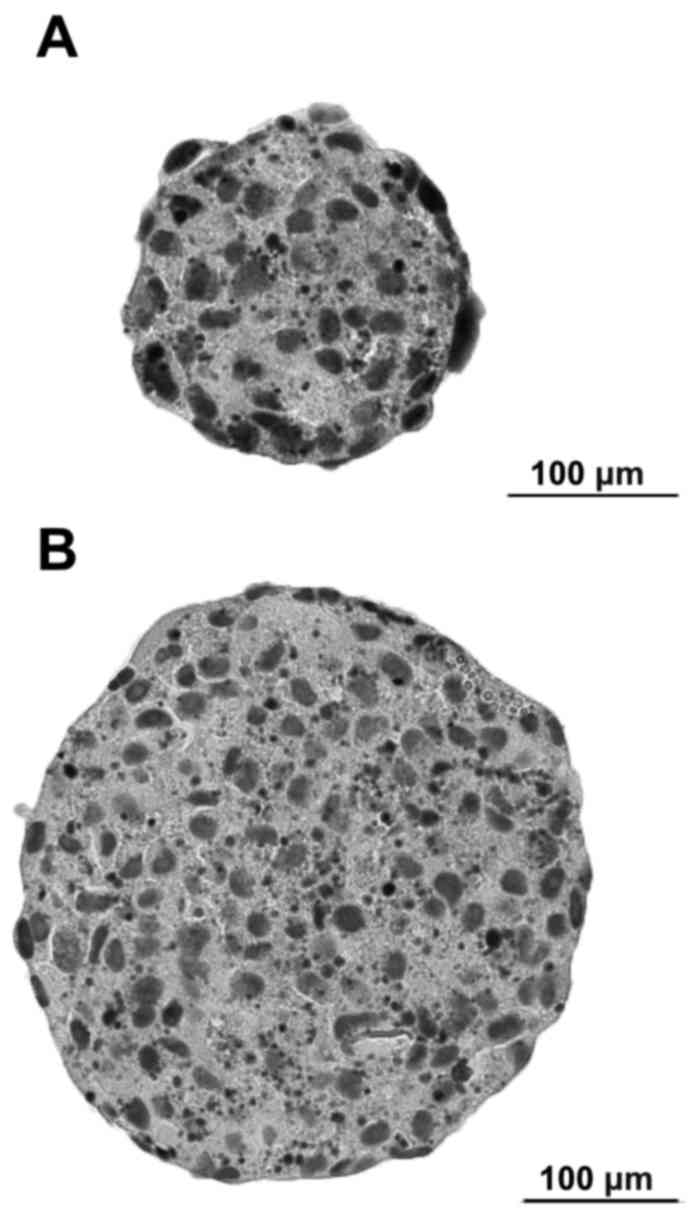
Highly differentiated OSCC cell line BHY formed different sized compact MCS within 24 h (Fig. 1). After 48 h, spheroids showed a compact body. After 72 h, no further increase in size could be observed. Spheroid compactness decreased with increasing incubation time over three days.

Figure 1.

Illustration of different sized BHY spheroids after three days of incubation. (A) Small-sized BHY MCS; (B) Large-sized BHY MCS. MCs, multicellular spheroids.

Diameter of the analysed spheroids ranged from 46,76 µm to 233,26 µm [mean 123.99 µm ±59.44 standard deviation (SD)]. Volume ranged from 5,35x104 µm3 to 6,65x106 µm3 [mean 1.74x106 µm3 ± 2.20 SD] (Table I).

Table I.

Size of each spheroids.

Table I.

Size of each spheroids.

Spheroid (N)Diameter [µm]Volume (µm3)
  1115,96 8,16×10⁵
  2   66,76 1,56×10⁵
  3122,53 9,63×10⁵
  4233,26 6,65×10⁶
  5112,72 7,50×10⁵
  6101,81 5,53×10⁵
  7208,53 4,75×10⁶
  8   72,74 2,02×10⁵
  9   46,76 5,35×10⁴
10   97,69 4,88×10⁵
11117,79 8,56×10⁵
12   69,10 1,73×10⁵
13129,48 1,14×10⁶
14   78,87 2,57×10⁵
15128,61 1,11×10⁶
16227,22 6,14×10⁶
17105,55 6,16×10⁵
18   96,42 4,69×10⁵
19217,79 5,41×10⁶
20   73,10 2,05×10⁵
21   94,40 4,40×10⁵
22   55,79 9,09×10⁴
23134,75 1,28×10⁶
24   57,11 9,75×10⁴
25   66,28 1,52×10⁵
26   73,17 2,05×10⁵
27210,22 4,86×10⁶
28211,22 4,93×10⁶
29   95,29 4,53×10⁵
30221,85 5,72×10⁶
31209,72 4,83×10⁶
32115,26 8,02×10⁵

Discussion

In the present investigation, for the first time, we generated reproducible MCS from highly differentiated OSCC cell line BHY by using the liquid overlay technique.

The advantage of the used method lies in its easy practicability compared to other protocols described in the literature that use the Matrigel, Hanging Drops, or doing Ultra-Low Attachment Assays (2,11,12).

Lee and colleagues compared the spheroid formation of four oral cancer cell lines (SCC9, SCC9β6, SCC9β6KDFyn, and SCC9β6D1) using agarose-coated tissue, and let a 0.6% agarose solution dry overnight at room temperature (11). The SCC9β6D1 cell line formed diminutive clusters containing 2–4 cells. In contrast, the SCC9β6KDFyn cell line generated large oversized spheres. The aforementioned method to generate spheroids seems to be very sensitive. In our study, the agarose solution was left to cool down at room temperature for only 30 min. An over-dried agarose solution might have a significant influence on spheroid stability.

The present results are contrary to those described by Adcock and colleagues, who described an increased average spheroid diameter with an increasing initial cell number per well plate, using the CAL-27 cell line from the tongue squamous cell carcinoma (2). While 5,000 BHY cells, resulted in one compact spheroid, adding 10,000 or 15,000 cells to each well plate led to the formation of small aggregates of cells, instead of one compact spheroid in our investigation.

This study shows that it is possible to rapidly generate spheroids with homogeneous size distribution, which is a prerequisite for drug screening (1,10). Within 3 days, BHY MCS grew to 46,76–233,26 µm in diameter. This is comparable to the results presented by Adcock et al, where CAL-27 MCS grew to 50–100 µm in diameter within 3 to 4 days (2). Hagemann et al also showed similar results by generating CAL-27 MCS that reached a diameter of 1–3 mm within 5 days (12).

The harvesting procedure of MCS was a critical step in the present protocol. Contrary to the method used by Gebhard et al, who harvested MCS using a plastic pipette of 2 mm tip diameter and centrifuged them to cell pellets (13), in the present investigation MCS were carefully harvested using a pasteur pipette and were not centrifuged. The use of a plastic pipette and centrifugation disrupted BHY MCS structure in the present investigation.

BHY is a slow-growing (doubling time of ~72 h) cell line, established from the tumour of the lower alveolus of a Japanese male, which was highly invasive towards the mandible and the oral floor (14). It has a stable growth on agarose, which means a reliable measure of the metastatic capability of the cancer cells (15). In the present study, BHY spheroids did not follow the typical growth patterns, with proliferating cells next to the oxygen supply and nutrients, and quiescent and necrotic cells farthest away from the capillaries, as described before (9).

However, a better understanding of the molecular mechanisms underlying tumour resistance to apoptotic cell death is expected to provide the basis for a rational approach to develop molecular targeted therapies (16).

Although BHY is a slow growing, difficult to cultivate highly differentiated OSCC cell line, it forms reproducible compact spheroids on an agarose surface. The generation of MCS using the liquid overlay technique is a simple method that can be used for further cancer research and anticancer drug development.

References

1 

Friedrich J, Seidel C, Ebner R and Kunz-Schughart LA: Spheroid-based drug screen: Considerations and practical approach. Nat Protoc. 4:309–324. 2009. View Article : Google Scholar : PubMed/NCBI

2 

Adcock AF, Trivedi G, Edmondson R, Spearman C and Yang L: Three-dimensional (3D) cell cultures in cell-based assays for in vitro evaluation of anticancer drugs. J Anal Bioanal Tech. 6:2472015. View Article : Google Scholar

3 

Metzger W, Sossong D, Bächle A, Pütz N, Wennemuth G, Pohlemann T and Oberringer M: The liquid overlay technique is the key to formation of co-culture spheroids consisting of primary osteoblasts, fibroblasts and endothelial cells. Cytotherapy. 13:1000–1012. 2011. View Article : Google Scholar : PubMed/NCBI

4 

Ivascu A and Kubbies M: Rapid generation of single-tumor spheroids for high-throughput cell function and toxicity analysis. J Biomol Screen. 11:922–932. 2006. View Article : Google Scholar : PubMed/NCBI

5 

Santini MT and Rainaldi G: Three-dimensional spheroid model in tumor biology. Pathobiology. 67:148–157. 1999. View Article : Google Scholar : PubMed/NCBI

6 

Mueller-Klieser W: Tumor biology and experimental therapeutics. Crit Rev Oncol Hematol. 36:123–139. 2000. View Article : Google Scholar : PubMed/NCBI

7 

Timmins NE, Dietmair S and Nielsen LK: Hanging-drop multicellular spheroids as a model of tumour angiogenesis. Angiogenesis. 7:97–103. 2004. View Article : Google Scholar : PubMed/NCBI

8 

Timmins NE and Nielsen LK: Generation of multicellular tumor spheroids by the hanging-drop method. Methods Mol Med. 140:141–151. 2007. View Article : Google Scholar : PubMed/NCBI

9 

Yuhas JM, Li AP, Martinez AO and Ladman AJ: A simplified method for production and growth of multicellular tumor spheroids. Cancer Res. 37:3639–3643. 1977.PubMed/NCBI

10 

Kelm JM, Timmins NE, Brown CJ, Fussenegger M and Nielsen LK: Method for generation of homogeneous multicellular tumor spheroids applicable to a wide variety of cell types. Biotechnol Bioeng. 83:173–180. 2003. View Article : Google Scholar : PubMed/NCBI

11 

Lee C, Lee C, Atakilit A, Siu A and Ramos DM: Differential spheroid formation by oral cancer cells. Anticancer Res. 34:6945–6949. 2014.PubMed/NCBI

12 

Hagemann J, Jacobi C, Hahn M, Schmid V, Welz C, Schwenk-Zieger S, Stauber R, Baumeister P and Becker S: Spheroid-based 3D cell cultures enable personalized therapy testing and drug discovery in head and neck cancer. Anticancer Res. 37:2201–2210. 2017. View Article : Google Scholar : PubMed/NCBI

13 

Gebhard C, Gabriel C and Walter I: Morphological and immunohistochemical characterization of canine osteosarcoma spheroid cell cultures. Anat Histol Embryol. 45:219–230. 2016. View Article : Google Scholar : PubMed/NCBI

14 

Kawamata H, Nakashiro K, Uchida D, Harada K, Yoshida H and Sato M: Possible contribution of active MMP2 to lymph-node metastasis and secreted cathepsin L to bone invasion of newly established human oral-squamous-cancer cell lines. Int J Cancer. 70:120–127. 1997. View Article : Google Scholar : PubMed/NCBI

15 

Lin CJ, Grandis JR, Carey TE, Gollin SM, Whiteside TL, Koch WM, Ferris RL and Lai SY: Head and neck squamous cell carcinoma cell lines: Established models and rationale for selection. Head Neck. 29:163–188. 2007. View Article : Google Scholar : PubMed/NCBI

16 

Fulda S: Tumor resistance to apoptosis. Int J Cancer. 124:511–515. 2009. View Article : Google Scholar : PubMed/NCBI

Related Articles

  • Abstract
  • View
  • Download
  • Twitter
Copy and paste a formatted citation
Spandidos Publications style
Sievers D, Bunzendahl J, Frosch A, Perske C, Hemmerlein B, Schliephake H and Brockmeyer P: Generation of highly differentiated BHY oral squamous cell carcinoma multicellular spheroids. Mol Clin Oncol 8: 323-325, 2018.
APA
Sievers, D., Bunzendahl, J., Frosch, A., Perske, C., Hemmerlein, B., Schliephake, H., & Brockmeyer, P. (2018). Generation of highly differentiated BHY oral squamous cell carcinoma multicellular spheroids. Molecular and Clinical Oncology, 8, 323-325. https://doi.org/10.3892/mco.2017.1514
MLA
Sievers, D., Bunzendahl, J., Frosch, A., Perske, C., Hemmerlein, B., Schliephake, H., Brockmeyer, P."Generation of highly differentiated BHY oral squamous cell carcinoma multicellular spheroids". Molecular and Clinical Oncology 8.2 (2018): 323-325.
Chicago
Sievers, D., Bunzendahl, J., Frosch, A., Perske, C., Hemmerlein, B., Schliephake, H., Brockmeyer, P."Generation of highly differentiated BHY oral squamous cell carcinoma multicellular spheroids". Molecular and Clinical Oncology 8, no. 2 (2018): 323-325. https://doi.org/10.3892/mco.2017.1514
Copy and paste a formatted citation
x
Spandidos Publications style
Sievers D, Bunzendahl J, Frosch A, Perske C, Hemmerlein B, Schliephake H and Brockmeyer P: Generation of highly differentiated BHY oral squamous cell carcinoma multicellular spheroids. Mol Clin Oncol 8: 323-325, 2018.
APA
Sievers, D., Bunzendahl, J., Frosch, A., Perske, C., Hemmerlein, B., Schliephake, H., & Brockmeyer, P. (2018). Generation of highly differentiated BHY oral squamous cell carcinoma multicellular spheroids. Molecular and Clinical Oncology, 8, 323-325. https://doi.org/10.3892/mco.2017.1514
MLA
Sievers, D., Bunzendahl, J., Frosch, A., Perske, C., Hemmerlein, B., Schliephake, H., Brockmeyer, P."Generation of highly differentiated BHY oral squamous cell carcinoma multicellular spheroids". Molecular and Clinical Oncology 8.2 (2018): 323-325.
Chicago
Sievers, D., Bunzendahl, J., Frosch, A., Perske, C., Hemmerlein, B., Schliephake, H., Brockmeyer, P."Generation of highly differentiated BHY oral squamous cell carcinoma multicellular spheroids". Molecular and Clinical Oncology 8, no. 2 (2018): 323-325. https://doi.org/10.3892/mco.2017.1514
Follow us
  • Twitter
  • LinkedIn
  • Facebook
About
  • Spandidos Publications
  • Careers
  • Cookie Policy
  • Privacy Policy
How can we help?
  • Help
  • Live Chat
  • Contact
  • Email to our Support Team