Spandidos Publications Logo
  • About
    • About Spandidos
    • Aims and Scopes
    • Abstracting and Indexing
    • Editorial Policies
    • Reprints and Permissions
    • Job Opportunities
    • Terms and Conditions
    • Contact
  • Journals
    • All Journals
    • Oncology Letters
      • Oncology Letters
      • Information for Authors
      • Editorial Policies
      • Editorial Board
      • Aims and Scope
      • Abstracting and Indexing
      • Bibliographic Information
      • Archive
    • International Journal of Oncology
      • International Journal of Oncology
      • Information for Authors
      • Editorial Policies
      • Editorial Board
      • Aims and Scope
      • Abstracting and Indexing
      • Bibliographic Information
      • Archive
    • Molecular and Clinical Oncology
      • Molecular and Clinical Oncology
      • Information for Authors
      • Editorial Policies
      • Editorial Board
      • Aims and Scope
      • Abstracting and Indexing
      • Bibliographic Information
      • Archive
    • Experimental and Therapeutic Medicine
      • Experimental and Therapeutic Medicine
      • Information for Authors
      • Editorial Policies
      • Editorial Board
      • Aims and Scope
      • Abstracting and Indexing
      • Bibliographic Information
      • Archive
    • International Journal of Molecular Medicine
      • International Journal of Molecular Medicine
      • Information for Authors
      • Editorial Policies
      • Editorial Board
      • Aims and Scope
      • Abstracting and Indexing
      • Bibliographic Information
      • Archive
    • Biomedical Reports
      • Biomedical Reports
      • Information for Authors
      • Editorial Policies
      • Editorial Board
      • Aims and Scope
      • Abstracting and Indexing
      • Bibliographic Information
      • Archive
    • Oncology Reports
      • Oncology Reports
      • Information for Authors
      • Editorial Policies
      • Editorial Board
      • Aims and Scope
      • Abstracting and Indexing
      • Bibliographic Information
      • Archive
    • Molecular Medicine Reports
      • Molecular Medicine Reports
      • Information for Authors
      • Editorial Policies
      • Editorial Board
      • Aims and Scope
      • Abstracting and Indexing
      • Bibliographic Information
      • Archive
    • World Academy of Sciences Journal
      • World Academy of Sciences Journal
      • Information for Authors
      • Editorial Policies
      • Editorial Board
      • Aims and Scope
      • Abstracting and Indexing
      • Bibliographic Information
      • Archive
    • International Journal of Functional Nutrition
      • International Journal of Functional Nutrition
      • Information for Authors
      • Editorial Policies
      • Editorial Board
      • Aims and Scope
      • Abstracting and Indexing
      • Bibliographic Information
      • Archive
    • International Journal of Epigenetics
      • International Journal of Epigenetics
      • Information for Authors
      • Editorial Policies
      • Editorial Board
      • Aims and Scope
      • Abstracting and Indexing
      • Bibliographic Information
      • Archive
    • Medicine International
      • Medicine International
      • Information for Authors
      • Editorial Policies
      • Editorial Board
      • Aims and Scope
      • Abstracting and Indexing
      • Bibliographic Information
      • Archive
  • Articles
  • Information
    • Information for Authors
    • Information for Reviewers
    • Information for Librarians
    • Information for Advertisers
    • Conferences
  • Language Editing
Spandidos Publications Logo
  • About
    • About Spandidos
    • Aims and Scopes
    • Abstracting and Indexing
    • Editorial Policies
    • Reprints and Permissions
    • Job Opportunities
    • Terms and Conditions
    • Contact
  • Journals
    • All Journals
    • Biomedical Reports
      • Information for Authors
      • Editorial Policies
      • Editorial Board
      • Aims and Scope
      • Abstracting and Indexing
      • Bibliographic Information
      • Archive
    • Experimental and Therapeutic Medicine
      • Information for Authors
      • Editorial Policies
      • Editorial Board
      • Aims and Scope
      • Abstracting and Indexing
      • Bibliographic Information
      • Archive
    • International Journal of Epigenetics
      • Information for Authors
      • Editorial Policies
      • Editorial Board
      • Aims and Scope
      • Abstracting and Indexing
      • Bibliographic Information
      • Archive
    • International Journal of Functional Nutrition
      • Information for Authors
      • Editorial Policies
      • Editorial Board
      • Aims and Scope
      • Abstracting and Indexing
      • Bibliographic Information
      • Archive
    • International Journal of Molecular Medicine
      • Information for Authors
      • Editorial Policies
      • Editorial Board
      • Aims and Scope
      • Abstracting and Indexing
      • Bibliographic Information
      • Archive
    • International Journal of Oncology
      • Information for Authors
      • Editorial Policies
      • Editorial Board
      • Aims and Scope
      • Abstracting and Indexing
      • Bibliographic Information
      • Archive
    • Medicine International
      • Information for Authors
      • Editorial Policies
      • Editorial Board
      • Aims and Scope
      • Abstracting and Indexing
      • Bibliographic Information
      • Archive
    • Molecular and Clinical Oncology
      • Information for Authors
      • Editorial Policies
      • Editorial Board
      • Aims and Scope
      • Abstracting and Indexing
      • Bibliographic Information
      • Archive
    • Molecular Medicine Reports
      • Information for Authors
      • Editorial Policies
      • Editorial Board
      • Aims and Scope
      • Abstracting and Indexing
      • Bibliographic Information
      • Archive
    • Oncology Letters
      • Information for Authors
      • Editorial Policies
      • Editorial Board
      • Aims and Scope
      • Abstracting and Indexing
      • Bibliographic Information
      • Archive
    • Oncology Reports
      • Information for Authors
      • Editorial Policies
      • Editorial Board
      • Aims and Scope
      • Abstracting and Indexing
      • Bibliographic Information
      • Archive
    • World Academy of Sciences Journal
      • Information for Authors
      • Editorial Policies
      • Editorial Board
      • Aims and Scope
      • Abstracting and Indexing
      • Bibliographic Information
      • Archive
  • Articles
  • Information
    • For Authors
    • For Reviewers
    • For Librarians
    • For Advertisers
    • Conferences
  • Language Editing
Login Register Submit
  • This site uses cookies
  • You can change your cookie settings at any time by following the instructions in our Cookie Policy. To find out more, you may read our Privacy Policy.

    I agree
Search articles by DOI, keyword, author or affiliation
Search
Advanced Search
presentation
Molecular and Clinical Oncology
Join Editorial Board Propose a Special Issue
Print ISSN: 2049-9450 Online ISSN: 2049-9469
Journal Cover
May-2018 Volume 8 Issue 5

Full Size Image

Sign up for eToc alerts
Recommend to Library

Journals

International Journal of Molecular Medicine

International Journal of Molecular Medicine

International Journal of Molecular Medicine is an international journal devoted to molecular mechanisms of human disease.

International Journal of Oncology

International Journal of Oncology

International Journal of Oncology is an international journal devoted to oncology research and cancer treatment.

Molecular Medicine Reports

Molecular Medicine Reports

Covers molecular medicine topics such as pharmacology, pathology, genetics, neuroscience, infectious diseases, molecular cardiology, and molecular surgery.

Oncology Reports

Oncology Reports

Oncology Reports is an international journal devoted to fundamental and applied research in Oncology.

Experimental and Therapeutic Medicine

Experimental and Therapeutic Medicine

Experimental and Therapeutic Medicine is an international journal devoted to laboratory and clinical medicine.

Oncology Letters

Oncology Letters

Oncology Letters is an international journal devoted to Experimental and Clinical Oncology.

Biomedical Reports

Biomedical Reports

Explores a wide range of biological and medical fields, including pharmacology, genetics, microbiology, neuroscience, and molecular cardiology.

Molecular and Clinical Oncology

Molecular and Clinical Oncology

International journal addressing all aspects of oncology research, from tumorigenesis and oncogenes to chemotherapy and metastasis.

World Academy of Sciences Journal

World Academy of Sciences Journal

Multidisciplinary open-access journal spanning biochemistry, genetics, neuroscience, environmental health, and synthetic biology.

International Journal of Functional Nutrition

International Journal of Functional Nutrition

Open-access journal combining biochemistry, pharmacology, immunology, and genetics to advance health through functional nutrition.

International Journal of Epigenetics

International Journal of Epigenetics

Publishes open-access research on using epigenetics to advance understanding and treatment of human disease.

Medicine International

Medicine International

An International Open Access Journal Devoted to General Medicine.

Journal Cover
May-2018 Volume 8 Issue 5

Full Size Image

Sign up for eToc alerts
Recommend to Library

  • Article
  • Citations
    • Cite This Article
    • Download Citation
    • Create Citation Alert
    • Remove Citation Alert
    • Cited By
  • Similar Articles
    • Related Articles (in Spandidos Publications)
    • Similar Articles (Google Scholar)
    • Similar Articles (PubMed)
  • Download PDF
  • Download XML
  • View XML
Case Report

Unusual growth of an Epstein-Barr virus-associated differentiated early-stage gastric carcinoma: A case report

  • Authors:
    • Noriyuki Horiguchi
    • Tomomitsu Tahara
    • Tomohiko Kawamura
    • Masaaki Okubo
    • Takamitsu Ishizuka
    • Naoko Nakano
    • Yoshihito Nakagawa
    • Mitsuo Nagasaka
    • Mitsuru Nakagawa
    • Tetsuya Tsukamoto
    • Tomoyuki Shibata
    • Naoki Ohmiya
  • View Affiliations / Copyright

    Affiliations: Department of Gastroenterology, School of Medicine, Fujita Health University, Toyoake, Aichi 470‑1192, Japan, Department of Diagnostic Pathology I, School of Medicine, Fujita Health University, Toyoake, Aichi 470‑1192, Japan
  • Pages: 657-660
    |
    Published online on: March 5, 2018
       https://doi.org/10.3892/mco.2018.1586
  • Expand metrics +
Metrics: Total Views: 0 (Spandidos Publications: | PMC Statistics: )
Metrics: Total PDF Downloads: 0 (Spandidos Publications: | PMC Statistics: )
Cited By (CrossRef): 0 citations Loading Articles...

This article is mentioned in:


Abstract

Epstein-Barr virus (EBV) infection is involved in a subset of gastric carcinoma (GC) cases, and is associated with distinct clinicopathological features. The present study reports a unique case of EBV‑associated early‑stage GC compared with the other cases experienced in our hospital. A 72‑year‑old male receiving treatment for cerebral infarction underwent an esophagogastroduodenoscopy (EGD) for suspicion of gastrointestinal bleeding. EGD revealed a type 0‑I protruding lesion in the lesser curvature of the upper gastric corpus. Biopsy indicated well‑differentiated adenocarcinoma. As the tumor diameter was >3 cm and the thickness of the tumor suggested submucosal invasion, laparoscopic gastrectomy was performed. Histological assessment revealed polypoid growth of an intramucosal, differentiated, tubular or papillary adenocarcinoma, with dense infiltration of lymphocytes. The carcinoma crypts were found to be EBV‑positive on in situ hybridization. A review of the clinicopathological features of 25 EBV‑associated GCs from 20 patients treated in our hospital between 2005 and 2014 was performed. All of these tumors, except that in the current case, appeared as shallow, depressed or ulcerative lesions. Thus, the current case appears to represent an unusual growth of EBV-positive GC.

Introduction

Epstein-Barr virus (EBV)-associated gastric carcinoma (GC) is defined by the presence of EBV within tumor cells (1–3). Clonal EBV is present in ~10% of GCs and is associated with distinct clinicopathological features. The typical characteristics of EBV-positive GC are male predominance, upper- and middle-third anatomical location, poorly differentiated carcinoma with dense infiltration of lymphocytes (1–3), and lymph node metastasis is rare in the EBV-positive than in EBV-negative GC. (4). On endoscopy, the informative features have been suggested to be superficial, depressed, ulcerated (5) or ‘saucer-like’ tumor appearance, accompanied by submucosal nodules of carcinoma with lymphoid stroma (1).

The present study reports a case of unusual growth of EBV-associated early-stage GC, which exhibited a polypoid form and appeared to be differentiated on histopathology. In addition, the clinicopathological features of 25 EBV-associated GCs from 20 patients treated in our hospital between 2005 and 2014 were reviewed for comparison with the current case.

Fujita Health University School of Medicine approved the study protocol, and written informed consent was obtained from all participants.

Case report

In June 2014, A 72-year-old male was receiving treatment for a cerebral infarction in the left medulla oblongata in the Fujita Health University Hospital. He underwent esophagogastroduodenoscopy (EGD) due to suspicion of gastrointestinal bleeding following the appearance of blood in the nasogastric tube aspirate. Physical examination revealed left hemiparesis. Laboratory evaluation did not show any abnormal findings, including red blood cell count and levels of hemoglobin, hematocrit and tumor markers (carcinoembryonic antigen and carbohydrate antigen 19-9).

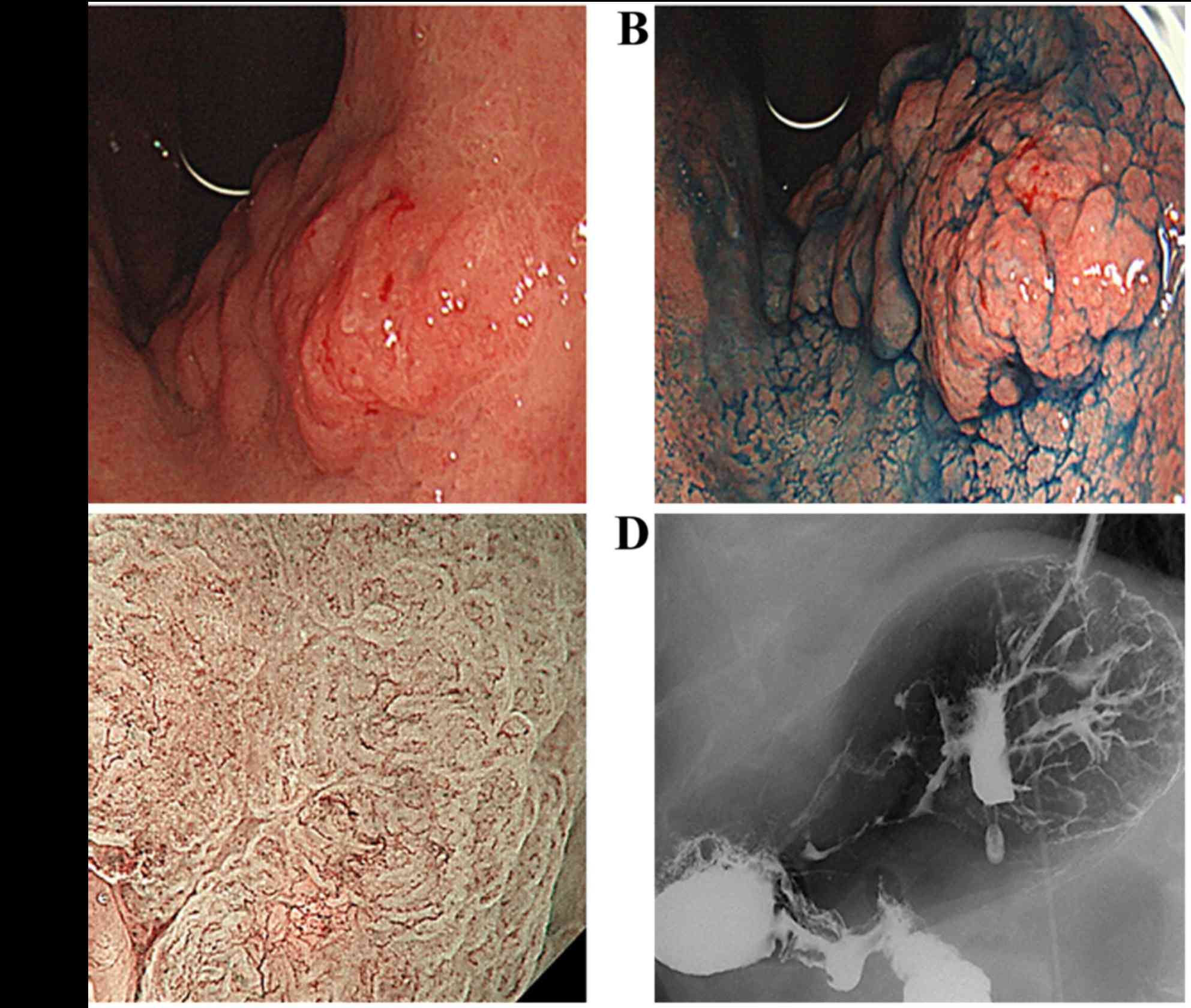
EGD revealed an uneven, type 0–I protruding lesion measuring ~4.0 cm, which was located in the lesser curvature of the upper gastric corpus (Fig. 1A and B). Magnifying endoscopy with narrow-band imaging revealed irregular microvascular and microsurface patterns with clear demarcation, suggesting that the lesion was a carcinoma (Fig. 1C). Double-contrast upper gastrointestinal barium X-ray radiography also showed an uneven, type 0–I protruding lesion in the same location in the stomach, consistent with the EGD findings (Fig. 1D).

Figure 1.

Appearance of the tumor. (A) Conventional endoscopy and (B) chromoendoscopy using indigo carmine dye showed an uneven, type 0–I protruding lesion measuring ~4.0 cm, which was located in the lesser curvature of the upper gastric corpus. (C) Narrow-band imaging with magnified endoscopy revealed irregular microvascular and microsurface patterns with clear demarcation. (D) Double-contrast upper gastrointestinal barium X-ray radiography showed an uneven, type 0–I protruding lesion in the same location in the stomach.

Biopsy specimens taken from the protruding lesion during EGD indicated a well-differentiated adenocarcinoma. Although no distant or lymph node metastases were observed on computed tomography, submucosal invasion was suspected due to the marked thickness, uneven form, and 4-cm diameter of the tumor. Based on its macroscopic appearance, laparoscopic gastrectomy with D1 lymphadenectomy was performed.

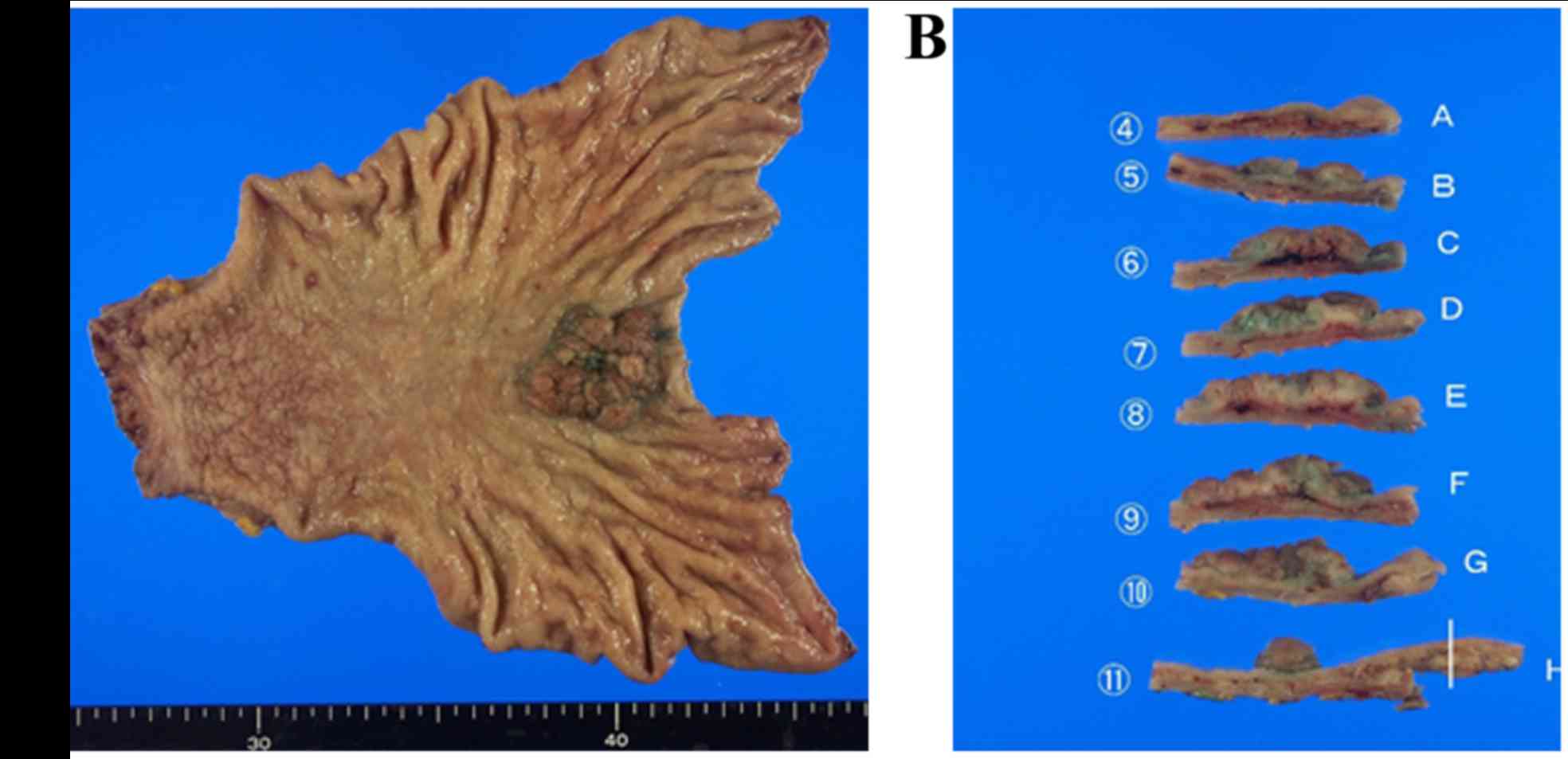
The resected tumor was 3.8×3.5×1.0 cm in size within the resected surgical specimen. The tumor had an elastic consistency, and its surface was uneven and irregular (Fig. 2A). The specimen was then cut into 11 pieces for histological assessment (Fig. 2B).

Figure 2.

Surgical specimen. (A) The resected tumor was 3.8×3.5×1.0 cm in size within the resected surgical specimen. The tumor was elastic in consistency, and its surface was uneven and irregular. (B) The histological assessment was performed by cutting the specimen into 11 pieces.

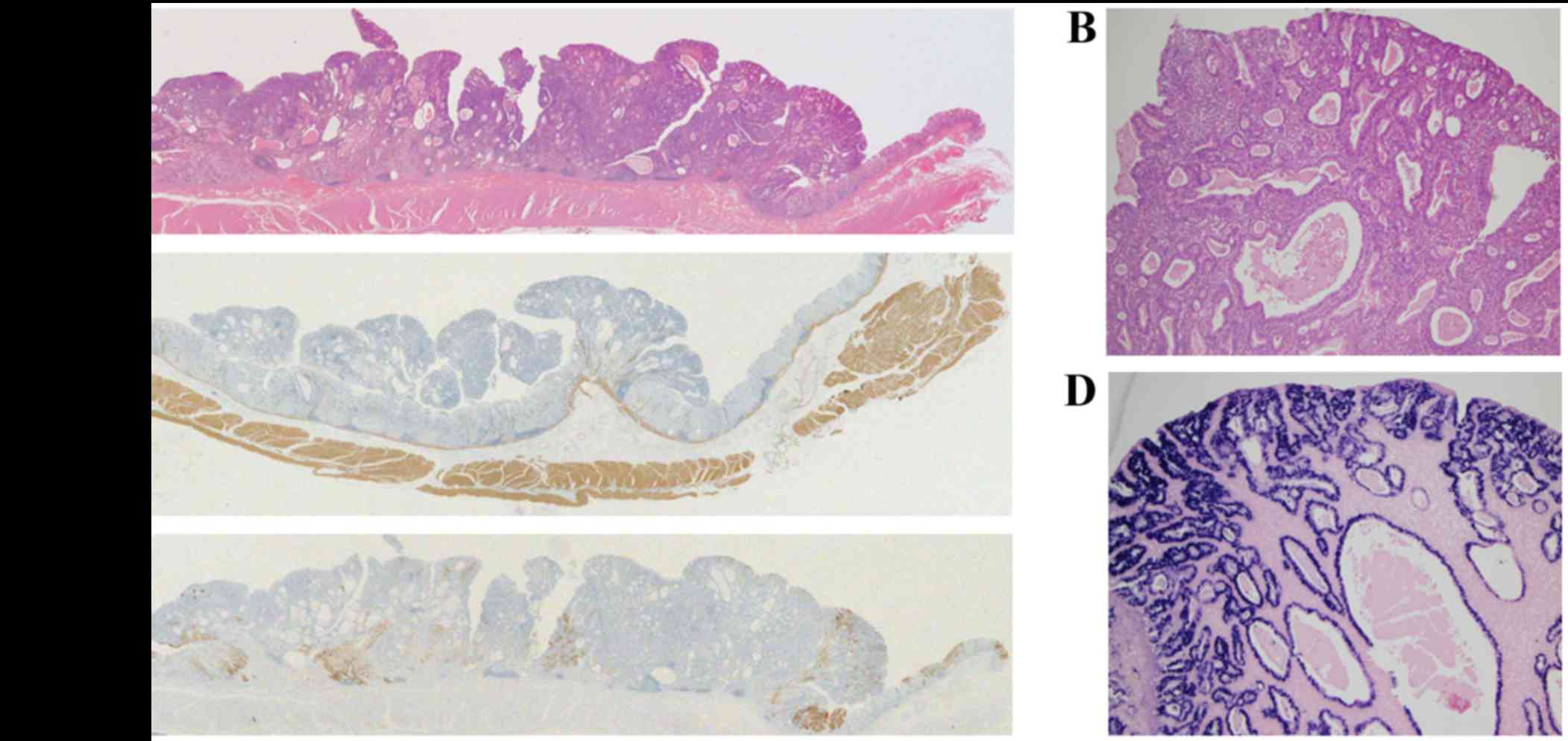
Histological assessment using the hematoxylin and eosin staining revealed polypoid growth of a well-differentiated tubular or papillary adenocarcinoma, with dense infiltration of lymphocytes through the entire layer of the tumor (Fig. 3A and B). Marked cystic dilatation and rounded expansion of the malignant glands with rich vascularization was also observed (Fig. 3B). The tumor cells were localized within the mucosal layer of the stomach, and an absence of submucosal invasion was confirmed using desmin immunohistochemistry (Fig. 3C). The carcinoma crypts, but not the infiltrating lymphocytes were EBV-positive on in situ hybridization (Fig. 3D). Immunohistochemistry also revealed that the tumor cells were partially positive for mucin (MUC) 5AC (Fig. 3E), but not for MUC6 or MUC1 (data not shown). No lymph node metastasis was observed in the resected lymph nodes.

Figure 3.

Histological assessment of the tumor. (A) Hematoxylin and eosin staining revealed polypoid growth of a well-differentiated tubular or papillary adenocarcinoma with dense infiltration of lymphocytes through the entire layer of the tumor. (B) Marked cystic dilatation and rounded expansion of the malignant glands with rich vascularization was also observed (hematoxylin and eosin staining). (C) Desmin immunohistochemistry showed that the tumor cell were localized within the mucosal layer of the stomach. (D) The carcinoma crypts, but not the infiltrating lymphocytes, were positive for Epstein-Barr virus on in situ hybridization. (E) Immunohistochemistry also revealed that the tumor cells were partially positive for mucin 5AC. Magnification, (A, C and E) ×1.25 and (B and D) ×4.

Discussion

EBV-positive GCs are characterized by distinctive clinicopathological features (1–4). TP53 mutations are rare in the EBV-positive than in EBV-negative GC (1). The typical endoscopic findings of EBV-associated GC are reported to be superficial, depressed, ulcerated (5) or ‘saucer-like’ (surrounding elevation) appearance of the tumor (1). When reviewing the clinicopathological features of 25 EBV-associated GCs from 20 patients treated in our hospital between 2005 and 2014 (Table I), all tumors except that in the current case appeared as shallow, depressed lesions (0–IIc, 0–IIc+III or 0–IIa+IIc) in the early stages and as ulcerative lesions (type 2 or type 3) in the advanced stages, according to the Japanese classification (6). Therefore, the current case, which showed polypoid growth of a well-differentiated tubular or papillary adenocarcinoma, with dense infiltration of lymphocytes through the entire layer of the tumor, seemed to be an unusual morphological appearance.

Table I.

Clinicopathological features of 25 Epstein-Barr virus-associated gastric cancers from 20 patients.

Table I.

Clinicopathological features of 25 Epstein-Barr virus-associated gastric cancers from 20 patients.

Patient no.Age, yearsSexH. pyloriLocationMultifocalMorphologyPathologyLymphocytic infiltrationDepthNode stageMet. stageStage
152Male+UpperNo0–IIcPoor+SM2001A
249Male−UpperNo0–IIc+IIIWell−M001A
375Male−MiddleNo0–IIcPoor−M001A
440Male+UpperNo0–IIa+IIcMod+SM1001A
548Male−UpperNo0–IIa+IIcPoor+SM2001A
662Male−MiddleYesType 3Poor+SE203B
−MiddleYesType 3Poor+SE203B
774Male+UpperNoType 2Poor+SS203A
863Male+MiddleNoType 3Poor+SE204
955Male+UpperYesType 3Poor+SE204
+UpperYesType 3Poor+SE204
1072Female+UpperYesType 3Poor+SE103A
+LowerYesType 2Poor+MP103A
1157MaleNDUpperNoType 2Poor+SE002B
1264Male−UpperYes0–IIcMod+SM1001A
−MiddleYes0–IIcMod+M001A
1370Male−UpperNoType 2Mod+SS203A
1461Male−UpperNoType 2Poor+SE103A
1573MaleNDUpperNoType 2Poor+SM2001A
1672MaleNDUpperNo0–IIaWell−M001A
1747MaleNDUpperNoType 3Poor+SS002A
1875Male−MiddleNoType 2Poor+MP001B
1955Male+UpperNo0–IIcPoor+SM2001A
2072MaleNDUpperNo0–IWell−M001A

[i] Patients 6, 9, 10 and 12 had multiple lesions. Clinicopathological features were classified according to the Japanese classification (6). ND, not determined; poor, poorly differentiated adenocarcinoma; well, well-differentiated adenocarcinoma; mod, moderately differentiated adenocarcinoma; M, cases of superficial mucosal cancers; SM1, cases with submucosal invasion <500 µm; SM2, submucosal invasion >500 µm; SE, tumor invasion is contiguous to or exposed beyond the Serosa; SS, cases with subserosal invasion; MP, cases with muscularis propria invasion; Met., metastasis.

The reasons underlying the unusual morphological appearance of the present case of EBV-associated GC are not clear. The background gastric mucosa in this case showed severe gastric atrophy, suggesting severe hypochlorhydria. Such a pathological state of the gastric mucosa may be associated with polypoid growth of well-differentiated tubular or papillary adenocarcinoma, even if it is EBV-associated. The typical histological features of EBV-associated GC include poorly differentiated carcinoma with dense infiltration of lymphocytes (1–3), while well or moderately differentiated histopathology may also be observed (1).

In the cases reviewed from our hospital, 5 out of 6 superficial cancers (M or SM1), including the current case, exhibited a differentiated histological type (well or moderately differentiated adenocarcinoma), suggesting that a considerable portion of the EBV-associated cases may have originally developed with a differentiated histopathology and then become poorly differentiated in the more advanced stages.

Dense infiltration of lymphocytes is a typical pathological feature of EBV-associated GC (1) (Table I), which was also observed in the current case (Fig. 3A and B). Furthermore, marked cystic dilatation and rounded expansion of the malignant glands with rich vascularization was also shown in this case (Fig. 3B); this may also explain the thickness of the lesion, which led to difficultly in predicting tumor depth. Although laparoscopic distal gastrectomy was performed in the present case, considering the increased risk of gastric surgery due to cerebral infarction, endoscopic submucosal dissection could be chosen with extended indication as the minimally invasive and curative treatment in this case. Furthermore, EBV infects B-, T- and NK cells and has been associated with a wide range of lymphoid malignancies as well as autoimmune diseases, such as lupus erythematosus, rheumatoid arthritis and particularly multiple sclerosis. Therefore, a vaccination strategy may be considered (7).

In conclusion, the present study reports a case of unusual growth of EBV-associated early-stage GC, which exhibited a polypoid form and appeared to be differentiated on histopathology. We hope the current report provide useful information for the physician treating the GC.

Acknowledgements

Not applicable.

Funding

Not applicable.

Availability of data and materials

Not applicable.

Authors' contributions

NH, TT, TK and MO performed data collection, analyzed data. NH and TT wrote manuscript.TI, NN, YN and MN, advised about the data analyzing. MN and TT performed histological examination. TS and N supervised throughout the study.

Ethics approval and consent to participate

Fujita Health University School of Medicine approved the protocol, and written informed consent was obtained from all participating subjects.

Consent for publication

Written informed consent was obtained from all participants of any associated data and accompanying images.

Competing interests

The authors declare that they have no competing interests.

References

1 

Fukayama M, Hino R and Uozaki H: Epstein-Barr virus and gastric carcinoma: Virus-hostinteractions leading to carcinoma. Cancer Sci. 99:1726–1733. 2008. View Article : Google Scholar : PubMed/NCBI

2 

Akiba S, Koriyama C, Herrera-Goepfert R and Eizuru Y: Epstein-Barr virus associated gastric carcinoma: Epidemiological and clinicopathological features. Cancer Sci. 99:195–201. 2008. View Article : Google Scholar : PubMed/NCBI

3 

Uozaki H and Fukayama M: Epstein-Barr virus and gastric carcinoma-viral carcinogenesis through epigenetic mechanisms. Int J Clin Exp Pathol. 1:198–216. 2008.PubMed/NCBI

4 

van Beek J, zur Hausen A, Kranenbarg Klein E, van de Velde CJ, Middeldorp JM, van den Brule AJ, Meijer CJ and Bloemena E: EBV-positive gastric adenocarcinomas: A distinct clinicopathologic entity with a low frequency of lymph node involvement. J Clin Oncol. 22:664–670. 2004. View Article : Google Scholar : PubMed/NCBI

5 

Yanai H, Nishikawa J, Mizugaki Y, Shimizu N, Takada K, Matsusaki K, Toda T, Matsumoto Y, Tada M and Okita K: Endoscopic and pathologic features of Epstein-Barr virus-associated gastric carcinoma. Gastrointest Endosc. 45:236–242. 1997. View Article : Google Scholar : PubMed/NCBI

6 

Japanese Gastric Cancer Association: Japanese classification of gastric carcinoma: III English edition. Gastric Cancer. 14:101–112. 2011. View Article : Google Scholar : PubMed/NCBI

7 

Capone G, Fasano C, Lucchese G, Calabrò M and Kanduc D: EBV-Associated Cancer and Autoimmunity: Searching for Therapies. Vaccines. 3:74–89. 2015. View Article : Google Scholar : PubMed/NCBI

Related Articles

  • Abstract
  • View
  • Download
  • Twitter
Copy and paste a formatted citation
Spandidos Publications style
Horiguchi N, Tahara T, Kawamura T, Okubo M, Ishizuka T, Nakano N, Nakagawa Y, Nagasaka M, Nakagawa M, Tsukamoto T, Tsukamoto T, et al: Unusual growth of an Epstein-Barr virus-associated differentiated early-stage gastric carcinoma: A case report. Mol Clin Oncol 8: 657-660, 2018.
APA
Horiguchi, N., Tahara, T., Kawamura, T., Okubo, M., Ishizuka, T., Nakano, N. ... Ohmiya, N. (2018). Unusual growth of an Epstein-Barr virus-associated differentiated early-stage gastric carcinoma: A case report. Molecular and Clinical Oncology, 8, 657-660. https://doi.org/10.3892/mco.2018.1586
MLA
Horiguchi, N., Tahara, T., Kawamura, T., Okubo, M., Ishizuka, T., Nakano, N., Nakagawa, Y., Nagasaka, M., Nakagawa, M., Tsukamoto, T., Shibata, T., Ohmiya, N."Unusual growth of an Epstein-Barr virus-associated differentiated early-stage gastric carcinoma: A case report". Molecular and Clinical Oncology 8.5 (2018): 657-660.
Chicago
Horiguchi, N., Tahara, T., Kawamura, T., Okubo, M., Ishizuka, T., Nakano, N., Nakagawa, Y., Nagasaka, M., Nakagawa, M., Tsukamoto, T., Shibata, T., Ohmiya, N."Unusual growth of an Epstein-Barr virus-associated differentiated early-stage gastric carcinoma: A case report". Molecular and Clinical Oncology 8, no. 5 (2018): 657-660. https://doi.org/10.3892/mco.2018.1586
Copy and paste a formatted citation
x
Spandidos Publications style
Horiguchi N, Tahara T, Kawamura T, Okubo M, Ishizuka T, Nakano N, Nakagawa Y, Nagasaka M, Nakagawa M, Tsukamoto T, Tsukamoto T, et al: Unusual growth of an Epstein-Barr virus-associated differentiated early-stage gastric carcinoma: A case report. Mol Clin Oncol 8: 657-660, 2018.
APA
Horiguchi, N., Tahara, T., Kawamura, T., Okubo, M., Ishizuka, T., Nakano, N. ... Ohmiya, N. (2018). Unusual growth of an Epstein-Barr virus-associated differentiated early-stage gastric carcinoma: A case report. Molecular and Clinical Oncology, 8, 657-660. https://doi.org/10.3892/mco.2018.1586
MLA
Horiguchi, N., Tahara, T., Kawamura, T., Okubo, M., Ishizuka, T., Nakano, N., Nakagawa, Y., Nagasaka, M., Nakagawa, M., Tsukamoto, T., Shibata, T., Ohmiya, N."Unusual growth of an Epstein-Barr virus-associated differentiated early-stage gastric carcinoma: A case report". Molecular and Clinical Oncology 8.5 (2018): 657-660.
Chicago
Horiguchi, N., Tahara, T., Kawamura, T., Okubo, M., Ishizuka, T., Nakano, N., Nakagawa, Y., Nagasaka, M., Nakagawa, M., Tsukamoto, T., Shibata, T., Ohmiya, N."Unusual growth of an Epstein-Barr virus-associated differentiated early-stage gastric carcinoma: A case report". Molecular and Clinical Oncology 8, no. 5 (2018): 657-660. https://doi.org/10.3892/mco.2018.1586
Follow us
  • Twitter
  • LinkedIn
  • Facebook
About
  • Spandidos Publications
  • Careers
  • Cookie Policy
  • Privacy Policy
How can we help?
  • Help
  • Live Chat
  • Contact
  • Email to our Support Team