Spandidos Publications Logo
  • About
    • About Spandidos
    • Aims and Scopes
    • Abstracting and Indexing
    • Editorial Policies
    • Reprints and Permissions
    • Job Opportunities
    • Terms and Conditions
    • Contact
  • Journals
    • All Journals
    • Oncology Letters
      • Oncology Letters
      • Information for Authors
      • Editorial Policies
      • Editorial Board
      • Aims and Scope
      • Abstracting and Indexing
      • Bibliographic Information
      • Archive
    • International Journal of Oncology
      • International Journal of Oncology
      • Information for Authors
      • Editorial Policies
      • Editorial Board
      • Aims and Scope
      • Abstracting and Indexing
      • Bibliographic Information
      • Archive
    • Molecular and Clinical Oncology
      • Molecular and Clinical Oncology
      • Information for Authors
      • Editorial Policies
      • Editorial Board
      • Aims and Scope
      • Abstracting and Indexing
      • Bibliographic Information
      • Archive
    • Experimental and Therapeutic Medicine
      • Experimental and Therapeutic Medicine
      • Information for Authors
      • Editorial Policies
      • Editorial Board
      • Aims and Scope
      • Abstracting and Indexing
      • Bibliographic Information
      • Archive
    • International Journal of Molecular Medicine
      • International Journal of Molecular Medicine
      • Information for Authors
      • Editorial Policies
      • Editorial Board
      • Aims and Scope
      • Abstracting and Indexing
      • Bibliographic Information
      • Archive
    • Biomedical Reports
      • Biomedical Reports
      • Information for Authors
      • Editorial Policies
      • Editorial Board
      • Aims and Scope
      • Abstracting and Indexing
      • Bibliographic Information
      • Archive
    • Oncology Reports
      • Oncology Reports
      • Information for Authors
      • Editorial Policies
      • Editorial Board
      • Aims and Scope
      • Abstracting and Indexing
      • Bibliographic Information
      • Archive
    • Molecular Medicine Reports
      • Molecular Medicine Reports
      • Information for Authors
      • Editorial Policies
      • Editorial Board
      • Aims and Scope
      • Abstracting and Indexing
      • Bibliographic Information
      • Archive
    • World Academy of Sciences Journal
      • World Academy of Sciences Journal
      • Information for Authors
      • Editorial Policies
      • Editorial Board
      • Aims and Scope
      • Abstracting and Indexing
      • Bibliographic Information
      • Archive
    • International Journal of Functional Nutrition
      • International Journal of Functional Nutrition
      • Information for Authors
      • Editorial Policies
      • Editorial Board
      • Aims and Scope
      • Abstracting and Indexing
      • Bibliographic Information
      • Archive
    • International Journal of Epigenetics
      • International Journal of Epigenetics
      • Information for Authors
      • Editorial Policies
      • Editorial Board
      • Aims and Scope
      • Abstracting and Indexing
      • Bibliographic Information
      • Archive
    • Medicine International
      • Medicine International
      • Information for Authors
      • Editorial Policies
      • Editorial Board
      • Aims and Scope
      • Abstracting and Indexing
      • Bibliographic Information
      • Archive
  • Articles
  • Information
    • Information for Authors
    • Information for Reviewers
    • Information for Librarians
    • Information for Advertisers
    • Conferences
  • Language Editing
Spandidos Publications Logo
  • About
    • About Spandidos
    • Aims and Scopes
    • Abstracting and Indexing
    • Editorial Policies
    • Reprints and Permissions
    • Job Opportunities
    • Terms and Conditions
    • Contact
  • Journals
    • All Journals
    • Biomedical Reports
      • Information for Authors
      • Editorial Policies
      • Editorial Board
      • Aims and Scope
      • Abstracting and Indexing
      • Bibliographic Information
      • Archive
    • Experimental and Therapeutic Medicine
      • Information for Authors
      • Editorial Policies
      • Editorial Board
      • Aims and Scope
      • Abstracting and Indexing
      • Bibliographic Information
      • Archive
    • International Journal of Epigenetics
      • Information for Authors
      • Editorial Policies
      • Editorial Board
      • Aims and Scope
      • Abstracting and Indexing
      • Bibliographic Information
      • Archive
    • International Journal of Functional Nutrition
      • Information for Authors
      • Editorial Policies
      • Editorial Board
      • Aims and Scope
      • Abstracting and Indexing
      • Bibliographic Information
      • Archive
    • International Journal of Molecular Medicine
      • Information for Authors
      • Editorial Policies
      • Editorial Board
      • Aims and Scope
      • Abstracting and Indexing
      • Bibliographic Information
      • Archive
    • International Journal of Oncology
      • Information for Authors
      • Editorial Policies
      • Editorial Board
      • Aims and Scope
      • Abstracting and Indexing
      • Bibliographic Information
      • Archive
    • Medicine International
      • Information for Authors
      • Editorial Policies
      • Editorial Board
      • Aims and Scope
      • Abstracting and Indexing
      • Bibliographic Information
      • Archive
    • Molecular and Clinical Oncology
      • Information for Authors
      • Editorial Policies
      • Editorial Board
      • Aims and Scope
      • Abstracting and Indexing
      • Bibliographic Information
      • Archive
    • Molecular Medicine Reports
      • Information for Authors
      • Editorial Policies
      • Editorial Board
      • Aims and Scope
      • Abstracting and Indexing
      • Bibliographic Information
      • Archive
    • Oncology Letters
      • Information for Authors
      • Editorial Policies
      • Editorial Board
      • Aims and Scope
      • Abstracting and Indexing
      • Bibliographic Information
      • Archive
    • Oncology Reports
      • Information for Authors
      • Editorial Policies
      • Editorial Board
      • Aims and Scope
      • Abstracting and Indexing
      • Bibliographic Information
      • Archive
    • World Academy of Sciences Journal
      • Information for Authors
      • Editorial Policies
      • Editorial Board
      • Aims and Scope
      • Abstracting and Indexing
      • Bibliographic Information
      • Archive
  • Articles
  • Information
    • For Authors
    • For Reviewers
    • For Librarians
    • For Advertisers
    • Conferences
  • Language Editing
Login Register Submit
  • This site uses cookies
  • You can change your cookie settings at any time by following the instructions in our Cookie Policy. To find out more, you may read our Privacy Policy.

    I agree
Search articles by DOI, keyword, author or affiliation
Search
Advanced Search
presentation
Molecular and Clinical Oncology
Join Editorial Board Propose a Special Issue
Print ISSN: 2049-9450 Online ISSN: 2049-9469
Journal Cover
September-2018 Volume 9 Issue 3

Full Size Image

Sign up for eToc alerts
Recommend to Library

Journals

International Journal of Molecular Medicine

International Journal of Molecular Medicine

International Journal of Molecular Medicine is an international journal devoted to molecular mechanisms of human disease.

International Journal of Oncology

International Journal of Oncology

International Journal of Oncology is an international journal devoted to oncology research and cancer treatment.

Molecular Medicine Reports

Molecular Medicine Reports

Covers molecular medicine topics such as pharmacology, pathology, genetics, neuroscience, infectious diseases, molecular cardiology, and molecular surgery.

Oncology Reports

Oncology Reports

Oncology Reports is an international journal devoted to fundamental and applied research in Oncology.

Experimental and Therapeutic Medicine

Experimental and Therapeutic Medicine

Experimental and Therapeutic Medicine is an international journal devoted to laboratory and clinical medicine.

Oncology Letters

Oncology Letters

Oncology Letters is an international journal devoted to Experimental and Clinical Oncology.

Biomedical Reports

Biomedical Reports

Explores a wide range of biological and medical fields, including pharmacology, genetics, microbiology, neuroscience, and molecular cardiology.

Molecular and Clinical Oncology

Molecular and Clinical Oncology

International journal addressing all aspects of oncology research, from tumorigenesis and oncogenes to chemotherapy and metastasis.

World Academy of Sciences Journal

World Academy of Sciences Journal

Multidisciplinary open-access journal spanning biochemistry, genetics, neuroscience, environmental health, and synthetic biology.

International Journal of Functional Nutrition

International Journal of Functional Nutrition

Open-access journal combining biochemistry, pharmacology, immunology, and genetics to advance health through functional nutrition.

International Journal of Epigenetics

International Journal of Epigenetics

Publishes open-access research on using epigenetics to advance understanding and treatment of human disease.

Medicine International

Medicine International

An International Open Access Journal Devoted to General Medicine.

Journal Cover
September-2018 Volume 9 Issue 3

Full Size Image

Sign up for eToc alerts
Recommend to Library

  • Article
  • Citations
    • Cite This Article
    • Download Citation
    • Create Citation Alert
    • Remove Citation Alert
    • Cited By
  • Similar Articles
    • Related Articles (in Spandidos Publications)
    • Similar Articles (Google Scholar)
    • Similar Articles (PubMed)
  • Download PDF
  • Download XML
  • View XML
Article

Oxidative stress marker 8-hydroxyguanosine is more highly expressed in prostate cancer than in benign prostatic hyperplasia

  • Authors:
    • Shinji Ohtake
    • Takashi Kawahara
    • Yukari Ishiguro
    • Teppei Takeshima
    • Shinnosuke Kuroda
    • Koji Izumi
    • Hiroshi Miyamoto
    • Hiroji Uemura
  • View Affiliations / Copyright

    Affiliations: Department of Urology, Yokohama City University Graduate School of Medicine, Yokohama, Kanagawa 236‑0004, Japan, Department of Urology and Renal Transplantation, Yokohama City University Medical Center, Yokohama, Kanagawa 232-0024, Japan, Departments of Pathology and Laboratory Medicine, Urology, and Oncology, University of Rochester Medical Center, Rochester, NY 14627, USA
  • Pages: 302-304
    |
    Published online on: July 3, 2018
       https://doi.org/10.3892/mco.2018.1665
  • Expand metrics +
Metrics: Total Views: 0 (Spandidos Publications: | PMC Statistics: )
Metrics: Total PDF Downloads: 0 (Spandidos Publications: | PMC Statistics: )
Cited By (CrossRef): 0 citations Loading Articles...

This article is mentioned in:


Abstract

Oxidative stress is a primary cause of vascular endothelial damage. In the prostate, ischemia increases the levels of reactive oxygen species, growth factors and cytokines, and induces the development of angiogenesis, which results in cancer progression. The expression levels of an oxidative stress marker, 8-hydroxyguanosine (8-OHdG), were compared between prostate cancer and non-neoplastic prostate tissues. A prostate tissue microarray composed of 10 cases of prostatic adenocarcinoma and 70 cases of benign prostatic hyperplasia was immunohistochemically stained for 8-OHdG. All cases expressed 8-OHdG. The levels of 8-OHdG expression in prostatic cancer (30.0% moderate and 70.0% strong) were significantly higher than those in benign prostatic hyperplasia (71.4% moderate and 28.6% strong; (p<0.01). Notably, 8-OHdG is expressed more highly in prostate cancer tissues in comparison to benign prostate tissues.

Introduction

Oxidative stress is a chief cause of vascular endothelial damage. It increases the levels of reactive oxygen species, which subsequently induces vascular endothelial dysfunction via the inhibition of nitric oxide production (1).

In the prostate, ischemia increases the levels of reactive oxygen species, growth factors, and cytokines, and induces the development of angiogenesis, resulting in cancer progression (2). Recent studies, using a prostate hyperplasia mouse model have demonstrated that ischemia in the prostatic epithelium induces oxidative stress, resulting in cell proliferation involved by inflammatory cytokines and several growth factors (3,4).

These findings indicate that oxidative stress plays an important role in the prostate. No report has described the tissue 8-hydroxyguanosine (8-OHdG) expression in prostatic specimens. In the present study, we compared the expression levels of an oxidative stress marker 8-hydroxyguanosine between prostate adenocarcinoma and non-neoplastic prostate tissues.

Materials and methods

Immunohistochemistry was performed, as described previously (5) in sections from a prostatic tissue microarray composed of 10 cases of prostatic adenocarcinoma and 70 cases of non-neoplastic prostate (PR804; US Biomax, Rockville, MD, USA). This company obtained informed consent (https://www.biomax.us/FAQs,Q10) Briefly, 5-µm-thick slides were dewaxed with xylene, hydrated with gradient ethanol, and microwaved at high level for 2 min., followed by 30 min. microwaved at middle-low levels for heat antigen retrieval (Target Retrieval Solution pH9, Dako, Carpinteria, CA, USA). After 3% hydrogen peroxidase block, the samples were incubated overnight at 4°C with a primary antibody to anti-8-OHdG (ab48508, diluted to 1:200; Abcam, Cambridge, MA, USA) and a broad-spectrum secondary antibody (Histostain-SP kit; Invitrogen, Grand Island, NY, USA) for 2 h (Table I). The slides were then examined by a single pathologist (HM) blinded to sample identify. The score of immunoreactivity was determined by multiplying the percentage of immunoreactive cells (0% = 0; 1–10% = 1; 11–50% = 2; 51–80% = 3; 81–100% = 4) by staining intensity (negative = 0; weak = 1; moderate = 2; strong = 3). The immunohistochemical scores (ranging from 0 to 12) were considered negative (0; 0–1), weakly positive (1+; 2–4), moderately positive (2+; 6–8), and strongly positive (3+; 9–12) for 8-OHdG expression (5).

Table I.

First and second antibody for immunohistochemistry analysis.

Table I.

First and second antibody for immunohistochemistry analysis.

NameCat. no.Company
First antibody
  8-Hydroxyguanosine polyclonal antibodyab48508Abcam
Second antibody and staining kit
  Histostain-SP kit95–9943Invitrogen

The 8-OHdG expression was analyzed by chi-square test using the Graph Pad Prism software program (Graph Pad Software, La Jolla, CA, USA).

Results

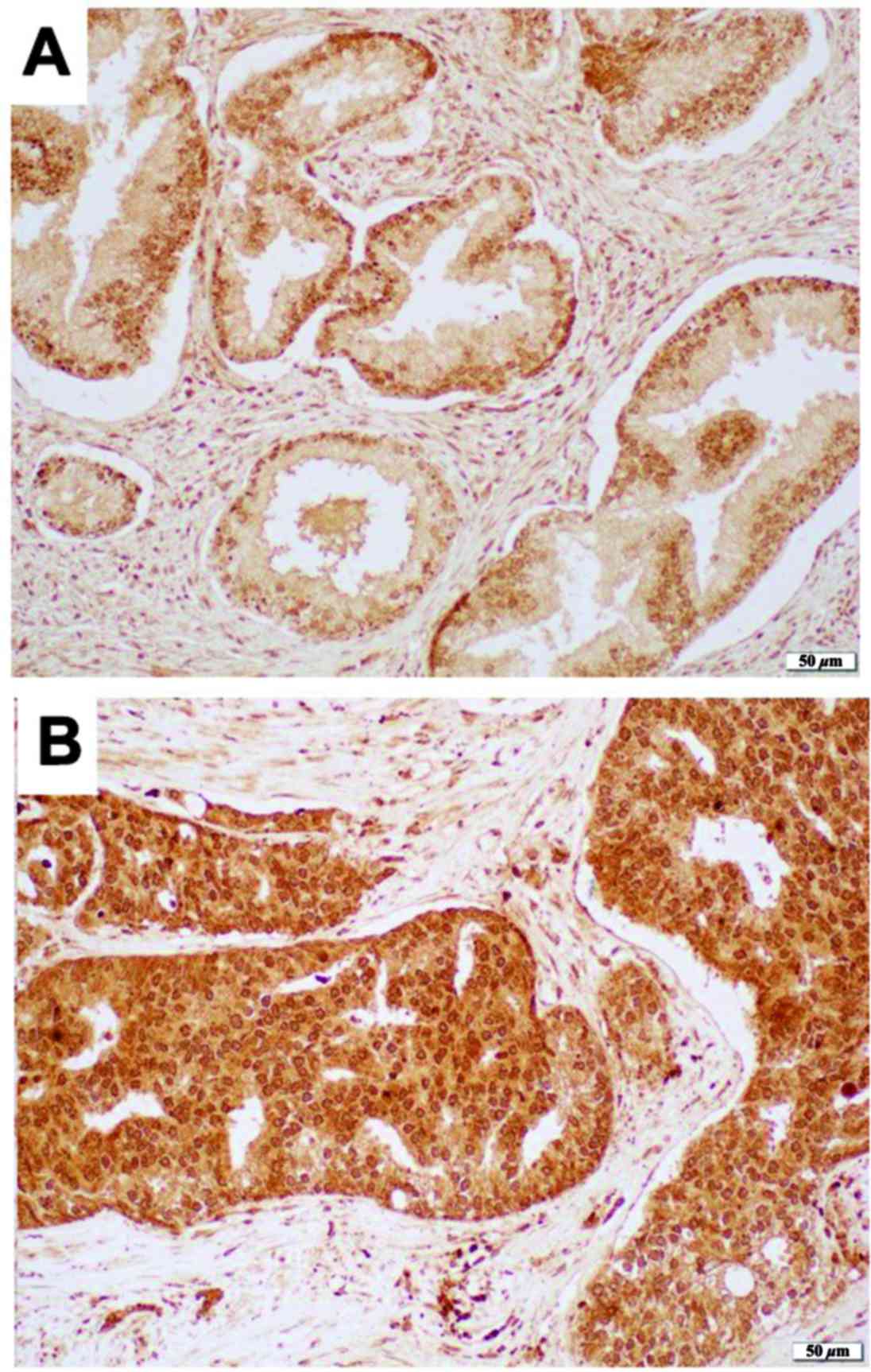
We immunohistochemically stained for 8-OHdG in a prostate tissue microarray. Positive signals were detected predominantly in cytoplasm of epithelial cells as well as in nucleus of epithelial cells only in a few cases (Fig. 1). 8-OHdG was immunoreactive in all 10 prostatic adenocarcinomas, including 3 (30%) cases with moderate (2+) expression and 7 (70%) cases with strong (3+) expression. Similarly, 8-OHdG was moderately and strongly positive in 50 (71.4%) and 20 (28.6%) cases of benign prostatic hyperplasia (Table II). Thus, the levels of 8-OHdG expression in prostatic adenocarcinoma tissue specimens were significantly higher than those in non-neoplastic prostate tissue specimens (P<0.01).

Figure 1.

Immunohistochemistry of 8-hydroxyguanosine. Strong and moderate expression was observed in (A) non-neoplastic prostate and (B) prostatic adenocarcinoma tissue specimens, respectively.

Table II.

Immunohistochemical staining of 8-hydroxyguanosine (P<0.01).

Table II.

Immunohistochemical staining of 8-hydroxyguanosine (P<0.01).

Immunoreactive score01+2+3+
Prostate adenocarcinoma0 (0.0%)0 (0.0%)3 (30.0%)7 (70.0%)
Non-neoplastic tissue0 (0.0%)0 (0.0%)50 (71.4%)20 (28.6%)

Discussion

Our results showed that prostate adenocarcinoma showed higher 8-OHdG expression than non-neoplastic prostate tissue. Miyake et al showed that prostate cancer patients had significantly higher levels of urine 8-OHdG/Cre than those without cancer (6). In patients with prostate cancer, urine 8-OHdG/Cre levels were not markedly different before and after radical prostatectomy. In contrast, their levels were decreased significantly after androgen deprivation therapy. These findings indicate that androgen deprivation therapy reduces oxidative stress.

The detailed mechanism underlying the cancer progression induced by 8-OHdG is still unknown. Guanine is easily damaged by anti-oxidant stress, resulting in a change to 8-OHdG. 8-OHdG is structurally stable and widely used as an oxidant-stress biomarker (6,7). H2O2 has also been shown to increase 8-OHdG in a time-dependent manner in prostatic epithelial cells, which is one potential mechanism underlying cancer progression, presumably due to continuous anti-oxidant damage (8,9). Based on these findings, oxidant stress produced 8-OHdG in prostate tissue, resulting in the time-dependent accumulation of 8-OHdG and subsequent carcinogenesis due to the damage of DNA. Wu and Ni showed the correlation between 8-OHdg and carcinogenesis and speculated that hypomethylation and regional hypermethylation contribute to carcinogenesis (10). In gastric cancer, a correlation has been reported between gastric cancer and cytotoxin-associated genes that induces cancer progression. However, the detailed mechanisms are still unknown (11). While further studies are needed, the findings from the present study suggest that 8-OHdG might be a candidate tumor marker for detecting prostate cancer.

Tadalafil, a PDE-5 inhibitor, inhibits cGMP in smooth muscle cells and induces reflexes smooth muscle (12,13). Gotoh et al demonstrated that tadalafil improved the bladder blood flow and increased the level of 8-OHdG in tissue (14). Tadalafil has also been reported to show anti-inflammatory activity in the prostate and might be a prevention effect from prostate cancer (15,16).

The limitations of this study include no staining in completely normal prostatic tissue. Further studies, using normal prostate tissues and/or cell lines, are also required to reveal the underlying mechanism for the involvement of 8-OHdG in prostate carcinogenesis and cancer progression.

We found that 8-OHdG expression was elevated in prostate cancer tissues compared with non-neoplastic prostate tissues. 8-OHdG may therefore play an important role in prostate cancer development.

Acknowledgements

Not applicable.

Funding

Funding was received from Kakenhi grants (grant no. 16K20152) for the Ministry of Education, Culture, Sports, Science and Technology of Japan.

Availability of data and materials

The datasets used and/or analyzed during the current study are available from the corresponding author upon request

Authors' contributions

SO, TK and HU conceived and designed the experiments. SO, TK, YI, TT, SK, KI, HM and HU performed the experiments. SO, TK and HM wrote the manuscript. All authors have read and approved the manuscript

Ethics approval and consent to participate

Not applicable.

Patient consent for publication

Not applicable.

Competing interests

The authors declare that they have no competing interests.

References

1 

Cai H and Harrison DG: Endothelial dysfunction in cardiovascular diseases: The role of oxidant stress. Circ Res. 87:840–844. 2000. View Article : Google Scholar : PubMed/NCBI

2 

De Nunzio C, Aronson W, Freedland SJ, Giovannucci E and Parsons JK: The correlation between metabolic syndrome and prostatic diseases. Eur Urol. 61:560–570. 2012. View Article : Google Scholar : PubMed/NCBI

3 

Sychlowy A, van der Gaag H and Hannen-Hofheinz I: Hyperkalemia-life-threatening early complication of asphyxia in premature infants. Monatsschr Kinderheilkd. 138:62–65. 1990.(In German). PubMed/NCBI

4 

Saito M, Tsounapi P, Oikawa R, Shimizu S, Honda M, Sejima T, Kinoshita Y and Tomita S: Prostatic ischemia induces ventral prostatic hyperplasia in the SHR; possible mechanism of development of BPH. Sci Rep. 4:38222014. View Article : Google Scholar : PubMed/NCBI

5 

Shim V, Gauthier ML, Sudilovsky D, Mantei K, Chew KL, Moore DH, Cha I, Tlsty TD and Esserman LJ: Cyclooxygenase-2 expression is related to nuclear grade in ductal carcinoma in situ and is increased in its normal adjacent epithelium. Cancer Res. 63:2347–2350. 2003.PubMed/NCBI

6 

Miyake H, Hara I, Kamidono S and Eto H: Oxidative DNA damage in patients with prostate cancer and its response to treatment. J Urol. 171:1533–1536. 2004. View Article : Google Scholar : PubMed/NCBI

7 

Nelson WG, DeWeese TL and DeMarzo AM: The diet, prostate inflammation, and the development of prostate cancer. Cancer Metastasis Rev. 21:3–16. 2002. View Article : Google Scholar : PubMed/NCBI

8 

Kanwal R, Pandey M, Bhaskaran N, Maclennan GT, Fu P, Ponsky LE and Gupta S: Protection against oxidative DNA damage and stress in human prostate by glutathione S-transferase P1. Mol Carcinog. 53:8–18. 2014. View Article : Google Scholar : PubMed/NCBI

9 

Koul HK, Kumar B, Koul S, Deb AA, Hwa JS, Maroni P, van Bokhoven A, Lucia MS, Kim FJ and Meacham RB: The role of inflammation and infection in prostate cancer: Importance in prevention, diagnosis and treatment. Drugs Today (Barc). 46:929–943. 2010. View Article : Google Scholar : PubMed/NCBI

10 

Wu Q and Ni X: ROS-mediated DNA methylation pattern alterations in carcinogenesis. Curr Drug Targets. 16:13–19. 2015. View Article : Google Scholar : PubMed/NCBI

11 

Raza Y, Khan A, Farooqui A, Mubarak M, Facista A, Akhtar SS, Khan S, Kazi JI, Bernstein C and Kazmi SU: Oxidative DNA damage as a potential early biomarker of Helicobacter pylori associated carcinogenesis. Pathol Oncol Res. 20:839–846. 2014. View Article : Google Scholar : PubMed/NCBI

12 

Fukumoto K, Nagai A, Hara R, Fujii T and Miyaji Y: Tadalafil for male lower urinary tract symptoms improves endothelial function. Int J Urol. 24:206–210. 2017. View Article : Google Scholar : PubMed/NCBI

13 

Yokoyama O, Ozeki A, Suzuki N and Murakami M: Early improvement of storage or voiding symptoms by tadalafil predicts treatment outcomes in patients with lower urinary tract symptoms from benign prostatic hyperplasia. Int J Urol. 25:240–245. 2018. View Article : Google Scholar : PubMed/NCBI

14 

Gotoh D, Torimoto K, Tatsumi Y, Hori S, Yamada A, Miyake M, Morizawa Y, Aoki K, Tanaka N, Hirayama A, et al: Tadalafil, a phosphodiesterase type 5 inhibitor, improves bladder blood supply and restores the initial phase of lower urinary tract dysfunction in diabetic rats. Neurourol Urodyn. 35:444–449. 2017.

15 

Vignozzi L, Gacci M, Cellai I, Morelli A, Maneschi E, Comeglio P, Santi R, Filippi S, Sebastianelli A, Nesi G, et al: PDE5 inhibitors blunt inflammation in human BPH: A potential mechanism of action for PDE5 inhibitors in LUTS. Prostate. 73:1391–1402. 2013. View Article : Google Scholar : PubMed/NCBI

16 

Zarifpour M, Nomiya M, Sawada N and Andersson KE: Protective effect of tadalafil on the functional and structural changes of the rat ventral prostate caused by chronic pelvic ischemia. Prostate. 75:233–241. 2015. View Article : Google Scholar : PubMed/NCBI

Related Articles

  • Abstract
  • View
  • Download
  • Twitter
Copy and paste a formatted citation
Spandidos Publications style
Ohtake S, Kawahara T, Ishiguro Y, Takeshima T, Kuroda S, Izumi K, Miyamoto H and Uemura H: Oxidative stress marker 8-hydroxyguanosine is more highly expressed in prostate cancer than in benign prostatic hyperplasia. Mol Clin Oncol 9: 302-304, 2018.
APA
Ohtake, S., Kawahara, T., Ishiguro, Y., Takeshima, T., Kuroda, S., Izumi, K. ... Uemura, H. (2018). Oxidative stress marker 8-hydroxyguanosine is more highly expressed in prostate cancer than in benign prostatic hyperplasia. Molecular and Clinical Oncology, 9, 302-304. https://doi.org/10.3892/mco.2018.1665
MLA
Ohtake, S., Kawahara, T., Ishiguro, Y., Takeshima, T., Kuroda, S., Izumi, K., Miyamoto, H., Uemura, H."Oxidative stress marker 8-hydroxyguanosine is more highly expressed in prostate cancer than in benign prostatic hyperplasia". Molecular and Clinical Oncology 9.3 (2018): 302-304.
Chicago
Ohtake, S., Kawahara, T., Ishiguro, Y., Takeshima, T., Kuroda, S., Izumi, K., Miyamoto, H., Uemura, H."Oxidative stress marker 8-hydroxyguanosine is more highly expressed in prostate cancer than in benign prostatic hyperplasia". Molecular and Clinical Oncology 9, no. 3 (2018): 302-304. https://doi.org/10.3892/mco.2018.1665
Copy and paste a formatted citation
x
Spandidos Publications style
Ohtake S, Kawahara T, Ishiguro Y, Takeshima T, Kuroda S, Izumi K, Miyamoto H and Uemura H: Oxidative stress marker 8-hydroxyguanosine is more highly expressed in prostate cancer than in benign prostatic hyperplasia. Mol Clin Oncol 9: 302-304, 2018.
APA
Ohtake, S., Kawahara, T., Ishiguro, Y., Takeshima, T., Kuroda, S., Izumi, K. ... Uemura, H. (2018). Oxidative stress marker 8-hydroxyguanosine is more highly expressed in prostate cancer than in benign prostatic hyperplasia. Molecular and Clinical Oncology, 9, 302-304. https://doi.org/10.3892/mco.2018.1665
MLA
Ohtake, S., Kawahara, T., Ishiguro, Y., Takeshima, T., Kuroda, S., Izumi, K., Miyamoto, H., Uemura, H."Oxidative stress marker 8-hydroxyguanosine is more highly expressed in prostate cancer than in benign prostatic hyperplasia". Molecular and Clinical Oncology 9.3 (2018): 302-304.
Chicago
Ohtake, S., Kawahara, T., Ishiguro, Y., Takeshima, T., Kuroda, S., Izumi, K., Miyamoto, H., Uemura, H."Oxidative stress marker 8-hydroxyguanosine is more highly expressed in prostate cancer than in benign prostatic hyperplasia". Molecular and Clinical Oncology 9, no. 3 (2018): 302-304. https://doi.org/10.3892/mco.2018.1665
Follow us
  • Twitter
  • LinkedIn
  • Facebook
About
  • Spandidos Publications
  • Careers
  • Cookie Policy
  • Privacy Policy
How can we help?
  • Help
  • Live Chat
  • Contact
  • Email to our Support Team