Spandidos Publications Logo
  • About
    • About Spandidos
    • Aims and Scopes
    • Abstracting and Indexing
    • Editorial Policies
    • Reprints and Permissions
    • Job Opportunities
    • Terms and Conditions
    • Contact
  • Journals
    • All Journals
    • Oncology Letters
      • Oncology Letters
      • Information for Authors
      • Editorial Policies
      • Editorial Board
      • Aims and Scope
      • Abstracting and Indexing
      • Bibliographic Information
      • Archive
    • International Journal of Oncology
      • International Journal of Oncology
      • Information for Authors
      • Editorial Policies
      • Editorial Board
      • Aims and Scope
      • Abstracting and Indexing
      • Bibliographic Information
      • Archive
    • Molecular and Clinical Oncology
      • Molecular and Clinical Oncology
      • Information for Authors
      • Editorial Policies
      • Editorial Board
      • Aims and Scope
      • Abstracting and Indexing
      • Bibliographic Information
      • Archive
    • Experimental and Therapeutic Medicine
      • Experimental and Therapeutic Medicine
      • Information for Authors
      • Editorial Policies
      • Editorial Board
      • Aims and Scope
      • Abstracting and Indexing
      • Bibliographic Information
      • Archive
    • International Journal of Molecular Medicine
      • International Journal of Molecular Medicine
      • Information for Authors
      • Editorial Policies
      • Editorial Board
      • Aims and Scope
      • Abstracting and Indexing
      • Bibliographic Information
      • Archive
    • Biomedical Reports
      • Biomedical Reports
      • Information for Authors
      • Editorial Policies
      • Editorial Board
      • Aims and Scope
      • Abstracting and Indexing
      • Bibliographic Information
      • Archive
    • Oncology Reports
      • Oncology Reports
      • Information for Authors
      • Editorial Policies
      • Editorial Board
      • Aims and Scope
      • Abstracting and Indexing
      • Bibliographic Information
      • Archive
    • Molecular Medicine Reports
      • Molecular Medicine Reports
      • Information for Authors
      • Editorial Policies
      • Editorial Board
      • Aims and Scope
      • Abstracting and Indexing
      • Bibliographic Information
      • Archive
    • World Academy of Sciences Journal
      • World Academy of Sciences Journal
      • Information for Authors
      • Editorial Policies
      • Editorial Board
      • Aims and Scope
      • Abstracting and Indexing
      • Bibliographic Information
      • Archive
    • International Journal of Functional Nutrition
      • International Journal of Functional Nutrition
      • Information for Authors
      • Editorial Policies
      • Editorial Board
      • Aims and Scope
      • Abstracting and Indexing
      • Bibliographic Information
      • Archive
    • International Journal of Epigenetics
      • International Journal of Epigenetics
      • Information for Authors
      • Editorial Policies
      • Editorial Board
      • Aims and Scope
      • Abstracting and Indexing
      • Bibliographic Information
      • Archive
    • Medicine International
      • Medicine International
      • Information for Authors
      • Editorial Policies
      • Editorial Board
      • Aims and Scope
      • Abstracting and Indexing
      • Bibliographic Information
      • Archive
  • Articles
  • Information
    • Information for Authors
    • Information for Reviewers
    • Information for Librarians
    • Information for Advertisers
    • Conferences
  • Language Editing
Spandidos Publications Logo
  • About
    • About Spandidos
    • Aims and Scopes
    • Abstracting and Indexing
    • Editorial Policies
    • Reprints and Permissions
    • Job Opportunities
    • Terms and Conditions
    • Contact
  • Journals
    • All Journals
    • Biomedical Reports
      • Information for Authors
      • Editorial Policies
      • Editorial Board
      • Aims and Scope
      • Abstracting and Indexing
      • Bibliographic Information
      • Archive
    • Experimental and Therapeutic Medicine
      • Information for Authors
      • Editorial Policies
      • Editorial Board
      • Aims and Scope
      • Abstracting and Indexing
      • Bibliographic Information
      • Archive
    • International Journal of Epigenetics
      • Information for Authors
      • Editorial Policies
      • Editorial Board
      • Aims and Scope
      • Abstracting and Indexing
      • Bibliographic Information
      • Archive
    • International Journal of Functional Nutrition
      • Information for Authors
      • Editorial Policies
      • Editorial Board
      • Aims and Scope
      • Abstracting and Indexing
      • Bibliographic Information
      • Archive
    • International Journal of Molecular Medicine
      • Information for Authors
      • Editorial Policies
      • Editorial Board
      • Aims and Scope
      • Abstracting and Indexing
      • Bibliographic Information
      • Archive
    • International Journal of Oncology
      • Information for Authors
      • Editorial Policies
      • Editorial Board
      • Aims and Scope
      • Abstracting and Indexing
      • Bibliographic Information
      • Archive
    • Medicine International
      • Information for Authors
      • Editorial Policies
      • Editorial Board
      • Aims and Scope
      • Abstracting and Indexing
      • Bibliographic Information
      • Archive
    • Molecular and Clinical Oncology
      • Information for Authors
      • Editorial Policies
      • Editorial Board
      • Aims and Scope
      • Abstracting and Indexing
      • Bibliographic Information
      • Archive
    • Molecular Medicine Reports
      • Information for Authors
      • Editorial Policies
      • Editorial Board
      • Aims and Scope
      • Abstracting and Indexing
      • Bibliographic Information
      • Archive
    • Oncology Letters
      • Information for Authors
      • Editorial Policies
      • Editorial Board
      • Aims and Scope
      • Abstracting and Indexing
      • Bibliographic Information
      • Archive
    • Oncology Reports
      • Information for Authors
      • Editorial Policies
      • Editorial Board
      • Aims and Scope
      • Abstracting and Indexing
      • Bibliographic Information
      • Archive
    • World Academy of Sciences Journal
      • Information for Authors
      • Editorial Policies
      • Editorial Board
      • Aims and Scope
      • Abstracting and Indexing
      • Bibliographic Information
      • Archive
  • Articles
  • Information
    • For Authors
    • For Reviewers
    • For Librarians
    • For Advertisers
    • Conferences
  • Language Editing
Login Register Submit
  • This site uses cookies
  • You can change your cookie settings at any time by following the instructions in our Cookie Policy. To find out more, you may read our Privacy Policy.

    I agree
Search articles by DOI, keyword, author or affiliation
Search
Advanced Search
presentation
Medicine International
Join Editorial Board Propose a Special Issue
Print ISSN: 2754-3242 Online ISSN: 2754-1304
Journal Cover
September-October 2024 Volume 4 Issue 5

Full Size Image

Sign up for eToc alerts
Recommend to Library

Journals

International Journal of Molecular Medicine

International Journal of Molecular Medicine

International Journal of Molecular Medicine is an international journal devoted to molecular mechanisms of human disease.

International Journal of Oncology

International Journal of Oncology

International Journal of Oncology is an international journal devoted to oncology research and cancer treatment.

Molecular Medicine Reports

Molecular Medicine Reports

Covers molecular medicine topics such as pharmacology, pathology, genetics, neuroscience, infectious diseases, molecular cardiology, and molecular surgery.

Oncology Reports

Oncology Reports

Oncology Reports is an international journal devoted to fundamental and applied research in Oncology.

Experimental and Therapeutic Medicine

Experimental and Therapeutic Medicine

Experimental and Therapeutic Medicine is an international journal devoted to laboratory and clinical medicine.

Oncology Letters

Oncology Letters

Oncology Letters is an international journal devoted to Experimental and Clinical Oncology.

Biomedical Reports

Biomedical Reports

Explores a wide range of biological and medical fields, including pharmacology, genetics, microbiology, neuroscience, and molecular cardiology.

Molecular and Clinical Oncology

Molecular and Clinical Oncology

International journal addressing all aspects of oncology research, from tumorigenesis and oncogenes to chemotherapy and metastasis.

World Academy of Sciences Journal

World Academy of Sciences Journal

Multidisciplinary open-access journal spanning biochemistry, genetics, neuroscience, environmental health, and synthetic biology.

International Journal of Functional Nutrition

International Journal of Functional Nutrition

Open-access journal combining biochemistry, pharmacology, immunology, and genetics to advance health through functional nutrition.

International Journal of Epigenetics

International Journal of Epigenetics

Publishes open-access research on using epigenetics to advance understanding and treatment of human disease.

Medicine International

Medicine International

An International Open Access Journal Devoted to General Medicine.

Journal Cover
September-October 2024 Volume 4 Issue 5

Full Size Image

Sign up for eToc alerts
Recommend to Library

  • Article
  • Citations
    • Cite This Article
    • Download Citation
    • Create Citation Alert
    • Remove Citation Alert
    • Cited By
  • Similar Articles
    • Related Articles (in Spandidos Publications)
    • Similar Articles (Google Scholar)
    • Similar Articles (PubMed)
  • Download PDF
  • Download XML
  • View XML
Case Report Open Access

Malignant character of an ossified posterior longitudinal ligament in a hyperflexion injury: A case report

  • Authors:
    • George Fotakopoulos
    • Vasiliki Epameinondas Georgakopoulou
    • Nikolaos Trakas
    • Pagona Sklapani
    • Alexandros G. Brotis
  • View Affiliations / Copyright

    Affiliations: Department of Neurosurgery, General University Hospital of Larissa, 41221 Larissa, Greece, Department of Pathophysiology, National and Kapodistrian University of Athens, 11527 Athens, Greece, Department of Biochemistry, Sismanogleio Hospital, 15126 Athens, Greece
    Copyright: © Fotakopoulos et al. This is an open access article distributed under the terms of Creative Commons Attribution License [CC BY 4.0].
  • Article Number: 48
    |
    Published online on: June 26, 2024
       https://doi.org/10.3892/mi.2024.172
  • Expand metrics +
Metrics: Total Views: 0 (Spandidos Publications: | PMC Statistics: )
Metrics: Total PDF Downloads: 0 (Spandidos Publications: | PMC Statistics: )
Cited By (CrossRef): 0 citations Loading Articles...

This article is mentioned in:


Abstract

The present study reports the case of a 50‑year‑old obese male with ankylosing spondylitis, Scheuermann's kyphosis. The patient was asymptomatic concerning the ectopic ossification of the posterior longitudinal ligament (OPLL) at the cervical spine; he developed quadriparesis and respiratory insufficiency following minor head trauma. Even though trauma to the cervical spine in patients with OPLL is common, to the best of our knowledge, this is the first reported case of an extensive osteophyte with a lethal outcome after syncope. In rare occasions, it may be present with syncope and potentially lethal outcomes, particularly when precipitated by trauma. Therefore, the management of OPLL with significant canal stenosis should not be unnecessarily delayed.

Introduction

The ectopic ossification of the posterior longitudinal ligament (OPLL) represents a localized form of skeletal hyperostosis. Its annual incidence is as high as 3 and 1.3% for Asian and non-Asian populations, respectively (1). It frequently involves the cervical and thoracic spine to a lesser extent.

The nature of this chronic disease is generally benign. OPLL is commonly associated with significant stenosis of the spinal canal. The majority of patients present with myelopathy in the fifth and sixth decades of life. During the disease, up to 17% of the cases require some form of assistance in the activities of daily living. Patients are at an increased risk of developing quadriparesis following cervical spine trauma, reaching as high as 15% (1).

The present study describes the case of an asymptomatic patient with OPLL who developed quadriparesis and respiratory insufficiency following minor head trauma. The patient succumbed shortly afterwards due to a respiratory infection.

Case report

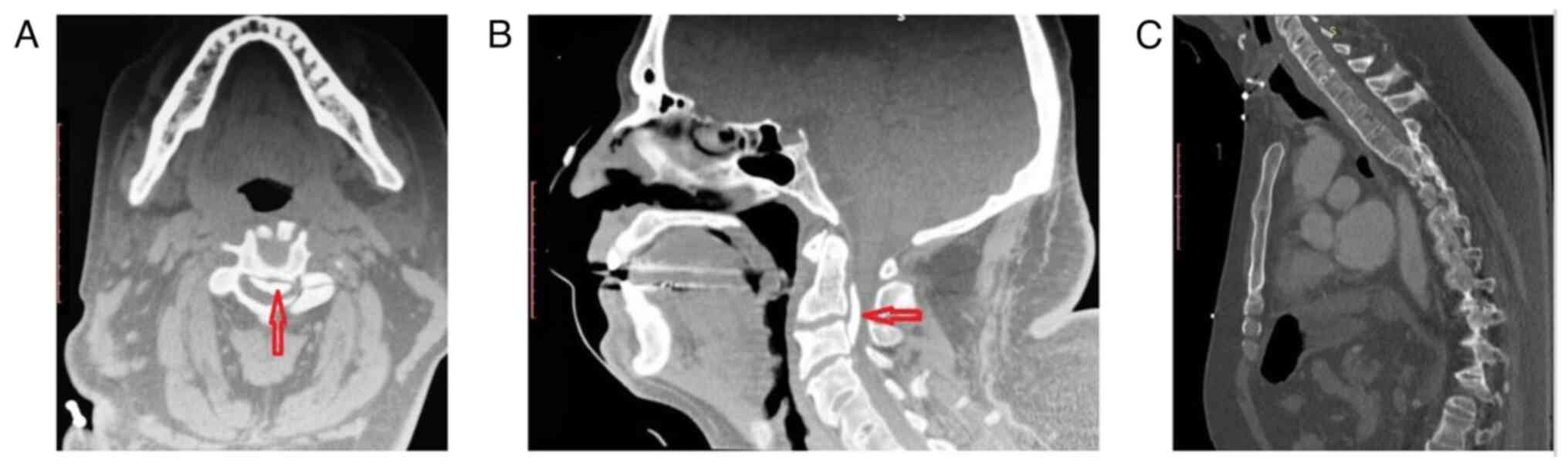
During hospitalization for a urinary tract infection, a 50-year-old obese male with ankylosing spondylitis (AS), Scheuermann's kyphosis (KS) and a body mass index of 42.4, lost consciousness and suffered a minor head injury at the occipital region. The immediate clinical examination revealed that the patient was hemodynamically stable (85 bpm and 123/85 mmHg) and febrile (39˚C) (from a urinary tract infection with pyospheres; a urine culture was positive for Escherichia. coli); he had sufficient respiration (SAO2, 97%). After 1-2 min, the patient regained consciousness but exhibit no contraction (0/5) in all key muscle groups and sensory paralysis during the neurological examination (ASIA A). A head computed tomography (CT) scan revealed no evidence of intracranial hemorrhage or other intracranial pathology and his Glasgow Coma Scale (GCS) score was 15/15. However, the CT scan of the cervical spine revealed an OPLL associated with severe spinal canal stenosis (canal diameter, 4.18 mm) and extensive anterior ankylosis (Fig. 1). After 30 min, the patient developed respiratory distress and was intubated using fiberoptic technology.

Figure 1

(A) A pre-operative CT scan of the cervical spine (sagittal view) and (B) axial view of a 50-year-old obese male with ectopic ossification of the posterior longitudinal ligament (red arrows); (C) pre-operative CT scan of the cervical and thoracic spine (axial view) illustrating ankylosing spondylitis and Scheuermann's kyphosis. CT, computed tomography.

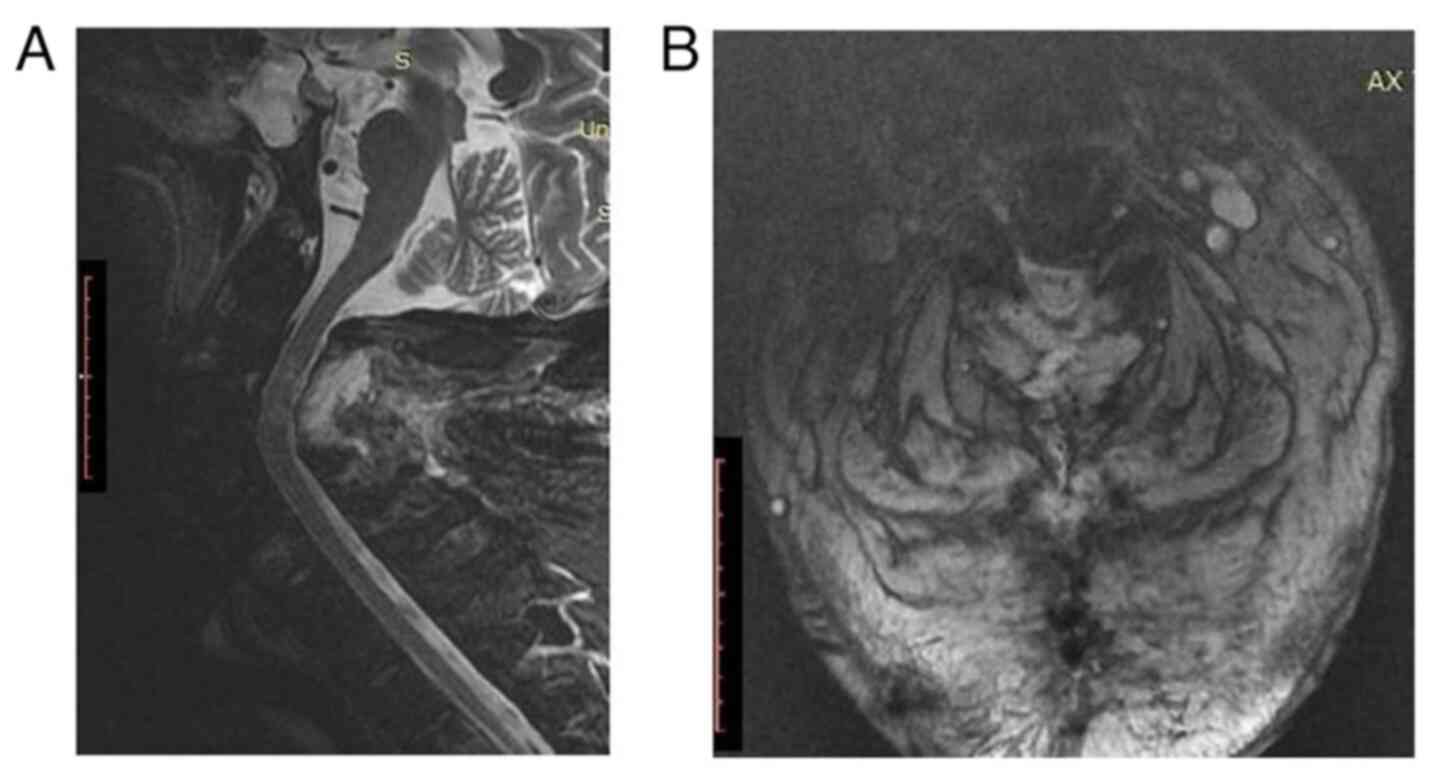
At that time, the patient was transferred to the University Hospital of Larissa (Larissa, Greece) with a cervical rigid collar. In the operating room, he underwent posterior cervical spine decompression with a laminectomy extending from C2 to C4. Following surgery, the patient was awakened and transferred to the intensive care unit for further cardiopulmonary support. The patient remained quadriplegic, with a minor improvement in the deltoid muscles (1/5). The post-operative magnetic resonance imaging scan documented the adequacy of decompression (Fig. 2). Additionally, it revealed a spinal cord with an increased signal intensity, compatible with edema. On the 6th day, the patient suffered a cardiac arrest, which he survived following half an hour of cardiopulmonary resuscitation. Moreover, a cardiac pacemaker was inserted to avoid future episodes. On the 11th day, the patient developed an acute abdomen following gastrostomy tube placement, for which he underwent an exploratory laparotomy. On the following day, the patient suffered a massive pulmonary embolism despite adequate anticoagulation and finally succumbed.

Figure 2

(A) Sagittal view and (B) axial view of a post-operative magnetic resonance imaging scan of a cervical spine documented the adequacy of decompression.

Discussion

Even though trauma to the cervical spine in patients with OPLL is common, to the best of our knowledge, this is the first reported case of an extensive osteophyte with a lethal outcome after a syncope (1,2). The most common presentation of OPLL is cervical myelopathy from the chronic narrowing of the spinal canal, followed by quadriparesis precipitated by trauma (1-4).

The association between the OPLL and syncope is not clear. Several pathogenetic mechanisms could be implicated. A vasogenic origin cannot be excluded following the compression of the anterior spinal arteries and blood stagnation in the vertebrobasilar system. It is unclear whether vertigo caused by vascular changes at the vertebrobasilar circulation causes syncope (5). Moreover, a neurogenic mechanism could be considered after an acute compression of the vagal and glossopharyngeal nuclei in the higher cervical region with parasympathetic over-discharge (5). Finally, the patient may have simply lost consciousness due to a hypotensive episode during an acute urinary tract infection or a latent arrhythmia.

In the present study, pre-operative imaging revealed an OPLL at the C1, C2, and C3 vertebral levels, corresponding to a continuous ossification based on the relevant classification pattern (1). Of note, two additional findings are worth noting, including a marked canal narrowing at the levels corresponding to the canal compromise and ankylosis of the subaxial spine compatible with AS (1,3). The co-existence of AS, KS and OPLL is infrequent, but both have been associated with human leukocyte antigen variants (1,3).

Symptomatic cases are usually treated surgically (1-3). Anterior procedures aim to remove the ossified ligament and directly decompress the spinal canal, but with a high risk of unintended durotomy (1-3). On the other hand, posterior approaches decompress the spinal canal indirectly (1,2). In the case presented herein, the posterior approach was preferred based on the level of the lesion and the curvature of the cervical spine. The K-line, a virtual line between the midpoints of the anteroposterior canal diameter at C2 and C7, fell behind the osteophyte, necessitating a posterior approach (6).

Studies have reported the association between obesity and hyperostosis situations resembling OPLL and diffuse idiopathic skeletal hyperostosis, where the mechanism of enormous cumulatively formed osteophytes remains unclear (7,8). However, the underlying mechanism may be connected with insulin-resistant states, and the surplus adipose tissue via mechanical, hormonal, and cytokine factors leads to bone upregulation (9,10).

In conclusion, OPLL is a rare disease that usually manifests with cervical myelopathy. In rare occasions, it may present with syncope and potentially lethal outcomes, particularly when precipitated by trauma. Therefore, the management of OPLL with marked canal stenosis should not be unnecessarily delayed. Further studies are required for the validation of the findings presented herein.

Acknowledgements

Not applicable.

Funding

Funding: No funding was received.

Availability of data and materials

The datasets used and/or analyzed during the current study are available from the corresponding author on reasonable request.

Authors' contributions

AGB and GF conceptualized the study. VEG, PS and NT advised on patient treatment, wrote and prepared the draft of the manuscript, and made a substantial contribution to the analysis of the patient's data. AGB and GF analyzed the patient patient's data and provided critical revisions. AGB and GF confirm the authenticity of all the raw data. All authors contributed to manuscript revision, and have read and approved the final version of the manuscript.

Ethics approval and consent to participate

Written informed consent was obtained from the patient for his participation in the present case report.

Patient consent for publication

Written informed consent was obtained from the patient for publication of the present case report and any accompanying images.

Competing interests

The authors declare that they have no competing interests.

References

1 

Matsunaga S and Sakou T: Ossification of the posterior longitudinal ligament of the cervical spine: Etiology and natural history. Spine (Phila Pa 1976). 37:E309–E314. 2012.PubMed/NCBI View Article : Google Scholar

2 

Head J, Rymarczuk G, Stricsek G, Velagapudi L, Maulucci C, Hoelscher C and Harrop J: Ossification of the posterior longitudinal ligament: Surgical approaches and associated complications. Neurospine. 16:517–529. 2019.PubMed/NCBI View Article : Google Scholar

3 

Abiola R, Rubery P and Mesfin A: Ossification of the posterior longitudinal ligament: Etiology, diagnosis, and outcomes of nonoperative and operative management. Global Spine J. 6:195–204. 2016.PubMed/NCBI View Article : Google Scholar

4 

Hirai T, Yoshii T, Ushio S, Mori K, Maki S, Katsumi K, Nagoshi N, Takeuchi K, Furuya T, Watanabe K, et al: Clinical characteristics in patients with ossification of the posterior longitudinal ligament: A prospective multi-institutional cross-sectional study. Sci Rep. 10(5532)2020.PubMed/NCBI View Article : Google Scholar

5 

Verma SK, Yaseen M, Bharadwaj V and Pasha A: Syncope: A rare presentation of Cervical spondylosis. IOSR J Dent Med Sci. 13:90–92. 2014.

6 

Ijima Y, Furuya T, Ota M, Maki S, Saito J, Kitamura M, Miyamoto T, Ohtori S, Orita S, Inage K, et al: The K-line in the cervical ossification of the posterior longitudinal ligament is different on plain radiographs and CT images. J Spine Surg. 4:403–407. 2018.PubMed/NCBI View Article : Google Scholar

7 

Wu JC, Liu L, Chen YC, Huang WC, Chen TJ and Cheng H: Ossification of the posterior longitudinal ligament in the cervical spine: An 11-year comprehensive national epidemiology study. Neurosurg Focus. 30(E5)2011.PubMed/NCBI View Article : Google Scholar

8 

Wang PN, Chen SS, Liu HC, Fuh JL, Kuo BI and Wang SJ: Ossification of the posterior longitudinal ligament of the spine. A case-control risk factor study. Spine (Phila Pa 1976). 24:142–144. 1999.PubMed/NCBI View Article : Google Scholar

9 

Inamasu J, Guiot BH and Sachs DC: Ossification of the posterior longitudinal ligament: An update on its biology, epidemiology, and natural history. Neurosurgery. 58:1027–1039. 2006.PubMed/NCBI View Article : Google Scholar

10 

Harvey AE, Lashinger LM and Hursting SD: The growing challenge of obesity and cancer: An inflammatory issue. Ann N Y Acad Sci. 1229:45–52. 2011.PubMed/NCBI View Article : Google Scholar

Related Articles

  • Abstract
  • View
  • Download
Copy and paste a formatted citation
Spandidos Publications style
Fotakopoulos G, Georgakopoulou VE, Trakas N, Sklapani P and Brotis AG: Malignant character of an ossified posterior longitudinal ligament in a hyperflexion injury: A case report. Med Int 4: 48, 2024.
APA
Fotakopoulos, G., Georgakopoulou, V.E., Trakas, N., Sklapani, P., & Brotis, A.G. (2024). Malignant character of an ossified posterior longitudinal ligament in a hyperflexion injury: A case report. Medicine International, 4, 48. https://doi.org/10.3892/mi.2024.172
MLA
Fotakopoulos, G., Georgakopoulou, V. E., Trakas, N., Sklapani, P., Brotis, A. G."Malignant character of an ossified posterior longitudinal ligament in a hyperflexion injury: A case report". Medicine International 4.5 (2024): 48.
Chicago
Fotakopoulos, G., Georgakopoulou, V. E., Trakas, N., Sklapani, P., Brotis, A. G."Malignant character of an ossified posterior longitudinal ligament in a hyperflexion injury: A case report". Medicine International 4, no. 5 (2024): 48. https://doi.org/10.3892/mi.2024.172
Copy and paste a formatted citation
x
Spandidos Publications style
Fotakopoulos G, Georgakopoulou VE, Trakas N, Sklapani P and Brotis AG: Malignant character of an ossified posterior longitudinal ligament in a hyperflexion injury: A case report. Med Int 4: 48, 2024.
APA
Fotakopoulos, G., Georgakopoulou, V.E., Trakas, N., Sklapani, P., & Brotis, A.G. (2024). Malignant character of an ossified posterior longitudinal ligament in a hyperflexion injury: A case report. Medicine International, 4, 48. https://doi.org/10.3892/mi.2024.172
MLA
Fotakopoulos, G., Georgakopoulou, V. E., Trakas, N., Sklapani, P., Brotis, A. G."Malignant character of an ossified posterior longitudinal ligament in a hyperflexion injury: A case report". Medicine International 4.5 (2024): 48.
Chicago
Fotakopoulos, G., Georgakopoulou, V. E., Trakas, N., Sklapani, P., Brotis, A. G."Malignant character of an ossified posterior longitudinal ligament in a hyperflexion injury: A case report". Medicine International 4, no. 5 (2024): 48. https://doi.org/10.3892/mi.2024.172
Follow us
  • Twitter
  • LinkedIn
  • Facebook
About
  • Spandidos Publications
  • Careers
  • Cookie Policy
  • Privacy Policy
How can we help?
  • Help
  • Live Chat
  • Contact
  • Email to our Support Team