Introduction
Breast cancer is one of the most common female
malignancies. Despite the use of a wide range of adjuvant treatment
options, including radiotherapy, conventional chemotherapy with
cytotoxic antitumor agents alone or in combination with endocrine
therapy, bisphosphonates and HER-2/neu-directed therapy, over
400,000 females are predicted to succumb to breast cancer worldwide
each year (1). Thus, new
therapeutic strategies for breast cancer should be identified where
viable treatment options are not successful.
A defect in the immune response may contribute to
tumor growth. T-cell co-stimulation is essential for the initiation
of an immune response. Lack of expression of CD80 and CD86 on tumor
cells is considered to be one reason for immune evasion (2,3).
However, inhibitory co-stimulatory factors may be involved in the
pathogenesis by inducing T-cell anergy in two ways: inducing
inhibitory cofactor expression in effector immune cells or
expression of ligands of inhibitory cofactors on tumor cells.
Blocking the interaction of inhibitory cofactors is a new strategy
in tumor therapy. Therefore, manipulation of inhibitory
costimulatory molecules may be critical for the control of an
immune response.
The B7 protein family provides stimulatory and
inhibitory regulation of T-cell responses, depending on which B7
ligand or receptor is engaged on the target (4,5).
B7-H3 is a previously identified member of the B7 family. It was
initially identified as a co-stimulatory molecule. However, studies
suggest a role of B7-H3 in the inhibition of T-cell response
(6–8). Ling et al(8) demonstrated that immunoglobulin-V-like
and immunoglobulin-C-like (VC) and VCVC forms of human B7-H3
inhibited CD4+ T-cell proliferation and downregulated
cytokine production upon TCR activation in vitro. Using
B7-H3-deficient mice, Prasad et al(6) demonstrated an enhanced lung
inflammatory infiltration by macrophages and lymphocytes. B7-H3
mRNA, but not protein expression, was detected in a wide range of
normal somatic tissues (9,10). However, expression of the cell
surface B7-H3 may be induced on monocytes and dentritic cells (DCs)
by interferon-γ (9).
B7-H3 protein has modest biological activities
associated with T-lymphocyte proliferation and enhanced
interleukin-10 (IL-10) secretion (11). IL-10 is a multifunctional cytokine
and has marked immunosuppressive effects (12,13).
In breast cancer patients, IL-10 has been reported to be
overexpressed in sentinel lymph nodes of breast cancer and
associated with specific tumor markers of poor prognosis (14,15).
However, it is currently unclear whether IL-10 production by tumor
cells is relevant to the tumor-associated B7-H3 expression.
To gain insight into the mechanism of breast cancer
progression, this study examined the expression of B7-H3 and IL-10
in ductal and lobular breast cancer specimens. The association
between B7-H3 or IL-10 expression and clinicopathological
characteristics was then analyzed. To explore the possible
mechanism underlying this association, the correlation between
B7-H3 and IL-10 in tumor cells was also investigated.
Materials and methods
Patient characteristics
Tumor specimens were obtained from 117 patients with
primary breast cancer who underwent surgery at the Clinical
Hospital of Shandong University (Shandong, China) between 2008 and
2010. The mean age of patients at the time of diagnosis was 51
years (range, 21–77). There were 97 invasive ductal and 20 lobular
carcinomas. Patients were classified as American Joint Committee on
Cancer pathological stage I (33 cases), stage II (52 cases) or
stage III (32 cases). All patients provided written informed
consent for the use of specimens and the study was approved by the
Institutional Review Board.
Information on estrogen receptor (ER), progesterone
receptor (PR) and human epidermal growth factor receptor 2
(HER-2/neu) status was collected from original surgical
pathological reports and records of surgery, in-patient medical
records, chest X-ray films, whole-body computed tomography (CT)
films and bone scanning films were also reviewed.
Immunohistochemistry
Immunohistochemical staining was performed using the
biotin-streptavidin-peroxidase method with a Vectastain ABC kit
(Vector Laboratories Inc., Burlingame, CA, USA). Resected tissue
specimens were fixed in formalin, embedded in paraffin, cut into
4-μm serial sections and then mounted on glass slides. Slides were
deparaffinized with xylene and dehydrated in graded alcohol.
Following this procedure, the antigen was retrieved through heating
in a microwave for 2 min at 900 W and the antigen was incubated
with 0.3% H2O2 solution in methanol for 30
min to block endogenous peroxidase. Slides were then washed three
times with PBS and incubated in 10% normal horse serum to block
nonspecific background staining. Sections were incubated with the
primary antibodies in a humid chamber at 4°C overnight. Mouse
anti-B7-H3 (diluted 1:60; R&D Systems, Minneapolis, MN, USA)
and anti-IL-10 (diluted 1:100; BiosPacific, Emeryville, CA, USA)
were used as primary antibodies. Following additional washing with
PBS, sections were incubated with biotinylated-horse anti-mouse
antibodies for 30 min, washed three times with PBS and then
incubated with streptavidin-conjugated peroxidase for 30 min.
Sections were visualized by incubation with 3,3′-diaminobenzidine
solution (0.3% hydrogen peroxide and 0.05% 3,3′-diaminobenzidine)
and counterstained with hematoxylin. Negative controls were carried
out by substituting a normal mouse IgG for the primary
antibody.
B7-H3 and IL-10 expression
Histological analysis was performed simultaneously
by two investigators using a double-headed light microscope without
knowledge of the patients' clinical records. B7-H3 or IL-10
expression was defined as the percentage of tumor cells exhibiting
immunoreactivity in the cytoplasm or on the cell membrane and
calculated by counting the number of B7-H3- or IL-10-stained tumor
cells among 1,000 tumor cells in each section. Cell counts were
performed at ×400 magnification, in at least 5 fields, in randomly
selected tumor areas. The intensity of the positive cells for B7-H3
and IL-10 was also graded semiquantitatively according to the
positive cell percentage: 0, expression <10%; +, 10–40%; ++,
40–80%; +++, >80%. Specimens were classified into two groups
based on the staining intensity consisting of a negative group
(expression <10%) and a positive group (expression 10–100%).
Statistical analysis
Correlation between the expression of B7-H3 or IL-10
and clinicopathological variables was analyzed using Fisher's exact
or the χ2 test, where appropriate. Spearman correlation
coefficient was used to determine the association between B7-H3 and
IL-10 expression. P<0.05 was considered to indicate a
statistically significant difference. Statistical analyses were
performed using SPSS 16.0 (IBM).
Results
B7-H3 and IL-10 expression in ductal and
lobular breast cancer tissue
B7-H3 was expressed in 106 of 117 specimens and
IL-10 was expressed in 94 of 117 specimens (90.60% and 80.34%,
respectively). In the majority of cases the expression pattern of
B7-H3 and IL-10 in tumor cells appeared to be extremely diffuse
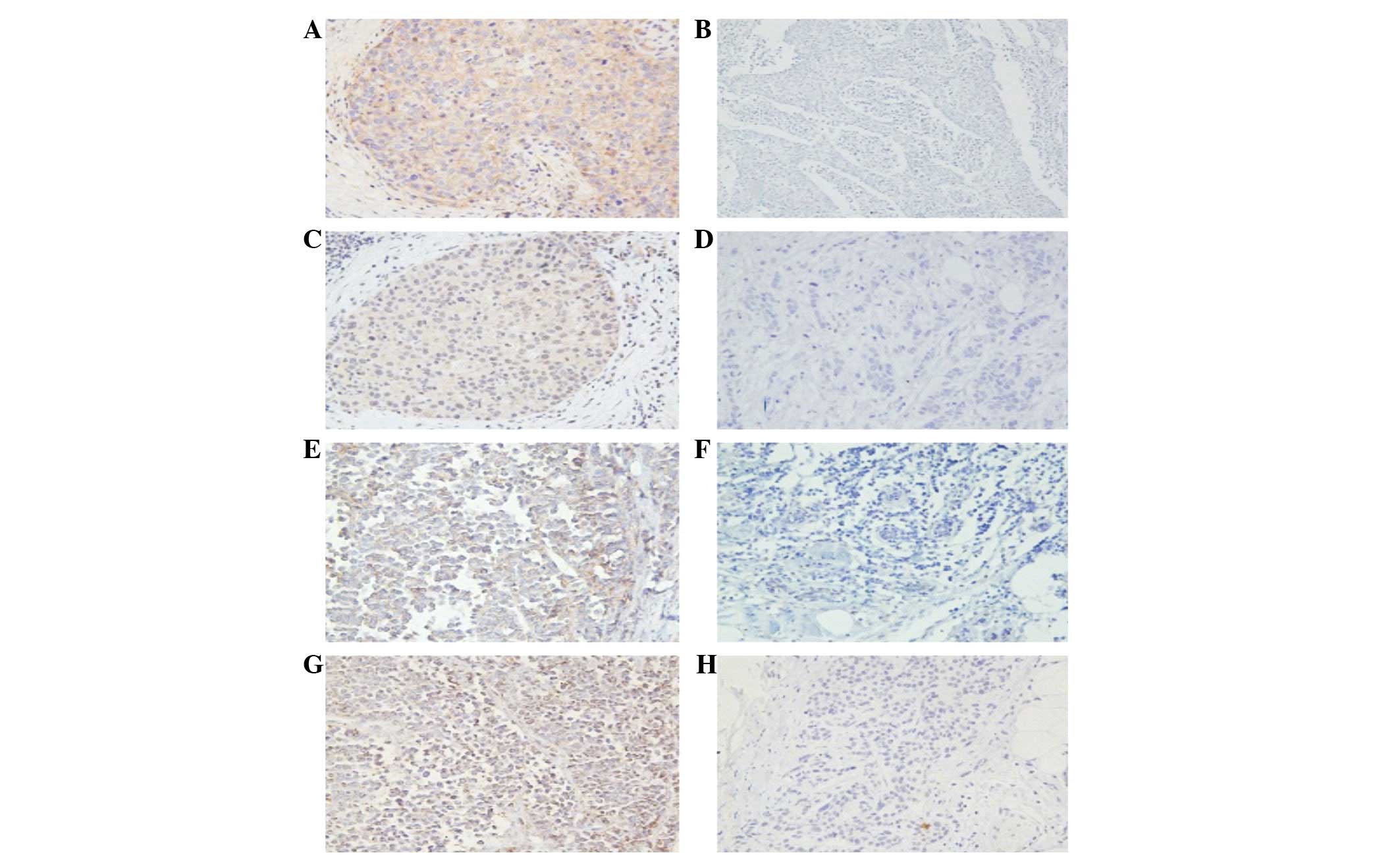
throughout the section. Microscopically, B7-H3 and IL-10 were
identified in the tumor cell membrane, cytoplasm, or both (Fig. 1A, C, E and G). Expression of IL-10
was also observed in infiltrating lymphoid cells, while little
staining of B7-H3 was identified in the stromal cells. Distribution
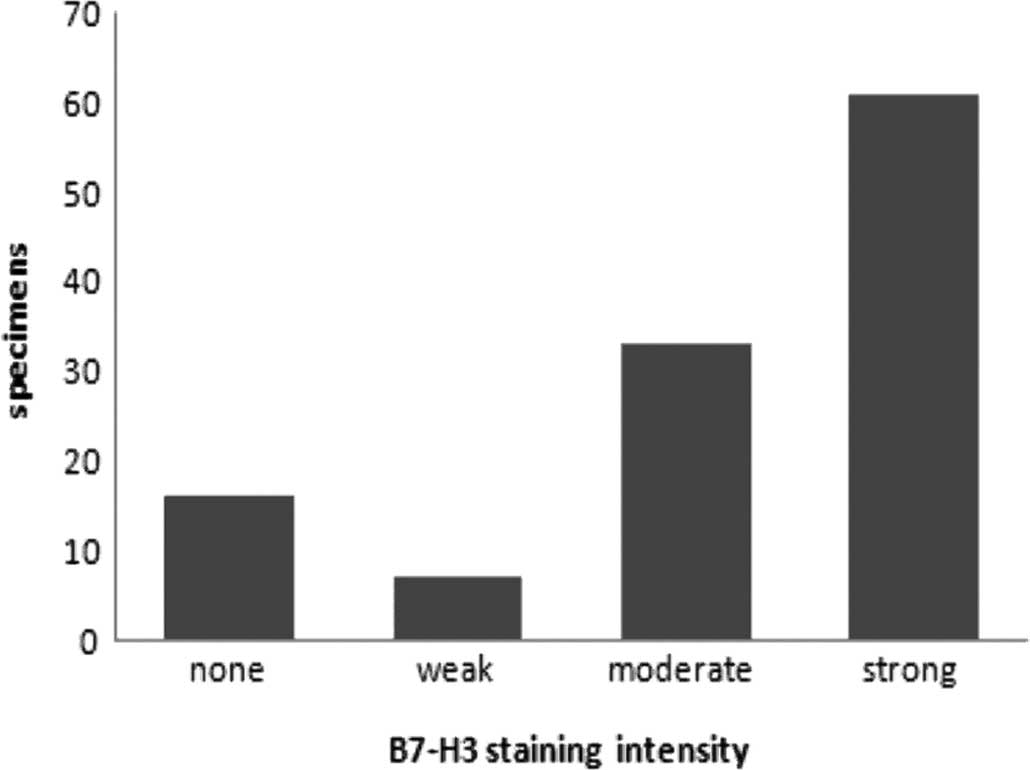
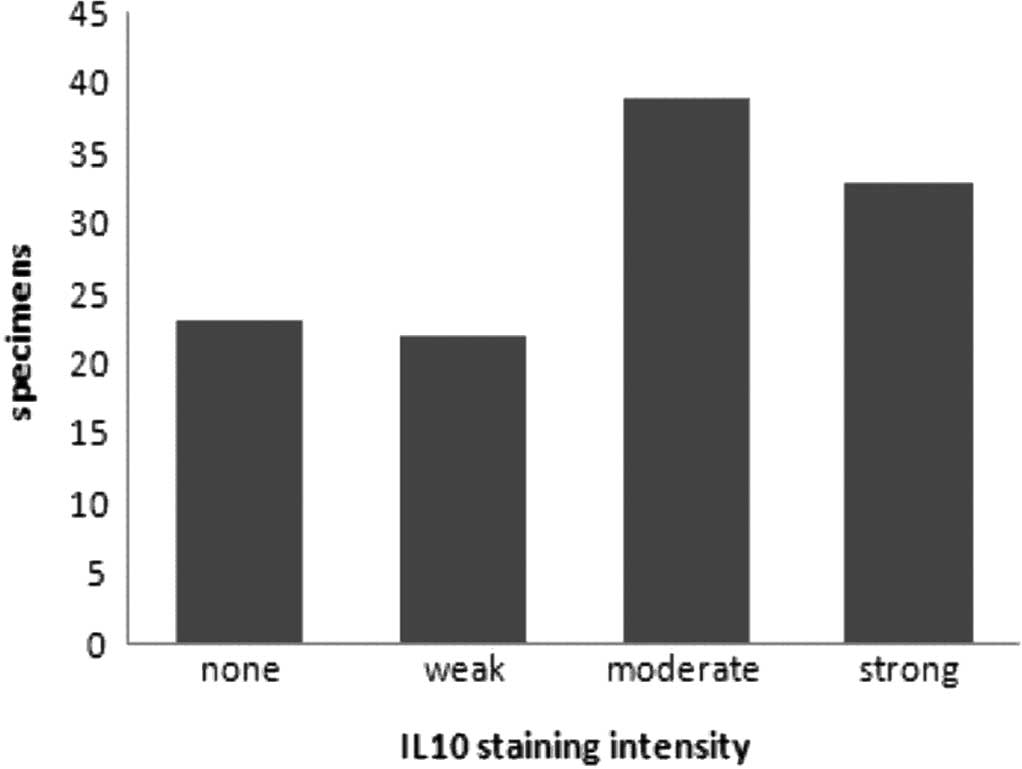
of the B7-H3 and IL-10 staining intensity in all specimens is
demonstrated in Figs. 2 and
3.
Correlation between B7-H3 or IL-10
expression and clinicopathological factor
Table I shows a
comparison of the clinical pathological factors with B7-H3 or IL-10
positive and negative expression groups. Patients with positive
B7-H3 or high IL-10 expression (focal expression of the staining
≥40%) were more likely to have lymph node metastasis (P=0.018 for
B7-H3 and P=0.035 for IL-10) and advanced disease (stage II–IV;
P=0.011 for B7-H3 and P=0.039 for IL-10) compared to those with
negative B7-H3 or low IL-10 expression (focal expression of the
staining <40%). IL-10 expression was higher in larger tumors
(>2 cm) and HER-2/neu-positive groups, but did not approach
significance. No significant correlation was identified between
age, histological types, differentiation, ER or PR status and the
expression of B7-H3 or IL-10.
 | Table ICorrelation between B7-H3 or IL-10
expression in tumor cells and clinicopathological factors. |
Table I
Correlation between B7-H3 or IL-10
expression in tumor cells and clinicopathological factors.
| | B7-H3 expression | | IL-10 expression | |
|---|
| |
| |
| |
|---|
| Clinicopathological
factors | No. | Positive | Negative | P-value | Positive | Negative | P-value |
|---|
| Age (years) |
| ≤50 | 63 | 56 | 7 | 0.543 | 34 | 29 | 0.854 |
| >50 | 54 | 50 | 4 | | 28 | 26 | |
| Histological cancer
types |
| Ductal | 97 | 89 | 8 | 0.397 | 53 | 44 | 0.432 |
| Lobular | 20 | 17 | 3 | | 9 | 11 | |
| Differentiation |
| Well | 22 | 19 | 3 | 0.431 | 10 | 12 | 0.483 |
| Moderate and
poorly | 95 | 87 | 8 | | 52 | 43 | |
| Tumor size (cm) |
| ≤2 | 50 | 42 | 8 | 0.053 | 21 | 29 | 0.061 |
| >2 | 67 | 64 | 3 | | 41 | 26 | |
| Lymph nodes |
| N0 | 43 | 35 | 8 | 0.018a | 17 | 26 | 0.035a |
| N1-3 | 74 | 71 | 3 | | 45 | 29 | |
| Pathological
stage |
| I | 33 | 26 | 7 | 0.011a | 12 | 21 | 0.039a |
| II–III | 84 | 80 | 4 | | 50 | 34 | |
| Biological
markers |
| ER |
| Positive | 82 | 73 | 9 | 0.502 | 40 | 42 | 0.225 |
| Negative | 35 | 33 | 2 | | 22 | 13 | |
| PR |
| Positive | 78 | 69 | 9 | 0.332 | 38 | 40 | 0.239 |
| Negative | 39 | 37 | 2 | | 24 | 15 | |
| HER-2/neu |
| Positive | 30 | 25 | 5 | 0.147 | 11 | 19 | 0.055 |
| Negative | 87 | 81 | 6 | | 51 | 36 | |
Correlation between the expression of
B7-H3 and IL-10
To explore the possible mechanism underlying the
association between B7-H3 and tumor progression, we analyzed
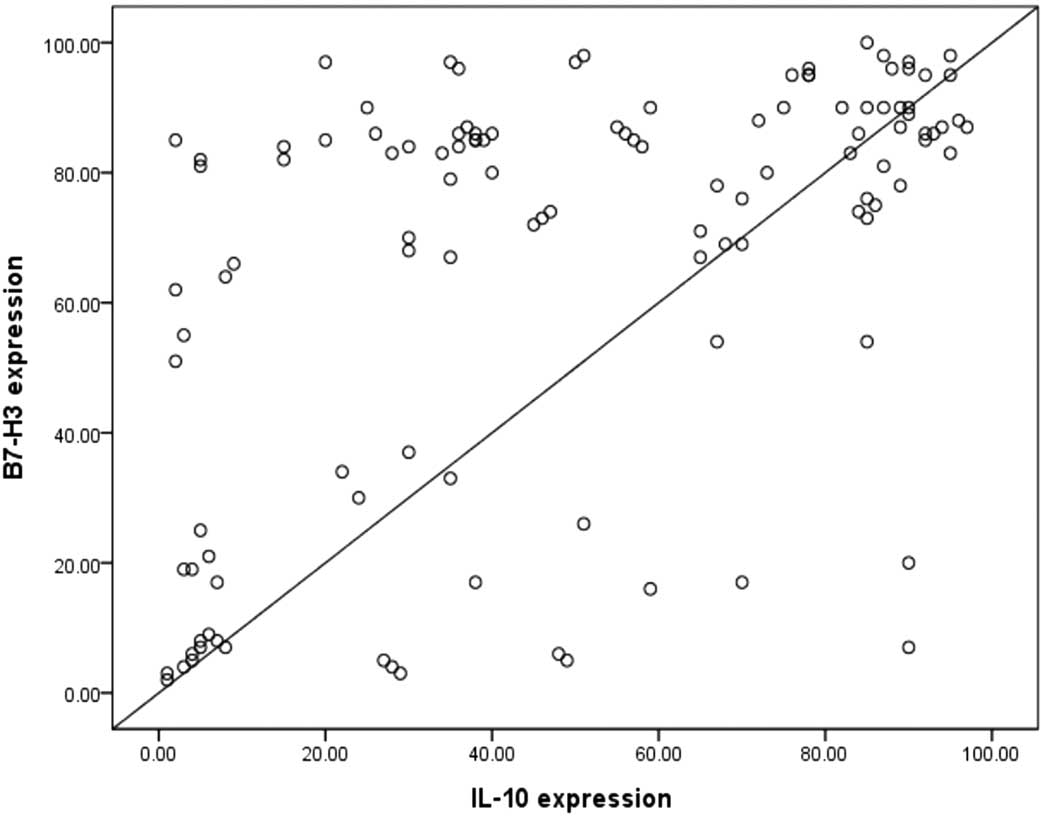
whether B7-H3 expression was correlated with IL-10 levels. The
results indicated a positive correlation between B7-H3 and IL-10
expression (R=0.545, P=0.000) (Fig.
4).
Discussion
Numerous therapeutic modalities are available for
adjuvant treatment of advanced breast cancer, including
radiotherapy, conventional chemotherapy with cytotoxic antitumor
agents, hormone therapy and signal-transduction inhibitors
(16). However, a number of
patients respond poorly to existing therapeutic modalities. Thus,
new molecular targets are required for the development of novel
therapeutic strategies for the treatment of breast cancer.
B7-H3 is a transmembrane glycoprotein and a member
of the B7 family of proteins, previously known as an
immunoregulatory molecule, demonstrated to be inducible in
macrophages and DCs (6). More
recently, it was identified to be of clinical significance in
various types of cancer. In certain tumor types, high expression of
B7-H3 has been linked to poor prognosis (17–19),
whereas in other cancer types the opposite effect has been observed
(20,21). IL-10 is a pleiotropic cytokine
produced by Th2 cells. Several studies have indicated that IL-10 is
present in the tumor site and suggest that it mediates
immunosuppression (13). A
significant correlation between the expression of IL-10 and
specific poor prognostic factors in human breast carcinomas has
been observed (14,15). The present study has examined B7-H3
and IL-10 expression in ductal and lobular breast cancer tissues.
Immunohistochemical staining of B7-H3 and IL-10 in tumor cells
revealed elevated cell surface and cytoplasmic staining. Our
results have demonstrated that B7-H3 and IL-10 expression in breast
cancer was associated with important prognostic factors associated
with lymph node metastasis and tumor stage. B7-H3 expression was
correlated with IL-10 in the tumor cells, which may be responsible
for the clinical significance of B7-H3 expression.
The mechanism accounting for the expression of B7-H3
in tumor cells remains unknown. However, expression of other
inhibitory costimulatory factors has previously been described in
various tumor cells. For example, a high expression of B7-H1, B7-H4
and ILT4 has been documented in certain malignant carcinomas
(17,22,23).
A common mechanism may exist in regulating the
overexpression of the inhibitory factors in tumor cells. Studies
have indicated that expression of some inhibitory costimulatory
factors in tumor-related macrophages and DCs are upregulated by
environmental IL-10 of cancer (24,25).
These observations suggest that the cytokine microenvironment
induces expression of those inhibitors in tumor environmental
cells. Expression of B7-H3 and IL-10 on breast cancer cells in the
present study expands the information on immune inhibition.
The role of B7-H3 expression in malignant
transformation or tumor progression has not been determined. B7
family members and their receptors are known to regulate
antigen-specific immune response through inhibition of T-cell
activation, cytokine secretion and the development of cytotoxicity
(4–6). Extensive laboratory and
histopathological data indicate that T-cell immune reactivity is a
favorable prognostic indicator in non-metastatic breast cancer and
the suppression of cell-mediated immunity may be critically
involved in breast cancer progress (12–14).
B7-H3 protein has modest biological activities associated with the
proliferation of T lymphocytes and enhanced IL-10 secretion
(11). Expression of IL-10 in
tumors has been associated with immunosuppression of a Th1 response
and increased tumorigenicity (15). In addition, animals receiving
xenotransplants of B16 melanoma cells demonstrate increased tumor
growth following intralesional injection of IL-10 (26). These immunosuppressions may allow
tumor cells to lodge and facilitate the growth of metastasis. Thus,
it is likely that tumor B7-H3 contributes to breast carcinoma
aggressiveness by promoting excessive IL-10 secretion, leading to a
strong immunosuppressive effect.
In summary, our findings suggest for the first time
that B7-H3 expression is correlated with IL-10 in tumor cells. This
suggests a new mechanism by which breast carcinoma escapes immune
defenses. Recognition of this new mechanism of tumor evasion is
likely to necessitate a new approach to the design of B7-H3-based
immunotherapy.
Acknowledgements
This study was partially sponsored by the Department
of Science and Technology of Shandong Province.
References
|
1
|
Glass AG, Lacey JV, Carreon JD and Hoover
RN: Breast cancer incidence, 1980–2006: combined roles of
menopausal hormone therapy, screening mammography, and estrogen
receptor status. J Natl Cancer Inst. 99:1152–1161. 2007.
|
|
2
|
Tirapu I, Huarte E, Guiducci C, et al: Low
surface expression of B7-1 (CD80) is an immunoescape mechanism of
colon carcinoma. Cancer Res. 66:2442–2450. 2006. View Article : Google Scholar : PubMed/NCBI
|
|
3
|
Ugurel S, Uhlig D, Pföhler C, Tilgen W,
Schadendorf D and Reinhold U: Down-regulation of HLA class II and
costimulatory CD86/B7-2 on circulating monocytes from melanoma
patients. Cancer Immunol Immunother. 53:551–559. 2004. View Article : Google Scholar : PubMed/NCBI
|
|
4
|
Carreno BM and Collins M: The B7 family of
ligands and its receptors: new pathways for costimulation and
inhibition of immune responses. Annu Rev Immunol. 20:29–53. 2002.
View Article : Google Scholar : PubMed/NCBI
|
|
5
|
Khoury SJ and Sayegh MH: The roles of the
new negative T cell costimulatory pathways in regulating
autoimmunity. Immunity. 20:529–538. 2004. View Article : Google Scholar : PubMed/NCBI
|
|
6
|
Prasad DV, Nguyen T, Li Z, Yang Y, Duong
J, Wang Y and Dong C: Murine B7-H3 is a negative regulator of T
cells. J Immunol. 173:2500–2506. 2004. View Article : Google Scholar : PubMed/NCBI
|
|
7
|
Suh WK, Gajewska BU, Okada H, et al: The
B7 family member B7-H3 preferentially down-regulates T helper type
1-mediated immune responses. Nat Immunol. 4:899–906. 2003.
View Article : Google Scholar : PubMed/NCBI
|
|
8
|
Ling V, Wu PW, Spaulding V, Kieleczawa J,
Luxenberg D, Carreno BM and Collins M: Duplication of primate and
rodent B7-H3 immunoglobulin V- and C-like domains: divergent
history of functional redundancy and exon loss. Genomics.
82:365–377. 2003. View Article : Google Scholar : PubMed/NCBI
|
|
9
|
Chapoval AI, Ni J, Lau JS, Wilcox RA,
Flies DB, Liu D, Dong H, Sica GL, Zhu G, Tamada K and Chen L:
B7-H3: a costimulatory molecule for T cell activation and IFN-gamma
production. Nat Immunol. 2:269–274. 2001. View Article : Google Scholar : PubMed/NCBI
|
|
10
|
Greenwald RJ, Freeman GJ and Sharpe AH:
The B7 family revisited. Annu Rev Immunol. 23:515–548. 2005.
View Article : Google Scholar : PubMed/NCBI
|
|
11
|
Zhang GB, Chen YJ, Shi Q, Ma HB, Ge Y,
Wang Q, Jiang Z, Xu Y and Zhang XG: Human recombinant B7-H3
expressed in E. coli enhances T lymphocyte proliferation and
IL-10 secretion in vitro. Acta Biochim Biophys Sin (Shanghai).
36:430–436. 2004.PubMed/NCBI
|
|
12
|
Moore KW, de Waal Malefyt R, Coffman RL
and O'Garra A: Interleukin-10 and the interleukin-10 receptor. Annu
Rev Immunol. 19:683–765. 2001. View Article : Google Scholar : PubMed/NCBI
|
|
13
|
Akdis CA and Blaser K: Mechanisms of
interleukin-10-mediated immune suppression. Immunology.
103:131–136. 2001. View Article : Google Scholar : PubMed/NCBI
|
|
14
|
Woo SU, Bae JW, Yang JH, Kim JH, Nam SJ
and Shin YK: Overexpression of interleukin-10 in sentinel lymph
node with breast cancer. Ann Surg Oncol. 14:3268–3273. 2007.
View Article : Google Scholar : PubMed/NCBI
|
|
15
|
Llanes-Fernández L, Alvarez-Goyanes RI,
Arango-Prado Mdel C, et al: Relationship between IL-10 and tumor
markers in breast cancer patients. Breast. 15:482–489.
2006.PubMed/NCBI
|
|
16
|
Smith IE: New drugs for breast cancer.
Lancet. 360:790–792. 2002. View Article : Google Scholar : PubMed/NCBI
|
|
17
|
Sun Y, Wang Y, Zhao J, Gu M, Giscombe R,
Lefvert AK and Wang X: B7-H3 and B7-H4 expression in non-small-cell
lung cancer. Lung Cancer. 53:143–151. 2006. View Article : Google Scholar : PubMed/NCBI
|
|
18
|
Crispen PL, Sheinin Y, Roth TJ, et al:
Tumor cell and tumor vasculature expression of B7-H3 predict
survival in clear cell renal cell carcinoma. Clin Cancer Res.
14:5150–5157. 2008. View Article : Google Scholar : PubMed/NCBI
|
|
19
|
Sun J, Chen LJ, Zhang GB, Jiang JT, Zhu M,
Tan Y, Wang HT, Lu BF and Zhang XG: Clinical significance and
regulation of the costimulatory molecule B7-H3 in human colorectal
carcinoma. Cancer Immunol Immunother. 59:1163–1171. 2010.
View Article : Google Scholar : PubMed/NCBI
|
|
20
|
Loos M, Hedderich DM, Ottenhausen M, Giese
NA, Laschinger M, Esposito I, Kleeff J and Friess H: Expression of
the costimulatory molecule B7-H3 is associated with prolonged
survival in human pancreatic cancer. BMC Cancer. 9:4632009.
View Article : Google Scholar : PubMed/NCBI
|
|
21
|
Wu CP, Jiang JT, Tan M, Zhu YB, Ji M, Xu
KF, Zhao JM, Zhang GB and Zhang XG: Relationship between
co-stimulatory molecule B7-H3 expression and gastric carcinoma
histology and prognosis. World J Gastroenterol. 12:457–459.
2006.PubMed/NCBI
|
|
22
|
Ohigashi Y, Sho M, Yamada Y, et al:
Clinical significance of programmed death-1 ligand-1 and programmed
death-1 ligand-2 expression in human esophageal cancer. Clin Cancer
Res. 11:2947–2953. 2005. View Article : Google Scholar : PubMed/NCBI
|
|
23
|
Sun Y, Liu J, Gao P, Wang Y and Liu C:
Expression of Ig-like transcript 4 inhibitory receptor in human
non-small cell lung cancer. Chest. 134:783–788. 2008. View Article : Google Scholar : PubMed/NCBI
|
|
24
|
Kryczek I, Wei S, Zhu G, Myers L, Mottram
P, Cheng P, Chen L, Coukos G and Zou W: Relationship between B7-H4,
regulatory T cells, and patient outcome in human ovarian carcinoma.
Cancer Res. 67:8900–8905. 2007. View Article : Google Scholar : PubMed/NCBI
|
|
25
|
Kryczek I, Zou L, Rodriguez P, et al:
B7-H4 expression identifies a novel suppressive macrophage
population in human ovarian carcinoma. J Exp Med. 203:871–881.
2006. View Article : Google Scholar : PubMed/NCBI
|
|
26
|
García-Hernández ML, Hernández-Pando R,
Gariglio P and Berumen J: Interleukin-10 promotes B16-melanoma
growth by inhibition of macrophage functions and induction of
tumour and vascular cell proliferation. Immunology. 105:231–243.
2002.PubMed/NCBI
|