Introduction
Successful heart preservation is essential for
clinical heart transplantation. Previous studies have shown that
heat shock protein 70 (HSP70) induced by gene transfection can
protect the mechanical and endothelial function of the donor heart
against ischemia-reperfusion injury (1,2).
However, gene transfection is a relatively complex method for
clinical practice, especially in developing countries. Therefore,
finding a practical and cost-effective method to using HSP70 to
protect donor hearts is crucial.
Studies have shown that HSP70 can be induced by heat
stress (3). Heat stress is much
easier to achieve clinically than gene transfection. Therefore, we
investigated whether heat stress-induced HSP70 protects donor
hearts by measuring the enzyme levels in recipients’ blood and
examining the transplanted hearts for pathological changes.
Materials and methods
Animals
Sixty male Wistar rats (weight, 200–250 g) were
purchased from the Experimental Animal Center of the 2nd Affiliated
Hospital of Harbin Medical University and cared for in compliance
with the Guide for the Care and Use of Laboratory Animals published
by the National Institutes of Health.
Heat stress procedure and animal
grouping
The donor rats were subjected to hyperthermia in an
incubator for 15 min, while the rectal temperature (at 42±0.5°C)
was monitored. Subsequently, the animals were transferred to a room
temperature (24°C) environment and were randomly divided into the
following groups (n=10 per group): control group (donor hearts
transplanted without heat stress) and experimental groups (0-, 24-,
48-, 96- and 192-h groups), according to the time points of
examination after heat stress.
Heterotopic heart transplantation
Heterotopic abdominal heart transplantation was
performed using improved microsurgical techniques (4). In brief, rats were anesthetized by
intraperitoneal administration of ketamine (75 mg/kg), and
dexmedetomidine (0.25 mg/kg). The donor hearts were transplanted
into the recipients by end-to-side anastomoses of the aorta and the
pulmonary artery to the abdominal aorta and inferior vena cava,
respectively, using 8-0 monofilament sutures. During surgery the
heart was wrapped in gauze and kept cold by the use of topical
ice-cold saline solution. After the operation, the rats recovered
with oxygen in a warm environment. Viability of the grafts was
verified by palpation of the beating transplanted heart.
Specimen collection
The donor hearts and receptor blood were collected
24 h after transplantation.
Detection of HSP70
HSP70 levels of donor hearts were measured by using
the enzyme-linked immunosorbent assay (ELISA) Kit of R&D
Systems (DYC1663E, Minneapolis, MN, USA). The optical density was
measured at λ=490 nm (reference at λ=620 nm). The detection range
of the assay was 0.05–2000 ng/ml, the intra/inter-assay variability
<10/<16%, respectively.
Detection of lactate dehydrogenase (LDH)
and creatine kinase muscle band (CK-MB)
Receptor blood samples with heparin were centrifuged
to obtain a serum to detect the leakage of LDH and CK-MB using
enzyme kits (Human UV test, Hamburg, Germany).
Detection of adenosine atriphosphate
(ATP) and malondialdehyde (MDA)
Two separate samples from each donor heart were
removed for myocardial ATP and MDA determinations. The tissue ATP
content was determined using an enzymatic spectrophotometric kit
(Sigma, St. Louis, MO, USA) after the tissue was homogenized in
perchloric acid (60% w/v) and K2CO3 solution
was added for neutralization. In this way, we determined the
decrease in absorbency at 340 nm resulting from the oxidization of
NADH to NAD. Tissue ATP levels were expressed as mmol/g wet tissue.
Tissue homogenates were prepared for MDA analyses in a ratio of 1 g
wet tissue to 9 mmol KCl using Heidolph RZR 2021 equipment. The MDA
content in the homogenate was determined by using a calorimetric
reaction with thiobarbituric acid as described by Buege and Aust
(5). The tissue MDA levels were
expressed as nmol/g wet tissue.
Statistical analysis
Values were presented as the mean ± SEM. Statistical
comparison was carried out by variance analysis and an unpaired
Student’s t-test, using the statistical packages SPSS 18.0 and R
2.10.1. P<0.05 was considered to indicate a statistically
significant difference.
Results
Detection of HSP70 expression level in
donor hearts by ELISA
HSP70 expression was the highest in the 24-h group
(p≤0.01) and decreased gradually in the 48- and 96-h groups. There
was no statistically significant difference in HSP70 expression in
the control, 0- and 192-h groups (p≥0.05; Table I).
 | Table IHSP70 expression level in donor
heart. |
Table I
HSP70 expression level in donor
heart.
| Groups (n=10) | HSP70 expression
(ng/ml) |
|---|
| Control | 36.18±12.15 |
| 0 h | 38.31±13.11 |
| 24 h | 116.86±16.67b |
| 48 h | 90.11±12.56b |
| 96 h | 52.02±11.60a |
| 192 h | 41.26±10.11 |
Cardiac enzyme concentration in receptor
blood and donor heart tissue
The 24-h group, which had the highest HSP70
expression, had the lowest LDH and CK-MB concentrations in receptor
blood of all the groups. This group also showed the lowest MDA
concentrations and the highest ATP concentrations in the
transplanted hearts (p≤0.01). There was no statistically
significant difference in the concentrations of cardiac enzymes in
the control, 0- and 192-h groups (p≥0.05; Table II).
| Table IIMyocardial enzyme concentrations in
receptor blood (LDH and CK-MB) and donor heart (ATP and MDA) after
transplantation in each group. |
Table II
Myocardial enzyme concentrations in
receptor blood (LDH and CK-MB) and donor heart (ATP and MDA) after
transplantation in each group.
| Groups | LDH (U/l) | CK-MB (U/l) | ATP (mmol/g) | MDA (nmol/g) |
|---|
| Control | 89.68±6.07 | 158.62±12.35 | 4.68±0.85 | 12.86±0.41 |
| 0 h | 86.32±5.72 | 148.96±11.78 | 4.82±0.93 | 12.79±0.37 |
| 24 h | 39.17±2.49 | 60.27±4.96 | 12.78±1.87 | 7.16±0.19 |
| 48 h | 51.97±2.56 | 98.52±4.21 | 9.09±2.14 | 9.14±0.17 |
| 96 h | 76.08±4.83 | 127.83±9.76 | 5.79±1.24 | 11.37±0.27 |
| 192 h | 87.54±5.87 | 152.78±10.65 | 4.57±0.75 | 12.76±0.34 |
Pathological changes in donor hearts
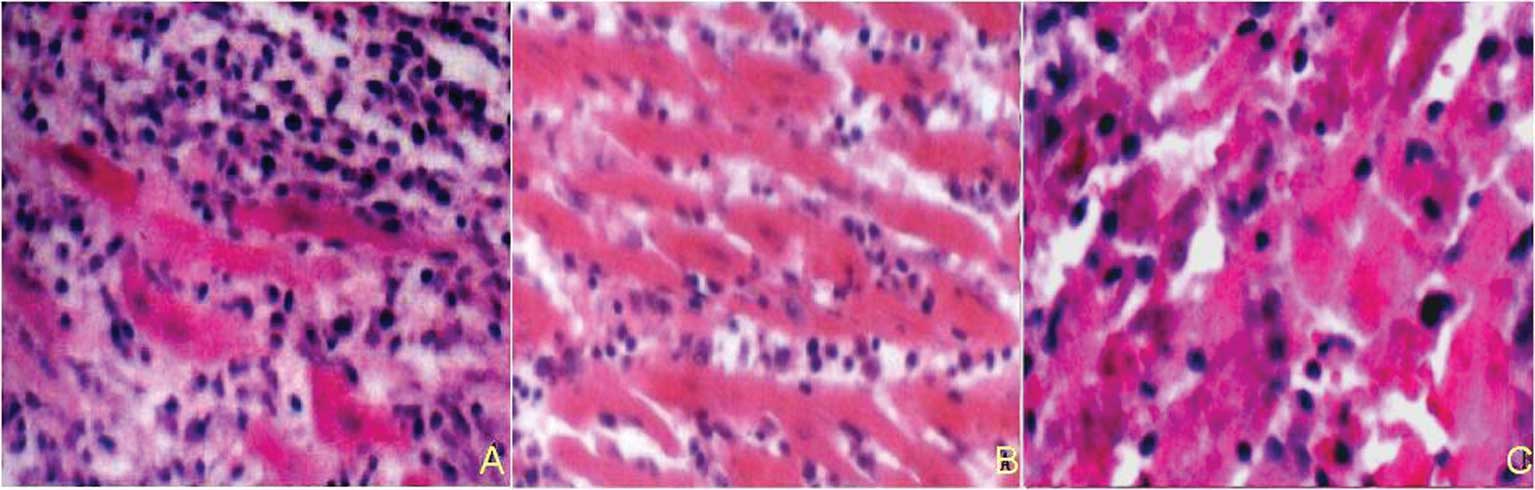
The cardiac tissue of donor hearts in the control
group showed sarcomere contraction, muscle fiber edema, myocardial
necrosis and inflammatory cell infiltration. The 24- and 48-h
groups, which had a higher HSP70 expression, had significantly
better pathological outcomes (Fig.
1).
Discussion
Heart transplantation has become an established
treatment for patients with end-stage heart failure. However,
current methods of donor heart preservation are limited by the
detrimental effects of ischemia-reperfusion injury. Previous
studies have shown that HSP70 gene transfection protects the
mitochondrial and ventricular function from ischemia-reperfusion
injury (2). Similarly, recent
reports demonstrate that the myocardial expression of HSP70i
protects early postoperative right ventricular function in cyanotic
tetralogy of Fallot (6). Moreover,
the leukocyte expression of HSP70 enhances the inflammatory
response in coronary artery bypass-grafting patients (7).
Heat stress induces the production of HSP70
(8), which may improve heart
recovery from injury and protect the heart from ischemia (9). In the present study, we found a
significant increase in the HSP70 expression in donor hearts
subsequent to heat stress. Recipients of hearts from animals that
had undergone heat stress had lower blood levels of cardiac enzymes
than the recipients of hearts from controls. Similarly, hearts
transplanted from the treated animals showed milder pathological
changes compared to hearts from the controls. A previous study has
also demonstrated that HSP70 contributes to the late-phase
protection of ischemic pre-conditioning in ischemic hearts
(10). However, in that study,
hearts were studied at a fixed time point subsequent to HSP70
induction, whereas our results were observed at successive time
points after heat stress, which demonstrated, for what appears to
be the first time, the HSP70 time-dose change in vivo.
The important role of HSP70 in protecting hearts
from ischemia-reperfusion injury has been clearly proven by
experiments with gene transfection (1,2). In
these experiments, ex vivo donor rat hearts with HSP70 gene
transfection demonstrated a better mechanical and endothelial
function after a period of ischemia and reperfusion. However, the
in vivo performance of donor hearts with HSP70
overexpression against ischemia-reperfusion injury has yet to be
adequately assessed. Gene transfection protocols are relatively
complex regarding clinical practice, whereas our protocol used heat
stress as an easier and more economical induction method.
To study the relationship of heat stress, HSP70 and
their protective effects on donor hearts in vivo, we
constructed the transplantation model at different time points
after donor rats received heat stress. Using this method, we
observed a time-dose relationship between heat shock and HSP70, and
compared the dose-effect relationship with HSP70 and markers of
cardiac injury, such as the cardiac enzymes in receptor blood and
donor heart and the pathological changes of cardiac tissue.
Our results indicate that heat stress may have
beneficial effects on the donor heart despite inducing endogenous
HSP70, and these effects are time-dependent. The peak of the HSP70
concentration in the donor heart occurred at 24 h after heat
stress, and hearts transplanted during this time period showed the
lowest cardiac enzyme levels both in the recipient blood and the
donated heart, as well as the slightest pathological changes in
donor heart tissue. This finding is consistent with that of
previous studies indicating that heat stress leads to HSP70
induction in the heart (11) and
that HSP70 protects the heart during cardiac surgery (12). Furthermore, our finding that HSP70
expression peaks at 24 h after heat stress may be clinically
useful.
Advantages of the present study include the use of
heat stress as a practical and cost-effective method to induce
endogenous protective ability, and the use of the time-dose-effect
relationship among heat stress, HSP70 and donor heart protection.
Limitations of the present study include the use of rats as study
subjects and the use of an incubator to produce heat stress. The
extent to which the findings are applicable in humans is unclear at
present. Furthermore, the use of an incubator is a relatively
inefficient and uncomfortable way to produce heat stress.
Alternatives that might be worth investigating include lasers,
ultrasound and microwaves.
Rectal temperature at 42°C during a 30-min heat
stress was required in this study. Endogenous HSP70 expression
kinetics is the basis of this design. This time period allows for
an optimal level of HSP70 expression between 24 and 48 h after heat
stress (the stress-induced rise in HSP70 levels returns to the
pre-stress level by 192 h) (13).
Collection of the donor hearts one week after transplantation
eliminated the tissue injury effect from surgery, which may
increase the cardiac enzyme level. Furthermore, one week is
sufficient for cardiac pathological changes to develop. Thus, the
present study provided an in vivo model for investigating
heat stress in cardiac protection. Advances in heat stress may
allow a more practical and cost-effective induction of HSP70
expression, particularly when the method of heat stress may be
achieved by higher thermal input rates. Notably, patients with high
initial myocardial levels of endogenous HSP70 had lower
ischemia-reperfusion injury during cardiac surgery, thus HSP70 may
have clinical application for myocardial protection (8,12,14).
In conclusion, we found that the induction of HSP70
in donor hearts through heat stress resulted in decreased enzyme
level alterations and improved preservation of myocardial cells
subsequent to heart transplantation. Our findings suggest that heat
stress is a promising approach towards myocardial protection in
clinical transplantation.
Acknowledgements
This study was supported by the Foundation of the
Education Department of Heilongjiang Province, No. 12511300.
References
|
1
|
Jayakumar J, Suzuki K, Khan M, et al: Gene
therapy for myocardial protection: transfection of donor hearts
with heat shock protein 70 gene protects cardiac function against
ischemia-reperfusion injury. Circulation. 102(Suppl 3): 302–306.
2000. View Article : Google Scholar
|
|
2
|
Jayakumar J, Suzuki K, Sammut IA, et al:
Heat shock protein 70 gene transfection protects mitochondrial and
ventricular function against ischemia-reperfusion injury.
Circulation. 104(Suppl 1): 303–307. 2001. View Article : Google Scholar : PubMed/NCBI
|
|
3
|
Wang SH, Diller DR and Aggarwal SJ:
Kinetics study of endogenous heat shock protein 70 expression. J
Biomech Eng. 125:794–797. 2003. View Article : Google Scholar : PubMed/NCBI
|
|
4
|
Ruzza A, Vespignani R, Czer LS, et al:
Heterotopic heart transplantation in rats: improved anesthetic and
surgical technique. Transplant Proc. 42:3828–3832. 2010. View Article : Google Scholar : PubMed/NCBI
|
|
5
|
Buege SA and Aust SD: Microsomal lipid
peroxidation. Methods Enzymol. 12:3021978. View Article : Google Scholar
|
|
6
|
Peng EW, McCaig D, Pollock JC, et al:
Myocardial expression of heat shock protein 70i protects early
postoperative right ventricular function in cyanotic tetralogy of
Fallot. J Thorac Cardiovasc Surg. 141:1184–1191. 2011. View Article : Google Scholar : PubMed/NCBI
|
|
7
|
Lin CY, Yang TL, Hong GJ, et al: Enhanced
intracellular heat shock protein 70 expression of leukocytes and
serum interleukins release: comparison of on-pump and off-pump
coronary artery surgery. World J Surg. 34:675–681. 2010. View Article : Google Scholar : PubMed/NCBI
|
|
8
|
Latchman DS: Heat shock proteins and
cardiac protection. Cardiovasc Res. 51:637–646. 2001. View Article : Google Scholar : PubMed/NCBI
|
|
9
|
Gowda A, Yang C, Asimakis GK, et al: Heat
shock improves recovery and provides protection against global
ischemia after hypothermic storage. Ann Thorac Surg. 66:1991–1997.
1998. View Article : Google Scholar : PubMed/NCBI
|
|
10
|
Yin C, Salloum FN and Kukreja RC: A novel
role of microRNA in late preconditioning upregulation of
endothelial nitric oxide synthase and heat shock protein 70. Circ
Res. 104:572–575. 2009. View Article : Google Scholar : PubMed/NCBI
|
|
11
|
Amrani M, Latif N, Morrison K, et al:
Relative induction of heat shock protein in coronary endothelial
cells and cardiomyocytes: implications for myocardial protection. J
Thorac Cardiovasc Surg. 115:200–209. 1998. View Article : Google Scholar : PubMed/NCBI
|
|
12
|
Chaudhry AZ, Diodato MD and Massad MG:
Heat shock protein expresssion during cardiac surgery. World J
Surg. 34:682–683. 2010. View Article : Google Scholar : PubMed/NCBI
|
|
13
|
Wang SH, Diller KR and Aggarwal SJ:
Kinetics study of endogenous heat shock protein 70 expression. J
Biomech Eng. 125:794–797. 2003. View Article : Google Scholar : PubMed/NCBI
|
|
14
|
Jong PR, Schadenberg AW, Jansen NJ, et al:
HSP70 and cardiac surgery: molecular chaperone and inflammatory
regulator with compartmentalized effects. Cell Stress Chaperones.
14:117–131. 2009. View Article : Google Scholar : PubMed/NCBI
|