Spandidos Publications Logo
  • About
    • About Spandidos
    • Aims and Scopes
    • Abstracting and Indexing
    • Editorial Policies
    • Reprints and Permissions
    • Job Opportunities
    • Terms and Conditions
    • Contact
  • Journals
    • All Journals
    • Oncology Letters
      • Oncology Letters
      • Information for Authors
      • Editorial Policies
      • Editorial Board
      • Aims and Scope
      • Abstracting and Indexing
      • Bibliographic Information
      • Archive
    • International Journal of Oncology
      • International Journal of Oncology
      • Information for Authors
      • Editorial Policies
      • Editorial Board
      • Aims and Scope
      • Abstracting and Indexing
      • Bibliographic Information
      • Archive
    • Molecular and Clinical Oncology
      • Molecular and Clinical Oncology
      • Information for Authors
      • Editorial Policies
      • Editorial Board
      • Aims and Scope
      • Abstracting and Indexing
      • Bibliographic Information
      • Archive
    • Experimental and Therapeutic Medicine
      • Experimental and Therapeutic Medicine
      • Information for Authors
      • Editorial Policies
      • Editorial Board
      • Aims and Scope
      • Abstracting and Indexing
      • Bibliographic Information
      • Archive
    • International Journal of Molecular Medicine
      • International Journal of Molecular Medicine
      • Information for Authors
      • Editorial Policies
      • Editorial Board
      • Aims and Scope
      • Abstracting and Indexing
      • Bibliographic Information
      • Archive
    • Biomedical Reports
      • Biomedical Reports
      • Information for Authors
      • Editorial Policies
      • Editorial Board
      • Aims and Scope
      • Abstracting and Indexing
      • Bibliographic Information
      • Archive
    • Oncology Reports
      • Oncology Reports
      • Information for Authors
      • Editorial Policies
      • Editorial Board
      • Aims and Scope
      • Abstracting and Indexing
      • Bibliographic Information
      • Archive
    • Molecular Medicine Reports
      • Molecular Medicine Reports
      • Information for Authors
      • Editorial Policies
      • Editorial Board
      • Aims and Scope
      • Abstracting and Indexing
      • Bibliographic Information
      • Archive
    • World Academy of Sciences Journal
      • World Academy of Sciences Journal
      • Information for Authors
      • Editorial Policies
      • Editorial Board
      • Aims and Scope
      • Abstracting and Indexing
      • Bibliographic Information
      • Archive
    • International Journal of Functional Nutrition
      • International Journal of Functional Nutrition
      • Information for Authors
      • Editorial Policies
      • Editorial Board
      • Aims and Scope
      • Abstracting and Indexing
      • Bibliographic Information
      • Archive
    • International Journal of Epigenetics
      • International Journal of Epigenetics
      • Information for Authors
      • Editorial Policies
      • Editorial Board
      • Aims and Scope
      • Abstracting and Indexing
      • Bibliographic Information
      • Archive
    • Medicine International
      • Medicine International
      • Information for Authors
      • Editorial Policies
      • Editorial Board
      • Aims and Scope
      • Abstracting and Indexing
      • Bibliographic Information
      • Archive
  • Articles
  • Information
    • Information for Authors
    • Information for Reviewers
    • Information for Librarians
    • Information for Advertisers
    • Conferences
  • Language Editing
Spandidos Publications Logo
  • About
    • About Spandidos
    • Aims and Scopes
    • Abstracting and Indexing
    • Editorial Policies
    • Reprints and Permissions
    • Job Opportunities
    • Terms and Conditions
    • Contact
  • Journals
    • All Journals
    • Biomedical Reports
      • Information for Authors
      • Editorial Policies
      • Editorial Board
      • Aims and Scope
      • Abstracting and Indexing
      • Bibliographic Information
      • Archive
    • Experimental and Therapeutic Medicine
      • Information for Authors
      • Editorial Policies
      • Editorial Board
      • Aims and Scope
      • Abstracting and Indexing
      • Bibliographic Information
      • Archive
    • International Journal of Epigenetics
      • Information for Authors
      • Editorial Policies
      • Editorial Board
      • Aims and Scope
      • Abstracting and Indexing
      • Bibliographic Information
      • Archive
    • International Journal of Functional Nutrition
      • Information for Authors
      • Editorial Policies
      • Editorial Board
      • Aims and Scope
      • Abstracting and Indexing
      • Bibliographic Information
      • Archive
    • International Journal of Molecular Medicine
      • Information for Authors
      • Editorial Policies
      • Editorial Board
      • Aims and Scope
      • Abstracting and Indexing
      • Bibliographic Information
      • Archive
    • International Journal of Oncology
      • Information for Authors
      • Editorial Policies
      • Editorial Board
      • Aims and Scope
      • Abstracting and Indexing
      • Bibliographic Information
      • Archive
    • Medicine International
      • Information for Authors
      • Editorial Policies
      • Editorial Board
      • Aims and Scope
      • Abstracting and Indexing
      • Bibliographic Information
      • Archive
    • Molecular and Clinical Oncology
      • Information for Authors
      • Editorial Policies
      • Editorial Board
      • Aims and Scope
      • Abstracting and Indexing
      • Bibliographic Information
      • Archive
    • Molecular Medicine Reports
      • Information for Authors
      • Editorial Policies
      • Editorial Board
      • Aims and Scope
      • Abstracting and Indexing
      • Bibliographic Information
      • Archive
    • Oncology Letters
      • Information for Authors
      • Editorial Policies
      • Editorial Board
      • Aims and Scope
      • Abstracting and Indexing
      • Bibliographic Information
      • Archive
    • Oncology Reports
      • Information for Authors
      • Editorial Policies
      • Editorial Board
      • Aims and Scope
      • Abstracting and Indexing
      • Bibliographic Information
      • Archive
    • World Academy of Sciences Journal
      • Information for Authors
      • Editorial Policies
      • Editorial Board
      • Aims and Scope
      • Abstracting and Indexing
      • Bibliographic Information
      • Archive
  • Articles
  • Information
    • For Authors
    • For Reviewers
    • For Librarians
    • For Advertisers
    • Conferences
  • Language Editing
Login Register Submit
  • This site uses cookies
  • You can change your cookie settings at any time by following the instructions in our Cookie Policy. To find out more, you may read our Privacy Policy.

    I agree
Search articles by DOI, keyword, author or affiliation
Search
Advanced Search
presentation
Molecular Medicine Reports
Join Editorial Board Propose a Special Issue
Print ISSN: 1791-2997 Online ISSN: 1791-3004
Journal Cover
March 2013 Volume 7 Issue 3

Full Size Image

Sign up for eToc alerts
Recommend to Library

Journals

International Journal of Molecular Medicine

International Journal of Molecular Medicine

International Journal of Molecular Medicine is an international journal devoted to molecular mechanisms of human disease.

International Journal of Oncology

International Journal of Oncology

International Journal of Oncology is an international journal devoted to oncology research and cancer treatment.

Molecular Medicine Reports

Molecular Medicine Reports

Covers molecular medicine topics such as pharmacology, pathology, genetics, neuroscience, infectious diseases, molecular cardiology, and molecular surgery.

Oncology Reports

Oncology Reports

Oncology Reports is an international journal devoted to fundamental and applied research in Oncology.

Experimental and Therapeutic Medicine

Experimental and Therapeutic Medicine

Experimental and Therapeutic Medicine is an international journal devoted to laboratory and clinical medicine.

Oncology Letters

Oncology Letters

Oncology Letters is an international journal devoted to Experimental and Clinical Oncology.

Biomedical Reports

Biomedical Reports

Explores a wide range of biological and medical fields, including pharmacology, genetics, microbiology, neuroscience, and molecular cardiology.

Molecular and Clinical Oncology

Molecular and Clinical Oncology

International journal addressing all aspects of oncology research, from tumorigenesis and oncogenes to chemotherapy and metastasis.

World Academy of Sciences Journal

World Academy of Sciences Journal

Multidisciplinary open-access journal spanning biochemistry, genetics, neuroscience, environmental health, and synthetic biology.

International Journal of Functional Nutrition

International Journal of Functional Nutrition

Open-access journal combining biochemistry, pharmacology, immunology, and genetics to advance health through functional nutrition.

International Journal of Epigenetics

International Journal of Epigenetics

Publishes open-access research on using epigenetics to advance understanding and treatment of human disease.

Medicine International

Medicine International

An International Open Access Journal Devoted to General Medicine.

Journal Cover
March 2013 Volume 7 Issue 3

Full Size Image

Sign up for eToc alerts
Recommend to Library

  • Article
  • Citations
    • Cite This Article
    • Download Citation
    • Create Citation Alert
    • Remove Citation Alert
    • Cited By
  • Similar Articles
    • Related Articles (in Spandidos Publications)
    • Similar Articles (Google Scholar)
    • Similar Articles (PubMed)
  • Download PDF
  • Download XML
  • View XML
Article

Immunosuppression induced by apoptosis of mixed lymphocyte culture is associated with p53

  • Authors:
    • Fuling Wei
    • Yongmei Cao
    • Mengran Zhang
    • Rui Huang
    • Jun Cheng
    • Guoan Xiang
    • Jinqian Zhang
  • View Affiliations / Copyright

    Affiliations: Department of Cardiovascular Surgery, The PLA 309 Hospital, Beijing 100091, P.R. China, International Mongolian Hospital, Hohhot of Inner Mongolia, Hohhot 010065, P.R. China, Institute of Infectious Diseases, Beijing Ditan Hospital, Capital Medical University, Beijing 100015, P.R. China, Department of General Surgery, The Second People's Hospital of Guangdong Province, Guangzhou 510515, P.R. China
  • Pages: 805-810
    |
    Published online on: January 28, 2013
       https://doi.org/10.3892/mmr.2013.1292
  • Expand metrics +
Metrics: Total Views: 0 (Spandidos Publications: | PMC Statistics: )
Metrics: Total PDF Downloads: 0 (Spandidos Publications: | PMC Statistics: )
Cited By (CrossRef): 0 citations Loading Articles...

This article is mentioned in:


Abstract

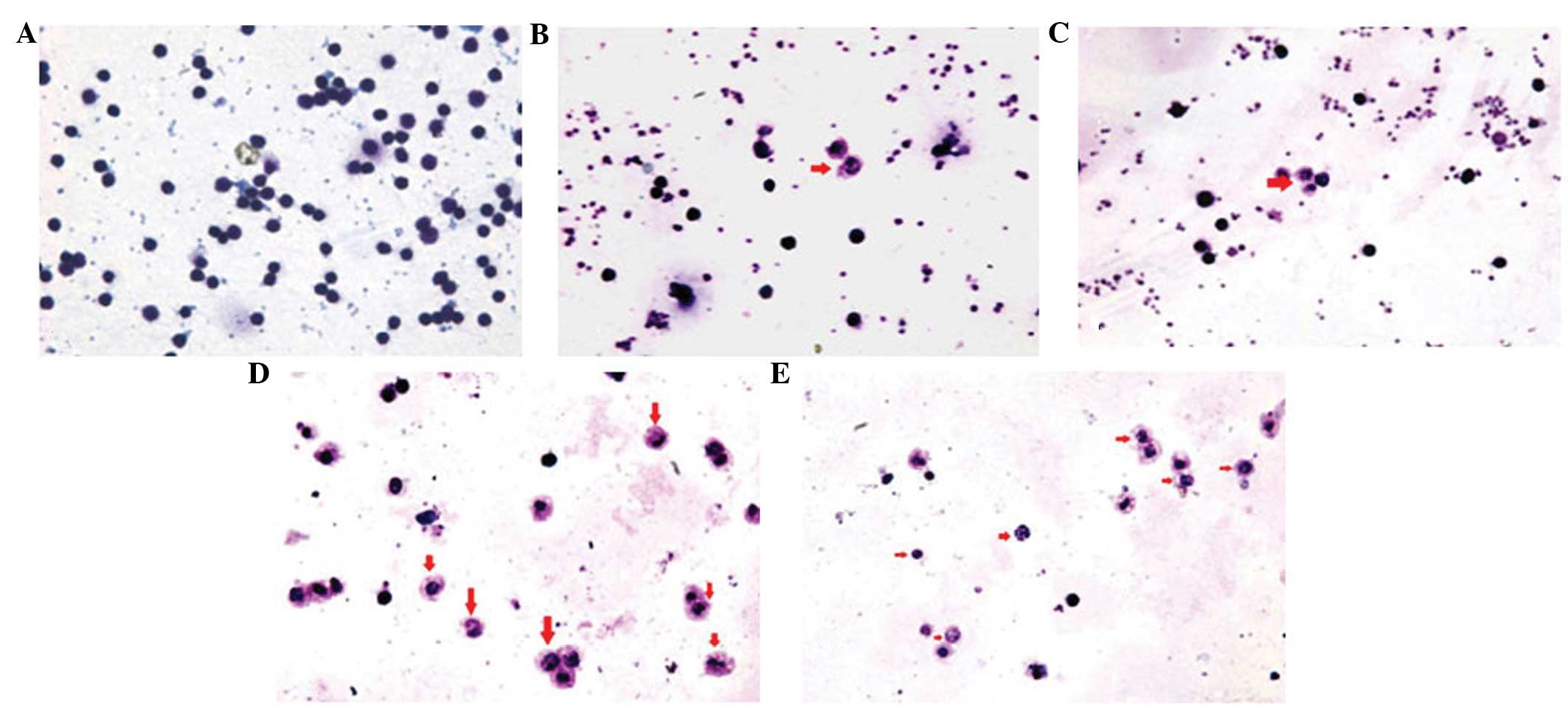
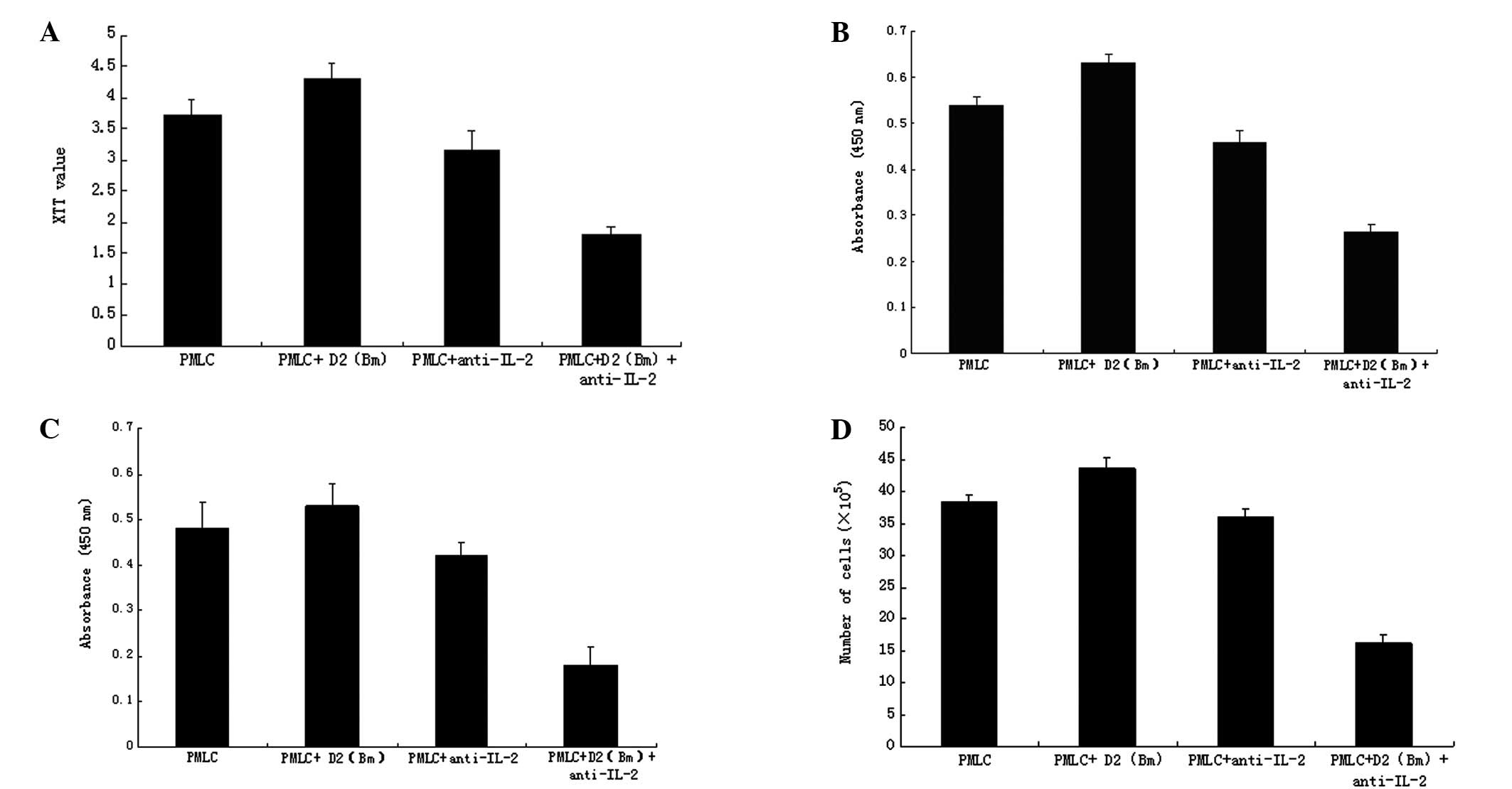
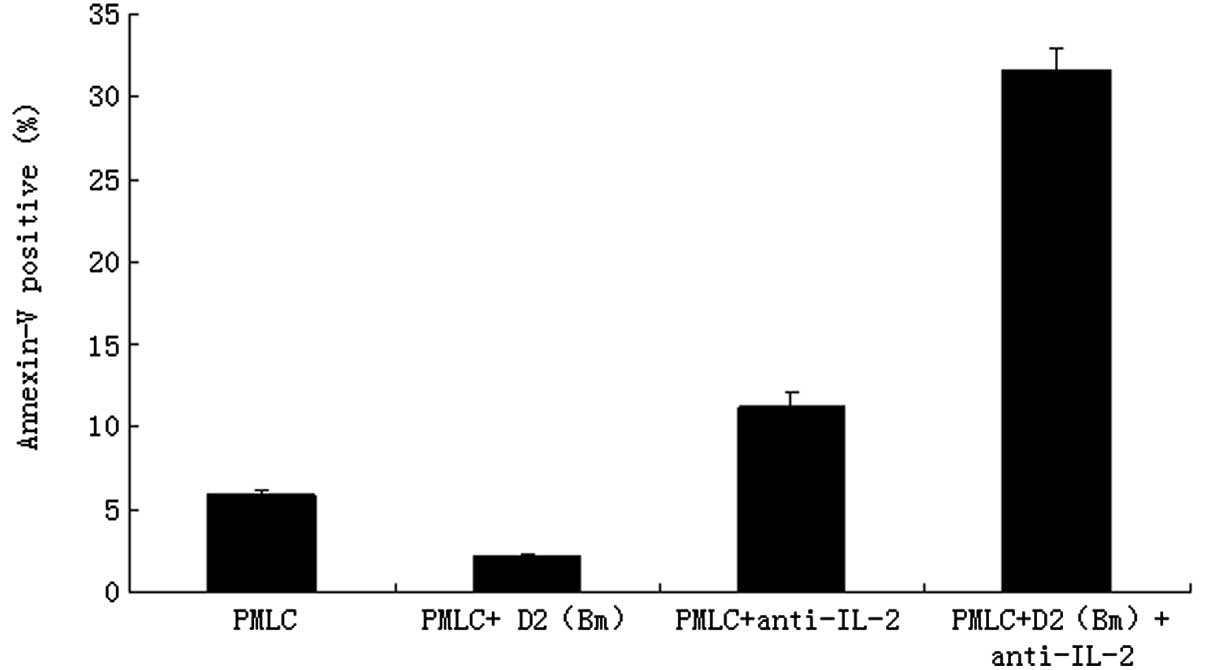
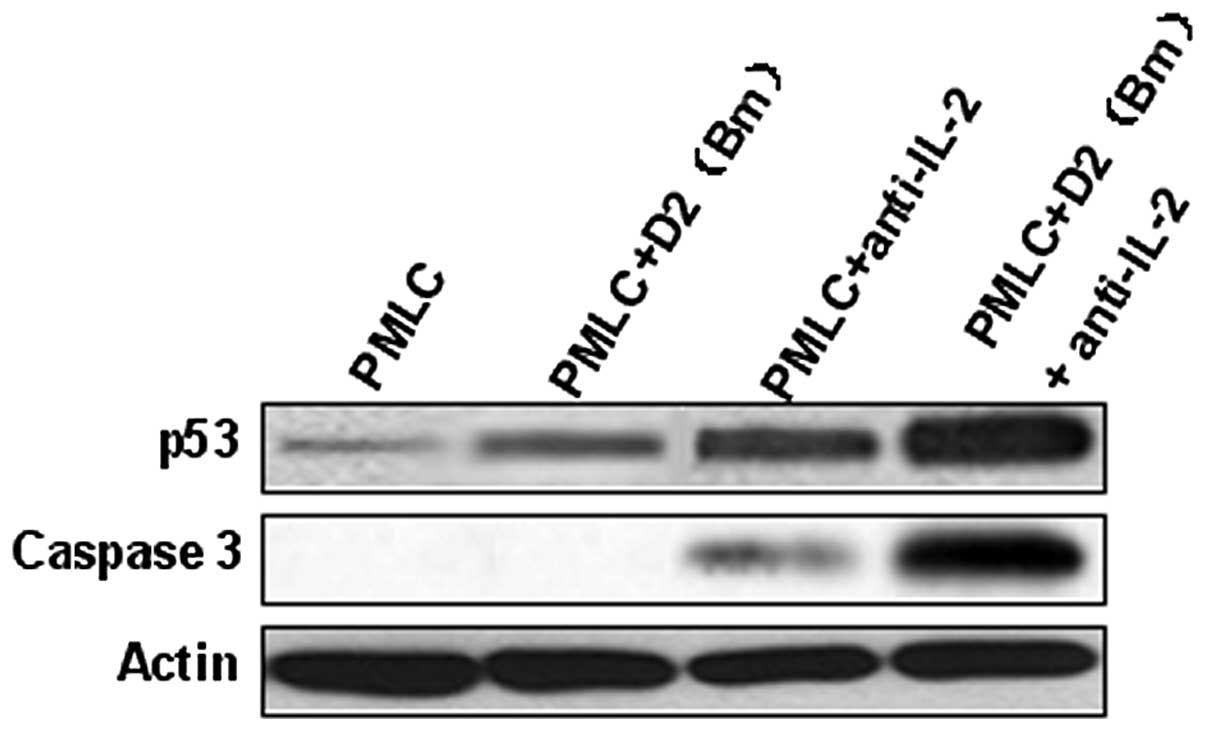
A lymphocyte inhibition model was created using a co-culture of donor and host lymphocytes, resulting in apoptosis of the latter, and subsequently, inducing immune tolerance. This method may be used to resolve the immune rejection problem prior to organ transplantation. Using mixed lymphocyte culture (MLC) and/or addition of anti-anti-IL-2 neutralizing monoclonal antibody, we successfully developed a lymphocyte inhibition model in vitro. In this model, the apoptosis of recipient lymphocytes co-cultured with donor lymphocytes was observed by Wright-Giemsa stain, electron microscopy imaging and flow cytometry. The growth and proliferation of mixed lymphocytes were detected by XTT and BrdU assays. Cell viability was determined using CCK-8 cell viability assay. The activity of the recipient lymphocytes was very high when stimulated by antigens alone [PMLC + D2 (Bm) group] but markedly lowered by anti-anti-IL-2 neutralizing monoclonal antibody [PMLC + D2 (Bm) + anti‑IL-2 group]. The suppression of recipient lymphocyte activity was due to apoptosis mediated by p53 and caspase-3, and the optimal ratio of donor and recipient lymphocytes for apoptosis was explored. With the exception of the control group, the ratio of apoptotic cells was highest in the PMLC + D2 (Bm) + anti-IL-2 group and lowest in the PMLC + D2 (Bm) group. Blockade of IL-2 with anti-IL-2 neutralizing antibody resulted in an increased number of apoptotic lymphocytes in our experiment, which suggested that IL-2 inhibits the apoptosis of lymphocytes. These data suggest that IL-2 is involved in MLC-induced apoptosis of recipient lymphocytes, and that apoptosis may be associated with p53 and caspase-3 pathways.
View Figures

Figure 1

Figure 2

Figure 3

Figure 4

View References

1 

Helderman JH, Hernandez J, Sagalowsky A, et al: Confirmation of the utility of fine needle aspiration biopsy of the renal allograft. Kidney Int. 34:376–381. 1988. View Article : Google Scholar : PubMed/NCBI

2 

Von Willebrand E and Hughes D: Fine-needle aspiration cytology of the transplanted kidney. Kidney Transplantation. Morris PJ: 4th edition. WB Saunders; Philadelphia, PA: pp. 3011994

3 

Suthanthiran M: Clinical application of molecular biology: a study of allograft rejection with polymerase chain reaction. Am J Med Sci. 313:264–267. 1997. View Article : Google Scholar : PubMed/NCBI

4 

Rimm IJ, Krenger W, Beland JL, et al: TCR-beta transgenic mice fail to mediate a GVHR due to defects of allorecognition and subsequent IL-2 generation. Bone Marrow Transplant. 17:835–842. 1996.PubMed/NCBI

5 

Koreth J, Matsuoka K, Kim HT, et al: Interleukin-2 and regulatory T cells in graft-versus-host disease. N Engl J Med. 365:2055–2066. 2011. View Article : Google Scholar : PubMed/NCBI

6 

Zhang S, Dai H, Wan N, et al: Manipulating IL-2 availability amid presentation of donor MHC antigens suppresses murine alloimmune responses by inducing regulatory T cells. PLoS One. 5:e87562010. View Article : Google Scholar : PubMed/NCBI

7 

Webster KE, Walters S, Kohler RE, et al: In vivo expansion of T reg cells with IL-2-mAb complexes: induction of resistance to EAE and long-term acceptance of islet allografts without immunosuppression. J Exp Med. 206:751–760. 2009. View Article : Google Scholar : PubMed/NCBI

8 

Kang HG, Zhang D, Degauque N, et al: Effects of cyclosporine on transplant tolerance: the role of IL-2. Am J Transplant. 7:1907–1916. 2007. View Article : Google Scholar : PubMed/NCBI

9 

Sebille F, Brouard S, Petzold T, et al: Tolerance induction in rats, using a combination of anti-CD154 and donor splenocytes, given once on the day of transplantation. Transplantation. 75:169–172. 2003. View Article : Google Scholar : PubMed/NCBI

10 

Subbotin V, Sun H, Aitouche A, et al: Abrogation of chronic rejection in a murine model of aortic allotransplantation by prior induction of donor-specific tolerance. Transplantation. 64:690–695. 1997. View Article : Google Scholar : PubMed/NCBI

11 

Shen Z, Mohiuddin M, Goldstein C, et al: Durability of donor-specific and organ-specific heart transplant tolerance induced by intrathymic pretreatment with allogeneic spleen cells. J Thorac Cardiovasc Surg. 111:429–431. 1996. View Article : Google Scholar

12 

Opelz G and Terasaki PI: Poor kidney-transplant survival in recipients with frozen-blood transfusions or no transfusions. Lancet. 2:696–698. 1974. View Article : Google Scholar : PubMed/NCBI

13 

Kroemer G, Galluzzi L and Brenner C: Mitochondrial membrane permeabilization in cell death. Physiol Rev. 87:99–163. 2007. View Article : Google Scholar : PubMed/NCBI

14 

Sheehy MJ, Sondel PM, Bach ML, et al: HL-A LD (lymphocyte defined) typing: a rapid assay with primed lymphocytes. Science. 188:1308–1310. 1975. View Article : Google Scholar : PubMed/NCBI

15 

Amicarelli F, Bucciarelli T, Poma A, et al: Adaptive response of human melanoma cells to methylglyoxal injury. Carcinogenesis. 19:519–523. 1998. View Article : Google Scholar : PubMed/NCBI

16 

Ford J, Jiang M and Milner J: Cancer-specific functions of SIRT1 enable human epithelial cancer cell growth and survival. Cancer Res. 65:10457–10463. 2005. View Article : Google Scholar : PubMed/NCBI

17 

Hamamoto R, Furukawa Y, Morita M, et al: SMYD3 encodes a histone methyltransferase involved in the proliferation of cancer cells. Nat Cell Biol. 6:731–740. 2004. View Article : Google Scholar : PubMed/NCBI

18 

Kerr JF, Wyllie AH and Currie AR: Apoptosis: a basic biological phenomenon with wide-ranging implications in tissue kinetics. Br J Cancer. 26:239–257. 1972. View Article : Google Scholar : PubMed/NCBI

19 

Thornberry NA and Lazebnik Y: Caspases: enemies within. Science. 281:1312–1316. 1998. View Article : Google Scholar : PubMed/NCBI

20 

Krajewska M, Wang HG, Krajewski S, et al: Immunohistochemical analysis of in vivo patterns of expression of CPP32 (Caspase-3), a cell death protease. Cancer Res. 57:1605–1613. 1997.PubMed/NCBI

21 

Amaral JD, Castro RE, Sola S, et al: p53 is a key molecular target of ursodeoxycholic acid in regulating apoptosis. J Biol Chem. 282:34250–34259. 2007. View Article : Google Scholar : PubMed/NCBI

22 

Amaral JD, Xavier JM, Steer CJ, et al: The role of p53 in apoptosis. Discov Med. 9:145–152. 2010.

23 

Shi YF, Sahai BM and Green DR: Cyclosporin A inhibits activation-induced cell death in T-cell hybridomas and thymocytes. Nature. 339:625–626. 1989. View Article : Google Scholar : PubMed/NCBI

24 

Lieberman AC, Refojo D, Antunica-Noguerol M, et al: Underlying mechanisms of cAMP- and glucocorticoid-mediated inhibition of FasL expression in activation-induced cell death. Mol Immunol. 50:220–235. 2012. View Article : Google Scholar : PubMed/NCBI

25 

Pender MP: Activation-induced apoptosis of autoreactive and alloreactive T lymphocytes in the target organ as a major mechanism of tolerance. Immunol Cell Biol. 77:216–223. 1999. View Article : Google Scholar : PubMed/NCBI

26 

Lawetzky A, Kubbies M and Hünig T: Rat ‘first-wave’ mature thymocytes: cycling lymphoblasts that are sensitive to activation-induced cell death but rescued by interleukin 2. Eur J Immunol. 21:2599–2604. 1991.

27 

Miller AT and Berg LJ: Defective Fas ligand expression and activation-induced cell death in the absence of IL-2-inducible T cell kinase. J Immunol. 168:2163–2172. 2002. View Article : Google Scholar : PubMed/NCBI

28 

Maher SG, Condron CE, Bouchier-Hayes DJ and Toomey DM: Taurine attenuates CD3/interleukin-2-induced T cell apoptosis in an in vitro model of activation-induced cell death (AICD). Clin Exp Immunol. 139:279–286. 2005. View Article : Google Scholar : PubMed/NCBI

29 

Curtale G, Citarella F, Carissimi C, et al: An emerging player in the adaptive immune response: microRNA-146a is a modulator of IL-2 expression and activation-induced cell death in T lymphocytes. Blood. 115:265–273. 2010. View Article : Google Scholar : PubMed/NCBI

30 

Liebermann DA, Hoffman B and Vesely D: p52 induced growth arrest versus apoptosis and its modulation by survival cytokines. Cell Cycle. 6:166–170. 2007. View Article : Google Scholar : PubMed/NCBI

31 

Olivier M, Petitjean A, Marcel V, et al: Recent advances in p53 research: an interdisciplinary perspective. Cancer Gene Ther. 16:1–12. 2009. View Article : Google Scholar

Related Articles

  • Abstract
  • View
  • Download
  • Twitter
Copy and paste a formatted citation
Spandidos Publications style
Wei F, Cao Y, Zhang M, Huang R, Cheng J, Xiang G and Zhang J: Immunosuppression induced by apoptosis of mixed lymphocyte culture is associated with p53. Mol Med Rep 7: 805-810, 2013.
APA
Wei, F., Cao, Y., Zhang, M., Huang, R., Cheng, J., Xiang, G., & Zhang, J. (2013). Immunosuppression induced by apoptosis of mixed lymphocyte culture is associated with p53. Molecular Medicine Reports, 7, 805-810. https://doi.org/10.3892/mmr.2013.1292
MLA
Wei, F., Cao, Y., Zhang, M., Huang, R., Cheng, J., Xiang, G., Zhang, J."Immunosuppression induced by apoptosis of mixed lymphocyte culture is associated with p53". Molecular Medicine Reports 7.3 (2013): 805-810.
Chicago
Wei, F., Cao, Y., Zhang, M., Huang, R., Cheng, J., Xiang, G., Zhang, J."Immunosuppression induced by apoptosis of mixed lymphocyte culture is associated with p53". Molecular Medicine Reports 7, no. 3 (2013): 805-810. https://doi.org/10.3892/mmr.2013.1292
Copy and paste a formatted citation
x
Spandidos Publications style
Wei F, Cao Y, Zhang M, Huang R, Cheng J, Xiang G and Zhang J: Immunosuppression induced by apoptosis of mixed lymphocyte culture is associated with p53. Mol Med Rep 7: 805-810, 2013.
APA
Wei, F., Cao, Y., Zhang, M., Huang, R., Cheng, J., Xiang, G., & Zhang, J. (2013). Immunosuppression induced by apoptosis of mixed lymphocyte culture is associated with p53. Molecular Medicine Reports, 7, 805-810. https://doi.org/10.3892/mmr.2013.1292
MLA
Wei, F., Cao, Y., Zhang, M., Huang, R., Cheng, J., Xiang, G., Zhang, J."Immunosuppression induced by apoptosis of mixed lymphocyte culture is associated with p53". Molecular Medicine Reports 7.3 (2013): 805-810.
Chicago
Wei, F., Cao, Y., Zhang, M., Huang, R., Cheng, J., Xiang, G., Zhang, J."Immunosuppression induced by apoptosis of mixed lymphocyte culture is associated with p53". Molecular Medicine Reports 7, no. 3 (2013): 805-810. https://doi.org/10.3892/mmr.2013.1292
Follow us
  • Twitter
  • LinkedIn
  • Facebook
About
  • Spandidos Publications
  • Careers
  • Cookie Policy
  • Privacy Policy
How can we help?
  • Help
  • Live Chat
  • Contact
  • Email to our Support Team