Spandidos Publications Logo
  • About
    • About Spandidos
    • Aims and Scopes
    • Abstracting and Indexing
    • Editorial Policies
    • Reprints and Permissions
    • Job Opportunities
    • Terms and Conditions
    • Contact
  • Journals
    • All Journals
    • Oncology Letters
      • Oncology Letters
      • Information for Authors
      • Editorial Policies
      • Editorial Board
      • Aims and Scope
      • Abstracting and Indexing
      • Bibliographic Information
      • Archive
    • International Journal of Oncology
      • International Journal of Oncology
      • Information for Authors
      • Editorial Policies
      • Editorial Board
      • Aims and Scope
      • Abstracting and Indexing
      • Bibliographic Information
      • Archive
    • Molecular and Clinical Oncology
      • Molecular and Clinical Oncology
      • Information for Authors
      • Editorial Policies
      • Editorial Board
      • Aims and Scope
      • Abstracting and Indexing
      • Bibliographic Information
      • Archive
    • Experimental and Therapeutic Medicine
      • Experimental and Therapeutic Medicine
      • Information for Authors
      • Editorial Policies
      • Editorial Board
      • Aims and Scope
      • Abstracting and Indexing
      • Bibliographic Information
      • Archive
    • International Journal of Molecular Medicine
      • International Journal of Molecular Medicine
      • Information for Authors
      • Editorial Policies
      • Editorial Board
      • Aims and Scope
      • Abstracting and Indexing
      • Bibliographic Information
      • Archive
    • Biomedical Reports
      • Biomedical Reports
      • Information for Authors
      • Editorial Policies
      • Editorial Board
      • Aims and Scope
      • Abstracting and Indexing
      • Bibliographic Information
      • Archive
    • Oncology Reports
      • Oncology Reports
      • Information for Authors
      • Editorial Policies
      • Editorial Board
      • Aims and Scope
      • Abstracting and Indexing
      • Bibliographic Information
      • Archive
    • Molecular Medicine Reports
      • Molecular Medicine Reports
      • Information for Authors
      • Editorial Policies
      • Editorial Board
      • Aims and Scope
      • Abstracting and Indexing
      • Bibliographic Information
      • Archive
    • World Academy of Sciences Journal
      • World Academy of Sciences Journal
      • Information for Authors
      • Editorial Policies
      • Editorial Board
      • Aims and Scope
      • Abstracting and Indexing
      • Bibliographic Information
      • Archive
    • International Journal of Functional Nutrition
      • International Journal of Functional Nutrition
      • Information for Authors
      • Editorial Policies
      • Editorial Board
      • Aims and Scope
      • Abstracting and Indexing
      • Bibliographic Information
      • Archive
    • International Journal of Epigenetics
      • International Journal of Epigenetics
      • Information for Authors
      • Editorial Policies
      • Editorial Board
      • Aims and Scope
      • Abstracting and Indexing
      • Bibliographic Information
      • Archive
    • Medicine International
      • Medicine International
      • Information for Authors
      • Editorial Policies
      • Editorial Board
      • Aims and Scope
      • Abstracting and Indexing
      • Bibliographic Information
      • Archive
  • Articles
  • Information
    • Information for Authors
    • Information for Reviewers
    • Information for Librarians
    • Information for Advertisers
    • Conferences
  • Language Editing
Spandidos Publications Logo
  • About
    • About Spandidos
    • Aims and Scopes
    • Abstracting and Indexing
    • Editorial Policies
    • Reprints and Permissions
    • Job Opportunities
    • Terms and Conditions
    • Contact
  • Journals
    • All Journals
    • Biomedical Reports
      • Information for Authors
      • Editorial Policies
      • Editorial Board
      • Aims and Scope
      • Abstracting and Indexing
      • Bibliographic Information
      • Archive
    • Experimental and Therapeutic Medicine
      • Information for Authors
      • Editorial Policies
      • Editorial Board
      • Aims and Scope
      • Abstracting and Indexing
      • Bibliographic Information
      • Archive
    • International Journal of Epigenetics
      • Information for Authors
      • Editorial Policies
      • Editorial Board
      • Aims and Scope
      • Abstracting and Indexing
      • Bibliographic Information
      • Archive
    • International Journal of Functional Nutrition
      • Information for Authors
      • Editorial Policies
      • Editorial Board
      • Aims and Scope
      • Abstracting and Indexing
      • Bibliographic Information
      • Archive
    • International Journal of Molecular Medicine
      • Information for Authors
      • Editorial Policies
      • Editorial Board
      • Aims and Scope
      • Abstracting and Indexing
      • Bibliographic Information
      • Archive
    • International Journal of Oncology
      • Information for Authors
      • Editorial Policies
      • Editorial Board
      • Aims and Scope
      • Abstracting and Indexing
      • Bibliographic Information
      • Archive
    • Medicine International
      • Information for Authors
      • Editorial Policies
      • Editorial Board
      • Aims and Scope
      • Abstracting and Indexing
      • Bibliographic Information
      • Archive
    • Molecular and Clinical Oncology
      • Information for Authors
      • Editorial Policies
      • Editorial Board
      • Aims and Scope
      • Abstracting and Indexing
      • Bibliographic Information
      • Archive
    • Molecular Medicine Reports
      • Information for Authors
      • Editorial Policies
      • Editorial Board
      • Aims and Scope
      • Abstracting and Indexing
      • Bibliographic Information
      • Archive
    • Oncology Letters
      • Information for Authors
      • Editorial Policies
      • Editorial Board
      • Aims and Scope
      • Abstracting and Indexing
      • Bibliographic Information
      • Archive
    • Oncology Reports
      • Information for Authors
      • Editorial Policies
      • Editorial Board
      • Aims and Scope
      • Abstracting and Indexing
      • Bibliographic Information
      • Archive
    • World Academy of Sciences Journal
      • Information for Authors
      • Editorial Policies
      • Editorial Board
      • Aims and Scope
      • Abstracting and Indexing
      • Bibliographic Information
      • Archive
  • Articles
  • Information
    • For Authors
    • For Reviewers
    • For Librarians
    • For Advertisers
    • Conferences
  • Language Editing
Login Register Submit
  • This site uses cookies
  • You can change your cookie settings at any time by following the instructions in our Cookie Policy. To find out more, you may read our Privacy Policy.

    I agree
Search articles by DOI, keyword, author or affiliation
Search
Advanced Search
presentation
Molecular Medicine Reports
Join Editorial Board Propose a Special Issue
Print ISSN: 1791-2997 Online ISSN: 1791-3004
Journal Cover
July 2013 Volume 8 Issue 1

Full Size Image

Sign up for eToc alerts
Recommend to Library

Journals

International Journal of Molecular Medicine

International Journal of Molecular Medicine

International Journal of Molecular Medicine is an international journal devoted to molecular mechanisms of human disease.

International Journal of Oncology

International Journal of Oncology

International Journal of Oncology is an international journal devoted to oncology research and cancer treatment.

Molecular Medicine Reports

Molecular Medicine Reports

Covers molecular medicine topics such as pharmacology, pathology, genetics, neuroscience, infectious diseases, molecular cardiology, and molecular surgery.

Oncology Reports

Oncology Reports

Oncology Reports is an international journal devoted to fundamental and applied research in Oncology.

Experimental and Therapeutic Medicine

Experimental and Therapeutic Medicine

Experimental and Therapeutic Medicine is an international journal devoted to laboratory and clinical medicine.

Oncology Letters

Oncology Letters

Oncology Letters is an international journal devoted to Experimental and Clinical Oncology.

Biomedical Reports

Biomedical Reports

Explores a wide range of biological and medical fields, including pharmacology, genetics, microbiology, neuroscience, and molecular cardiology.

Molecular and Clinical Oncology

Molecular and Clinical Oncology

International journal addressing all aspects of oncology research, from tumorigenesis and oncogenes to chemotherapy and metastasis.

World Academy of Sciences Journal

World Academy of Sciences Journal

Multidisciplinary open-access journal spanning biochemistry, genetics, neuroscience, environmental health, and synthetic biology.

International Journal of Functional Nutrition

International Journal of Functional Nutrition

Open-access journal combining biochemistry, pharmacology, immunology, and genetics to advance health through functional nutrition.

International Journal of Epigenetics

International Journal of Epigenetics

Publishes open-access research on using epigenetics to advance understanding and treatment of human disease.

Medicine International

Medicine International

An International Open Access Journal Devoted to General Medicine.

Journal Cover
July 2013 Volume 8 Issue 1

Full Size Image

Sign up for eToc alerts
Recommend to Library

  • Article
  • Citations
    • Cite This Article
    • Download Citation
    • Create Citation Alert
    • Remove Citation Alert
    • Cited By
  • Similar Articles
    • Related Articles (in Spandidos Publications)
    • Similar Articles (Google Scholar)
    • Similar Articles (PubMed)
  • Download PDF
  • Download XML
  • View XML
Article

An effective treatment for penile strangulation

  • Authors:
    • Chao Li
    • Yue-Min Xu
    • Rong Chen
    • Chen-Liang Deng
  • View Affiliations / Copyright

    Affiliations: Department of Urology, The Affiliated Sixth People's Hospital, Shanghai Jiaotong University, Shanghai 200233, P.R. China, Department of Orthopedics, The Affiliated Sixth People's Hospital, Shanghai Jiaotong University, Shanghai 200233, P.R. China
  • Pages: 201-204
    |
    Published online on: May 2, 2013
       https://doi.org/10.3892/mmr.2013.1456
  • Expand metrics +
Metrics: Total Views: 0 (Spandidos Publications: | PMC Statistics: )
Metrics: Total PDF Downloads: 0 (Spandidos Publications: | PMC Statistics: )
Cited By (CrossRef): 0 citations Loading Articles...

This article is mentioned in:


Abstract

The aim of this study was to present our experience of patients with penile strangulation. The clinical data of 6 patients (mean age, 36 years; range, 18-72 years) with penile strangulation caused by a metal hoop are provided, where the duration of strangulation was between 3 h and 1 month. Among these patients, the case of a 22-year-old patient with a steel hoop entrapment on his penis for 5 days is described; due to serious injury of the skin at the root of penis, an intermediate split‑thickness thigh skin graft was used to repair the skin loss. A review of the literature is also provided in this study, and current treatment options and outcomes are evaluated. In all the cases described, the metal hoops were successfully removed, without gangrene of the penis. These patients were discharged 2-27 days later with a satisfactory outcome. Penile strangulation is an unusual clinical condition and the consequences may be severe. The choice of method for removal depends on the type and size of metal hoop, incarceration time, trauma grade and availability of equipment. Early treatment is essential to avoid potential complications, including ischemic necrosis and autoamputation.

Introduction

Entrapment or strangulation of the penis is a rare emergency situation that may lead to a wide range of vascular and mechanical injuries. Urgent treatment is required, as potential delays may lead to irreversible penile ischemia and gangrene. Penile strangulation, though uncommon, may be challenging to manage. As the constricting devices involved are variable, clinicians require the ability to be creative in their attempts to extricate the foreign bodies, and industrial strength devices should be deployed when necessary.

Penile strangulation is an unusual clinical condition that was first reported in 1755 by Gauthier (1). Since then, approximately 120 cases have been reported in the literature worldwide.

In middle-aged and elderly men, the leading cause of penile injury by foreign bodies is the attempt to increase sexual performance or due to autoerotic intentions (2), while masturbation and sexual curiosity are the leading causes in male adolescents. In infants and children, the foreign body is usually a string (3), thread (4) or hair tied around the penis. The most commonly reported reason for intentionally placing hair around the penis is for enuresis (5–7).

The attachment of foreign bodies to the penis leading to incarceration of the penis has been accomplished using a variety of non-metallic and metallic objects; the only characteristic these objects have in common is circularity (8–16). Entrapment of the penis by an encircling object leads to swelling of the penis distal to the object, due to the initial blockage of venous return and arterial supply. After several hours, penile strangulation may result in ischemic necrosis and gangrene of the tissue. By contrast, the encircling object may block the venous return without any arterial involvement, resulting in massive enlargement of the penis due to lymphedema, which may lead to necrosis as a result of anoxia associated with venous stasis. Additionally, a whole spectrum of various degrees of mechanical penile injuries is recognized, including skin ulceration, urethral injuries, constriction of corpus spongiosum and corpora cavernosa, development of urethral fistula and loss of distal penile sensations. Delayed removal may lead to necrosis, fistula, sepsis and penile amputation (17–19). Gangrene is an uncommon outcome, as each corpus cavernosum has an individual artery, and the thickness of Buck’s fascia and corporeal tissue resists pressure on the deep vessels (20).

Materials and methods

Patients

This study was approved by the Ethics Committee of The Affiliated Sixth People’s Hospital, Shanghai Jiaotong University (Shanghai, China) prior to initiation of the study. Written informed consent was obtained from the patients. Between November 2005 and December 2011, 6 cases of patients with penile strangulation caused by a metal hoop (mean age, 36 years; range, 18–72 years) were admitted to our hospital, where the duration of strangulation was between 3 h and 1 month. All the patients presented to the Emergency Department with a metal hoop (ring or steel hoop) entrapment on the penis, which resulted in significant penile edema, thus preventing its removal. All the patients maintained normal micturition.

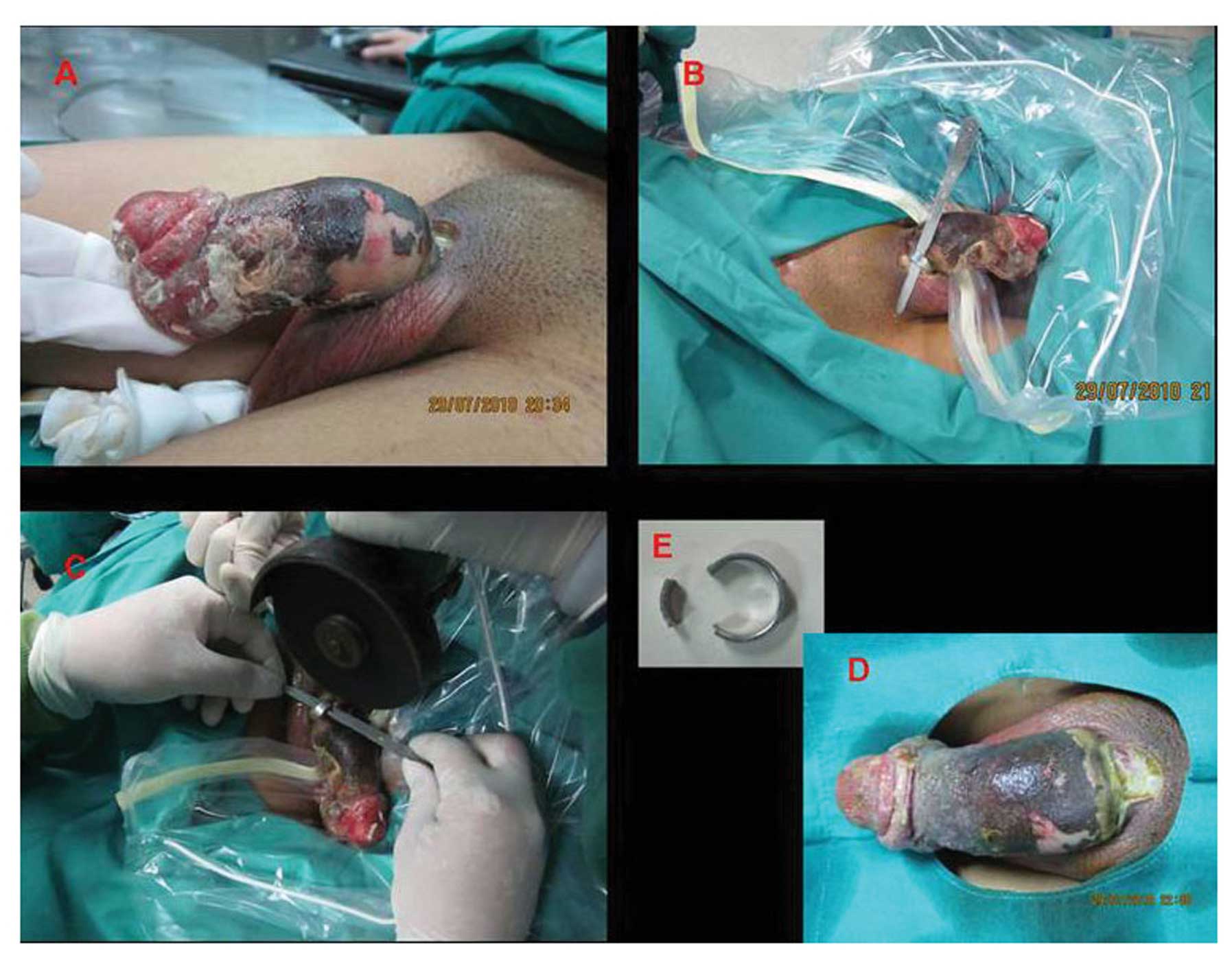
Among the admitted patients, a 72-year-old patient with penile strangulation (duration, 1 month) presented with evident penile edema; however, cutaneous necrosis had not occurred due to the small diameter of the penis. In addition, a 22-year-old patient with penile strangulation (duration, 5 days) presented with a penis that was dark purple in color, with serious cutaneous necrosis and desquamation (Fig. 1A).

Figure 1

Penile strangulation and removal of steel hoop. (A) Patient with penis strangulation (duration, 5 days) caused by steel hoop on the base of the penis. (B) A metallic strip was placed between the hoop and the penis to protect the skin. (C) The steel hoop was cut with a motor-operated emery wheel machine. (D) Penis following removal and (E) the removed constricting object.

Surgery procedure

All the patients were administered a tetanus injection and were subsequently transferred to an emergency operation room; a team of urologists and a technician carried out the removal procedure. Following anesthesia, a metallic strip was placed between the metal hoop and the penis to protect the skin (Fig. 1B). To remove the steel hoop, a motor-operated emery wheel machine was used to create intermittent cuts at two points of the hoop, which was subsequently removed from the penis (Fig. 1C) (Chong Chuan Qu Cheng Bang Power Tools Factory, Nantong, China). Care was required when using the machine, particularly with regard to the following points: i) The patients required a protector to be placed with both ends over the rim of the inner edge of the hoop to prevent damage to the skin and ii) constant rinsing with iced physiological saline was required to prevent the skin from burning.

Results

The mean operation duration was 36 min. In the case of the 22-year-old patient (penile strangulation duration, 5 days), the removed constricting steel hoop was 16–20 mm in external diameter (Fig. 1D and E). The metal hoops were successfully removed from all the patients, without gangrene of the penis. All the patients were discharged 2–27 days after the original procedure, with a satisfactory outcome. No dysuria or erectile dysfunction was identified during the 3-month follow-up period.

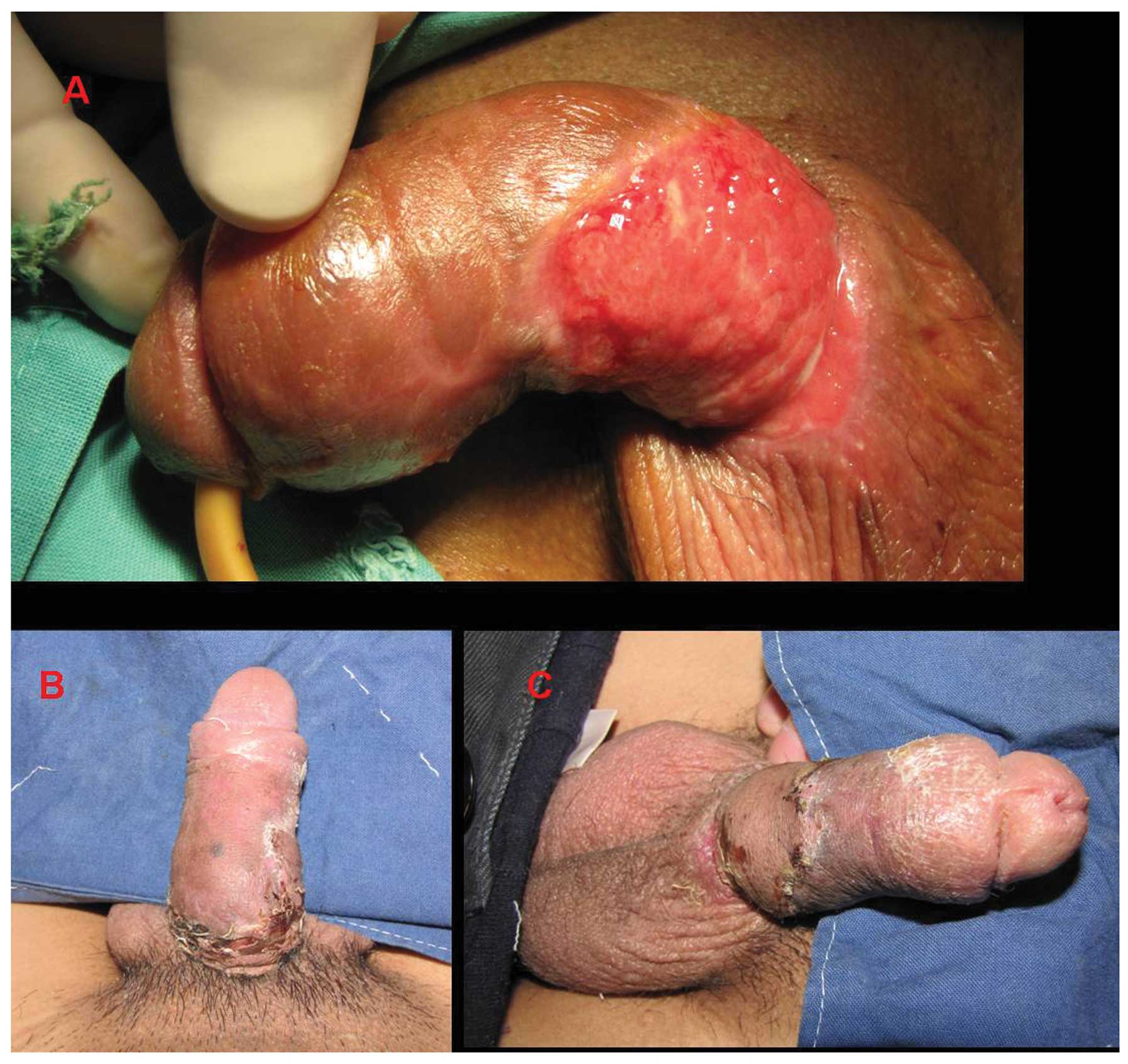
Due to the serious injury of the skin at the root of penis (Fig. 2A) of the 22-year-old patient (penile strangulation duration, 5 days), an intermediate split-thickness thigh skin graft was used to repair the skin loss in the Department of Orthopedics of our hospital at day 20 following the procedure. The patient was discharged after 27 days with a satisfactory outcome (Fig. 2B and C).

Figure 2

(A) Serious injury of the skin at the root of penis prior to skin grafting; (B and C) The penis following skin grafting.

Discussion

Chronic penile strangulation by the same mechanism is extremely rare, and only 6 cases have been previously reported (20). This is usually caused by the inappropriate use of devices, developed for autoerotic purposes or to prolong erection, which may be regularly acquired at specialized shops.

Non-metal or thin metal rings are easily removable by severing, but heavy metal rings pose a challenge to emergency physicians and urologists. Various procedures depending on the constricting object have been described for removal (20–23). These include the common metal ring cutter, cutting nippers, metal saw, high-speed drill and string method. Removal is usually performed under anesthesia and the urologist should remove the ring with great care to avoid iatrogenic injury to the external genitalia. Furthermore, removal of these objects may be challenging and require equipment that is not directly available in a urology department. The tools and mechanical methods used are typically selected according to the specific condition (24). In the present study, a motor-operated emery wheel machine was used to cut the steel hoop in two spots; this was provided by the mechanical workers. The metal hoop required a protector to be placed with both ends over the rim of the inner edge of the hoop to prevent damage to the skin.

A grinder, hacksaw, fret-saw or emery wheel machine are tools that are frequently selected to sever a metal object constricting the penis; as a result, significant heat may be produced during the cutting procedure (25). In the present study, to prevent heat damage to the tissue beneath the cutting point, iced physiological saline was applied locally, and rinsing was applied while the preoperative preparations were proceeding. Lower temperatures applied locally protected the tissue by decreasing ischemic-reperfusion injury. The benefit of low temperature locally in the management of penile strangulation requires further evaluation.

When removal of the strangulation object is not possible by any of the aforementioned methods due to the size of the object and/or increased edema, the penis may be denuded, and postoperative treatment follows the principles of severe traumatic penile and scrotal avulsion, including skin grafting (12,13) or the use of a myofascial flap for construction of a neoglans penis (26). Vähäsarja et al(8) described a string method with a glandular incision, which was more simple and rapid compared with previously used methods for removing thick and hardened steel. In the present study, due to the serious injury of the skin at the root of the penis, an intermediate split-thickness thigh skin graft was used to repair the skin loss. No erectile dysfunction was identified during the 3-month follow-up period.

Following the removal of the object, the urethra requires radiological evaluation, particularly in cases where the device has cut through the skin and/or caused ulceration. In such cases, the value of methylene blue in aiding the localization of urethral injury is well recognized (27).

When this is not possible, urinary drainage may be provided by suprapubic tube prior to removal, or urethral catheterization following removal of the strangulation object. Penile block with local anesthetic may improve patient comfort during removal. Patient preparation with parenteral pain medication, tetanus prophylaxis and antibiotics should be considered. Tetanus prophylaxis and pain control has received limited attention in the treatment of penile strangulation in China.

In conclusion, penile incarceration is an urgent matter, with potentially severe clinical consequences. With rapid intervention and removal of the foreign body, a successful outcome may be achieved and no further intervention is required. Early and effective treatment is essential to avoid potential complications, including ischemic necrosis and autoamputation.

Acknowledgements

This study was supported by the National Natural Science Foundation of China (grant no. 30901503).

References

1 

Gauthier M: Strangulating agents used on the penis, an important cause of gangrene. J Med Chir Pharmacol (Paris). 3:3581755.(In French).

2 

Singh B, Kim H and Wax SH: Strangulation of glans penis by hair. Urology. 11:170–172. 1978. View Article : Google Scholar : PubMed/NCBI

3 

Ehrich WS: Two unusual penile injuries. J Urol. 21:239–241. 1929.

4 

Harrow B: Strangulation of penis by a hidden thread. JAMA. 199:1351967. View Article : Google Scholar : PubMed/NCBI

5 

Pantuck AJ, Kraus SL and Barone JG: Hair strangulation injury of the penis. Pediatr Emerg Care. 13:423–424. 1997. View Article : Google Scholar : PubMed/NCBI

6 

Alpert JJ, Filler R and Glaser HH: Strangulation of an appendage by hair wrapping. N Engl J Med. 273:866–867. 1965. View Article : Google Scholar : PubMed/NCBI

7 

Markland C and Merrill D: Accidental penile gangrene. J Urol. 108:494–495. 1972.PubMed/NCBI

8 

Vähäsarja VJ, Hellström PA, Serlo W and Kontturi MJ: Treatment of penile incarceration by the string method: 2 case reports. J Urol. 149:372–373. 1993.PubMed/NCBI

9 

Hoffman HA and Colby FH: Incarceration of the penis. J Urol. 54:391–399. 1945.

10 

Stephens JRW: Penis captivus. Br Med J. 1:6621921.

11 

Sinha BB: Penile incarceration by a metallic object. Br J Surg. 75:331988. View Article : Google Scholar : PubMed/NCBI

12 

Tiwari VS, Razdan JL and Yadav VN: Strangulation of the penis by a metallic nut. Int Surg. 62:558–560. 1977.PubMed/NCBI

13 

Schellhammer P and Donnelly J: A mode of treatment for incarceration of the penis. J Trauma. 13:171–173. 1973. View Article : Google Scholar : PubMed/NCBI

14 

Lopes RI, Lopes SI and Lopes RN: Chronic penile strangulation. Int Braz J Urol. 29:327–329. 2003. View Article : Google Scholar : PubMed/NCBI

15 

Mark SD and Gray JM: Iatrogenic penile foreign body. Br J Urol. 67:555–556. 1991. View Article : Google Scholar : PubMed/NCBI

16 

Akkus E, Iscimen A, Tasli L and Hattal H: Paraffinoma and ulcer of the external genitalia after self-injection of vaseline. J Sex Med. 3:170–172. 2006. View Article : Google Scholar : PubMed/NCBI

17 

Stuppler SA, Walker JG, Kandzari SJ and Milam DF: Incarceration of penis by foreign body. Urology. 2:308–309. 1973. View Article : Google Scholar : PubMed/NCBI

18 

Tanabe N, Muya M, Isonokami M, Kozuka T, Honda T and Ohtani H: Lymphedema due to chronic penile strangulation: a case report. J Dermatol. 23:648–651. 1996.PubMed/NCBI

19 

Sowery RD, Beiko DT and Heaton JP: Long-term penile incarceration by a metal ring resulting in urethral erosion and chronic lymphedema. Can J Urol. 11:2167–2168. 2004.PubMed/NCBI

20 

Ivanovski O, Stankov O, Kuzmanoski M, Saidi S, Banev S, Filipovski V, Lekovski L and Popov Z: Penile strangulation: two case reports and review of the literature. J Sex Med. 4:1775–1780. 2007. View Article : Google Scholar : PubMed/NCBI

21 

Dar NR, Siddiqui S, Qayyum R and Ghafoor T: Hair coil strangulation - an uncommon cause of penile edema. Pediatr Dermatol. 24:33–35. 2007. View Article : Google Scholar : PubMed/NCBI

22 

Noh J, Kang TW, Heo T, Kwon DD, Park K and Ryu SB: Penile strangulation treated with the modified string method. Urology. 64:5912004. View Article : Google Scholar : PubMed/NCBI

23 

Santucci RA, Deng D and Carney J: Removal of metal penile foreign body with a widely available emergency-medical-services-provided air-driven grinder. Urology. 63:1183–1184. 2004. View Article : Google Scholar : PubMed/NCBI

24 

Perabo FG, Steiner G, Albers P and Müller SC: Treatment of penile strangulation caused by constricting devices. Urology. 59:137–139. 2002. View Article : Google Scholar : PubMed/NCBI

25 

Xu T, Gu M and Wang H: Emergency management of penile strangulation: a case report and review of the Chinese literature. Emerg Med J. 26:73–74. 2009. View Article : Google Scholar : PubMed/NCBI

26 

Shaeer O and El-Sebaie A: Construction of neoglans penis: a new sculpturing technique from rectus abdominis myofascial flap. J Sex Med. 2:259–265. 2005. View Article : Google Scholar : PubMed/NCBI

27 

Shaeer O: Methylene blue-guided repair of fractured penis. J Sex Med. 3:349–354. 2006. View Article : Google Scholar : PubMed/NCBI

Related Articles

  • Abstract
  • View
  • Download
  • Twitter
Copy and paste a formatted citation
Spandidos Publications style
Li C, Xu Y, Chen R and Deng C: An effective treatment for penile strangulation. Mol Med Rep 8: 201-204, 2013.
APA
Li, C., Xu, Y., Chen, R., & Deng, C. (2013). An effective treatment for penile strangulation. Molecular Medicine Reports, 8, 201-204. https://doi.org/10.3892/mmr.2013.1456
MLA
Li, C., Xu, Y., Chen, R., Deng, C."An effective treatment for penile strangulation". Molecular Medicine Reports 8.1 (2013): 201-204.
Chicago
Li, C., Xu, Y., Chen, R., Deng, C."An effective treatment for penile strangulation". Molecular Medicine Reports 8, no. 1 (2013): 201-204. https://doi.org/10.3892/mmr.2013.1456
Copy and paste a formatted citation
x
Spandidos Publications style
Li C, Xu Y, Chen R and Deng C: An effective treatment for penile strangulation. Mol Med Rep 8: 201-204, 2013.
APA
Li, C., Xu, Y., Chen, R., & Deng, C. (2013). An effective treatment for penile strangulation. Molecular Medicine Reports, 8, 201-204. https://doi.org/10.3892/mmr.2013.1456
MLA
Li, C., Xu, Y., Chen, R., Deng, C."An effective treatment for penile strangulation". Molecular Medicine Reports 8.1 (2013): 201-204.
Chicago
Li, C., Xu, Y., Chen, R., Deng, C."An effective treatment for penile strangulation". Molecular Medicine Reports 8, no. 1 (2013): 201-204. https://doi.org/10.3892/mmr.2013.1456
Follow us
  • Twitter
  • LinkedIn
  • Facebook
About
  • Spandidos Publications
  • Careers
  • Cookie Policy
  • Privacy Policy
How can we help?
  • Help
  • Live Chat
  • Contact
  • Email to our Support Team