Spandidos Publications Logo
  • About
    • About Spandidos
    • Aims and Scopes
    • Abstracting and Indexing
    • Editorial Policies
    • Reprints and Permissions
    • Job Opportunities
    • Terms and Conditions
    • Contact
  • Journals
    • All Journals
    • Oncology Letters
      • Oncology Letters
      • Information for Authors
      • Editorial Policies
      • Editorial Board
      • Aims and Scope
      • Abstracting and Indexing
      • Bibliographic Information
      • Archive
    • International Journal of Oncology
      • International Journal of Oncology
      • Information for Authors
      • Editorial Policies
      • Editorial Board
      • Aims and Scope
      • Abstracting and Indexing
      • Bibliographic Information
      • Archive
    • Molecular and Clinical Oncology
      • Molecular and Clinical Oncology
      • Information for Authors
      • Editorial Policies
      • Editorial Board
      • Aims and Scope
      • Abstracting and Indexing
      • Bibliographic Information
      • Archive
    • Experimental and Therapeutic Medicine
      • Experimental and Therapeutic Medicine
      • Information for Authors
      • Editorial Policies
      • Editorial Board
      • Aims and Scope
      • Abstracting and Indexing
      • Bibliographic Information
      • Archive
    • International Journal of Molecular Medicine
      • International Journal of Molecular Medicine
      • Information for Authors
      • Editorial Policies
      • Editorial Board
      • Aims and Scope
      • Abstracting and Indexing
      • Bibliographic Information
      • Archive
    • Biomedical Reports
      • Biomedical Reports
      • Information for Authors
      • Editorial Policies
      • Editorial Board
      • Aims and Scope
      • Abstracting and Indexing
      • Bibliographic Information
      • Archive
    • Oncology Reports
      • Oncology Reports
      • Information for Authors
      • Editorial Policies
      • Editorial Board
      • Aims and Scope
      • Abstracting and Indexing
      • Bibliographic Information
      • Archive
    • Molecular Medicine Reports
      • Molecular Medicine Reports
      • Information for Authors
      • Editorial Policies
      • Editorial Board
      • Aims and Scope
      • Abstracting and Indexing
      • Bibliographic Information
      • Archive
    • World Academy of Sciences Journal
      • World Academy of Sciences Journal
      • Information for Authors
      • Editorial Policies
      • Editorial Board
      • Aims and Scope
      • Abstracting and Indexing
      • Bibliographic Information
      • Archive
    • International Journal of Functional Nutrition
      • International Journal of Functional Nutrition
      • Information for Authors
      • Editorial Policies
      • Editorial Board
      • Aims and Scope
      • Abstracting and Indexing
      • Bibliographic Information
      • Archive
    • International Journal of Epigenetics
      • International Journal of Epigenetics
      • Information for Authors
      • Editorial Policies
      • Editorial Board
      • Aims and Scope
      • Abstracting and Indexing
      • Bibliographic Information
      • Archive
    • Medicine International
      • Medicine International
      • Information for Authors
      • Editorial Policies
      • Editorial Board
      • Aims and Scope
      • Abstracting and Indexing
      • Bibliographic Information
      • Archive
  • Articles
  • Information
    • Information for Authors
    • Information for Reviewers
    • Information for Librarians
    • Information for Advertisers
    • Conferences
  • Language Editing
Spandidos Publications Logo
  • About
    • About Spandidos
    • Aims and Scopes
    • Abstracting and Indexing
    • Editorial Policies
    • Reprints and Permissions
    • Job Opportunities
    • Terms and Conditions
    • Contact
  • Journals
    • All Journals
    • Biomedical Reports
      • Information for Authors
      • Editorial Policies
      • Editorial Board
      • Aims and Scope
      • Abstracting and Indexing
      • Bibliographic Information
      • Archive
    • Experimental and Therapeutic Medicine
      • Information for Authors
      • Editorial Policies
      • Editorial Board
      • Aims and Scope
      • Abstracting and Indexing
      • Bibliographic Information
      • Archive
    • International Journal of Epigenetics
      • Information for Authors
      • Editorial Policies
      • Editorial Board
      • Aims and Scope
      • Abstracting and Indexing
      • Bibliographic Information
      • Archive
    • International Journal of Functional Nutrition
      • Information for Authors
      • Editorial Policies
      • Editorial Board
      • Aims and Scope
      • Abstracting and Indexing
      • Bibliographic Information
      • Archive
    • International Journal of Molecular Medicine
      • Information for Authors
      • Editorial Policies
      • Editorial Board
      • Aims and Scope
      • Abstracting and Indexing
      • Bibliographic Information
      • Archive
    • International Journal of Oncology
      • Information for Authors
      • Editorial Policies
      • Editorial Board
      • Aims and Scope
      • Abstracting and Indexing
      • Bibliographic Information
      • Archive
    • Medicine International
      • Information for Authors
      • Editorial Policies
      • Editorial Board
      • Aims and Scope
      • Abstracting and Indexing
      • Bibliographic Information
      • Archive
    • Molecular and Clinical Oncology
      • Information for Authors
      • Editorial Policies
      • Editorial Board
      • Aims and Scope
      • Abstracting and Indexing
      • Bibliographic Information
      • Archive
    • Molecular Medicine Reports
      • Information for Authors
      • Editorial Policies
      • Editorial Board
      • Aims and Scope
      • Abstracting and Indexing
      • Bibliographic Information
      • Archive
    • Oncology Letters
      • Information for Authors
      • Editorial Policies
      • Editorial Board
      • Aims and Scope
      • Abstracting and Indexing
      • Bibliographic Information
      • Archive
    • Oncology Reports
      • Information for Authors
      • Editorial Policies
      • Editorial Board
      • Aims and Scope
      • Abstracting and Indexing
      • Bibliographic Information
      • Archive
    • World Academy of Sciences Journal
      • Information for Authors
      • Editorial Policies
      • Editorial Board
      • Aims and Scope
      • Abstracting and Indexing
      • Bibliographic Information
      • Archive
  • Articles
  • Information
    • For Authors
    • For Reviewers
    • For Librarians
    • For Advertisers
    • Conferences
  • Language Editing
Login Register Submit
  • This site uses cookies
  • You can change your cookie settings at any time by following the instructions in our Cookie Policy. To find out more, you may read our Privacy Policy.

    I agree
Search articles by DOI, keyword, author or affiliation
Search
Advanced Search
presentation
Molecular Medicine Reports
Join Editorial Board Propose a Special Issue
Print ISSN: 1791-2997 Online ISSN: 1791-3004
Journal Cover
July 2013 Volume 8 Issue 1

Full Size Image

Sign up for eToc alerts
Recommend to Library

Journals

International Journal of Molecular Medicine

International Journal of Molecular Medicine

International Journal of Molecular Medicine is an international journal devoted to molecular mechanisms of human disease.

International Journal of Oncology

International Journal of Oncology

International Journal of Oncology is an international journal devoted to oncology research and cancer treatment.

Molecular Medicine Reports

Molecular Medicine Reports

Covers molecular medicine topics such as pharmacology, pathology, genetics, neuroscience, infectious diseases, molecular cardiology, and molecular surgery.

Oncology Reports

Oncology Reports

Oncology Reports is an international journal devoted to fundamental and applied research in Oncology.

Experimental and Therapeutic Medicine

Experimental and Therapeutic Medicine

Experimental and Therapeutic Medicine is an international journal devoted to laboratory and clinical medicine.

Oncology Letters

Oncology Letters

Oncology Letters is an international journal devoted to Experimental and Clinical Oncology.

Biomedical Reports

Biomedical Reports

Explores a wide range of biological and medical fields, including pharmacology, genetics, microbiology, neuroscience, and molecular cardiology.

Molecular and Clinical Oncology

Molecular and Clinical Oncology

International journal addressing all aspects of oncology research, from tumorigenesis and oncogenes to chemotherapy and metastasis.

World Academy of Sciences Journal

World Academy of Sciences Journal

Multidisciplinary open-access journal spanning biochemistry, genetics, neuroscience, environmental health, and synthetic biology.

International Journal of Functional Nutrition

International Journal of Functional Nutrition

Open-access journal combining biochemistry, pharmacology, immunology, and genetics to advance health through functional nutrition.

International Journal of Epigenetics

International Journal of Epigenetics

Publishes open-access research on using epigenetics to advance understanding and treatment of human disease.

Medicine International

Medicine International

An International Open Access Journal Devoted to General Medicine.

Journal Cover
July 2013 Volume 8 Issue 1

Full Size Image

Sign up for eToc alerts
Recommend to Library

  • Article
  • Citations
    • Cite This Article
    • Download Citation
    • Create Citation Alert
    • Remove Citation Alert
    • Cited By
  • Similar Articles
    • Related Articles (in Spandidos Publications)
    • Similar Articles (Google Scholar)
    • Similar Articles (PubMed)
  • Download PDF
  • Download XML
  • View XML
Article

A248, a novel synthetic HDAC inhibitor, induces apoptosis through the inhibition of specificity protein 1 and its downstream proteins in human prostate cancer cells

  • Authors:
    • Eun-Sun Choi
    • Gyoonhee Han
    • Song-Kyu Park
    • Kiho Lee
    • Hyun-Jung Kim
    • Sung-Dae Cho
    • Hwan Mook Kim
  • View Affiliations / Copyright

    Affiliations: Department of Oral Pathology, School of Dentistry and Institute of Oral Bioscience, Brain Korea 21 Project, Chonbuk National University, Jeonju 561-756, Republic of Korea, Translational Research Center for Protein Function Control (TRCP), Department of Biotechnology and Department of Biomedical Sciences (WCU Program), Yonsei University, Seoul 120-749, Republic of Korea , College of Pharmacy, Korea University, Sejong 339-700, Republic of Korea, BioRunx Co., Ltd., Huengduk-gu, Cheongju 361-763, Republic of Korea, Gachon Institute of Pharmaceutical Sciences, Gachon University, Yeonsu-gu, Incheon 406-840, Republic of Korea
  • Pages: 195-200
    |
    Published online on: May 16, 2013
       https://doi.org/10.3892/mmr.2013.1481
  • Expand metrics +
Metrics: Total Views: 0 (Spandidos Publications: | PMC Statistics: )
Metrics: Total PDF Downloads: 0 (Spandidos Publications: | PMC Statistics: )
Cited By (CrossRef): 0 citations Loading Articles...

This article is mentioned in:


Abstract

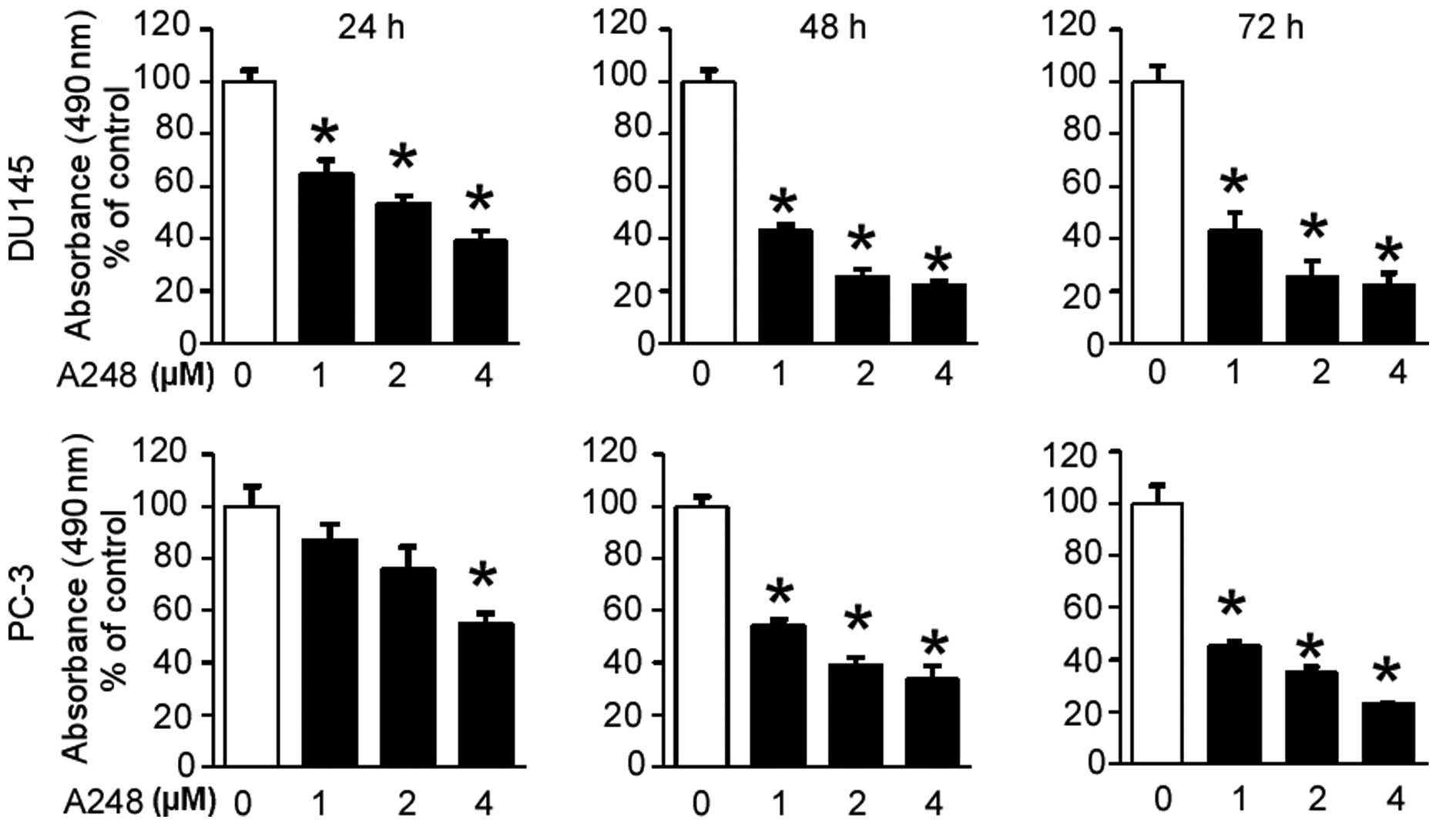
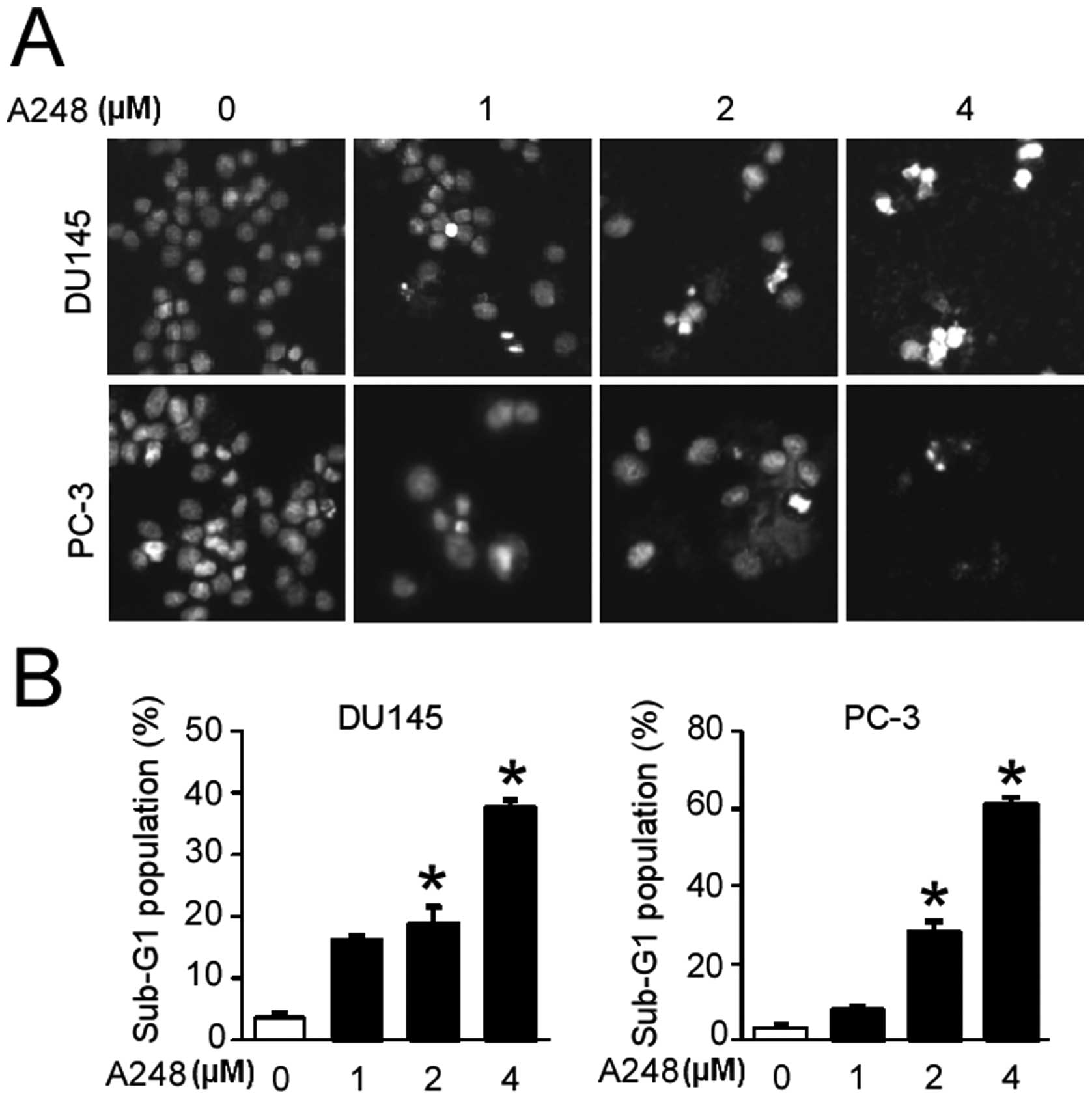
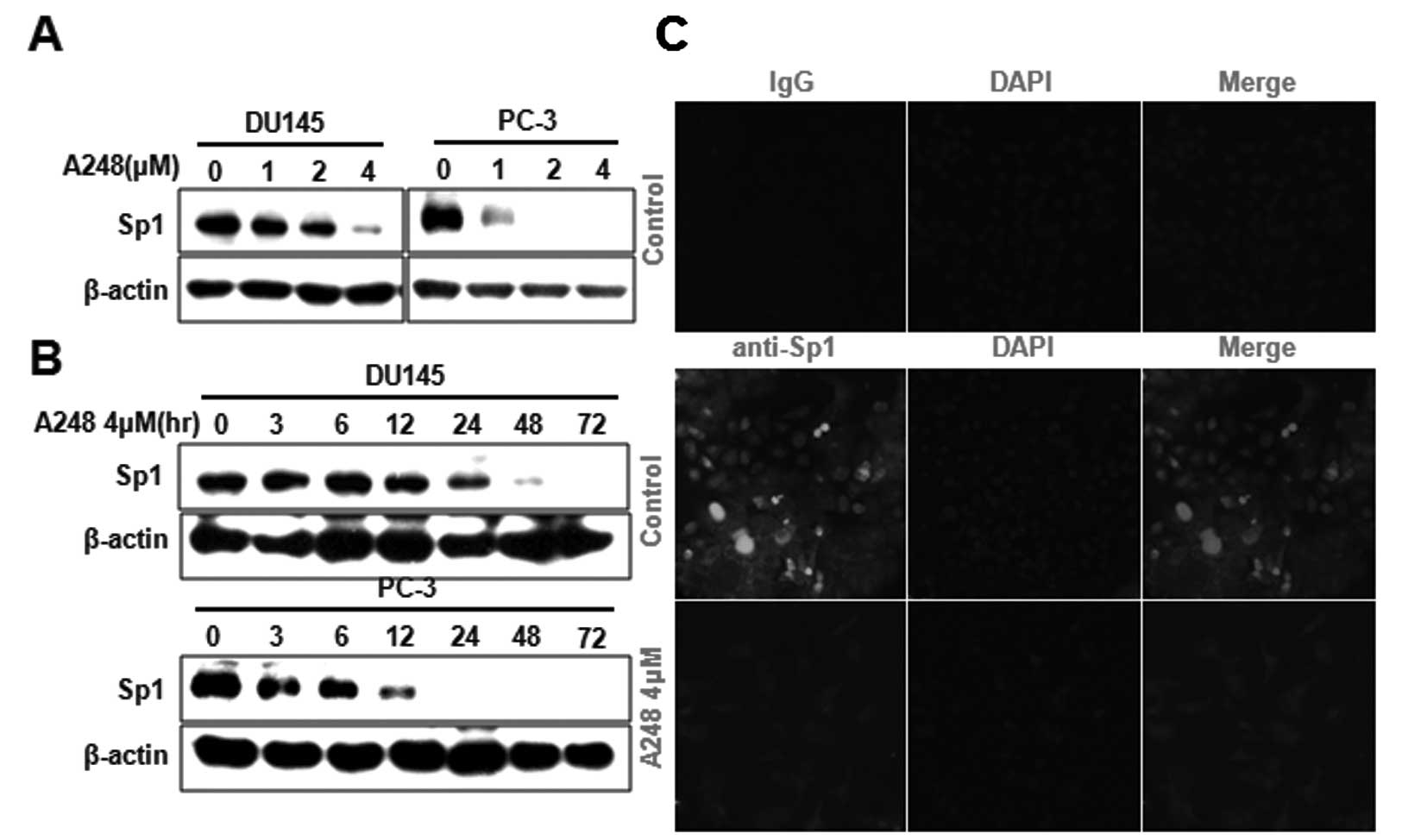
Histone deacetylase (HDAC) inhibitors are emerging as potent anticancer agents due to their ability to induce apoptosis in various cancer cells, including prostate cancer cells. In the present study, we synthesized a novel HDAC inhibitor, A248, and investigated its apoptotic activity and molecular target in the DU145 and PC3 human prostate cancer cell lines. A248 inhibited the growth of DU145 and PC3 cells and induced apoptosis, as demonstrated by nuclear fragmentation and the accumulation of cells at subG1 phase of cell cycle. The treatment of DU145 and PC3 prostate cancer cells with A248 resulted in the downregulation of specificity protein 1 (Sp1) expression. Since the expression levels of survivin and Mcl-1 depend on Sp1, we also investigated the effects of A248 on survivin and Mcl-1 expression using western blot analysis and immunocytochemistry. The results showed that A248 markedly decreased the expression of survivin and Mcl-1. These data suggest that A248 has apoptotic activity in human prostate cancer cells and that Sp1 may be the molecular target of A248 treatment for inducing apoptosis in prostate cancer cells.
View Figures

Figure 1

Figure 2

Figure 3

Figure 4

View References

1 

Alshatwi AA, Hasan TN, Shafi G, Syed NA, Al-Assaf AH, Alamri MS and Al-Khalifa AS: Validation of the antiproliferative effects of organic extracts from the green husk of Juglans regia L. on PC3 human prostate cancer cells by assessment of apoptosis-related genes. Evid Based Complement Alternat Med. 2012:Feb 6–2012.(Epub ahead of print).

2 

Malek A, Núñez LE, Magistri M, et al: Modulation of the activity of Sp transcription factors by mithramycin analogues as a new strategy for treatment of metastatic prostate cancer. PLoS One. 7:e351302012. View Article : Google Scholar : PubMed/NCBI

3 

Soriano-Hernández AD, Galvan-Salazar HR, Montes-Galindo DA, et al: Antitumor effect of meclofenamic acid on human androgen-independent prostate cancer: a preclinical evaluation. Int Urol Nephrol. 44:471–477. 2012.PubMed/NCBI

4 

Sankpal UT, Abdelrahim M, Connelly SF, et al: Small molecule tolfenamic acid inhibits PC3 cell proliferation and invasion in vitro, and tumor growth in orthotopic mouse model for prostate cancer. Prostate. 72:1648–1658. 2012. View Article : Google Scholar : PubMed/NCBI

5 

Lou Z, O’Reilly S, Liang H, Maher VM, Sleight SD and McCormick JJ: Down-regulation of overexpressed sp1 protein in human fibrosarcoma cell lines inhibits tumor formation. Cancer Res. 65:1007–1017. 2005.PubMed/NCBI

6 

Chintharlapalli S, Papineni S, Ramaiah SK and Safe S: Betulinic acid inhibits prostate cancer growth through inhibition of specificity protein transcription factors. Cancer Res. 67:2816–2823. 2007. View Article : Google Scholar : PubMed/NCBI

7 

Choi ES, Shim JH, Jung JY, et al: Apoptotic effect of tolfenamic acid in androgen receptor-independent prostate cancer cell and xenograft tumor through specificity protein 1. Cancer Sci. 102:742–748. 2011. View Article : Google Scholar : PubMed/NCBI

8 

Shim JH, Shin JA, Jung JY, et al: Chemopreventive effect of tolfenamic acid on KB human cervical cancer cells and tumor xenograft by downregulating specificity protein 1. Eur J Cancer Prev. 20:102–111. 2011. View Article : Google Scholar : PubMed/NCBI

9 

Zhang CZ, Pan Y, Cao Y, Lai PB, Liu L, Chen GG and Yun J: Histone deacetylase inhibitors facilitate dihydroartemisinin-induced apoptosis in liver cancer in vitro and in vivo. PLoS One. 7:e398702012. View Article : Google Scholar : PubMed/NCBI

10 

Roh MS, Kim CW, Park BS, et al: Mechanism of histone deacetylase inhibitor Trichostatin A induced apoptosis in human osteosarcoma cells. Apoptosis. 9:583–589. 2004. View Article : Google Scholar : PubMed/NCBI

11 

Vallo S, Mani J, Stastny M, et al: The prostate cancer blocking potential of the histone deacetylase inhibitor LBH589 is not enhanced by the multi receptor tyrosine kinase inhibitor TKI258. Invest New Drugs. 31:265–272. 2013. View Article : Google Scholar : PubMed/NCBI

12 

Rikiishi H: Autophagic and apoptotic effects of HDAC inhibitors on cancer cells. J Biomed Biotechnol. 2011:May 18–2011.(Epub ahead of print).

13 

Perego P, Zuco V, Gatti L and Zunino F: Sensitization of tumor cells by targeting histone deacetylases. Biochem Pharmacol. 83:987–994. 2012. View Article : Google Scholar : PubMed/NCBI

14 

Khan O and La Thangue NB: HDAC inhibitors in cancer biology: emerging mechanisms and clinical applications. Immunol Cell Biol. 90:85–94. 2012. View Article : Google Scholar : PubMed/NCBI

15 

Marks PA: The clinical development of histone deacetylase inhibitors as targeted anticancer drugs. Expert Opin Investig Drugs. 19:1049–1066. 2010. View Article : Google Scholar : PubMed/NCBI

16 

Chou YW, Chaturvedi NK, Ouyang S, et al: Histone deacetylase inhibitor valproic acid suppresses the growth and increases the androgen responsiveness of prostate cancer cells. Cancer Lett. 311:177–186. 2011. View Article : Google Scholar : PubMed/NCBI

17 

Hudak L, Tezeeh P, Wedel S, et al: Low dosed interferon alpha augments the anti-tumor potential of histone deacetylase inhibition on prostate cancer cell growth and invasion. Prostate. 72:1719–1735. 2012. View Article : Google Scholar : PubMed/NCBI

18 

Kim NH, Kim SN and Kim YK: Involvement of HDAC1 in E-cadherin expression in prostate cancer cells; its implication for cell motility and invasion. Biochem Biophys Res Commun. 404:915–921. 2011. View Article : Google Scholar : PubMed/NCBI

19 

Gravina GL, Marampon F, Giusti I, et al: Differential effects of PXD101 (belinostat) on androgen-dependent and androgen-independent prostate cancer models. Int J Oncol. 40:711–720. 2012.PubMed/NCBI

20 

Zhou X, Yang XY and Popescu NC: Preclinical evaluation of combined antineoplastic effect of DLC1 tumor suppressor protein and suberoylanilide hydroxamic acid on prostate cancer cells. Biochem Biophys Res Commun. 420:325–330. 2012. View Article : Google Scholar

21 

Lai MT, Yang CC, Lin TY, Tsai FJ and Chen WC: Depsipeptide (FK228) inhibits growth of human prostate cancer cells. Urol Oncol. 26:182–189. 2008. View Article : Google Scholar : PubMed/NCBI

22 

Bjorkman M, Iljin K, Halonen P, Sara H, Kaivanto E, Nees M and Kallioniemi OP: Defining the molecular action of HDAC inhibitors and synergism with androgen deprivation in ERG-positive prostate cancer. Int J Cancer. 123:2774–2781. 2008. View Article : Google Scholar : PubMed/NCBI

23 

Abdelrahim M, Smith R 3rd, Burghardt R and Safe S: Role of Sp proteins in regulation of vascular endothelial growth factor expression and proliferation of pancreatic cancer cells. Cancer Res. 64:6740–6749. 2004. View Article : Google Scholar : PubMed/NCBI

24 

Abdelrahim M, Samudio I, Smith R 3rd, Burghardt R and Safe S: Small inhibitory RNA duplexes for Sp1 mRNA block basal and estrogen-induced gene expression and cell cycle progression in MCF-7 breast cancer cells. J Biol Chem. 277:28815–28822. 2002. View Article : Google Scholar : PubMed/NCBI

25 

Safe S and Abdelrahim M: Sp transcription factor family and its role in cancer. Eur J Cancer. 41:2438–2448. 2005. View Article : Google Scholar : PubMed/NCBI

26 

Yao JC, Wang L, Wei D, et al: Association between expression of transcription factor Sp1 and increased vascular endothelial growth factor expression, advanced stage, and poor survival in patients with resected gastric cancer. Clin Cancer Res. 10:4109–4117. 2004. View Article : Google Scholar

27 

Wang L, Wei D, Huang S, et al: Transcription factor Sp1 expression is a significant predictor of survival in human gastric cancer. Clin Cancer Res. 9:6371–6380. 2003.PubMed/NCBI

28 

Zannetti A, Del Vecchio S, Carriero MV, et al: Coordinate up-regulation of Sp1 DNA-binding activity and urokinase receptor expression in breast carcinoma. Cancer Res. 60:1546–1551. 2000.PubMed/NCBI

29 

Hosoi Y, Watanabe T, Nakagawa K, et al: Up-regulation of DNA-dependent protein kinase activity and Sp1 in colorectal cancer. Int J Oncol. 25:461–468. 2004.PubMed/NCBI

30 

Ishibashi H, Nakagawa K, Onimaru M, et al: Sp1 decoy transfected to carcinoma cells suppresses the expression of vascular endothelial growth factor, transforming growth factor beta1, and tissue factor and also cell growth and invasion activities. Cancer Res. 60:6531–6536. 2000.

31 

Chadalapaka G, Jutooru I, Chintharlapalli S, Papineni S, Smith R 3rd, Li X and Safe S: Curcumin decreases specificity protein expression in bladder cancer cells. Cancer Res. 68:5345–5354. 2008. View Article : Google Scholar : PubMed/NCBI

32 

Jutooru I, Chadalapaka G, Lei P and Safe S: Inhibition of NFkappaB and pancreatic cancer cell and tumor growth by curcumin is dependent on specificity protein down-regulation. J Biol Chem. 285:25332–25344. 2010. View Article : Google Scholar : PubMed/NCBI

33 

Chu S and Ferro TJ: Sp1: regulation of gene expression by phosphorylation. Gene. 348:1–11. 2005. View Article : Google Scholar : PubMed/NCBI

34 

Deniaud E, Baguet J, Chalard R, et al: Overexpression of transcription factor Sp1 leads to gene expression perturbations and cell cycle inhibition. PLoS One. 4:e70352009. View Article : Google Scholar : PubMed/NCBI

35 

Choi KH, Shim JH, Huong LD, Cho NP and Cho SD: Inhibition of myeloid cell leukemia-1 by tolfenamic acid induces apoptosis in mucoepidermoid carcinoma. Oral Dis. 17:469–475. 2011. View Article : Google Scholar : PubMed/NCBI

36 

Yu DC, Waby JS, Chirakkal H, Staton CA and Corfe BM: Butyrate suppresses expression of neuropilin I in colorectal cell lines through inhibition of Sp1 transactivation. Mol Cancer. 9:2762010. View Article : Google Scholar : PubMed/NCBI

37 

Xu J, Zhou JY, Wei WZ, Philipsen S and Wu GS: Sp1-mediated TRAIL induction in chemosensitization. Cancer Res. 68:6718–6726. 2008. View Article : Google Scholar : PubMed/NCBI

38 

Kadonaga JT, Courey AJ, Ladika J and Tjian R: Distinct regions of Sp1 modulate DNA binding and transcriptional activation. Science. 242:1566–1570. 1988. View Article : Google Scholar : PubMed/NCBI

39 

Pietrzak M and Puzianowska-Kuznicka M: p53-dependent repression of the human MCL-1 gene encoding an anti-apoptotic member of the BCL-2 family: the role of Sp1 and of basic transcription factor binding sites in the MCL-1 promoter. Biol Chem. 389:383–393. 2008. View Article : Google Scholar : PubMed/NCBI

40 

Li F and Altieri DC: Transcriptional analysis of human survivin gene expression. Biochem J. 344:305–311. 1999. View Article : Google Scholar

41 

Li Y, Xie M, Yang J, Yang D, Deng R, Wan Y and Yan B: The expression of antiapoptotic protein survivin is transcriptionally upregulated by DEC1 primarily through multiple sp1 binding sites in the proximal promoter. Oncogene. 25:3296–3306. 2006. View Article : Google Scholar : PubMed/NCBI

42 

Wu J, Ling X, Pan D, et al: Molecular mechanism of inhibition of survivin transcription by the GC-rich sequence-selective DNA binding antitumor agent, hedamycin: evidence of survivin down-regulation associated with drug sensitivity. J Biol Chem. 280:9745–9751. 2005. View Article : Google Scholar

Related Articles

  • Abstract
  • View
  • Download
  • Twitter
Copy and paste a formatted citation
Spandidos Publications style
Choi E, Han G, Park S, Lee K, Kim H, Cho S and Kim HM: A248, a novel synthetic HDAC inhibitor, induces apoptosis through the inhibition of specificity protein 1 and its downstream proteins in human prostate cancer cells. Mol Med Rep 8: 195-200, 2013.
APA
Choi, E., Han, G., Park, S., Lee, K., Kim, H., Cho, S., & Kim, H.M. (2013). A248, a novel synthetic HDAC inhibitor, induces apoptosis through the inhibition of specificity protein 1 and its downstream proteins in human prostate cancer cells. Molecular Medicine Reports, 8, 195-200. https://doi.org/10.3892/mmr.2013.1481
MLA
Choi, E., Han, G., Park, S., Lee, K., Kim, H., Cho, S., Kim, H. M."A248, a novel synthetic HDAC inhibitor, induces apoptosis through the inhibition of specificity protein 1 and its downstream proteins in human prostate cancer cells". Molecular Medicine Reports 8.1 (2013): 195-200.
Chicago
Choi, E., Han, G., Park, S., Lee, K., Kim, H., Cho, S., Kim, H. M."A248, a novel synthetic HDAC inhibitor, induces apoptosis through the inhibition of specificity protein 1 and its downstream proteins in human prostate cancer cells". Molecular Medicine Reports 8, no. 1 (2013): 195-200. https://doi.org/10.3892/mmr.2013.1481
Copy and paste a formatted citation
x
Spandidos Publications style
Choi E, Han G, Park S, Lee K, Kim H, Cho S and Kim HM: A248, a novel synthetic HDAC inhibitor, induces apoptosis through the inhibition of specificity protein 1 and its downstream proteins in human prostate cancer cells. Mol Med Rep 8: 195-200, 2013.
APA
Choi, E., Han, G., Park, S., Lee, K., Kim, H., Cho, S., & Kim, H.M. (2013). A248, a novel synthetic HDAC inhibitor, induces apoptosis through the inhibition of specificity protein 1 and its downstream proteins in human prostate cancer cells. Molecular Medicine Reports, 8, 195-200. https://doi.org/10.3892/mmr.2013.1481
MLA
Choi, E., Han, G., Park, S., Lee, K., Kim, H., Cho, S., Kim, H. M."A248, a novel synthetic HDAC inhibitor, induces apoptosis through the inhibition of specificity protein 1 and its downstream proteins in human prostate cancer cells". Molecular Medicine Reports 8.1 (2013): 195-200.
Chicago
Choi, E., Han, G., Park, S., Lee, K., Kim, H., Cho, S., Kim, H. M."A248, a novel synthetic HDAC inhibitor, induces apoptosis through the inhibition of specificity protein 1 and its downstream proteins in human prostate cancer cells". Molecular Medicine Reports 8, no. 1 (2013): 195-200. https://doi.org/10.3892/mmr.2013.1481
Follow us
  • Twitter
  • LinkedIn
  • Facebook
About
  • Spandidos Publications
  • Careers
  • Cookie Policy
  • Privacy Policy
How can we help?
  • Help
  • Live Chat
  • Contact
  • Email to our Support Team