Spandidos Publications Logo
  • About
    • About Spandidos
    • Aims and Scopes
    • Abstracting and Indexing
    • Editorial Policies
    • Reprints and Permissions
    • Job Opportunities
    • Terms and Conditions
    • Contact
  • Journals
    • All Journals
    • Oncology Letters
      • Oncology Letters
      • Information for Authors
      • Editorial Policies
      • Editorial Board
      • Aims and Scope
      • Abstracting and Indexing
      • Bibliographic Information
      • Archive
    • International Journal of Oncology
      • International Journal of Oncology
      • Information for Authors
      • Editorial Policies
      • Editorial Board
      • Aims and Scope
      • Abstracting and Indexing
      • Bibliographic Information
      • Archive
    • Molecular and Clinical Oncology
      • Molecular and Clinical Oncology
      • Information for Authors
      • Editorial Policies
      • Editorial Board
      • Aims and Scope
      • Abstracting and Indexing
      • Bibliographic Information
      • Archive
    • Experimental and Therapeutic Medicine
      • Experimental and Therapeutic Medicine
      • Information for Authors
      • Editorial Policies
      • Editorial Board
      • Aims and Scope
      • Abstracting and Indexing
      • Bibliographic Information
      • Archive
    • International Journal of Molecular Medicine
      • International Journal of Molecular Medicine
      • Information for Authors
      • Editorial Policies
      • Editorial Board
      • Aims and Scope
      • Abstracting and Indexing
      • Bibliographic Information
      • Archive
    • Biomedical Reports
      • Biomedical Reports
      • Information for Authors
      • Editorial Policies
      • Editorial Board
      • Aims and Scope
      • Abstracting and Indexing
      • Bibliographic Information
      • Archive
    • Oncology Reports
      • Oncology Reports
      • Information for Authors
      • Editorial Policies
      • Editorial Board
      • Aims and Scope
      • Abstracting and Indexing
      • Bibliographic Information
      • Archive
    • Molecular Medicine Reports
      • Molecular Medicine Reports
      • Information for Authors
      • Editorial Policies
      • Editorial Board
      • Aims and Scope
      • Abstracting and Indexing
      • Bibliographic Information
      • Archive
    • World Academy of Sciences Journal
      • World Academy of Sciences Journal
      • Information for Authors
      • Editorial Policies
      • Editorial Board
      • Aims and Scope
      • Abstracting and Indexing
      • Bibliographic Information
      • Archive
    • International Journal of Functional Nutrition
      • International Journal of Functional Nutrition
      • Information for Authors
      • Editorial Policies
      • Editorial Board
      • Aims and Scope
      • Abstracting and Indexing
      • Bibliographic Information
      • Archive
    • International Journal of Epigenetics
      • International Journal of Epigenetics
      • Information for Authors
      • Editorial Policies
      • Editorial Board
      • Aims and Scope
      • Abstracting and Indexing
      • Bibliographic Information
      • Archive
    • Medicine International
      • Medicine International
      • Information for Authors
      • Editorial Policies
      • Editorial Board
      • Aims and Scope
      • Abstracting and Indexing
      • Bibliographic Information
      • Archive
  • Articles
  • Information
    • Information for Authors
    • Information for Reviewers
    • Information for Librarians
    • Information for Advertisers
    • Conferences
  • Language Editing
Spandidos Publications Logo
  • About
    • About Spandidos
    • Aims and Scopes
    • Abstracting and Indexing
    • Editorial Policies
    • Reprints and Permissions
    • Job Opportunities
    • Terms and Conditions
    • Contact
  • Journals
    • All Journals
    • Biomedical Reports
      • Information for Authors
      • Editorial Policies
      • Editorial Board
      • Aims and Scope
      • Abstracting and Indexing
      • Bibliographic Information
      • Archive
    • Experimental and Therapeutic Medicine
      • Information for Authors
      • Editorial Policies
      • Editorial Board
      • Aims and Scope
      • Abstracting and Indexing
      • Bibliographic Information
      • Archive
    • International Journal of Epigenetics
      • Information for Authors
      • Editorial Policies
      • Editorial Board
      • Aims and Scope
      • Abstracting and Indexing
      • Bibliographic Information
      • Archive
    • International Journal of Functional Nutrition
      • Information for Authors
      • Editorial Policies
      • Editorial Board
      • Aims and Scope
      • Abstracting and Indexing
      • Bibliographic Information
      • Archive
    • International Journal of Molecular Medicine
      • Information for Authors
      • Editorial Policies
      • Editorial Board
      • Aims and Scope
      • Abstracting and Indexing
      • Bibliographic Information
      • Archive
    • International Journal of Oncology
      • Information for Authors
      • Editorial Policies
      • Editorial Board
      • Aims and Scope
      • Abstracting and Indexing
      • Bibliographic Information
      • Archive
    • Medicine International
      • Information for Authors
      • Editorial Policies
      • Editorial Board
      • Aims and Scope
      • Abstracting and Indexing
      • Bibliographic Information
      • Archive
    • Molecular and Clinical Oncology
      • Information for Authors
      • Editorial Policies
      • Editorial Board
      • Aims and Scope
      • Abstracting and Indexing
      • Bibliographic Information
      • Archive
    • Molecular Medicine Reports
      • Information for Authors
      • Editorial Policies
      • Editorial Board
      • Aims and Scope
      • Abstracting and Indexing
      • Bibliographic Information
      • Archive
    • Oncology Letters
      • Information for Authors
      • Editorial Policies
      • Editorial Board
      • Aims and Scope
      • Abstracting and Indexing
      • Bibliographic Information
      • Archive
    • Oncology Reports
      • Information for Authors
      • Editorial Policies
      • Editorial Board
      • Aims and Scope
      • Abstracting and Indexing
      • Bibliographic Information
      • Archive
    • World Academy of Sciences Journal
      • Information for Authors
      • Editorial Policies
      • Editorial Board
      • Aims and Scope
      • Abstracting and Indexing
      • Bibliographic Information
      • Archive
  • Articles
  • Information
    • For Authors
    • For Reviewers
    • For Librarians
    • For Advertisers
    • Conferences
  • Language Editing
Login Register Submit
  • This site uses cookies
  • You can change your cookie settings at any time by following the instructions in our Cookie Policy. To find out more, you may read our Privacy Policy.

    I agree
Search articles by DOI, keyword, author or affiliation
Search
Advanced Search
presentation
Molecular Medicine Reports
Join Editorial Board Propose a Special Issue
Print ISSN: 1791-2997 Online ISSN: 1791-3004
Journal Cover
May-2014 Volume 9 Issue 5

Full Size Image

Sign up for eToc alerts
Recommend to Library

Journals

International Journal of Molecular Medicine

International Journal of Molecular Medicine

International Journal of Molecular Medicine is an international journal devoted to molecular mechanisms of human disease.

International Journal of Oncology

International Journal of Oncology

International Journal of Oncology is an international journal devoted to oncology research and cancer treatment.

Molecular Medicine Reports

Molecular Medicine Reports

Covers molecular medicine topics such as pharmacology, pathology, genetics, neuroscience, infectious diseases, molecular cardiology, and molecular surgery.

Oncology Reports

Oncology Reports

Oncology Reports is an international journal devoted to fundamental and applied research in Oncology.

Experimental and Therapeutic Medicine

Experimental and Therapeutic Medicine

Experimental and Therapeutic Medicine is an international journal devoted to laboratory and clinical medicine.

Oncology Letters

Oncology Letters

Oncology Letters is an international journal devoted to Experimental and Clinical Oncology.

Biomedical Reports

Biomedical Reports

Explores a wide range of biological and medical fields, including pharmacology, genetics, microbiology, neuroscience, and molecular cardiology.

Molecular and Clinical Oncology

Molecular and Clinical Oncology

International journal addressing all aspects of oncology research, from tumorigenesis and oncogenes to chemotherapy and metastasis.

World Academy of Sciences Journal

World Academy of Sciences Journal

Multidisciplinary open-access journal spanning biochemistry, genetics, neuroscience, environmental health, and synthetic biology.

International Journal of Functional Nutrition

International Journal of Functional Nutrition

Open-access journal combining biochemistry, pharmacology, immunology, and genetics to advance health through functional nutrition.

International Journal of Epigenetics

International Journal of Epigenetics

Publishes open-access research on using epigenetics to advance understanding and treatment of human disease.

Medicine International

Medicine International

An International Open Access Journal Devoted to General Medicine.

Journal Cover
May-2014 Volume 9 Issue 5

Full Size Image

Sign up for eToc alerts
Recommend to Library

  • Article
  • Citations
    • Cite This Article
    • Download Citation
    • Create Citation Alert
    • Remove Citation Alert
    • Cited By
  • Similar Articles
    • Related Articles (in Spandidos Publications)
    • Similar Articles (Google Scholar)
    • Similar Articles (PubMed)
  • Download PDF
  • Download XML
  • View XML
Article

p53 N‑terminal binding and stabilisation by PIAS3 inhibits MDM2‑induced p53 ubiquitination and regulates cell growth

  • Authors:
    • Ziyi Zhao
    • Lan Wu
    • Huimin Shi
    • Chuanfang Wu
  • View Affiliations / Copyright

    Affiliations: Key Laboratory of Bioresources and Ecoenvironment, Ministry of Education, College of Life Sciences, Sichuan University, Chengdu, Sichuan 610064, P.R. China
  • Pages: 1903-1908
    |
    Published online on: February 27, 2014
       https://doi.org/10.3892/mmr.2014.1993
  • Expand metrics +
Metrics: Total Views: 0 (Spandidos Publications: | PMC Statistics: )
Metrics: Total PDF Downloads: 0 (Spandidos Publications: | PMC Statistics: )
Cited By (CrossRef): 0 citations Loading Articles...

This article is mentioned in:


Abstract

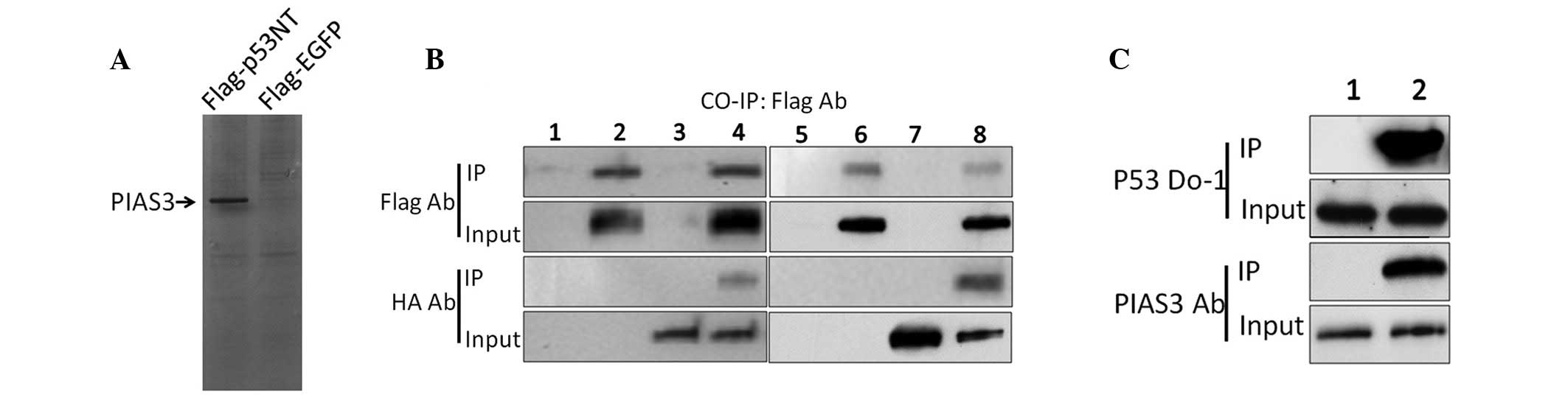
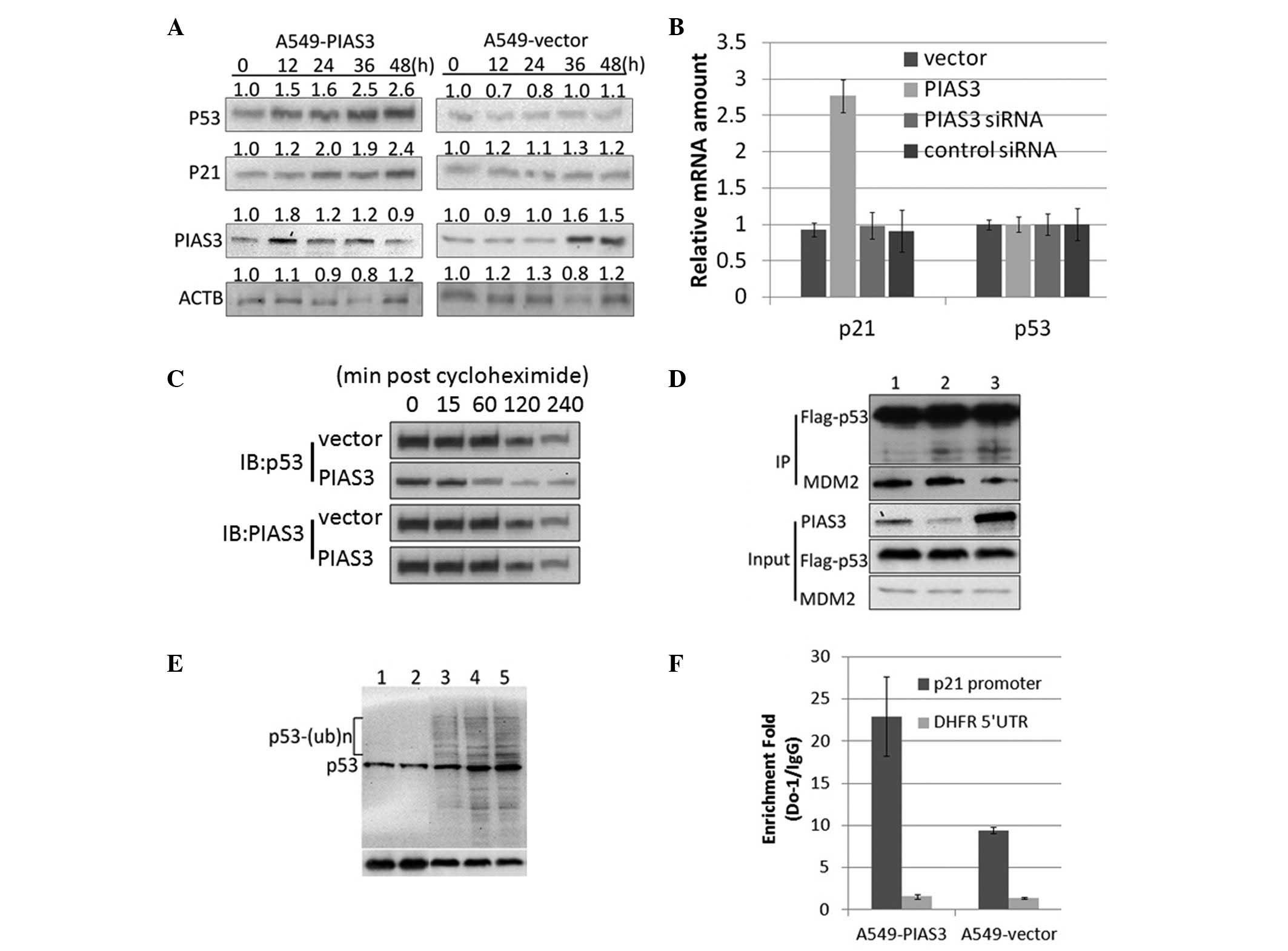
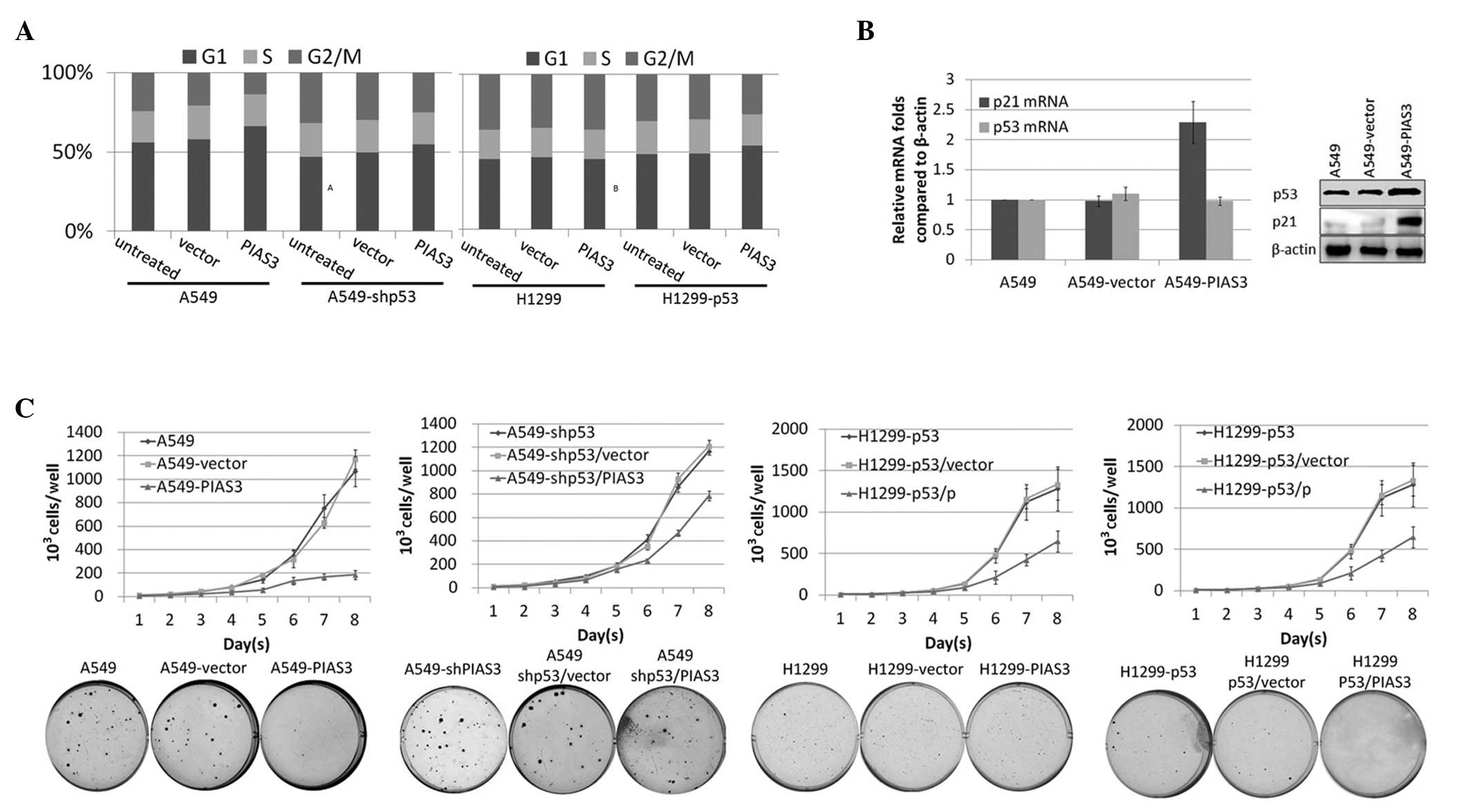
Mouse double minute 2 homolog (MDM2) binds to p53 through the 1‑52 amino acid region of p53, in order to ubiquitinate p53. MDM2 thus destabilises p53 and inhibits the effect of p53 on cell cycle arrest and apoptosis. In the present study, the 1‑52 amino acid region of the wild‑type (wt) p53 protein was stably expressed in H1299 cells. The lysate of the transfected cells was then analysed using co‑immunoprecipitation. A specific fraction of the precipitate was subjected to mass spectrometry analysis, which revealed that p53 bound to protein inhibitor of activated STAT3 (PIAS3). To the best of our knowledge, the present study is the first to report that the interaction of PIAS3 with p53 occurs through the 1‑52 amino acid region of p53. Overexpression of PIAS3 in the A549 wt p53‑expressing cell line was found to significantly increase the half‑life of p53 in the presence of cycloheximide, an inhibitor of protein synthesis. However, PIAS3 overexpression did not affect p53 mRNA levels. Furthermore, PIAS3 overexpression was observed to decrease p53 ubiquitination. Protein‑protein interaction analysis revealed that PIAS3 binds to the 1‑52 amino acid region of p53, thus disrupts the formation of the p53‑MDM2 complex. In addition, overexpression of PIAS3 in A549 cells was found to enhance the transcription of the p53‑transactivated target p21/waf1, due to p53 accumulation, which led to an increase in p53 binding to the p21 gene promoter. These findings indicate that this newly identified p53‑PIAS3 interaction through the 1‑52 amino acid region of p53, reduces p53‑MDM2 complex formation, which not only increases the half‑life of p53, but also its transactivation of target genes.
View Figures

Figure 1

Figure 2

Figure 3

View References

1 

Shaper NJ, Harrison M and Bates T: Impact of laparoscopic cholecystectomy on surgical training. Ann R Coll Surg Engl. 78:39–42. 1996.PubMed/NCBI

2 

Evans SC and Lozano G: The Li-Fraumeni syndrome: an inherited susceptibility to cancer. Mol Med Today. 3:390–395. 1997. View Article : Google Scholar : PubMed/NCBI

3 

Attardi LD and Jacks T: The role of p53 in tumour suppression: lessons from mouse models. Cell Mol Life Sci. 55:48–63. 1999. View Article : Google Scholar : PubMed/NCBI

4 

Choi J and Donehower LA: p53 in embryonic development: maintaining a fine balance. Cell Mol Life Sci. 55:38–47. 1999. View Article : Google Scholar : PubMed/NCBI

5 

Piette J, Neel H and Maréchal V: Mdm2: keeping p53 under control. Oncogene. 15:1001–1010. 1997. View Article : Google Scholar : PubMed/NCBI

6 

Karanicolas J and Brooks CL III: The structural basis for biphasic kinetics in the folding of the WW domain from a forming-binding protein: Lessons for protein design? Proc Natl Acad Sci USA. 100:3954–3959. 2003. View Article : Google Scholar : PubMed/NCBI

7 

Kussie PH, Gorina S, Marechal V, Elenbaas B, Moreau J, Levine AJ and Pavletich NP: Structure of the MDM2 oncoprotein bound to the p53 tumor suppressor transactivation domain. Science. 274:948–953. 1996. View Article : Google Scholar : PubMed/NCBI

8 

Momand J, Zambetti GP, Olson DC, George D and Levine AJ: The mdm-2 oncogene product forms a complex with the p53 protein and inhibits p53-mediated transactivation. Cell. 69:1237–1245. 1992. View Article : Google Scholar : PubMed/NCBI

9 

Haupt Y, Maya R, Kazaz A and Oren M: Mdm2 promotes the rapid degradation of p53. Nature. 387:296–299. 1997. View Article : Google Scholar : PubMed/NCBI

10 

Kamijo T, Weber JD, Zambetti G, Zindy F, Roussel MF and Sherr CJ: Functional and physical interactions of the ARF tumor suppressor with p53 and Mdm2. Proc Natl Acad Sci USA. 95:8292–8297. 1998. View Article : Google Scholar : PubMed/NCBI

11 

Pomerantz J, Schreiber-Agus N, Liégeois NJ, Silverman A, Alland L, Chin L, Potes J, Chen K, Orlow I, Lee HW, Cordon-Cardo C and DePinho RA: The Ink4a tumor suppressor gene product, p19Arf, interacts with MDM2 and neutralizes MDM2’s inhibition of p53. Cell. 92:713–723. 1998.PubMed/NCBI

12 

Honda R and Yasuda H: Association of p19(ARF) with Mdm2 inhibits ubiquitin ligase activity of Mdm2 for tumor suppressor p53. EMBO J. 18:22–27. 1999. View Article : Google Scholar : PubMed/NCBI

13 

Tao W and Levine AJ: P19(ARF) stabilizes p53 by blocking nucleo-cytoplasmic shuttling of Mdm2. Proc Natl Acad Sci USA. 96:6937–6941. 1999. View Article : Google Scholar : PubMed/NCBI

14 

Weber JD, Taylor LJ, Roussel MF, Sherr CJ and Bar-Sagi D: Nucleolar Arf sequesters Mdm2 and activates p53. Nat Cell Biol. 1:20–26. 1999. View Article : Google Scholar : PubMed/NCBI

15 

Shadfan M, Lopez-Pajares V and Yuan ZM: MDM2 and MDMX: Alone and together in regulation of p53. Transl Cancer Res. 1:88–89. 2012.PubMed/NCBI

16 

Chen J, Marechal V and Levine AJ: Mapping of the p53 and mdm-2 interaction domains. Mol Cell Biol. 13:4107–4114. 1993.PubMed/NCBI

17 

Momand J, Zambetti GP, Olson DC, George D and Levine AJ: The mdm-2 oncogene product forms a complex with the p53 protein and inhibits p53-mediated transactivation. Cell. 69:1237–1245. 1992. View Article : Google Scholar : PubMed/NCBI

18 

Takimoto R, Wang W, Dicker DT, Rastinejad F, Lyssikatos J and el-Deiry WS: The mutant p53-conformation modifying drug, CP-31398, can induce apoptosis of human cancer cells and can stabilize wild-type p53 protein. Cancer Biol Ther. 1:47–55. 2002. View Article : Google Scholar : PubMed/NCBI

19 

el-Deiry WS, Tokino T, Velculescu VE, Levy DB, Parsons R, Trent JM, Lin D, Mercer WE, Kinzler KW and Vogelstein B: WAF1, a potential mediator of p53 tumor suppression. Cell. 75:817–825. 1993. View Article : Google Scholar : PubMed/NCBI

20 

Martin K, Trouche K, Hagemeier C, Sørensen TS, La Thangue NB and Kouzarides T: Stimulation of E2F1/DP1 transcriptional activity by MDM2 oncoprotein. Nature. 375:691–694. 1995. View Article : Google Scholar : PubMed/NCBI

21 

Lughran O and La Thangue NB: Apoptotic and growth-promoting activity of E2F modulated by MDM2. Mol Cell Biol. 20:2186–2197. 2000. View Article : Google Scholar : PubMed/NCBI

22 

Grossman SR, Perez M, Kung AL, et al: P300/MDM2 complexes participate in Mdm2-mediated p53 degradation. Mol Cell. 2:405–415. 1998. View Article : Google Scholar : PubMed/NCBI

23 

Avantaggiati ML, Ogryzko V, Gardner K, Giordano A, Levine AS and Kelly K: Recruitment of p300/CBP in p53-dependent signal pathways. Cell. 89:1175–1184. 1997. View Article : Google Scholar : PubMed/NCBI

24 

Kubbutat MH, Jones SN and Vousden KH: Regulation of p53 stability by Mdm2. Nature. 387:299–303. 1997. View Article : Google Scholar : PubMed/NCBI

25 

Yu ZK, Geyer RK and Maki CG: MDM2-dependent ubiquitination of nuclear and cytoplasmic P53. Oncogen. 19:5892–5897. 2000. View Article : Google Scholar : PubMed/NCBI

26 

Fang S, Jensen JP, Ludwig RL, Vousden KH and Weissman AM: Mdm2 is a RING finger-dependent ubiquitin protein ligase for itself and p53. J Biol Chem. 275:8945–8951. 2000. View Article : Google Scholar : PubMed/NCBI

27 

Geyer RK, Yu ZK and Maki CG: The MDM2 RING-finger domain is required to promote p53 nuclear export. Nat Cell Biol. 2:569–573. 2000. View Article : Google Scholar : PubMed/NCBI

28 

Xirodimas DP, Stephen CW and Lane DP: Compartmentalization of p53 and Mdm2 is a major determinant for Mdm2-mediated degradation of p53. Exp Cell Res. 270:66–77. 2001. View Article : Google Scholar : PubMed/NCBI

29 

Barak Y, Juven T, Haffner R and Oren M: Mdm2 expression is induced by wild type p53 activity. EMBO J. 12:461–468. 1993.PubMed/NCBI

30 

Durocher D and Jackson SP: DNA-PK, ATM and ATR as sensors of DNA damage: variations on a theme? Curr Opin Cell Biol. 13:225–231. 2001. View Article : Google Scholar : PubMed/NCBI

31 

Chehab NH, Malikzay A, Stavridi ES and Halazonetis TD: Phosphorylation of Ser-20 mediates stabilization of human p53 in response to DNA damage. Proc Natl Acad Sci USA. 96:13777–13782. 1999. View Article : Google Scholar : PubMed/NCBI

32 

Dumaz N, Milne DM, Jardine LJ and Meek DW: Critical roles for the serine 20, but not the serine 15, phosphorylation site and for the polyproline domain in regulating p53 turnover. Biochem J. 359:459–464. 2001. View Article : Google Scholar : PubMed/NCBI

33 

Unger T, Juven-Gershon T, Moallem E, Berger M, Vogt Sionov R, Lozano G, Oren M and Haupt Y: Critical role for Ser20 of human p53 in the negative regulation of p53 by Mdm2. EMBO J. 18:1805–1814. 1999. View Article : Google Scholar : PubMed/NCBI

34 

Stindt MH, Carter S, Vigneron AM, Ryan KM and Vousden KH: MDM2 promotes SUMO-2/3 modification of p53 to modulate transcriptional activity. Cell Cycle. 10:3176–3188. 2001. View Article : Google Scholar : PubMed/NCBI

35 

Lee SW, Lee MH, Park JH, Kang SH, Yoo HM, Ka SH, Oh YM, Jeon YJ and Chung CH: SUMOylation of hnRNP-K is required for p53-mediated cell-cycle arrest in response to DNA damage. EMBO J. 31:4441–4452. 2012. View Article : Google Scholar : PubMed/NCBI

36 

Lin J, Chen J, Elenbaas B and Levine AJ: Several hydrophobic amino acids in the p53 amino-terminal domain are required for transcriptional activation, binding to mdm-2 and the adenovirus 5 E1B 55-kD protein. Genes Dev. 8:1235–1246. 1994. View Article : Google Scholar : PubMed/NCBI

37 

Poyurovsky MV, Katz C, Laptenko O, Beckerman R, Lokshin M, Ahn J, Byeon IJ, Gabizon R, Mattia M, Zupnick A, Brown LM, Friedler A and Prives C: The C-terminus of p53 binds the N-terminal domain of MDM2. Nat Struct Mol Biol. 17:982–989. 2010. View Article : Google Scholar : PubMed/NCBI

Related Articles

  • Abstract
  • View
  • Download
  • Twitter
Copy and paste a formatted citation
Spandidos Publications style
Zhao Z, Wu L, Shi H and Wu C: p53 N‑terminal binding and stabilisation by PIAS3 inhibits MDM2‑induced p53 ubiquitination and regulates cell growth. Mol Med Rep 9: 1903-1908, 2014.
APA
Zhao, Z., Wu, L., Shi, H., & Wu, C. (2014). p53 N‑terminal binding and stabilisation by PIAS3 inhibits MDM2‑induced p53 ubiquitination and regulates cell growth. Molecular Medicine Reports, 9, 1903-1908. https://doi.org/10.3892/mmr.2014.1993
MLA
Zhao, Z., Wu, L., Shi, H., Wu, C."p53 N‑terminal binding and stabilisation by PIAS3 inhibits MDM2‑induced p53 ubiquitination and regulates cell growth". Molecular Medicine Reports 9.5 (2014): 1903-1908.
Chicago
Zhao, Z., Wu, L., Shi, H., Wu, C."p53 N‑terminal binding and stabilisation by PIAS3 inhibits MDM2‑induced p53 ubiquitination and regulates cell growth". Molecular Medicine Reports 9, no. 5 (2014): 1903-1908. https://doi.org/10.3892/mmr.2014.1993
Copy and paste a formatted citation
x
Spandidos Publications style
Zhao Z, Wu L, Shi H and Wu C: p53 N‑terminal binding and stabilisation by PIAS3 inhibits MDM2‑induced p53 ubiquitination and regulates cell growth. Mol Med Rep 9: 1903-1908, 2014.
APA
Zhao, Z., Wu, L., Shi, H., & Wu, C. (2014). p53 N‑terminal binding and stabilisation by PIAS3 inhibits MDM2‑induced p53 ubiquitination and regulates cell growth. Molecular Medicine Reports, 9, 1903-1908. https://doi.org/10.3892/mmr.2014.1993
MLA
Zhao, Z., Wu, L., Shi, H., Wu, C."p53 N‑terminal binding and stabilisation by PIAS3 inhibits MDM2‑induced p53 ubiquitination and regulates cell growth". Molecular Medicine Reports 9.5 (2014): 1903-1908.
Chicago
Zhao, Z., Wu, L., Shi, H., Wu, C."p53 N‑terminal binding and stabilisation by PIAS3 inhibits MDM2‑induced p53 ubiquitination and regulates cell growth". Molecular Medicine Reports 9, no. 5 (2014): 1903-1908. https://doi.org/10.3892/mmr.2014.1993
Follow us
  • Twitter
  • LinkedIn
  • Facebook
About
  • Spandidos Publications
  • Careers
  • Cookie Policy
  • Privacy Policy
How can we help?
  • Help
  • Live Chat
  • Contact
  • Email to our Support Team