Spandidos Publications Logo
  • About
    • About Spandidos
    • Aims and Scopes
    • Abstracting and Indexing
    • Editorial Policies
    • Reprints and Permissions
    • Job Opportunities
    • Terms and Conditions
    • Contact
  • Journals
    • All Journals
    • Oncology Letters
      • Oncology Letters
      • Information for Authors
      • Editorial Policies
      • Editorial Board
      • Aims and Scope
      • Abstracting and Indexing
      • Bibliographic Information
      • Archive
    • International Journal of Oncology
      • International Journal of Oncology
      • Information for Authors
      • Editorial Policies
      • Editorial Board
      • Aims and Scope
      • Abstracting and Indexing
      • Bibliographic Information
      • Archive
    • Molecular and Clinical Oncology
      • Molecular and Clinical Oncology
      • Information for Authors
      • Editorial Policies
      • Editorial Board
      • Aims and Scope
      • Abstracting and Indexing
      • Bibliographic Information
      • Archive
    • Experimental and Therapeutic Medicine
      • Experimental and Therapeutic Medicine
      • Information for Authors
      • Editorial Policies
      • Editorial Board
      • Aims and Scope
      • Abstracting and Indexing
      • Bibliographic Information
      • Archive
    • International Journal of Molecular Medicine
      • International Journal of Molecular Medicine
      • Information for Authors
      • Editorial Policies
      • Editorial Board
      • Aims and Scope
      • Abstracting and Indexing
      • Bibliographic Information
      • Archive
    • Biomedical Reports
      • Biomedical Reports
      • Information for Authors
      • Editorial Policies
      • Editorial Board
      • Aims and Scope
      • Abstracting and Indexing
      • Bibliographic Information
      • Archive
    • Oncology Reports
      • Oncology Reports
      • Information for Authors
      • Editorial Policies
      • Editorial Board
      • Aims and Scope
      • Abstracting and Indexing
      • Bibliographic Information
      • Archive
    • Molecular Medicine Reports
      • Molecular Medicine Reports
      • Information for Authors
      • Editorial Policies
      • Editorial Board
      • Aims and Scope
      • Abstracting and Indexing
      • Bibliographic Information
      • Archive
    • World Academy of Sciences Journal
      • World Academy of Sciences Journal
      • Information for Authors
      • Editorial Policies
      • Editorial Board
      • Aims and Scope
      • Abstracting and Indexing
      • Bibliographic Information
      • Archive
    • International Journal of Functional Nutrition
      • International Journal of Functional Nutrition
      • Information for Authors
      • Editorial Policies
      • Editorial Board
      • Aims and Scope
      • Abstracting and Indexing
      • Bibliographic Information
      • Archive
    • International Journal of Epigenetics
      • International Journal of Epigenetics
      • Information for Authors
      • Editorial Policies
      • Editorial Board
      • Aims and Scope
      • Abstracting and Indexing
      • Bibliographic Information
      • Archive
    • Medicine International
      • Medicine International
      • Information for Authors
      • Editorial Policies
      • Editorial Board
      • Aims and Scope
      • Abstracting and Indexing
      • Bibliographic Information
      • Archive
  • Articles
  • Information
    • Information for Authors
    • Information for Reviewers
    • Information for Librarians
    • Information for Advertisers
    • Conferences
  • Language Editing
Spandidos Publications Logo
  • About
    • About Spandidos
    • Aims and Scopes
    • Abstracting and Indexing
    • Editorial Policies
    • Reprints and Permissions
    • Job Opportunities
    • Terms and Conditions
    • Contact
  • Journals
    • All Journals
    • Biomedical Reports
      • Information for Authors
      • Editorial Policies
      • Editorial Board
      • Aims and Scope
      • Abstracting and Indexing
      • Bibliographic Information
      • Archive
    • Experimental and Therapeutic Medicine
      • Information for Authors
      • Editorial Policies
      • Editorial Board
      • Aims and Scope
      • Abstracting and Indexing
      • Bibliographic Information
      • Archive
    • International Journal of Epigenetics
      • Information for Authors
      • Editorial Policies
      • Editorial Board
      • Aims and Scope
      • Abstracting and Indexing
      • Bibliographic Information
      • Archive
    • International Journal of Functional Nutrition
      • Information for Authors
      • Editorial Policies
      • Editorial Board
      • Aims and Scope
      • Abstracting and Indexing
      • Bibliographic Information
      • Archive
    • International Journal of Molecular Medicine
      • Information for Authors
      • Editorial Policies
      • Editorial Board
      • Aims and Scope
      • Abstracting and Indexing
      • Bibliographic Information
      • Archive
    • International Journal of Oncology
      • Information for Authors
      • Editorial Policies
      • Editorial Board
      • Aims and Scope
      • Abstracting and Indexing
      • Bibliographic Information
      • Archive
    • Medicine International
      • Information for Authors
      • Editorial Policies
      • Editorial Board
      • Aims and Scope
      • Abstracting and Indexing
      • Bibliographic Information
      • Archive
    • Molecular and Clinical Oncology
      • Information for Authors
      • Editorial Policies
      • Editorial Board
      • Aims and Scope
      • Abstracting and Indexing
      • Bibliographic Information
      • Archive
    • Molecular Medicine Reports
      • Information for Authors
      • Editorial Policies
      • Editorial Board
      • Aims and Scope
      • Abstracting and Indexing
      • Bibliographic Information
      • Archive
    • Oncology Letters
      • Information for Authors
      • Editorial Policies
      • Editorial Board
      • Aims and Scope
      • Abstracting and Indexing
      • Bibliographic Information
      • Archive
    • Oncology Reports
      • Information for Authors
      • Editorial Policies
      • Editorial Board
      • Aims and Scope
      • Abstracting and Indexing
      • Bibliographic Information
      • Archive
    • World Academy of Sciences Journal
      • Information for Authors
      • Editorial Policies
      • Editorial Board
      • Aims and Scope
      • Abstracting and Indexing
      • Bibliographic Information
      • Archive
  • Articles
  • Information
    • For Authors
    • For Reviewers
    • For Librarians
    • For Advertisers
    • Conferences
  • Language Editing
Login Register Submit
  • This site uses cookies
  • You can change your cookie settings at any time by following the instructions in our Cookie Policy. To find out more, you may read our Privacy Policy.

    I agree
Search articles by DOI, keyword, author or affiliation
Search
Advanced Search
presentation
Molecular Medicine Reports
Join Editorial Board Propose a Special Issue
Print ISSN: 1791-2997 Online ISSN: 1791-3004
Journal Cover
June-2014 Volume 9 Issue 6

Full Size Image

Sign up for eToc alerts
Recommend to Library

Journals

International Journal of Molecular Medicine

International Journal of Molecular Medicine

International Journal of Molecular Medicine is an international journal devoted to molecular mechanisms of human disease.

International Journal of Oncology

International Journal of Oncology

International Journal of Oncology is an international journal devoted to oncology research and cancer treatment.

Molecular Medicine Reports

Molecular Medicine Reports

Covers molecular medicine topics such as pharmacology, pathology, genetics, neuroscience, infectious diseases, molecular cardiology, and molecular surgery.

Oncology Reports

Oncology Reports

Oncology Reports is an international journal devoted to fundamental and applied research in Oncology.

Experimental and Therapeutic Medicine

Experimental and Therapeutic Medicine

Experimental and Therapeutic Medicine is an international journal devoted to laboratory and clinical medicine.

Oncology Letters

Oncology Letters

Oncology Letters is an international journal devoted to Experimental and Clinical Oncology.

Biomedical Reports

Biomedical Reports

Explores a wide range of biological and medical fields, including pharmacology, genetics, microbiology, neuroscience, and molecular cardiology.

Molecular and Clinical Oncology

Molecular and Clinical Oncology

International journal addressing all aspects of oncology research, from tumorigenesis and oncogenes to chemotherapy and metastasis.

World Academy of Sciences Journal

World Academy of Sciences Journal

Multidisciplinary open-access journal spanning biochemistry, genetics, neuroscience, environmental health, and synthetic biology.

International Journal of Functional Nutrition

International Journal of Functional Nutrition

Open-access journal combining biochemistry, pharmacology, immunology, and genetics to advance health through functional nutrition.

International Journal of Epigenetics

International Journal of Epigenetics

Publishes open-access research on using epigenetics to advance understanding and treatment of human disease.

Medicine International

Medicine International

An International Open Access Journal Devoted to General Medicine.

Journal Cover
June-2014 Volume 9 Issue 6

Full Size Image

Sign up for eToc alerts
Recommend to Library

  • Article
  • Citations
    • Cite This Article
    • Download Citation
    • Create Citation Alert
    • Remove Citation Alert
    • Cited By
  • Similar Articles
    • Related Articles (in Spandidos Publications)
    • Similar Articles (Google Scholar)
    • Similar Articles (PubMed)
  • Download PDF
  • Download XML
  • View XML
Article

A novel mild variant of osteogenesis imperfecta type I caused by a Gly1088Glu mutation in COL1A1

  • Authors:
    • Xin‑Yi Xia
    • Wei‑Wei Li
    • Na Li
    • Qiu‑Yue Wu
    • Ying‑Xia Cui
    • Xiao‑Jun Li
  • View Affiliations / Copyright

    Affiliations: Institute of Laboratory Medicine, Jinling Hospital, Nanjing University School of Medicine, Nanjing 210002, P.R. China
  • Pages: 2187-2190
    |
    Published online on: March 28, 2014
       https://doi.org/10.3892/mmr.2014.2084
  • Expand metrics +
Metrics: Total Views: 0 (Spandidos Publications: | PMC Statistics: )
Metrics: Total PDF Downloads: 0 (Spandidos Publications: | PMC Statistics: )
Cited By (CrossRef): 0 citations Loading Articles...

This article is mentioned in:


Abstract

Osteogenesis imperfecta (OI), also known as brittle bone disease, characterized by multiplicative osteopsathyrosis, blue sclera, dentinogenesis imperfecta and mild audition, is a rare inherited connective tissue disease. There are seven types of OI, I to VII, among which type I‑IV are relatively common and associated with type I collagen. Defects in type I collagen synthesis or structure are responsible for the majority of clinical OI cases since collagen is the major matrix protein of all connective tissues. Type I collagen consists of two pro-α1 chains and one pro-α2 chain, which are encoded by two genes, COL1A1 and COL1A2, respectively. The two subunits have a Gly‑X‑Y repeat domain, of which glycine is highly conserved in the majority of species. Point mutations on these sites appear to trigger OI. In the current study, a heterozygous mutation, c.3263G>A, p.Gly1088Glu, was identified in the Gly‑X‑Y domain of type I collagen in an affected individual with type I OI. A lethal phenotype with the p.Gly1088Ala mutation was observed at the same site as the current findings. This suggests that variant characteristics of the substitution for Gly may trigger a varying degree of OI from lethal to mild, even when the mutation occurs at the same site. It is hypothesized that the study may provide insight into the phenotype‑genotype association and may assist, not only in the clinical diagnosis, but also in investigating the mechanism of collagen‑associated diseases.

Introduction

Osteogenesis imperfecta (OI), also known as brittle bone disease, characterized by increased bone fragility and low bone mass, is a rare inherited connective tissue disease (1,2), mainly with autosomal dominant inheritance. The incidence of OI is ~1:10,000 and the capital clinical manifestations of OI are multiplicative osteopsathyrosis, blue sclera, dentinogenesis imperfecta and mild audition (3). The traditional classification is based on clinical and radiographic criteria, and the mode of inheritance findings include type I (MIM #166200), II (MIM #166210), III (MIM #259420) and IV (MIM #166220) (4,5). Their phenotypic presentation varies from mild to lethal, of which type I is the mildest with the highest incidence rate.

More than 90% patients with OI types I–IV have autosomal dominant mutations in one of the two genes that encode the α chains of type I collagen. Type I collagen, the main component of bone matrix, consists of two pro-α1 chains and one pro-α2 chain, which are encoded by COL1A1 (MIM #120150; accession# for mRNA Z74615.1) and COL1A2 (MIM #120160; accession# for mRNA Z74616.1) genes, respectively. COL1A1 is fixed on chromosome 17q21.3–17q22 and COL1A2 on chromosome 7q22.1, their total lengths are 18 and 38 kb, respectively, containing ~50 exons. Furthermore, each α chain consists of 1,014 amino acids forming a triple helical domain encoded by 43 exons. The folding of the three chains, with limited space, with triple helical domain restricts every third residue to a Gly, generating a repeating (Gly-X-Y)n sequence pattern. Once Gly in triple helix domains is substituted with other amino acids, the structure of type I collagen is destroyed. Gly is significant role in the formation of the triple helical domain, these sites are also the molecular basis of numerous diseases.

A number of gene mutations associated with COL1A1 and COL1A2 have been reported resulting in OI. To date, hundreds of mutations referring to COL1A1 and COL1A2 have been submitted to the University of Leicester’s (Leicester, UK) database (http://www.le.ac.uk/genetics/collagen/) highlighting mutations of the collagen gene (6). A Chinese patient with OI type I disease, who possessed a novel single base substitution mutation (c.3263G>A) in the COL1A1 gene was observed. This identification is likely to add to the the mutation database of collagen genes and provide more abundant materials for clinical diagnosis of heritable diseases and aid in the development of gene therapy and molecular diagnosis in the antepartum period.

Materials and methods

Case presentation and analysis

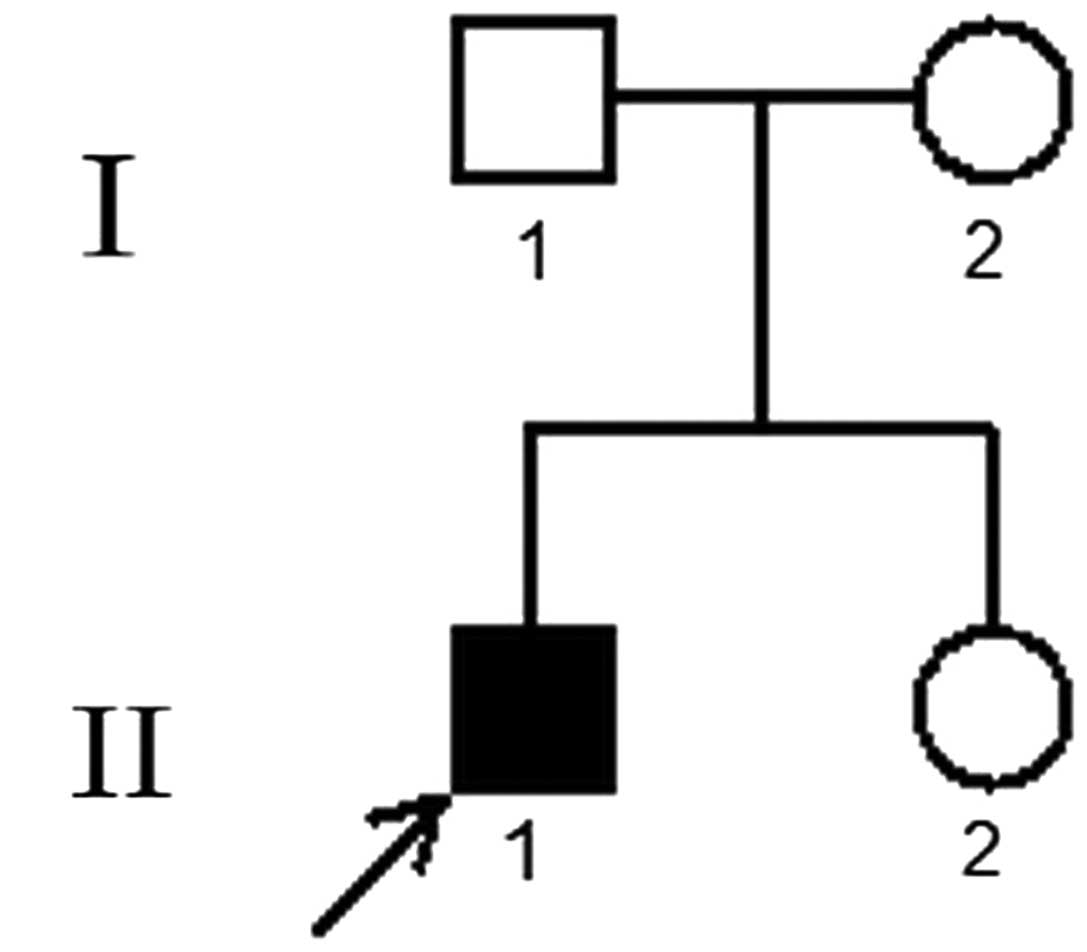
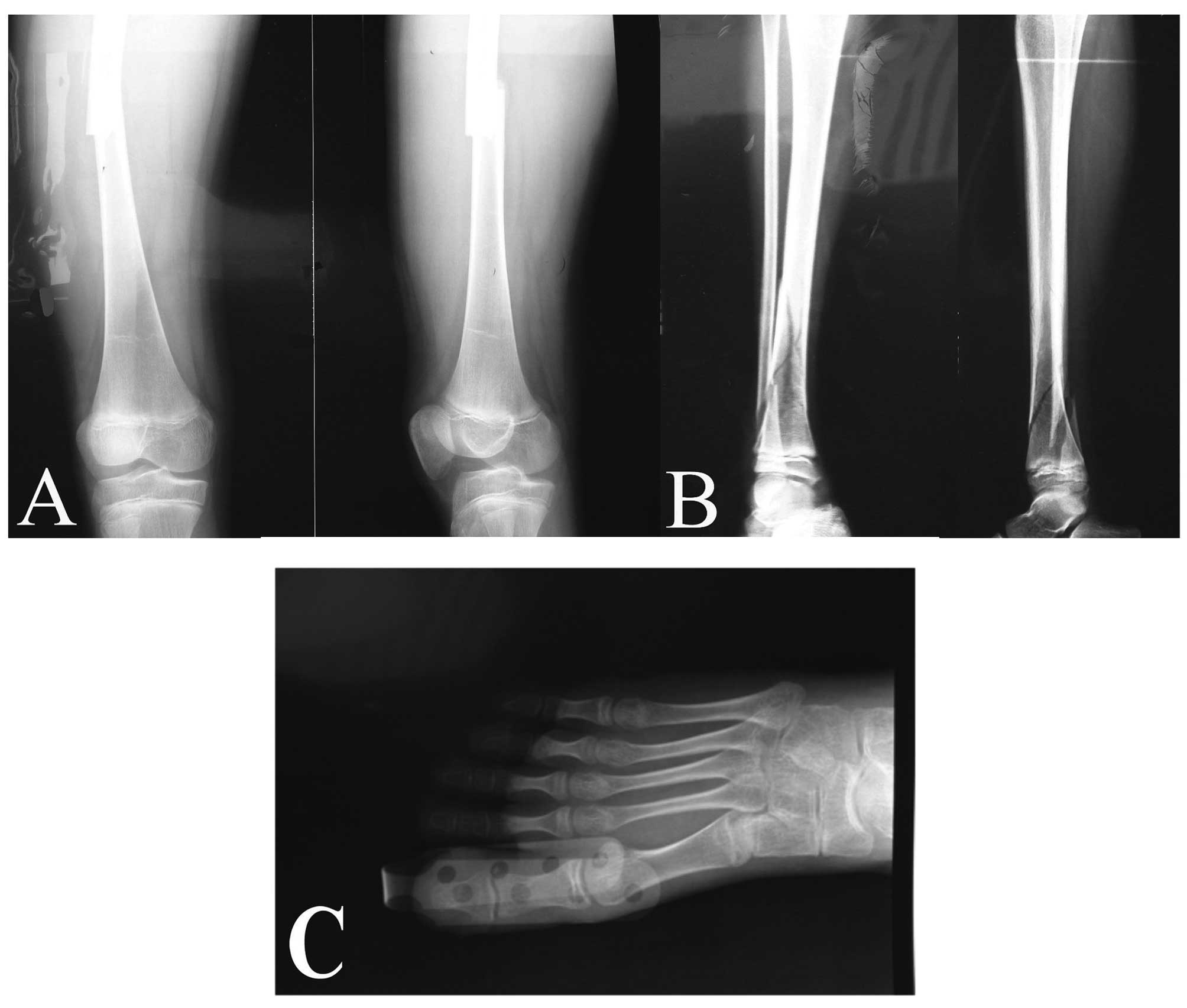
A 15-year-old Chinese male (Fig. 1) came to the Jinling Hospital (Nanjing, China) for genetic counseling of constitutional bone disease, which was characterized by blue sclera and mild abnormalities with the teeth. The patient was 171 cm tall and weighed 54 kg, with normal vision, audition and intelligence. According to the patient, he had previously suffered six fractures in the four limbs. Among these, foot dislocation was the latest fracture in 2010, and the most serious was a comminuted fracture in the right tibiofibula in 2006 (Fig. 2). The patient’s parents and sister were all healthy. In addition, 250 healthy adults were used as controls.

Figure 1

Pedigree of osteogenesis imperfecfa type I in a Chinese patient. The black symbol indicates the patient with OI and white symbols represent unaffected individuals in the family. OI, osteogenesis imperfecta.

Figure 2

X-ray images from the patient with osteogenesis imperfecta. The patient previously suffered with severe fractures and a foot dislocation. There existed evidence of >6 previous limb fractures. (A) The femur fracture occurred on the right side following falling down the stairs in 2009 and (B) evidence of a previous comminuted fracture was observed on the right tibiofibula that occured without apparent stress in 2006 (the left radiographs of A and B were the adem position view and the right radiographs were the lateral position view) (C) The first apotelus dislocation occurred in 2010 and was the latest affection.

DNA sequencing

A peripheral blood sample (5 ml) was obtained from the patient, the patient’s parents and sister, and 250 normal adults, respectively. All instructions were performed by the Institutional Review Board and the Committee on Ethics of Research Involving Human Subjects of Nanjing University Medical Center, Nanjing, China (7). The Wizard™ Genomic DNA Purification kit (Promega Corporation, Madison, WI, USA) was used to extract leucocyte genomic DNA, which was stored at -20°C, according to the manufacturer’s instructions. The primers were designed according to ~50 exons of COL1A1 and COL1A2 (8), respectively, and polymerase chain reaction (PCR) was completed under the following conditions: 95°C for 5 min followed by 35 cycles of 95°C for 30 sec, 56°C for 30 sec, and 72°C for 60 sec (8). PCR products were sequenced directly using an ABI Prism 3700 automated sequencer (Applied Biosystems, Foster City, CA, USA). The sequencing results were compared with the NCBI Reference Sequence (NM_000088).

PCR-sequence specific primer (SSP) experiments

Allele-specific primer extension was used to confirm the heterozygous state. The wild-type gene sequence was amplified with primer A (5′-TGTCGCTTTTTC TCTTGTAGGG-3′) plus primer C (5′-CTCGCATAATCGCTCTTTGTGTA-3′) and the mutation sequence was amplified with primer B (5′-TGTCGCTTTTTCTCTTGTAGGA-3′) plus primer C. It was expected that the products of wild-type and mutation-type sequences generated a fragment of 315 bp. The PCR cycling products were visualized using a UV transilluminator (WD-9403B; Beijing Liuyi Instrument Factory, Beijing, China) in a 2.0% agarose gel following electrophoresis and staining with ethidium bromide.

Results

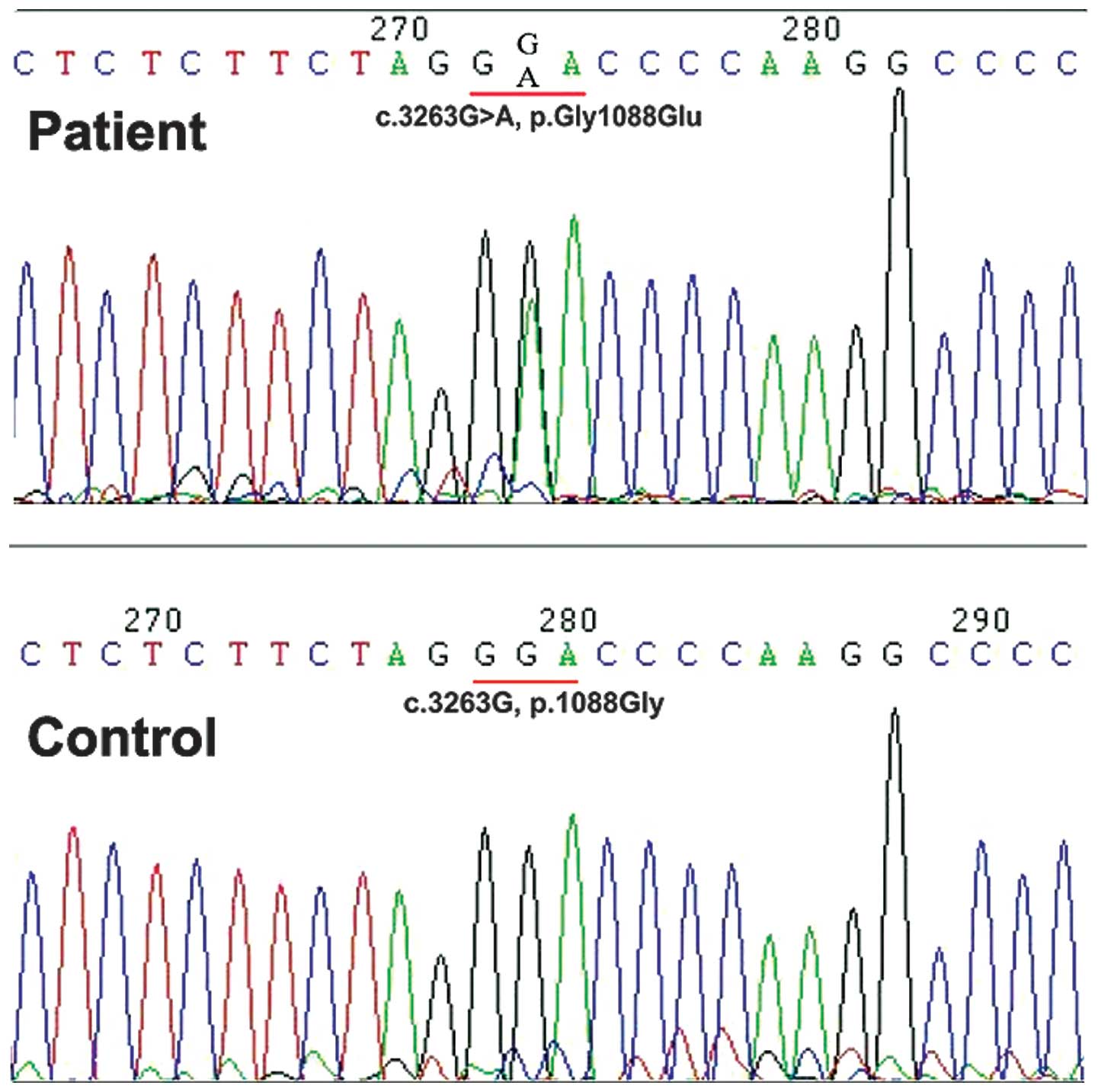
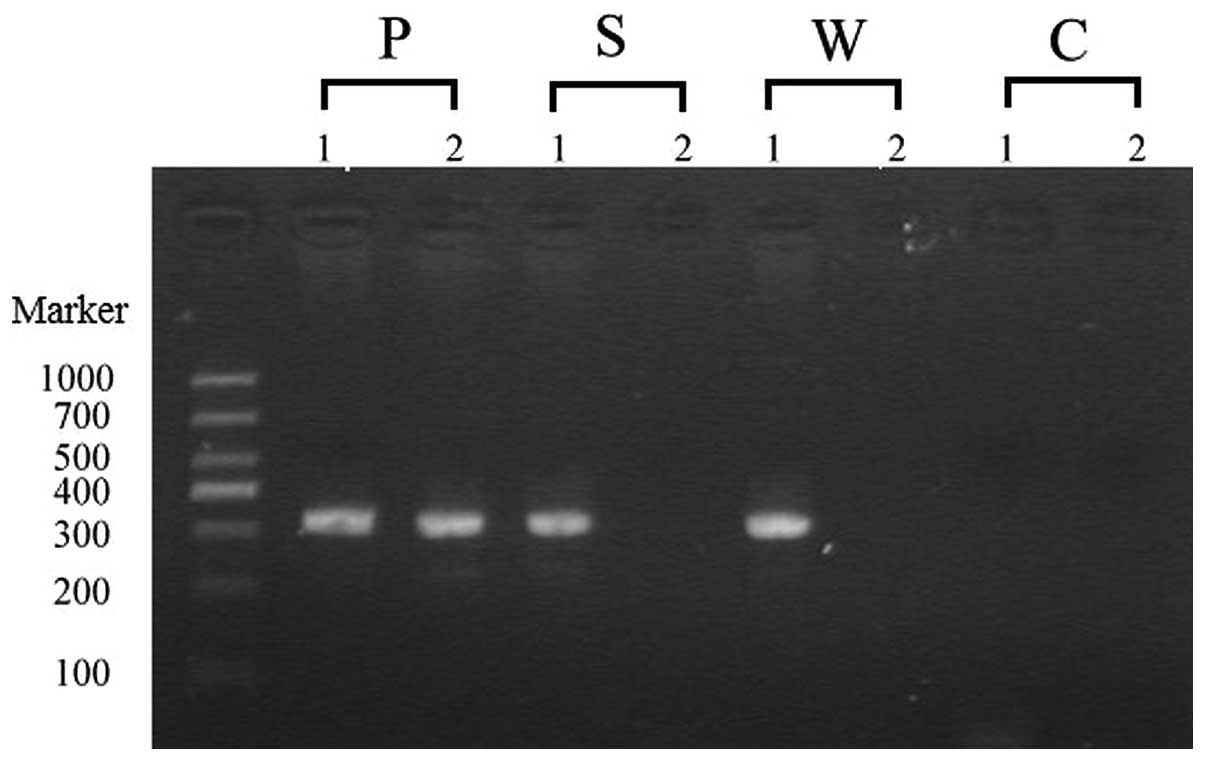
A single base substitute mutation, c.3263G>A (p. Gly1088Glu), was identified in the sequence analysis of the COL1A1 gene. The number of this mutation site was based on the cDNA sequence found in GenBank for human mRNA pre-pro-αI (I) (GenBank accession no. Z74615.1), using the A of ATG translation initiation start site as nucleotide +1 (9). This mutation (c.3263G>A) was shown in the spectrum of the group (Fig. 3), the same mutation was not identified in the patient’s parents or sister, or the 250 unrelated controls. The novelty of this mutation was identified, which was not defined in the Type I Collagen Mutation Database (http://www.le.ac.uk/genetics/collagen/), or the Human Gene Mutation Database (http://www.uwcm.ac.uk/uwcm/mg/hgmd().html). This mutation was further confirmed by PCR-SSP in the schematic diagram (Fig. 4). There also existed a single-nucleotide polymorphism in exon 33 (c.2298T>C) in this sporadic case, no other mutations were identified.

Figure 3

Sequence analysis of COL1A1 exon 45. The nucleotide sequence of the patient and a normal subjects are shown in the upper and lower panels, respectively. The patient has a novel heterozygous G→A mutation at nucleotide 3263 in exon 45 (c.3263G>A), resulting in the substitution of glycine with glutamic acid at codon 1088 (p.G1088E).

Figure 4

The electrophoretogram of PCR-SSP results of the affected and unaffected individuals. Each individual was amplified with two pairs of primers. Lane 1, represents PCR product amplified with primer A plus C, which were amplified in homozygotes and heterozygotes. Lane 2, represents PCR product amplified with primer A plus B, which was amplified only in heterozygotes. PCR, polymerase chian reaction; P, patient; S, sister; W, one of 250 normal adults; C, negative control.

Discussion

There are numerous mutations in the prolyl 3-hydroxylation complex, including CRTAP (MIM #605497), LEPRE1 (MIM #610339) and PPIB (MIM #123841), and the non-collagen related genes, FKBP10 (MIM #607063), PLOD2 (MIM #601865), SERPINF1 (MIM #172860), SERPINH1 (MIM #600943) and SP7 (MIM #606633). These lead to defective bone development and abnormal collagen helix formation associated with a clinical spectrum of recessive OI (10). In addition, type I–IV of OI were almost all triggered by mutations in COL1A1 and COL1A2. Type I collagen, encoded by COL1A1 and COL1A2, consists of two pro-α1 chains and one pro-α2 chain. Each α chain includes an N- and C-terminal, and a core triple helical domain of the Gly-X-Y triplet repeat unit, which is highly conserved. The C-terminal is used for recognition and assembly of type I collagen (11,12), and is cleaved until the triple helical domain is assembled into type I collagen. The N-terminal domain is also cleaved. According to the protein sequences in NCBI, with the reference sequence NM_000088.3, there are 1442 amino acids in the collagen pro-α1 (I) chain. The N-terminal domain consists of approximately the first 200 amino acids and the C-terminal domain consists of almost all the last 200 amino acids. (13). The remaining amino acids form the triple helix domain. Substitution mutations in the first 200 amino acids, occur only in the N-terminal domain, thus are nonlethal and exhibit a variable outcome. The triple helix domain is not considered as a domain purely, but rather as being composed of subdomains, each having its own specific function. The sizes of these subdomains remain unknown; however, the biochemical features of the substitution amino acids are linked to the role of the regions where the mutations occur.

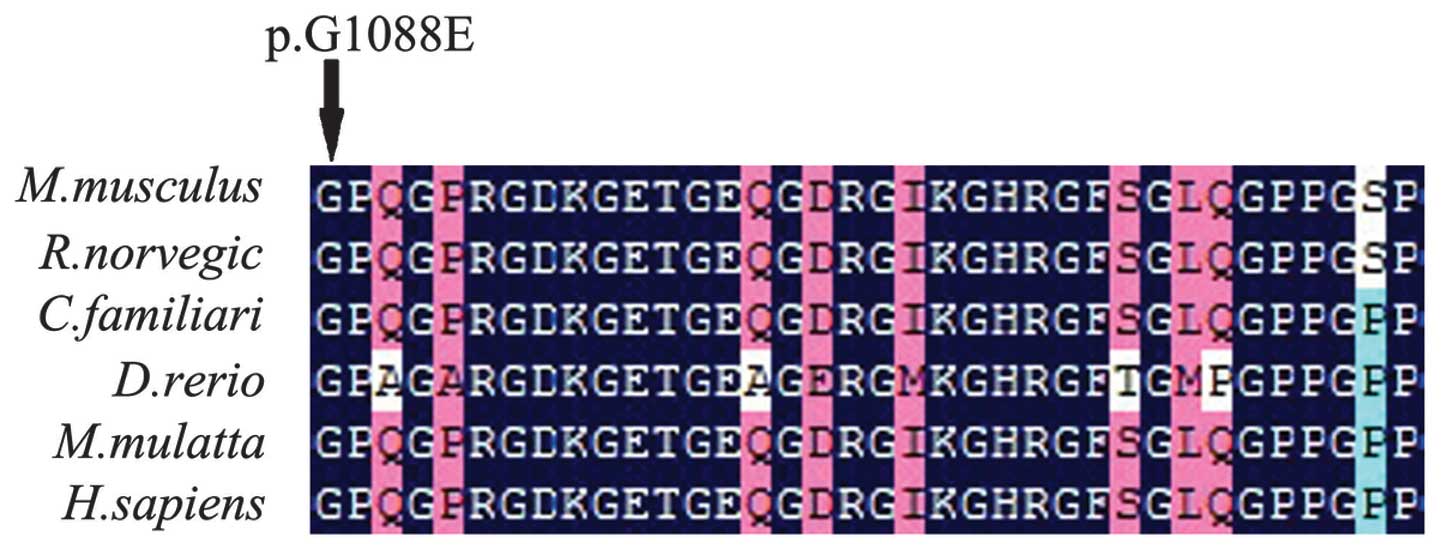
The patient with OI type I had a guanine to adenine transition at nucleotide c.3263G>A in exon 45 that may result in a Gly to Glu substitution, which corresponds to the glycine position of Gly-X-Y repeat units within the triple helix domain of the collage protein (14). This variant was not identified in the patient’s parents or sister, or 250 controls. As shown in an alignment of COL1A1 orthologs from six species of M. musculus, R. norvegicus, C. familiaris, D. rerio, M. mulatta, and H. sapiens, the original mutation position in COL1A1 is highly conserved across a number of species (Fig. 5). That suggests a substitution for Gly across the triple helix domain may induce different types of OI regardless of the substitution. However, the collagen gene mutations were not located in already existing hot spots.

Figure 5

Multispecies alignment of the type I collagen α1 chain sequence shows that the mutation site (p.G1088E) indicated with an arrow, identified in the sporadic patient alters amino acids that are highly conserved in all species listed.

Maurizia et al (15) reported a proband with disease of a lethal form of OI, in which an 18-month-old female succumbed to respiratory failure. The study showed that a G to C conversion at nucleotide 3263 of pro-α1 (I) (c.3263G>C), which may change Gly to Ala in the triple helix domain. The mutation site was the same as that reported in the current study, however resulted in substitution with a different amino acid. The triple helix chain bearing these point mutations may exhibit secretion difficulties and the extensive mutable trimers may obstruct the secretion of normal chains. Furthermore, the chains containing one or two mutations exhibited poor thermal stability. The different substituted amino acids were hypothesized to result in a number of abnormalities, including collagen recognition, anomalous assembly and functional abnormality. To the best of our knowledge, this is the first this is the first study to demonstrate that disparate substitutions of amino acids at the same position may result in entirely different phenotypes from mild to lethal. It provided evidence for further establishment of phenotype-genotype associations, and it also suggested the foundations for the determination of the molecular mechanism underlying the development of OI.

In conclusion, a novel Gly substitution mutation (c.3263.G>A) in exon 45 of COL1A1 gene resulting in OI type I was identified in a sporadic patient. The detailed molecular and clinical features are likely to be useful for extending the evidence for genetic and phenotypic heterogeneity and exploring the phenotype-genotype correlations in OI.

Acknowledgements

This study was supported by the National Natural Science Foundation of China (grant no. 30901652), the Key foundation of Jiangsu Science and Technology Bureau (grant no. BM2013058) and the Foundation of Jiangsu province (grant no. BK2011660). The authors would like to thank all members of the family for their cooperation in the study.

References

1 

Byers PH: Disorders of collagen biosynthesis and structure. The Metabolic and Molecular Basis of Inherited Disease. Scriver CR, Beaudet AL, Sly WS and Valle D: 7th edition. McGraw-Hill; New York, NY: pp. 4029–4077. 1995

2 

Byers PH, Wallis GA and Willing MC: Osteogenesis imperfecta: translation of mutation to phenotype. J Med Genet. 28:433–442. 1991. View Article : Google Scholar : PubMed/NCBI

3 

Pollitt R, McMahon R, Nunn J, et al: Mutation analysis of COL1A1 and COL1A2 in patients diagnosed with osteogenesis imperfecta type I–IV. Hum Mutat. 27:7162006.

4 

Morello R, Bertin TK, Chen Y, et al: CRTAP is required for prolyl 3-hydroxylation and mutations cause recessive osteogenesis imperfecta. Cell. 127:291–304. 2006. View Article : Google Scholar : PubMed/NCBI

5 

Van Dijk FS, Nesbitt IM, Zwikstra EH, et al: PPIB mutations cause severe osteogenesis imperfecta. Am J Hum Genet. 85:521–527. 2009.PubMed/NCBI

6 

Marini JC, Forlino A, Cabral WA, et al: Consortium for osteogenesis imperfecta mutations in the helical domain of type I collagen: regions rich in lethal mutations align with collagen binding sites for integrins and proteoglycans. Hum Mutat. 28:209–221. 2007. View Article : Google Scholar

7 

Xia XY, Cui YX, Huang YF, et al: A novel RNA-splicing mutation in COL1A1 gene causing osteogenesis imperfecta type I in a Chinese family. Clin Chim Acta. 398:148–151. 2008. View Article : Google Scholar : PubMed/NCBI

8 

Körkkö J, Ala-Kokko L, De Paepe A, Nuytinck L, Earley J and Prockop DJ: Analysis of the COL1A1 and COL1A2 genes by PCR amplification and scanning by conformation-sensitive gel electrophoresis identifies only COL1A1 mutations in 15 patients with osteogenesis imperfecta type I: identification of common sequences of null-allele mutations. Am J Hum Genet. 62:98–110. 1998.

9 

Lee KS, Song HR, Cho TJ, et al: Mutational spectrum of type I collagen genes in Korean patients with osteogenesis imperfecta. Hum Mutat. 27:5992006. View Article : Google Scholar : PubMed/NCBI

10 

Forlino A, Cabral WA, Barnes AM and Marini JC: New perspectives on osteogenesis imperfecta. Nat Rev Endocrinol. 7:540–557. 2011. View Article : Google Scholar : PubMed/NCBI

11 

Boot-Handford RP and Tuckwell DS: Fibrillar collagen: the key to vertebrate evolution? A tale of molecular incest. Bioessays. 25:142–151. 2003. View Article : Google Scholar : PubMed/NCBI

12 

Exposito JY, Cluzel C, Garrone R and Lethias C: Evolution of collagens. Anat Rec. 268:302–316. 2002. View Article : Google Scholar : PubMed/NCBI

13 

Stover DA and Verrelli BC: Comparative vertebrate evolutionary analyses of type I collagen: potential of COL1a1 gene structure and intron variation for common bone-related diseases. Mol Biol Evol. 28:533–542. 2011. View Article : Google Scholar : PubMed/NCBI

14 

Weng YC, Sonni A, Labelle-Dumais C, et al: COL4A1 mutations in patients with sporadic late-onset intracerebral hemorrhage. Ann Neurol. 71:470–477. 2012. View Article : Google Scholar : PubMed/NCBI

15 

Valli M, Sangalli A, Rossi A, et al: Osteogenesis imperfecta and type I collagen mutations A lethal variant carsed by a Gly910 - Ala substitution in the α1(I) chain. Eur J Biochem. 211:415–419. 1993.PubMed/NCBI

Related Articles

  • Abstract
  • View
  • Download
  • Twitter
Copy and paste a formatted citation
Spandidos Publications style
Xia XY, Li WW, Li N, Wu QY, Cui YX and Li XJ: A novel mild variant of osteogenesis imperfecta type I caused by a Gly1088Glu mutation in COL1A1. Mol Med Rep 9: 2187-2190, 2014.
APA
Xia, X., Li, W., Li, N., Wu, Q., Cui, Y., & Li, X. (2014). A novel mild variant of osteogenesis imperfecta type I caused by a Gly1088Glu mutation in COL1A1. Molecular Medicine Reports, 9, 2187-2190. https://doi.org/10.3892/mmr.2014.2084
MLA
Xia, X., Li, W., Li, N., Wu, Q., Cui, Y., Li, X."A novel mild variant of osteogenesis imperfecta type I caused by a Gly1088Glu mutation in COL1A1". Molecular Medicine Reports 9.6 (2014): 2187-2190.
Chicago
Xia, X., Li, W., Li, N., Wu, Q., Cui, Y., Li, X."A novel mild variant of osteogenesis imperfecta type I caused by a Gly1088Glu mutation in COL1A1". Molecular Medicine Reports 9, no. 6 (2014): 2187-2190. https://doi.org/10.3892/mmr.2014.2084
Copy and paste a formatted citation
x
Spandidos Publications style
Xia XY, Li WW, Li N, Wu QY, Cui YX and Li XJ: A novel mild variant of osteogenesis imperfecta type I caused by a Gly1088Glu mutation in COL1A1. Mol Med Rep 9: 2187-2190, 2014.
APA
Xia, X., Li, W., Li, N., Wu, Q., Cui, Y., & Li, X. (2014). A novel mild variant of osteogenesis imperfecta type I caused by a Gly1088Glu mutation in COL1A1. Molecular Medicine Reports, 9, 2187-2190. https://doi.org/10.3892/mmr.2014.2084
MLA
Xia, X., Li, W., Li, N., Wu, Q., Cui, Y., Li, X."A novel mild variant of osteogenesis imperfecta type I caused by a Gly1088Glu mutation in COL1A1". Molecular Medicine Reports 9.6 (2014): 2187-2190.
Chicago
Xia, X., Li, W., Li, N., Wu, Q., Cui, Y., Li, X."A novel mild variant of osteogenesis imperfecta type I caused by a Gly1088Glu mutation in COL1A1". Molecular Medicine Reports 9, no. 6 (2014): 2187-2190. https://doi.org/10.3892/mmr.2014.2084
Follow us
  • Twitter
  • LinkedIn
  • Facebook
About
  • Spandidos Publications
  • Careers
  • Cookie Policy
  • Privacy Policy
How can we help?
  • Help
  • Live Chat
  • Contact
  • Email to our Support Team