Spandidos Publications Logo
  • About
    • About Spandidos
    • Aims and Scopes
    • Abstracting and Indexing
    • Editorial Policies
    • Reprints and Permissions
    • Job Opportunities
    • Terms and Conditions
    • Contact
  • Journals
    • All Journals
    • Oncology Letters
      • Oncology Letters
      • Information for Authors
      • Editorial Policies
      • Editorial Board
      • Aims and Scope
      • Abstracting and Indexing
      • Bibliographic Information
      • Archive
    • International Journal of Oncology
      • International Journal of Oncology
      • Information for Authors
      • Editorial Policies
      • Editorial Board
      • Aims and Scope
      • Abstracting and Indexing
      • Bibliographic Information
      • Archive
    • Molecular and Clinical Oncology
      • Molecular and Clinical Oncology
      • Information for Authors
      • Editorial Policies
      • Editorial Board
      • Aims and Scope
      • Abstracting and Indexing
      • Bibliographic Information
      • Archive
    • Experimental and Therapeutic Medicine
      • Experimental and Therapeutic Medicine
      • Information for Authors
      • Editorial Policies
      • Editorial Board
      • Aims and Scope
      • Abstracting and Indexing
      • Bibliographic Information
      • Archive
    • International Journal of Molecular Medicine
      • International Journal of Molecular Medicine
      • Information for Authors
      • Editorial Policies
      • Editorial Board
      • Aims and Scope
      • Abstracting and Indexing
      • Bibliographic Information
      • Archive
    • Biomedical Reports
      • Biomedical Reports
      • Information for Authors
      • Editorial Policies
      • Editorial Board
      • Aims and Scope
      • Abstracting and Indexing
      • Bibliographic Information
      • Archive
    • Oncology Reports
      • Oncology Reports
      • Information for Authors
      • Editorial Policies
      • Editorial Board
      • Aims and Scope
      • Abstracting and Indexing
      • Bibliographic Information
      • Archive
    • Molecular Medicine Reports
      • Molecular Medicine Reports
      • Information for Authors
      • Editorial Policies
      • Editorial Board
      • Aims and Scope
      • Abstracting and Indexing
      • Bibliographic Information
      • Archive
    • World Academy of Sciences Journal
      • World Academy of Sciences Journal
      • Information for Authors
      • Editorial Policies
      • Editorial Board
      • Aims and Scope
      • Abstracting and Indexing
      • Bibliographic Information
      • Archive
    • International Journal of Functional Nutrition
      • International Journal of Functional Nutrition
      • Information for Authors
      • Editorial Policies
      • Editorial Board
      • Aims and Scope
      • Abstracting and Indexing
      • Bibliographic Information
      • Archive
    • International Journal of Epigenetics
      • International Journal of Epigenetics
      • Information for Authors
      • Editorial Policies
      • Editorial Board
      • Aims and Scope
      • Abstracting and Indexing
      • Bibliographic Information
      • Archive
    • Medicine International
      • Medicine International
      • Information for Authors
      • Editorial Policies
      • Editorial Board
      • Aims and Scope
      • Abstracting and Indexing
      • Bibliographic Information
      • Archive
  • Articles
  • Information
    • Information for Authors
    • Information for Reviewers
    • Information for Librarians
    • Information for Advertisers
    • Conferences
  • Language Editing
Spandidos Publications Logo
  • About
    • About Spandidos
    • Aims and Scopes
    • Abstracting and Indexing
    • Editorial Policies
    • Reprints and Permissions
    • Job Opportunities
    • Terms and Conditions
    • Contact
  • Journals
    • All Journals
    • Biomedical Reports
      • Information for Authors
      • Editorial Policies
      • Editorial Board
      • Aims and Scope
      • Abstracting and Indexing
      • Bibliographic Information
      • Archive
    • Experimental and Therapeutic Medicine
      • Information for Authors
      • Editorial Policies
      • Editorial Board
      • Aims and Scope
      • Abstracting and Indexing
      • Bibliographic Information
      • Archive
    • International Journal of Epigenetics
      • Information for Authors
      • Editorial Policies
      • Editorial Board
      • Aims and Scope
      • Abstracting and Indexing
      • Bibliographic Information
      • Archive
    • International Journal of Functional Nutrition
      • Information for Authors
      • Editorial Policies
      • Editorial Board
      • Aims and Scope
      • Abstracting and Indexing
      • Bibliographic Information
      • Archive
    • International Journal of Molecular Medicine
      • Information for Authors
      • Editorial Policies
      • Editorial Board
      • Aims and Scope
      • Abstracting and Indexing
      • Bibliographic Information
      • Archive
    • International Journal of Oncology
      • Information for Authors
      • Editorial Policies
      • Editorial Board
      • Aims and Scope
      • Abstracting and Indexing
      • Bibliographic Information
      • Archive
    • Medicine International
      • Information for Authors
      • Editorial Policies
      • Editorial Board
      • Aims and Scope
      • Abstracting and Indexing
      • Bibliographic Information
      • Archive
    • Molecular and Clinical Oncology
      • Information for Authors
      • Editorial Policies
      • Editorial Board
      • Aims and Scope
      • Abstracting and Indexing
      • Bibliographic Information
      • Archive
    • Molecular Medicine Reports
      • Information for Authors
      • Editorial Policies
      • Editorial Board
      • Aims and Scope
      • Abstracting and Indexing
      • Bibliographic Information
      • Archive
    • Oncology Letters
      • Information for Authors
      • Editorial Policies
      • Editorial Board
      • Aims and Scope
      • Abstracting and Indexing
      • Bibliographic Information
      • Archive
    • Oncology Reports
      • Information for Authors
      • Editorial Policies
      • Editorial Board
      • Aims and Scope
      • Abstracting and Indexing
      • Bibliographic Information
      • Archive
    • World Academy of Sciences Journal
      • Information for Authors
      • Editorial Policies
      • Editorial Board
      • Aims and Scope
      • Abstracting and Indexing
      • Bibliographic Information
      • Archive
  • Articles
  • Information
    • For Authors
    • For Reviewers
    • For Librarians
    • For Advertisers
    • Conferences
  • Language Editing
Login Register Submit
  • This site uses cookies
  • You can change your cookie settings at any time by following the instructions in our Cookie Policy. To find out more, you may read our Privacy Policy.

    I agree
Search articles by DOI, keyword, author or affiliation
Search
Advanced Search
presentation
Molecular Medicine Reports
Join Editorial Board Propose a Special Issue
Print ISSN: 1791-2997 Online ISSN: 1791-3004
Journal Cover
July-2014 Volume 10 Issue 1

Full Size Image

Sign up for eToc alerts
Recommend to Library

Journals

International Journal of Molecular Medicine

International Journal of Molecular Medicine

International Journal of Molecular Medicine is an international journal devoted to molecular mechanisms of human disease.

International Journal of Oncology

International Journal of Oncology

International Journal of Oncology is an international journal devoted to oncology research and cancer treatment.

Molecular Medicine Reports

Molecular Medicine Reports

Covers molecular medicine topics such as pharmacology, pathology, genetics, neuroscience, infectious diseases, molecular cardiology, and molecular surgery.

Oncology Reports

Oncology Reports

Oncology Reports is an international journal devoted to fundamental and applied research in Oncology.

Experimental and Therapeutic Medicine

Experimental and Therapeutic Medicine

Experimental and Therapeutic Medicine is an international journal devoted to laboratory and clinical medicine.

Oncology Letters

Oncology Letters

Oncology Letters is an international journal devoted to Experimental and Clinical Oncology.

Biomedical Reports

Biomedical Reports

Explores a wide range of biological and medical fields, including pharmacology, genetics, microbiology, neuroscience, and molecular cardiology.

Molecular and Clinical Oncology

Molecular and Clinical Oncology

International journal addressing all aspects of oncology research, from tumorigenesis and oncogenes to chemotherapy and metastasis.

World Academy of Sciences Journal

World Academy of Sciences Journal

Multidisciplinary open-access journal spanning biochemistry, genetics, neuroscience, environmental health, and synthetic biology.

International Journal of Functional Nutrition

International Journal of Functional Nutrition

Open-access journal combining biochemistry, pharmacology, immunology, and genetics to advance health through functional nutrition.

International Journal of Epigenetics

International Journal of Epigenetics

Publishes open-access research on using epigenetics to advance understanding and treatment of human disease.

Medicine International

Medicine International

An International Open Access Journal Devoted to General Medicine.

Journal Cover
July-2014 Volume 10 Issue 1

Full Size Image

Sign up for eToc alerts
Recommend to Library

  • Article
  • Citations
    • Cite This Article
    • Download Citation
    • Create Citation Alert
    • Remove Citation Alert
    • Cited By
  • Similar Articles
    • Related Articles (in Spandidos Publications)
    • Similar Articles (Google Scholar)
    • Similar Articles (PubMed)
  • Download PDF
  • Download XML
  • View XML
Article

Substituted 3‑acyl‑2‑phenylamino‑1,4‑naphthoquinones intercalate into DNA and cause genotoxicity through the increased generation of reactive oxygen species culminating in cell death

  • Authors:
    • Mirelle Sifroni Farias
    • Claus Tröger Pich
    • Maicon Roberto Kviecinski
    • Nádia Cristina Falcão Bucker
    • Karina Bettega Felipe
    • Fabiana Ourique Da Silva
    • Tânia Mara Fisher Günther
    • João Francisco Correia
    • David Ríos
    • Julio Benites
    • Jaime A. Valderrama
    • Pedro Buc Calderon
    • Rozangela Curi Pedrosa
  • View Affiliations / Copyright

    Affiliations: Laboratory of Experimental Biochemistry, Department of Biochemistry, Federal University of Santa Catarina, Florianópolis, Santa Catarina 88040-900, Brazil, Campus Araranguá, University of Santa Catarina, Araranguá 88900-000, Brazil, Faculty of Health Sciences, University of Arturo Prat, Iquique 1100000, Chile
  • Pages: 405-410
    |
    Published online on: April 16, 2014
       https://doi.org/10.3892/mmr.2014.2160
  • Expand metrics +
Metrics: Total Views: 0 (Spandidos Publications: | PMC Statistics: )
Metrics: Total PDF Downloads: 0 (Spandidos Publications: | PMC Statistics: )
Cited By (CrossRef): 0 citations Loading Articles...

This article is mentioned in:


Abstract

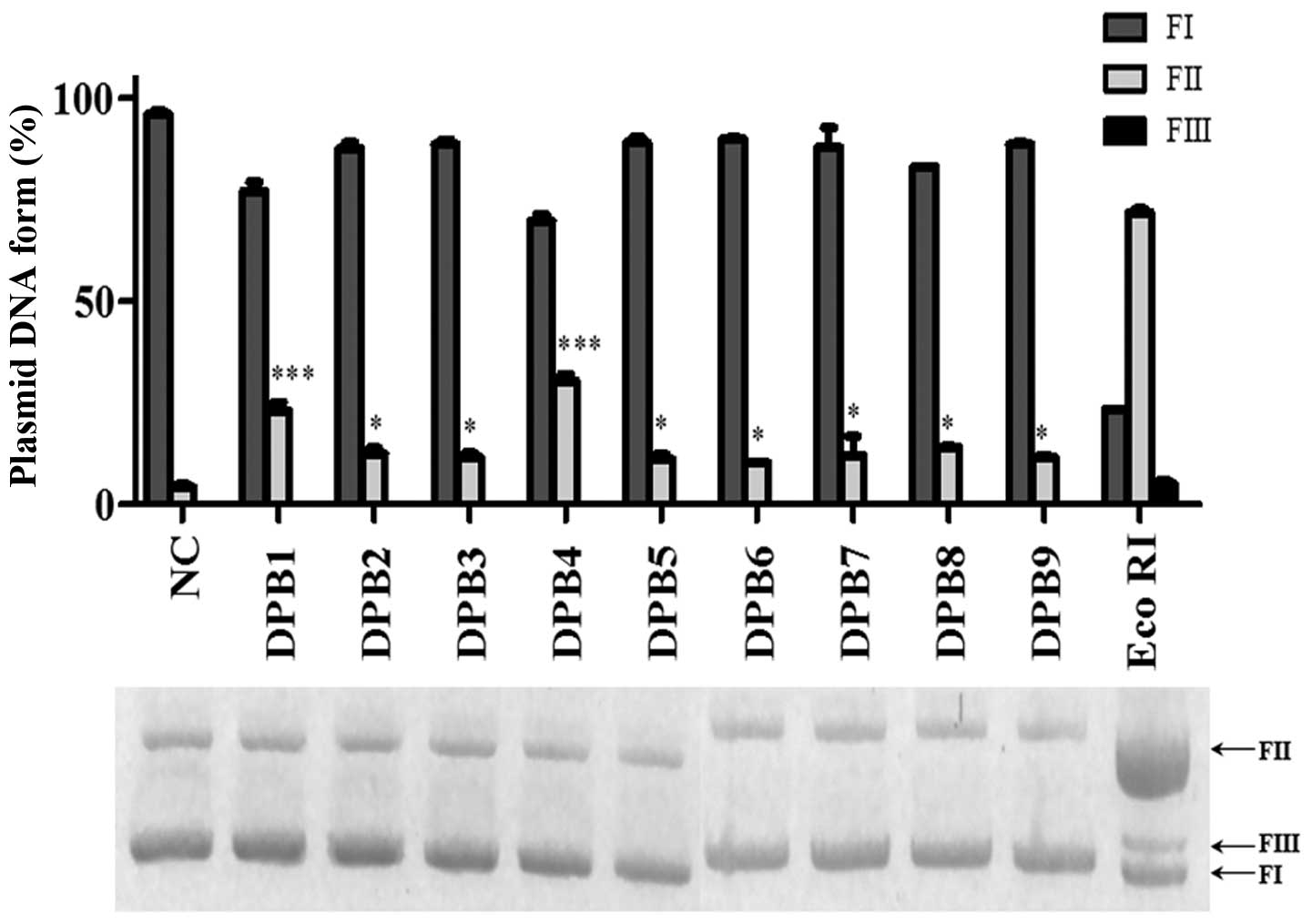
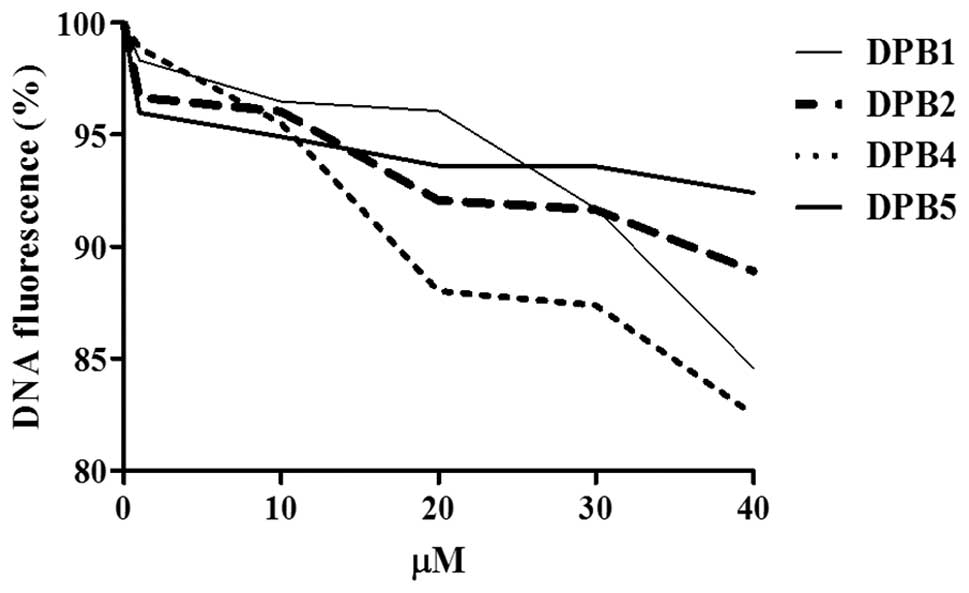
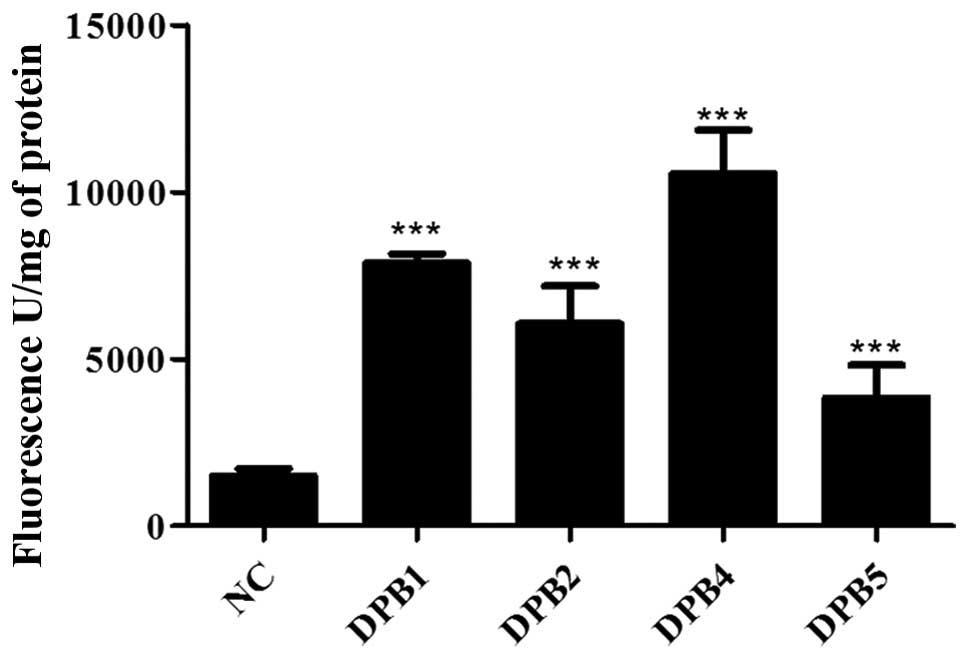
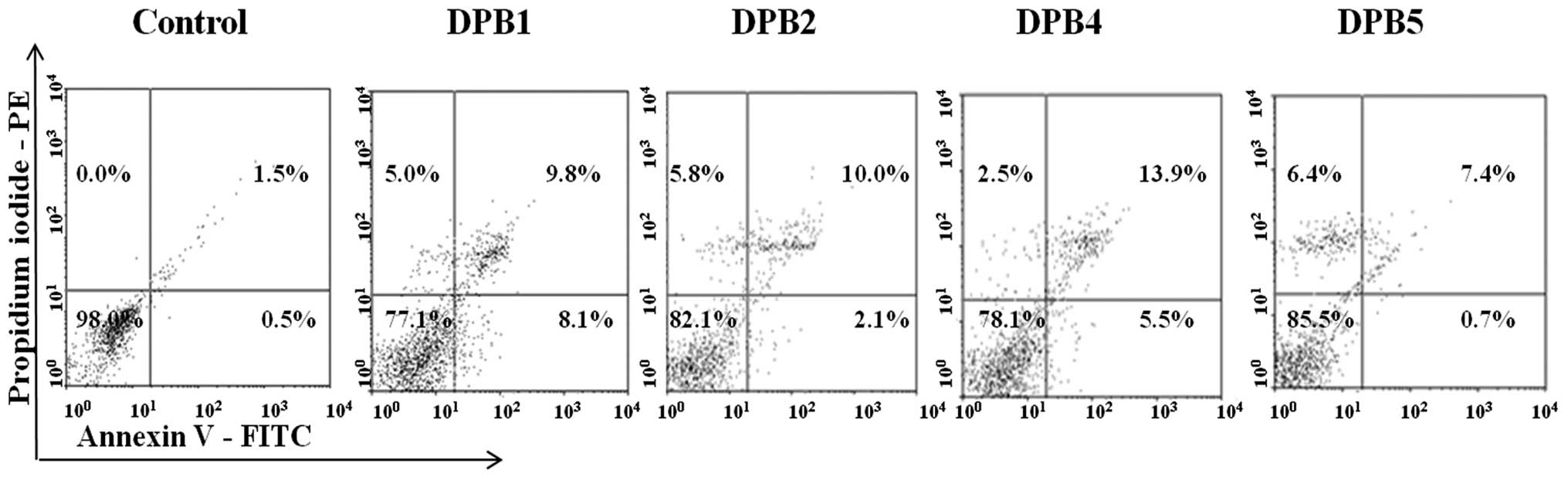
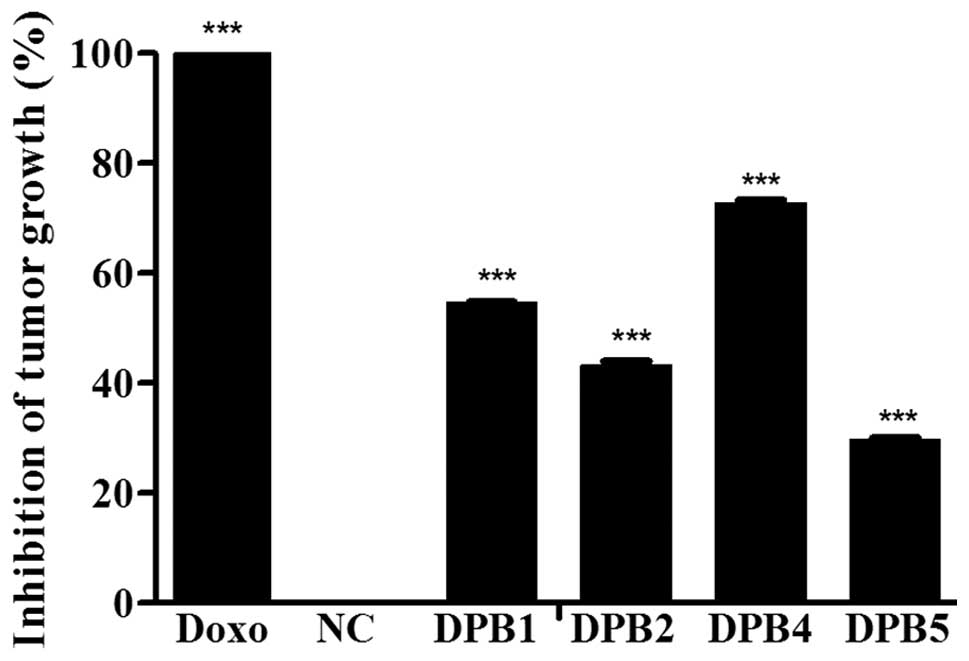
Naphthoquinones interact with biological systems by generating reactive oxygen species (ROS) that can damage cancer cells. The cytotoxicity and the antitumor activity of 3‑acyl‑2‑phenylamino‑1,4‑naphthoquinones (DPB1‑DPB9) were evaluated in the MCF7 human breast cancer cell line and in male Ehrlich tumor‑bearing Balb/c mice. DPB4 was the most cytotoxic derivative against MCF7 cells (EC50 15 µM) and DPB6 was the least cytotoxic one (EC50 56 µM). The 1,4‑naphthoquinone derivatives were able to cause DNA damage and promote DNA fragmentation as shown by the plasmid DNA cleavage assay (FII form). In addition, 1,4‑naphthoquinone derivatives possibly interacted with DNA as intercalating agents, which was demonstrated by the changes caused in the fluorescence of the DNA‑ethidium bromide complexes. Cell death of MCF7 cells induced by 3‑acyl‑2‑phenylamino‑1,4‑naphthoquinones was mostly due to apoptosis. The DNA fragmentation and subsequent apoptosis may be correlated to the redox potential of the 1,4‑naphthoquinone derivatives that, once present in the cell nucleus, led to the increased generation of ROS. Finally, certain 1,4‑naphthoquinone derivatives and particularly DPB4 significantly inhibited the growth of Ehrlich ascites tumors in mice (73%).
View Figures

Figure 1

Figure 2

Figure 3

Figure 4

Figure 5

Figure 6

View References

1 

Jemal A, Bray F, Center MM, Ferlay J and Forman D: Global cancer statistics. CA Cancer J Clin. 61:69–90. 2011. View Article : Google Scholar

2 

Adams VR: Adverse events associated with chemotherapy for common cancers. Pharmacotherapy. 20:S96–S103. 2000. View Article : Google Scholar : PubMed/NCBI

3 

Schwartz J: Current combination chemotherapy regimens for metastatic breast cancer. Am J Health Syst Pharm. 66(Suppl 6): S3–S8. 2009. View Article : Google Scholar : PubMed/NCBI

4 

Nadas J and Sun D: Anthracyclines as effective anticancer drugs. Expert Opin Drug Discov. 1:549–568. 2006. View Article : Google Scholar : PubMed/NCBI

5 

Carvajal D, Kennedy S, Boustani A, et al: Induction of cell death by a novel naphthoquinone containing a modified anthracycline ring system. Chem Biol Drug Des. 78:764–777. 2011. View Article : Google Scholar : PubMed/NCBI

6 

Gholivand MB, Kashanian S and Peyman H: DNA-binding, DNA cleavage and cytotoxicity studies of two anthraquinone derivatives. Spectrochim Acta A Mol Biomol Spectrosc. 87:232–240. 2012. View Article : Google Scholar : PubMed/NCBI

7 

Zucchi R and Danesi R: Cardiac toxicity of antineoplastic anthracyclines. Curr Med Chem Anticancer Agents. 3:151–71. 2003. View Article : Google Scholar : PubMed/NCBI

8 

Babula P, Adam V, Havel L and Kizek R: Naphthoquinones and their pharmacological properties. Ceska Slov Farm. 56:114–120. 2007.(Article in Czech).

9 

Kviecinski MR, Pedrosa RC, Felipe KB, et al: Inhibition of cell proliferation and migration by oxidative stress from ascorbate-driven juglone redox cycling in human bladder-derived T24 cells. Biochem Biophys Res Commun. 421:268–273. 2012. View Article : Google Scholar : PubMed/NCBI

10 

Smith MT: Quinones as mutagens, carcinogens, and anticancer agents: introduction and overview. J Toxicol Environ Health. 16:665–672. 1985. View Article : Google Scholar : PubMed/NCBI

11 

Benites J, Valderrama JA, Taper H and Buc Calderon P: Part 2: influence of 2-euryfuryl-1,4-naphthoquinone and its peri-hydroxy derivatives on both cell death and metabolism of TLT cells, a murine hepatoma cell line. Modulation of cytotoxicity by vitamin C. Chem Pharm Bull. 57:615–619. 2009. View Article : Google Scholar : PubMed/NCBI

12 

Benites J, Ríos D, Díaz P and Valderrama J: The solar-chemical-Friedel-Crafts heteroacylation of 1,4-quinones. Tetrahedron Lett. 52:609–611. 2011. View Article : Google Scholar

13 

Trachootham D, Zhou Y, Zhang H, et al: Selective killing of oncogenically transformed cells through a ROS-mediated mechanism by beta-phenylethyl isothiocyanate. Cancer Cell. 10:241–252. 2006. View Article : Google Scholar

14 

Verrax J, Beck R, Dejeans N, et al: Redox-active quinones and ascorbate: an innovative cancer therapy that exploits the vulnerability of cancer cells to oxidative stress. Anticancer Agents Med Chem. 11:213–221. 2011. View Article : Google Scholar : PubMed/NCBI

15 

Ríos D, Benites J, Valderrama JA, et al: Biological evaluation of 3-acyl-2-arylamino-1,4-naphthoquinones as inhibitors of Hsp90 chaperoning function. Curr Top Med Chem. 12:2094–2102. 2012.PubMed/NCBI

16 

Mosmann T: Rapid colorimetric assay for cellular growth and survival: application to proliferation and cytotoxicity assays. J Immunol Methods. 16:55–63. 1983. View Article : Google Scholar : PubMed/NCBI

17 

Günther TMF, Kviecinski MR, Baron CC, et al: Sodium orthovanadate associated with pharmacological doses of ascorbate causes an increased generation of ROS in tumor cells that inhibits proliferation and triggers apoptosis. Biochem Biophys Res Commun. 430:883–888. 2013.

18 

Sreedhara A and Cowan JA: Catalytic hydrolysis of DNA by metal ions and complexes. J Biol Inorg Chem. 4:337–347. 2001. View Article : Google Scholar : PubMed/NCBI

19 

da Silveira VC, Benezra H, Luz JS, et al: Binding of oxindole-Schiff base copper (II) complexes to DNA and its modulation by the ligand. J Inorg Biochem. 105:1692–1703. 2011.PubMed/NCBI

20 

Glorieux C, Dejeans N, Sid B, et al: Catalase overexpression in mammary cancer cells leads to a less aggressive phenotype and an altered response to chemotherapy. Biochem Pharmacol. 15:1384–1390. 2011. View Article : Google Scholar : PubMed/NCBI

21 

Kviecinski MR, Benelli P, Felipe KB, et al: SFE from Bidens pilosa Linné to obtain extracts rich in cytotoxic polyacetilenes with antitumor activity. J Supercrit Fluid. 56:243–248. 2010.

22 

Neidle S: The molecular basis for the action of some DNA-binding drugs. Prog Med Chem. 16:151–221. 1979. View Article : Google Scholar : PubMed/NCBI

23 

Kennedy S, DiCesare JC and Sheaff RJ: Topoisomerase I/II inhibition by a novel naphthoquinone containing a modified anthracycline ring system. Biochem Biophys Res Commun. 408:94–98. 2011. View Article : Google Scholar : PubMed/NCBI

24 

Verrax J, Delvaux M, Beghein N, et al: Enhancement of quinone redox cycling by ascorbate induces a caspase-3 independent cell death in human leukaemia cells. An in vitro comparative study. Free Radic Res. 39:649–657. 2005. View Article : Google Scholar : PubMed/NCBI

25 

Deeb D, Gao X, Jiang H, et al: Oleanane triterpenoid CDDO-Me inhibits growth and induces apoptosis in prostate cancer cells through a ROS-dependent mechanism. Biochem Pharmacol. 79:350–360. 2010. View Article : Google Scholar : PubMed/NCBI

26 

Hyun MS, Hur JM, Mun YJ, Kim D and Woo WH: BBR induces apoptosis in HepG2 cell through an Akt-ASK1-ROS-p38MAPKs-linked cascade. J Cell Biochem. 109:329–338. 2010.PubMed/NCBI

27 

Xu HL, Yu JF, Qu SC, Jiang YF and Sui da Y: Juglone, from Juglans mandshruica Maxim, inhibits growth and induces apoptosis in human leukemia cell HL-60 through a reactive oxygen species-dependent mechanism. Food Chem Toxicol. 50:590–596. 2012. View Article : Google Scholar : PubMed/NCBI

28 

Verrax J, Cadrobbi J, Marques C, et al: Ascorbate potentiates the cytotoxity of menadione leading to an oxidative stress that kills cancer cells by a non-apoptotic caspase-3 independent form of cell death. Apoptosis. 9:223–333. 2004. View Article : Google Scholar

Related Articles

  • Abstract
  • View
  • Download
  • Twitter
Copy and paste a formatted citation
Spandidos Publications style
Farias MS, Pich CT, Kviecinski MR, Bucker NC, Felipe KB, Da Silva FO, Günther TM, Correia JF, Ríos D, Benites J, Benites J, et al: Substituted 3‑acyl‑2‑phenylamino‑1,4‑naphthoquinones intercalate into DNA and cause genotoxicity through the increased generation of reactive oxygen species culminating in cell death. Mol Med Rep 10: 405-410, 2014.
APA
Farias, M.S., Pich, C.T., Kviecinski, M.R., Bucker, N.C., Felipe, K.B., Da Silva, F.O. ... Pedrosa, R.C. (2014). Substituted 3‑acyl‑2‑phenylamino‑1,4‑naphthoquinones intercalate into DNA and cause genotoxicity through the increased generation of reactive oxygen species culminating in cell death. Molecular Medicine Reports, 10, 405-410. https://doi.org/10.3892/mmr.2014.2160
MLA
Farias, M. S., Pich, C. T., Kviecinski, M. R., Bucker, N. C., Felipe, K. B., Da Silva, F. O., Günther, T. M., Correia, J. F., Ríos, D., Benites, J., Valderrama, J. A., Calderon, P. B., Pedrosa, R. C."Substituted 3‑acyl‑2‑phenylamino‑1,4‑naphthoquinones intercalate into DNA and cause genotoxicity through the increased generation of reactive oxygen species culminating in cell death". Molecular Medicine Reports 10.1 (2014): 405-410.
Chicago
Farias, M. S., Pich, C. T., Kviecinski, M. R., Bucker, N. C., Felipe, K. B., Da Silva, F. O., Günther, T. M., Correia, J. F., Ríos, D., Benites, J., Valderrama, J. A., Calderon, P. B., Pedrosa, R. C."Substituted 3‑acyl‑2‑phenylamino‑1,4‑naphthoquinones intercalate into DNA and cause genotoxicity through the increased generation of reactive oxygen species culminating in cell death". Molecular Medicine Reports 10, no. 1 (2014): 405-410. https://doi.org/10.3892/mmr.2014.2160

Copy and paste a formatted citation
x
Spandidos Publications style
Farias MS, Pich CT, Kviecinski MR, Bucker NC, Felipe KB, Da Silva FO, Günther TM, Correia JF, Ríos D, Benites J, Benites J, et al: Substituted 3‑acyl‑2‑phenylamino‑1,4‑naphthoquinones intercalate into DNA and cause genotoxicity through the increased generation of reactive oxygen species culminating in cell death. Mol Med Rep 10: 405-410, 2014.
APA
Farias, M.S., Pich, C.T., Kviecinski, M.R., Bucker, N.C., Felipe, K.B., Da Silva, F.O. ... Pedrosa, R.C. (2014). Substituted 3‑acyl‑2‑phenylamino‑1,4‑naphthoquinones intercalate into DNA and cause genotoxicity through the increased generation of reactive oxygen species culminating in cell death. Molecular Medicine Reports, 10, 405-410. https://doi.org/10.3892/mmr.2014.2160
MLA
Farias, M. S., Pich, C. T., Kviecinski, M. R., Bucker, N. C., Felipe, K. B., Da Silva, F. O., Günther, T. M., Correia, J. F., Ríos, D., Benites, J., Valderrama, J. A., Calderon, P. B., Pedrosa, R. C."Substituted 3‑acyl‑2‑phenylamino‑1,4‑naphthoquinones intercalate into DNA and cause genotoxicity through the increased generation of reactive oxygen species culminating in cell death". Molecular Medicine Reports 10.1 (2014): 405-410.
Chicago
Farias, M. S., Pich, C. T., Kviecinski, M. R., Bucker, N. C., Felipe, K. B., Da Silva, F. O., Günther, T. M., Correia, J. F., Ríos, D., Benites, J., Valderrama, J. A., Calderon, P. B., Pedrosa, R. C."Substituted 3‑acyl‑2‑phenylamino‑1,4‑naphthoquinones intercalate into DNA and cause genotoxicity through the increased generation of reactive oxygen species culminating in cell death". Molecular Medicine Reports 10, no. 1 (2014): 405-410. https://doi.org/10.3892/mmr.2014.2160
Follow us
  • Twitter
  • LinkedIn
  • Facebook
About
  • Spandidos Publications
  • Careers
  • Cookie Policy
  • Privacy Policy
How can we help?
  • Help
  • Live Chat
  • Contact
  • Email to our Support Team