Spandidos Publications Logo
  • About
    • About Spandidos
    • Aims and Scopes
    • Abstracting and Indexing
    • Editorial Policies
    • Reprints and Permissions
    • Job Opportunities
    • Terms and Conditions
    • Contact
  • Journals
    • All Journals
    • Oncology Letters
      • Oncology Letters
      • Information for Authors
      • Editorial Policies
      • Editorial Board
      • Aims and Scope
      • Abstracting and Indexing
      • Bibliographic Information
      • Archive
    • International Journal of Oncology
      • International Journal of Oncology
      • Information for Authors
      • Editorial Policies
      • Editorial Board
      • Aims and Scope
      • Abstracting and Indexing
      • Bibliographic Information
      • Archive
    • Molecular and Clinical Oncology
      • Molecular and Clinical Oncology
      • Information for Authors
      • Editorial Policies
      • Editorial Board
      • Aims and Scope
      • Abstracting and Indexing
      • Bibliographic Information
      • Archive
    • Experimental and Therapeutic Medicine
      • Experimental and Therapeutic Medicine
      • Information for Authors
      • Editorial Policies
      • Editorial Board
      • Aims and Scope
      • Abstracting and Indexing
      • Bibliographic Information
      • Archive
    • International Journal of Molecular Medicine
      • International Journal of Molecular Medicine
      • Information for Authors
      • Editorial Policies
      • Editorial Board
      • Aims and Scope
      • Abstracting and Indexing
      • Bibliographic Information
      • Archive
    • Biomedical Reports
      • Biomedical Reports
      • Information for Authors
      • Editorial Policies
      • Editorial Board
      • Aims and Scope
      • Abstracting and Indexing
      • Bibliographic Information
      • Archive
    • Oncology Reports
      • Oncology Reports
      • Information for Authors
      • Editorial Policies
      • Editorial Board
      • Aims and Scope
      • Abstracting and Indexing
      • Bibliographic Information
      • Archive
    • Molecular Medicine Reports
      • Molecular Medicine Reports
      • Information for Authors
      • Editorial Policies
      • Editorial Board
      • Aims and Scope
      • Abstracting and Indexing
      • Bibliographic Information
      • Archive
    • World Academy of Sciences Journal
      • World Academy of Sciences Journal
      • Information for Authors
      • Editorial Policies
      • Editorial Board
      • Aims and Scope
      • Abstracting and Indexing
      • Bibliographic Information
      • Archive
    • International Journal of Functional Nutrition
      • International Journal of Functional Nutrition
      • Information for Authors
      • Editorial Policies
      • Editorial Board
      • Aims and Scope
      • Abstracting and Indexing
      • Bibliographic Information
      • Archive
    • International Journal of Epigenetics
      • International Journal of Epigenetics
      • Information for Authors
      • Editorial Policies
      • Editorial Board
      • Aims and Scope
      • Abstracting and Indexing
      • Bibliographic Information
      • Archive
    • Medicine International
      • Medicine International
      • Information for Authors
      • Editorial Policies
      • Editorial Board
      • Aims and Scope
      • Abstracting and Indexing
      • Bibliographic Information
      • Archive
  • Articles
  • Information
    • Information for Authors
    • Information for Reviewers
    • Information for Librarians
    • Information for Advertisers
    • Conferences
  • Language Editing
Spandidos Publications Logo
  • About
    • About Spandidos
    • Aims and Scopes
    • Abstracting and Indexing
    • Editorial Policies
    • Reprints and Permissions
    • Job Opportunities
    • Terms and Conditions
    • Contact
  • Journals
    • All Journals
    • Biomedical Reports
      • Information for Authors
      • Editorial Policies
      • Editorial Board
      • Aims and Scope
      • Abstracting and Indexing
      • Bibliographic Information
      • Archive
    • Experimental and Therapeutic Medicine
      • Information for Authors
      • Editorial Policies
      • Editorial Board
      • Aims and Scope
      • Abstracting and Indexing
      • Bibliographic Information
      • Archive
    • International Journal of Epigenetics
      • Information for Authors
      • Editorial Policies
      • Editorial Board
      • Aims and Scope
      • Abstracting and Indexing
      • Bibliographic Information
      • Archive
    • International Journal of Functional Nutrition
      • Information for Authors
      • Editorial Policies
      • Editorial Board
      • Aims and Scope
      • Abstracting and Indexing
      • Bibliographic Information
      • Archive
    • International Journal of Molecular Medicine
      • Information for Authors
      • Editorial Policies
      • Editorial Board
      • Aims and Scope
      • Abstracting and Indexing
      • Bibliographic Information
      • Archive
    • International Journal of Oncology
      • Information for Authors
      • Editorial Policies
      • Editorial Board
      • Aims and Scope
      • Abstracting and Indexing
      • Bibliographic Information
      • Archive
    • Medicine International
      • Information for Authors
      • Editorial Policies
      • Editorial Board
      • Aims and Scope
      • Abstracting and Indexing
      • Bibliographic Information
      • Archive
    • Molecular and Clinical Oncology
      • Information for Authors
      • Editorial Policies
      • Editorial Board
      • Aims and Scope
      • Abstracting and Indexing
      • Bibliographic Information
      • Archive
    • Molecular Medicine Reports
      • Information for Authors
      • Editorial Policies
      • Editorial Board
      • Aims and Scope
      • Abstracting and Indexing
      • Bibliographic Information
      • Archive
    • Oncology Letters
      • Information for Authors
      • Editorial Policies
      • Editorial Board
      • Aims and Scope
      • Abstracting and Indexing
      • Bibliographic Information
      • Archive
    • Oncology Reports
      • Information for Authors
      • Editorial Policies
      • Editorial Board
      • Aims and Scope
      • Abstracting and Indexing
      • Bibliographic Information
      • Archive
    • World Academy of Sciences Journal
      • Information for Authors
      • Editorial Policies
      • Editorial Board
      • Aims and Scope
      • Abstracting and Indexing
      • Bibliographic Information
      • Archive
  • Articles
  • Information
    • For Authors
    • For Reviewers
    • For Librarians
    • For Advertisers
    • Conferences
  • Language Editing
Login Register Submit
  • This site uses cookies
  • You can change your cookie settings at any time by following the instructions in our Cookie Policy. To find out more, you may read our Privacy Policy.

    I agree
Search articles by DOI, keyword, author or affiliation
Search
Advanced Search
presentation
Molecular Medicine Reports
Join Editorial Board Propose a Special Issue
Print ISSN: 1791-2997 Online ISSN: 1791-3004
Journal Cover
July-2014 Volume 10 Issue 1

Full Size Image

Sign up for eToc alerts
Recommend to Library

Journals

International Journal of Molecular Medicine

International Journal of Molecular Medicine

International Journal of Molecular Medicine is an international journal devoted to molecular mechanisms of human disease.

International Journal of Oncology

International Journal of Oncology

International Journal of Oncology is an international journal devoted to oncology research and cancer treatment.

Molecular Medicine Reports

Molecular Medicine Reports

Covers molecular medicine topics such as pharmacology, pathology, genetics, neuroscience, infectious diseases, molecular cardiology, and molecular surgery.

Oncology Reports

Oncology Reports

Oncology Reports is an international journal devoted to fundamental and applied research in Oncology.

Experimental and Therapeutic Medicine

Experimental and Therapeutic Medicine

Experimental and Therapeutic Medicine is an international journal devoted to laboratory and clinical medicine.

Oncology Letters

Oncology Letters

Oncology Letters is an international journal devoted to Experimental and Clinical Oncology.

Biomedical Reports

Biomedical Reports

Explores a wide range of biological and medical fields, including pharmacology, genetics, microbiology, neuroscience, and molecular cardiology.

Molecular and Clinical Oncology

Molecular and Clinical Oncology

International journal addressing all aspects of oncology research, from tumorigenesis and oncogenes to chemotherapy and metastasis.

World Academy of Sciences Journal

World Academy of Sciences Journal

Multidisciplinary open-access journal spanning biochemistry, genetics, neuroscience, environmental health, and synthetic biology.

International Journal of Functional Nutrition

International Journal of Functional Nutrition

Open-access journal combining biochemistry, pharmacology, immunology, and genetics to advance health through functional nutrition.

International Journal of Epigenetics

International Journal of Epigenetics

Publishes open-access research on using epigenetics to advance understanding and treatment of human disease.

Medicine International

Medicine International

An International Open Access Journal Devoted to General Medicine.

Journal Cover
July-2014 Volume 10 Issue 1

Full Size Image

Sign up for eToc alerts
Recommend to Library

  • Article
  • Citations
    • Cite This Article
    • Download Citation
    • Create Citation Alert
    • Remove Citation Alert
    • Cited By
  • Similar Articles
    • Related Articles (in Spandidos Publications)
    • Similar Articles (Google Scholar)
    • Similar Articles (PubMed)
  • Download PDF
  • Download XML
  • View XML
Article

Anti-fibrotic effects of specific-siRNA targeting of the receptor for advanced glycation end products in a rat model of experimental hepatic fibrosis

  • Authors:
    • Xiao-Gang Cai
    • Jin-Rong Xia
    • Wei-Dong Li
    • Feng-Lin Lu
    • Juan Liu
    • Qin Lu
    • Hong Zhi
  • View Affiliations / Copyright

    Affiliations: Department of Gastroenterology, Zhongda Hospital, School of Medicine, Southeast University, Nanjing, Jiangsu 210009, P.R. China
  • Pages: 306-314
    |
    Published online on: May 2, 2014
       https://doi.org/10.3892/mmr.2014.2207
  • Expand metrics +
Metrics: Total Views: 0 (Spandidos Publications: | PMC Statistics: )
Metrics: Total PDF Downloads: 0 (Spandidos Publications: | PMC Statistics: )
Cited By (CrossRef): 0 citations Loading Articles...

This article is mentioned in:


Abstract

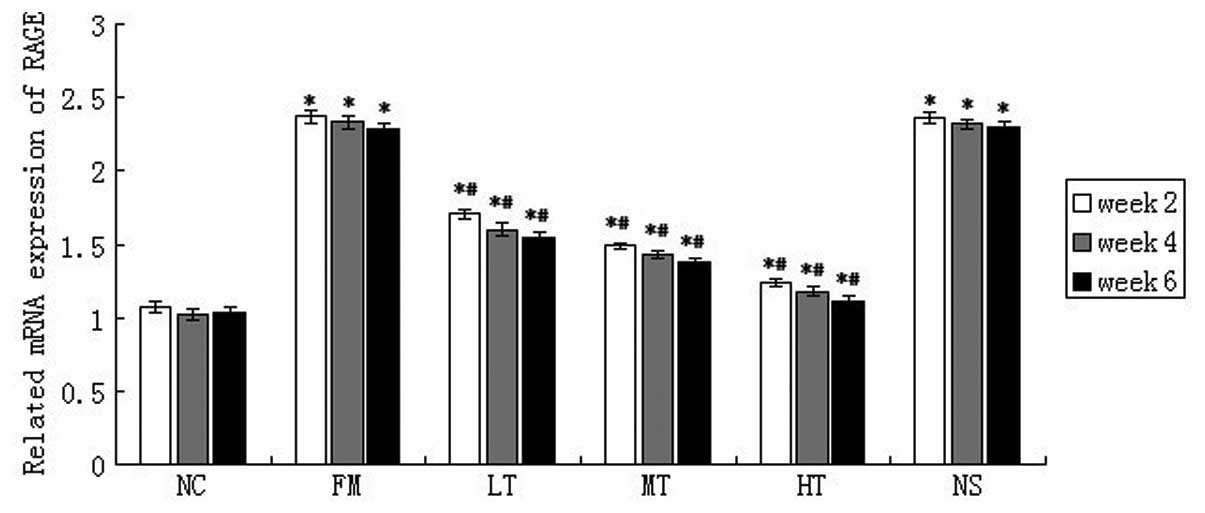
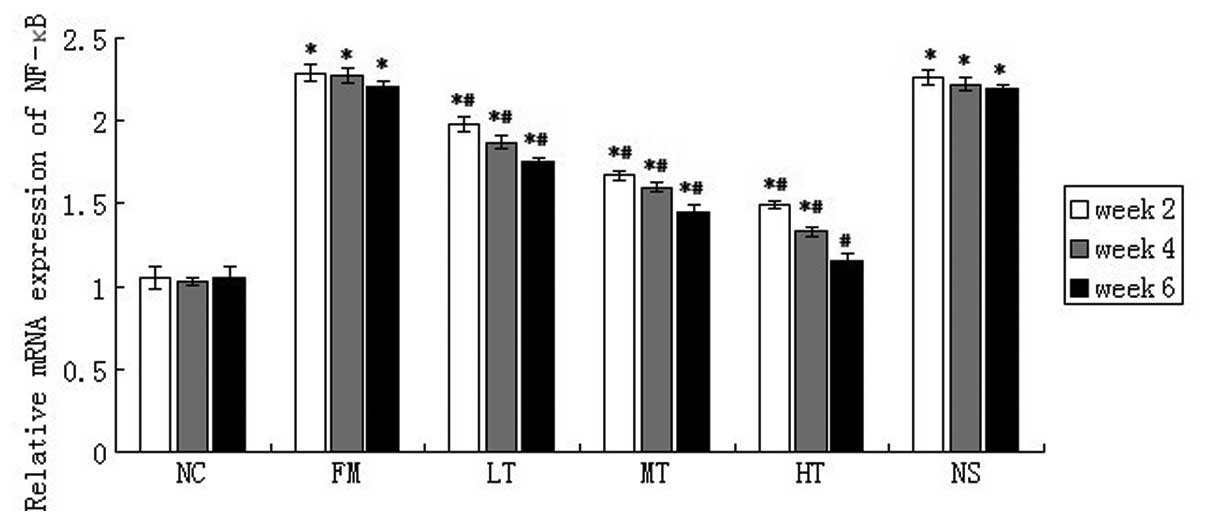
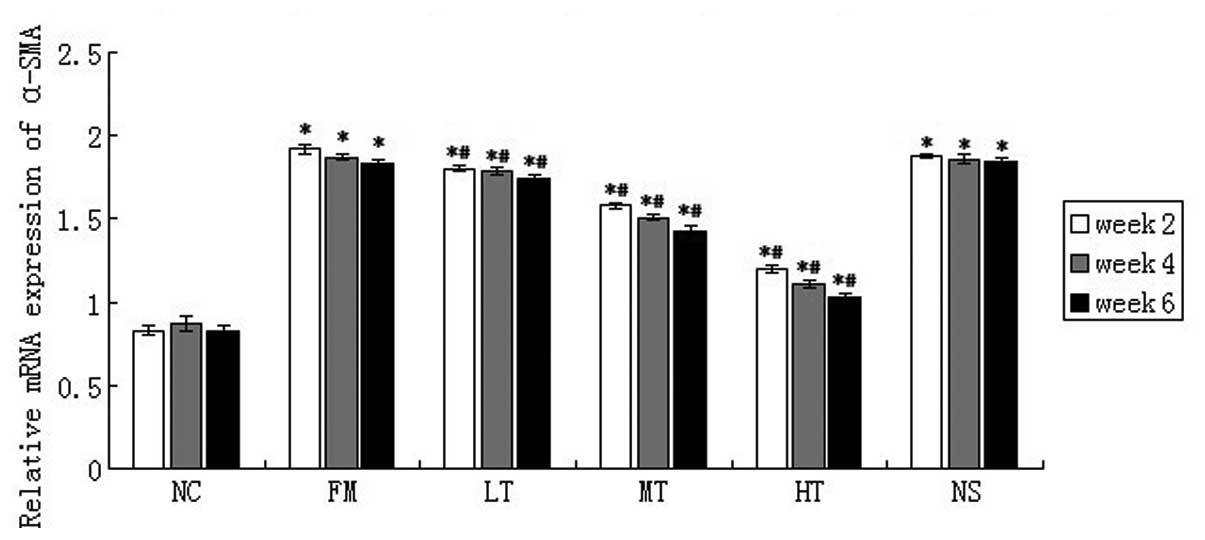
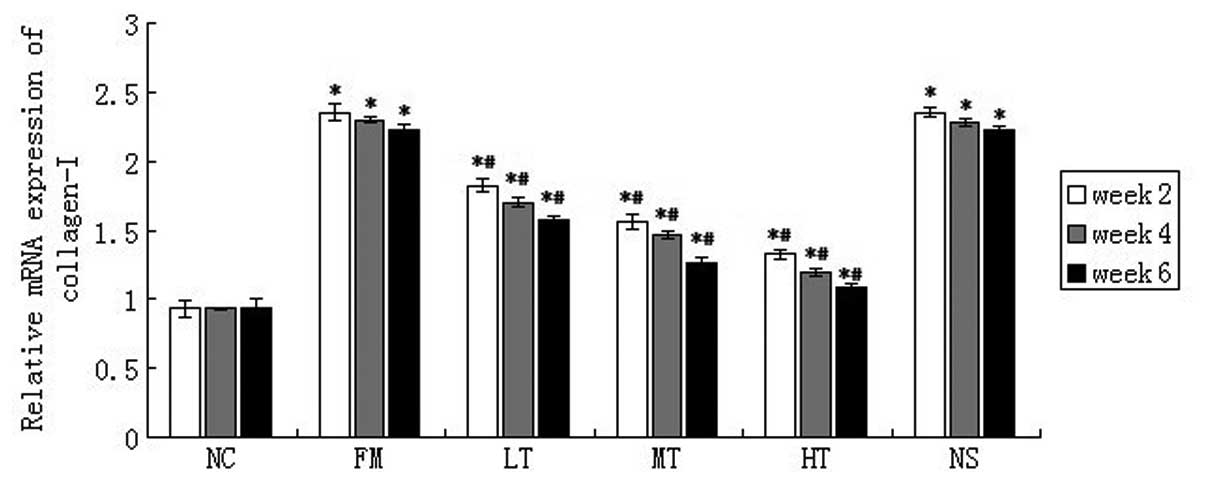
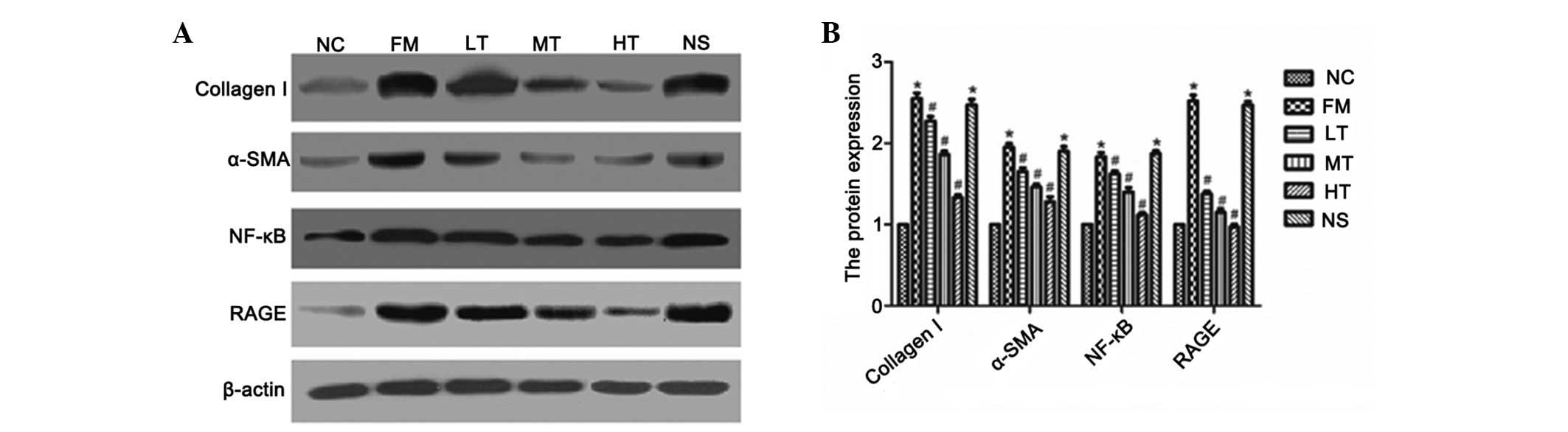
Since the receptor for advanced glycation end products (RAGE)-ligand axis has been demonstrated to be important in fibrogenesis, rat models may be used to assess whether specific small interfering RNAs (siRNAs) that target RAGE are able to reduce the progression of hepatic fibrosis. However, the effect of RAGE-targeted siRNA on established hepatic fibrosis remains to be elucidated. In the present study, RAGE-specific siRNA expression vectors were constructed prior to the animal experiment. Sprague-Dawley rats were treated initially with olive oil (2 ml/kg) or 50% CCl4 (2 ml/kg; CCl4/olive oil=1:1) twice per week for six weeks to generate the fibrosis model. The rats were then treated with phosphate‑buffered saline, a RAGE-specific siRNA expression vector, at different doses or a non-specific siRNA expression vector twice weekly via tail vein injection for up to six weeks, and were sacrificed at week two, four or six. Compared with the control groups, RAGE‑specific siRNA therapy significantly decreased RAGE mRNA and protein expression in rat livers (P<0.01). Following six weeks of RAGE gene-silencing treatment, the liver function, which was assessed by analyzing serum levels of alanine aminotransferase (ALT), aspartate aminotransferase (AST), alkaline phosphatase (ALP) and total bilirubin (TBIL), improved to varying degrees (P<0.01). The expression of nuclear factor-κB (NF-κB) significantly decreased following RAGE gene‑silencing therapy (P<0.01). In addition, the serum levels of inflammatory cytokines, including tumor necrosis factor‑α (TNF-α) and interleukin-6 (IL-6), and extracellular matrix (ECM) components, including hyaluronic acid (HA), laminin (LN) and procollagen type III (PCIII) also decreased (P<0.01). Furthermore, the expression of α-smooth muscle actin (α-SMA) and collagen I, which indicate the activation of hepatic stellate cells (HSCs), were downregulated following RAGE gene-silencing therapy (P<0.01). Furthermore, the inflammatory activity grade and fibrosis stage of rat livers also significantly improved compared with the control groups following RAGE gene-silencing therapy. Specific targeting of RAGE using siRNA may inhibit RAGE gene expression effectively in the rat hepatic fibrosis model and attenuate the progression of established hepatic fibrosis. This therapeutic effect may be mediated via inhibition of the expression of NF-κB. These findings suggest that RAGE may be a new target to prevent hepatic fibrosis.
View Figures

Figure 1

Figure 2

Figure 3

Figure 4

Figure 5

Figure 6

Figure 7

Figure 8

Figure 9

View References

1 

Anthony PP, Ishak KG, Nayak NC, Poulsen HE, Scheuer PJ and Sobin LH: The morphology of cirrhosis. Recommendations on definition, nomenclature, and classification by a working group sponsored by the World Health Organization. J Clin Pathol. 31:395–414. 1978. View Article : Google Scholar : PubMed/NCBI

2 

Friedman SL, Roll FJ, Boyles J and Bissell DM: Hepatic lipocytes: the principal collagen-producing cells of normal rat liver. Proc Natl Acad Sci USA. 82:8681–8685. 1985. View Article : Google Scholar : PubMed/NCBI

3 

Rippe RA: Life or death: the fate of the hepatic stellate cell following hepatic injury. Hepatology. 27:1447–1448. 1998. View Article : Google Scholar : PubMed/NCBI

4 

Brandão DF, Ramalho LN, Ramalho FS, Zucoloto S, de Martinelli AL and de Silva OC: Liver cirrhosis and hepatic stellate cells. Acta Cir Bras. 21(Suppl 1): 54–57. 2006.

5 

Lee UE and Friedman SL: Mechanisms of hepatic fibrogenesis. Best Pract Res Clin Gastroenterol. 25:195–206. 2011. View Article : Google Scholar

6 

Neeper M, Schmidt AM, Brett J, et al: Cloning and expression of a cell surface receptor for advanced glycosylation end products of proteins. J Biol Chem. 267:14998–15004. 1992.PubMed/NCBI

7 

Sparvero LJ, Asafu-Adjei D, Kang R, et al: RAGE (Receptor for Advanced Glycation Endproducts), RAGE ligands, and their role in cancer and inflammation. J Transl Med. 7:172009. View Article : Google Scholar : PubMed/NCBI

8 

Schmidt AM, Yan SD, Yan SF and Stern DM: The biology of the receptor for advanced glycation end products and its ligands. Biochim Biophys Acta. 1498:99–111. 2000. View Article : Google Scholar : PubMed/NCBI

9 

Wautier MP, Chappey O, Corda S, Stern DM, Schmidt AM and Wautier JL: Activation of NADPH oxidase by AGE links oxidant stress to altered gene expression via RAGE. Am J Physiol Endocrinol Metab. 280:E685–E694. 2001.PubMed/NCBI

10 

Mohamed AK, Bierhaus A, Schiekofer S, Tritschler H, Ziegler R and Nawroth PP: The role of oxidative stress and NF-kappaB activation in late diabetic complications. Biofactors. 10:157–167. 1999. View Article : Google Scholar : PubMed/NCBI

11 

Fehrenbach H, Weiskirchen R, Kasper M and Gressner AM: Up-regulated expression of the receptor for advanced glycation end products in cultured rat hepatic stellate cells during transdifferentiation to myofibroblasts. Hepatology. 34:943–952. 2001. View Article : Google Scholar : PubMed/NCBI

12 

Brett J, Schmidt AM, Yan SD, et al: Survey of the distribution of a newly characterized receptor for advanced glycation end products in tissues. Am J Pathol. 143:1699–1712. 1993.PubMed/NCBI

13 

Lohwasser C, Neureiter D, Popov Y, Bauer M and Schuppan D: Role of the receptor for advanced glycation end products in hepatic fibrosis. World J Gastroenterol. 15:5789–5798. 2009. View Article : Google Scholar : PubMed/NCBI

14 

Guimarães EL, Empsen C, Geerts A and van Grunsven LA: Advanced glycation end products induce production of reactive oxygen species via the activation of NADPH oxidase in murine hepatic stellate cells. J Hepatol. 52:389–397. 2010.PubMed/NCBI

15 

Xia JR, Liu NF and Zhu NX: Specific siRNA targeting the receptor for advanced glycation end products inhibits experimental hepatic fibrosis in rats. Int J Mol Sci. 9:638–661. 2008. View Article : Google Scholar

16 

Barouch DH, Liu J, Li H, et al: Vaccine protection against acquisition of neutralization-resistant SIV challenges in rhesus monkeys. Nature. 482:89–93. 2012. View Article : Google Scholar : PubMed/NCBI

17 

Desmet VJ, Knodell RG, Ishak KG, Black WC, Chen TS, Craig R, Kaplowitz N, Kiernan TW and Wollman J: Formulation and application of a numerical scoring system for assessing histological activity in asymptomatic chronic active hepatitis. [Hepatology 1981;1:431–435]. J Hepatol. 38:382–386. 2003.PubMed/NCBI

18 

Ishak K, Baptista A, Bianchi L, et al: Histological grading and staging of chronic hepatitis. J Hepatol. 22:696–699. 1995. View Article : Google Scholar : PubMed/NCBI

19 

Karin M and Lin A: NF-kappaB at the crossroads of life and death. Nat Immunol. 3:221–227. 2002. View Article : Google Scholar : PubMed/NCBI

20 

Luo JL, Kamata H and Karin M: The anti-death machinery in IKK/NF-kappaB signaling. J Clin Immunol. 25:541–550. 2005. View Article : Google Scholar : PubMed/NCBI

21 

Haskill S, Beg AA, Tompkins SM, et al: Characterization of an immediate-early gene induced in adherent monocytes that encodes I kappa B-like activity. Cell. 65:1281–1289. 1991. View Article : Google Scholar : PubMed/NCBI

22 

Beg AA, Finco TS, Nantermet PV and Baldwin AS Jr: Tumor necrosis factor and interleukin-1 lead to phosphorylation and loss of I kappa B alpha: a mechanism for NF-kappa B activation. Mol Cell Biol. 13:3301–3310. 1993.PubMed/NCBI

23 

Aggarwal BB: Nuclear factor-kappaB: the enemy within. Cancer Cell. 6:203–208. 2004.PubMed/NCBI

24 

Yan SD, Schmidt AM, Anderson GM, et al: Enhanced cellular oxidant stress by the interaction of advanced glycation end products with their receptors/binding proteins. J Biol Chem. 269:9889–9897. 1994.PubMed/NCBI

25 

Yan SD, Stern D and Schmidt AM: What’s the RAGE? The receptor for advanced glycation end products (RAGE) and the dark side of glucose. Eur J Clin Invest. 27:179–181. 1997.

26 

Li J and Schmidt AM: Characterization and functional analysis of the promoter of RAGE, the receptor for advanced glycation end products. J Biol Chem. 272:16498–16506. 1997. View Article : Google Scholar : PubMed/NCBI

27 

Hellerbrand C, Jobin C, Licato LL, Sartor RB and Brenner DA: Cytokines induce NF-kappaB in activated but not in quiescent rat hepatic stellate cells. Am J Physiol. 275:G269–G278. 1998.PubMed/NCBI

28 

Hellerbrand, Wang SC, Tsukamoto H, Brenner DA and Rippe RA: Expression of intracellular adhesion molecule 1 by activated hepatic stellate cells. Hepatology. 24:670–676. 1996. View Article : Google Scholar : PubMed/NCBI

29 

Liu C, Tao Q, Sun M, et al: Kupffer cells are associated with apoptosis, inflammation and fibrotic effects in hepatic fibrosis in rats. Lab Invest. 90:1805–1816. 2010. View Article : Google Scholar : PubMed/NCBI

30 

Senoo H, Yoshikawa K, Morii M, Miura M, Imai K and Mezaki Y: Hepatic stellate cell (vitamin A-storing cell) and its relative - past, present and future. Cell Biol Int. 34:1247–1272. 2010. View Article : Google Scholar : PubMed/NCBI

31 

Otogawa K, Ogawa T, Shiga R, Ikeda K and Kawada N: Induction of tropomyosin during hepatic stellate cell activation and the progression of liver fibrosis. Hepatol Int. 3:378–383. 2009. View Article : Google Scholar : PubMed/NCBI

Related Articles

  • Abstract
  • View
  • Download
  • Twitter
Copy and paste a formatted citation
Spandidos Publications style
Cai X, Xia J, Li W, Lu F, Liu J, Lu Q and Zhi H: Anti-fibrotic effects of specific-siRNA targeting of the receptor for advanced glycation end products in a rat model of experimental hepatic fibrosis. Mol Med Rep 10: 306-314, 2014.
APA
Cai, X., Xia, J., Li, W., Lu, F., Liu, J., Lu, Q., & Zhi, H. (2014). Anti-fibrotic effects of specific-siRNA targeting of the receptor for advanced glycation end products in a rat model of experimental hepatic fibrosis. Molecular Medicine Reports, 10, 306-314. https://doi.org/10.3892/mmr.2014.2207
MLA
Cai, X., Xia, J., Li, W., Lu, F., Liu, J., Lu, Q., Zhi, H."Anti-fibrotic effects of specific-siRNA targeting of the receptor for advanced glycation end products in a rat model of experimental hepatic fibrosis". Molecular Medicine Reports 10.1 (2014): 306-314.
Chicago
Cai, X., Xia, J., Li, W., Lu, F., Liu, J., Lu, Q., Zhi, H."Anti-fibrotic effects of specific-siRNA targeting of the receptor for advanced glycation end products in a rat model of experimental hepatic fibrosis". Molecular Medicine Reports 10, no. 1 (2014): 306-314. https://doi.org/10.3892/mmr.2014.2207
Copy and paste a formatted citation
x
Spandidos Publications style
Cai X, Xia J, Li W, Lu F, Liu J, Lu Q and Zhi H: Anti-fibrotic effects of specific-siRNA targeting of the receptor for advanced glycation end products in a rat model of experimental hepatic fibrosis. Mol Med Rep 10: 306-314, 2014.
APA
Cai, X., Xia, J., Li, W., Lu, F., Liu, J., Lu, Q., & Zhi, H. (2014). Anti-fibrotic effects of specific-siRNA targeting of the receptor for advanced glycation end products in a rat model of experimental hepatic fibrosis. Molecular Medicine Reports, 10, 306-314. https://doi.org/10.3892/mmr.2014.2207
MLA
Cai, X., Xia, J., Li, W., Lu, F., Liu, J., Lu, Q., Zhi, H."Anti-fibrotic effects of specific-siRNA targeting of the receptor for advanced glycation end products in a rat model of experimental hepatic fibrosis". Molecular Medicine Reports 10.1 (2014): 306-314.
Chicago
Cai, X., Xia, J., Li, W., Lu, F., Liu, J., Lu, Q., Zhi, H."Anti-fibrotic effects of specific-siRNA targeting of the receptor for advanced glycation end products in a rat model of experimental hepatic fibrosis". Molecular Medicine Reports 10, no. 1 (2014): 306-314. https://doi.org/10.3892/mmr.2014.2207
Follow us
  • Twitter
  • LinkedIn
  • Facebook
About
  • Spandidos Publications
  • Careers
  • Cookie Policy
  • Privacy Policy
How can we help?
  • Help
  • Live Chat
  • Contact
  • Email to our Support Team