Spandidos Publications Logo
  • About
    • About Spandidos
    • Aims and Scopes
    • Abstracting and Indexing
    • Editorial Policies
    • Reprints and Permissions
    • Job Opportunities
    • Terms and Conditions
    • Contact
  • Journals
    • All Journals
    • Oncology Letters
      • Oncology Letters
      • Information for Authors
      • Editorial Policies
      • Editorial Board
      • Aims and Scope
      • Abstracting and Indexing
      • Bibliographic Information
      • Archive
    • International Journal of Oncology
      • International Journal of Oncology
      • Information for Authors
      • Editorial Policies
      • Editorial Board
      • Aims and Scope
      • Abstracting and Indexing
      • Bibliographic Information
      • Archive
    • Molecular and Clinical Oncology
      • Molecular and Clinical Oncology
      • Information for Authors
      • Editorial Policies
      • Editorial Board
      • Aims and Scope
      • Abstracting and Indexing
      • Bibliographic Information
      • Archive
    • Experimental and Therapeutic Medicine
      • Experimental and Therapeutic Medicine
      • Information for Authors
      • Editorial Policies
      • Editorial Board
      • Aims and Scope
      • Abstracting and Indexing
      • Bibliographic Information
      • Archive
    • International Journal of Molecular Medicine
      • International Journal of Molecular Medicine
      • Information for Authors
      • Editorial Policies
      • Editorial Board
      • Aims and Scope
      • Abstracting and Indexing
      • Bibliographic Information
      • Archive
    • Biomedical Reports
      • Biomedical Reports
      • Information for Authors
      • Editorial Policies
      • Editorial Board
      • Aims and Scope
      • Abstracting and Indexing
      • Bibliographic Information
      • Archive
    • Oncology Reports
      • Oncology Reports
      • Information for Authors
      • Editorial Policies
      • Editorial Board
      • Aims and Scope
      • Abstracting and Indexing
      • Bibliographic Information
      • Archive
    • Molecular Medicine Reports
      • Molecular Medicine Reports
      • Information for Authors
      • Editorial Policies
      • Editorial Board
      • Aims and Scope
      • Abstracting and Indexing
      • Bibliographic Information
      • Archive
    • World Academy of Sciences Journal
      • World Academy of Sciences Journal
      • Information for Authors
      • Editorial Policies
      • Editorial Board
      • Aims and Scope
      • Abstracting and Indexing
      • Bibliographic Information
      • Archive
    • International Journal of Functional Nutrition
      • International Journal of Functional Nutrition
      • Information for Authors
      • Editorial Policies
      • Editorial Board
      • Aims and Scope
      • Abstracting and Indexing
      • Bibliographic Information
      • Archive
    • International Journal of Epigenetics
      • International Journal of Epigenetics
      • Information for Authors
      • Editorial Policies
      • Editorial Board
      • Aims and Scope
      • Abstracting and Indexing
      • Bibliographic Information
      • Archive
    • Medicine International
      • Medicine International
      • Information for Authors
      • Editorial Policies
      • Editorial Board
      • Aims and Scope
      • Abstracting and Indexing
      • Bibliographic Information
      • Archive
  • Articles
  • Information
    • Information for Authors
    • Information for Reviewers
    • Information for Librarians
    • Information for Advertisers
    • Conferences
  • Language Editing
Spandidos Publications Logo
  • About
    • About Spandidos
    • Aims and Scopes
    • Abstracting and Indexing
    • Editorial Policies
    • Reprints and Permissions
    • Job Opportunities
    • Terms and Conditions
    • Contact
  • Journals
    • All Journals
    • Biomedical Reports
      • Information for Authors
      • Editorial Policies
      • Editorial Board
      • Aims and Scope
      • Abstracting and Indexing
      • Bibliographic Information
      • Archive
    • Experimental and Therapeutic Medicine
      • Information for Authors
      • Editorial Policies
      • Editorial Board
      • Aims and Scope
      • Abstracting and Indexing
      • Bibliographic Information
      • Archive
    • International Journal of Epigenetics
      • Information for Authors
      • Editorial Policies
      • Editorial Board
      • Aims and Scope
      • Abstracting and Indexing
      • Bibliographic Information
      • Archive
    • International Journal of Functional Nutrition
      • Information for Authors
      • Editorial Policies
      • Editorial Board
      • Aims and Scope
      • Abstracting and Indexing
      • Bibliographic Information
      • Archive
    • International Journal of Molecular Medicine
      • Information for Authors
      • Editorial Policies
      • Editorial Board
      • Aims and Scope
      • Abstracting and Indexing
      • Bibliographic Information
      • Archive
    • International Journal of Oncology
      • Information for Authors
      • Editorial Policies
      • Editorial Board
      • Aims and Scope
      • Abstracting and Indexing
      • Bibliographic Information
      • Archive
    • Medicine International
      • Information for Authors
      • Editorial Policies
      • Editorial Board
      • Aims and Scope
      • Abstracting and Indexing
      • Bibliographic Information
      • Archive
    • Molecular and Clinical Oncology
      • Information for Authors
      • Editorial Policies
      • Editorial Board
      • Aims and Scope
      • Abstracting and Indexing
      • Bibliographic Information
      • Archive
    • Molecular Medicine Reports
      • Information for Authors
      • Editorial Policies
      • Editorial Board
      • Aims and Scope
      • Abstracting and Indexing
      • Bibliographic Information
      • Archive
    • Oncology Letters
      • Information for Authors
      • Editorial Policies
      • Editorial Board
      • Aims and Scope
      • Abstracting and Indexing
      • Bibliographic Information
      • Archive
    • Oncology Reports
      • Information for Authors
      • Editorial Policies
      • Editorial Board
      • Aims and Scope
      • Abstracting and Indexing
      • Bibliographic Information
      • Archive
    • World Academy of Sciences Journal
      • Information for Authors
      • Editorial Policies
      • Editorial Board
      • Aims and Scope
      • Abstracting and Indexing
      • Bibliographic Information
      • Archive
  • Articles
  • Information
    • For Authors
    • For Reviewers
    • For Librarians
    • For Advertisers
    • Conferences
  • Language Editing
Login Register Submit
  • This site uses cookies
  • You can change your cookie settings at any time by following the instructions in our Cookie Policy. To find out more, you may read our Privacy Policy.

    I agree
Search articles by DOI, keyword, author or affiliation
Search
Advanced Search
presentation
Molecular Medicine Reports
Join Editorial Board Propose a Special Issue
Print ISSN: 1791-2997 Online ISSN: 1791-3004
Journal Cover
October 2014 Volume 10 Issue 4

Full Size Image

Sign up for eToc alerts
Recommend to Library

Journals

International Journal of Molecular Medicine

International Journal of Molecular Medicine

International Journal of Molecular Medicine is an international journal devoted to molecular mechanisms of human disease.

International Journal of Oncology

International Journal of Oncology

International Journal of Oncology is an international journal devoted to oncology research and cancer treatment.

Molecular Medicine Reports

Molecular Medicine Reports

Covers molecular medicine topics such as pharmacology, pathology, genetics, neuroscience, infectious diseases, molecular cardiology, and molecular surgery.

Oncology Reports

Oncology Reports

Oncology Reports is an international journal devoted to fundamental and applied research in Oncology.

Experimental and Therapeutic Medicine

Experimental and Therapeutic Medicine

Experimental and Therapeutic Medicine is an international journal devoted to laboratory and clinical medicine.

Oncology Letters

Oncology Letters

Oncology Letters is an international journal devoted to Experimental and Clinical Oncology.

Biomedical Reports

Biomedical Reports

Explores a wide range of biological and medical fields, including pharmacology, genetics, microbiology, neuroscience, and molecular cardiology.

Molecular and Clinical Oncology

Molecular and Clinical Oncology

International journal addressing all aspects of oncology research, from tumorigenesis and oncogenes to chemotherapy and metastasis.

World Academy of Sciences Journal

World Academy of Sciences Journal

Multidisciplinary open-access journal spanning biochemistry, genetics, neuroscience, environmental health, and synthetic biology.

International Journal of Functional Nutrition

International Journal of Functional Nutrition

Open-access journal combining biochemistry, pharmacology, immunology, and genetics to advance health through functional nutrition.

International Journal of Epigenetics

International Journal of Epigenetics

Publishes open-access research on using epigenetics to advance understanding and treatment of human disease.

Medicine International

Medicine International

An International Open Access Journal Devoted to General Medicine.

Journal Cover
October 2014 Volume 10 Issue 4

Full Size Image

Sign up for eToc alerts
Recommend to Library

  • Article
  • Citations
    • Cite This Article
    • Download Citation
    • Create Citation Alert
    • Remove Citation Alert
    • Cited By
  • Similar Articles
    • Related Articles (in Spandidos Publications)
    • Similar Articles (Google Scholar)
    • Similar Articles (PubMed)
  • Download PDF
  • Download XML
  • View XML
Article

MicroRNA-181 inhibits glioma cell proliferation by targeting cyclin B1

  • Authors:
    • Fei Wang
    • Ji-Yong Sun
    • You‑Hou Zhu
    • Ning-Tao Liu
    • Yi-Fang Wu
    • Fei Yu
  • View Affiliations / Copyright

    Affiliations: Department of Neurosurgery, Tongji Hospital, Tongji University, Shanghai 200065, P.R. China, Department of Neurosurgery, Wuxi Second Hospital Affiliated to Nanjing Medical University, Wuxi, Jiangsu 214002, P.R. China
  • Pages: 2160-2164
    |
    Published online on: July 28, 2014
       https://doi.org/10.3892/mmr.2014.2423
  • Expand metrics +
Metrics: Total Views: 0 (Spandidos Publications: | PMC Statistics: )
Metrics: Total PDF Downloads: 0 (Spandidos Publications: | PMC Statistics: )
Cited By (CrossRef): 0 citations Loading Articles...

This article is mentioned in:


Abstract

Small non‑coding RNAs from the microRNA family (miRs) are important elements in the posttranscriptional control of gene expression. miRs are known to regulate numerous cellular processes and are of crucial importance during development and in pathological conditions, including tumor initiation and progression. In the present study, the expression level of miR‑181 was reduced in glioma tissues compared with the adjacent normal tissues. The enforced expression of miR‑181 was able to inhibit cell proliferation in U251 and SHG‑44 cells, while antisense miR‑181 oligonucleotides (antisense miR‑181) enhanced cell proliferation. At the molecular level, these results further revealed that the expression of cyclin B1, a positive cell‑cycle regulator, was negatively regulated by miR‑181. Therefore, the data reported in the present study demonstrates that miR‑181 is an important regulator in glioma. These results may contribute to improving the understanding of the key misregulated miRNAs in glioma.

Introduction

Glioma is the most aggressive type of adult brain cancer (1,2). Despite research efforts, the average lifespan for glioma patients postdiagnosis is ~15 months, with the majority of patients experiencing tumor relapse and outgrowth within seven months of initial radiation therapy (3,4). Therefore, it is important to understanding the pathological mechanisms for tumor initiation and progression.

MicroRNA (miR) is a small non-coding RNA molecule, which functions in the transcriptional and posttranscriptional regulation of gene expression. Several recent studies have demonstrated that miRs have a critical role in cell proliferation, apoptosis and metastasis. Accumulating evidence has demonstrated the involvement of microRNAs in cancerous processes as either oncogenes or tumor suppressor genes (5,6). Early investigations demonstrated that miR-181 downregulated the homeobox protein Hox-A11, a repressor of the differentiation process, which revealed the existence of a functional correlation between miR-181 and mammalian skeletal-muscle differentiation (7). Subsequently, it was identified that the expression levels of miR-181 were inversely correlated with Tcl1 oncogene expression in B-cell chronic lymphocytic leukemia samples (8). Furthermore, miR-181 was reported to function as a tumor suppressor, which triggered growth inhibition, induced apoptosis and inhibited invasion in multiple tumor types, including breast, colon and hepatocellular carcinoma (9–12). However, whether miR-181 is involved in the development of glioma remains largely unknown. Thus, the present study aimed to investigate the role of miR-181 in glioma cell proliferation.

Materials and methods

Cell culture and tissue samples

Glioma cells (U251 and SHG-44) were obtained from the American Type Culture Collection (Rockville, MD, USA). The cells were cultured in Dulbecco’s modified Eagle’s medium (Sigma, St. Louis, MO, USA) supplemented with 10% fetal bovine serum. The cultures were maintained at 37°C in a humidified atmosphere with 5% CO2. The tumor tissues and adjacent normal non-tumor tissues were collected from routine therapeutic surgery at the Department of Thoracic Surgery, Provincial Hospital Affiliated to Shandong University (Jinan, China). All of the samples were obtained with informed consent and the present study was approved by the Ethics Committee of the Provincial Hospital Affiliated to Shandong University.

Analysis of miRNA expression using TaqMan reverse transcription polymerase chain reaction (RT-PCR)

Total RNA from tissue samples and the cell lines was harvested using the miRNA Isolation kit (Ambion, Austin, TX, USA). The expression of mature miRNAs was assayed using a Taqman MicroRNA assay (Applied Biosystems, Shanghai, China) specific for hsa-miR-181. Briefly, 10 ng of total RNA were reverse transcribed to cDNA with the following specific stem-loop RT primers: Forward, 5′-UGGAAGGACGGGAAGUGGAA-3′ and reverse, 5′-CCAGUGCAGGGUCCGAGGUA-3′. Quantitative (q)PCR was performed using an Applied Biosystems 7900 Real-time PCR system and a TaqMan Universal PCR Master mix (Applied Biosystems). All of the primers were obtained from the TaqMan miRNA assays. Small nuclear U6 snRNA (Applied Biosystems) was used as an internal control.

Plasmid construction and transfection

For the miR-181 expression plasmid, the human miR-181 precursor was cloned into pSilencer 4.1 (Ambion). The negative control plasmid consisted of a scrambled sequence (Ambion). To inhibit miR-181 function, an Ambion miRNA inhibitor for miR-181 was used, along with the negative control. For transfection, a complex of Lipofectamine® 2000 (Invitrogen Life Technologies, Carlsbad, CA, USA) and 25 nM miRNA mentioned above was prepared according to the manufacturer’s instructions.

BrdU assays

A cell proliferation enzyme-linked immunosorbent assay (BrdU kit; Beyotime, Nantong, China) was used to analyze the incorporation of BrdU during DNA synthesis according to the manufacturer’s instructions. All of the experiments were performed in triplicate. Absorbance was measured at 450 nm in the Spectra Max 190 ELISA reader (Molecular Devices, Sunnyvale, CA, USA)

Western blotting

The cells or tissues were harvested and lysed with ice-cold lysis buffer (50 mM Tris-HCl, pH 6.8; 100 mM 2-ME, 2% w/v SDS and 10% glycerol). Following centrifugation at 20,000 × g for 10 min at 4°C, the proteins in the supernatants were quantified and separated by 10% SDS PAGE, and transferred onto a nitrocellulose membrane (Amersham Bioscience, Buckinghamshire, UK). Following blocking with 10% non-fat milk in PBS, the membranes were immunoblotted with cyclin B1 (Santa Cruz Biotechnology, Inc., Santa Cruz, CA, USA) and GAPDH (Abcam, Cambridge, MA, USA) antibodies, followed by anti-rabbit horseradish peroxidase-linked secondary antibodies (Cell Signaling Technology, Inc., Beverly, MA, USA). The signals were detected by a SuperSignal West Pico Chemiluminescent Substrate kit (Pierce Biotechnology, Inc., Rockford, IL, USA) according to manufacturer’s instructions. Anti-cyclin B1 antibodies were purchased from Cell Signaling Technology, Inc.. The protein levels were normalized to total GAPDH, using a mouse anti-GAPDH antibody (Santa Cruz Biotechnology, Inc., Santa Cruz, CA, USA).

Luciferase reporter assay

Total cDNA from the U251 cells was used to amplify the 3′ untranslated region (UTR) of cyclin B1 by PCR. The cyclin B1 3′UTR was cloned into pMir-Report (Ambion), yielding pMir-Report-cyclin B1. Mutations were introduced in potential miR-181 binding sites using the QuikChange site-directed mutagenesis kit (Stratagene, La Jolla, CA, USA). The cells were transfected with the 3′-UTR luciferase reporter and the miR-181 precursor plasmids for 36 h. The pRL-SV40 vector (Promega Corporation, Madison, WI, USA) carrying the Renilla luciferase gene was used as an internal control to normalize the transfection efficiency. The luciferase values were determined using the Dual-Luciferase Reporter Assay system (Promega Corporation).

Statistical analysis

Data are expressed as the mean ± standard error of the mean from at least three separate experiments. The differences between the groups were analyzed using Student’s t-test. P<0.05 was considered to indicate a statistically significant difference.

Results

miR-181 expression levels are downregulated in patients with glioma

Firstly, to examine whether the miR-181 is differentially expressed in human glioma, its expression level was determined using TaqMan qPCR in 30 pairs of human glioma tissues and pair-matched adjacent non-cancerous tissues. The results demonstrated that the expression level of miR-181 was significantly decreased in glioma tissues compared with the adjacent non-cancerous tissues (Fig. 1).

Figure 1

Expression levels of miR-181 in glioma tissues. miR-181 expression was determined by TaqMan quantitative polymerase chain reaction in human glioma tissues and adjacent non-cancerous tissues (normal). ***P<0.001, compared with normal tissues. miRNA, microRNA.

miR-181 overexpression inhibits cell proliferation

In order to assess the effects of miR-181 on glioma cell growth, the miR-181 precursor was transfected into the U251 and SHG-44 cells, and cell growth post-transfection was examined. The miR-181 precursor was found to upregulate miR-181 expression (Fig. 2A and B), significantly reduce the cell number and inhibit the proliferation of cells post-transfection (Fig. 2C–F).

Figure 2

Overexpression of miR-181 inhibits glioma cell proliferation. (A–B) Expression of miR-181 was determined in U251 and SHG-44 cells following miR-181 precursor or negative control (miR-control) co-transfection, compared with the controls. The growth curve of (C) U251 and (D) SHG-44 cells following miR-181 precursor transfection, compared with the controls. Cell proliferative potential (BrdU) was determined in (E) U251 and (F) SHG-44 cells transfected with miR-181 precursor or negative control (Ctrl). A450 absorption was assayed following transfection for 24 h. *P<0.05, **P<0.01 and ***P<0.001, compared with the miR-control.

Inhibition of miR-181 promotes the proliferation of glioma cells

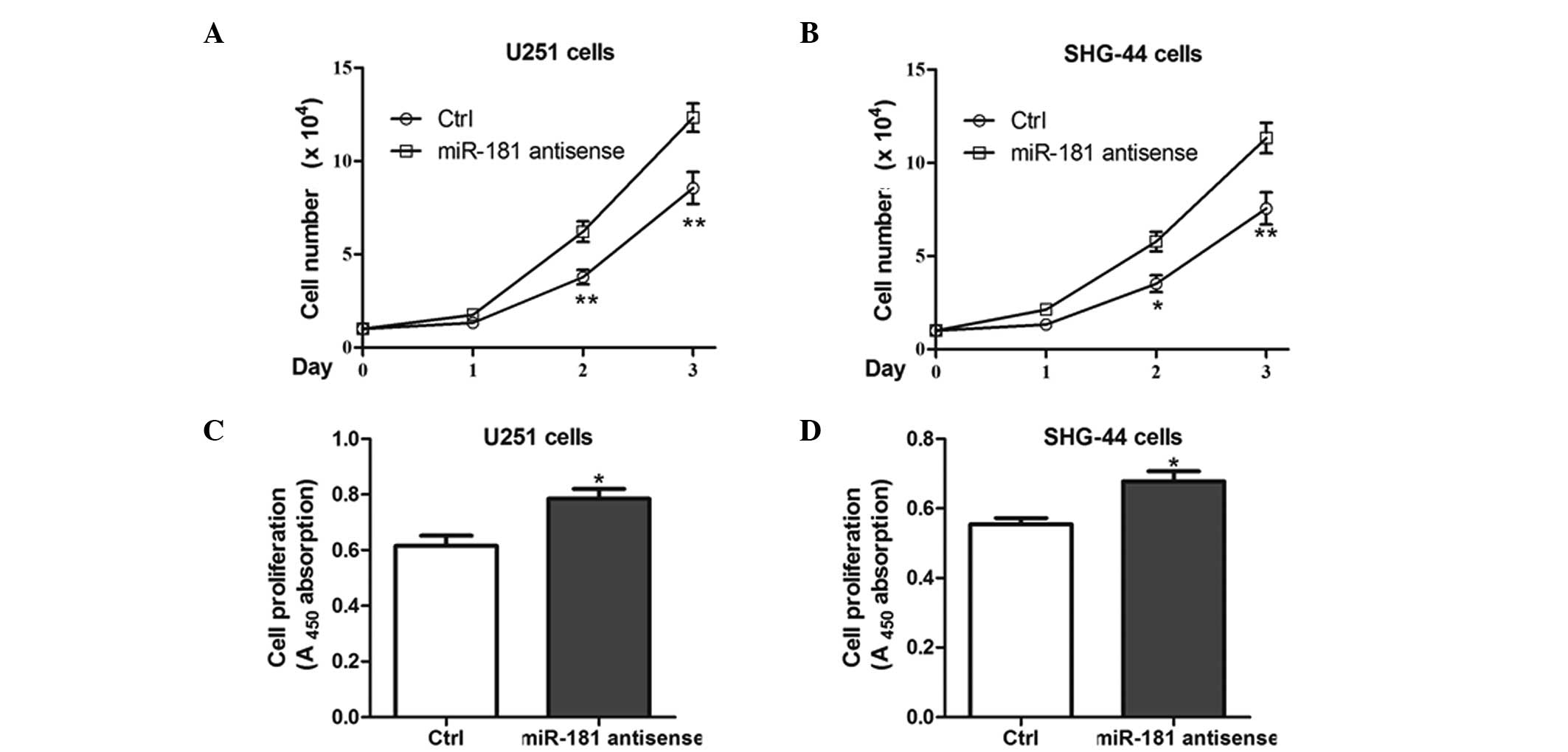
As described above, miR-181 has a critical role in the proliferation of glioma cells. However, whether inhibiting miR-181 enhances cell proliferation is unclear. Therefore, the two cell lines were transfected with antisense miR-181 and it was revealed that the ectopic expression of antisense hsa-miR-181 promoted the growth of U251 and SHG-44 cells, compared with that of the NC-transfected cells (Fig. 3A–D).

Figure 3

Antisense miR-181 promotes the proliferation of glioma cells. The growth curve of (A) U251 and (B) SHG-44 cells following antisense miR-181 transfection compared with the Ctrl. The cell proliferative potential (BrdU) was determined in (C) U251 and (D) SHG-44 cells transfected with antisense miR-181 or Ctrl. A450 absorption was assayed following transfection for 24 h. *P<0.05 and **P<0.01, compared with the Ctrl. Ctrl, negative control; miRNA, microRNA.

miR-181 directly targets cyclin B1 in glioma cells

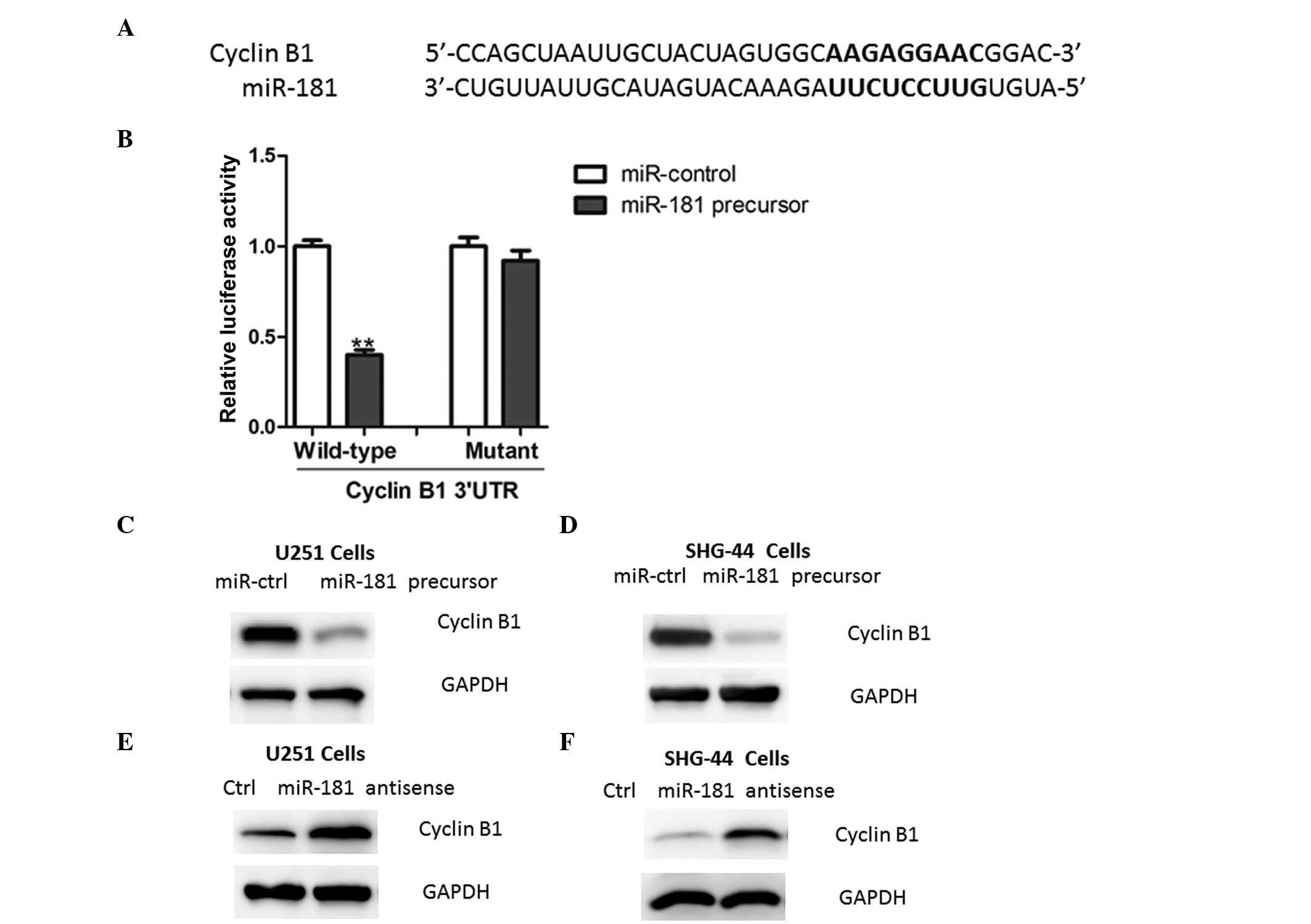
Using a stringent bioinformatics approach (miRWalk software, Heidelberg, Germany; http://www.umm.uni-heidelberg.de/apps/zmf/mirwalk/), 24 putative human miR-181 target genes were identified (data not shown), among which the gene encoding cyclin B1 harbored a potential miR-181 binding site (Fig. 4A). The overexpression of miR-181 led to a reduction of luciferase activity when the reporter construct contained the cyclin B1 3′UTR (Fig. 4B). By contrast, mutations in the conserved miR-181 binding motif abrogated the reduced luciferase expression (Fig. 4B). Furthermore, the overexpression of miR-181 in glioma cells led to reduced cyclin B1 protein expression (Fig. 4C–D). Consistently, the inhibition of miR-181 led to an increased expression of cyclin B1 (Fig. 4E–F), further indicating that cyclin B1 is a target of miR-181 in glioma cells.

Figure 4

miR-181 negatively regulates cyclin B1 expression in glioma cells. (A) Computer prediction of miR-181 binding sites in the 3′UTRs of human cyclin B1 genes. The potential binding site is highlighted in bold. (B) Luciferase reporter assays in U251 cells. Cells were transfected with 100 ng of wild-type 3′-UTR-reporter or mutant constructs together with 100 nM miR-181 precursor or control. **P<0.01, compared with the miR-control. Western blot analysis of cyclin B1 in (C) U251 and (D) SHG-44 cells transfected with miR-181 precursor or miR-control. Western blot analysis of cyclin B1 in (E) U251 and (F) SHG-44 cells transfected with antisense miR-181 or negative control. miRNA, microRNA; UTR, untranslated region.

Discussion

In the present study, it was demonstrated that miR-181 expression is downregulated in glioma tissues. To the best of our knowledge, the present study was the first to identify at a molecular level that miR-181 regulated cyclin B1 expression by targeting its 3′UTR. Collectively, these findings suggest that the downregulation of miR-181 may promote the initiation and progression of glioma. Notably, a recent study demonstrated that transiently overexpressed miR-181 significantly sensitized malignant glioma cells to radiation treatment, which was concurrent with the downregulation of B cell lymphoma/leukemia-2 (Bcl-2) protein expression (13). This indicates that miR-181 may modulate radiosensitivity by targeting Bcl-2 in human malignant glioma cells (13), suggesting that miR-181 may be a target for enhancing the effect of radiation treatment on malignant glioma cells. Therefore, the precise roles of miR-181 may be diverse in glioma cells.

It has been reported that several miRNAs were misregulated in glioma tissues or cells (14,15). For example, miR-92b controls glioma proliferation and invasion by regulating Wnt/β-catenin signaling via Nemo-like kinase (16). In addition, miR-200b targets CREB1 and suppresses cell growth in human malignant glioma (17). Furthermore, the downregulation of miR-383 promotes glioma cell invasion by targeting insulin-like growth factor 1 receptor (18). By contrast, miR-107 inhibits U87 glioma stem cell growth and invasion by modulating Notch2 expression (19,20). Therefore, miRNA expression appears to have a key role in regulating cellular processes in glioma, which requires further investigation in the future.

In conclusion, the key finding of the present study is that miR-181 is able to promote the proliferation of glioma cell lines by targeting cyclin B1. This data indicates that miR-181 has an essential role in the regulation of glioma cell proliferation and may function as a tumor suppressor.

References

1 

Wang Y and Jiang T: Understanding high grade glioma: molecular mechanism, therapy and comprehensive management. Cancer Lett. 331:139–146. 2013. View Article : Google Scholar : PubMed/NCBI

2 

Chaudhry NS, Shah AH, Ferraro N, Snelling BM, Bregy A, Madhavan K and Komotar RJ: Predictors of long-term survival in patients with glioblastoma multiforme: advancements from the last quarter century. Cancer Invest. 31:287–308. 2013. View Article : Google Scholar : PubMed/NCBI

3 

Hirst TC, Vesterinen HM, Sena ES, Egan KJ, Macleod MR and Whittle IR: Systematic review and meta-analysis of temozolomide in animal models of glioma: was clinical efficacy predicted? Br J Cancer. 108:64–71. 2013. View Article : Google Scholar

4 

Marsh JC, Goldfarb J, Shafman TD and Diaz AZ: Current status of immunotherapy and gene therapy for high-grade gliomas. Cancer Control. 20:43–48. 2013.PubMed/NCBI

5 

Pritchard CC, Cheng HH and Tewari M: MicroRNA profiling: approaches and considerations. Nat Rev Genet. 13:358–369. 2012. View Article : Google Scholar : PubMed/NCBI

6 

Kasinski AL and Slack FJ: Epigenetics and genetics. MicroRNAs en route to the clinic: progress in validating and targeting microRNAs for cancer therapy. Nat Rev Cancer. 11:849–864. 2011. View Article : Google Scholar : PubMed/NCBI

7 

Naguibneva I, Ameyar-Zazoua M, Polesskaya A, Ait-Si-Ali S, Groisman R, Souidi M, Cuvellier S and Harel-Bellan A: The microRNA miR-181 targets the homeobox protein Hox-A11 during mammalian myoblast differentiation. Nat Cell Biol. 8:278–284. 2006. View Article : Google Scholar : PubMed/NCBI

8 

Pekarsky Y, Santanam U, Cimmino A, Palamarchuk A, Efanov A, Maximov V, Volinia S, Alder H, Liu CG, Rassenti L, Calin GA, Hagan JP, Kipps T and Croce CM: Tcl1 expression in chronic lymphocytic leukemia is regulated by miR-29 and miR-181. Cancer Res. 66:11590–11593. 2006. View Article : Google Scholar : PubMed/NCBI

9 

Neel JC and Lebrun JJ: Activin and TGFβ regulate expression of the microRNA-181 family to promote cell migration and invasion in breast cancer cells. Cell Signal. 25:1556–1566. 2013.

10 

Kim CH, Kim HK, Rettig RL, Kim J, Lee ET, Aprelikova O, Choi IJ, Munroe DJ and Green JE: miRNA signature associated with outcome of gastric cancer patients following chemotherapy. BMC Med Genomics. 4:792011. View Article : Google Scholar : PubMed/NCBI

11 

Ji J, Yamashita T, Budhu A, Forgues M, Jia HL, Li C, Deng C, Wauthier E, Reid LM, Ye QH, Qin LX, Yang W, Wang HY, Tang ZY, Croce CM and Wang XW: Identification of microRNA-181 by genome-wide screening as a critical player in EpCAM-positive hepatic cancer stem cells. Hepatology. 50:472–480. 2009. View Article : Google Scholar : PubMed/NCBI

12 

Wang B, Hsu SH, Majumder S, Kutay H, Huang W, Jacob ST and Ghoshal K: TGFbeta-mediated upregulation of hepatic miR-181b promotes hepatocarcinogenesis by targeting TIMP3. Oncogene. 9:1787–1797. 2010. View Article : Google Scholar : PubMed/NCBI

13 

Chen G, Zhu W, Shi D, Lv L, Zhang C, Liu P and Hu W: MicroRNA-181a sensitizes human malignant glioma U87MG cells to radiation by targeting Bcl-2. Oncol Rep. 23:997–1003. 2010.PubMed/NCBI

14 

Goodenberger ML and Jenkins RB: Genetics of adult glioma. Cancer Genet. 205:613–621. 2012. View Article : Google Scholar : PubMed/NCBI

15 

Odjélé A, Charest D and Morin P Jr: miRNAs as important drivers of glioblastomas: a no-brainer? Cancer Biomark. 11:245–252. 2012.PubMed/NCBI

16 

Wang K, Wang X, Zou J, Zhang A, Wan Y, Pu P, Song Z, Qian C, Chen Y, Yang S and Wang Y: miR-92b controls glioma proliferation and invasion through regulating Wnt/beta-catenin signaling via Nemo-like kinase. Neuro Oncol. 15:578–588. 2013. View Article : Google Scholar : PubMed/NCBI

17 

Peng B, Hu S, Jun Q, Luo D, Zhang X, Zhao H and Li D: MicroRNA-200b targets CREB1 and suppresses cell growth in human malignant glioma. Mol Cell Biochem. 379:51–58. 2013. View Article : Google Scholar : PubMed/NCBI

18 

He Z, Cen D, Luo X, Li D, Li P, Liang L and Meng Z: Downregulation of miR-383 promotes glioma cell invasion by targeting insulin-like growth factor 1 receptor. Med Oncol. 30:5572013. View Article : Google Scholar : PubMed/NCBI

19 

Chen L, Chen XR, Zhang R, Li P, Liu Y, Yan K and Jiang XD: MicroRNA-107 inhibits glioma cell migration and invasion by modulating Notch2 expression. J Neurooncol. 112:59–66. 2013. View Article : Google Scholar : PubMed/NCBI

20 

Chen L, Chen XR, Chen FF, Liu Y, Li P, Zhang R, Yan K, Yi YJ, Xu ZM and Jiang XD: MicroRNA-107 inhibits U87 glioma stem cells growth and invasion. Cell Mol Neurobiol. 33:651–657. 2013. View Article : Google Scholar : PubMed/NCBI

Related Articles

  • Abstract
  • View
  • Download
  • Twitter
Copy and paste a formatted citation
Spandidos Publications style
Wang F, Sun J, Zhu YH, Liu N, Wu Y and Yu F: MicroRNA-181 inhibits glioma cell proliferation by targeting cyclin B1. Mol Med Rep 10: 2160-2164, 2014.
APA
Wang, F., Sun, J., Zhu, Y., Liu, N., Wu, Y., & Yu, F. (2014). MicroRNA-181 inhibits glioma cell proliferation by targeting cyclin B1. Molecular Medicine Reports, 10, 2160-2164. https://doi.org/10.3892/mmr.2014.2423
MLA
Wang, F., Sun, J., Zhu, Y., Liu, N., Wu, Y., Yu, F."MicroRNA-181 inhibits glioma cell proliferation by targeting cyclin B1". Molecular Medicine Reports 10.4 (2014): 2160-2164.
Chicago
Wang, F., Sun, J., Zhu, Y., Liu, N., Wu, Y., Yu, F."MicroRNA-181 inhibits glioma cell proliferation by targeting cyclin B1". Molecular Medicine Reports 10, no. 4 (2014): 2160-2164. https://doi.org/10.3892/mmr.2014.2423
Copy and paste a formatted citation
x
Spandidos Publications style
Wang F, Sun J, Zhu YH, Liu N, Wu Y and Yu F: MicroRNA-181 inhibits glioma cell proliferation by targeting cyclin B1. Mol Med Rep 10: 2160-2164, 2014.
APA
Wang, F., Sun, J., Zhu, Y., Liu, N., Wu, Y., & Yu, F. (2014). MicroRNA-181 inhibits glioma cell proliferation by targeting cyclin B1. Molecular Medicine Reports, 10, 2160-2164. https://doi.org/10.3892/mmr.2014.2423
MLA
Wang, F., Sun, J., Zhu, Y., Liu, N., Wu, Y., Yu, F."MicroRNA-181 inhibits glioma cell proliferation by targeting cyclin B1". Molecular Medicine Reports 10.4 (2014): 2160-2164.
Chicago
Wang, F., Sun, J., Zhu, Y., Liu, N., Wu, Y., Yu, F."MicroRNA-181 inhibits glioma cell proliferation by targeting cyclin B1". Molecular Medicine Reports 10, no. 4 (2014): 2160-2164. https://doi.org/10.3892/mmr.2014.2423
Follow us
  • Twitter
  • LinkedIn
  • Facebook
About
  • Spandidos Publications
  • Careers
  • Cookie Policy
  • Privacy Policy
How can we help?
  • Help
  • Live Chat
  • Contact
  • Email to our Support Team