Spandidos Publications Logo
  • About
    • About Spandidos
    • Aims and Scopes
    • Abstracting and Indexing
    • Editorial Policies
    • Reprints and Permissions
    • Job Opportunities
    • Terms and Conditions
    • Contact
  • Journals
    • All Journals
    • Oncology Letters
      • Oncology Letters
      • Information for Authors
      • Editorial Policies
      • Editorial Board
      • Aims and Scope
      • Abstracting and Indexing
      • Bibliographic Information
      • Archive
    • International Journal of Oncology
      • International Journal of Oncology
      • Information for Authors
      • Editorial Policies
      • Editorial Board
      • Aims and Scope
      • Abstracting and Indexing
      • Bibliographic Information
      • Archive
    • Molecular and Clinical Oncology
      • Molecular and Clinical Oncology
      • Information for Authors
      • Editorial Policies
      • Editorial Board
      • Aims and Scope
      • Abstracting and Indexing
      • Bibliographic Information
      • Archive
    • Experimental and Therapeutic Medicine
      • Experimental and Therapeutic Medicine
      • Information for Authors
      • Editorial Policies
      • Editorial Board
      • Aims and Scope
      • Abstracting and Indexing
      • Bibliographic Information
      • Archive
    • International Journal of Molecular Medicine
      • International Journal of Molecular Medicine
      • Information for Authors
      • Editorial Policies
      • Editorial Board
      • Aims and Scope
      • Abstracting and Indexing
      • Bibliographic Information
      • Archive
    • Biomedical Reports
      • Biomedical Reports
      • Information for Authors
      • Editorial Policies
      • Editorial Board
      • Aims and Scope
      • Abstracting and Indexing
      • Bibliographic Information
      • Archive
    • Oncology Reports
      • Oncology Reports
      • Information for Authors
      • Editorial Policies
      • Editorial Board
      • Aims and Scope
      • Abstracting and Indexing
      • Bibliographic Information
      • Archive
    • Molecular Medicine Reports
      • Molecular Medicine Reports
      • Information for Authors
      • Editorial Policies
      • Editorial Board
      • Aims and Scope
      • Abstracting and Indexing
      • Bibliographic Information
      • Archive
    • World Academy of Sciences Journal
      • World Academy of Sciences Journal
      • Information for Authors
      • Editorial Policies
      • Editorial Board
      • Aims and Scope
      • Abstracting and Indexing
      • Bibliographic Information
      • Archive
    • International Journal of Functional Nutrition
      • International Journal of Functional Nutrition
      • Information for Authors
      • Editorial Policies
      • Editorial Board
      • Aims and Scope
      • Abstracting and Indexing
      • Bibliographic Information
      • Archive
    • International Journal of Epigenetics
      • International Journal of Epigenetics
      • Information for Authors
      • Editorial Policies
      • Editorial Board
      • Aims and Scope
      • Abstracting and Indexing
      • Bibliographic Information
      • Archive
    • Medicine International
      • Medicine International
      • Information for Authors
      • Editorial Policies
      • Editorial Board
      • Aims and Scope
      • Abstracting and Indexing
      • Bibliographic Information
      • Archive
  • Articles
  • Information
    • Information for Authors
    • Information for Reviewers
    • Information for Librarians
    • Information for Advertisers
    • Conferences
  • Language Editing
Spandidos Publications Logo
  • About
    • About Spandidos
    • Aims and Scopes
    • Abstracting and Indexing
    • Editorial Policies
    • Reprints and Permissions
    • Job Opportunities
    • Terms and Conditions
    • Contact
  • Journals
    • All Journals
    • Biomedical Reports
      • Information for Authors
      • Editorial Policies
      • Editorial Board
      • Aims and Scope
      • Abstracting and Indexing
      • Bibliographic Information
      • Archive
    • Experimental and Therapeutic Medicine
      • Information for Authors
      • Editorial Policies
      • Editorial Board
      • Aims and Scope
      • Abstracting and Indexing
      • Bibliographic Information
      • Archive
    • International Journal of Epigenetics
      • Information for Authors
      • Editorial Policies
      • Editorial Board
      • Aims and Scope
      • Abstracting and Indexing
      • Bibliographic Information
      • Archive
    • International Journal of Functional Nutrition
      • Information for Authors
      • Editorial Policies
      • Editorial Board
      • Aims and Scope
      • Abstracting and Indexing
      • Bibliographic Information
      • Archive
    • International Journal of Molecular Medicine
      • Information for Authors
      • Editorial Policies
      • Editorial Board
      • Aims and Scope
      • Abstracting and Indexing
      • Bibliographic Information
      • Archive
    • International Journal of Oncology
      • Information for Authors
      • Editorial Policies
      • Editorial Board
      • Aims and Scope
      • Abstracting and Indexing
      • Bibliographic Information
      • Archive
    • Medicine International
      • Information for Authors
      • Editorial Policies
      • Editorial Board
      • Aims and Scope
      • Abstracting and Indexing
      • Bibliographic Information
      • Archive
    • Molecular and Clinical Oncology
      • Information for Authors
      • Editorial Policies
      • Editorial Board
      • Aims and Scope
      • Abstracting and Indexing
      • Bibliographic Information
      • Archive
    • Molecular Medicine Reports
      • Information for Authors
      • Editorial Policies
      • Editorial Board
      • Aims and Scope
      • Abstracting and Indexing
      • Bibliographic Information
      • Archive
    • Oncology Letters
      • Information for Authors
      • Editorial Policies
      • Editorial Board
      • Aims and Scope
      • Abstracting and Indexing
      • Bibliographic Information
      • Archive
    • Oncology Reports
      • Information for Authors
      • Editorial Policies
      • Editorial Board
      • Aims and Scope
      • Abstracting and Indexing
      • Bibliographic Information
      • Archive
    • World Academy of Sciences Journal
      • Information for Authors
      • Editorial Policies
      • Editorial Board
      • Aims and Scope
      • Abstracting and Indexing
      • Bibliographic Information
      • Archive
  • Articles
  • Information
    • For Authors
    • For Reviewers
    • For Librarians
    • For Advertisers
    • Conferences
  • Language Editing
Login Register Submit
  • This site uses cookies
  • You can change your cookie settings at any time by following the instructions in our Cookie Policy. To find out more, you may read our Privacy Policy.

    I agree
Search articles by DOI, keyword, author or affiliation
Search
Advanced Search
presentation
Molecular Medicine Reports
Join Editorial Board Propose a Special Issue
Print ISSN: 1791-2997 Online ISSN: 1791-3004
Journal Cover
November-2014 Volume 10 Issue 5

Full Size Image

Sign up for eToc alerts
Recommend to Library

Journals

International Journal of Molecular Medicine

International Journal of Molecular Medicine

International Journal of Molecular Medicine is an international journal devoted to molecular mechanisms of human disease.

International Journal of Oncology

International Journal of Oncology

International Journal of Oncology is an international journal devoted to oncology research and cancer treatment.

Molecular Medicine Reports

Molecular Medicine Reports

Covers molecular medicine topics such as pharmacology, pathology, genetics, neuroscience, infectious diseases, molecular cardiology, and molecular surgery.

Oncology Reports

Oncology Reports

Oncology Reports is an international journal devoted to fundamental and applied research in Oncology.

Experimental and Therapeutic Medicine

Experimental and Therapeutic Medicine

Experimental and Therapeutic Medicine is an international journal devoted to laboratory and clinical medicine.

Oncology Letters

Oncology Letters

Oncology Letters is an international journal devoted to Experimental and Clinical Oncology.

Biomedical Reports

Biomedical Reports

Explores a wide range of biological and medical fields, including pharmacology, genetics, microbiology, neuroscience, and molecular cardiology.

Molecular and Clinical Oncology

Molecular and Clinical Oncology

International journal addressing all aspects of oncology research, from tumorigenesis and oncogenes to chemotherapy and metastasis.

World Academy of Sciences Journal

World Academy of Sciences Journal

Multidisciplinary open-access journal spanning biochemistry, genetics, neuroscience, environmental health, and synthetic biology.

International Journal of Functional Nutrition

International Journal of Functional Nutrition

Open-access journal combining biochemistry, pharmacology, immunology, and genetics to advance health through functional nutrition.

International Journal of Epigenetics

International Journal of Epigenetics

Publishes open-access research on using epigenetics to advance understanding and treatment of human disease.

Medicine International

Medicine International

An International Open Access Journal Devoted to General Medicine.

Journal Cover
November-2014 Volume 10 Issue 5

Full Size Image

Sign up for eToc alerts
Recommend to Library

  • Article
  • Citations
    • Cite This Article
    • Download Citation
    • Create Citation Alert
    • Remove Citation Alert
    • Cited By
  • Similar Articles
    • Related Articles (in Spandidos Publications)
    • Similar Articles (Google Scholar)
    • Similar Articles (PubMed)
  • Download PDF
  • Download XML
  • View XML
Article Open Access

Death receptor 5 expression IS inversely correlated WITH prostate cancer progression

Corrigendum in: /10.3892/mco.2017.7234
  • Authors:
    • Angeles Hernandez‑Cueto
    • Daniel Hernandez‑Cueto
    • Gabriela Antonio‑Andres
    • Marisela Mendoza‑Marin
    • Carlos Jimenez‑Gutierrez
    • Ana Lilia Sandoval‑Mejia
    • Rosario Mora‑Campos
    • Cesar Gonzalez‑Bonilla
    • Mario I. Vega
    • Benjamin Bonavida
    • Sara Huerta‑Yepez
  • View Affiliations / Copyright

    Affiliations: Immunology and Infection Research Unit, National Medical Center ‘La Raza’, IMSS, Mexico City 02200, Mexico, Oncology Disease Research Unit, Children Hospital of Mexico ‘Federico Gomez’, Mexico City 06720, Mexico, Department of Pathology, Hospital General Regional No. 25, IMSS, Mexico City 06720, Mexico, Women Hospital, Mexico City 11340, Mexico, Gineco‑Obstetricia Hospital No. 3, CMN ‘La Raza’, IMSS, Mexico City 02200, Mexico, Speciality Hospital CMN ‘La Raza’, IMSS, Mexico City 02200, Mexico, Oncology Research Unit, Oncology Hospital, Siglo XXI National Medical Center, IMSS, Mexico City 06720, Mexico, Department of Microbiology, Immunology and Molecular Genetics, David Geffen School of Medicine, University of California, Los Angeles, CA 90095, USA
    Copyright: © Hernandez‑Cueto et al. This is an open access article distributed under the terms of Creative Commons Attribution License [CC BY_NC 3.0].
  • Pages: 2279-2286
    |
    Published online on: August 21, 2014
       https://doi.org/10.3892/mmr.2014.2504
  • Expand metrics +
Metrics: Total Views: 0 (Spandidos Publications: | PMC Statistics: )
Metrics: Total PDF Downloads: 0 (Spandidos Publications: | PMC Statistics: )
Cited By (CrossRef): 0 citations Loading Articles...

This article is mentioned in:


Abstract

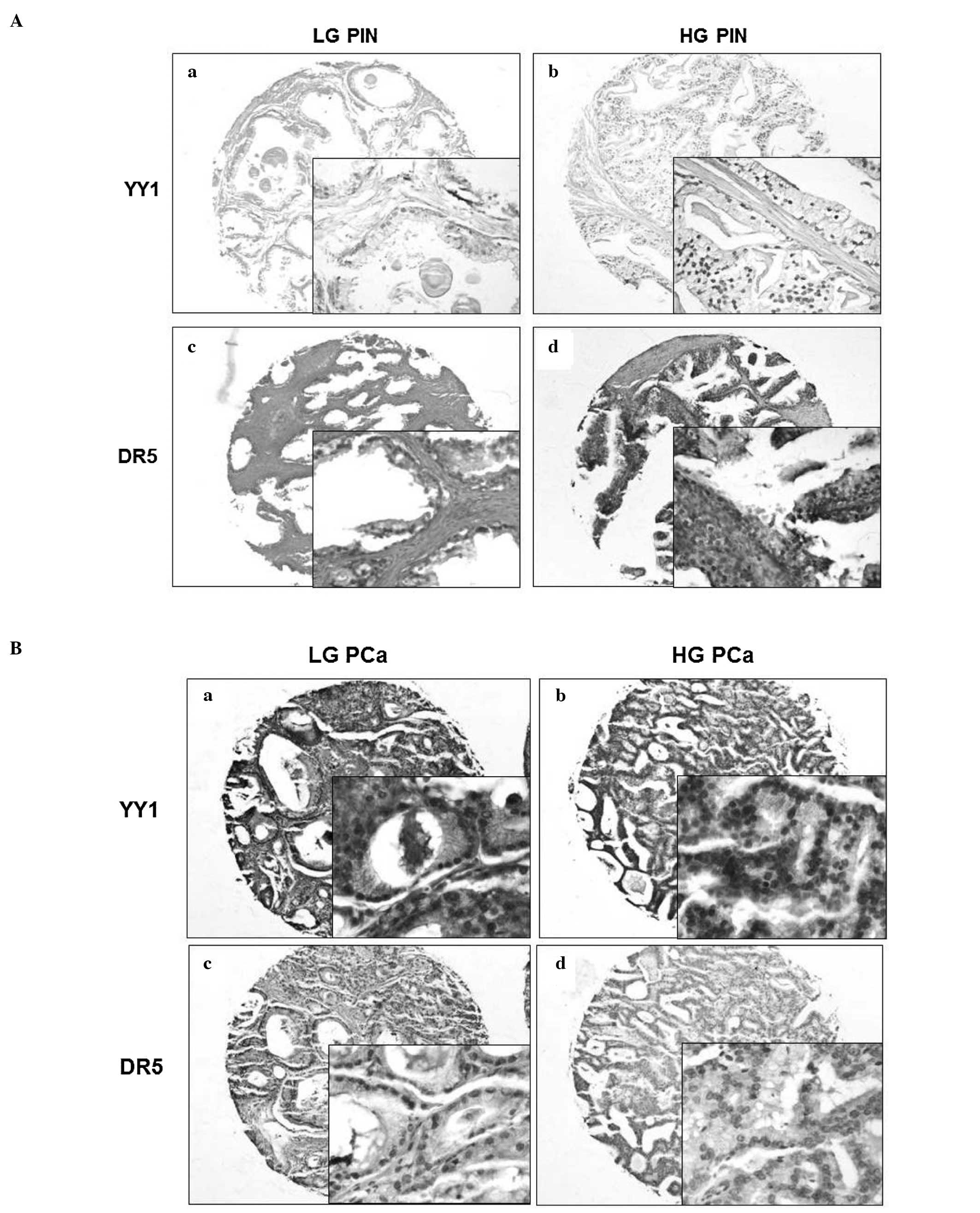
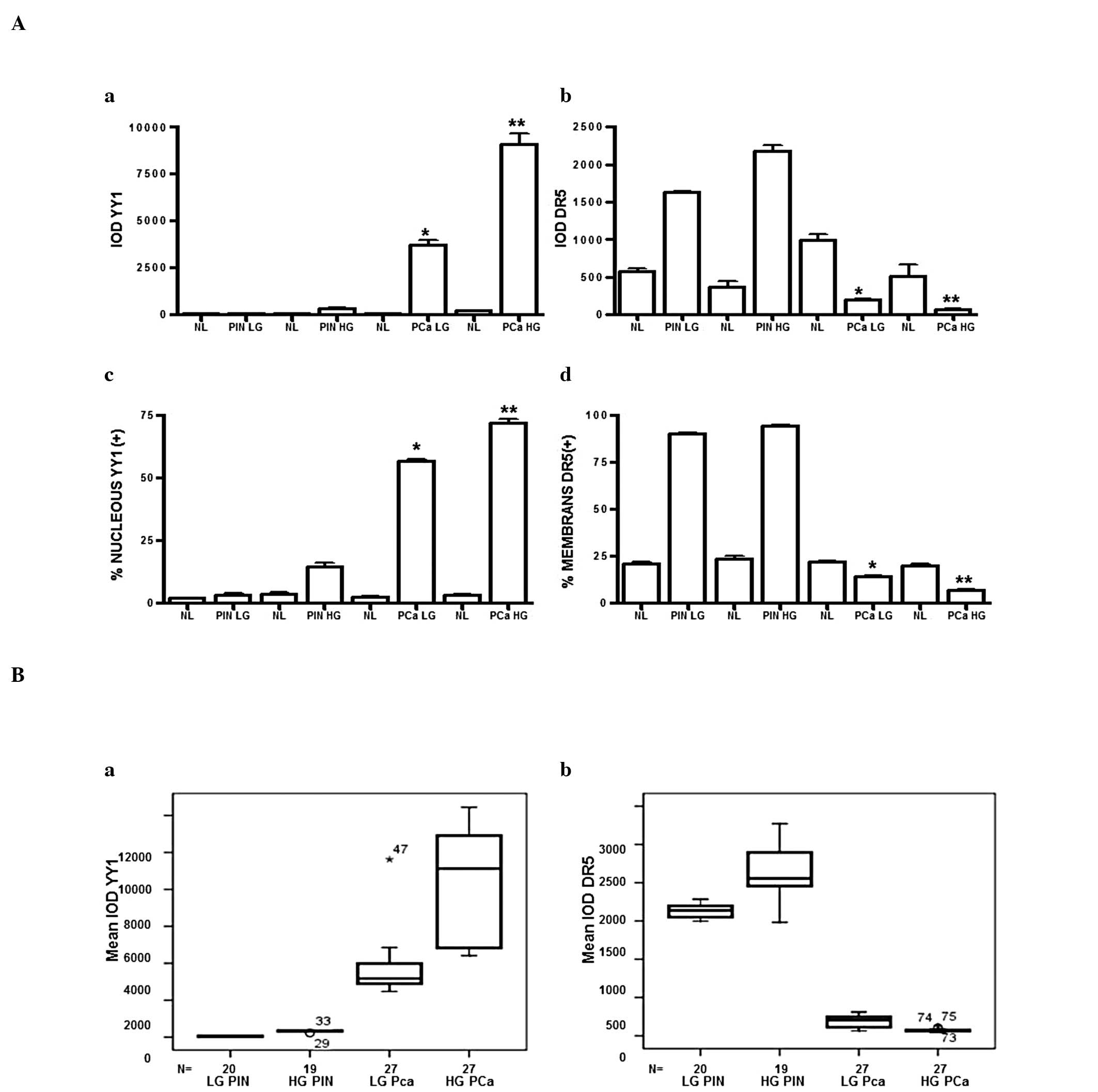
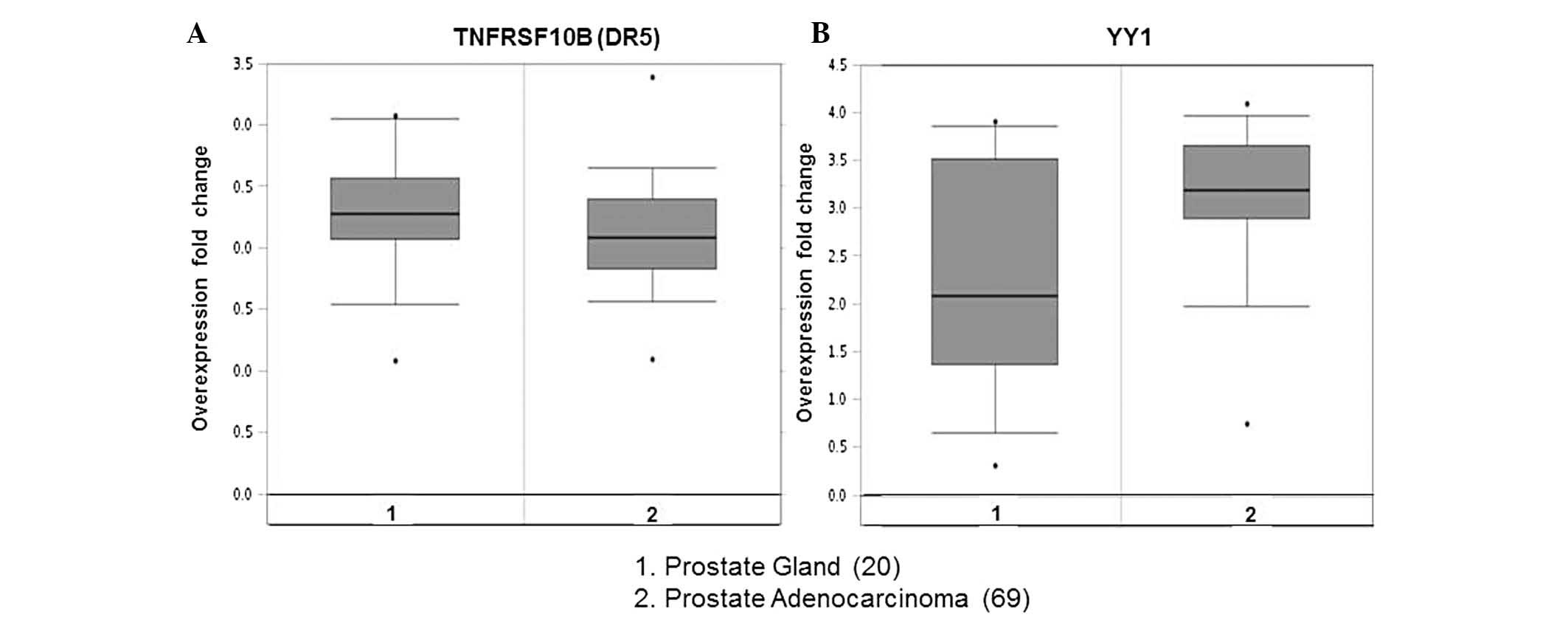
Prostate carcinoma (PCa) is one of the most common cancers in men. Prostate-specific antigen (PSA) has been widely used to predict the outcome of PCa and screening with PSA has resulted in a decline in mortality. However, PSA is not an optimal prognostic tool as its sensitivity may be too low to reduce morbidity and mortality. Consequently, there is a demand for additional robust biomarkers for prostate cancer. Death receptor 5 (DR5) has been implicated in the prognosis of several cancers and it has been previously shown that it is negatively regulated by Yin Yang 1 (YY1) in prostate cancer cell lines. The present study investigated the clinical significance of DR5 expression in a prostate cancer patient cohort and its correlation with YY1 expression. Immunohistochemical analysis of protein expression distribution was performed using tissue microarray constructs from 54 primary PCa and 39 prostatic intraepithelial neoplasia (PIN) specimens. DR5 expression was dramatically reduced as a function of higher tumor grade. By contrast, YY1 expression was elevated in PCa tumors as compared with that in PIN, and was increased with higher tumor grade. DR5 had an inverse correlation with YY1 expression. Bioinformatic analyses corroborated these data. The present findings suggested that DR5 and YY1 expression levels may serve as progression biomarkers for prostate cancer.
View Figures

Figure 1

Figure 2

Figure 3

View References

1 

Liang Y, Ketchum NS, Louden C, et al: The use of the finasteride-adjusted Prostate Cancer Prevention Trial Prostate Cancer Risk Calculator in a Mexican referral population: a validation study. Urol Int. 89:9–16. 2012. View Article : Google Scholar

2 

Siegel R, Naishadham D and Jemal A: Cancer statistics, 2012. CA Cancer J Clin. 62:10–29. 2012. View Article : Google Scholar

3 

Cooperberg MR, Broering JM and Carroll PR: Risk assessment for prostate cancer metastasis and mortality at the time of diagnosis. J Natl Cancer Inst. 16:878–887. 2009. View Article : Google Scholar : PubMed/NCBI

4 

Major JM, Norman Oliver M, Doubeni CA, et al: Socioeconomic status, healthcare density, and risk of prostate cancer among African American and Caucasian men in a large prospective study. Cancer Causes Control. 23:1185–1191. 2012. View Article : Google Scholar

5 

Lee EW, Marien T, Laze J, Agalliu I and Lepor H: Comparison of health-related quality-of-life outcomes for African-American and Caucasian-American men after radical prostatectomy. BJU Int. 110:1129–1133. 2012. View Article : Google Scholar : PubMed/NCBI

6 

Parker PM, Rice KR, Sterbis JR, et al: Prostate cancer in men less than the age of 50: a comparison of race and outcomes. Urology. 78:110–115. 2011. View Article : Google Scholar : PubMed/NCBI

7 

Seligson DB, Hongo F, Huerta-Yepez S, et al: Expression of X-linked inhibitor of apoptosis protein is a strong predictor of human prostate cancer recurrence. Clin Cancer Res. 15:6056–6063. 2007. View Article : Google Scholar

8 

Chen C, Chen J and Zhao KN: Editorial: Signalling pathways in anti-cancer drug resistance. Curr Med Chem. 21:3007–3008. 2014. View Article : Google Scholar : PubMed/NCBI

9 

Gomella LG: Addressing the needs of the high-risk prostate cancer patient. Rev Urol. 7:S18–S28. 2005.PubMed/NCBI

10 

Chodak G: Prostate cancer: epidemiology, screening, and biomarkers. Rev Urol. 8 Suppl:S3–S8. 2006.PubMed/NCBI

11 

Shariat SF, Semjonow A, Lilja H, et al: Tumor markers in prostate cancer I: blood-based markers. Acta Oncol. 50 Suppl:61–75. 2011. View Article : Google Scholar : PubMed/NCBI

12 

McGuire SE, Lee AK, Cerne JZ, et al: PSA response to neoadjuvant androgen deprivation therapy is a strong independent predictor of survival in high-risk prostate cancer in the dose-escalated radiation therapy era. Int J Radiat Oncol Biol Phys. 85:e39–e46. 2013. View Article : Google Scholar

13 

Masieri L, Minervini A, Vittori G, et al: The role of free to total PSA ratio in prediction of extracapsular tumor extension and biochemical recurrence after radical prostatectomy in patients with PSA between 4 and 10 ng/ml. Int Urol Nephrol. 44:1031–1038. 2012. View Article : Google Scholar

14 

Elmore S: Apoptosis: a review of programmed cell death. Toxicol Pathol. 35:495–516. 2007. View Article : Google Scholar : PubMed/NCBI

15 

Horak P, Pils D, Haller G, et al: Contribution of epigenetic silencing of tumor necrosis factor-related apoptosis inducing ligand receptor 1 (DR4) to TRAIL resistance and ovarian cancer. Mol Cancer Res. 3:335–343. 2005. View Article : Google Scholar : PubMed/NCBI

16 

Thomas LR, Bender LM, Morgan MJ and Thorburn A: Extensive regions of the FADD death domain are required for binding to the TRAIL receptor DR5. Cell Death Differ. 13:160–162. 2006. View Article : Google Scholar : PubMed/NCBI

17 

Ramaswamy M, Efimova EV, Martinez O, et al: IG20 (MADD splice variant-5), a proapoptotic protein, interacts with DR4/DR5 and enhances TRAIL-induced apoptosis by increasing recruitment of FADD and caspase-8 to the DISC. Oncogene. 23:6083–6094. 2004. View Article : Google Scholar

18 

Thomas LR, Henson A, Reed JC, Salsbury FR and Thorburn A: Direct binding of Fas-associated death domain (FADD) to the tumor necrosis factor-related apoptosis-inducing ligand receptor DR5 is regulated by the death effector domain of FADD. J Biol Chem. 279:32780–32785. 2004. View Article : Google Scholar

19 

Cooper WA, Kohonen-Corish MR, Zhuang L, et al: Role and prognostic significance of tumor necrosis factor-related apoptosis-inducing ligand death receptor DR5 in nonsmall-cell lung cancer and precursor lesions. Cancer. 113:135–142. 2008. View Article : Google Scholar : PubMed/NCBI

20 

Zhuang L, Lee CS, Scolyer RA, et al: Progression in melanoma is associated with decreased expression of death receptors for tumor necrosis factor-related apoptosis-inducing ligand. Hum Pathol. 37:1286–1294. 2006. View Article : Google Scholar

21 

Ganten TM, Sykora J, Koschny R, et al: Prognostic significance of tumour necrosis factor-related apoptosis-inducing ligand (TRAIL) receptor expression in patients with breast cancer. J Mol Med (Berl). 87:995–1007. 2009. View Article : Google Scholar

22 

Maduro JH, Noordhuis MG, ten Hoor KA, et al: The prognostic value of TRAIL and its death receptors in cervical cancer. Int J Radiat Oncol Biol Phys. 75:203–211. 2009. View Article : Google Scholar : PubMed/NCBI

23 

van Geelen CM, Westra JL, de Vries EG, et al: Prognostic significance of tumor necrosis factor-related apoptosis-inducing ligand and its receptors in adjuvantly treated stage III colon cancer patients. J Clin Oncol. 24:4998–5004. 2006.

24 

Seligson D, Horvath S, Huerta-Yepez S, et al: Expression of transcription factor Yin Yang 1 in prostate cancer. Int J Oncol. 27:131–141. 2005.PubMed/NCBI

25 

Baritaki S, Huerta-Yepez S, Sakai T, Spandidos DA and Bonavida B: Chemotherapeutic drugs sensitize cancer cells to TRAIL-mediated apoptosis: up-regulation of DR5 and inhibition of Yin Yang 1. Mol Cancer Ther. 6:1387–1399. 2007. View Article : Google Scholar : PubMed/NCBI

26 

Baritaki S, Suzuki E, Umezawa K, et al: Inhibition of Yin Yang 1-dependent repressor activity of DR5 transcription and expression by the novel proteasome inhibitor NPI-0052 contributes to its TRAIL-enhanced apoptosis in cancer cells. J Immunol. 180:6199–6210. 2008. View Article : Google Scholar

27 

Huerta-Yepez S, Vega M, Escoto-Chavez SE, et al: Nitric oxide sensitizes tumor cells to TRAIL-induced apoptosis via inhibition of the DR5 transcription repressor Yin Yang 1. Nitric Oxide. 20:39–52. 2009. View Article : Google Scholar : PubMed/NCBI

28 

Vanaja DK, Cheville JC, Iturria SJ and Young CY: Transcriptional silencing of zinc finger protein 185 identified by expression profiling is associated with prostate cancer progression. Cancer Res. 63:3877–3882. 2003.PubMed/NCBI

29 

Wallace TA, Prueitt RL, Yi M, et al: Tumor immunobiological differences in prostate cancer between African-American and European-American men. Cancer Res. 68:927–936. 2008. View Article : Google Scholar : PubMed/NCBI

30 

Liu P, Ramachandran S, Ali Seyed SM, et al: Sex-determining region Y box 4 is a transforming oncogene in human prostate cancer cells. Cancer Res. 66:4011–4019. 2006. View Article : Google Scholar : PubMed/NCBI

31 

Luo J, Duggan DJ, Chen Y, et al: Human prostate cancer and benign prostatic hyperplasia: molecular dissection by gene expression profiling. Cancer Res. 61:4683–4688. 2001.PubMed/NCBI

32 

Han M, Snow PB, Epstein JI, Chan TY, Jones KA, Walsh PC and Partin AW: A neural network predicts progression for men with gleason score 3+4 versus 4+3 tumors after radical prostatectomy. Urology. 56:994–999. 2000. View Article : Google Scholar

33 

Yu YP, Landsittel D, Jing L, et al: Gene expression alterations in prostate cancer predicting tumor aggression and preceding development of malignancy. J Clin Oncol. 22:2790–2799. 2004. View Article : Google Scholar : PubMed/NCBI

34 

Oliver PG, LoBuglio AF, Zhou T, et al: Effect of anti-DR5 and chemotherapy on basal-like breast cancer. Breast Cancer Res Treat. 133:417–426. 2012. View Article : Google Scholar : PubMed/NCBI

35 

Sharma S, de Vries EG, Infante JR, et al: Safety, pharmacokinetics, and pharmacodynamics of the DR5 antibody LBY135 alone and in combination with capecitabine in patients with advanced solid tumors. Invest New Drugs. 32:135–144. 2014. View Article : Google Scholar : PubMed/NCBI

36 

Zinonos I, Labrinidis A, Lee M, et al: Apomab, a fully human agonistic antibody to DR5, exhibits potent antitumor activity against primary and metastatic breast cancer. Mol Cancer Ther. 8:2969–2980. 2009. View Article : Google Scholar : PubMed/NCBI

37 

Baritaki S, Katsman A, Chatterjee D, et al: Regulation of tumor cell sensitivity to TRAIL-induced apoptosis by the metastatic suppressor Raf kinase inhibitor protein via Yin Yang 1 inhibition and death receptor 5 up-regulation. J Immunol. 179:5441–5453. 2007. View Article : Google Scholar

38 

Miyata Y, Watanabe S, Sagara Y, et al: High expression of HuR in cytoplasm, but not nuclei, is associated with malignant aggressiveness and prognosis in bladder cancer. PLoS One. 8:e590952013. View Article : Google Scholar

39 

Keane MM, Ettenberg SA, Nau MM, Russell EK and Lipkowitz S: Chemotherapy augments TRAIL-induced apoptosis in breast cell lines. Cancer Res. 59:734–741. 1999.PubMed/NCBI

40 

Elrod HA, Fan S, Muller S, et al: Analysis of death receptor 5 and caspase-8 expression in primary and metastatic head and neck squamous cell carcinoma and their prognostic impact. PLoS One. 5:e121782010. View Article : Google Scholar : PubMed/NCBI

41 

Sung B, Ravindran J, Prasad S, Pandey MK and Aggarwal BB: Gossypol induces death receptor-5 through activation of the ROS-ERK-CHOP pathway and sensitizes colon cancer cells to TRAIL. J Biol Chem. 12:35418–35427. 2010. View Article : Google Scholar : PubMed/NCBI

42 

Chang MS, Lee HS, Lee BL, et al: Differential protein expression between esophageal squamous cell carcinoma and dysplasia, and prognostic significance of protein markers. Pathol Res Pract. 201:417–425. 2005. View Article : Google Scholar

43 

Oikonomou E and Pintzas A: The TRAIL of oncogenes to apoptosis. Biofactors. 39:343–354. 2013. View Article : Google Scholar : PubMed/NCBI

44 

Deng Z, Cao P, Wan MM and Sui G: Yin Yang 1: a multifaceted protein beyond a transcription factor. Transcription. 1:81–84. 2010. View Article : Google Scholar : PubMed/NCBI

45 

Pilarsky C, Wenzig M, Specht T, Saeger HD and Grützmann R: Identification and validation of commonly overexpressed genes in solid tumors by comparison of microarray data. Neoplasia. 6:744–750. 2004. View Article : Google Scholar

46 

Zamai L, Ahmad M, Bennett IM, et al: Natural killer (NK) cell-mediated cytotoxicity: differential use of TRAIL and Fas ligand by immature and mature primary human NK cells. J Exp Med. 188:2375–2380. 1998. View Article : Google Scholar : PubMed/NCBI

47 

Anees M, Horak P, El-Gazzar A, Susani M, Heinze G, Perco P, Loda M, Lis R, Krainer M and Oh WK: Recurrence-free survival in prostate cancer is related to increased stromal TRAIL expression. Cancer. 117:1172–1182. 2011. View Article : Google Scholar : PubMed/NCBI

Related Articles

  • Abstract
  • View
  • Download
  • Twitter
Copy and paste a formatted citation
Spandidos Publications style
Hernandez‑Cueto A, Hernandez‑Cueto D, Antonio‑Andres G, Mendoza‑Marin M, Jimenez‑Gutierrez C, Sandoval‑Mejia AL, Mora‑Campos R, Gonzalez‑Bonilla C, Vega MI, Bonavida B, Bonavida B, et al: Death receptor 5 expression IS inversely correlated WITH prostate cancer progression Corrigendum in /10.3892/mco.2017.7234. Mol Med Rep 10: 2279-2286, 2014.
APA
Hernandez‑Cueto, A., Hernandez‑Cueto, D., Antonio‑Andres, G., Mendoza‑Marin, M., Jimenez‑Gutierrez, C., Sandoval‑Mejia, A.L. ... Huerta‑Yepez, S. (2014). Death receptor 5 expression IS inversely correlated WITH prostate cancer progression Corrigendum in /10.3892/mco.2017.7234. Molecular Medicine Reports, 10, 2279-2286. https://doi.org/10.3892/mmr.2014.2504
MLA
Hernandez‑Cueto, A., Hernandez‑Cueto, D., Antonio‑Andres, G., Mendoza‑Marin, M., Jimenez‑Gutierrez, C., Sandoval‑Mejia, A. L., Mora‑Campos, R., Gonzalez‑Bonilla, C., Vega, M. I., Bonavida, B., Huerta‑Yepez, S."Death receptor 5 expression IS inversely correlated WITH prostate cancer progression Corrigendum in /10.3892/mco.2017.7234". Molecular Medicine Reports 10.5 (2014): 2279-2286.
Chicago
Hernandez‑Cueto, A., Hernandez‑Cueto, D., Antonio‑Andres, G., Mendoza‑Marin, M., Jimenez‑Gutierrez, C., Sandoval‑Mejia, A. L., Mora‑Campos, R., Gonzalez‑Bonilla, C., Vega, M. I., Bonavida, B., Huerta‑Yepez, S."Death receptor 5 expression IS inversely correlated WITH prostate cancer progression Corrigendum in /10.3892/mco.2017.7234". Molecular Medicine Reports 10, no. 5 (2014): 2279-2286. https://doi.org/10.3892/mmr.2014.2504
Copy and paste a formatted citation
x
Spandidos Publications style
Hernandez‑Cueto A, Hernandez‑Cueto D, Antonio‑Andres G, Mendoza‑Marin M, Jimenez‑Gutierrez C, Sandoval‑Mejia AL, Mora‑Campos R, Gonzalez‑Bonilla C, Vega MI, Bonavida B, Bonavida B, et al: Death receptor 5 expression IS inversely correlated WITH prostate cancer progression Corrigendum in /10.3892/mco.2017.7234. Mol Med Rep 10: 2279-2286, 2014.
APA
Hernandez‑Cueto, A., Hernandez‑Cueto, D., Antonio‑Andres, G., Mendoza‑Marin, M., Jimenez‑Gutierrez, C., Sandoval‑Mejia, A.L. ... Huerta‑Yepez, S. (2014). Death receptor 5 expression IS inversely correlated WITH prostate cancer progression Corrigendum in /10.3892/mco.2017.7234. Molecular Medicine Reports, 10, 2279-2286. https://doi.org/10.3892/mmr.2014.2504
MLA
Hernandez‑Cueto, A., Hernandez‑Cueto, D., Antonio‑Andres, G., Mendoza‑Marin, M., Jimenez‑Gutierrez, C., Sandoval‑Mejia, A. L., Mora‑Campos, R., Gonzalez‑Bonilla, C., Vega, M. I., Bonavida, B., Huerta‑Yepez, S."Death receptor 5 expression IS inversely correlated WITH prostate cancer progression Corrigendum in /10.3892/mco.2017.7234". Molecular Medicine Reports 10.5 (2014): 2279-2286.
Chicago
Hernandez‑Cueto, A., Hernandez‑Cueto, D., Antonio‑Andres, G., Mendoza‑Marin, M., Jimenez‑Gutierrez, C., Sandoval‑Mejia, A. L., Mora‑Campos, R., Gonzalez‑Bonilla, C., Vega, M. I., Bonavida, B., Huerta‑Yepez, S."Death receptor 5 expression IS inversely correlated WITH prostate cancer progression Corrigendum in /10.3892/mco.2017.7234". Molecular Medicine Reports 10, no. 5 (2014): 2279-2286. https://doi.org/10.3892/mmr.2014.2504
Follow us
  • Twitter
  • LinkedIn
  • Facebook
About
  • Spandidos Publications
  • Careers
  • Cookie Policy
  • Privacy Policy
How can we help?
  • Help
  • Live Chat
  • Contact
  • Email to our Support Team