Spandidos Publications Logo
  • About
    • About Spandidos
    • Aims and Scopes
    • Abstracting and Indexing
    • Editorial Policies
    • Reprints and Permissions
    • Job Opportunities
    • Terms and Conditions
    • Contact
  • Journals
    • All Journals
    • Oncology Letters
      • Oncology Letters
      • Information for Authors
      • Editorial Policies
      • Editorial Board
      • Aims and Scope
      • Abstracting and Indexing
      • Bibliographic Information
      • Archive
    • International Journal of Oncology
      • International Journal of Oncology
      • Information for Authors
      • Editorial Policies
      • Editorial Board
      • Aims and Scope
      • Abstracting and Indexing
      • Bibliographic Information
      • Archive
    • Molecular and Clinical Oncology
      • Molecular and Clinical Oncology
      • Information for Authors
      • Editorial Policies
      • Editorial Board
      • Aims and Scope
      • Abstracting and Indexing
      • Bibliographic Information
      • Archive
    • Experimental and Therapeutic Medicine
      • Experimental and Therapeutic Medicine
      • Information for Authors
      • Editorial Policies
      • Editorial Board
      • Aims and Scope
      • Abstracting and Indexing
      • Bibliographic Information
      • Archive
    • International Journal of Molecular Medicine
      • International Journal of Molecular Medicine
      • Information for Authors
      • Editorial Policies
      • Editorial Board
      • Aims and Scope
      • Abstracting and Indexing
      • Bibliographic Information
      • Archive
    • Biomedical Reports
      • Biomedical Reports
      • Information for Authors
      • Editorial Policies
      • Editorial Board
      • Aims and Scope
      • Abstracting and Indexing
      • Bibliographic Information
      • Archive
    • Oncology Reports
      • Oncology Reports
      • Information for Authors
      • Editorial Policies
      • Editorial Board
      • Aims and Scope
      • Abstracting and Indexing
      • Bibliographic Information
      • Archive
    • Molecular Medicine Reports
      • Molecular Medicine Reports
      • Information for Authors
      • Editorial Policies
      • Editorial Board
      • Aims and Scope
      • Abstracting and Indexing
      • Bibliographic Information
      • Archive
    • World Academy of Sciences Journal
      • World Academy of Sciences Journal
      • Information for Authors
      • Editorial Policies
      • Editorial Board
      • Aims and Scope
      • Abstracting and Indexing
      • Bibliographic Information
      • Archive
    • International Journal of Functional Nutrition
      • International Journal of Functional Nutrition
      • Information for Authors
      • Editorial Policies
      • Editorial Board
      • Aims and Scope
      • Abstracting and Indexing
      • Bibliographic Information
      • Archive
    • International Journal of Epigenetics
      • International Journal of Epigenetics
      • Information for Authors
      • Editorial Policies
      • Editorial Board
      • Aims and Scope
      • Abstracting and Indexing
      • Bibliographic Information
      • Archive
    • Medicine International
      • Medicine International
      • Information for Authors
      • Editorial Policies
      • Editorial Board
      • Aims and Scope
      • Abstracting and Indexing
      • Bibliographic Information
      • Archive
  • Articles
  • Information
    • Information for Authors
    • Information for Reviewers
    • Information for Librarians
    • Information for Advertisers
    • Conferences
  • Language Editing
Spandidos Publications Logo
  • About
    • About Spandidos
    • Aims and Scopes
    • Abstracting and Indexing
    • Editorial Policies
    • Reprints and Permissions
    • Job Opportunities
    • Terms and Conditions
    • Contact
  • Journals
    • All Journals
    • Biomedical Reports
      • Information for Authors
      • Editorial Policies
      • Editorial Board
      • Aims and Scope
      • Abstracting and Indexing
      • Bibliographic Information
      • Archive
    • Experimental and Therapeutic Medicine
      • Information for Authors
      • Editorial Policies
      • Editorial Board
      • Aims and Scope
      • Abstracting and Indexing
      • Bibliographic Information
      • Archive
    • International Journal of Epigenetics
      • Information for Authors
      • Editorial Policies
      • Editorial Board
      • Aims and Scope
      • Abstracting and Indexing
      • Bibliographic Information
      • Archive
    • International Journal of Functional Nutrition
      • Information for Authors
      • Editorial Policies
      • Editorial Board
      • Aims and Scope
      • Abstracting and Indexing
      • Bibliographic Information
      • Archive
    • International Journal of Molecular Medicine
      • Information for Authors
      • Editorial Policies
      • Editorial Board
      • Aims and Scope
      • Abstracting and Indexing
      • Bibliographic Information
      • Archive
    • International Journal of Oncology
      • Information for Authors
      • Editorial Policies
      • Editorial Board
      • Aims and Scope
      • Abstracting and Indexing
      • Bibliographic Information
      • Archive
    • Medicine International
      • Information for Authors
      • Editorial Policies
      • Editorial Board
      • Aims and Scope
      • Abstracting and Indexing
      • Bibliographic Information
      • Archive
    • Molecular and Clinical Oncology
      • Information for Authors
      • Editorial Policies
      • Editorial Board
      • Aims and Scope
      • Abstracting and Indexing
      • Bibliographic Information
      • Archive
    • Molecular Medicine Reports
      • Information for Authors
      • Editorial Policies
      • Editorial Board
      • Aims and Scope
      • Abstracting and Indexing
      • Bibliographic Information
      • Archive
    • Oncology Letters
      • Information for Authors
      • Editorial Policies
      • Editorial Board
      • Aims and Scope
      • Abstracting and Indexing
      • Bibliographic Information
      • Archive
    • Oncology Reports
      • Information for Authors
      • Editorial Policies
      • Editorial Board
      • Aims and Scope
      • Abstracting and Indexing
      • Bibliographic Information
      • Archive
    • World Academy of Sciences Journal
      • Information for Authors
      • Editorial Policies
      • Editorial Board
      • Aims and Scope
      • Abstracting and Indexing
      • Bibliographic Information
      • Archive
  • Articles
  • Information
    • For Authors
    • For Reviewers
    • For Librarians
    • For Advertisers
    • Conferences
  • Language Editing
Login Register Submit
  • This site uses cookies
  • You can change your cookie settings at any time by following the instructions in our Cookie Policy. To find out more, you may read our Privacy Policy.

    I agree
Search articles by DOI, keyword, author or affiliation
Search
Advanced Search
presentation
Molecular Medicine Reports
Join Editorial Board Propose a Special Issue
Print ISSN: 1791-2997 Online ISSN: 1791-3004
Journal Cover
August-2015 Volume 12 Issue 2

Full Size Image

Sign up for eToc alerts
Recommend to Library

Journals

International Journal of Molecular Medicine

International Journal of Molecular Medicine

International Journal of Molecular Medicine is an international journal devoted to molecular mechanisms of human disease.

International Journal of Oncology

International Journal of Oncology

International Journal of Oncology is an international journal devoted to oncology research and cancer treatment.

Molecular Medicine Reports

Molecular Medicine Reports

Covers molecular medicine topics such as pharmacology, pathology, genetics, neuroscience, infectious diseases, molecular cardiology, and molecular surgery.

Oncology Reports

Oncology Reports

Oncology Reports is an international journal devoted to fundamental and applied research in Oncology.

Experimental and Therapeutic Medicine

Experimental and Therapeutic Medicine

Experimental and Therapeutic Medicine is an international journal devoted to laboratory and clinical medicine.

Oncology Letters

Oncology Letters

Oncology Letters is an international journal devoted to Experimental and Clinical Oncology.

Biomedical Reports

Biomedical Reports

Explores a wide range of biological and medical fields, including pharmacology, genetics, microbiology, neuroscience, and molecular cardiology.

Molecular and Clinical Oncology

Molecular and Clinical Oncology

International journal addressing all aspects of oncology research, from tumorigenesis and oncogenes to chemotherapy and metastasis.

World Academy of Sciences Journal

World Academy of Sciences Journal

Multidisciplinary open-access journal spanning biochemistry, genetics, neuroscience, environmental health, and synthetic biology.

International Journal of Functional Nutrition

International Journal of Functional Nutrition

Open-access journal combining biochemistry, pharmacology, immunology, and genetics to advance health through functional nutrition.

International Journal of Epigenetics

International Journal of Epigenetics

Publishes open-access research on using epigenetics to advance understanding and treatment of human disease.

Medicine International

Medicine International

An International Open Access Journal Devoted to General Medicine.

Journal Cover
August-2015 Volume 12 Issue 2

Full Size Image

Sign up for eToc alerts
Recommend to Library

  • Article
  • Citations
    • Cite This Article
    • Download Citation
    • Create Citation Alert
    • Remove Citation Alert
    • Cited By
  • Similar Articles
    • Related Articles (in Spandidos Publications)
    • Similar Articles (Google Scholar)
    • Similar Articles (PubMed)
  • Download PDF
  • Download XML
  • View XML
Article

Particulate matter 2.5 induces autophagy via inhibition of the phosphatidylinositol 3-kinase/Akt/mammalian target of rapamycin kinase signaling pathway in human bronchial epithelial cells

  • Authors:
    • Tie Liu
    • Bin Wu
    • Yahong Wang
    • Huijuan He
    • Ziying Lin
    • Jianxin Tan
    • Lawei Yang
    • David W. Kamp
    • Xu Zhou
    • Jinfeng Tang
    • Haili Huang
    • Liangqing Zhang
    • Liu Bin
    • Gang Liu
  • View Affiliations / Copyright

    Affiliations: Clinical Research Center, Guangdong Medical College, Zhanjiang, Guangdong 524001, P.R. China, Department of Respiratory Medicine, Affiliated Hospital of Guangdong Medical College, Zhanjiang, Guangdong 524001, P.R. China, Department of Medicine, Division of Pulmonary and Critical Care Medicine, Northwestern University Feinberg School of Medicine and Jesse Brown VA Medical Center, Chicago, IL 60611, USA, Department of Immunology and Tumor Research Institute, The First Affiliated Hospital, Medical School of Xi'an Jiaotong University, Xi'an, Shanxi 710061, P.R. China
  • Pages: 1914-1922
    |
    Published online on: March 31, 2015
       https://doi.org/10.3892/mmr.2015.3577
  • Expand metrics +
Metrics: Total Views: 0 (Spandidos Publications: | PMC Statistics: )
Metrics: Total PDF Downloads: 0 (Spandidos Publications: | PMC Statistics: )
Cited By (CrossRef): 0 citations Loading Articles...

This article is mentioned in:


Abstract

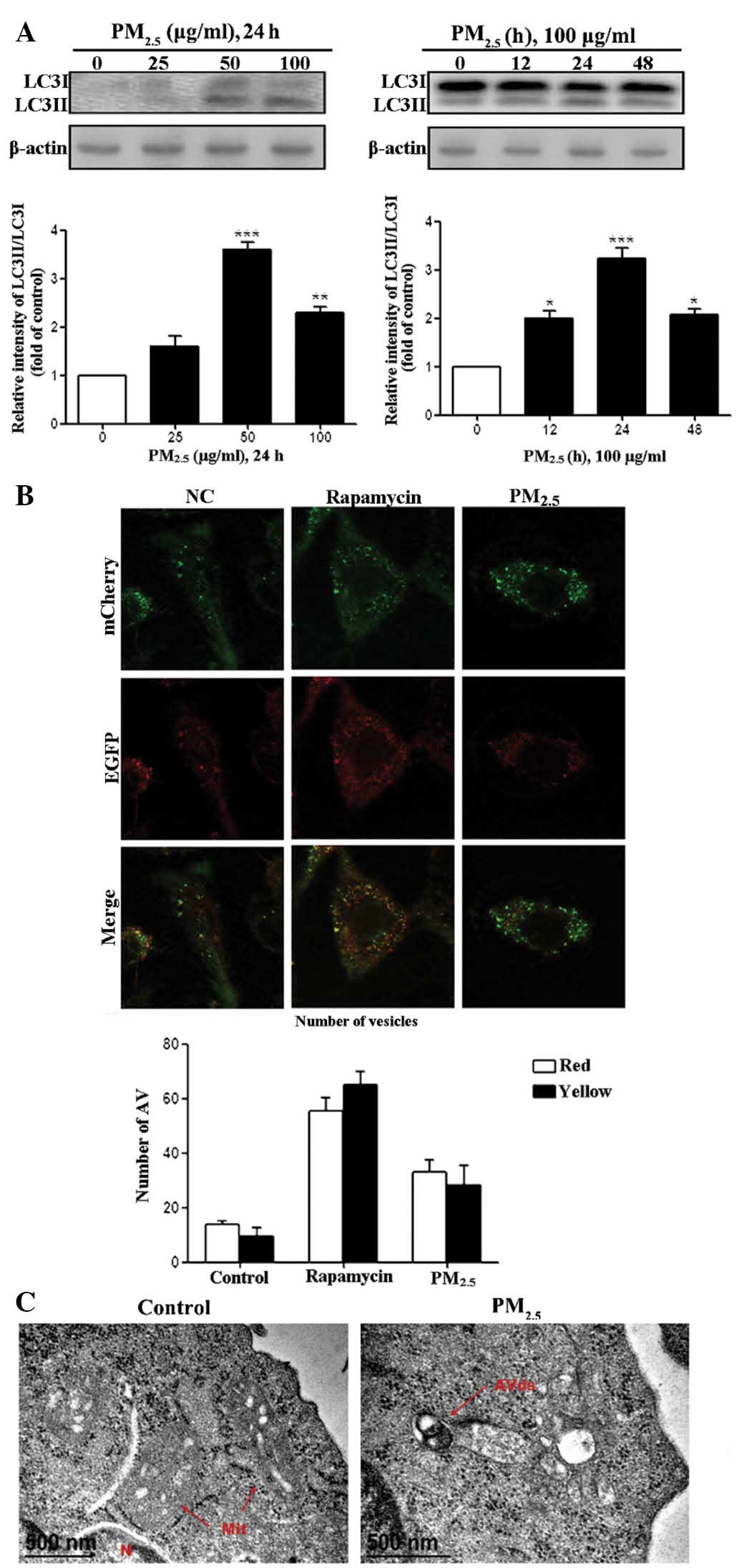
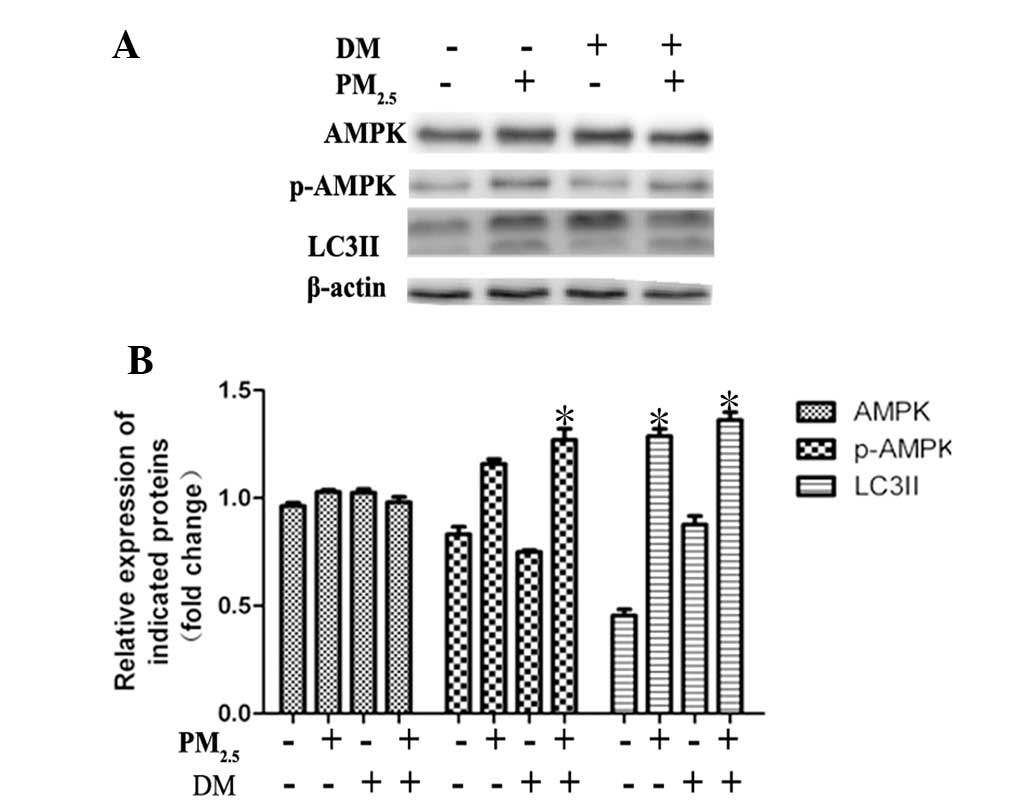
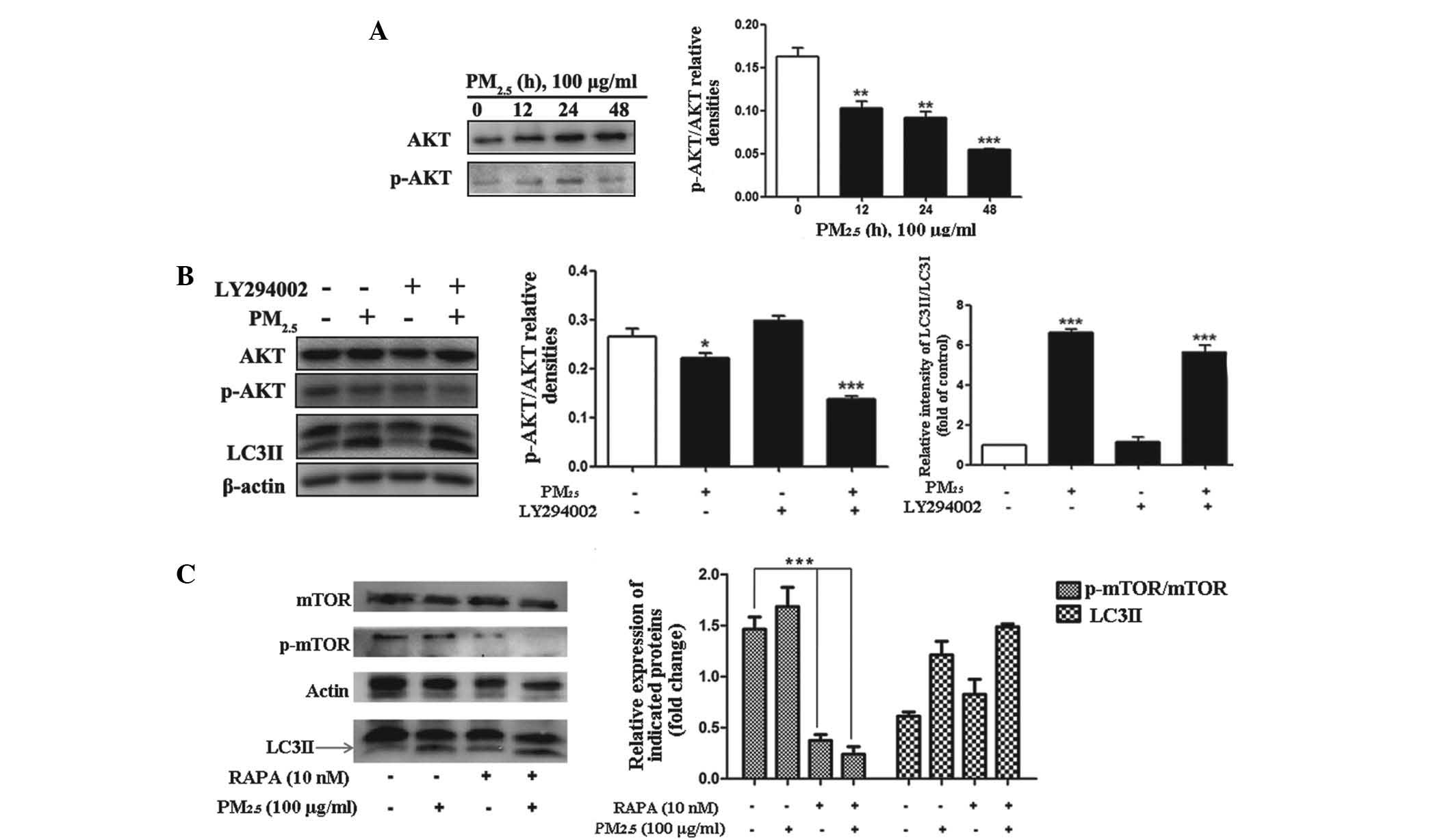
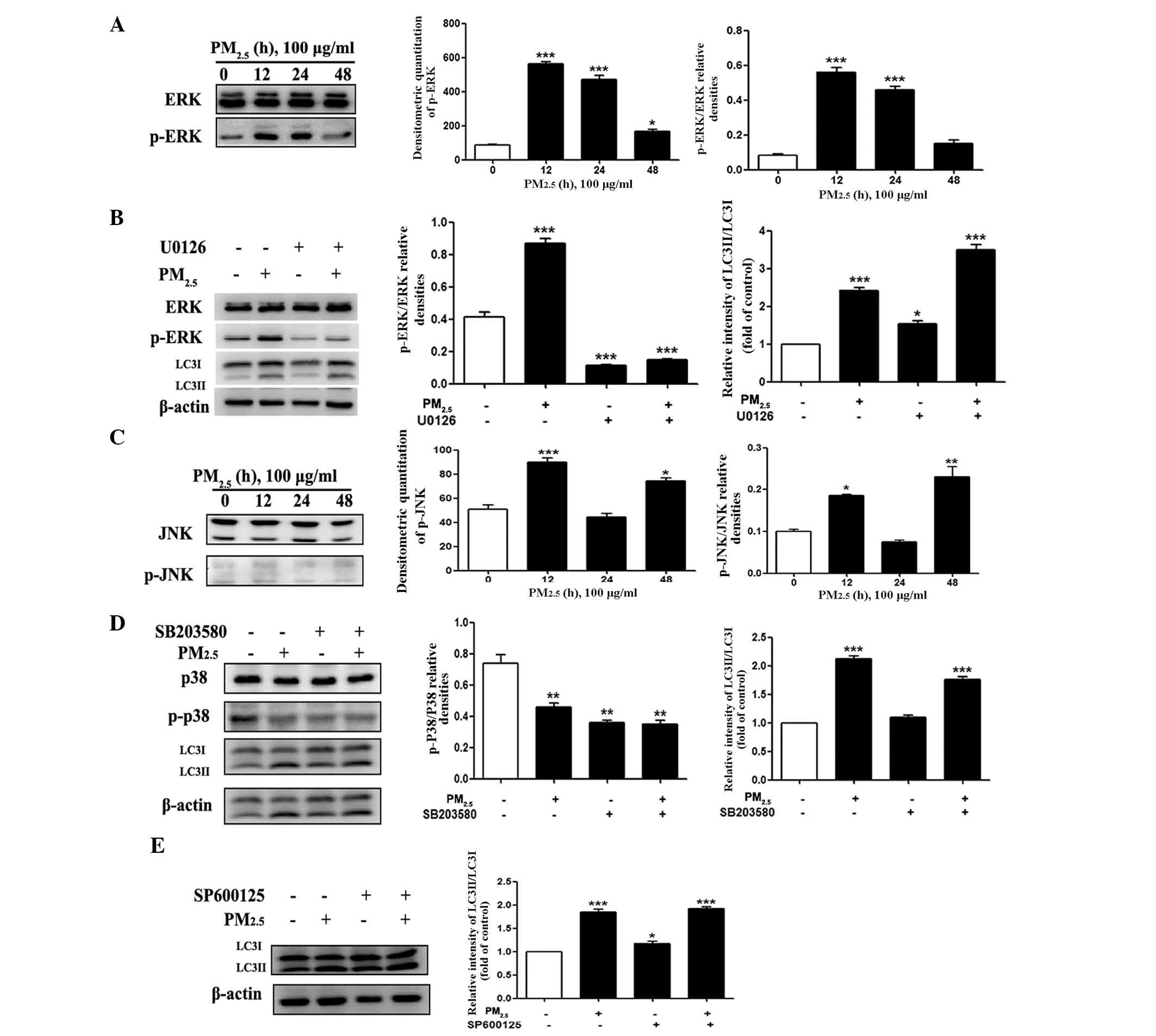
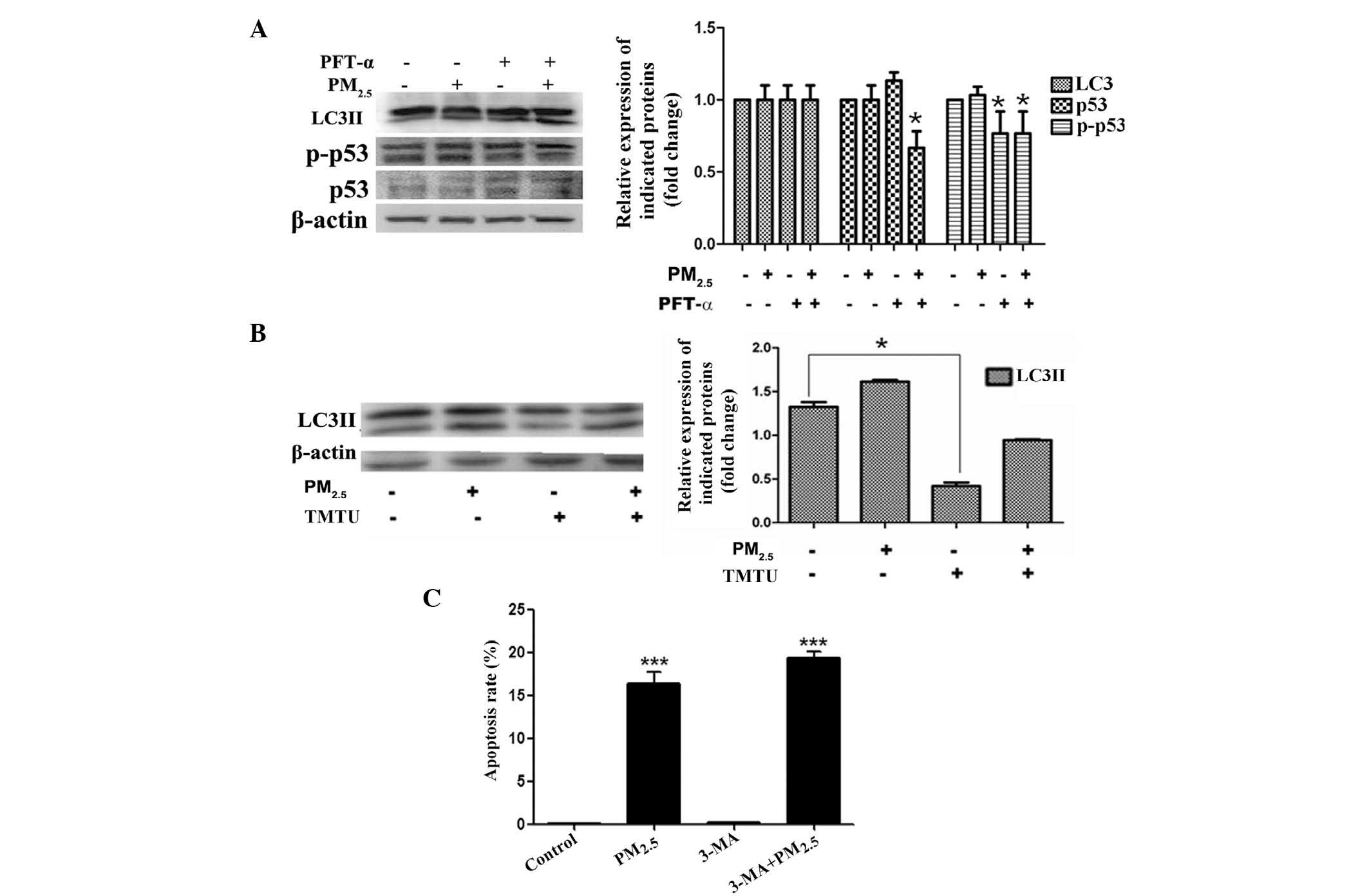
Particulate matter 2.5 (PM2.5) is a significant risk factor for asthma. A recent study revealed that autophagy was associated with asthma pathogenesis. However, the specific mechanisms underlying PM2.5‑induced autophagy in asthma have remained elusive. In the present study, PM2.5‑induced autophagy was evaluated in Beas‑2B human bronchial epithelial cells and the potential molecular mechanisms were investigated. Using electron microscopy, immunofluorescence staining and immunoblot studies, it was confirmed that PM2.5 induced autophagy in Beas‑2B cells as a result of PM2.5‑mediated inhibition of the phosphatidylinositol 3‑kinase (PI3K)/Akt/mammalian target of rapamycin (mTOR) pathway in Beas‑2B cells. LY294002, a PI3K inhibitor, reduced the accumulation of microtubule‑associated protein 1 light chain 3 II and attenuated the effect of PM2.5. Phosphorylated (p‑)p38, p‑extracellular signal‑regulated kinase and p‑c‑Jun N‑terminal kinase were dephosphorylated following exposure to PM2.5. The roles of p53, reactive oxygen species scavenger tetramethylthiourea and autophagy inhibitor 3‑methyladenine in PM2.5‑induced autophagy in Beas‑2B cells were also investigated. The results suggested that the PI3K/Akt/mTOR signaling pathway may be a key contributor to PM2.5‑induced autophagy in Beas‑2B cells. The results of the present study therefore provided an a insight into potential future clinical applications targeting these signaling pathways, for the prevention and/or treatment of PM2.5‑induced lung diseases.
View Figures

Figure 1

Figure 2

Figure 3

Figure 4

Figure 5

View References

1 

Zanobetti A, Franklin M, Koutrakis P and Schwartz J: Fine particulate air pollution and its components in association with cause-specific emergency admissions. Environ Health. 8:582009. View Article : Google Scholar : PubMed/NCBI

2 

Delfino RJ, Sioutas C and Malik S: Potential role of ultrafine particles in associations between airborne particle mass and cardiovascular health. Environ Health Perspect. 113:934–946. 2005. View Article : Google Scholar : PubMed/NCBI

3 

Dockery DW, Pope CA III, Xu X, et al: An association between air pollution and mortality in six U.S. cities. N Engl J Med. 329:1753–1759. 1993. View Article : Google Scholar : PubMed/NCBI

4 

Trejo Bittar HE, Yousem SA and Wenzel SE: Pathobiology of severe asthma. Annu Rev Pathol. 10:511–545. 2015. View Article : Google Scholar

5 

Mehta M, Chen LC, Gordon T, Rom W and Tang MS: Particulate matter inhibits DNA repair and enhances mutagenesis. Mutat Res. 657:116–121. 2008. View Article : Google Scholar : PubMed/NCBI

6 

Nordling E, Berglind N, Melén E, et al: Traffic-related air pollution and childhood respiratory symptoms, function and allergies. Epidemiology. 19:401–408. 2008. View Article : Google Scholar : PubMed/NCBI

7 

Anderson HR, Favarato G and Atkinson RW: Long-term exposure to air pollution and the incidence of asthma: meta-analysis of cohort studies. Air Qual Atmos Health. 6:47–56. 2013. View Article : Google Scholar

8 

Zeng Y, Yang X, Wang J, Fan J, Kong Q and Yu X: Aristolochic acid I induced autophagy extenuates cell apoptosis via ERK 1/2 pathway in renal tubular epithelial cells. PloS One. 7:e303122012. View Article : Google Scholar : PubMed/NCBI

9 

Poon AH, Chouiali F, Tse SM, et al: Genetic and histologic evidence for autophagy in asthma pathogenesis. J Allergy Clin Immunol. 129:569–571. 2012. View Article : Google Scholar :

10 

Maiuri MC, Galluzzi L, Morselli E, Kepp O, Malik SA and Kroemer G: Autophagy regulation by p53. Curr Opin Cell Biol. 22:181–185. 2010. View Article : Google Scholar : PubMed/NCBI

11 

Glick D, Barth S and Macleod KF: Autophagy: cellular and molecular mechanisms. J Pathol. 221:3–12. 2010. View Article : Google Scholar : PubMed/NCBI

12 

Akhtar S, Yousif MH, Chandrasekhar B and Benter IF: Activation of EGFR/ERBB2 via pathways involving ERK1/2, P38 MAPK, AKT and FOXO enhances recovery of diabetic hearts from ischemia-reperfusion injury. PloS One. 7:e390662012. View Article : Google Scholar : PubMed/NCBI

13 

Soberanes S, Panduri V, Mutlu GM, Ghio A, Bundinger GR and Kamp DW: p53 mediates particulate matter-induced alveolar epithelial cell mitochondria-regulated apoptosis. Am J Respir Crit Care Med. 174:1229–1238. 2006. View Article : Google Scholar : PubMed/NCBI

14 

Lin Z, Liu T, et al: AKT/mTOR and c-Jun N-terminal kinase signaling pathways are required for chrysotile asbestos-induced autophagy. Free Radic Biol Med. 72:296–307. 2014. View Article : Google Scholar : PubMed/NCBI

15 

Yang L, Liu G, Lin Z, et al: Pro-inflammatory response and oxidative stress induced by specific components in ambient particulate matter in human bronchial epithelial cells. Environ Toxicol. Dec 23–2014.Epub ahead of print. View Article : Google Scholar

16 

Wiltfang J, Smirnov A, Schnierstein B, et al: Improved electrophoretic separation and immunoblotting of beta-amyloid (A beta) peptides 1–40, 1–42, and 1–43. Electrophoresis. 18:527–532. 1997. View Article : Google Scholar : PubMed/NCBI

17 

Zhou C, Zhong W, Zhou J, et al: Monitoring autophagic flux by an improved tandem fluorescent-tagged LC3 (mTagRFP-mWasabi-LC3) reveals that high-dose rapamycin impairs autophagic flux in cancer cells. Autophagy. 8:1215–1226. 2012. View Article : Google Scholar : PubMed/NCBI

18 

Bolster DR, Crozier SJ, Kimball SR and Jefferson LS: AMP-activated protein kinase suppresses protein synthesis in rat skeletal muscle through down-regulated mammalian target of rapamycin (mTOR) signaling. J Biol Chem. 277:23977–23980. 2002. View Article : Google Scholar : PubMed/NCBI

19 

Corcelle EA, Puustinen P and Jäättelä M: Apoptosis and autophagy: Targeting autophagy signalling in cancer cells – ‘trick or treats’? FEBS J. 276:6084–6096. 2009. View Article : Google Scholar : PubMed/NCBI

20 

Jung CH, Ro SH, Cao J, Otto NM and Kim DH: mTOR regulation of autophagy. FEBS Lett. 584:1287–1295. 2010. View Article : Google Scholar : PubMed/NCBI

21 

Codogno P and Meijer AJ: Autophagy and signaling: their role in cell survival and cell death. Cell Death Differ. 12(Suppl 2): 1509–1518. 2005. View Article : Google Scholar : PubMed/NCBI

22 

Roy B, Pattanaik AK, Das J, et al: Role of PI3K/Akt/mTOR and MEK/ERK pathway in Concanavalin A induced autophagy in HeLa cells. Chem Biol Interact. 210:96–102. 2014. View Article : Google Scholar : PubMed/NCBI

23 

Hamamura K, Goldring MB and Yokota H: Involvement of p38 MAPK in regulation of MMP13 mRNA in chondrocytes in response to surviving stress to endoplasmic reticulum. Arch Oral Biol. 54:279–286. 2009. View Article : Google Scholar :

24 

Dougherty R and Fahy JV: Acute exacerbations of asthma: epidemiology, biology and the exacerbation-prone phenotype. Clin Exp Allergy. 39:193–202. 2009. View Article : Google Scholar : PubMed/NCBI

25 

Delfino RJ, Wu J, Tjoa T, Gullesserian SK, Nickerson B and Gillen DL: Asthma morbidity and ambient air pollution: effect modification by residential traffic-related air pollution. Epidemiology. 25:48–57. 2014. View Article : Google Scholar

26 

Jyothula SS and Eissa NT: Autophagy and role in asthma. Curr Opin Pulm Med. 19:30–35. 2013. View Article : Google Scholar

27 

Martin LJ, Gupta J, Jyothula SS, et al: Functional variant in the autophagy-related 5 gene promotor is associated with childhood asthma. PLoS One. 7:e334542012. View Article : Google Scholar : PubMed/NCBI

28 

Poon A, Eidelman D, Laprise C and Hamid Q: ATG5, autophagy and lung function in asthma. Autophagy. 8:694–695. 2012. View Article : Google Scholar : PubMed/NCBI

29 

Albert L, Karsy M, Murali R and Jhanwar-Uniyal M: Inhibition of mTOR activates the MAPK pathway in glioblastoma multiforme. Cancer Genomics Proteomics. 6:255–261. 2009.PubMed/NCBI

30 

Hazzalin CA and Mahadevan LC: MAPK-regulated transcription: a continuously variable gene switch? Nat Rev Mol Cell Biol. 3:30–40. 2002. View Article : Google Scholar : PubMed/NCBI

31 

Webber JL and Tooze SA: Coordinated regulation of autophagy by p38alpha MAPK through mAtg9 and p38IP. EMBO J. 29:27–40. 2010. View Article : Google Scholar :

32 

de la Cruz-Morcillo MA, Valero ML, Callejas-Valera JL, et al: P38MAPK is a major determinant of the balance between apoptosis and autophagy triggered by 5-fluorouracil: implication in resistance. Oncogene. 31:1073–1085. 2012. View Article : Google Scholar

33 

Brigelius-Flohé R: Commentary: oxidative stress reconsidered. Genes Nutr. 4:161–163. 2009. View Article : Google Scholar : PubMed/NCBI

34 

Cheng Y, Qiu F, Tashiro S, Onodera S and Ikejima T: ERK and JNK mediate TNFalpha-induced p53 activation in apoptotic and autophagic L929 cell death. Biochem Biophys Res Commun. 376:483–488. 2008. View Article : Google Scholar : PubMed/NCBI

35 

Kabesch M and Adcock IM: Epigenetics in asthma and COPD. Biochimie. 94:2231–2241. 2012. View Article : Google Scholar : PubMed/NCBI

36 

Urich D, Soberanes S, Burgess Z, et al: Proapoptotic Noxa is required for particulate matter-induced cell death and lung inflammation. FASEB J. 23:2055–2064. 2009. View Article : Google Scholar : PubMed/NCBI

37 

McCarthy N: Autophagy: Directed development. Nat Rev Cancer. 14:74–75. 2014. View Article : Google Scholar : PubMed/NCBI

38 

Green DR and Kroemer G: Cytoplasmic functions of the tumour suppressor p53. Nature. 458:1127–1130. 2009. View Article : Google Scholar : PubMed/NCBI

39 

Kim MN, Lee KE, Hong JY, et al: Involvement of the MAPK and PI3K pathways in chitinase 3-like 1-regulated hyperoxia-induced airway epithelial cell death. Biochem Biophys Res Commun. 421:790–796. 2012. View Article : Google Scholar : PubMed/NCBI

40 

Takada E, Furuhata M, Nakae S, Ichijo H, Sudo K and Mizuguchi J: Requirement of apoptosis-inducing kinase 1 for the induction of bronchial asthma following stimulation with ovalbumin. Int Arch Allergy Immunol. 162:104–114. 2013. View Article : Google Scholar : PubMed/NCBI

Related Articles

  • Abstract
  • View
  • Download
  • Twitter
Copy and paste a formatted citation
Spandidos Publications style
Liu T, Wu B, Wang Y, He H, Lin Z, Tan J, Yang L, Kamp DW, Zhou X, Tang J, Tang J, et al: Particulate matter 2.5 induces autophagy via inhibition of the phosphatidylinositol 3-kinase/Akt/mammalian target of rapamycin kinase signaling pathway in human bronchial epithelial cells. Mol Med Rep 12: 1914-1922, 2015.
APA
Liu, T., Wu, B., Wang, Y., He, H., Lin, Z., Tan, J. ... Liu, G. (2015). Particulate matter 2.5 induces autophagy via inhibition of the phosphatidylinositol 3-kinase/Akt/mammalian target of rapamycin kinase signaling pathway in human bronchial epithelial cells. Molecular Medicine Reports, 12, 1914-1922. https://doi.org/10.3892/mmr.2015.3577
MLA
Liu, T., Wu, B., Wang, Y., He, H., Lin, Z., Tan, J., Yang, L., Kamp, D. W., Zhou, X., Tang, J., Huang, H., Zhang, L., Bin, L., Liu, G."Particulate matter 2.5 induces autophagy via inhibition of the phosphatidylinositol 3-kinase/Akt/mammalian target of rapamycin kinase signaling pathway in human bronchial epithelial cells". Molecular Medicine Reports 12.2 (2015): 1914-1922.
Chicago
Liu, T., Wu, B., Wang, Y., He, H., Lin, Z., Tan, J., Yang, L., Kamp, D. W., Zhou, X., Tang, J., Huang, H., Zhang, L., Bin, L., Liu, G."Particulate matter 2.5 induces autophagy via inhibition of the phosphatidylinositol 3-kinase/Akt/mammalian target of rapamycin kinase signaling pathway in human bronchial epithelial cells". Molecular Medicine Reports 12, no. 2 (2015): 1914-1922. https://doi.org/10.3892/mmr.2015.3577
Copy and paste a formatted citation
x
Spandidos Publications style
Liu T, Wu B, Wang Y, He H, Lin Z, Tan J, Yang L, Kamp DW, Zhou X, Tang J, Tang J, et al: Particulate matter 2.5 induces autophagy via inhibition of the phosphatidylinositol 3-kinase/Akt/mammalian target of rapamycin kinase signaling pathway in human bronchial epithelial cells. Mol Med Rep 12: 1914-1922, 2015.
APA
Liu, T., Wu, B., Wang, Y., He, H., Lin, Z., Tan, J. ... Liu, G. (2015). Particulate matter 2.5 induces autophagy via inhibition of the phosphatidylinositol 3-kinase/Akt/mammalian target of rapamycin kinase signaling pathway in human bronchial epithelial cells. Molecular Medicine Reports, 12, 1914-1922. https://doi.org/10.3892/mmr.2015.3577
MLA
Liu, T., Wu, B., Wang, Y., He, H., Lin, Z., Tan, J., Yang, L., Kamp, D. W., Zhou, X., Tang, J., Huang, H., Zhang, L., Bin, L., Liu, G."Particulate matter 2.5 induces autophagy via inhibition of the phosphatidylinositol 3-kinase/Akt/mammalian target of rapamycin kinase signaling pathway in human bronchial epithelial cells". Molecular Medicine Reports 12.2 (2015): 1914-1922.
Chicago
Liu, T., Wu, B., Wang, Y., He, H., Lin, Z., Tan, J., Yang, L., Kamp, D. W., Zhou, X., Tang, J., Huang, H., Zhang, L., Bin, L., Liu, G."Particulate matter 2.5 induces autophagy via inhibition of the phosphatidylinositol 3-kinase/Akt/mammalian target of rapamycin kinase signaling pathway in human bronchial epithelial cells". Molecular Medicine Reports 12, no. 2 (2015): 1914-1922. https://doi.org/10.3892/mmr.2015.3577
Follow us
  • Twitter
  • LinkedIn
  • Facebook
About
  • Spandidos Publications
  • Careers
  • Cookie Policy
  • Privacy Policy
How can we help?
  • Help
  • Live Chat
  • Contact
  • Email to our Support Team