Spandidos Publications Logo
  • About
    • About Spandidos
    • Aims and Scopes
    • Abstracting and Indexing
    • Editorial Policies
    • Reprints and Permissions
    • Job Opportunities
    • Terms and Conditions
    • Contact
  • Journals
    • All Journals
    • Oncology Letters
      • Oncology Letters
      • Information for Authors
      • Editorial Policies
      • Editorial Board
      • Aims and Scope
      • Abstracting and Indexing
      • Bibliographic Information
      • Archive
    • International Journal of Oncology
      • International Journal of Oncology
      • Information for Authors
      • Editorial Policies
      • Editorial Board
      • Aims and Scope
      • Abstracting and Indexing
      • Bibliographic Information
      • Archive
    • Molecular and Clinical Oncology
      • Molecular and Clinical Oncology
      • Information for Authors
      • Editorial Policies
      • Editorial Board
      • Aims and Scope
      • Abstracting and Indexing
      • Bibliographic Information
      • Archive
    • Experimental and Therapeutic Medicine
      • Experimental and Therapeutic Medicine
      • Information for Authors
      • Editorial Policies
      • Editorial Board
      • Aims and Scope
      • Abstracting and Indexing
      • Bibliographic Information
      • Archive
    • International Journal of Molecular Medicine
      • International Journal of Molecular Medicine
      • Information for Authors
      • Editorial Policies
      • Editorial Board
      • Aims and Scope
      • Abstracting and Indexing
      • Bibliographic Information
      • Archive
    • Biomedical Reports
      • Biomedical Reports
      • Information for Authors
      • Editorial Policies
      • Editorial Board
      • Aims and Scope
      • Abstracting and Indexing
      • Bibliographic Information
      • Archive
    • Oncology Reports
      • Oncology Reports
      • Information for Authors
      • Editorial Policies
      • Editorial Board
      • Aims and Scope
      • Abstracting and Indexing
      • Bibliographic Information
      • Archive
    • Molecular Medicine Reports
      • Molecular Medicine Reports
      • Information for Authors
      • Editorial Policies
      • Editorial Board
      • Aims and Scope
      • Abstracting and Indexing
      • Bibliographic Information
      • Archive
    • World Academy of Sciences Journal
      • World Academy of Sciences Journal
      • Information for Authors
      • Editorial Policies
      • Editorial Board
      • Aims and Scope
      • Abstracting and Indexing
      • Bibliographic Information
      • Archive
    • International Journal of Functional Nutrition
      • International Journal of Functional Nutrition
      • Information for Authors
      • Editorial Policies
      • Editorial Board
      • Aims and Scope
      • Abstracting and Indexing
      • Bibliographic Information
      • Archive
    • International Journal of Epigenetics
      • International Journal of Epigenetics
      • Information for Authors
      • Editorial Policies
      • Editorial Board
      • Aims and Scope
      • Abstracting and Indexing
      • Bibliographic Information
      • Archive
    • Medicine International
      • Medicine International
      • Information for Authors
      • Editorial Policies
      • Editorial Board
      • Aims and Scope
      • Abstracting and Indexing
      • Bibliographic Information
      • Archive
  • Articles
  • Information
    • Information for Authors
    • Information for Reviewers
    • Information for Librarians
    • Information for Advertisers
    • Conferences
  • Language Editing
Spandidos Publications Logo
  • About
    • About Spandidos
    • Aims and Scopes
    • Abstracting and Indexing
    • Editorial Policies
    • Reprints and Permissions
    • Job Opportunities
    • Terms and Conditions
    • Contact
  • Journals
    • All Journals
    • Biomedical Reports
      • Information for Authors
      • Editorial Policies
      • Editorial Board
      • Aims and Scope
      • Abstracting and Indexing
      • Bibliographic Information
      • Archive
    • Experimental and Therapeutic Medicine
      • Information for Authors
      • Editorial Policies
      • Editorial Board
      • Aims and Scope
      • Abstracting and Indexing
      • Bibliographic Information
      • Archive
    • International Journal of Epigenetics
      • Information for Authors
      • Editorial Policies
      • Editorial Board
      • Aims and Scope
      • Abstracting and Indexing
      • Bibliographic Information
      • Archive
    • International Journal of Functional Nutrition
      • Information for Authors
      • Editorial Policies
      • Editorial Board
      • Aims and Scope
      • Abstracting and Indexing
      • Bibliographic Information
      • Archive
    • International Journal of Molecular Medicine
      • Information for Authors
      • Editorial Policies
      • Editorial Board
      • Aims and Scope
      • Abstracting and Indexing
      • Bibliographic Information
      • Archive
    • International Journal of Oncology
      • Information for Authors
      • Editorial Policies
      • Editorial Board
      • Aims and Scope
      • Abstracting and Indexing
      • Bibliographic Information
      • Archive
    • Medicine International
      • Information for Authors
      • Editorial Policies
      • Editorial Board
      • Aims and Scope
      • Abstracting and Indexing
      • Bibliographic Information
      • Archive
    • Molecular and Clinical Oncology
      • Information for Authors
      • Editorial Policies
      • Editorial Board
      • Aims and Scope
      • Abstracting and Indexing
      • Bibliographic Information
      • Archive
    • Molecular Medicine Reports
      • Information for Authors
      • Editorial Policies
      • Editorial Board
      • Aims and Scope
      • Abstracting and Indexing
      • Bibliographic Information
      • Archive
    • Oncology Letters
      • Information for Authors
      • Editorial Policies
      • Editorial Board
      • Aims and Scope
      • Abstracting and Indexing
      • Bibliographic Information
      • Archive
    • Oncology Reports
      • Information for Authors
      • Editorial Policies
      • Editorial Board
      • Aims and Scope
      • Abstracting and Indexing
      • Bibliographic Information
      • Archive
    • World Academy of Sciences Journal
      • Information for Authors
      • Editorial Policies
      • Editorial Board
      • Aims and Scope
      • Abstracting and Indexing
      • Bibliographic Information
      • Archive
  • Articles
  • Information
    • For Authors
    • For Reviewers
    • For Librarians
    • For Advertisers
    • Conferences
  • Language Editing
Login Register Submit
  • This site uses cookies
  • You can change your cookie settings at any time by following the instructions in our Cookie Policy. To find out more, you may read our Privacy Policy.

    I agree
Search articles by DOI, keyword, author or affiliation
Search
Advanced Search
presentation
Molecular Medicine Reports
Join Editorial Board Propose a Special Issue
Print ISSN: 1791-2997 Online ISSN: 1791-3004
Journal Cover
August-2015 Volume 12 Issue 2

Full Size Image

Sign up for eToc alerts
Recommend to Library

Journals

International Journal of Molecular Medicine

International Journal of Molecular Medicine

International Journal of Molecular Medicine is an international journal devoted to molecular mechanisms of human disease.

International Journal of Oncology

International Journal of Oncology

International Journal of Oncology is an international journal devoted to oncology research and cancer treatment.

Molecular Medicine Reports

Molecular Medicine Reports

Covers molecular medicine topics such as pharmacology, pathology, genetics, neuroscience, infectious diseases, molecular cardiology, and molecular surgery.

Oncology Reports

Oncology Reports

Oncology Reports is an international journal devoted to fundamental and applied research in Oncology.

Experimental and Therapeutic Medicine

Experimental and Therapeutic Medicine

Experimental and Therapeutic Medicine is an international journal devoted to laboratory and clinical medicine.

Oncology Letters

Oncology Letters

Oncology Letters is an international journal devoted to Experimental and Clinical Oncology.

Biomedical Reports

Biomedical Reports

Explores a wide range of biological and medical fields, including pharmacology, genetics, microbiology, neuroscience, and molecular cardiology.

Molecular and Clinical Oncology

Molecular and Clinical Oncology

International journal addressing all aspects of oncology research, from tumorigenesis and oncogenes to chemotherapy and metastasis.

World Academy of Sciences Journal

World Academy of Sciences Journal

Multidisciplinary open-access journal spanning biochemistry, genetics, neuroscience, environmental health, and synthetic biology.

International Journal of Functional Nutrition

International Journal of Functional Nutrition

Open-access journal combining biochemistry, pharmacology, immunology, and genetics to advance health through functional nutrition.

International Journal of Epigenetics

International Journal of Epigenetics

Publishes open-access research on using epigenetics to advance understanding and treatment of human disease.

Medicine International

Medicine International

An International Open Access Journal Devoted to General Medicine.

Journal Cover
August-2015 Volume 12 Issue 2

Full Size Image

Sign up for eToc alerts
Recommend to Library

  • Article
  • Citations
    • Cite This Article
    • Download Citation
    • Create Citation Alert
    • Remove Citation Alert
    • Cited By
  • Similar Articles
    • Related Articles (in Spandidos Publications)
    • Similar Articles (Google Scholar)
    • Similar Articles (PubMed)
  • Download PDF
  • Download XML
  • View XML
Article Open Access

Epigallocatechin‑3‑gallate and zinc provide anti‑apoptotic protection against hypoxia/reoxygenation injury in H9c2 rat cardiac myoblast cells

  • Authors:
    • Xing Zeng
    • Xuerui Tan
  • View Affiliations / Copyright

    Affiliations: Department of Cardiology, The First Affiliated Hospital of Shantou University Medical College, Shantou, Guangdong 515041, P.R. China
    Copyright: © Zeng et al. This is an open access article distributed under the terms of Creative Commons Attribution License [CC BY_NC 3.0].
  • Pages: 1850-1856
    |
    Published online on: April 8, 2015
       https://doi.org/10.3892/mmr.2015.3603
  • Expand metrics +
Metrics: Total Views: 0 (Spandidos Publications: | PMC Statistics: )
Metrics: Total PDF Downloads: 0 (Spandidos Publications: | PMC Statistics: )
Cited By (CrossRef): 0 citations Loading Articles...

This article is mentioned in:


Abstract

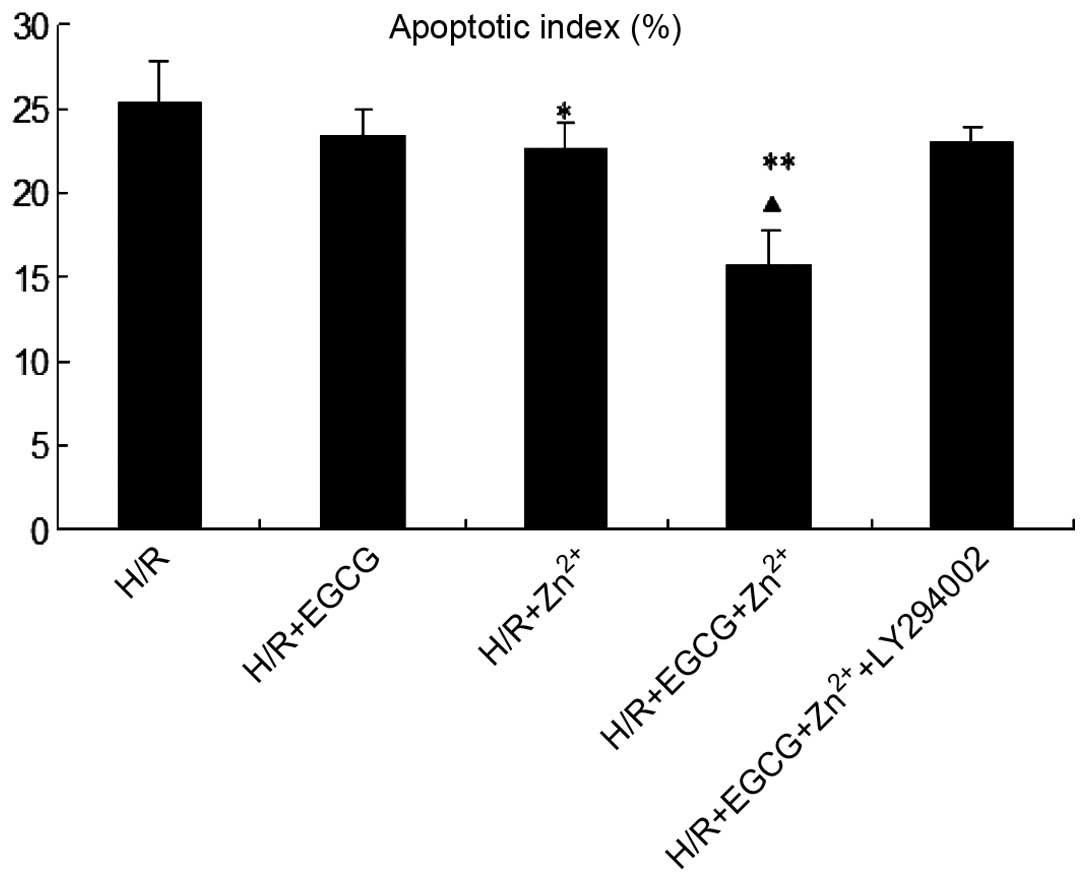
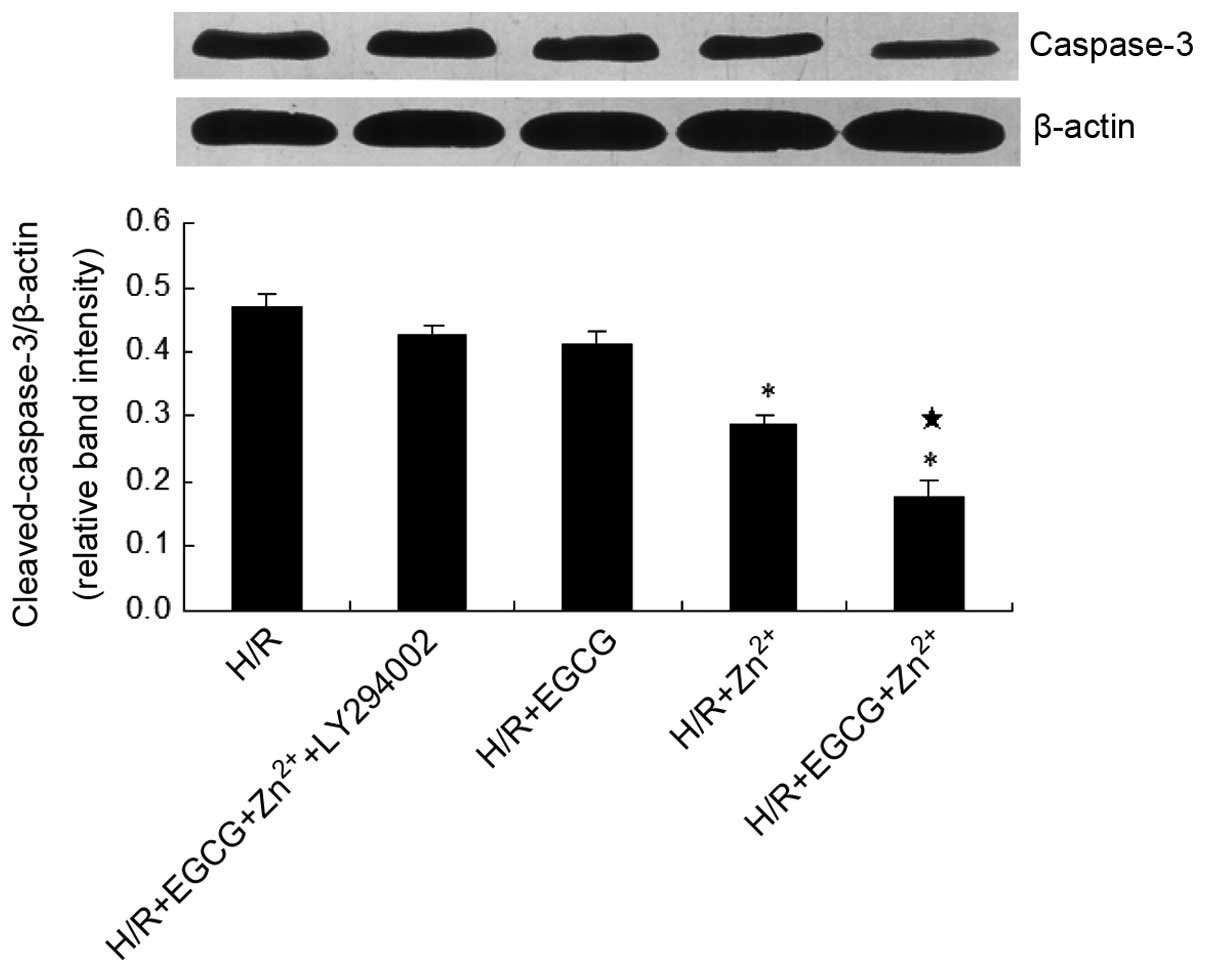
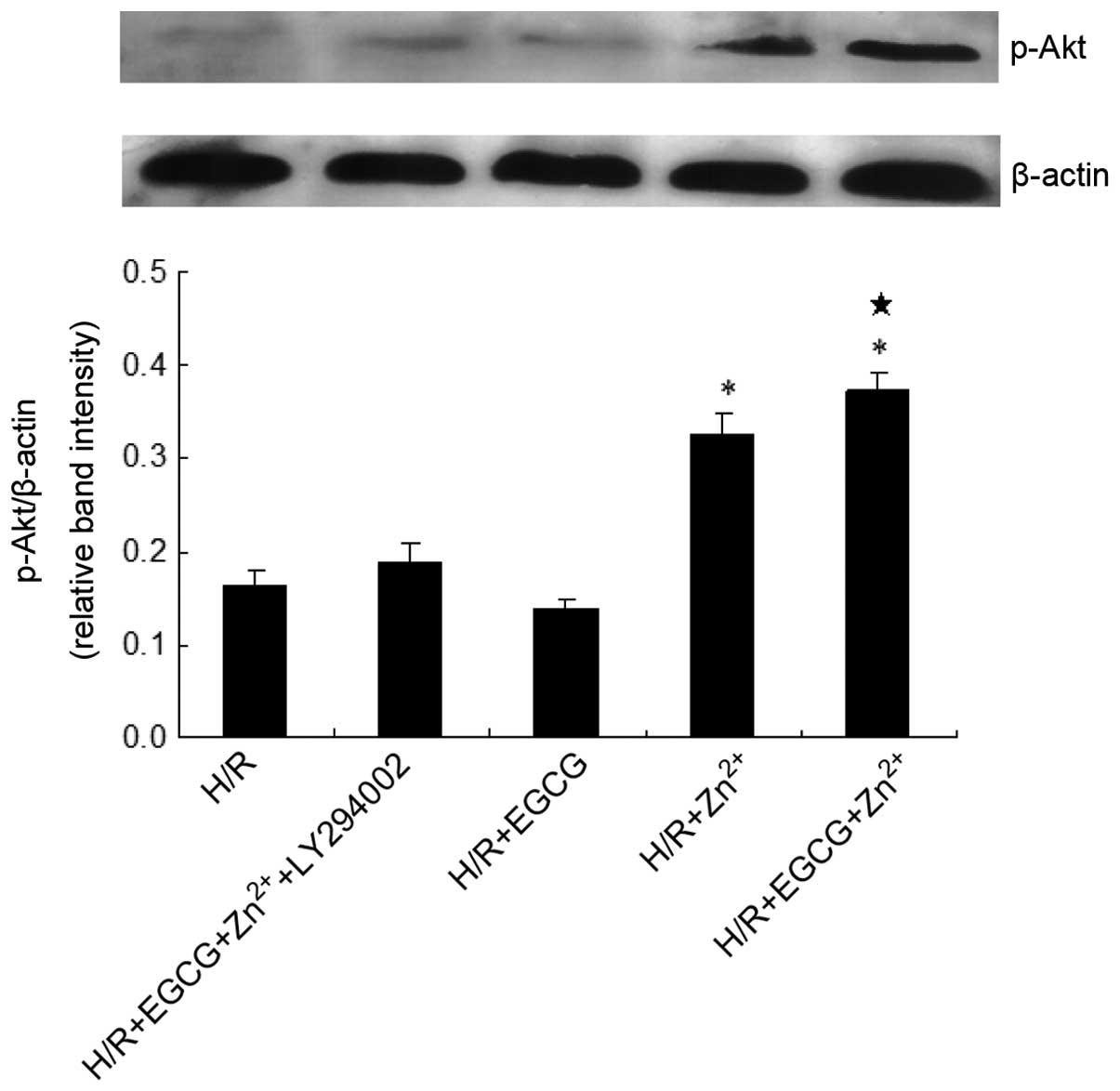
It has previously been demonstrated that phosphatidylinositol‑3‑kinase (PI3K)/Akt and cleaved caspase‑3 serve critical roles in the apoptosis of cardiac myocytes following ischemia/reperfusion injury. Epigallocatechin‑3‑gallate (EGCG), the predominant catechin component of green tea, has been reported to have potential cardioprotective effects in primary cultures of cardiac myocytes exposed to I/R injury, mediated through inhibition of signal transducers and activators of transcription‑1 activity. In addition, it is also known that the biological behavior of EGCG may be influenced by metal ions, for example the hepatoprotective activity of EGCG has been reported to be enhanced by zinc. In the present study, the protective effects of EGCG with zinc were assessed on cultures of rat cardiac myoblasts exposed to hypoxia/reoxygenation (H/R) injury. H9c2 cells were subjected to 3‑h hypoxia, followed by 1‑h reperfusion. EGCG and/or zinc were perfused prior to induced hypoxic stress. It was demonstrated that when EGCG interacted with zinc, the anti‑apoptotic activity was significantly enhanced. To the best of our knowledge, the current study was the first to demonstrate that EGCG + Zn2+ protects H9c2 cells against H/R injury through activation of the PI3K/Akt pathway, as determined by western blotting. Since EGCG + Zn2+ may, at least in part, protect cardiac myocytes against H/R‑induced apoptotic cell death, the PI3K/Akt pathway of EGCG may be enhanced by its interactions with zinc during H/R injury. Furthermore, it was suggested that a similar procedure may be implemented in a clinical setting, in order to maximize PI3K/Akt activation levels in patients with acute coronary artery disease. EGCG and zinc may therefore represent effective agents for use in the prevention of I/R injury in clinical practice.
View Figures

Figure 1

Figure 2

Figure 3

Figure 4

Figure 5

Figure 6

Figure 7

View References

1 

Cannon RO III: Mechanisms, management and future directions for reperfusion injury after acute myocardial infarction. Nat Clin Pract Cardiovasc Med. 2:88–94. 2005. View Article : Google Scholar : PubMed/NCBI

2 

Aversano T, Aversano LT, Passamani E, et al: Thrombolytic therapy vs. primary percutaneous coronary intervention for myocardial infarction in patients presenting to hospitals without on-site cardiac surgery: a randomized controlled trial. JAMA. 287:1943–1951. 2002. View Article : Google Scholar : PubMed/NCBI

3 

Fröhlich GM, Meier P, White SK, Yellon DM and Hausenloy DJ: Myocardial reperfusion injury: looking beyond primary PCI. Eur Heart J. 34:1714–1722. 2013. View Article : Google Scholar : PubMed/NCBI

4 

Wang GW, Zhou Z, Klein JB and Kang YJ: Inhibition of hypoxia/reoxygenation-induced apoptosis in metallothionein-overexpressing cardio-myocytes. Am J Physiol Heart Circ Physiol. 280:H2292–H2299. 2001.PubMed/NCBI

5 

Moens AL, Claeys MJ, Timmermans JP and Vrints CJ: Myocardial ischemia/reperfusion-injury, a clinical view on a complex patho-physiological process. Int J Cardiol. 100:179–190. 2005. View Article : Google Scholar : PubMed/NCBI

6 

Stephanou A, Brar B, Liao Z, et al: Distinct initiator caspases are required for the induction of apoptosis in cardiac myocytes during ischaemia versus reperfusion injury. Cell Death Differ. 8:434–435. 2001. View Article : Google Scholar : PubMed/NCBI

7 

Scarabelli TM, Stephanou A, Pasini E, et al: Different signaling pathways induce apoptosis in endothelial cells and cardiac myocytes during ischemia/reperfusion injury. Circ Res. 90:745–748. 2002. View Article : Google Scholar : PubMed/NCBI

8 

Buja LM and Entman ML: Modes of myocardial cell injury and cell death in ischemic heart disease. Circulation. 98:1355–1357. 1998. View Article : Google Scholar : PubMed/NCBI

9 

Geleijnse JM, Launer LJ, Hofman A, Pols HA and Witteman JC: Tea flavonoids may protect against atherosclerosis: the Rotterdam Study. Arch Intern Med. 159:2170–2174. 1999. View Article : Google Scholar : PubMed/NCBI

10 

Sano J, Inami S, Seimiya K, et al: Effects of green tea intake on the development of coronary artery disease. Circ J. 68:665–670. 2004. View Article : Google Scholar : PubMed/NCBI

11 

Aneja R, Hake PW, Burroughs TJ, et al: Epigallocatechin, a green tea polyphenol, attenuates myocardial ischemia reperfusion injury in rats. Mol Med. 10:55–62. 2004. View Article : Google Scholar : PubMed/NCBI

12 

Townsend PA, Scarabelli TM, Pasini E, et al: Epigallocatechin-3-gallate inhibits STAT-1 activation and protects cardiac myocytes from ischemia/reperfusion-induced apoptosis. FASEB J. 18:1621–1623. 2004.PubMed/NCBI

13 

Piao CS, Kim DS, Ha KC, et al: The protective effect of epigallocatechin-3 gallate on ischemia/reperfusion injury in isolated rat hearts: An ex vivo approach. Korean J Physiol Pharmacol. 15:259–266. 2011. View Article : Google Scholar : PubMed/NCBI

14 

Sheng R, Gu ZL and Xie ML: Epigallocatechin gallate, the major component of polyphenols in green tea, inhibits telomere attrition mediated cardiomyocyte apoptosis in cardiac hypertrophy. Int J Cardiol. 162:199–209. 2013. View Article : Google Scholar

15 

Hayakawa F, Ishizu Y, Hoshino N, et al: Prooxidative activities of tea catechins in the presence of Cu2+. Biosci Biotechnol Biochem. 68:1825–1830. 2004. View Article : Google Scholar : PubMed/NCBI

16 

Yu HN, Shen SR and Xiong YK: Cytotoxicity of epigallo-catechin-3-gallate to LNCaP cells in the presence of Cu2+. J Zhejiang Univ Sci B. 6:125–131. 2005. View Article : Google Scholar : PubMed/NCBI

17 

Chen X, Yu H, Shen S and Yin J: Role of Zn2+ in epigallocatechin gallate affecting the growth of PC-3 cells. J Trace Elem Med. 21:125–131. 2007. View Article : Google Scholar

18 

Viswanath K, Bodiga S, Balogun V, Zhang A and Bodiga VL: Cardioprotective effect of zinc requires ErbB2 and Akt during hypoxia/reoxygenation. Biometals. 24:171–180. 2011. View Article : Google Scholar

19 

Lee S, Chanoit G, McIntosh R, et al: Molecular mechanism underlying Akt activation in zinc-induced cardioprotection. Am J Physiol Heart Circ Physiol. 297:H569–H575. 2009. View Article : Google Scholar : PubMed/NCBI

20 

Vinten-Johansen J, Zhao ZQ, Jiang R, Zatta AJ and Dobson GP: Preconditioning and postconditioning: innate cardioprotection from ischemia-reperfusion injury. J Appl Physiol (1985). 103:1441–1448. 2007. View Article : Google Scholar

21 

Hausenloy DJ and Yellon DM: Survival kinases in ischemic preconditioning and postconditioning. Cardiovasc Res. 70:240–253. 2006. View Article : Google Scholar : PubMed/NCBI

22 

Zhang T, Yang D, Fan Y, et al: Epigallocatechin-3-gallate enhances ischemia/reperfusion-induced apoptosis in human umbilical vein endothelial cells via AKT and MAPK pathways. Apoptosis. 14:1245–1254. 2009. View Article : Google Scholar : PubMed/NCBI

23 

Yaoita H, Ogawa K, Maehara K and Maruyama Y: Attenuation of ischemia/reperfusion injury in rats by a caspase inhibitor. Circulation. 97:276–281. 1998. View Article : Google Scholar : PubMed/NCBI

24 

Mocanu MM, Baxter GF and Yellon DM: Caspase inhibition and limitation of myocardial infarct size: Protection against lethal reperfusion injury. Br J Pharmacol. 130:197–200. 2000. View Article : Google Scholar : PubMed/NCBI

25 

Ross R: Atherosclerosis is an inflammatory disease. Am Heart J. 138:S419–S420. 1999. View Article : Google Scholar : PubMed/NCBI

26 

Bayes-Genis A, Conover CA and Schwartz RS: The insulin-like growth factor axis: a review of atherosclerosis and restenosis. Circ Res. 86:125–130. 2000. View Article : Google Scholar : PubMed/NCBI

27 

Zeng X, Li Q, Zhang M, et al: Green tea may be benefit to the therapy of atrial fibrillation. J Cell Biochem. 112:1709–1712. 2011. View Article : Google Scholar : PubMed/NCBI

28 

Sesso HD, Gaziano JM, Buring JE and Hennekens CH: Coffee and tea intake and the risk of myocardial infarction. Am J Epidemiol. 149:162–167. 1999. View Article : Google Scholar : PubMed/NCBI

29 

Cheng TO: Tea is good for the heart. Arch Intern Med. 160:23972000. View Article : Google Scholar : PubMed/NCBI

30 

Kagaya N, Kawase M, Maeda H, Tagawa Y, Nagashima H, Ohmori H and Yagi K: Enhancing effect of zinc on hepatoprotectivity of epigallocatechin gallate in isolated rat hepatocytes. Biol Pharm Bull. 25:1156–1160. 2002. View Article : Google Scholar : PubMed/NCBI

31 

Kim MK, Jung HS, Yoon CS, et al: EGCG and quercetin protected INS-1 cells in oxidative stress via different mechanisms. Front Biosci (Elite Ed). 2:810–817. 2010. View Article : Google Scholar

32 

Brewer GJ, Johnson VD, Dick RD, et al: Treatment of Wilson’s disease with zinc. XVII: treatment during pregnancy. Hepatology. 31:364–370. 2000. View Article : Google Scholar : PubMed/NCBI

Related Articles

  • Abstract
  • View
  • Download
  • Twitter
Copy and paste a formatted citation
Spandidos Publications style
Zeng X and Tan X: Epigallocatechin‑3‑gallate and zinc provide anti‑apoptotic protection against hypoxia/reoxygenation injury in H9c2 rat cardiac myoblast cells. Mol Med Rep 12: 1850-1856, 2015.
APA
Zeng, X., & Tan, X. (2015). Epigallocatechin‑3‑gallate and zinc provide anti‑apoptotic protection against hypoxia/reoxygenation injury in H9c2 rat cardiac myoblast cells. Molecular Medicine Reports, 12, 1850-1856. https://doi.org/10.3892/mmr.2015.3603
MLA
Zeng, X., Tan, X."Epigallocatechin‑3‑gallate and zinc provide anti‑apoptotic protection against hypoxia/reoxygenation injury in H9c2 rat cardiac myoblast cells". Molecular Medicine Reports 12.2 (2015): 1850-1856.
Chicago
Zeng, X., Tan, X."Epigallocatechin‑3‑gallate and zinc provide anti‑apoptotic protection against hypoxia/reoxygenation injury in H9c2 rat cardiac myoblast cells". Molecular Medicine Reports 12, no. 2 (2015): 1850-1856. https://doi.org/10.3892/mmr.2015.3603
Copy and paste a formatted citation
x
Spandidos Publications style
Zeng X and Tan X: Epigallocatechin‑3‑gallate and zinc provide anti‑apoptotic protection against hypoxia/reoxygenation injury in H9c2 rat cardiac myoblast cells. Mol Med Rep 12: 1850-1856, 2015.
APA
Zeng, X., & Tan, X. (2015). Epigallocatechin‑3‑gallate and zinc provide anti‑apoptotic protection against hypoxia/reoxygenation injury in H9c2 rat cardiac myoblast cells. Molecular Medicine Reports, 12, 1850-1856. https://doi.org/10.3892/mmr.2015.3603
MLA
Zeng, X., Tan, X."Epigallocatechin‑3‑gallate and zinc provide anti‑apoptotic protection against hypoxia/reoxygenation injury in H9c2 rat cardiac myoblast cells". Molecular Medicine Reports 12.2 (2015): 1850-1856.
Chicago
Zeng, X., Tan, X."Epigallocatechin‑3‑gallate and zinc provide anti‑apoptotic protection against hypoxia/reoxygenation injury in H9c2 rat cardiac myoblast cells". Molecular Medicine Reports 12, no. 2 (2015): 1850-1856. https://doi.org/10.3892/mmr.2015.3603
Follow us
  • Twitter
  • LinkedIn
  • Facebook
About
  • Spandidos Publications
  • Careers
  • Cookie Policy
  • Privacy Policy
How can we help?
  • Help
  • Live Chat
  • Contact
  • Email to our Support Team