Introduction
Traumatic injury is one of the most common diseases
in orthopedics. Its manifestations predominantly include localized
pain, purplish swelling and joint dysfunction. Traumatic injury may
also affect diet and sleep. The primary western drugs clinically
available are analgesics and anti-inflammatory drugs, which
predominantly alleviate the pain and swelling; however, these drugs
have numerous side-effects (1).
Recovery from traumatic injury is slow; therefore, it is essential
to develop novel drugs suitable for prolonged use.
Diesun Miaofang (DSMF), a well-known herbal formula
developed in the Ming Dynasty, has been widely used to treat
traumatic injuries associated with parts of the body in China
(2). The major herbs of this
formula are Angelica sinensis (AS), Radix rehmanniae
(RR), Areca catechu (AC) and Radix paeoniae rubra
(RPR); these herbs have been reported to work together to
activate blood, remove stasis, promote qi circulation and relieve
pain (3). However, the molecular
features and active components of DSMF, as well as how these active
components exert effects on targets remain to be elucidated.
Several computer simulation methods have been successfully used to
understand the theory of Traditional Chinese Medicine (TCM) and the
relevant mechanisms of action from the molecular and systems level
(4–8). In the present study, it was
hypothesized that an integrated model combining cluster ligands,
human intestinal absorption and aqueous solution prediction,
chemical space mapping, molecular docking and network
pharmacological techniques, may shed light on the herbal molecular
features and pharmacological information of DSMF. These attempts
offer key information for drug development from TCM and uncover
holistic and synergic essence for TCM, which provided a guide for
the modernization of TCM.
Materials and methods
Molecular database building and compound
clustering
Chemical ingredients from AS, RR, AC
and RPR were collected from the Chinese Herbal Drug Database
(2002 version) and the Handbook of the Constituents in Chinese Herb
Original Plants (9,10). Excluding duplicates, 158 compounds
were determined and their structures were drawn using ISIS Draw 2.5
(MDL Information Systems, Inc., San Leandro, CA, USA), then further
optimized using Discovery studio 2.0 (DS2.0; Accelrys, Inc., San
Diego, CA, USA) with a Merck molecular force field (Merck Research
Laboratories, Boston, MA,USA). The protocol of cluster ligands in
DS2.0 were performed to group DSMF compounds under the standard
default settings (11).
Human intestinal absorption (HIA) and
aqueous solubility prediction
HIA following oral administration and aqueous
solubility were predicted using the ADMET module of DS2.0 (12). Compounds with an absorption level
of 0, 1, 2 or 3 were considered to have good, moderate, poor or
very poor absorption, respectively. Compounds with the solubility
levels in the interval from 2 to 4 were considered to exhibit
drug-like properties. Acceptable HIA means HIA level is 0 or 1, and
acceptable solubility means solubility level values are 2, 3 or
4.
Chemical space mapping and analysis
In order to investigate whether the four herbs had
diverse chemical components, 150 physicochemical properties,
including 1 dimensional (D)-, 2D- and 3D-molecular descriptors,
were selected for analysis using the Quantitative
Structure-Activity Relationship module of DS2.0 (6,13).
Distribution of chemical ingredients in the chemical space was
visualized via principal component analysis using the library
analysis module of DS2.0. In addition, analysis of four important
pharmacology-associated descriptors, including molecular weight
(MW), number of HBond donors (nHDon), number of HBond acceptors
(nHAcc) and octanol-water partition coefficients (AlogP), were
performed to predict the drug-likeness of DSMF base on Sigmaplot
version 10.0 (Systat Software, Inc., San Jose, CA, USA).
Potential active compound prediction
Molecular docking was performed to determine whether
DSMF interacted with the key proteins associated with blood
circulation activation and anti-inflammation, using the LigandFit
module of DS2.0. The crystal structures of protein-ligand complexes
were downloaded from the Research Collaboratory for Structural
Bioinformatics Protein Data bank (http://www.pdb.org/; Table I), with the exception of
thromboxane A2 receptor (TP) (14–17).
The homology model of TP was obtained from the Center for
Experimental Therapeutics and Pharmacoinformatics (University of
Houston, Houston, TX, USA)(18,19).
For each crystal structure, crystallo graphic water molecules were
removed and missing hydrogen atoms were added. The inhibitor from
the crystal structure defined the active site. A total of 158 DSMF
compounds were docked into the protein models and interactions
between them were evaluated by DockScore which estimates the ligand
position and orientation based on the most favorable energy
production from the interactions between the ligand conformations
and receptor proteins (20).
Compounds with top 8 DockScores were selected as potential active
compounds in DSMF (21).
 | Table IKey target proteins associated with
activating blood, removing stasis, promoting qi circulation and
relieving pain. |
Table I
Key target proteins associated with
activating blood, removing stasis, promoting qi circulation and
relieving pain.
A, Targets associated
with activating blood and removing stasis
|
|---|
| Protein | PDB code |
|---|
| Thrombin | 1AWH |
| Factor-IXa | 1RFN |
| PDE5A | 4G2W |
| ACE | 1O86 |
| ACE2 | 1R42 |
| Catechol-O-methyl
transferase | 3BWM |
| Phenylethanolamine
N-methyltransferase | 2AN4 |
| Abelson
tyrosine-protein kinase1 | 3QRI |
B, Targets
associated with promoting qi circulation and relieving pain
|
|---|
| Protein | PDB code |
|---|
| Inhibitor of
nuclear factor κ-B kinase-β | 3RZF |
| JNK-1 | 2GMX |
| JNK-3 | 1PMN |
| P38 | 1A9U |
|
Cyclooxygenase-2 | 6COX |
| Phospholipase
2 | 1DB4 |
| Leukotriene A4
hydrolase | 3B7R |
| Tumor necrosis
factor-α | 2AZ5 |
| PDE4A | 3TVX |
Network construction and analysis
To elucidate the functional mechanism underlying
DSMF, the compound-target (C-T) network and herb-compound-target
(H-C-T) network were constructed. The procedure for network
construction was as follows: The C-T network was constructed by
linking the potential active compounds and their corresponding
targets; and the H-C-T network was constructed by connecting
previously mentioned compounds to any associated herbs. All
networks were produced and analyzed using Cytoscape 2.8.3
(University of California, San Diego, CA, USA) (22).
Results
Molecular features of DSMF
The compounds from DSMF were divided into 10
clusters (Table II). These
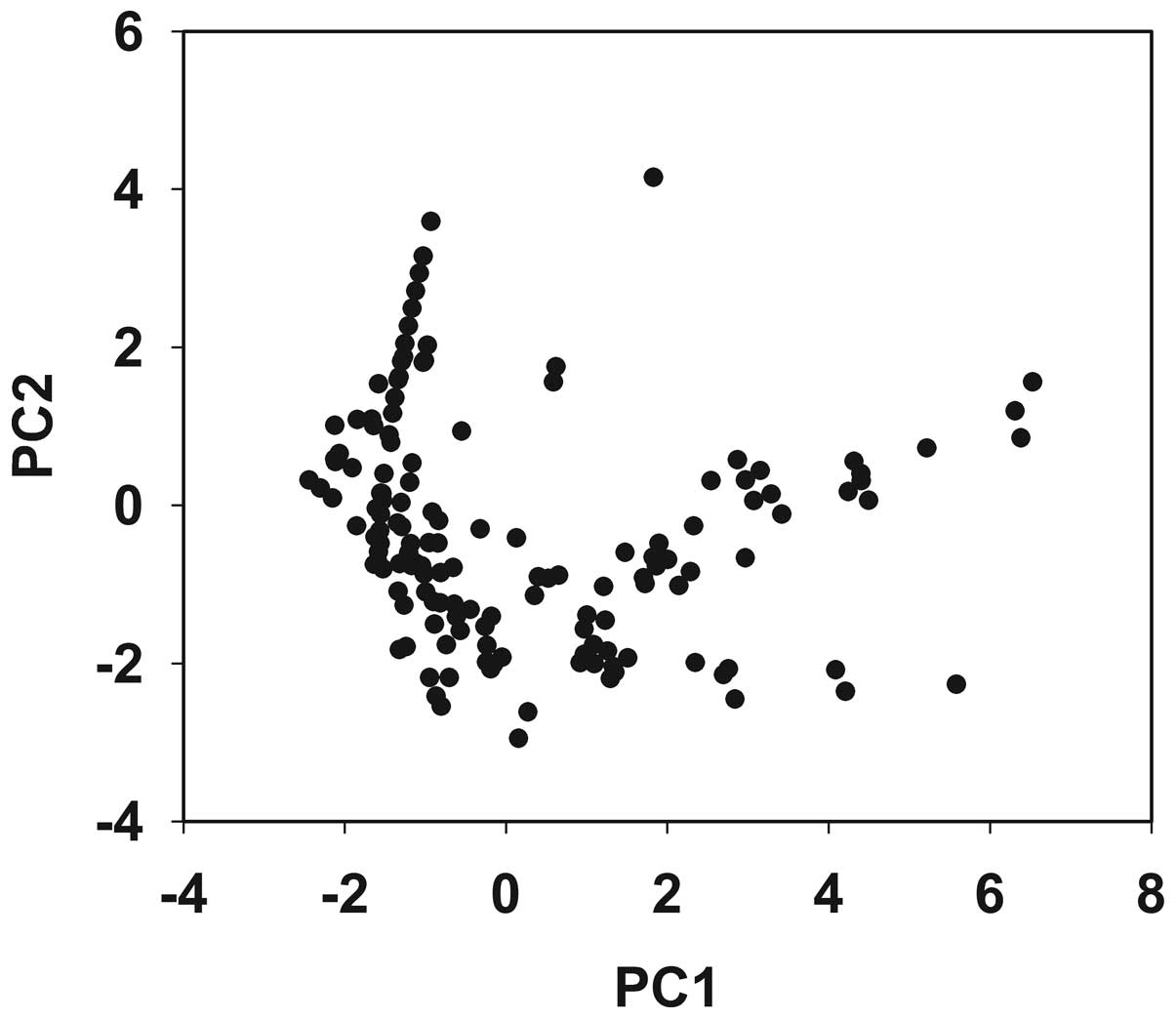
compounds were widely distributed in the chemical space (Fig. 1; Table III). Additionally, >56%
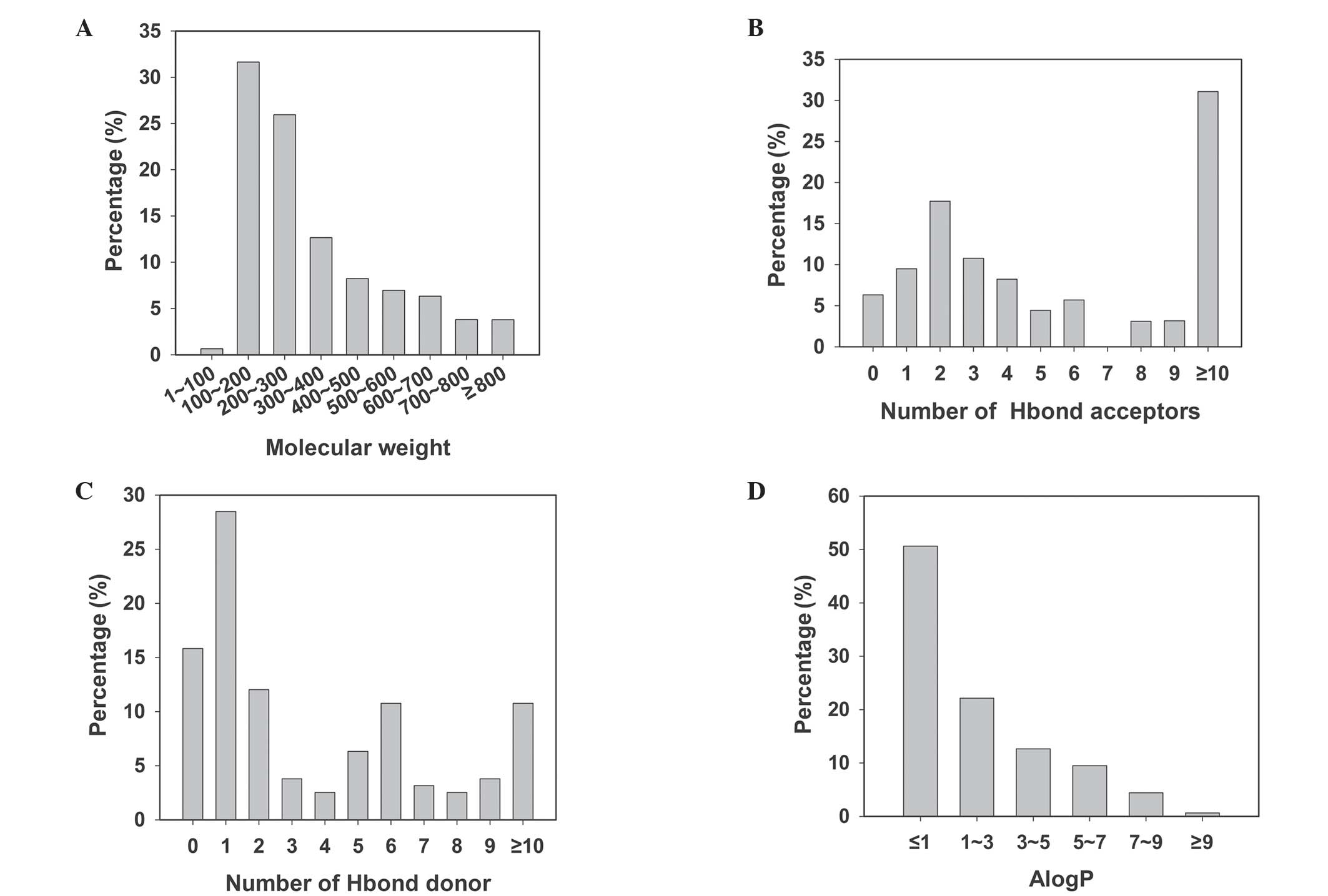
exhibited an acceptable HIA and aqueous solubility (Fig. 2). Four molecular descriptors,
including MW, nHAcc, nHDon and AlogP, which reflect the basic
characteristics of drug-likeness were analyzed and are shown in
Fig. 3. The percentages of
compounds with MW <500 Da, nHAcc <10, nHDon <5 and AlogP
<5 were 79.12, 69.62, 62.66 and 85.44%, respectively. These
results indicated that the compounds from DSMF were diverse and
exhibited potent drug-like properties for oral administration,
according to the ‘rule of five’ (23).
| Table IICluster result of compounds from
Diesun Miaofang. |
Table II
Cluster result of compounds from
Diesun Miaofang.
| Cluster | Number of
compounds | Source |
|---|
| 1 | 7 | AS, RR,
AC |
| 2 | 13 | AS, AC |
| 3 | 34 | AS, RR,
AC |
| 4 | 28 | RR, AC,
RPR |
| 5 | 2 | RR |
| 6 | 2 | AS |
| 7 | 2 | AC |
| 8 | 14 | AS, RR, AC,
RPR |
| 9 | 13 | AS, RR,
AC |
| 10 | 43 | RR, RPR |
| Table IIIKey molecular properties of compounds
in Diesun Miaofang. |
Table III
Key molecular properties of compounds
in Diesun Miaofang.
| Property | Mean | Standard
deviation | Minimum | Maximum |
|---|
| Number of carbon
atoms | 16.67 | 8.97 | 4 | 41 |
| Number of nitrogen
atoms | 0.16 | 0.79 | 0 | 8 |
| Number of oxygen
atoms | 6.66 | 6.33 | 0 | 26 |
| Molecular
weight | 334.78 | 205.36 | 94.11 | 940.68 |
| Number of hydrogen
acceptors | 6.78 | 6.31 | 0 | 26 |
| Number of hydrogen
donors | 3.78 | 3.91 | 0 | 17 |
| Octanol-water
partition coefficients | 1.07 | 3.45 | −9.55 | 9.13 |
Potential active compounds and diverse
functions in DSMF
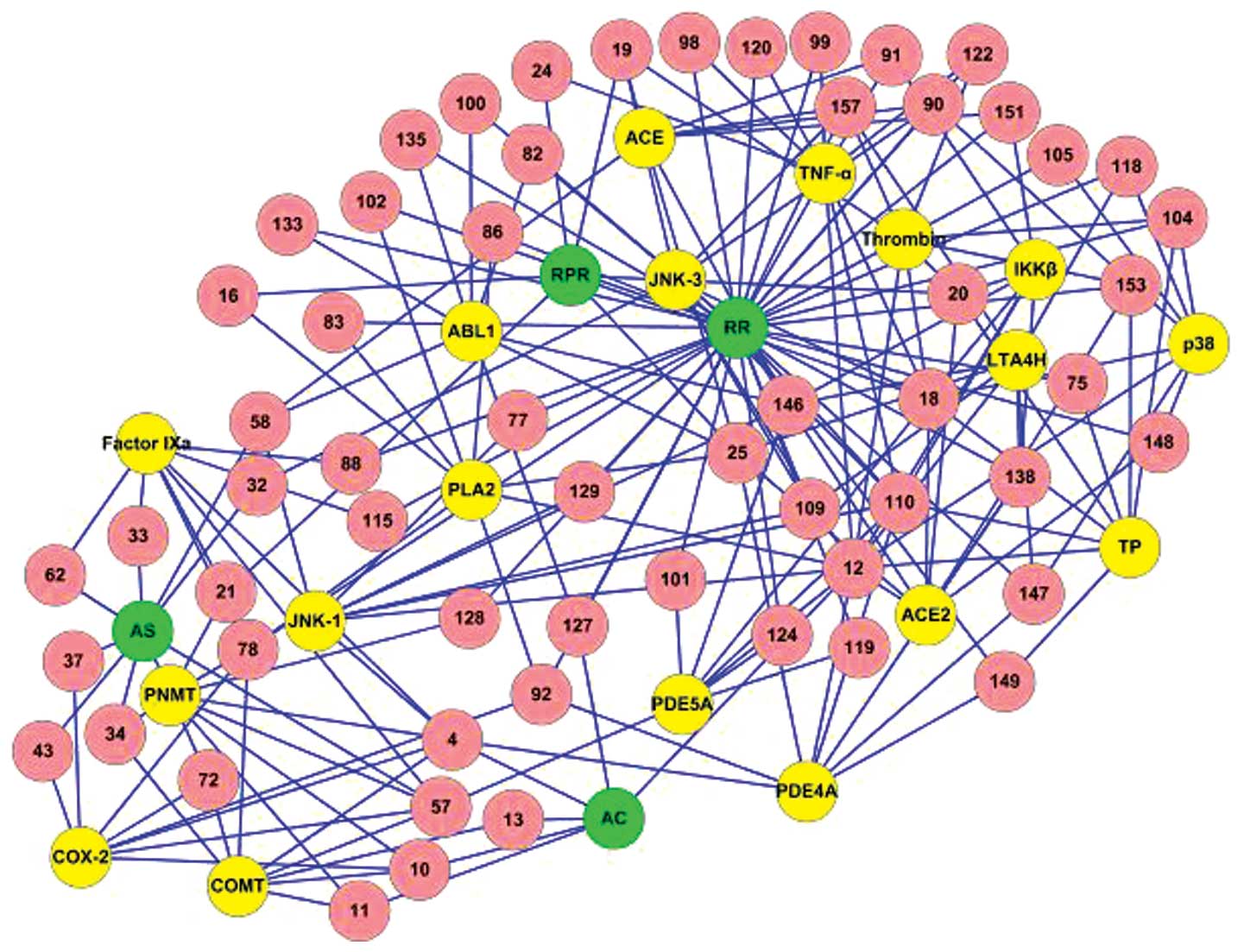
A total of 59 compounds were screened out by the
docking method, which linked with compounds with 16 targets. To
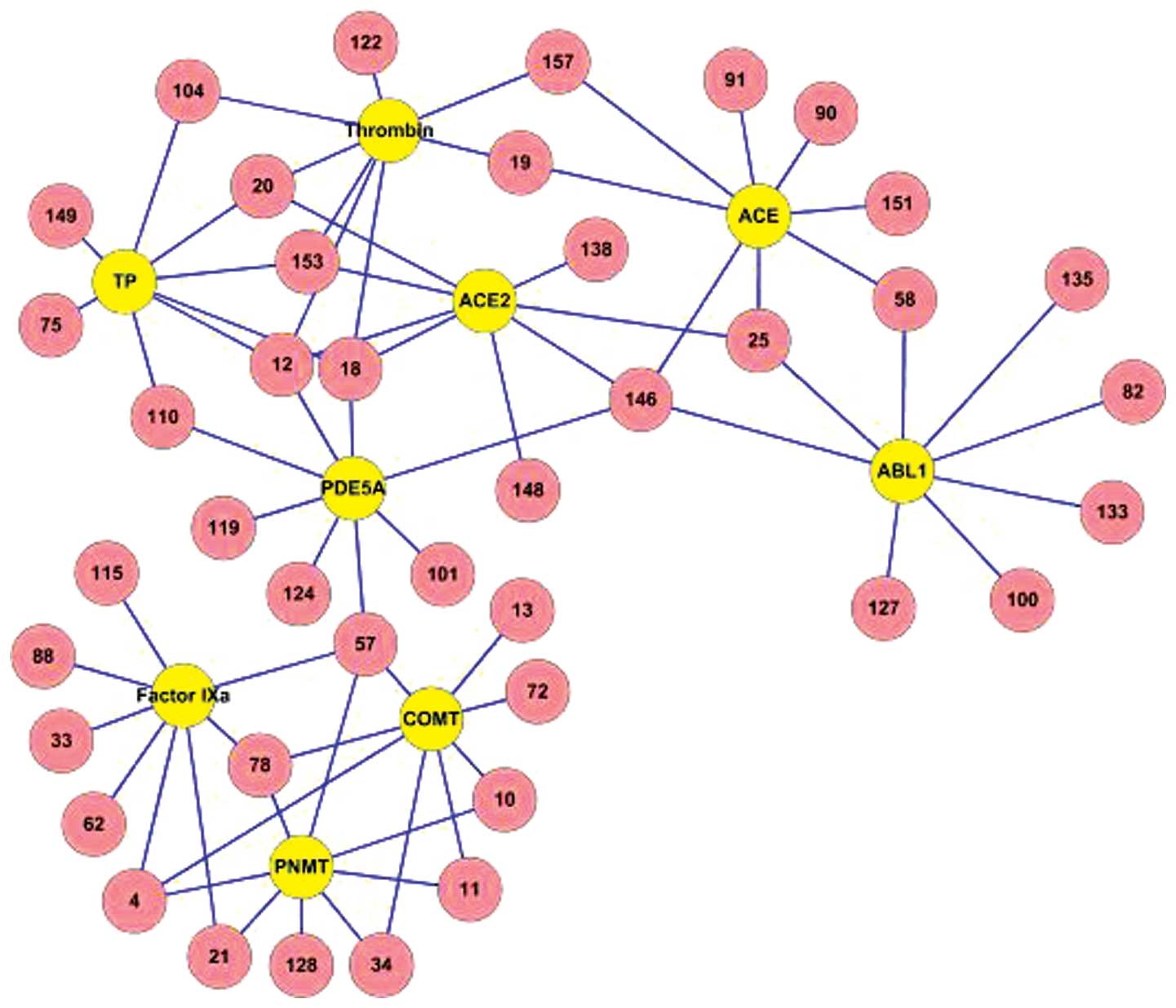
highlight the functions of DSMF, one H-C-T network and two C-T
networks associated with activating blood, removing stasis,
promoting qi circulation and relieving pain were constructed and
are shown in Figs. 4Figure 5–6. In Fig.
4, 29 compounds were associated with only one target, while 30
compounds of exhibited a relatively potent interaction with ≥2
targets. Notably, six compounds were associated with >5 targets.
The key network parameters of the above networks and compounds in
the H-C-T network were listed in Tables IV and V, respectively. The topological
properties of two C-T networks were analyzed in Fig. 7. The two C-T networks with
different functions had a small number of overlaps in the
distributions of betweenness centrality, closeness centrality,
average shortest path length and topological coefficients, which
indicated that certain compounds in the two networks may have
synergy, and more compounds may possess diverse functions.
| Table IVSimple parameters of H-C-T and C-T
networks. |
Table IV
Simple parameters of H-C-T and C-T
networks.
| Parameter | H-C-T network | C-T network
function
|
|---|
| Activating blood
and removing stasis | Promoting qi
circulation and relieving pain |
|---|
| Network
centralization | 0.423 | 0.109 | 0.110 |
| Network
heterogeneity | 0.911 | 0.891 | 0.926 |
| Characteristic path
length | 2.821 | 3.924 | 3.372 |
| Average number of
neighbors | 5.012 | 2.880 | 2.939 |
| Table VKey compounds in the
herb-compound-target network. |
Table V
Key compounds in the
herb-compound-target network.
| Degree | Index | Chemical name |
|---|
| 12 | 12 | Proanthocyanidin
B2 |
| 8 | 18 | Eugeniin |
| 7 | 146 | Rehmannioside
A |
| 7 | 110 | Isoacteoside |
| 6 | 25 |
(Z)-(1S,5R)-β-Pinen-10-yl-β-vicianoside |
| 6 | 4 | Catechin |
| 5 | 78 | Adenosine |
| 5 | 57 | Ferulic acid |
| 4 | 157 |
6-O-Vanilloylajugol |
| 4 | 20 |
Oxypaeoniflorin |
Discussion
TCM, as an important part of complementary and
alternative medicine, demonstrated an improved effect on
osteopathia (24). However, the
active substances involved in the herbal formulae and the
mechanisms of action associated with the therapeutic effectiveness
remain to be fully elucidated. Additionally, conventional methods
of herbal investigation generally focus on extraction, isolation,
purification, structure identification and activity assays. These
often lead to a failure to screen out certain active ingredients
from herbs and may not reflect the integrality of TCM (25). Therefore, determining reasonable
approaches to solve the above shortcomings has become a focus of
research (26,27).
There has been an increasing focus on identifying
novel drugs from TCM and elucidating the underlying pharmacological
mechanisms of TCMs via different modern computational
pharmacological methods (28).
These are important for improving current understanding of the
nature of TCM. In the present study, Table II demonstrated that the compounds
from DSMF may be separated into 10 independent clusters. The
compounds from clusters 1, 2, 3, 4, 8, 9 and 10, were observed in
no less than two herbs, suggesting that different herbs may have
similar structural features. The clusters 5, 6 and 7 also suggested
that different herbs may have their own structural features. In
order to gain more knowledge regarding the physicochemical features
of compounds from DSMF, the chemical space of DSMF was mapped in
Fig. 1. According to the theory of
chemical space (13), the
superposed and close dots indicated that these compounds may have
similar mechanisms of action and may act on identical targets.
Conversely, dispersive dots indicated that these compounds may have
different pharmacological activities. These results may explain why
DSMF has diverse efficacies from TCM theory. In addition, Figs. 2 and 3 demonstrated that the compounds from
DSMF have favorable drug-like properties and are suitable for
screening lead compounds.
Docking results revealed that 59 potential compounds
exhibited desired interactions with the targets. The global
understanding of the association among the herbs, compounds and
targets was shown in Fig. 2. Out
of the 59 potential compounds, 30 had at least two links with other
targets, indicating that the majority of targets share common
compounds with other targets. The average number of potential
targets per compound was 3.28. In addition, the four herbs from
DSMF were found to work together on 9 common targets, suggesting
that DSMF was a broad-spectrum formula acting on multiple targets.
Since the synergistic multitarget effects mean that natural
products affect not only one target, but several targets (5), DSMF has potential synergistic
interactions.
To further elucidate the multicompound therapeutic
mechanism of DSMF in the present study, the key topological
properties of two compound-target networks associated with
activating blood, removing stasis, promoting qi circulation and
relieving pain, including betweenness centrality, closeness
centrality, average shortest path length and topological
coefficient, were selected to perform the analysis (Figs. 5, 6 and 7).
These results may provide important information with regards to the
properties of compounds and proteins involved in the network. As
shown in Fig. 5, the efficacy of
activating blood and removing stasis may be accomplished by
interacting with several targets associated with hemostasis and
blood circulation. Fig. 6 also
demonstrated that DSMF may promote qi circulation and relieve pain
by influencing several targets associated with anti-inflammation.
For example, ferulic acid in Table
V presents a relatively strong interaction with these targets
associated with hemostasis and blood circulation (catechol-O-methyl
transferase, phenylethanolamine N-methyltransferase,
phenyl-ethanolamine, phosphodiesterase 5A and Factor-IXa) and
anti-inflammation (cyclooxygenase-2). Notably, it has been reported
that ferulic acid had effects on anti-platelet aggregation and
alleviating pain (29,30). In addition, in the present study,
Fig. 7 demonstrated that certain
nodes with an identical degree may have different effects on the
above topological properties, which suggested that there are
different modes of action between compounds and targets during the
treatment of DSMF. Taken together, these results consistently
indicated that DSMF exists as multicompounds and combination
therapies to act on several targets, finally exerting diverse
pharmacological effects on traumatic injury.
In conclusion, the present study provided a systems
pharmacology model to dissect the molecular features and modes of
action of DSMF. The key findings demonstrated that the compounds
from DSMF were diverse in chemical structure and widely distributed
in chemical space, the majority of the compounds from DSMF had
potent drug-like properties for oral administration and DSMF
possessed multicompound synergy associated with the interacting
targets and exerted different pharmacological effects. The present
study provided a systematic view of the association between
components in herbal formula, the efficacy of herbal formula and
targets, which contributed to an improved understanding of the
chemical and pharmacological basis of TCM, which may enhance the
process of drug discovery from TCM.
Acknowledgments
The present study was supported by a grant from the
Developmental Fund of ChenKeji Integrative Medicine (no.
CKJ2010032).
Abbreviations:
|
DSMF
|
Diesun Miaofang
|
|
AS
|
Angelica sinensis
|
|
RR
|
Radix rehmanniae
|
|
AC
|
Areca catechu
|
|
RPR
|
Radix paeoniae rubra
|
|
TCM
|
Traditional Chinese Medicine
|
|
HIA
|
human intestinal absorption
|
|
PDE5A
|
phosphodiesterase 5A
|
|
PDE4A
|
phosphodiesterase 4A
|
|
ACE
|
angiotensin-converting enzyme
|
|
COMT
|
catechol O-methyltransferase
|
|
PNMT
|
phenylethanolamine
N-methyltransferase
|
|
IKK
|
inhibitor of κB kinase
|
|
JNK
|
c-Jun terminal kinase
|
|
COX-2
|
cyclooxygenase-2
|
|
PLA2
|
phospholipase A2
|
|
LTA4H
|
leukotriene A-4 hydrolase
|
|
TNF-α
|
tumor necrosis factor-α
|
|
TP
|
thromboxane A2 receptor
|
|
MW
|
molecular weight
|
|
nHDon
|
number of HBond donors
|
|
nHAcc
|
number of HBond acceptors
|
|
AlogP
|
octanol-water partition
coefficients
|
|
Std Dev
|
standard deviation
|
References
|
1
|
Quan LG, Liu H and Wang JY: The effect of
external application of herbal medicines on 1147 patients with
swelling and pain after traumatic injury. Chinese Journal of Rural
Medicine. 8:39–40. 2010.In Chinese.
|
|
2
|
Luo YW and Sun ZG: The brief analysis of
treatment in line with the seasons, change of climate in Diesun
Miaofang. Journal of Hunan College of Traditional Chinese Medicine.
15:12–14. 1995.In Chinese.
|
|
3
|
Li JM and Li X: The application methods of
drug and commonly used formulae of traditional Chinese
traumatology. People’s Military Medical Press; Beijing: pp.
104–113. 1994, In Chinese.
|
|
4
|
Zheng CS, Xu XJ, Ye HZ and Liu XX:
Comparative Research on computer simulation of two different
therapeutic principles and formulae for osteoarthritis. Zhongguo
Zhong Xi Yi Jie He Za Zhi. 34:480–485. 2014.In Chinese. PubMed/NCBI
|
|
5
|
Liu H, Wang J, Zhou W, Wang Y and Yang L:
Systems approaches and polypharmacology for drug discovery from
herbal medicines: an example using licorice. J Ethnopharmacol.
146:773–793. 2013. View Article : Google Scholar : PubMed/NCBI
|
|
6
|
Zheng CS, Xu XJ, Ye HZ, Wu GW, Li XH,
Huang SP and Liu XX: Computational approaches for exploring the
potential synergy and polypharmacology of Duhuo Jisheng Decoction
in the therapy of osteoarthritis. Mol Med Rep. 7:1812–1818.
2013.PubMed/NCBI
|
|
7
|
Shi SH, Cai YP, Cai XJ, Zheng XY, Cao DS,
Ye FQ and Xiang Z: A network pharmacology approach to understanding
the mechanisms of action of traditional medicine: Bushenhuoxue
formula for treatment of chronic kidney disease. PLoS One.
9:e891232014. View Article : Google Scholar : PubMed/NCBI
|
|
8
|
Zheng CS, Ye HZ, Xu XJ and Liu XX:
Computational pharmacology study of tougu xiaotong granule in
preventing and treating knee osteoarthritis. Chin J Integr Med.
15:371–376. 2009.In Chinese. View Article : Google Scholar : PubMed/NCBI
|
|
9
|
Qiao X, Hou T, Zhang W, Guo S and Xu X: A
3D structure database of components from Chinese traditional
medicinal herbs. J Chem Inf Comput Sci. 42:481–489. 2002.
View Article : Google Scholar : PubMed/NCBI
|
|
10
|
Zhou JX, Xie GR and Yang XD: Handbook of
the chemical constituents in chinese herb original plants. Chemical
industry Press; Beijing: pp. 1165–1211. 2004, In Chinese.
|
|
11
|
Hassan M, Bielawski JP, Hempel JC and
Waldman M: Optimization and visualization of molecular diversity of
combinatorial libraries. Mol Divers. 2:64–74. 1996. View Article : Google Scholar : PubMed/NCBI
|
|
12
|
Zheng CS, Xu XJ, Liu XX and Ye HZ:
Computational pharmacology of Jingzhi Tougu Xiaotong granule in
preventing and treating Osteoarthritis. Acta Phys Chim Sin.
26:775–783. 2010.In Chinese.
|
|
13
|
Dobson CM: Chemical space and biology.
Nature. 432:824–828. 2004. View Article : Google Scholar : PubMed/NCBI
|
|
14
|
Zhou W and Wang Y: A network-based
analysis of the types of coronary artery disease from traditional
Chinese medicine perspective: potential for therapeutics and drug
discovery. J Ethnopharmacol. 151:66–77. 2014. View Article : Google Scholar
|
|
15
|
Liu HB, Xu J, Peng Y, Zhou JX and Xiao PG:
Targets of Danshen’s active components for activating circulation
activities. Acta Phys Chim Sin. 26:199–205. 2010.In Chinese.
|
|
16
|
Liu ZZ, Liang JP, Nie YC, Liu H, Xie CS,
Cheng GH and Su WW: Network pharmacology study of compound
xueshuantong capsule based on the targets related to blood
circulation and hemostasis. Acta Scientiarum Naturalium
Universitatis Sunyatseni. 52:97–100. 2013.In Chinese.
|
|
17
|
Zhang H, Zan JH, Long W and Liu PX: Study
on the anti-inflammatory mechanism of Chinese medicine herbs by the
molecular docking method. Heralad Med. 31:1542–1546. 2012.In
Chinese.
|
|
18
|
Ruan KH, Wijaya C, Cervantes V and Wu J:
Characterization of the prostaglandin H2 mimic: binding to the
purified human thromboxane A2 receptor in solution. Arch Biochem
Biophys. 477:396–403. 2008. View Article : Google Scholar : PubMed/NCBI
|
|
19
|
Wu J, Feng M and Ruan KH: Assembling NMR
structures for the intracellular loops of the human thromboxane A2
receptor: implication of the G protein-coupling pocket. Arch
Biochem Biophys. 470:73–82. 2008. View Article : Google Scholar :
|
|
20
|
Montes M, Braud E, Miteva MA, Goddard ML,
Mondésert O, Kolb S, Brun MP, Ducommun B, Garbay C and Villoutreix
BO: Receptor-based virtual ligand screening for the identification
of novel CDC25 phosphatase inhibitors. J Chem Inf Model.
48:157–165. 2008. View Article : Google Scholar
|
|
21
|
Zheng CS, Ye HZ, Cai LL, Chen JS, Wei LS
and Liu XX: Discussion on multi-component and multi-target pattern
of Liuwei Dihuang pill in the treatment of osteoarthritis on the
basis of computer simulation. J Trad Chin Orthop Traumatol.
25:11–13. 2013.In Chinese.
|
|
22
|
Smoot ME, Ono K, Ruscheinski J, Wang PL
and Ideker T: Cytoscape 2.8: new features for data integration and
network visualization. Bioinformatics. 27:431–432. 2011. View Article : Google Scholar :
|
|
23
|
Lipinski CA, Lombardo F, Dominy BW and
Feeney PJ: Experimental and computational approaches to estimate
solubility and permeability in drug discovery and development
settings. Adv Drug Deliv Rev. 46:3–26. 2001. View Article : Google Scholar : PubMed/NCBI
|
|
24
|
Chen MC: Effect of fumigation therapy for
ankle injury. J Nurs Sci. 20:28–29. 2005.
|
|
25
|
Xu X: New concepts and approaches for drug
discovery based on traditional Chinese medicine. Drug Discov Today
Technol. 3:247–253. 2006. View Article : Google Scholar : PubMed/NCBI
|
|
26
|
Li S and Zhang B: Traditional Chinese
medicine network pharmacology: Theory, methodology and application.
Chin J Nat Med. 11:110–120. 2013. View Article : Google Scholar : PubMed/NCBI
|
|
27
|
Xu XJ: Study on computer simulation for
Chinese traditional compound medicine. Prog Chem. 11:202–204.
1999.In Chinese.
|
|
28
|
Li P, Chen J, Wang J, et al: Systems
pharmacology strategies for drug discovery and combination with
applications to cardiovascular diseases. J Ethnopharmacol.
151:93–107. 2014. View Article : Google Scholar
|
|
29
|
Xu Y, Zhang L, Shao T, et al: Ferulic acid
increases pain threshold and ameliorates depression-like behaviors
in reserpine-treated mice: behavioral and neurobiological analyses.
Metab Brain Dis. 28:571–583. 2013. View Article : Google Scholar : PubMed/NCBI
|
|
30
|
Zhao J, Suyama A, Tanaka M and Matsui T:
Ferulic acid enhances the vasorelaxant effect of epigallocatechin
gallate in tumor necrosis factor-alpha-induced inflammatory rat
aorta. J Nutr Biochem. 25:807–814. 2014. View Article : Google Scholar : PubMed/NCBI
|