Spandidos Publications Logo
  • About
    • About Spandidos
    • Aims and Scopes
    • Abstracting and Indexing
    • Editorial Policies
    • Reprints and Permissions
    • Job Opportunities
    • Terms and Conditions
    • Contact
  • Journals
    • All Journals
    • Oncology Letters
      • Oncology Letters
      • Information for Authors
      • Editorial Policies
      • Editorial Board
      • Aims and Scope
      • Abstracting and Indexing
      • Bibliographic Information
      • Archive
    • International Journal of Oncology
      • International Journal of Oncology
      • Information for Authors
      • Editorial Policies
      • Editorial Board
      • Aims and Scope
      • Abstracting and Indexing
      • Bibliographic Information
      • Archive
    • Molecular and Clinical Oncology
      • Molecular and Clinical Oncology
      • Information for Authors
      • Editorial Policies
      • Editorial Board
      • Aims and Scope
      • Abstracting and Indexing
      • Bibliographic Information
      • Archive
    • Experimental and Therapeutic Medicine
      • Experimental and Therapeutic Medicine
      • Information for Authors
      • Editorial Policies
      • Editorial Board
      • Aims and Scope
      • Abstracting and Indexing
      • Bibliographic Information
      • Archive
    • International Journal of Molecular Medicine
      • International Journal of Molecular Medicine
      • Information for Authors
      • Editorial Policies
      • Editorial Board
      • Aims and Scope
      • Abstracting and Indexing
      • Bibliographic Information
      • Archive
    • Biomedical Reports
      • Biomedical Reports
      • Information for Authors
      • Editorial Policies
      • Editorial Board
      • Aims and Scope
      • Abstracting and Indexing
      • Bibliographic Information
      • Archive
    • Oncology Reports
      • Oncology Reports
      • Information for Authors
      • Editorial Policies
      • Editorial Board
      • Aims and Scope
      • Abstracting and Indexing
      • Bibliographic Information
      • Archive
    • Molecular Medicine Reports
      • Molecular Medicine Reports
      • Information for Authors
      • Editorial Policies
      • Editorial Board
      • Aims and Scope
      • Abstracting and Indexing
      • Bibliographic Information
      • Archive
    • World Academy of Sciences Journal
      • World Academy of Sciences Journal
      • Information for Authors
      • Editorial Policies
      • Editorial Board
      • Aims and Scope
      • Abstracting and Indexing
      • Bibliographic Information
      • Archive
    • International Journal of Functional Nutrition
      • International Journal of Functional Nutrition
      • Information for Authors
      • Editorial Policies
      • Editorial Board
      • Aims and Scope
      • Abstracting and Indexing
      • Bibliographic Information
      • Archive
    • International Journal of Epigenetics
      • International Journal of Epigenetics
      • Information for Authors
      • Editorial Policies
      • Editorial Board
      • Aims and Scope
      • Abstracting and Indexing
      • Bibliographic Information
      • Archive
    • Medicine International
      • Medicine International
      • Information for Authors
      • Editorial Policies
      • Editorial Board
      • Aims and Scope
      • Abstracting and Indexing
      • Bibliographic Information
      • Archive
  • Articles
  • Information
    • Information for Authors
    • Information for Reviewers
    • Information for Librarians
    • Information for Advertisers
    • Conferences
  • Language Editing
Spandidos Publications Logo
  • About
    • About Spandidos
    • Aims and Scopes
    • Abstracting and Indexing
    • Editorial Policies
    • Reprints and Permissions
    • Job Opportunities
    • Terms and Conditions
    • Contact
  • Journals
    • All Journals
    • Biomedical Reports
      • Information for Authors
      • Editorial Policies
      • Editorial Board
      • Aims and Scope
      • Abstracting and Indexing
      • Bibliographic Information
      • Archive
    • Experimental and Therapeutic Medicine
      • Information for Authors
      • Editorial Policies
      • Editorial Board
      • Aims and Scope
      • Abstracting and Indexing
      • Bibliographic Information
      • Archive
    • International Journal of Epigenetics
      • Information for Authors
      • Editorial Policies
      • Editorial Board
      • Aims and Scope
      • Abstracting and Indexing
      • Bibliographic Information
      • Archive
    • International Journal of Functional Nutrition
      • Information for Authors
      • Editorial Policies
      • Editorial Board
      • Aims and Scope
      • Abstracting and Indexing
      • Bibliographic Information
      • Archive
    • International Journal of Molecular Medicine
      • Information for Authors
      • Editorial Policies
      • Editorial Board
      • Aims and Scope
      • Abstracting and Indexing
      • Bibliographic Information
      • Archive
    • International Journal of Oncology
      • Information for Authors
      • Editorial Policies
      • Editorial Board
      • Aims and Scope
      • Abstracting and Indexing
      • Bibliographic Information
      • Archive
    • Medicine International
      • Information for Authors
      • Editorial Policies
      • Editorial Board
      • Aims and Scope
      • Abstracting and Indexing
      • Bibliographic Information
      • Archive
    • Molecular and Clinical Oncology
      • Information for Authors
      • Editorial Policies
      • Editorial Board
      • Aims and Scope
      • Abstracting and Indexing
      • Bibliographic Information
      • Archive
    • Molecular Medicine Reports
      • Information for Authors
      • Editorial Policies
      • Editorial Board
      • Aims and Scope
      • Abstracting and Indexing
      • Bibliographic Information
      • Archive
    • Oncology Letters
      • Information for Authors
      • Editorial Policies
      • Editorial Board
      • Aims and Scope
      • Abstracting and Indexing
      • Bibliographic Information
      • Archive
    • Oncology Reports
      • Information for Authors
      • Editorial Policies
      • Editorial Board
      • Aims and Scope
      • Abstracting and Indexing
      • Bibliographic Information
      • Archive
    • World Academy of Sciences Journal
      • Information for Authors
      • Editorial Policies
      • Editorial Board
      • Aims and Scope
      • Abstracting and Indexing
      • Bibliographic Information
      • Archive
  • Articles
  • Information
    • For Authors
    • For Reviewers
    • For Librarians
    • For Advertisers
    • Conferences
  • Language Editing
Login Register Submit
  • This site uses cookies
  • You can change your cookie settings at any time by following the instructions in our Cookie Policy. To find out more, you may read our Privacy Policy.

    I agree
Search articles by DOI, keyword, author or affiliation
Search
Advanced Search
presentation
Molecular Medicine Reports
Join Editorial Board Propose a Special Issue
Print ISSN: 1791-2997 Online ISSN: 1791-3004
Journal Cover
September-2015 Volume 12 Issue 3

Full Size Image

Sign up for eToc alerts
Recommend to Library

Journals

International Journal of Molecular Medicine

International Journal of Molecular Medicine

International Journal of Molecular Medicine is an international journal devoted to molecular mechanisms of human disease.

International Journal of Oncology

International Journal of Oncology

International Journal of Oncology is an international journal devoted to oncology research and cancer treatment.

Molecular Medicine Reports

Molecular Medicine Reports

Covers molecular medicine topics such as pharmacology, pathology, genetics, neuroscience, infectious diseases, molecular cardiology, and molecular surgery.

Oncology Reports

Oncology Reports

Oncology Reports is an international journal devoted to fundamental and applied research in Oncology.

Experimental and Therapeutic Medicine

Experimental and Therapeutic Medicine

Experimental and Therapeutic Medicine is an international journal devoted to laboratory and clinical medicine.

Oncology Letters

Oncology Letters

Oncology Letters is an international journal devoted to Experimental and Clinical Oncology.

Biomedical Reports

Biomedical Reports

Explores a wide range of biological and medical fields, including pharmacology, genetics, microbiology, neuroscience, and molecular cardiology.

Molecular and Clinical Oncology

Molecular and Clinical Oncology

International journal addressing all aspects of oncology research, from tumorigenesis and oncogenes to chemotherapy and metastasis.

World Academy of Sciences Journal

World Academy of Sciences Journal

Multidisciplinary open-access journal spanning biochemistry, genetics, neuroscience, environmental health, and synthetic biology.

International Journal of Functional Nutrition

International Journal of Functional Nutrition

Open-access journal combining biochemistry, pharmacology, immunology, and genetics to advance health through functional nutrition.

International Journal of Epigenetics

International Journal of Epigenetics

Publishes open-access research on using epigenetics to advance understanding and treatment of human disease.

Medicine International

Medicine International

An International Open Access Journal Devoted to General Medicine.

Journal Cover
September-2015 Volume 12 Issue 3

Full Size Image

Sign up for eToc alerts
Recommend to Library

  • Article
  • Citations
    • Cite This Article
    • Download Citation
    • Create Citation Alert
    • Remove Citation Alert
    • Cited By
  • Similar Articles
    • Related Articles (in Spandidos Publications)
    • Similar Articles (Google Scholar)
    • Similar Articles (PubMed)
  • Download PDF
  • Download XML
  • View XML
Article

Docosahexaenoic acid inhibits the growth of hormone-dependent prostate cancer cells by promoting the degradation of the androgen receptor

  • Authors:
    • Zhimei Hu
    • Haixia Qi
    • Ruixue Zhang
    • Kun Zhang
    • Zhemin Shi
    • Yanan Chang
    • Linfeng Chen
    • Mohsen Esmaeili
    • Aria Baniahmad
    • Wei Hong
  • View Affiliations / Copyright

    Affiliations: Department of Histology and Embryology, School of Basic Medical Sciences, Tianjin Medical University, Tianjin 300070, P.R. China, Department of Medical Oncology, Harvard Medical School, Dana Farber Cancer Institute, Boston, MA 02115, USA, Institute of Human Genetics, Jena University Hospital, Jena D‑07740, Germany
  • Pages: 3769-3774
    |
    Published online on: May 21, 2015
       https://doi.org/10.3892/mmr.2015.3813
  • Expand metrics +
Metrics: Total Views: 0 (Spandidos Publications: | PMC Statistics: )
Metrics: Total PDF Downloads: 0 (Spandidos Publications: | PMC Statistics: )
Cited By (CrossRef): 0 citations Loading Articles...

This article is mentioned in:


Abstract

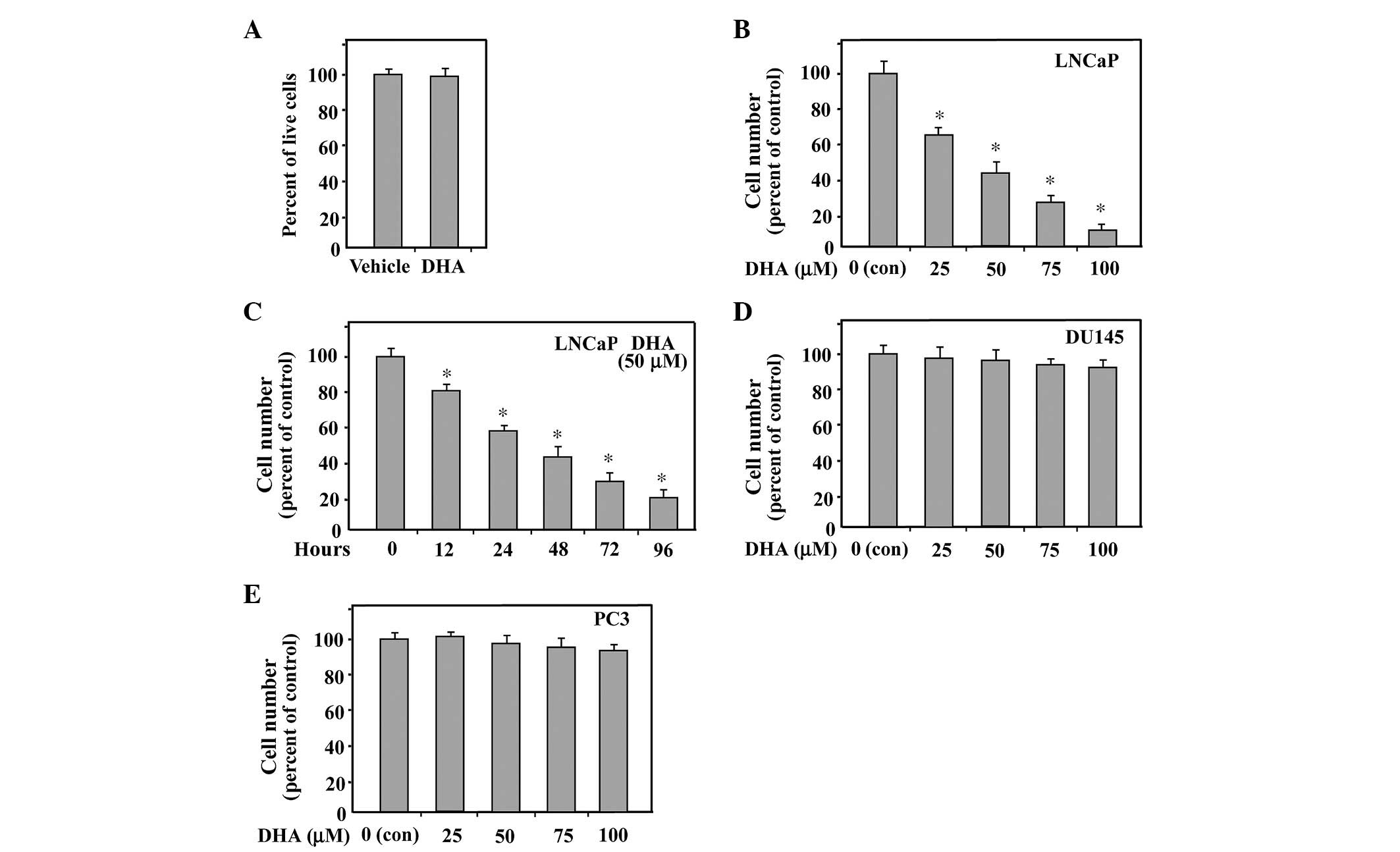
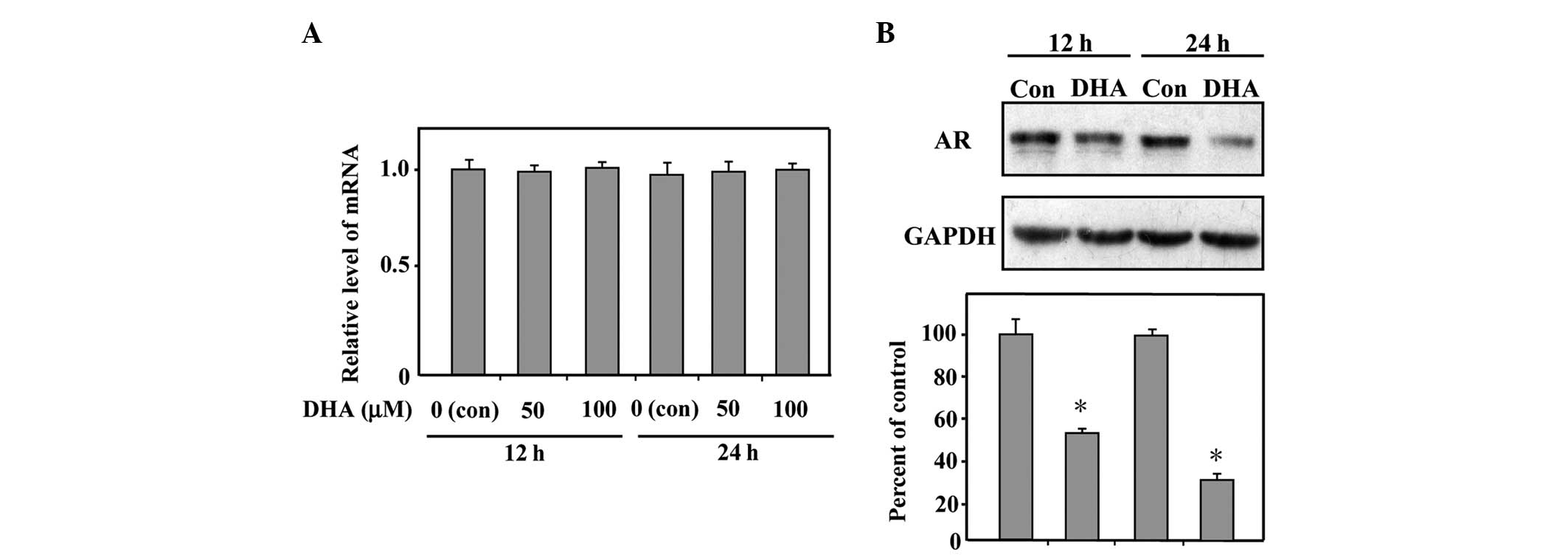
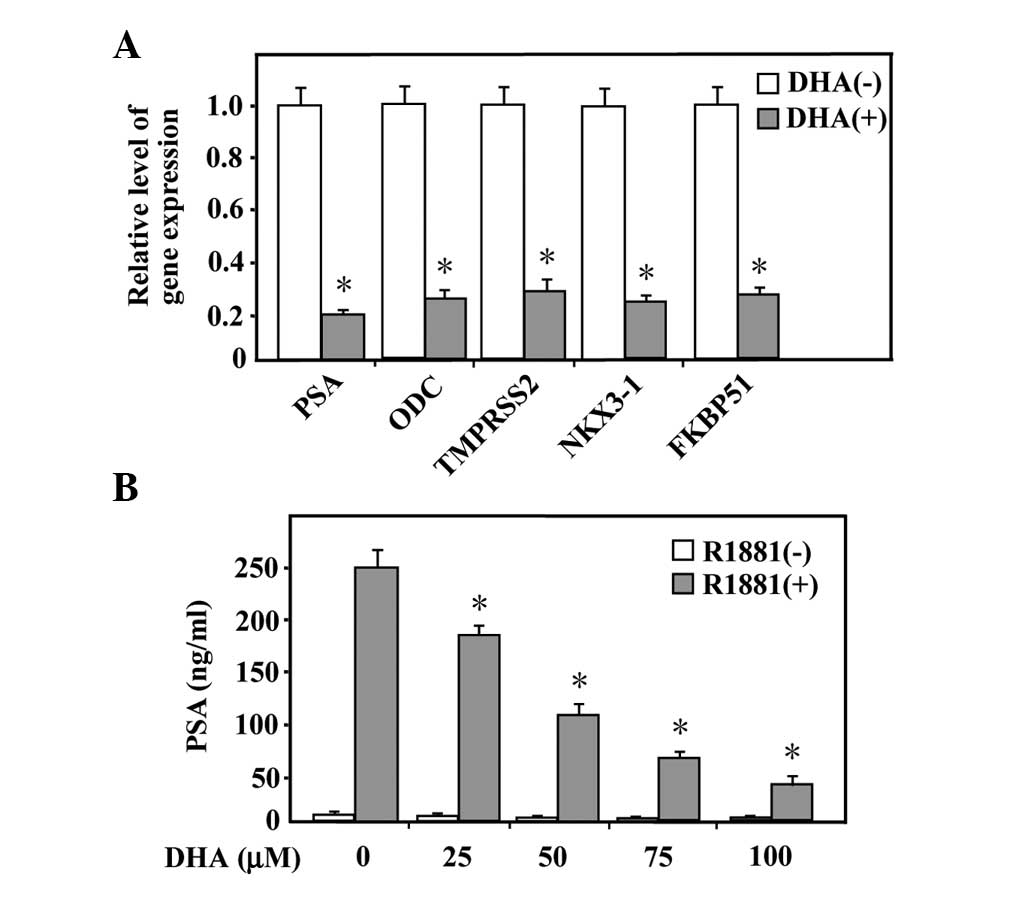
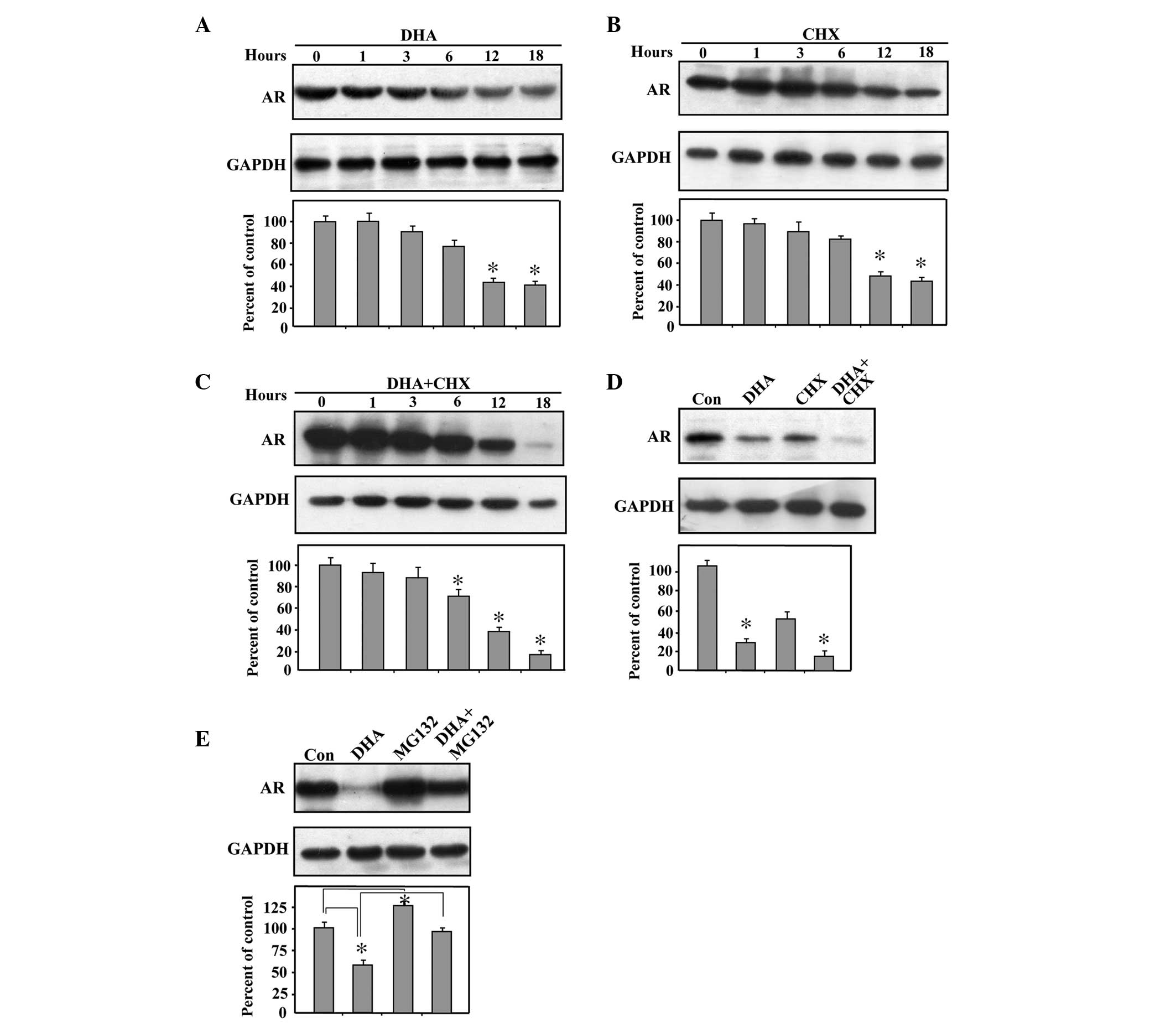
Epidemiological and preclinical data have demonstrated the preventative effects of ω-3 polyunsaturated fatty acids, including docosahexaenoic acid (DHA), on prostate cancer. However, there are inconsistencies in these previous studies and the underlying mechanisms remain to be elucidated. In the present study, the androgen receptor (AR), which is a transcription factor involved in cell proliferation and prostate carcinogenesis, was identified as a target of DHA. It was revealed that DHA inhibited hormone‑dependent growth of LNCaP prostate cancer cells. Reverse transcription-quantitative polymerase chain reaction analysis revealed that treatment with DHA caused no alteration in the transcribed mRNA expression levels of the AR gene. However, immunoblotting revealed that this treatment reduces the protein expression level of the AR. The androgen‑induced genes were subsequently repressed by treatment with DHA. It was demonstrated that DHA exhibits no effect on the translation process of the AR, however, it promotes the proteasome‑mediated degradation of the AR. Therefore, the present study provided a novel mechanism by which DHA exhibits an inhibitory effect on growth of prostate cancer cells.
View Figures

Figure 1

Figure 2

Figure 3

Figure 4

View References

1 

Saman DM, Lemieux AM, Nawal Lutfiyya M and Lipsky MS: A review of the current epidemiology and treatment options for prostate cancer. Dis Mon. 60:150–154. 2014. View Article : Google Scholar : PubMed/NCBI

2 

Gathirua-Mwangi WG and Zhang J: Dietary factors and risk for advanced prostate cancer. Eur J Cancer Prev. 23:96–109. 2014. View Article : Google Scholar :

3 

Masko EM, Allott EH and Freedland SJ: The relationship between nutrition and prostate cancer: Is more always better? Eur Urol. 63:810–820. 2013. View Article : Google Scholar :

4 

Pelser C, Mondul AM, Hollenbeck AR and Park Y: Dietary fat, fatty acids and risk of prostate cancer in the NIH-AARP diet and health study. Cancer Epidemiol Biomarkers Prev. 22:697–707. 2013. View Article : Google Scholar : PubMed/NCBI

5 

Wright JL, Plymate S, D'Oria-Cameron A, et al: A study of caloric restriction versus standard diet in overweight men with newly diagnosed prostate cancer: A randomized controlled trial. Prostate. 73:1345–1351. 2013. View Article : Google Scholar : PubMed/NCBI

6 

Kang JX, Wan JB and He C: Concise review: Regulation of stem cell proliferation and differentiation by essential fatty acids and their metabolites. Stem Cells. 32:1092–1098. 2014. View Article : Google Scholar

7 

Olivo SE and Hilakivi-Clarke L: Opposing effects of prepubertal low- and high-fat n-3 polyunsaturated fatty acid diets on rat mammary tumorigenesis. Carcinogenesis. 26:1563–1572. 2005. View Article : Google Scholar : PubMed/NCBI

8 

Chen Z, Zhang Y, Jia C, et al: mTORC1/2 targeted by n-3 polyunsaturated fatty acids in the prevention of mammary tumorigenesis and tumor progression. Oncogene. 33:4548–4557. 2014. View Article : Google Scholar

9 

Apte SA, Cavazos DA, Whelan KA and Degraffenried LA: A low dietary ratio of omega-6 to omega-3 Fatty acids may delay progression of prostate cancer. Nutr Cancer. 65:556–562. 2013. View Article : Google Scholar : PubMed/NCBI

10 

Chua ME, Sio MC, Sorongon MC and Dy JS: Relationship of dietary intake of omega-3 and omega-6 Fatty acids with risk of prostate cancer development: A meta-analysis of prospective studies and review of literature. Prostate Cancer. 2012:8262542012. View Article : Google Scholar : PubMed/NCBI

11 

Akinsete JA, Ion G, Witte TR and Hardman WE: Consumption of high ω-3 fatty acid diet suppressed prostate tumorigenesis in C3 (1) Tag mice. Carcinogenesis. 33:140–148. 2012. View Article : Google Scholar :

12 

Berquin IM, Edwards IJ and Chen YQ: Multi-targeted therapy of cancer by omega-3 fatty acids. Cancer Lett. 269:363–377. 2008. View Article : Google Scholar : PubMed/NCBI

13 

Virtanen JK, Mozaffarian D, Chiuve SE and Rimm EB: Fish consumption and risk of major chronic disease in men. Am J Clin Nutr. 88:1618–1625. 2008. View Article : Google Scholar : PubMed/NCBI

14 

Williams CD, Whitley BM, Hoyo C, et al: A high ratio of dietary n-6/n-3 polyunsaturated fatty acids is associated with increased risk of prostate cancer. Nutr Res. 31:1–8. 2011. View Article : Google Scholar : PubMed/NCBI

15 

Brasky TM, Till C, White E, et al: Serum phospholipid fatty acids and prostate cancer risk: Results from the prostate cancer prevention trial. Am J Epidemiol. 173:1429–1439. 2011. View Article : Google Scholar : PubMed/NCBI

16 

Comba A, Lin YH, Eynard AR, Valentich MA, Fernandez-Zapico ME and Pasqualini ME: Basic aspects of tumor cell fatty acid-regulated signaling and transcription factors. Cancer Metastasis Rev. 30:325–342. 2011. View Article : Google Scholar : PubMed/NCBI

17 

Stillwell W, Shaikh SR, Zerouga M, Siddiqui R and Wassall SR: Docosahexaenoic acid affects cell signaling by altering lipid rafts. Reprod Nutr Dev. 45:559–579. 2005. View Article : Google Scholar : PubMed/NCBI

18 

Bazan NG: Omega-3 fatty acids, pro-inflammatory signaling and neuroprotection. Curr Opin Clin Nutr Metab Care. 10:136–141. 2007. View Article : Google Scholar : PubMed/NCBI

19 

Balk SP: Androgen receptor functions in prostate cancer development and progression. Asian J Androl. 16:561–564. 2014. View Article : Google Scholar : PubMed/NCBI

20 

Taplin ME and Balk SP: Androgen receptor: A key molecule in the progression of prostate cancer to hormone independence. J Cell Biochem. 91:483–490. 2004. View Article : Google Scholar : PubMed/NCBI

21 

Wang LG, Ossowski L and Ferrari AC: Androgen receptor level controlled by a suppressor complex lost in an androgen-independent prostate cancer cell line. Oncogene. 23:5175–5184. 2004. View Article : Google Scholar : PubMed/NCBI

22 

Chen CD, Welsbie DS, Tran C, Baek SH, Chen R, Vessella R, Rosenfeld MG and Sawyers CL: Molecular determinants of resistance to antiandrogen therapy. Nat Med. 10:33–39. 2004. View Article : Google Scholar : PubMed/NCBI

23 

Linja MJ, Savinainen KJ, Saramäki OR, Tammela TL, Vessella RL and Visakorpi T: Amplification and overexpression of androgen receptor gene in hormone–refractory prostate cancer. Cancer Res. 61:3550–3555. 2001.PubMed/NCBI

24 

Friedrichs W, Ruparel SB, Marciniak RA and deGraffenried L: Omega-3 fatty acid inhibition of prostate cancer progression to hormone independence is associated with suppression of mTOR signaling and androgen receptor expression. Nutr Cancer. 63:771–777. 2011. View Article : Google Scholar : PubMed/NCBI

25 

Hong W, Li J, Wang B, et al: Epigenetic involvement of Alien/ESET complex in thyroid hormone-mediated repression of E2F1 gene expression and cell proliferation. Biochem Biophys Res Commun. 415:650–655. 2011. View Article : Google Scholar : PubMed/NCBI

26 

Joshi AD, John EM, Koo J, Ingles SA and Stern MC: Fish intake, cooking practices, and risk of prostate cancer: Results from a multi-ethnic case-control study. Cancer Causes Control. 23:405–420. 2012. View Article : Google Scholar

27 

Huang M, Narita S, Numakura K, Tsuruta H, Saito M, Inoue T, Horikawa Y, Tsuchiya N and Habuchi T: A high-fat diet enhances proliferation of prostate cancer cells and activates MCP-1/CCR2 signaling. Prostate. 72:1779–1788. 2012. View Article : Google Scholar : PubMed/NCBI

28 

Chang SN, Han J, Abdelkader TS, Kim TH, Lee JM, Song J, Kim KS and Park JH and Park JH: High animal fat intake enhances prostate cancer progression and reduces glutathione peroxidase 3 expression in early stages of TRAMP mice. Prostate. 74:1266–1277. 2014. View Article : Google Scholar : PubMed/NCBI

29 

Berkow SE, Barnard ND, Saxe GA and Ankerberg-Nobis T: Diet and survival after prostate cancer diagnosis. Nutr Rev. 65:391–403. 2007. View Article : Google Scholar : PubMed/NCBI

30 

Astorg P: Dietary N-6 and N-3 polyunsaturated fatty acids and prostate cancer risk: a review of epidemiological and experimental evidence. Cancer Causes Control. 15:367–386. 2004. View Article : Google Scholar : PubMed/NCBI

31 

McEntee MF, Ziegler C, Reel D, et al: Dietary n-3 polyunsaturated fatty acids enhance hormone ablation therapy in androgen-dependentprostate cancer. Am J Pathol. 173:229–241. 2008. View Article : Google Scholar : PubMed/NCBI

32 

Symes AJ, Eilertsen M, Millar M, et al: Quantitative analysis of BTF3, HINT1, NDRG1 and ODC1 protein over-expression in human prostate cancer tissue. PLoS One. 8:e842952013. View Article : Google Scholar

33 

Chen Y, Sawyers CL and Scher HI: Targeting the androgen receptor pathway in prostate cancer. Curr Opin Pharmacol. 8:440–448. 2008. View Article : Google Scholar : PubMed/NCBI

Related Articles

  • Abstract
  • View
  • Download
  • Twitter
Copy and paste a formatted citation
Spandidos Publications style
Hu Z, Qi H, Zhang R, Zhang K, Shi Z, Chang Y, Chen L, Esmaeili M, Baniahmad A, Hong W, Hong W, et al: Docosahexaenoic acid inhibits the growth of hormone-dependent prostate cancer cells by promoting the degradation of the androgen receptor. Mol Med Rep 12: 3769-3774, 2015.
APA
Hu, Z., Qi, H., Zhang, R., Zhang, K., Shi, Z., Chang, Y. ... Hong, W. (2015). Docosahexaenoic acid inhibits the growth of hormone-dependent prostate cancer cells by promoting the degradation of the androgen receptor. Molecular Medicine Reports, 12, 3769-3774. https://doi.org/10.3892/mmr.2015.3813
MLA
Hu, Z., Qi, H., Zhang, R., Zhang, K., Shi, Z., Chang, Y., Chen, L., Esmaeili, M., Baniahmad, A., Hong, W."Docosahexaenoic acid inhibits the growth of hormone-dependent prostate cancer cells by promoting the degradation of the androgen receptor". Molecular Medicine Reports 12.3 (2015): 3769-3774.
Chicago
Hu, Z., Qi, H., Zhang, R., Zhang, K., Shi, Z., Chang, Y., Chen, L., Esmaeili, M., Baniahmad, A., Hong, W."Docosahexaenoic acid inhibits the growth of hormone-dependent prostate cancer cells by promoting the degradation of the androgen receptor". Molecular Medicine Reports 12, no. 3 (2015): 3769-3774. https://doi.org/10.3892/mmr.2015.3813
Copy and paste a formatted citation
x
Spandidos Publications style
Hu Z, Qi H, Zhang R, Zhang K, Shi Z, Chang Y, Chen L, Esmaeili M, Baniahmad A, Hong W, Hong W, et al: Docosahexaenoic acid inhibits the growth of hormone-dependent prostate cancer cells by promoting the degradation of the androgen receptor. Mol Med Rep 12: 3769-3774, 2015.
APA
Hu, Z., Qi, H., Zhang, R., Zhang, K., Shi, Z., Chang, Y. ... Hong, W. (2015). Docosahexaenoic acid inhibits the growth of hormone-dependent prostate cancer cells by promoting the degradation of the androgen receptor. Molecular Medicine Reports, 12, 3769-3774. https://doi.org/10.3892/mmr.2015.3813
MLA
Hu, Z., Qi, H., Zhang, R., Zhang, K., Shi, Z., Chang, Y., Chen, L., Esmaeili, M., Baniahmad, A., Hong, W."Docosahexaenoic acid inhibits the growth of hormone-dependent prostate cancer cells by promoting the degradation of the androgen receptor". Molecular Medicine Reports 12.3 (2015): 3769-3774.
Chicago
Hu, Z., Qi, H., Zhang, R., Zhang, K., Shi, Z., Chang, Y., Chen, L., Esmaeili, M., Baniahmad, A., Hong, W."Docosahexaenoic acid inhibits the growth of hormone-dependent prostate cancer cells by promoting the degradation of the androgen receptor". Molecular Medicine Reports 12, no. 3 (2015): 3769-3774. https://doi.org/10.3892/mmr.2015.3813
Follow us
  • Twitter
  • LinkedIn
  • Facebook
About
  • Spandidos Publications
  • Careers
  • Cookie Policy
  • Privacy Policy
How can we help?
  • Help
  • Live Chat
  • Contact
  • Email to our Support Team