Spandidos Publications Logo
  • About
    • About Spandidos
    • Aims and Scopes
    • Abstracting and Indexing
    • Editorial Policies
    • Reprints and Permissions
    • Job Opportunities
    • Terms and Conditions
    • Contact
  • Journals
    • All Journals
    • Oncology Letters
      • Oncology Letters
      • Information for Authors
      • Editorial Policies
      • Editorial Board
      • Aims and Scope
      • Abstracting and Indexing
      • Bibliographic Information
      • Archive
    • International Journal of Oncology
      • International Journal of Oncology
      • Information for Authors
      • Editorial Policies
      • Editorial Board
      • Aims and Scope
      • Abstracting and Indexing
      • Bibliographic Information
      • Archive
    • Molecular and Clinical Oncology
      • Molecular and Clinical Oncology
      • Information for Authors
      • Editorial Policies
      • Editorial Board
      • Aims and Scope
      • Abstracting and Indexing
      • Bibliographic Information
      • Archive
    • Experimental and Therapeutic Medicine
      • Experimental and Therapeutic Medicine
      • Information for Authors
      • Editorial Policies
      • Editorial Board
      • Aims and Scope
      • Abstracting and Indexing
      • Bibliographic Information
      • Archive
    • International Journal of Molecular Medicine
      • International Journal of Molecular Medicine
      • Information for Authors
      • Editorial Policies
      • Editorial Board
      • Aims and Scope
      • Abstracting and Indexing
      • Bibliographic Information
      • Archive
    • Biomedical Reports
      • Biomedical Reports
      • Information for Authors
      • Editorial Policies
      • Editorial Board
      • Aims and Scope
      • Abstracting and Indexing
      • Bibliographic Information
      • Archive
    • Oncology Reports
      • Oncology Reports
      • Information for Authors
      • Editorial Policies
      • Editorial Board
      • Aims and Scope
      • Abstracting and Indexing
      • Bibliographic Information
      • Archive
    • Molecular Medicine Reports
      • Molecular Medicine Reports
      • Information for Authors
      • Editorial Policies
      • Editorial Board
      • Aims and Scope
      • Abstracting and Indexing
      • Bibliographic Information
      • Archive
    • World Academy of Sciences Journal
      • World Academy of Sciences Journal
      • Information for Authors
      • Editorial Policies
      • Editorial Board
      • Aims and Scope
      • Abstracting and Indexing
      • Bibliographic Information
      • Archive
    • International Journal of Functional Nutrition
      • International Journal of Functional Nutrition
      • Information for Authors
      • Editorial Policies
      • Editorial Board
      • Aims and Scope
      • Abstracting and Indexing
      • Bibliographic Information
      • Archive
    • International Journal of Epigenetics
      • International Journal of Epigenetics
      • Information for Authors
      • Editorial Policies
      • Editorial Board
      • Aims and Scope
      • Abstracting and Indexing
      • Bibliographic Information
      • Archive
    • Medicine International
      • Medicine International
      • Information for Authors
      • Editorial Policies
      • Editorial Board
      • Aims and Scope
      • Abstracting and Indexing
      • Bibliographic Information
      • Archive
  • Articles
  • Information
    • Information for Authors
    • Information for Reviewers
    • Information for Librarians
    • Information for Advertisers
    • Conferences
  • Language Editing
Spandidos Publications Logo
  • About
    • About Spandidos
    • Aims and Scopes
    • Abstracting and Indexing
    • Editorial Policies
    • Reprints and Permissions
    • Job Opportunities
    • Terms and Conditions
    • Contact
  • Journals
    • All Journals
    • Biomedical Reports
      • Information for Authors
      • Editorial Policies
      • Editorial Board
      • Aims and Scope
      • Abstracting and Indexing
      • Bibliographic Information
      • Archive
    • Experimental and Therapeutic Medicine
      • Information for Authors
      • Editorial Policies
      • Editorial Board
      • Aims and Scope
      • Abstracting and Indexing
      • Bibliographic Information
      • Archive
    • International Journal of Epigenetics
      • Information for Authors
      • Editorial Policies
      • Editorial Board
      • Aims and Scope
      • Abstracting and Indexing
      • Bibliographic Information
      • Archive
    • International Journal of Functional Nutrition
      • Information for Authors
      • Editorial Policies
      • Editorial Board
      • Aims and Scope
      • Abstracting and Indexing
      • Bibliographic Information
      • Archive
    • International Journal of Molecular Medicine
      • Information for Authors
      • Editorial Policies
      • Editorial Board
      • Aims and Scope
      • Abstracting and Indexing
      • Bibliographic Information
      • Archive
    • International Journal of Oncology
      • Information for Authors
      • Editorial Policies
      • Editorial Board
      • Aims and Scope
      • Abstracting and Indexing
      • Bibliographic Information
      • Archive
    • Medicine International
      • Information for Authors
      • Editorial Policies
      • Editorial Board
      • Aims and Scope
      • Abstracting and Indexing
      • Bibliographic Information
      • Archive
    • Molecular and Clinical Oncology
      • Information for Authors
      • Editorial Policies
      • Editorial Board
      • Aims and Scope
      • Abstracting and Indexing
      • Bibliographic Information
      • Archive
    • Molecular Medicine Reports
      • Information for Authors
      • Editorial Policies
      • Editorial Board
      • Aims and Scope
      • Abstracting and Indexing
      • Bibliographic Information
      • Archive
    • Oncology Letters
      • Information for Authors
      • Editorial Policies
      • Editorial Board
      • Aims and Scope
      • Abstracting and Indexing
      • Bibliographic Information
      • Archive
    • Oncology Reports
      • Information for Authors
      • Editorial Policies
      • Editorial Board
      • Aims and Scope
      • Abstracting and Indexing
      • Bibliographic Information
      • Archive
    • World Academy of Sciences Journal
      • Information for Authors
      • Editorial Policies
      • Editorial Board
      • Aims and Scope
      • Abstracting and Indexing
      • Bibliographic Information
      • Archive
  • Articles
  • Information
    • For Authors
    • For Reviewers
    • For Librarians
    • For Advertisers
    • Conferences
  • Language Editing
Login Register Submit
  • This site uses cookies
  • You can change your cookie settings at any time by following the instructions in our Cookie Policy. To find out more, you may read our Privacy Policy.

    I agree
Search articles by DOI, keyword, author or affiliation
Search
Advanced Search
presentation
Molecular Medicine Reports
Join Editorial Board Propose a Special Issue
Print ISSN: 1791-2997 Online ISSN: 1791-3004
Journal Cover
October-2015 Volume 12 Issue 4

Full Size Image

Sign up for eToc alerts
Recommend to Library

Journals

International Journal of Molecular Medicine

International Journal of Molecular Medicine

International Journal of Molecular Medicine is an international journal devoted to molecular mechanisms of human disease.

International Journal of Oncology

International Journal of Oncology

International Journal of Oncology is an international journal devoted to oncology research and cancer treatment.

Molecular Medicine Reports

Molecular Medicine Reports

Covers molecular medicine topics such as pharmacology, pathology, genetics, neuroscience, infectious diseases, molecular cardiology, and molecular surgery.

Oncology Reports

Oncology Reports

Oncology Reports is an international journal devoted to fundamental and applied research in Oncology.

Experimental and Therapeutic Medicine

Experimental and Therapeutic Medicine

Experimental and Therapeutic Medicine is an international journal devoted to laboratory and clinical medicine.

Oncology Letters

Oncology Letters

Oncology Letters is an international journal devoted to Experimental and Clinical Oncology.

Biomedical Reports

Biomedical Reports

Explores a wide range of biological and medical fields, including pharmacology, genetics, microbiology, neuroscience, and molecular cardiology.

Molecular and Clinical Oncology

Molecular and Clinical Oncology

International journal addressing all aspects of oncology research, from tumorigenesis and oncogenes to chemotherapy and metastasis.

World Academy of Sciences Journal

World Academy of Sciences Journal

Multidisciplinary open-access journal spanning biochemistry, genetics, neuroscience, environmental health, and synthetic biology.

International Journal of Functional Nutrition

International Journal of Functional Nutrition

Open-access journal combining biochemistry, pharmacology, immunology, and genetics to advance health through functional nutrition.

International Journal of Epigenetics

International Journal of Epigenetics

Publishes open-access research on using epigenetics to advance understanding and treatment of human disease.

Medicine International

Medicine International

An International Open Access Journal Devoted to General Medicine.

Journal Cover
October-2015 Volume 12 Issue 4

Full Size Image

Sign up for eToc alerts
Recommend to Library

  • Article
  • Citations
    • Cite This Article
    • Download Citation
    • Create Citation Alert
    • Remove Citation Alert
    • Cited By
  • Similar Articles
    • Related Articles (in Spandidos Publications)
    • Similar Articles (Google Scholar)
    • Similar Articles (PubMed)
  • Download PDF
  • Download XML
  • View XML
Article

A novel endoplasmic reticulum stress‑induced apoptosis model using tunicamycin in primary cultured neonatal rat cardiomyocytes

  • Authors:
    • Mingzhi Shen
    • Lin Wang
    • Xiaowang Guo
    • Qiao Xue
    • Cong Huo
    • Xing Li
    • Li Fan
    • Xiaoming Wang
  • View Affiliations / Copyright

    Affiliations: Department of Geriatrics, Xijing Hospital, Fourth Military Medical University, Xi'an, Shaanxi 710032, P.R. China, Department of Cardiology, Hainan Branch of PLA General Hospital, Sanya, Hainan 572013, P.R. China, Department of Geriatric Cardiology, Chinese PLA General Hospital, Beijing 100853, P.R. China
  • Pages: 5149-5154
    |
    Published online on: July 3, 2015
       https://doi.org/10.3892/mmr.2015.4040
  • Expand metrics +
Metrics: Total Views: 0 (Spandidos Publications: | PMC Statistics: )
Metrics: Total PDF Downloads: 0 (Spandidos Publications: | PMC Statistics: )
Cited By (CrossRef): 0 citations Loading Articles...

This article is mentioned in:


Abstract

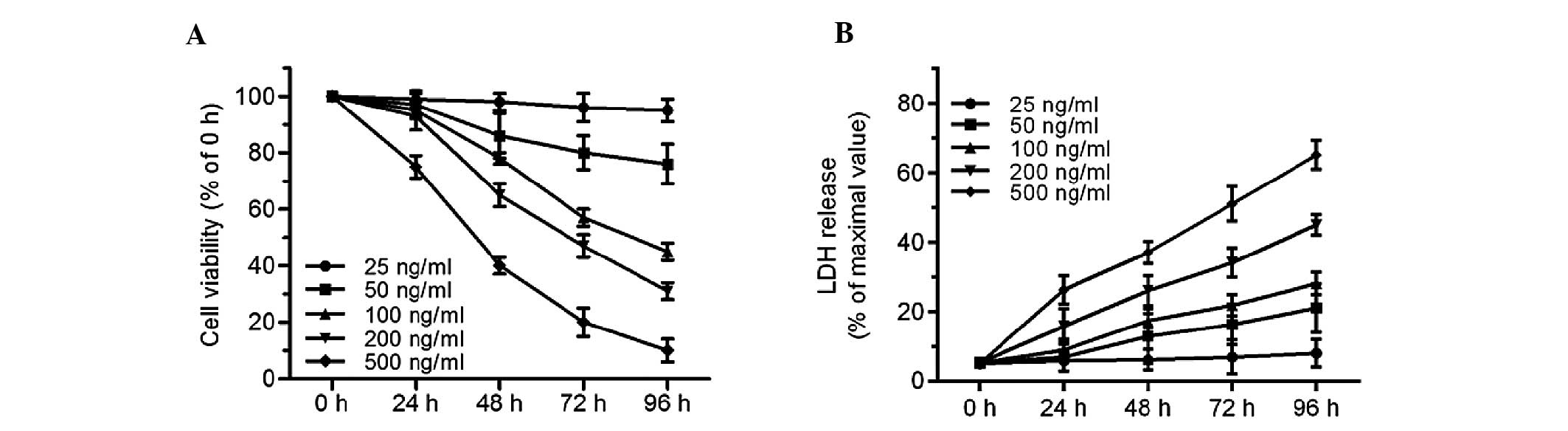
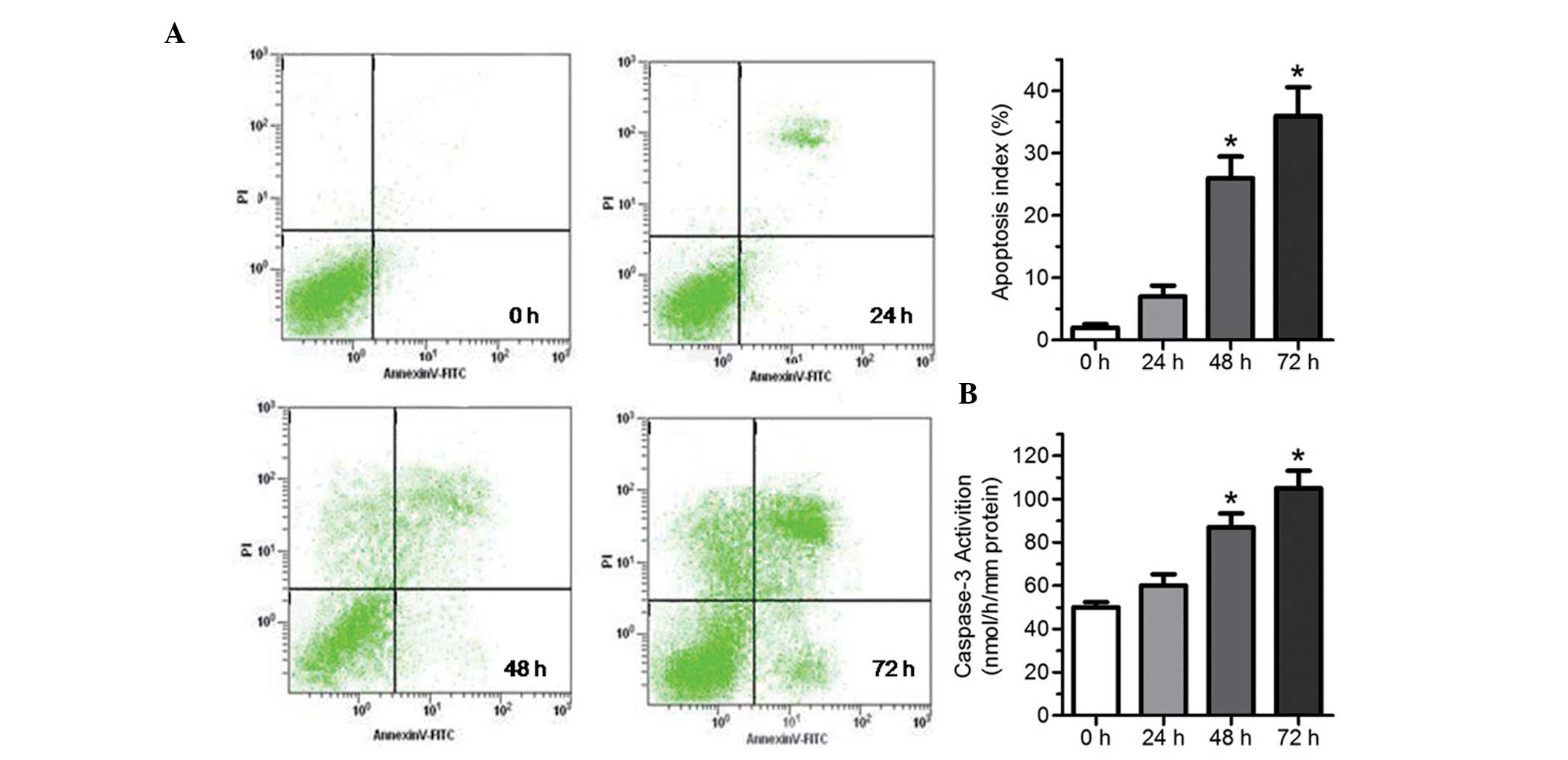
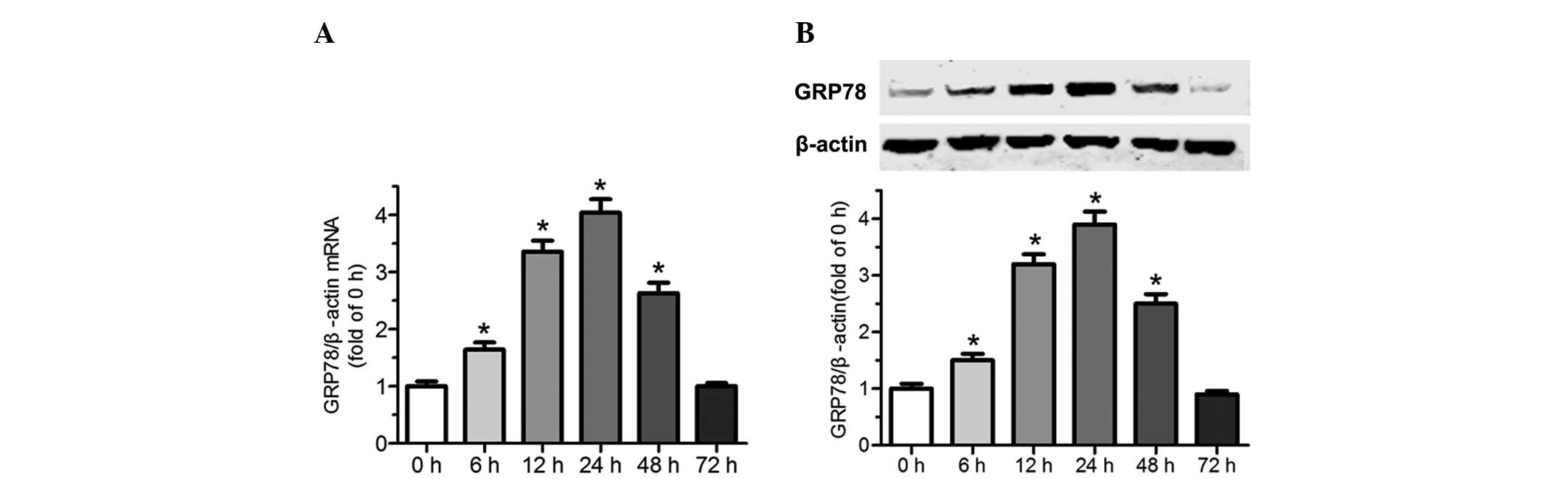
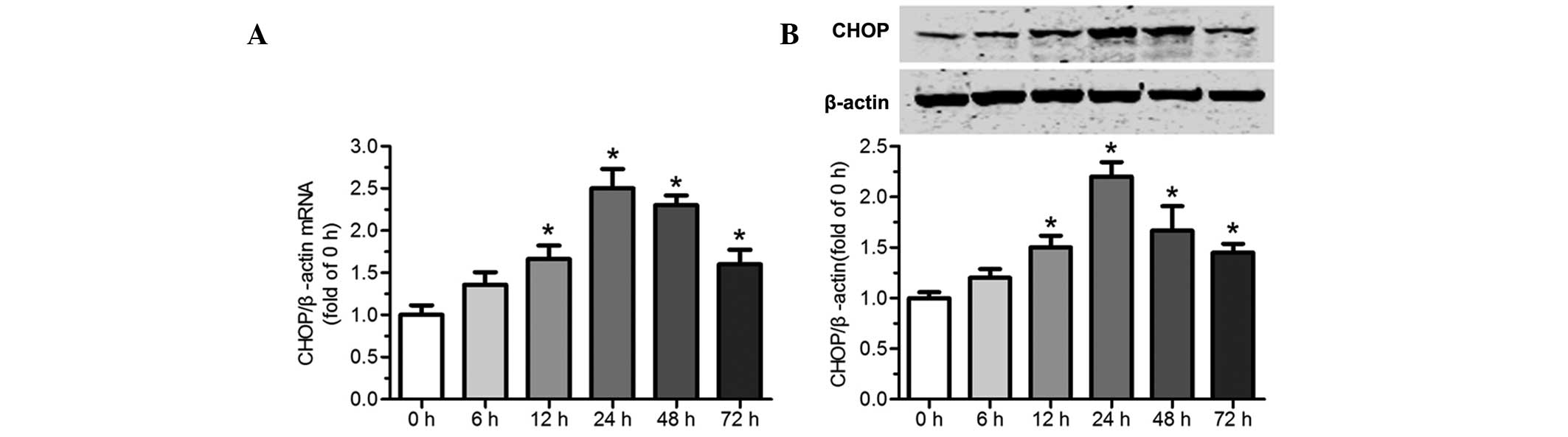
Endoplasmic reticulum (ER) stress is key in the development of cardiovascular diseases. However, there is a lack of a systemic ER stress‑induced cardiomyocyte apoptosis model. In the present study, primary cultured neonatal rat cardiomyocytes were exposed to tunicamycin. Cell viability was determined by an MTT assay, and cell damage was detected by a lactose dehydrogenase assay. Flow cytometry was used and the activity of caspase‑3 was analyzed in order to measure apoptosis. Reverse transcription-quantitative polymerase chain reaction and western blotting were used to examine the expression of glucose‑regulated protein 78‑kDa (GRP78) and C/EBP homologous protein (CHOP). As a result, tunicamycin significantly increased cardiomyocyte injury, which occurred in a time- and concentration‑dependent manner. In addition, tunicamycin treatment resulted in apoptosis of cardiomyocytes. Molecularly, tunicamycin (100 ng/ml) increased the levels of GRP78 and CHOP 6 h after administration. In addition, GRP78 and CHOP reached maximum mRNA and protein levels 24 h after administration. In conclusion, the results implicate that the tunicamycin‑induced ER stress‑induced apoptotic model was successfully constructed in cultured neonatal rat cardiomyocytes. A 100 ng/ml concentration of tunicamycin was selected, and MTT, LDH release and flow cytometry assay was at 72 h. In addition, GRP78 and GRP94 were detected 24 h following administration. The results of the present study indicate a novel experimental basis for the investigation of ERS-induced cardiac apoptosis.
View Figures

Figure 1

Figure 2

Figure 3

Figure 4

View References

1 

Millott R, Dudek E and Michalak M: The endoplasmic reticulum in cardiovascular health and disease. Can J Physiol Pharmacol. 90:1209–1217. 2012. View Article : Google Scholar : PubMed/NCBI

2 

Peralta C and Brenner C: Endoplasmic reticulum stress inhibition enhances liver tolerance to ischemia/reperfusion. Curr Med Chem. 18:2016–2024. 2011. View Article : Google Scholar : PubMed/NCBI

3 

Ding W and Zhang X, Huang H, Ding N, Zhang S, Hutchinson SZ and Zhang X: Adiponectin protects rat myocardium against chronic intermittent hypoxia-induced injury via inhibition of endoplasmic reticulum stress. PLoS One. 9:e945452014. View Article : Google Scholar : PubMed/NCBI

4 

Gomes-Alves P, Couto F, Pesquita C, Coelho AV and Penque D: Rescue of F508del-CFTR by RXR motif inactivation triggers proteome modulation associated with the unfolded protein response. Biochim Biophys Acta. 1804:856–865. 2010. View Article : Google Scholar : PubMed/NCBI

5 

Farrukh MR, Nissar UA, Afnan Q, et al: Oxidative stress mediated Ca (2+) release manifests endoplasmic reticulum stress leading to unfolded protein response in UV-B irradiated human skin cells. J Dermatol Sci. 75:24–35. 2014. View Article : Google Scholar : PubMed/NCBI

6 

Zhang K and Kaufman RJ: From endoplasmic-reticulum stress to the inflammatory response. Nature. 454:455–462. 2008. View Article : Google Scholar : PubMed/NCBI

7 

Fu HY, Okada K, Liao Y, et al: Ablation of C/EBP homologous protein attenuates endoplasmic reticulum-mediated apoptosis and cardiac dysfunction induced by pressure overload. Circulation. 122:361–369. 2010. View Article : Google Scholar : PubMed/NCBI

8 

Yang L, Zhao D, Ren J and Yang J: Endoplasmic reticulum stress and protein quality control in diabetic cardiomyopathy. Biochim Biophys Acta. 1852:209–218. 2014. View Article : Google Scholar : PubMed/NCBI

9 

Groenendyk J, Sreenivasaiah PK, Kim do H, Agellon LB and Michalak M: Biology of endoplasmic reticulum stress in the heart. Circ Res. 107:1185–1197. 2010. View Article : Google Scholar : PubMed/NCBI

10 

Avery J, Etzion S, DeBosch BJ, et al: TRB3 function in cardiac endoplasmic reticulum stress. Circ Res. 106:1516–1523. 2010. View Article : Google Scholar : PubMed/NCBI

11 

Liu D, Zhang M and Yin H: Signaling pathways involved in endoplasmic reticulum stress-induced neuronal apoptosis. Int J Neurosci. 123:155–162. 2013. View Article : Google Scholar

12 

Thuerauf DJ, Marcinko M, Gude N, Rubio M, Sussman MA and Glembotski CC: Activation of the unfolded protein response in infarcted mouse heart and hypoxic cultured cardiac myocytes. Circ Res. 99:275–282. 2006. View Article : Google Scholar : PubMed/NCBI

13 

Endo H, Murata K, Mukai M, Ishikawa O and Inoue M: Activation of insulin-like growth factor signaling induces apoptotic cell death under prolonged hypoxia by enhancing endoplasmic reticulum stress response. Cancer Res. 67:8095–8103. 2007. View Article : Google Scholar : PubMed/NCBI

14 

Erbay E, Babaev VR, Mayers JR, et al: Reducing endoplasmic reticulum stress through a macrophage lipid chaperone alleviates atherosclerosis. Nat Med. 15:1383–1391. 2009. View Article : Google Scholar : PubMed/NCBI

15 

Hotamisligil GS: Endoplasmic reticulum stress and atherosclerosis. Nat Med. 16:396–399. 2010. View Article : Google Scholar : PubMed/NCBI

16 

Myoishi M, Hao H, Minamino T, et al: Increased endoplasmic reticulum stress in atherosclerotic plaques associated with acute coronary syndrome. Circulation. 116:1226–1233. 2007. View Article : Google Scholar : PubMed/NCBI

17 

Glembotski CC: Endoplasmic reticulum stress in the heart. Circ Res. 101:975–984. 2007. View Article : Google Scholar : PubMed/NCBI

18 

Kim I, Xu W and Reed JC: Cell death and endoplasmic reticulum stress: disease relevance and therapeutic opportunities. Nat Rev Drug Discov. 7:1013–1030. 2008. View Article : Google Scholar : PubMed/NCBI

19 

Dickhout JG, Carlisle RE and Austin RC: Interrelationship between cardiac hypertrophy, heart failure and chronic kidney disease: endoplasmic reticulum stress as a mediator of pathogenesis. Circ Res. 108:629–642. 2011. View Article : Google Scholar : PubMed/NCBI

20 

van Empel VP, Bertrand AT, Hofstra L, Crijns HJ, Doevendans PA and De Windt LJ: Myocyte apoptosis in heart failure. Cardiovasc Res. 67:21–29. 2005. View Article : Google Scholar : PubMed/NCBI

21 

Shen M, Wang L, Yang G, et al: Baicalin protects the cardiomyocytes from ER stress-induced apoptosis: inhibition of CHOP through induction of endothelial nitric oxide synthase. PLoS One. 9:e883892014. View Article : Google Scholar : PubMed/NCBI

22 

Liu B, Niu L, Shen MZ, et al: Decreased astroglial monocarboxylate transporter 4 expression in temporal lobe epilepsy. Mol Neurobiol. 50:327–338. 2014. View Article : Google Scholar : PubMed/NCBI

23 

Fu HY, Minamino T, Tsukamoto O, et al: Overexpression of endoplasmic reticulum-resident chaperone attenuates cardiomyocyte death induced by proteasome inhibition. Cardiovasc Res. 79:600–610. 2008. View Article : Google Scholar : PubMed/NCBI

24 

Liu B, Wang L, Shen LL, et al: RNAi-mediated inhibition of presenilin 2 inhibits glioma cell growth and invasion and is involved in the regulation of Nrg1/ErbB signaling. Neuro Oncol. 14:994–1006. 2012. View Article : Google Scholar : PubMed/NCBI

25 

Zhou S, Yin X, Zheng Y, et al: Metallothionein prevents intermittent hypoxia-induced cardiac endoplasmic reticulum stress and cell death likely via activation of Akt signaling pathway in mice. Toxicol Lett. 227:113–123. 2014. View Article : Google Scholar : PubMed/NCBI

26 

Yang Y, Li C, Xiang X, et al: Ursolic acid prevents endoplasmic reticulum stress-mediated apoptosis induced by heat stress in mouse cardiac myocytes. J Mol Cell Cardiol. 67:103–111. 2014. View Article : Google Scholar : PubMed/NCBI

27 

Qi X, Vallentin A, Churchill E and Mochly-Rosen D: DeltaPKC participates in the endoplasmic reticulum stress-induced response in cultured cardiac myocytes and ischemic heart. J Mol Cell Cardiol. 43:420–428. 2007. View Article : Google Scholar : PubMed/NCBI

28 

Okada K, Minamino T, Tsukamoto Y, et al: Prolonged endoplasmic reticulum stress in hypertrophic and failing heart after aortic constriction: possible contribution of endoplasmic reticulum stress to cardiac myocyte apoptosis. Circulation. 110:705–712. 2004. View Article : Google Scholar : PubMed/NCBI

29 

Lin JH, Li H, Yasumura D, et al: IRE1 signaling affects cell fate during the unfolded protein response. Science. 318:944–949. 2007. View Article : Google Scholar : PubMed/NCBI

Related Articles

  • Abstract
  • View
  • Download
  • Twitter
Copy and paste a formatted citation
Spandidos Publications style
Shen M, Wang L, Guo X, Xue Q, Huo C, Li X, Fan L and Wang X: A novel endoplasmic reticulum stress‑induced apoptosis model using tunicamycin in primary cultured neonatal rat cardiomyocytes. Mol Med Rep 12: 5149-5154, 2015.
APA
Shen, M., Wang, L., Guo, X., Xue, Q., Huo, C., Li, X. ... Wang, X. (2015). A novel endoplasmic reticulum stress‑induced apoptosis model using tunicamycin in primary cultured neonatal rat cardiomyocytes. Molecular Medicine Reports, 12, 5149-5154. https://doi.org/10.3892/mmr.2015.4040
MLA
Shen, M., Wang, L., Guo, X., Xue, Q., Huo, C., Li, X., Fan, L., Wang, X."A novel endoplasmic reticulum stress‑induced apoptosis model using tunicamycin in primary cultured neonatal rat cardiomyocytes". Molecular Medicine Reports 12.4 (2015): 5149-5154.
Chicago
Shen, M., Wang, L., Guo, X., Xue, Q., Huo, C., Li, X., Fan, L., Wang, X."A novel endoplasmic reticulum stress‑induced apoptosis model using tunicamycin in primary cultured neonatal rat cardiomyocytes". Molecular Medicine Reports 12, no. 4 (2015): 5149-5154. https://doi.org/10.3892/mmr.2015.4040
Copy and paste a formatted citation
x
Spandidos Publications style
Shen M, Wang L, Guo X, Xue Q, Huo C, Li X, Fan L and Wang X: A novel endoplasmic reticulum stress‑induced apoptosis model using tunicamycin in primary cultured neonatal rat cardiomyocytes. Mol Med Rep 12: 5149-5154, 2015.
APA
Shen, M., Wang, L., Guo, X., Xue, Q., Huo, C., Li, X. ... Wang, X. (2015). A novel endoplasmic reticulum stress‑induced apoptosis model using tunicamycin in primary cultured neonatal rat cardiomyocytes. Molecular Medicine Reports, 12, 5149-5154. https://doi.org/10.3892/mmr.2015.4040
MLA
Shen, M., Wang, L., Guo, X., Xue, Q., Huo, C., Li, X., Fan, L., Wang, X."A novel endoplasmic reticulum stress‑induced apoptosis model using tunicamycin in primary cultured neonatal rat cardiomyocytes". Molecular Medicine Reports 12.4 (2015): 5149-5154.
Chicago
Shen, M., Wang, L., Guo, X., Xue, Q., Huo, C., Li, X., Fan, L., Wang, X."A novel endoplasmic reticulum stress‑induced apoptosis model using tunicamycin in primary cultured neonatal rat cardiomyocytes". Molecular Medicine Reports 12, no. 4 (2015): 5149-5154. https://doi.org/10.3892/mmr.2015.4040
Follow us
  • Twitter
  • LinkedIn
  • Facebook
About
  • Spandidos Publications
  • Careers
  • Cookie Policy
  • Privacy Policy
How can we help?
  • Help
  • Live Chat
  • Contact
  • Email to our Support Team