Introduction
Immunolabelled techniques (ILTs) are dependent on
the binding of a specific antibody to a labeling material, such as
enzymes (1), fluorescein dyes
(2) and other compounds (3). When used to detect antibodies in
animal species, the binding complex usually consists of the
labeling molecule bound to a specific antibody targeting the
immunoglobulin (Ig) of the species of interest (4–7).
However, when conducting a serological test for a specific disease
in various animal species including humans, a more appropriate
technique is to use a single conjugate targeting all the tested
species. This is carried out using Staphylococcus aureus
protein A and streptococcus protein G (SPG) as ILT conjugates
(8).
Protein A was originally detected in the cell wall
of the bacterium Staphylococcus aureus (9), and exhibits a unique affinity for the
IgG of numerous mammalian species (10), and for the IgM and IgA of certain
species via interaction with the heavy chain (11). Numerous labeling molecules may be
coupled to protein A without affecting its Ig-binding ability.
Since its discovery, protein A has been widely used in various
immunology and molecular biology fields (11). To increase the specificity of
protein A for IgG for use in both research and bioprocessing,
genetically engineered protein A can be expressed by Escherichia
(E.) coli or yeast (12–15).
SPG is an Ig-binding protein, which was initially
detected in group C and G Streptococcus (16), the gene structure and
protein-binding properties of which have previously been described
(17). Similar to protein A, SPG
is able to bind to the Fc fragment of IgGs from numerous mammalian
species over a wide range of pH (4.0–8.0). Furthermore, SPG has a
broader range of reactivity than protein A, and SPG is more
appropriate for the purification and isolation of IgG due to its
binding specificities to all four subclasses of human IgG (14). SPG is a 65 kDa (group G protein G)
or 58 kDa (group C protein G) cell surface protein that may be used
to purify antibodies IgG1, IgG2, IgG3 and IgG4 by binding to the Fc
region (14). Although the
tertiary structures of protein A and SPG are very similar, their
amino acid compositions differ significantly, resulting in
different binding characteristics. SPG may be used for the
purification of mammalian monoclonal and polyclonal IgGs, which do
not bind well to protein A. As compared with protein A, SPG has a
greater affinity to most mammalian IgGs, particularly for certain
subclasses of IgG, including human IgG3, mouse IgG1, and rat IgG2a
(18). However, unlike protein A,
SPG does not bind to human IgM, IgD, or IgA (12).
With the emergence of novel pathogens worldwide,
more antibodies will be required in order to detect the pathogens
of various animals. Purified recombinant SPG (rSPG) has an
important role in the purification of pathogen-targeting
antibodies, and for the detection of specific pathogenic antigens
via the conjugation of antibodies with sensitive immunolabelled
molecules. Furthermore, the use of purified rSPG conjugates may be
vital for the diagnosis of certain diseases, such as autoimmune
diseases. Since IgG3 is overexpressed in numerous autoimmune
diseases and represents ≥45% of autoimmune antibodies, rSPG may
prove useful for the study and diagnosis of autoimmunity. Due to
these various properties, SPG has more commercial value than
protein A.
The cost of commercial rSPG has so far hindered
further research into the application of rSPG. Previous studies
have described high cell density fermentation and purification of
rSPG in E. coli (15,19,20).
The present study aimed to promote the accuracy of synthesized
rSPG, and decrease its price by developing an optimal fermentation
and purification method.
Materials and methods
Fermentation and purification of
rSPG
In order to obtain large amounts of highly purified
rSPG, high cell density fermentation of genetically modified E.
coli BL21, and purification technology were employed according
to the method of a previous study by our group (20). Cell densities (optical density, 600
nm), inoculation, concentration of isopropyl β-d-1-thiogalactopyranoside (IPTG;
Takara Bio Inc., Otsu, Japan), dissolved oxygen, pH, and induction
time were optimized. The expressed rSPG was then purified using a
Ni-NTA column, Sephadex G-25 desalting step, and DEAE-FF
ion-exchange chromatography. The protein content of the column
elution was monitored by measuring absorbance at a wavelength of
280 nm. The purity of rSPG was subsequently determined by 12%
SDS-PAGE, and the concentration of rSPG was determined using a
Bradford assay normalized to bovine serum albumin (BSA).
Functional assessment of rSPG by western
blotting and rSPG-Q Sepharose® Fast Flow
The purified rSPG and the commercial SPG (Beijing
Dapbiotech Company, Beijing, China) were separated by 12% SDS-PAGE
and trans ferred to polyvinylidene difluoride (PVDF) membranes
(Bio-Rad Laboratories, Inc. Hercules, CA, USA), as described in a
previous study by our group (20).
In order to compare the function of the purified
rSPG with that of the commercial SPG, the two were immobilized
using activated mercapto group Q Sepharose® Fast Flow
(GE Healthcare Bio-Sciences, Pittsburg, PA, USA). A total of 1 mg
purified rSPG dissolved in 2 ml Buffer L (0.2 mol/l Tris-HCl
buffer, 2 mmol/l EDTA, pH 8.0) was mixed with 0.2 g activated
mercapto group Q Sepharose® Fast Flow at 4°C for 16 h,
in order to form rSPG-Q Sepharose® Fast Flow. The rSPG-Q
Sepharose® Fast Flow was placed into a column (6.6 mm ×
32 mm; Omnifit® Solvent Plus Column; Diba Industries,
Inc., Danbury, CT, USA) and equilibrated with Buffer L to wash off
the unreacted rSPG, prior to further washing with Buffer M (0.01
mol/l phosphate-buffered saline, 0.137 mol/l NaCl, 2.7 mmol/l KCl,
pH 7.4). A total of 50 ml mouse serum solution was loaded into the
column, and the elution was monitored at 280 nm using a
spectrophotometer (Shanghai Jinda Biochemical Instruments Co.,
Ltd., Shanghai, China). The flow-through fraction was subsequently
collected, and the column was eluted using Buffer W (0.1 mol/l
sodium citrate, pH 3.0). Using the Beer-Lambert law, the
concentration of IgG (mg/ml) in the elution was calculated.
Briefly, the amount of IgG bound to the column was determined by
subtracting the amount of protein in the flow-through fraction from
the total amount of protein in the sample prior to loading. The
resulting value was used to calculate the IgG-binding rate of the
rSPG-Q Sepharose® Fast Flow with the following
equation:
In the equation, At, Ap, and Ar represent the total
amount of protein prior to loading, the amount of protein in the
flow-through fraction, and the amount of rSPG in the flow-through
fraction, respectively. The IgG-binding rate of commercial SPG-Q
Sepharose® Fast Flow was determined in a similar manner.
The antibodies eluted from the purified rSPG and the commercial
SPG-Q Sepharose® Fast Flow were monitored for purity by
12% SDS-PAGE.
Identification of rSPG by Nanoflow Liquid
Chromatography (LC)-Mass Spectrometry (MS)/MS
The purified rSPG was recovered from the SDS-PAGE
using a Mini Protein Gel Extraction kit (Beijing Biolab Company,
Beijing, China) and dissolved in deionized water. The sample was
then reduced with dithiothreitol at a final concentration of 10
mmol/l at 56°C for 1 h. The sample was subsequently alkylated with
iodoacetamide at a final concentration of 55 mmol/l, at room
temperature for 45 min. The sample was subsequently diluted with 25
mmol/l ammonium bicarbonate and digested in trypsin (12.5
µg/ml) overnight at 37°C. Formic acid (FA; 0.1%) was added
in order to terminate the reaction, and the supernatant was used
for subsequent experimentation.
Nanoflow LC-MS/MS was performed by coupling a Dionex
UltiMate 3000 Nano LC system (Thermo Fisher Scientific, Inc.,
Waltham, MA, USA) to a Q Exactive Mass Spectrometer system (Thermo
Fisher Scientific, Inc.). A total of 10 µl sample acidified
with 0.1% FA was delivered to a Trap column (Acclaim PepMap Protein
and Peptide Column C18, 75 µm x 20 mm, 3 µm, 100 Å;
Thermo Fisher Scientific, Inc.). The column was pre-equilibrated
with mobile phase A (aqueous solution supplemented with 0.1% FA)
and then eluted by a gradient of mobile phase B (acetonitrile
solution supplemented with 0.1% FA) from 5–80% over 56 min (5–8%
for 6 min, 8–30% for 34 min, 30–60% for 5 min, 60–80% for 3 min and
80% for 8 min), followed by 5% B at a flow rate of 0.4
µl/min.
The peptides were subsequently transferred to a Q
Exactive Mass Spectrometer system using a C18 Venusil BP
house-packed analytical column (4.6 mm × 150 mm, 5 µm, 150
Å; Agela Technologies) for identification. Conditions for the
initial ionization in the positive ionization mode included
electrospray voltages at 1.8 kV and a temperature of 360°C. Intact
peptides were detected in the Orbitrap at a first full scanning
resolution of 70,000 from 350–2,000 Da. Tandem MS (MS/MS) was
performed using helium as the collision gas at 11.0 pounds per
square inch (psi). Peptides were selected for MS/MS using
high-energy collisional dissociation operating mode with a
normalized collision energy setting of 28%. Second full-scan m/z
spectra were automatically selected depending on the level of the
first parent ion mass with a scanning resolution of 17,500.
Automatic gain control was used to prevent overfilling of the
Orbitrap; 1x10⁴ ions were accumulated in the ion trap to
generate CID spectra. Data were analyzed with Mascot (version
2.3.0; Matrix Science Inc., Boston, MA, USA).
MS data analysis of the purified
rSPG
The MS/MS data were first searched using Mascot with
the following parameters: Type of search, MS/MS ion search;
enzyme-trypsin, fixed modifications-carbamidomethyl; variable
modifications, Gln->pyro-Glu (N-term Q); mass values:
monoisotopic, protein mass: unrestricted, peptide mass tolerance ±
15 ppm, fragment mass tolerance ± 20 mmu, and maximum missed
cleavages: 1. The samples were further analyzed using an algorithm
with the DAT files generated by Mascot. Positive identification was
determined if a minimum of 8 amino acids matched with minimum
probabilities of 95% at the protein level, and 95% at the
corresponding peptide level, and P<0.05 was considered to
indicate a statistically significant result. Finally, all potential
MS/MS spectral matches were subjected to manual inspection as a
final validation step prior to acceptance as valid peptide
identification.
Results and Discussion
Optimization of the expression conditions of rSPG
was first carried out for a shake-flask culture. The preliminary
results suggested that the levels of rSPG increased over 4 h of
induction (20). In order to
further increase the rSPG yield, various parameters, including
inoculation, dissolved oxygen, pH, and IPTG, were optimized for the
fermentation carried out in a fermenter (2).
rSPG purification
The highest expression levels of rSPG obtained were
>20% of the total expressed protein. The rSPG was isolated and
purified using affinity Ni-NTA chromatography and Anion exchange
DEAE-FF chromatography (data not shown). A final yield of 15 ml of
0.45 mg/ml rSPG was obtained, indicating a yield of 87.2% for rSPG
(20).
Binding capacity of purified rSPG and
commercial SPG
To detect the IgG-binding ability of the purified
rSPG, and to compare the binding ability of rSPG with that of the
commercial SPG, each of the proteins were immobilized onto PVDF
membranes at a concentration of 15 µg. Although both the
purified rSPG and commercial SPG bound efficiently to goat IgG, the
IgG-binding capacity of the purified rSPG was higher, as compared
with that of the commercial SPG (20). The IgG-binding rate of the purified
rSPG and the commercial SPG-Q Sepharose® Fast Flow were
99 and 95% (Fig. 1A),
respectively, indicating that both the purified rSPG and the
commercial SPG have similar IgG-binding abilities. Monitoring of
the mouse serum and its flow-through fraction from both the columns
via the reduction of SDS-PAGE indicated that the majority of serum
IgGs were bound by the SPG-Q Sepharose® Fast Flow
(Fig. 1B). When the same volume of
mouse serum was loaded into both the SPG-Q Sepharose®
Fast Flow columns, the purified rSPG-Q Sepharose® Fast
Flow bound more IgG, as compared with the commercial-Q
Sepharose® Fast Flow. These results support the
hypothesis that purified rSPG is more efficient than commercial SPG
at binding IgG.
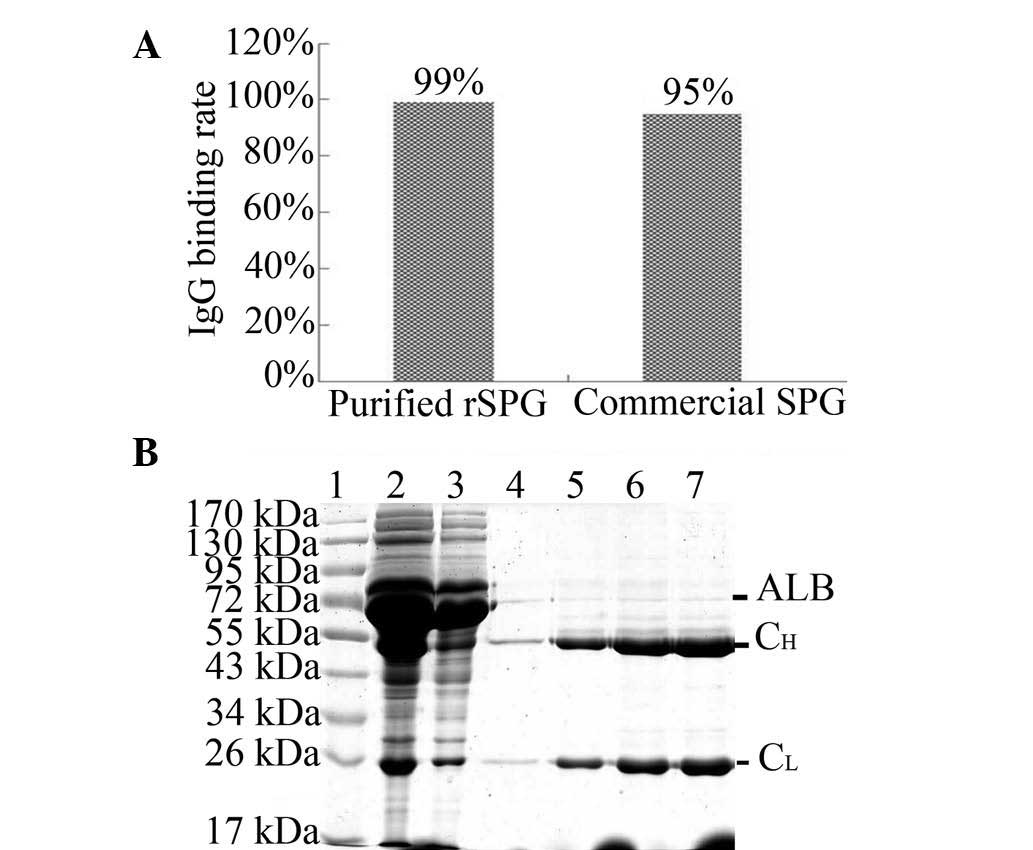 | Figure 1Functional comparison of the
immunoglobulin (Ig)G binding ability of the purified recombinant
streptococcal protein G (rSPG) and the commercial SPG. (A)
IgG-binding rate comparison of the purified rSPG to that of the
commercial SPG. (B) Binding of mouse IgG purified from mouse serum
with purified rSPG- and commercial SPG-Q Sepharose® Fast
Flow. Lane 1, Protein molecular weight markers; lane 2, mouse serum
prior to column loading; lane 3, flow-through fraction of mouse
serum; lane 4 and 6, 5, and 15 µl purified mouse IgG eluted
from commercial SPG-Q Sepharose® Fast Flow; lane 5 and
7, 5, and 15 µl purified mouse IgG eluted from purified
rSPG-Q Sepharose® Fast Flow. ALB, mouse serum albumin;
CH, heavy chain; CL, light chain. |
Identification of purified rSPG by
LC-MS/MS
During the early stages of the mass spectrometry
analysis, both the electrospray ionization (ESI) and atmospheric
pressure chemical ionization sources were evaluated. ESI was shown
to offer higher protein sensitivity, and was therefore chosen as
the ion source for the present study. Since the positive ion mode
produced higher intensity signals than the negative ion mode, the
positive ion mode was selected for the analysis of rSPG. The total
ion current (TIC) chromatogram represents the sum of the
intensities of the entire range of masses detected at each analysis
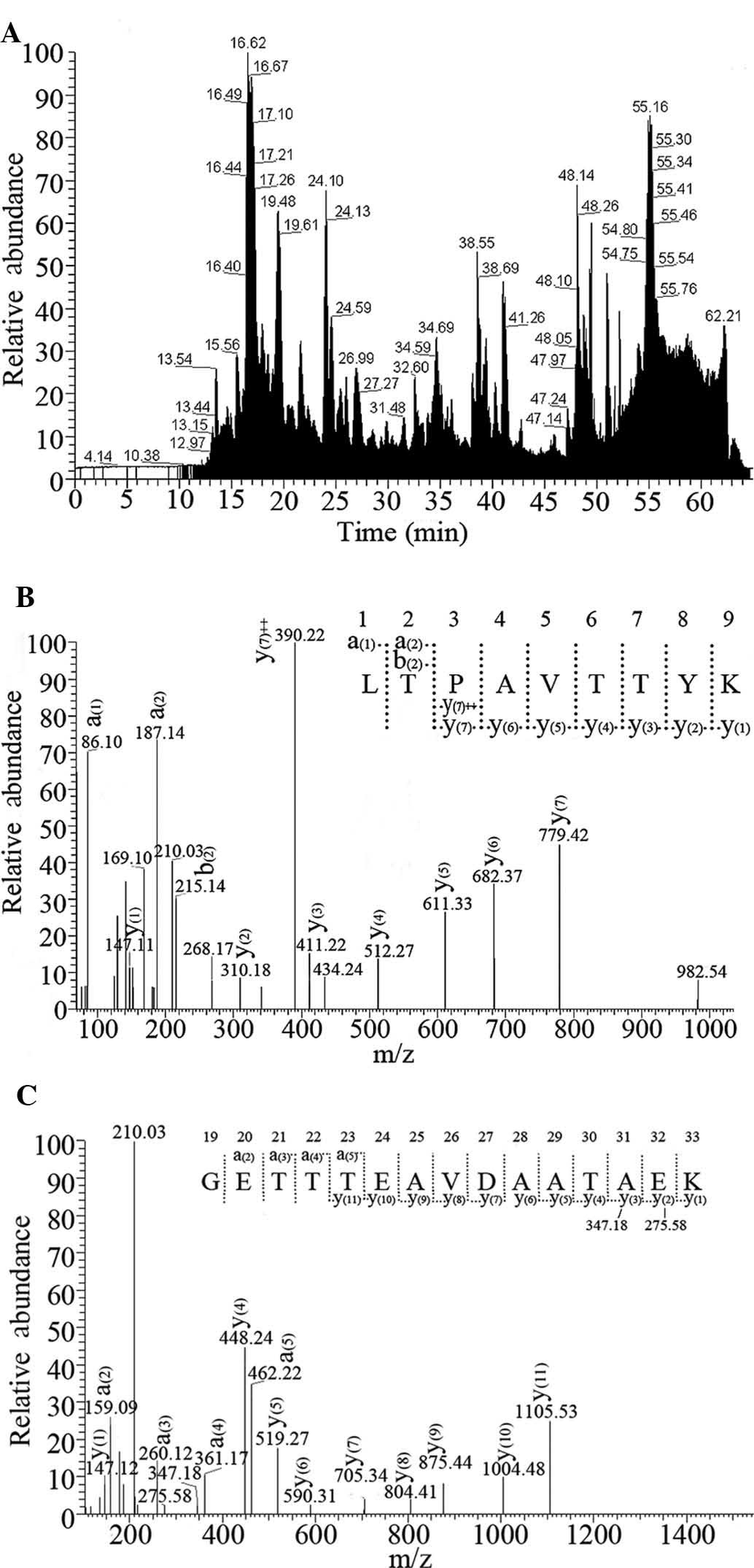
point. The purified rSPG TIC chromatographic peak demonstrates the
necessity of well distribution to achieve the ideal separation
effect (Fig. 2A). Each peptide ion
in the mass peptide map acted as the parent ion, and was collided
by inert gas with high velocity in order to cause a
collision-induced dissociation in the mass spectrometer chamber.
The polypeptide chain was broken in the amide bond forming various
ions, including a, b, c, and x, y, z ions.
The spectra in Fig. 2B
and C were obtained from the precursor at 18.5 min and 19.2
min, respectively. The 1–9 and 19–33 fragment ions spectra
indicated that the amino acid sequence was LTPAVTTYK and
GETTTEAVDAATAEK, respectively. The two ion spectra indicated that
the two peptide fragments matched the protein G from
Streptococcus sp. GX7805 as listed in the National Center
for Biotechnology Information (NCBI) database (http://www.ncbi.nlm.nih.gov/protein/CAA68489.1).
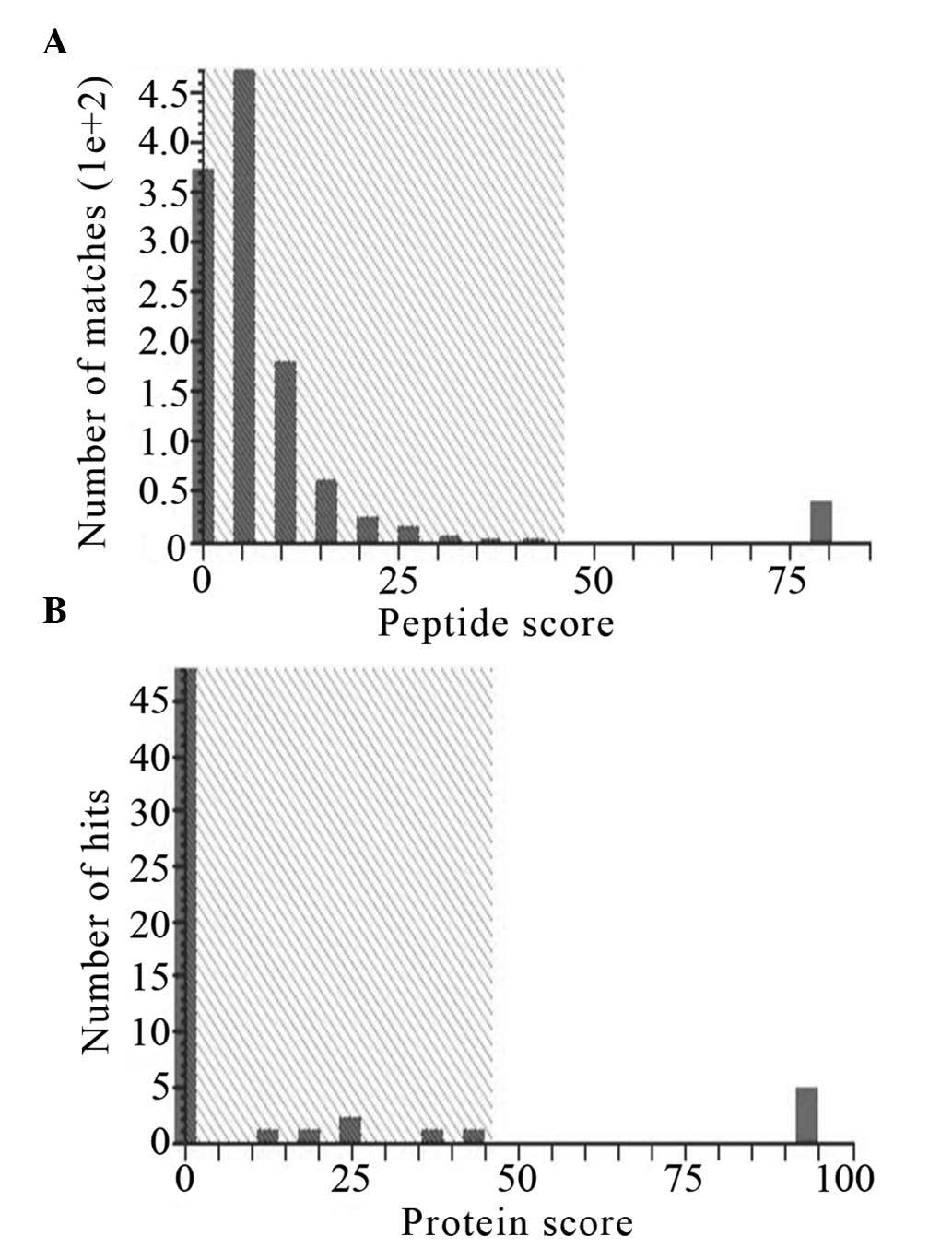
The ionic score was l g (P), where P is the
probability that the observed match is a random event. In the
present study, individual ion scores >46 indicated that the
peptide or protein sequence was identical or had extensive homology
(P<0.05), as compared with the NCBI protein, and rSPG exhibited
a peptide score of ~80 (Fig. 3A)
and a protein score of ~95 (Fig.
3B).
The purified rSPG in the present study was
successfully identified using the LC-MS/MS techniques described
above, and was matched to protein G from Streptococcus sp.
GX7805 as listed in the NCBI database.
In conclusion, the methods described in the present
study may prove useful for the overexpression of rSPG in E.
coli, and the purification of rSPG. In addition, the method may
provide an appropriate choice for large-scale commercial production
of rSPG. However, further research is required in order to
investigate the stability and sensitivity of the antibody and
purified rSPG labeling molecule-conjugated complex.
Acknowledgments
The authors thank Professor Xiulan Xin for her
valuable instructions and suggestions on the thesis as well as her
careful reading of the manuscript. The present study was supported
by a grant from the Program for Research Team in Beijing
Polytechnic.
References
|
1
|
Lequin RM: Enzyme immunoassay
(EIA)/enzyme-linked immunosorbent assay (ELISA). Clin Chem.
51:2415–2418. 2005. View Article : Google Scholar : PubMed/NCBI
|
|
2
|
Singhrao SK, Müller CT, Gilbert SJ, Duance
VC and Archer CW: An immunofluorescence method for postembedded
tissue in the acrylic resin Technovit 9100 New using fluorescein
isothiocyanate secondary detection. Microsc Res Tech. 72:501–506.
2009. View Article : Google Scholar : PubMed/NCBI
|
|
3
|
Harle DG, Baldo BA and Fisher MM:
Immunoassays employing substituted ammonium compounds other than
neuromuscular blocking drugs to increase the detection of IgE
antibodies to these drugs. Mol Immunol. 27:1039–1045. 1990.
View Article : Google Scholar : PubMed/NCBI
|
|
4
|
De Boer GF, Back W and Osterhaus ADME: An
ELISA for detection of antibodies against influenza A nucleoprotein
in humans and various animal species. Arch Virol. 115:47–61. 1990.
View Article : Google Scholar : PubMed/NCBI
|
|
5
|
Ebel GD, Dupuis AP II, Nicholas D, Young
D, Maffei J and Kramer LD: Detection by enzyme-linked immunosorbent
assay of antibodies to West Nile virus in birds. Emerg Infect Dis.
8:979–982. 2002. View Article : Google Scholar : PubMed/NCBI
|
|
6
|
Seiler BM, Yoon KJ, Andreasen CB, Block
SM, Marsden S and Blitvich BJ: Antibodies to influenza A virus (H1
and H3) in companion animals in Iowa, USA. Vet Rec. 167:705–707.
2010. View
Article : Google Scholar
|
|
7
|
Ding S, Yin H, Xu X, Liu G, Jiang S, Wang
W, Han X, Liu J, Niu G, Zhang X, et al: A cross-sectional survey of
severe fever with thrombocytopenia syndrome virus infection of
domestic animals in Laizhou city, Shandong Province, China. Jpn J
Infect Dis. 67:1–4. 2014. View Article : Google Scholar : PubMed/NCBI
|
|
8
|
Sidorin EV and Solov'eva TF: IgG-binding
proteins of bacteria. Biochemistry (Mosc). 76:295–308. 2011.
View Article : Google Scholar
|
|
9
|
Löfkvist T and Sjöquist J: Chemical and
serological analysis of antigen preparations from Staphylococcus
aureus. Acta Pathol Microbiol Scand. 56:295–304. 1962. View Article : Google Scholar
|
|
10
|
Forsgren A and Sjöquist J: 'Protein A'
from S. aureus I. Pseudo-immune reaction with human gamma-globulin.
J Immunol. 97:822–827. 1966.PubMed/NCBI
|
|
11
|
Björk I, Petersson BA and Sjöquist J: Some
physiochemical properties of protein A from Staphylococcus aureus.
Eur J Biochem. 29:579–584. 1972. View Article : Google Scholar : PubMed/NCBI
|
|
12
|
Graille M, Stura EA, Corper AL, Sutton BJ,
Taussig MJ, Charbonnier JB and Silverman GJ: Crystal structure of a
Staphylococcus aureus protein A domain complexed with the Fab
fragment of a human IgM antibody: Structural basis for recognition
of B-cell receptors and super antigen activity. Proc Natl Acad Sci
USA. 97:5399–5404. 2000. View Article : Google Scholar
|
|
13
|
Hao J, Xu L, He H, Du X and Jia L:
High-level expression of Staphylococcal Protein A in Pichia
pastoris and purification and characterization of the recombinant
protein. Protein Expr Purif. 90:178–185. 2013. View Article : Google Scholar : PubMed/NCBI
|
|
14
|
Kmiecik S and Kolinski A: Folding pathway
of the B1 domain of protein G explored by multiscale modeling.
Biophys J. 94:726–736. 2008. View Article : Google Scholar
|
|
15
|
Yee L and Blanch HW: Recombinant protein
expression in high cell density fed-batch cultures of Escherichia
coli. Biotechnology (NY). 10:1550–1556. 1992. View Article : Google Scholar
|
|
16
|
Björck L and Kronvall G: Purification and
some properties of Streptococcus protein G, a novel IgG-binding
reagent. J Immunol. 133:969–974. 1984.
|
|
17
|
Sjöbring U, Björck L and Kastern W:
Streptococcal protein G, gene structure and protein binding
properties. J Biol Chem. 266:399–405. 1991.
|
|
18
|
Aybay C: Differential binding
characteristics of protein G and protein A for Fc fragments of
papain-digested mouse IgG. Immunol Lett. 85:231–235. 2003.
View Article : Google Scholar : PubMed/NCBI
|
|
19
|
Riesenberg D and Guthke R:
High-cell-density cultivation of microorganisms. Appl Microbiol
Biotechnol. 51:422–430. 1999. View Article : Google Scholar : PubMed/NCBI
|
|
20
|
Zhang HC, Yang J, Yang GW, Wang XJ and Fan
HT: Production of recombinant protein G through high-density
fermentation of engineered bacteria as well as purification. Mol
Med Rep. 12:3132–3138. 2015.PubMed/NCBI
|