Spandidos Publications Logo
  • About
    • About Spandidos
    • Aims and Scopes
    • Abstracting and Indexing
    • Editorial Policies
    • Reprints and Permissions
    • Job Opportunities
    • Terms and Conditions
    • Contact
  • Journals
    • All Journals
    • Oncology Letters
      • Oncology Letters
      • Information for Authors
      • Editorial Policies
      • Editorial Board
      • Aims and Scope
      • Abstracting and Indexing
      • Bibliographic Information
      • Archive
    • International Journal of Oncology
      • International Journal of Oncology
      • Information for Authors
      • Editorial Policies
      • Editorial Board
      • Aims and Scope
      • Abstracting and Indexing
      • Bibliographic Information
      • Archive
    • Molecular and Clinical Oncology
      • Molecular and Clinical Oncology
      • Information for Authors
      • Editorial Policies
      • Editorial Board
      • Aims and Scope
      • Abstracting and Indexing
      • Bibliographic Information
      • Archive
    • Experimental and Therapeutic Medicine
      • Experimental and Therapeutic Medicine
      • Information for Authors
      • Editorial Policies
      • Editorial Board
      • Aims and Scope
      • Abstracting and Indexing
      • Bibliographic Information
      • Archive
    • International Journal of Molecular Medicine
      • International Journal of Molecular Medicine
      • Information for Authors
      • Editorial Policies
      • Editorial Board
      • Aims and Scope
      • Abstracting and Indexing
      • Bibliographic Information
      • Archive
    • Biomedical Reports
      • Biomedical Reports
      • Information for Authors
      • Editorial Policies
      • Editorial Board
      • Aims and Scope
      • Abstracting and Indexing
      • Bibliographic Information
      • Archive
    • Oncology Reports
      • Oncology Reports
      • Information for Authors
      • Editorial Policies
      • Editorial Board
      • Aims and Scope
      • Abstracting and Indexing
      • Bibliographic Information
      • Archive
    • Molecular Medicine Reports
      • Molecular Medicine Reports
      • Information for Authors
      • Editorial Policies
      • Editorial Board
      • Aims and Scope
      • Abstracting and Indexing
      • Bibliographic Information
      • Archive
    • World Academy of Sciences Journal
      • World Academy of Sciences Journal
      • Information for Authors
      • Editorial Policies
      • Editorial Board
      • Aims and Scope
      • Abstracting and Indexing
      • Bibliographic Information
      • Archive
    • International Journal of Functional Nutrition
      • International Journal of Functional Nutrition
      • Information for Authors
      • Editorial Policies
      • Editorial Board
      • Aims and Scope
      • Abstracting and Indexing
      • Bibliographic Information
      • Archive
    • International Journal of Epigenetics
      • International Journal of Epigenetics
      • Information for Authors
      • Editorial Policies
      • Editorial Board
      • Aims and Scope
      • Abstracting and Indexing
      • Bibliographic Information
      • Archive
    • Medicine International
      • Medicine International
      • Information for Authors
      • Editorial Policies
      • Editorial Board
      • Aims and Scope
      • Abstracting and Indexing
      • Bibliographic Information
      • Archive
  • Articles
  • Information
    • Information for Authors
    • Information for Reviewers
    • Information for Librarians
    • Information for Advertisers
    • Conferences
  • Language Editing
Spandidos Publications Logo
  • About
    • About Spandidos
    • Aims and Scopes
    • Abstracting and Indexing
    • Editorial Policies
    • Reprints and Permissions
    • Job Opportunities
    • Terms and Conditions
    • Contact
  • Journals
    • All Journals
    • Biomedical Reports
      • Information for Authors
      • Editorial Policies
      • Editorial Board
      • Aims and Scope
      • Abstracting and Indexing
      • Bibliographic Information
      • Archive
    • Experimental and Therapeutic Medicine
      • Information for Authors
      • Editorial Policies
      • Editorial Board
      • Aims and Scope
      • Abstracting and Indexing
      • Bibliographic Information
      • Archive
    • International Journal of Epigenetics
      • Information for Authors
      • Editorial Policies
      • Editorial Board
      • Aims and Scope
      • Abstracting and Indexing
      • Bibliographic Information
      • Archive
    • International Journal of Functional Nutrition
      • Information for Authors
      • Editorial Policies
      • Editorial Board
      • Aims and Scope
      • Abstracting and Indexing
      • Bibliographic Information
      • Archive
    • International Journal of Molecular Medicine
      • Information for Authors
      • Editorial Policies
      • Editorial Board
      • Aims and Scope
      • Abstracting and Indexing
      • Bibliographic Information
      • Archive
    • International Journal of Oncology
      • Information for Authors
      • Editorial Policies
      • Editorial Board
      • Aims and Scope
      • Abstracting and Indexing
      • Bibliographic Information
      • Archive
    • Medicine International
      • Information for Authors
      • Editorial Policies
      • Editorial Board
      • Aims and Scope
      • Abstracting and Indexing
      • Bibliographic Information
      • Archive
    • Molecular and Clinical Oncology
      • Information for Authors
      • Editorial Policies
      • Editorial Board
      • Aims and Scope
      • Abstracting and Indexing
      • Bibliographic Information
      • Archive
    • Molecular Medicine Reports
      • Information for Authors
      • Editorial Policies
      • Editorial Board
      • Aims and Scope
      • Abstracting and Indexing
      • Bibliographic Information
      • Archive
    • Oncology Letters
      • Information for Authors
      • Editorial Policies
      • Editorial Board
      • Aims and Scope
      • Abstracting and Indexing
      • Bibliographic Information
      • Archive
    • Oncology Reports
      • Information for Authors
      • Editorial Policies
      • Editorial Board
      • Aims and Scope
      • Abstracting and Indexing
      • Bibliographic Information
      • Archive
    • World Academy of Sciences Journal
      • Information for Authors
      • Editorial Policies
      • Editorial Board
      • Aims and Scope
      • Abstracting and Indexing
      • Bibliographic Information
      • Archive
  • Articles
  • Information
    • For Authors
    • For Reviewers
    • For Librarians
    • For Advertisers
    • Conferences
  • Language Editing
Login Register Submit
  • This site uses cookies
  • You can change your cookie settings at any time by following the instructions in our Cookie Policy. To find out more, you may read our Privacy Policy.

    I agree
Search articles by DOI, keyword, author or affiliation
Search
Advanced Search
presentation
Molecular Medicine Reports
Join Editorial Board Propose a Special Issue
Print ISSN: 1791-2997 Online ISSN: 1791-3004
Journal Cover
December-2015 Volume 12 Issue 6

Full Size Image

Sign up for eToc alerts
Recommend to Library

Journals

International Journal of Molecular Medicine

International Journal of Molecular Medicine

International Journal of Molecular Medicine is an international journal devoted to molecular mechanisms of human disease.

International Journal of Oncology

International Journal of Oncology

International Journal of Oncology is an international journal devoted to oncology research and cancer treatment.

Molecular Medicine Reports

Molecular Medicine Reports

Covers molecular medicine topics such as pharmacology, pathology, genetics, neuroscience, infectious diseases, molecular cardiology, and molecular surgery.

Oncology Reports

Oncology Reports

Oncology Reports is an international journal devoted to fundamental and applied research in Oncology.

Experimental and Therapeutic Medicine

Experimental and Therapeutic Medicine

Experimental and Therapeutic Medicine is an international journal devoted to laboratory and clinical medicine.

Oncology Letters

Oncology Letters

Oncology Letters is an international journal devoted to Experimental and Clinical Oncology.

Biomedical Reports

Biomedical Reports

Explores a wide range of biological and medical fields, including pharmacology, genetics, microbiology, neuroscience, and molecular cardiology.

Molecular and Clinical Oncology

Molecular and Clinical Oncology

International journal addressing all aspects of oncology research, from tumorigenesis and oncogenes to chemotherapy and metastasis.

World Academy of Sciences Journal

World Academy of Sciences Journal

Multidisciplinary open-access journal spanning biochemistry, genetics, neuroscience, environmental health, and synthetic biology.

International Journal of Functional Nutrition

International Journal of Functional Nutrition

Open-access journal combining biochemistry, pharmacology, immunology, and genetics to advance health through functional nutrition.

International Journal of Epigenetics

International Journal of Epigenetics

Publishes open-access research on using epigenetics to advance understanding and treatment of human disease.

Medicine International

Medicine International

An International Open Access Journal Devoted to General Medicine.

Journal Cover
December-2015 Volume 12 Issue 6

Full Size Image

Sign up for eToc alerts
Recommend to Library

  • Article
  • Citations
    • Cite This Article
    • Download Citation
    • Create Citation Alert
    • Remove Citation Alert
    • Cited By
  • Similar Articles
    • Related Articles (in Spandidos Publications)
    • Similar Articles (Google Scholar)
    • Similar Articles (PubMed)
  • Download PDF
  • Download XML
  • View XML
Article

Determination of the mechanism of action of repetitive halothane exposure on rat brain tissues using a combined method of microarray gene expression profiling and bioinformatics analysis

  • Authors:
    • Jiansheng Wang
    • Xiaojun Yang
    • Huan Xiao
    • Jianqiang Kong
    • Miao Bing
  • View Affiliations / Copyright

    Affiliations: Department of Anesthesiology, Shanghai Baoshan District Integrated Traditional and Western Medicine Hospital, Shanghai 201900, P.R. China
  • Pages: 8071-8076
    |
    Published online on: October 21, 2015
       https://doi.org/10.3892/mmr.2015.4462
  • Expand metrics +
Metrics: Total Views: 0 (Spandidos Publications: | PMC Statistics: )
Metrics: Total PDF Downloads: 0 (Spandidos Publications: | PMC Statistics: )
Cited By (CrossRef): 0 citations Loading Articles...

This article is mentioned in:


Abstract

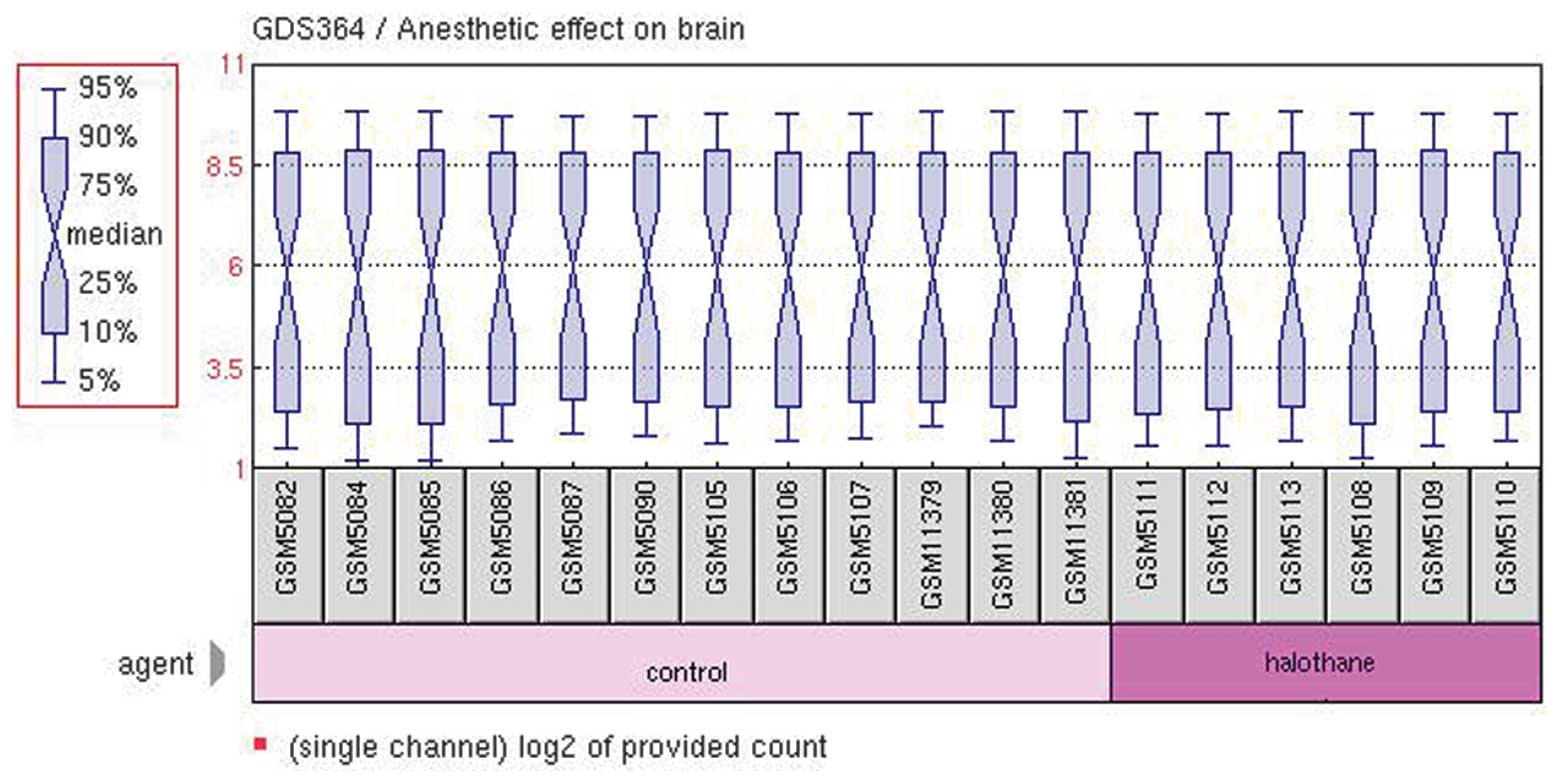
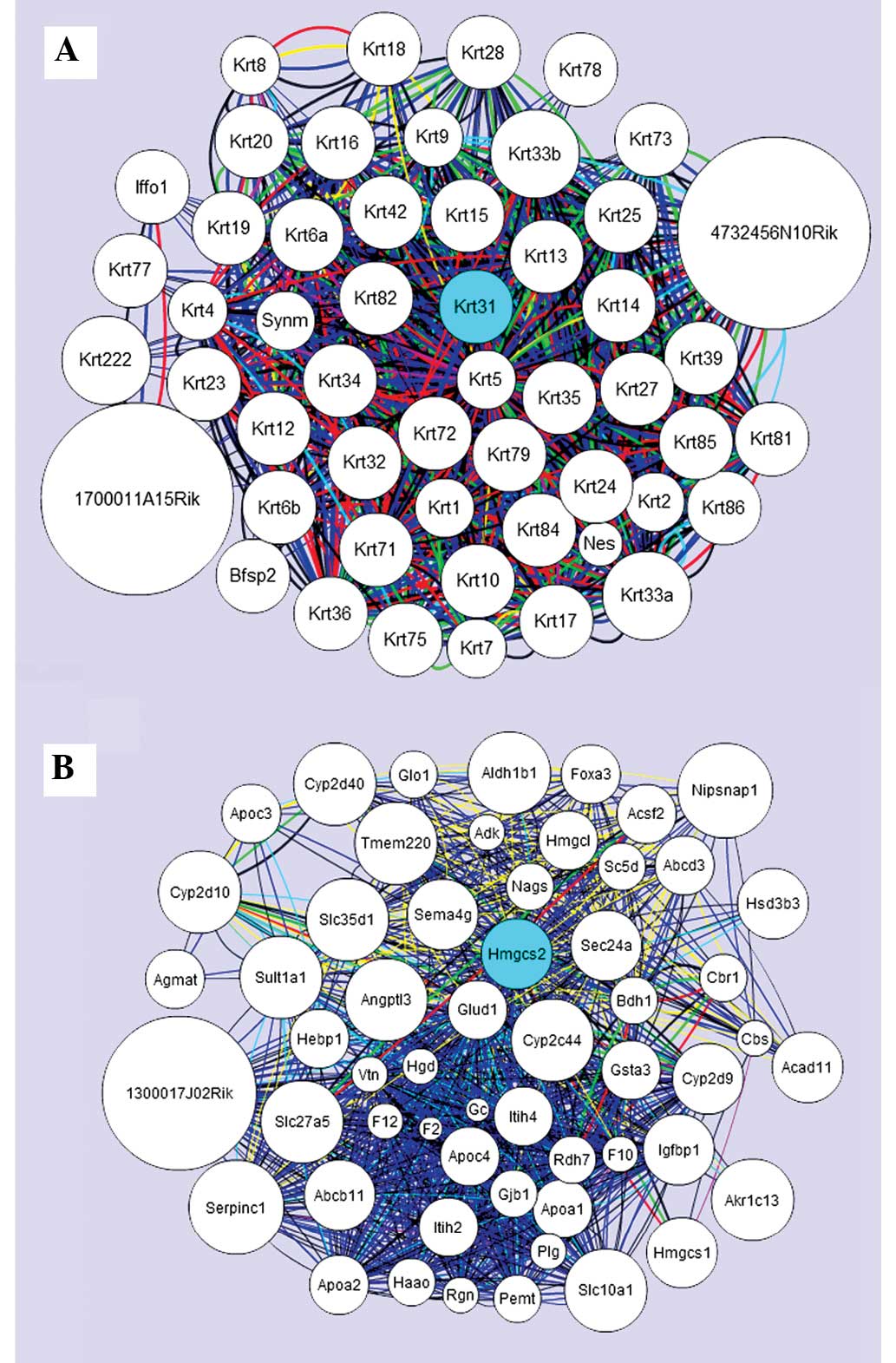
The present study aimed to investigate the gene expression profiles of rats brain tissues treated with halothane compared with untreated controls to improve current understanding of the mechanism of action of the inhaled anesthetic. The GSE357 gene expression profile was dowloaded from the Gene Expression Omnibus database, and included six gene chips of samples repeatedly exposed to halothane and 12 gene chips of untreated controls. The differentially expressed genes (DEGs) between these two groups were identified using the Limma package in R language. Subsequently, the Database for Annotation, Visualization and Integrated Discovery was used to annotate the function of these DEGs. In addition, the most significantly upregulated gene and downregulated gene were annotated, to reveal the functional interactions with other associated genes, in FuncBase database. A total of 44 DEGs were obtained between The control and halothane exposure samples. Following Gene Ontology functional classification, these DEGs were found to be involved predominantly in the circulatory system, regulation of cell proliferation and response to endogenous stimulus and corticosteroid stimulus processes. KRT31 and HMGCS2, which were identified as the most significantly downregulated and upregulated DEGs, respectively, were associated with the lipid metabolic process and T cell activation, respectively. These results provided a basis for the development of improved inhalational anesthetics with minimal side effects and are essential for optimization of inhaled anesthetic techniques for advanced surgical procedures.
View Figures

Figure 1

Figure 2

View References

1 

Weiser TG, Regenbogen SE, Thompson KD, et al: An estimation of the global volume of surgery: a modelling strategy based on available data. Lancet. 372:139–144. 2008. View Article : Google Scholar : PubMed/NCBI

2 

Eger EI 2nd and Sonner JM: Anaesthesia defined (gentlemen,this is no humbug). Best Pract Res Clin Anaesthesiol. 20:23–29. 2006. View Article : Google Scholar : PubMed/NCBI

3 

Richter J, Landau EM and Cohen S: The action of volatile anesthetics and convulsants on synaptic transmission: A unified concept. Mol Pharmacol. 13:548–559. 1977.PubMed/NCBI

4 

Alkire MT, Pomfrett CJ, Haier RJ, et al: Functional brain imaging during anesthesia in humans: effects of halothane on global and regional cerebral glucose metabolism. Anesthesiology. 90:701–709. 1999. View Article : Google Scholar : PubMed/NCBI

5 

Matsumoto N, Koizumi M and Sugai M: Hepatolobectomy-induced depression of hepatic circulation and metabolism in the dog is counteracted by isoflurane, but not by halothane. Acta Anaesthesiol Scand. 43:850–854. 1999. View Article : Google Scholar : PubMed/NCBI

6 

Harrfeldt HP: Acute liver failure following repeated halothane anesthesia-related to an accident covered by industrial insurance. Monatsschr Unfallheilkd Versicher Versorg Verkehrsmed. 72:3171969.In German.

7 

Lo SK, Wendon J, Mieli-Vergani G and Williams R: Halothane-induced acute liver failure: continuing occurrence and use of liver transplantation. Eur J Gastroenterol Hepatol. 10:635–639. 1998.PubMed/NCBI

8 

Wessler S: Halothane and liver failure. JAMA. 213:1291970. View Article : Google Scholar : PubMed/NCBI

9 

Hemmings HC Jr, Akabas MH, Goldstein PA, Trudell JR, Orser BA and Harrison NL: Emerging molecular mechanisms of general anesthetic action. Trends Pharmacol Sci. 26:503–510. 2005. View Article : Google Scholar : PubMed/NCBI

10 

Nishikawa K, Jenkins A, Paraskevakis I and Harrison NL: Volatile anesthetic actions on the GABAA receptors: contrasting effects of alpha 1 (S270) and beta 2 (N265) point mutations. Neuropharmacology. 42:337–345. 2002. View Article : Google Scholar : PubMed/NCBI

11 

Gomez RS, Guatimosim C and Gomez MV: Mechanism of action of volatile anesthetics: role of protein kinase C. Cell Mol Neurobiol. 23:877–885. 2003. View Article : Google Scholar

12 

Hemmings HC Jr and Adamo AI: Effects of halothane and propofol on purified brain protein kinase C activation. Anesthesiology. 81:147–155. 1994. View Article : Google Scholar : PubMed/NCBI

13 

Maingret F, Patel AJ, Lesage F, Lazdunski M and Honoré E: Mechano- or acid stimulation, two interactive modes of activation of the TREK-1 potassium channel. J Biol Chem. 274:26691–26696. 1999. View Article : Google Scholar : PubMed/NCBI

14 

Eckenhoff RG and Shuman H: Localization of volatile anesthetic molecules at the subcellular and molecular level. Ann N Y Acad Sci. 625:755–756. 1991. View Article : Google Scholar : PubMed/NCBI

15 

Xi J, Liu R, Asbury GR, Eckenhoff MF and Eckenhoff RG: Inhalational anesthetic-binding proteins in rat neuronal membranes. J Biol Chem. 279:19628–19633. 2004. View Article : Google Scholar : PubMed/NCBI

16 

Chepovetsky J, Kalir T and Weiderpass E: Clinical applicability of microarray technology in the diagnosis, prognostic stratification, treatment and clinical surveillance of cervical adenocarcinoma. Curr Pharm Des. 19:1425–1429. 2013.

17 

Pan JZ, Wei H, Hecker JG, Tobias JW, Eckenhoff RG and Eckenhoff MF: Rat brain DNA transcript profile of halothane and isofurane exposure. Pharmacogenet Genomics. 16:171–182. 2006.PubMed/NCBI

18 

Xia X, Mcclelland M and Wang Y: WebArray: an online platform for microarray data analysis. BMC Bioinformatics. 6:3062005. View Article : Google Scholar : PubMed/NCBI

19 

Fernandez P, Soria M, Blesa D, et al: Development, characterization and experimental validation of a cultivated sunfower (Helianthus annuus L.) gene expression oligonucleotide microarray. PLoS One. 7:e458992012. View Article : Google Scholar

20 

Ashburner M, Ball CA, Blake JA, et al: Gene ontology: tool for the unification of biology. The Gene Ontology Consortium. Nat Genet. 25:25–29. 2000. View Article : Google Scholar : PubMed/NCBI

21 

Brown DL and Brock-Utne JG: The first structure-function approach to drug design in anaesthesia. Dr David S Savage and pancuronium bromide. Anaesthesia. 52:1202–1204. 1997. View Article : Google Scholar

22 

Quentien MH, Delemer B, Papadimitriou DT, et al: Deficit in anterior pituitary function and variable immune deficiency (DAVID) in children presenting with adrenocorticotropin deficiency and severe infections. J Clin Endocrinol Metab. 97:E121–E128. 2012. View Article : Google Scholar

23 

Beaver JE, Tasan M, Gibbons FD, Tian W, Hughes TR and Roth FP: FuncBase: a resource for quantitative gene function annotation. Bioinformatics. 26:1806–1807. 2010. View Article : Google Scholar : PubMed/NCBI

24 

Shakouri P, Ordys A and Askari MR: Adaptive cruise control with stop & go function using the state-dependent nonlinear model predictive control approach. ISA Trans. 51:622–631. 2012. View Article : Google Scholar : PubMed/NCBI

25 

Wang J, Zhou X, Zhu J, et al: GO-function: deriving biologically relevant functions from statistically significant functions. Brief Bioinform. 13:216–227. 2012. View Article : Google Scholar

26 

Wright J, Morales MM, Sousa-Menzes J, et al: Transcriptional adaptation to Clcn5 knockout in proximal tubules of mouse kidney. Physiol Genomics. 33:341–354. 2008. View Article : Google Scholar : PubMed/NCBI

27 

Medzhitov R and Janeway C Jr: Innate immune recognition: mechanisms and pathways. Immunol Rev. 173:89–97. 2000. View Article : Google Scholar : PubMed/NCBI

28 

Park JS, Svetkauskaite D, He Q, et al: Involvement of Toll-like receptors 2 and 4 in cellular activation by high mobility group box 1 protein. J Biol Chem. 279:7370–7377. 2004. View Article : Google Scholar

29 

Dugan CM, Fullerton AM, Roth RA and Ganey PE: Natural killer cells mediate severe liver injury in a murine model of halothane hepatitis. Toxicol Sci. 120:507–518. 2011. View Article : Google Scholar : PubMed/NCBI

30 

Scaffidi P, Misteli T and Bianchi ME: Release of chromatin protein HMGB1 by necrotic cells triggers inflammation. Nature. 418:191–195. 2002. View Article : Google Scholar : PubMed/NCBI

31 

Nyirenda MJ, Lind say RS, Kenyon CJ, Burchell A and Seckl JR: Glucocorticoid exposure in late gestation permanently programs rat hepatic phosphoenolpyruvate carboxykinase and glucocorticoid receptor expression and causes glucose intolerance in adult offspring. J Clin Invest. 101:2174–2181. 1998. View Article : Google Scholar : PubMed/NCBI

32 

Agresti A, Scaffidi P, Riva A, Caiolfa VR and Bianchi ME: GR and HMGB1 interact only within chromatin and influence each other's residence time. Mol Cell. 18:109–121. 2005. View Article : Google Scholar : PubMed/NCBI

33 

Loranger A, Duclos S, Grenier A, et al: Simple epithelium keratins are required for maintenance of hepatocyte integrity. Am J Pathol. 151:1673–1683. 1997.PubMed/NCBI

34 

Asch HL, Mayhew E, Lazo RO and Asch BB: Lipids covalently bound to keratins of mouse mammary epithelial cells. Biochem Mol Biol Int. 29:1161–1169. 1993.PubMed/NCBI

Related Articles

  • Abstract
  • View
  • Download
  • Twitter
Copy and paste a formatted citation
Spandidos Publications style
Wang J, Yang X, Xiao H, Kong J and Bing M: Determination of the mechanism of action of repetitive halothane exposure on rat brain tissues using a combined method of microarray gene expression profiling and bioinformatics analysis. Mol Med Rep 12: 8071-8076, 2015.
APA
Wang, J., Yang, X., Xiao, H., Kong, J., & Bing, M. (2015). Determination of the mechanism of action of repetitive halothane exposure on rat brain tissues using a combined method of microarray gene expression profiling and bioinformatics analysis. Molecular Medicine Reports, 12, 8071-8076. https://doi.org/10.3892/mmr.2015.4462
MLA
Wang, J., Yang, X., Xiao, H., Kong, J., Bing, M."Determination of the mechanism of action of repetitive halothane exposure on rat brain tissues using a combined method of microarray gene expression profiling and bioinformatics analysis". Molecular Medicine Reports 12.6 (2015): 8071-8076.
Chicago
Wang, J., Yang, X., Xiao, H., Kong, J., Bing, M."Determination of the mechanism of action of repetitive halothane exposure on rat brain tissues using a combined method of microarray gene expression profiling and bioinformatics analysis". Molecular Medicine Reports 12, no. 6 (2015): 8071-8076. https://doi.org/10.3892/mmr.2015.4462
Copy and paste a formatted citation
x
Spandidos Publications style
Wang J, Yang X, Xiao H, Kong J and Bing M: Determination of the mechanism of action of repetitive halothane exposure on rat brain tissues using a combined method of microarray gene expression profiling and bioinformatics analysis. Mol Med Rep 12: 8071-8076, 2015.
APA
Wang, J., Yang, X., Xiao, H., Kong, J., & Bing, M. (2015). Determination of the mechanism of action of repetitive halothane exposure on rat brain tissues using a combined method of microarray gene expression profiling and bioinformatics analysis. Molecular Medicine Reports, 12, 8071-8076. https://doi.org/10.3892/mmr.2015.4462
MLA
Wang, J., Yang, X., Xiao, H., Kong, J., Bing, M."Determination of the mechanism of action of repetitive halothane exposure on rat brain tissues using a combined method of microarray gene expression profiling and bioinformatics analysis". Molecular Medicine Reports 12.6 (2015): 8071-8076.
Chicago
Wang, J., Yang, X., Xiao, H., Kong, J., Bing, M."Determination of the mechanism of action of repetitive halothane exposure on rat brain tissues using a combined method of microarray gene expression profiling and bioinformatics analysis". Molecular Medicine Reports 12, no. 6 (2015): 8071-8076. https://doi.org/10.3892/mmr.2015.4462
Follow us
  • Twitter
  • LinkedIn
  • Facebook
About
  • Spandidos Publications
  • Careers
  • Cookie Policy
  • Privacy Policy
How can we help?
  • Help
  • Live Chat
  • Contact
  • Email to our Support Team