International Journal of Molecular Medicine is an international journal devoted to molecular mechanisms of human disease.
International Journal of Oncology is an international journal devoted to oncology research and cancer treatment.
Covers molecular medicine topics such as pharmacology, pathology, genetics, neuroscience, infectious diseases, molecular cardiology, and molecular surgery.
Oncology Reports is an international journal devoted to fundamental and applied research in Oncology.
Experimental and Therapeutic Medicine is an international journal devoted to laboratory and clinical medicine.
Oncology Letters is an international journal devoted to Experimental and Clinical Oncology.
Explores a wide range of biological and medical fields, including pharmacology, genetics, microbiology, neuroscience, and molecular cardiology.
International journal addressing all aspects of oncology research, from tumorigenesis and oncogenes to chemotherapy and metastasis.
Multidisciplinary open-access journal spanning biochemistry, genetics, neuroscience, environmental health, and synthetic biology.
Open-access journal combining biochemistry, pharmacology, immunology, and genetics to advance health through functional nutrition.
Publishes open-access research on using epigenetics to advance understanding and treatment of human disease.
An International Open Access Journal Devoted to General Medicine.
Mol Med Rep 12:[Related article:] 8041–8047, 2015; DOI: 10.3892/mmr.2015.4459
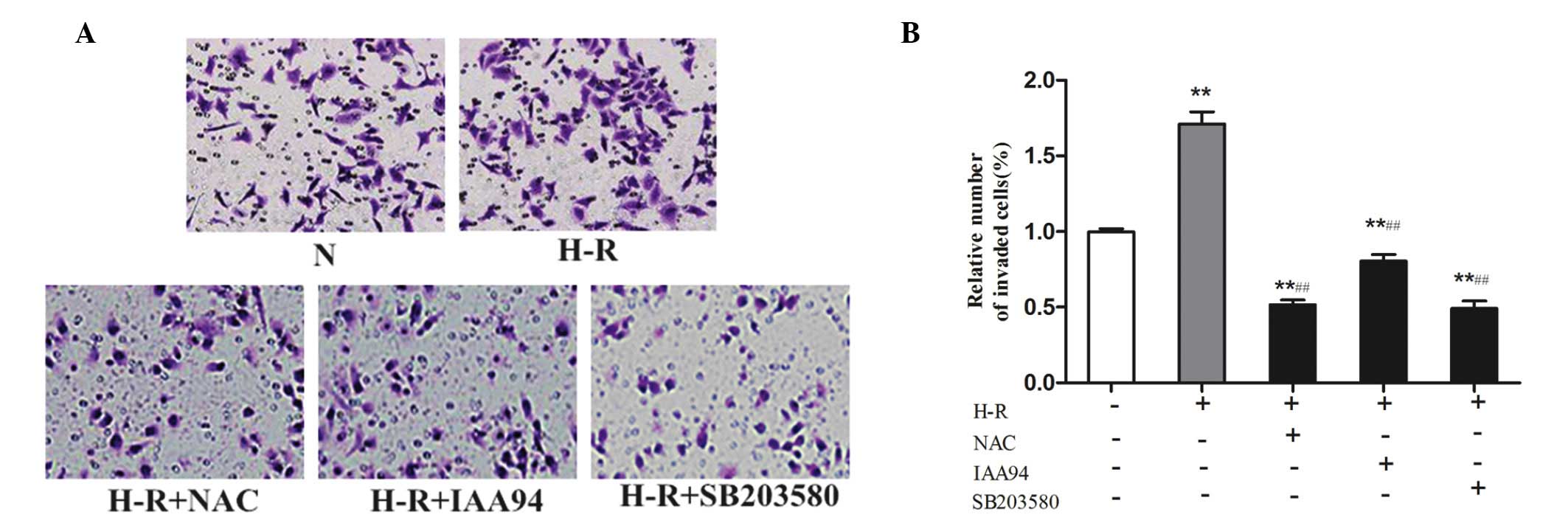
Following the publication of this article, an interested reader drew to our attention anomalies associated with the presentation of Fig. 4A. In the original presentation of the Figure, different representations of the same photomicrograph were inadvertently used for the panels labelled 'N', 'H-R', 'H-R + NAC' and 'H-R + SB203580'. This error arose as a consequence of an incorrect ordering of our original image numbers. A corrected version of Fig. 4A is provided below, featuring the appropriate data for each of the five panels listed above. This Figure was intended to show how, compared with the normoxic control group, the invasiveness of the SGC-7901 gastric cancer cells was markedly increased under hypoxia-reoxygenation (H-R) conditions, although pretreatment with N-acetyl cysteine (NAC; 30 mmol/l) or indanyloxyacetic acid 94 (IAA-94; 40 μmol/l), inhibited the invasiveness resulting from H-R exposure. Similarly, treatment with the inhibitor of p38 mitogen-activated protein kinase, SB203580 (10 μmol/l), also inhibited the cell invasiveness induced under the H-R conditions. We sincerely apologize for this mistake, and thank the reader of our article who drew this matter to our attention. Furthermore, we regret any inconvenience this mistake has caused.