Introduction
Atrial fibrillation (AF), which is the most common
type of arrhythmia, is characterized by an irregular and rapid
heartbeat. AF has strong associations with other cardiovascular
diseases, including heart failure, coronary artery disease,
valvular heart disease, diabetes mellitus, and hypertension
(1). The prevalence of AF within a
population increases with age, and 8% of people over 80 years old
have AF (2). AF accounts for 1/3
of hospital admissions for cardiac rhythm disorders, and the rate
of admissions for AF has risen in recent years (3).
The molecular mechanisms underlying AF-associated
cardiovascular risk factors have gained attention in recent years,
since a clear understanding of these mechanisms is essential for
further AF management. Regulation of gene expression by microRNAs
(miRNAs) has also garnered much attention. miRNAs belong to a class
of endogenous small regulatory RNA molecules, which target mRNAs
and trigger either translational suppression or mRNA degradation
(4). Abnormal expression of
several miRNAs has been reported to be associated with various
types of disease, including AF (5). Luo et al (6) demonstrated that miR-26 family members
were significantly downregulated in left atrial appendages from a
canine model of AF (miR-26a), and in right atrial appendages from
patients with AF (miR-26a and miR-26b). Gene expression profiling
has also been used to investigate various types of disease, and a
range of gene signatures have been identified using DNA chips
(7). Chen et al (7) identified 31 differentially expressed
genes, which were associated with transcriptional regulation,
signal transduction, and structural components, in a porcine model
of AF using a low-density cDNA array. This study indicated that
four and a half LIM domains 1 and cardiac ankyrin repeat protein
may have important regulatory roles in AF activation.
miRNAs, as important regulators of mRNAs, are
excellent biomarkers for disease development. mRNA and miRNA
markers always function through relationship networks. It has
previously been reported that miRNA-1 levels are markedly reduced
in human AF, which may contribute to upregulation of Kir2.1
subunits, leading to increased cardiac inward-rectifier potassium
current (IK1) (8).
Furthermore, miR-26 has been suggested as a potentially important
regulator of potassium channel, inwardly rectifying subfamily J,
member 2 gene expression and, via IK1, a determinant of
AF susceptibility (6).
The present study aimed to screen the differentially
expressed miRNAs and genes (DEGs) in AF tissues compared with
control samples, using expression profile data downloaded from an
online database (GSE28954 and GSE2240). In addition, a regulatory
network was constructed using Cytoscape and a functional analysis
of miRNA-targeted genes was performed. The results of the present
study may help elucidate the mechanisms underlying AF pathogenesis
and contribute to the improvement of AF treatment.
Materials and methods
Datasets
A dataset containing mRNA gene expression profiles
for 10 patients with AF and 10 control samples (9,10)
was downloaded from the Gene Expression Omnibus (GEO) deposited on
the public National Center for Biotechnology Information database
(accession number: GSE2240) (http://www.ncbi.nlm.nih.gov/geo/). U133A and U133B
microarray chips (Affymetrix, Inc., Santa Clara, CA, USA), together
representing 44,928 probe sets, were used to analyze each human
heart sample. A dataset containing miRNA expression profiles for 10
patients with AF and 5 healthy control samples (11) was downloaded from the GEO
(accession number: GSE28954). miRNA expression profiling was
conducted using the 15 human samples (10 AF and 5 healthy controls)
using microarrays covering whole miRNAs from Agilent Technologies
(Human miRNA Microarrays: G4470B, cat. no. 019118 and V3, cat. no.
021827; Santa Clara, CA, USA). According to the original data, all
studies were approved by the appropriate Human Ethics Committees
and informed consent was obtained from all of the patients.
Data processing and significance
analysis
The raw miRNA and mRNA microarray data of all AF and
control samples were normalized simultaneously using the robust
multiarray average (RMA) method (12), implemented in R/Bioconductor
project (https://www.bioconductor.org/). DEGs between AF and
control samples were calculated using the significance analysis of
microarray (SAM) method (13).
Furthermore, each miRNA expression comparison was tested between AF
patients and healthy controls using Student's t-test (14), and raw P-values were adjusted using
the Benjamini-Hochberg method (15). Fold changes between the two groups
were also calculated. A false discovery rate (FDR)<0.05 from
Student's t-test, and P<0.05 from SAM were used to identify
differentially expressed miRNAs and DEGs.
Hierarchical cluster analysis of selected
miRNAs and genes
The hierarchical cluster analysis of differentially
expressed miRNAs was performed using CLUSTER3.0 (16), and the hierarchical clustering
heat-map was visualized by TreeView (17).
Identification of potential target genes
of miRNAs
The candidate target genes of the identified miRNAs
were predicted using miRecords (18) (http://mirecords.biolead.org/; no longer accessible)
and TarBase (19) (http://diana.imis.athena-innovation.gr/DianaTools/index.php?r=tarbase/index/).
The miRNAs differentially expressed between AF patients and healthy
controls were searched for in the miRecords database and TarBase,
which contains validated miRNA-target interactions. In addition,
the probability of a miRNA-target interaction existing between
differentially expressed miRNAs and DEGs was predicted by miRecords
(score ≥50, energy ≤−20). The untranslated region (UTR) location
was also predicted.
Construction of a miRNA-target
network
miRNAs regulate target gene expression via mRNA
degradation or translational inhibition (20,21).
The expression of miRNA-targeted genes that are regulated by mRNA
degradation are negatively correlated with the expression of miRNA
regulators. Therefore, a miRNA-mRNA regulatory network was
constructed containing the paired miRNA-mRNA expression profiles,
and the putative target genes of miRNAs were predicted. Predictive
and validated miRNA-mRNA pairs were extracted from the miRecords
database and TarBase, and only the miRNA-mRNA pairs predicted by
both miRe-cords database and TarBase were retained. Subsequently, a
miRNA-mRNA regulatory network was constructed via Cytoscape
(22).
Functional analysis of targeted genes
from the network
To obtain a better understanding of the biological
function of miRNAs and their target genes in AF, a functional
analysis of the miRNA-targeted genes was carried out using the
Database for Annotation, Visualization and Integrated Discovery
(23) (https://david.ncifcrf.gov/). FDR<0.05 was set as
the cut-off criterion.
Results
Differentially expressed miRNAs and DEGs,
and cluster analysis
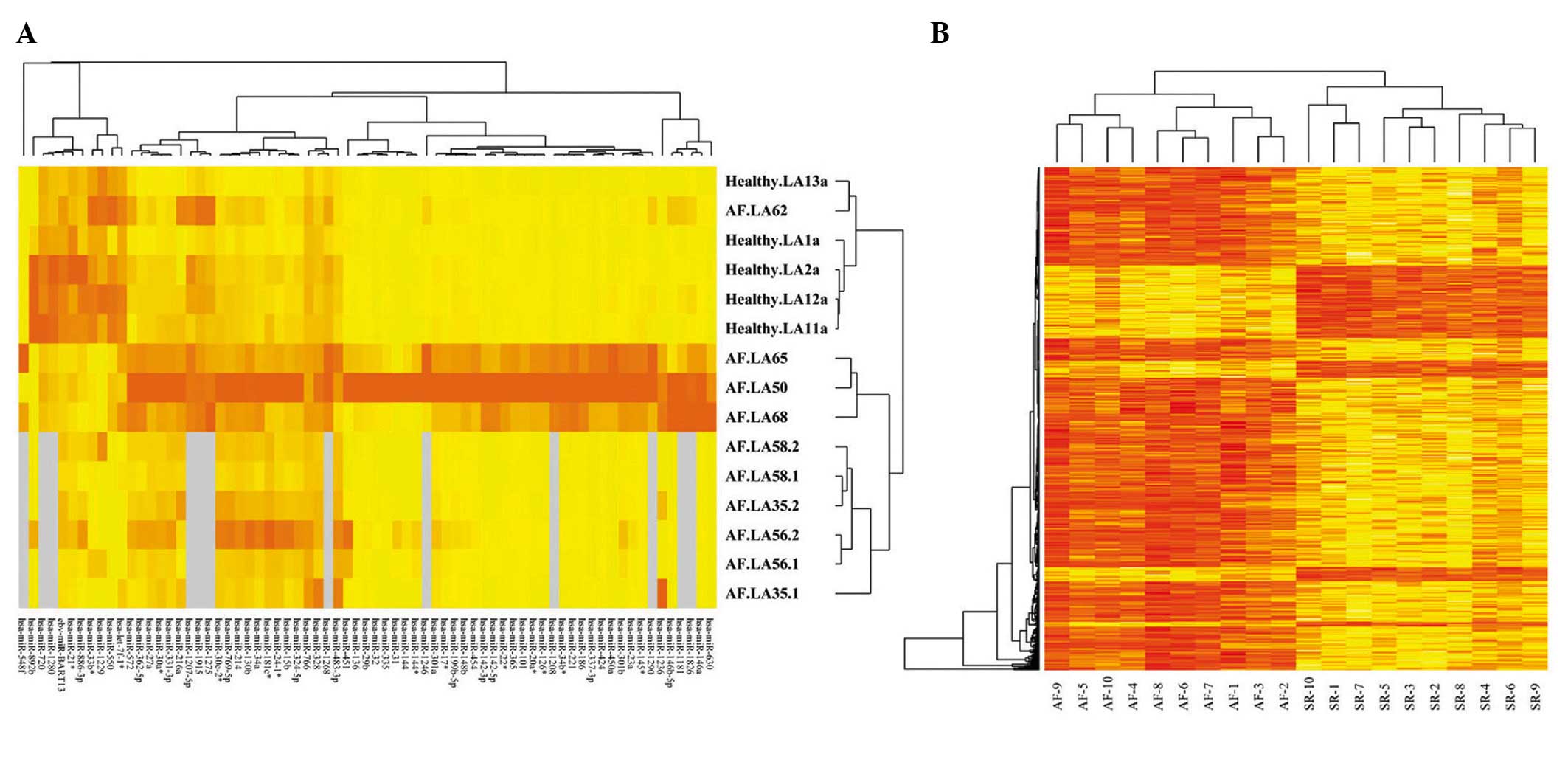
Following normalization using the RMA algorithm and
SAM analysis of raw data, 71 significantly differentially expressed
miRNAs and 390 DEGs were identified between the AF and normal
tissues. In addition, the expression levels of these miRNAs and
mRNAs were analyzed via heat-maps (Fig. 1).
Construction of the miRNA-target
network
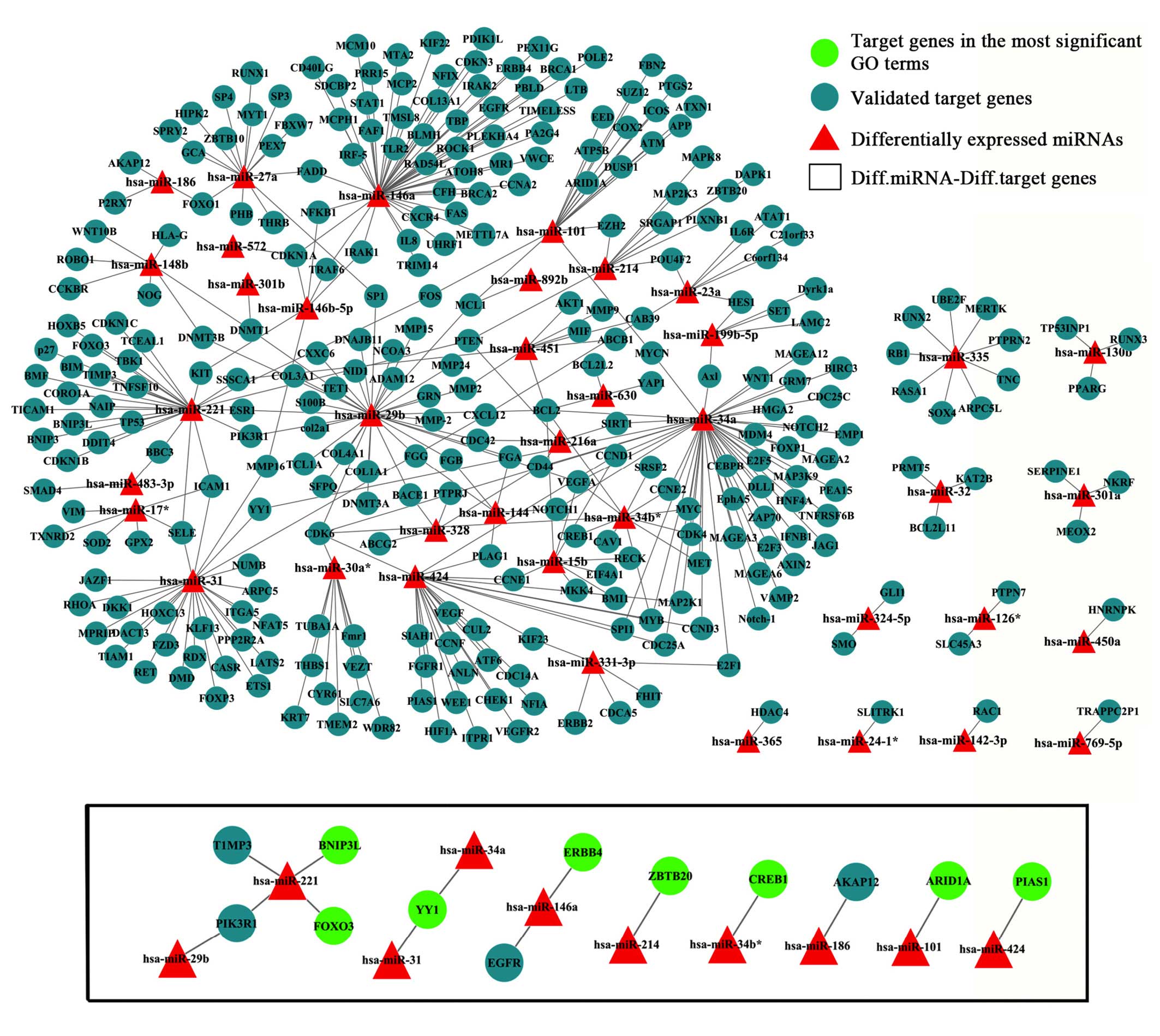
Using the criteria: Score ≥50 and energy ≤−20, 3,506
miRNA-mRNA pairs were predicted. A total of 372 validated
miRNA-mRNA relationship pairs were simultaneously predicted by the
miRecords database and TarBase, and were therefore used to
construct the miRNA-mRNA regulatory network (Fig. 2, upper panel). Furthermore, 10
miRNAs and 12 targeted mRNAs were identified, which formed 14
interactive pairs (Fig. 2, lower
panel). The selected miRNAs were upregulated in AF tissues, whereas
the mRNAs were downregulated in the AF tissues. The expression
levels of the 14 miRNA-mRNA pairs are presented in Table I, which indicated that the selected
miRNAs were upregulated in AF tissues, whereas the mRNAs were
downregulated.
 | Table ISelected miRNA-mRNA pairs. |
Table I
Selected miRNA-mRNA pairs.
| Diff. miRNAs | Diff. & validated
targets | miRNA-mRNA
expression |
|---|
| hsa-miR-186 | AKAP12 | Up-down |
| hsa-miR-101 | ARID1A | Up-down |
| hsa-miR-221 | BNIP3L | Up-down |
|
hsa-miR-34b* | CREB1 | Up-down |
| hsa-miR-146a | EGFR | Up-down |
| hsa-miR-146a | ERBB4 | Up-down |
| hsa-miR-221 | FOXO3 | Up-down |
| hsa-miR-424 | PIAS1 | Up-down |
| hsa-miR-221 | PIK3R1 | Up-down |
| hsa-miR-29b | PIK3R1 | Up-down |
| hsa-miR-221 | TIMP3 | Up-down |
| hsa-miR-31 | YY1 | Up-down |
| hsa-miR-34a | YY1 | Up-down |
| hsa-miR-214 | ZBTB20 | Up-down |
Functional analysis of miRNA-targeted
genes
The miRNA-targeted genes were significantly enriched
into 14 Gene Ontology (GO) categories (Table II). The GO term gene expression
(GO10468) was the most significantly enriched, and was associated
with 8 miRNAs (miR-146a, miR-31, miR-34a, miR-221, miR-424,
miR34b*, miR-214, miR-101) and 8 target genes [zinc finger and BTB
domain containing 20 (ZBTB20), Erb-B2 receptor tyrosine kinase 4
(ERBB4), YY1 transcription factor (YY1), cAMP response
element-binding protein (CREB1), BCL2/adenovirus E1B 19 kDa
protein-interacting protein 3-like (BNIP3L), AT rich interactive
domain 1A (ARID1A), protein inhibitor of activated STAT, 1 (PIAS1),
forkhead box O3 (FOXO3)]. No significantly enriched Kyoto
Encyclopedia of Genes and Genomes pathway was detected.
| Table IIEnriched GO terms of target genes. |
Table II
Enriched GO terms of target genes.
| GO term ID | FDR | Description | Target genes |
|---|
| 10468 | 0.00895 | Gene expression | ZBTB20, ERBB4, YY1,
CREB1, BNIP3L, ARID1A, PIAS1, FOXO3 |
| 19219 | 0.00973 | Nucleobase,
nucleoside, nucleotide and nucleic acid metabolic process | ZBTB20, ERBB4, YY1,
CREB1, AKAP12, ARID1A, PIAS1, FOXO3 |
| 48522 | 0.00115 | Positive regulation
of cellular process | EGFR, ERBB4, CREB1,
BNIP3L, AKAP12, ARID1A, PIAS1, FOXO3, PIK3R1 |
| 48518 | 0.00115 | Positive regulation
of biological process | EGFR, ERBB4, CREB1,
BNIP3L, AKAP12, ARID1A, PIAS1, FOXO3, PIK3R1 |
| 31326 | 0.00352 | Cellular biosynthetic
process | EGFR, ZBTB20, ERBB4,
YY1, CREB1, AKAP12, ARID1A, PIAS1, FOXO3 |
| 51171 | 0.00352 | Nitrogen compound
metabolic process | EGFR, ZBTB20, ERBB4,
YY1, CREB1, AKAP12, ARID1A, PIAS1, FOXO3 |
| 9889 | 0.00352 | Biosynthetic
process | EGFR, ZBTB20, ERBB4,
YY1, CREB1, AKAP12, ARID1A, PIAS1, FOXO3 |
| 60255 | 0.00179 | Macromolecule
metabolic process | EGFR, ZBTB20, ERBB4,
YY1, CREB1, BNIP3L, ARID1A, PIAS1, FOXO3, TIMP3 |
| 80090 | 0.00254 | Primary metabolic
process | EGFR, ZBTB20, ERBB4,
YY1, CREB1, AKAP12, ARID1A, PIAS1, FOXO3, TIMP3 |
| 31323 | 0.00292 | Cellular metabolic
process | EGFR, ZBTB20, ERBB4,
YY1, CREB1, AKAP12, ARID1A, PIAS1, FOXO3, TIMP3 |
| 19222 | 0.00115 | Metabolic
process | EGFR, ZBTB20, ERBB4,
YY1, CREB1, BNIP3L, AKAP12, ARID1A, PIAS1, FOXO3, TIMP3 |
| 50794 | 0.00292 | Regulation of
cellular process | EGFR, ZBTB20, ERBB4,
YY1, CREB1, BNIP3L, AKAP12, ARID1A, PIAS1, FOXO3, TIMP3,
PIK3R1 |
| 50789 | 0.00351 | Regulation of
biological process | EGFR, ZBTB20,
ERBB4, YY1, CREB1, BNIP3L, AKAP12, ARID1A, PIAS1, FOXO3, TIMP3,
PIK3R1 |
| 65007 | 0.00463 | Biological
regulation | EGFR, ZBTB20,
ERBB4, YY1, CREB1, BNIP3L, AKAP12, ARID1A, PIAS1, FOXO3, TIMP3,
PIK3R1 |
Discussion
miRNAs are negative regulators of gene expression,
which regulate various biological processes via inhibition of their
target gene expression. It is important to identify miRNA targets
and elucidate their complex regulatory networks, in order to
contribute to a systematic understanding of pathological changes in
medical and clinical studies. AF is associated with alterations to
several proteins, molecules and pathways. As a result, these
changes result in disease progression, which may develop into heart
failure. In the present study, a very strict criteria was adopted
to identify miRNA targets. Briefly, the target genes had to be
significantly differentially expressed, and predicted by both
miRecords and TarBase. Consequently, 14 miRNA-mRNA pairs were
identified to have a high probability of association with AF.
Compared with previous studies, the miRNAs selected
in the present study included genes that have been reported to be
involved in heart disease, including miR-221 (7,24)
and miR-101 (25,26). In the present study, ARID1A gene
expression was shown to be predominantly regulated by miR-101,
which binds with the 3′-UTR of ARID1A, thus inducing ARID1A
instability or translational inhibition. miR-101 and its target
gene ARID1A participated in the most significant GO term (GO:
10468, regulation of gene expression) and therefore may be
considered a specific biosignature of AF. In addition, several
other miRNAs, including miR-146a, miR-31, miR-34a, miR-221,
miR-424, miR34b* and miR-214, were identified to be strongly
associated with AF. The regulation of miRNA-mRNA pairs differs in
various diseases, resulting in disease-specific expression profiles
that interact via a complex regulatory network. Although numerous
methods have been used to identify regulatory miRNA-mRNA pairs in
disease, no method is perfect or able to determine all miRNA-mRNA
pairs.
The present study identified 8 target genes: ZBTB20,
ERBB4, YY1, CREB1, BNIP3L, ARID1A, PIAS1 and FOXO3. It has
previously been demonstrated that ErbB receptors (ErbB2, ErbB3,
ErbB4) are overexpressed in the atrium, compared with the
ventricle, and are downregulated in AF (27). It has therefore been hypothesized
that downregulation of ErbB may contribute to the propensity for
structural remodeling in AF and congestive heart failure.
Furthermore, ZBTB20 (28), YY1
(29), BNIP3L (30), PIAS1 (31) and FOXO3 (32) have been suggested to be associated
with AF. Notably, no previous study has reported a relationship
between CREB1 expression and AF.
There are several limitations to the present study.
Firstly, the miRNA and mRNA data of AF and normal tissues were
obtained from different studies, which may affect the results.
Furthermore, the results are based on pure public data and further
experimental validation is required, such as target miRNA and mRNA
knockdown experiments.
In conclusion, the miRNA-mRNA interactions
identified in the present study may act as biosignatures for AF,
and may provide evidence for the identification of a novel agent
for the diagnosis and gene-targeted therapy of AF.
References
|
1
|
Wyse DG, Waldo AL, DiMarco JP, Domanski
MJ, Rosenberg Y, Schron EB, Kellen JC, Greene HL, Mickel MC,
Dalquist JE and Corley SD: Atrial Fibrillation Follow-up
Investigation of Rhythm Management (AFFIRM) Investigators: A
comparison of rate control and rhythm control in patients with
atrial fibrillation. N Engl J Med. 347:1825–1833. 2002. View Article : Google Scholar : PubMed/NCBI
|
|
2
|
Anderson JL, Halperin JL, Albert NM,
Bozkurt B, Brindis RG, Curtis LH, DeMets D, Guyton RA, Hochman JS,
Kovacs RJ, et al: Management of patients with atrial fibrillation
(compilation of 2006 ACCF/AHA/ESC and 2011 ACCF/AHA/HRS
recommendations): A report of the American College of
Cardiology/American Heart Association Task Force on Practice
Guidelines. J Am Coll Cardiol. 61:1935–1944. 2013. View Article : Google Scholar : PubMed/NCBI
|
|
3
|
Gilligan DM, Joyner CA and Bundy GM:
Multidisciplinary collaboration for the treatment of atrial
fibrillation: Convergent procedure outcomes from a single center.
Innovation in CRM. 4:1396–1403. 2013.
|
|
4
|
Bartel DP: MicroRNAs: Target recognition
and regulatory functions. Cell. 136:215–233. 2009. View Article : Google Scholar : PubMed/NCBI
|
|
5
|
Lu Y, Zhang Y, Wang N, Pan Z, Gao X, Zhang
F, Zhang Y, Shan H, Luo X, Bai Y, et al: MicroRNA-328 contributes
to adverse electrical remodeling in atrial fibrillation.
Circulation. 122:2378–2387. 2010. View Article : Google Scholar : PubMed/NCBI
|
|
6
|
Luo X, Pan Z, Shan H, Xiao J, Sun X, Wang
N, Lin H, Xiao L, Maguy A, Qi XY, et al: MicroRNA-26 governs
profibrillatory inward-rectifier potassium current changes in
atrial fibrillation. J Clin Invest. 123:1939–1951. 2013. View Article : Google Scholar : PubMed/NCBI
|
|
7
|
Chen CL, Lin JL, Lai LP, Pan CH, Huang SK
and Lin CS: Altered expression of FHL1, CARP, TSC-22 and P311
provide insights into complex transcriptional regulation in
pacing-induced atrial fibrillation. Biochim Biophys Acta.
1772:317–29. 2007. View Article : Google Scholar
|
|
8
|
Girmatsion Z, Biliczki P, Bonauer A,
Wimmer-Greinecker G, Scherer M, Moritz A, Bukowska A, Goette A,
Nattel S, Hohnloser SH and Ehrlich JR: Changes in microRNA-1
expression and IK1 upregulation in human atrial fibrillation. Heart
Rhythm. 6:1802–1809. 2009. View Article : Google Scholar : PubMed/NCBI
|
|
9
|
Barth AS, Merk S, Arnoldi E, Zwermann L,
Kloos P, Gebauer M, Steinmeyer K, Bleich M, Kääb S, Hinterseer M,
et al: Reprogramming of the human atrial transcriptome in permanent
atrial fibrillation: Expression of a ventricular-like genomic
signature. Circ Res. 96:1022–1029. 2005. View Article : Google Scholar : PubMed/NCBI
|
|
10
|
Barth AS, Merk S, Arnoldi E, Zwermann L,
Kloos P, Gebauer M, Steinmeyer K, Bleich M, Kääb S, Pfeufer A, et
al: Functional profiling of human atrial and ventricular gene
expression. Pflugers Arch. 450:201–208. 2005. View Article : Google Scholar : PubMed/NCBI
|
|
11
|
Cooley N, Cowley MJ, Lin RC, Marasco S,
Wong C, Kaye DM, Dart AM and Woodcock EA: Influence of atrial
fibrillation on microRNA expression profiles in left and right
atria from patients with valvular heart disease. Physiol Genomics.
44:211–219. 2012. View Article : Google Scholar
|
|
12
|
Irizarry RA, Hobbs B, Collin F,
Beazer-Barclay YD, Antonellis KJ, Scherf U and Speed TP:
Exploration, normalization, and summaries of high density
oligonucleotide array probe level data. Biostatistics. 4:249–264.
2003. View Article : Google Scholar : PubMed/NCBI
|
|
13
|
Zhang S: A comprehensive evaluation of
SAM, the SAM R-package and a simple modification to improve its
performance. BMC Bioinformatics. 8:2302007. View Article : Google Scholar : PubMed/NCBI
|
|
14
|
Sawilowsky SS (2005): Misconceptions
leading to choosing the t test over the Wilcoxon Mann-Whitney U
test for shift in location parameter. Journal of Modern Applied
Statistical Methods. 4(2): 598–600. 2005.
|
|
15
|
Shaffer JP: Multiple hypothesis testing.
Annual Review of Psychology. 46:561–584. 1995. View Article : Google Scholar
|
|
16
|
Yeung KY and Ruzzo WL: Principal component
analysis for clustering gene expression data. Bioinformatics.
17:763–774. 2001. View Article : Google Scholar : PubMed/NCBI
|
|
17
|
Eisen MB, Spellman PT, Brown PO and
Botstein D: Cluster analysis and display of genome-wide expression
patterns. Proc Natl Acad Sci USA. 95:14863–14868. 1998. View Article : Google Scholar : PubMed/NCBI
|
|
18
|
Xiao F, Zuo Z, Cai G, Kang S, Gao X and Li
T: MiRecords: An integrated resource for microRNA-target
interactions. Nucleic Acids Res. 37(Database issue): D105–D110.
2009. View Article : Google Scholar :
|
|
19
|
Sethupathy P, Corda B and Hatzigeorgiou
AG: TarBase: A comprehensive database of experimentally supported
animal microRNA targets. RNA. 12:192–197. 2006. View Article : Google Scholar :
|
|
20
|
Peng X, Li Y, Walters KA, Rosenzweig ER,
Lederer SL, Aicher LD, Proll S and Katze MG: Computational
identification of hepatitis C virus associated microRNA-mRNA
regulatory modules in human livers. BMC Genomics. 10:3732009.
View Article : Google Scholar : PubMed/NCBI
|
|
21
|
Liu H, Brannon AR, Reddy AR, Alexe G,
Seiler MW, Arreola A, Oza JH, Yao M, Juan D, Liou LS, et al:
Identifying mRNA targets of microRNA dysregulated in cancer: With
application to clear cell renal cell carcinoma. BMC Syst Biol.
4:512010. View Article : Google Scholar : PubMed/NCBI
|
|
22
|
Shannon P, Markiel A, Ozier O, Baliga NS,
Wang JT, Ramage D, Amin N, Schwikowski B and Ideker T: Cytoscape: A
software environment for integrated models of biomolecular
interaction networks. Genome Res. 13:2498–2504. 2003. View Article : Google Scholar : PubMed/NCBI
|
|
23
|
Huang da W, Sherman BT and Lempicki RA:
Systematic and integrative analysis of large gene lists using DAVID
bioinformatics resources. Nat Protoc. 4:44–57. 2009. View Article : Google Scholar : PubMed/NCBI
|
|
24
|
Ji R, Cheng Y, Yue J, Yang J, Liu X, Chen
H, Dean DB and Zhang C: MicroRNA expression signature and
antisense-mediated depletion reveal an essential role of MicroRNA
in vascular neointimal lesion formation. Circ Res. 100:1579–1588.
2007. View Article : Google Scholar : PubMed/NCBI
|
|
25
|
Luo X, Pan Z, Shan H, Xiao J, Sun X, Wang
N, Lin H, Xiao L, Maguy A, Qi XY, et al: MicroRNA-26 governs
profibrillatory inward-rectifier potassium current changes in
atrial fibrillation. J Clin Invest. 123:1939–1951. 2013. View Article : Google Scholar : PubMed/NCBI
|
|
26
|
Rao PK, Kumar RM, Farkhondeh M,
Baskerville S and Lodish HF: Myogenic factors that regulate
expression of muscle-specific microRNAs. Proc Natl Acad Sci USA.
103:8721–8726. 2006. View Article : Google Scholar : PubMed/NCBI
|
|
27
|
Barth AS, Merk S, Arnoldi E, Zwermann L,
Kloos P, Gebauer M, Steinmeyer K, Bleich M, Kääb S, Hinterseer M,
et al: Reprogramming of the human atrial transcriptome in permanent
atrial fibrillation: Expression of a ventricular-like genomic
signature. Circ Res. 96:1022–1029. 2005. View Article : Google Scholar : PubMed/NCBI
|
|
28
|
Mao S and Huang S: Toll-like receptors
signaling in glomerular diseases. J Recept Signal Transduct Res.
34:81–84. 2014. View Article : Google Scholar
|
|
29
|
Kharlap MS, Timofeeva AV, Goryunova LE,
Khaspekov GL, Dzemeshkevich SL, Ruskin VV, Akchurin RS, Golitsyn SP
and Beabealashvilli RSh: Atrial appendage transcriptional profile
in patients with atrial fibrillation with structural heart
diseases. Ann N Y Acad Sci. 1091:205–217. 2006. View Article : Google Scholar
|
|
30
|
Wajapeyee N, Serra RW, Zhu X, Mahalingam M
and Green MR: Role for IGFBP7 in senescence induction by BRAF.
Cell. 141:746–747. 2010. View Article : Google Scholar : PubMed/NCBI
|
|
31
|
Benson MD, Li QJ, Kieckhafer K, Dudek D,
Whorton MR, Sunahara RK, Iñiguez-Lluhí JA and Martens JR: SUMO
modification regulates inactivation of the voltage-gated potassium
channel Kv1.5. Proc Natl Acad Sci USA. 104:1805–1810. 2007.
View Article : Google Scholar : PubMed/NCBI
|
|
32
|
Rossi S, Tsirigos A, Amoroso A, Mascellani
N, Rigoutsos I, Calin GA and Volinia S: OMiR: Identification of
associations between OMIM diseases and microRNAs. Genomics.
97:71–76. 2011. View Article : Google Scholar
|