Spandidos Publications Logo
  • About
    • About Spandidos
    • Aims and Scopes
    • Abstracting and Indexing
    • Editorial Policies
    • Reprints and Permissions
    • Job Opportunities
    • Terms and Conditions
    • Contact
  • Journals
    • All Journals
    • Oncology Letters
      • Oncology Letters
      • Information for Authors
      • Editorial Policies
      • Editorial Board
      • Aims and Scope
      • Abstracting and Indexing
      • Bibliographic Information
      • Archive
    • International Journal of Oncology
      • International Journal of Oncology
      • Information for Authors
      • Editorial Policies
      • Editorial Board
      • Aims and Scope
      • Abstracting and Indexing
      • Bibliographic Information
      • Archive
    • Molecular and Clinical Oncology
      • Molecular and Clinical Oncology
      • Information for Authors
      • Editorial Policies
      • Editorial Board
      • Aims and Scope
      • Abstracting and Indexing
      • Bibliographic Information
      • Archive
    • Experimental and Therapeutic Medicine
      • Experimental and Therapeutic Medicine
      • Information for Authors
      • Editorial Policies
      • Editorial Board
      • Aims and Scope
      • Abstracting and Indexing
      • Bibliographic Information
      • Archive
    • International Journal of Molecular Medicine
      • International Journal of Molecular Medicine
      • Information for Authors
      • Editorial Policies
      • Editorial Board
      • Aims and Scope
      • Abstracting and Indexing
      • Bibliographic Information
      • Archive
    • Biomedical Reports
      • Biomedical Reports
      • Information for Authors
      • Editorial Policies
      • Editorial Board
      • Aims and Scope
      • Abstracting and Indexing
      • Bibliographic Information
      • Archive
    • Oncology Reports
      • Oncology Reports
      • Information for Authors
      • Editorial Policies
      • Editorial Board
      • Aims and Scope
      • Abstracting and Indexing
      • Bibliographic Information
      • Archive
    • Molecular Medicine Reports
      • Molecular Medicine Reports
      • Information for Authors
      • Editorial Policies
      • Editorial Board
      • Aims and Scope
      • Abstracting and Indexing
      • Bibliographic Information
      • Archive
    • World Academy of Sciences Journal
      • World Academy of Sciences Journal
      • Information for Authors
      • Editorial Policies
      • Editorial Board
      • Aims and Scope
      • Abstracting and Indexing
      • Bibliographic Information
      • Archive
    • International Journal of Functional Nutrition
      • International Journal of Functional Nutrition
      • Information for Authors
      • Editorial Policies
      • Editorial Board
      • Aims and Scope
      • Abstracting and Indexing
      • Bibliographic Information
      • Archive
    • International Journal of Epigenetics
      • International Journal of Epigenetics
      • Information for Authors
      • Editorial Policies
      • Editorial Board
      • Aims and Scope
      • Abstracting and Indexing
      • Bibliographic Information
      • Archive
    • Medicine International
      • Medicine International
      • Information for Authors
      • Editorial Policies
      • Editorial Board
      • Aims and Scope
      • Abstracting and Indexing
      • Bibliographic Information
      • Archive
  • Articles
  • Information
    • Information for Authors
    • Information for Reviewers
    • Information for Librarians
    • Information for Advertisers
    • Conferences
  • Language Editing
Spandidos Publications Logo
  • About
    • About Spandidos
    • Aims and Scopes
    • Abstracting and Indexing
    • Editorial Policies
    • Reprints and Permissions
    • Job Opportunities
    • Terms and Conditions
    • Contact
  • Journals
    • All Journals
    • Biomedical Reports
      • Information for Authors
      • Editorial Policies
      • Editorial Board
      • Aims and Scope
      • Abstracting and Indexing
      • Bibliographic Information
      • Archive
    • Experimental and Therapeutic Medicine
      • Information for Authors
      • Editorial Policies
      • Editorial Board
      • Aims and Scope
      • Abstracting and Indexing
      • Bibliographic Information
      • Archive
    • International Journal of Epigenetics
      • Information for Authors
      • Editorial Policies
      • Editorial Board
      • Aims and Scope
      • Abstracting and Indexing
      • Bibliographic Information
      • Archive
    • International Journal of Functional Nutrition
      • Information for Authors
      • Editorial Policies
      • Editorial Board
      • Aims and Scope
      • Abstracting and Indexing
      • Bibliographic Information
      • Archive
    • International Journal of Molecular Medicine
      • Information for Authors
      • Editorial Policies
      • Editorial Board
      • Aims and Scope
      • Abstracting and Indexing
      • Bibliographic Information
      • Archive
    • International Journal of Oncology
      • Information for Authors
      • Editorial Policies
      • Editorial Board
      • Aims and Scope
      • Abstracting and Indexing
      • Bibliographic Information
      • Archive
    • Medicine International
      • Information for Authors
      • Editorial Policies
      • Editorial Board
      • Aims and Scope
      • Abstracting and Indexing
      • Bibliographic Information
      • Archive
    • Molecular and Clinical Oncology
      • Information for Authors
      • Editorial Policies
      • Editorial Board
      • Aims and Scope
      • Abstracting and Indexing
      • Bibliographic Information
      • Archive
    • Molecular Medicine Reports
      • Information for Authors
      • Editorial Policies
      • Editorial Board
      • Aims and Scope
      • Abstracting and Indexing
      • Bibliographic Information
      • Archive
    • Oncology Letters
      • Information for Authors
      • Editorial Policies
      • Editorial Board
      • Aims and Scope
      • Abstracting and Indexing
      • Bibliographic Information
      • Archive
    • Oncology Reports
      • Information for Authors
      • Editorial Policies
      • Editorial Board
      • Aims and Scope
      • Abstracting and Indexing
      • Bibliographic Information
      • Archive
    • World Academy of Sciences Journal
      • Information for Authors
      • Editorial Policies
      • Editorial Board
      • Aims and Scope
      • Abstracting and Indexing
      • Bibliographic Information
      • Archive
  • Articles
  • Information
    • For Authors
    • For Reviewers
    • For Librarians
    • For Advertisers
    • Conferences
  • Language Editing
Login Register Submit
  • This site uses cookies
  • You can change your cookie settings at any time by following the instructions in our Cookie Policy. To find out more, you may read our Privacy Policy.

    I agree
Search articles by DOI, keyword, author or affiliation
Search
Advanced Search
presentation
Molecular Medicine Reports
Join Editorial Board Propose a Special Issue
Print ISSN: 1791-2997 Online ISSN: 1791-3004
Journal Cover
November-2016 Volume 14 Issue 5

Full Size Image

Sign up for eToc alerts
Recommend to Library

Journals

International Journal of Molecular Medicine

International Journal of Molecular Medicine

International Journal of Molecular Medicine is an international journal devoted to molecular mechanisms of human disease.

International Journal of Oncology

International Journal of Oncology

International Journal of Oncology is an international journal devoted to oncology research and cancer treatment.

Molecular Medicine Reports

Molecular Medicine Reports

Covers molecular medicine topics such as pharmacology, pathology, genetics, neuroscience, infectious diseases, molecular cardiology, and molecular surgery.

Oncology Reports

Oncology Reports

Oncology Reports is an international journal devoted to fundamental and applied research in Oncology.

Experimental and Therapeutic Medicine

Experimental and Therapeutic Medicine

Experimental and Therapeutic Medicine is an international journal devoted to laboratory and clinical medicine.

Oncology Letters

Oncology Letters

Oncology Letters is an international journal devoted to Experimental and Clinical Oncology.

Biomedical Reports

Biomedical Reports

Explores a wide range of biological and medical fields, including pharmacology, genetics, microbiology, neuroscience, and molecular cardiology.

Molecular and Clinical Oncology

Molecular and Clinical Oncology

International journal addressing all aspects of oncology research, from tumorigenesis and oncogenes to chemotherapy and metastasis.

World Academy of Sciences Journal

World Academy of Sciences Journal

Multidisciplinary open-access journal spanning biochemistry, genetics, neuroscience, environmental health, and synthetic biology.

International Journal of Functional Nutrition

International Journal of Functional Nutrition

Open-access journal combining biochemistry, pharmacology, immunology, and genetics to advance health through functional nutrition.

International Journal of Epigenetics

International Journal of Epigenetics

Publishes open-access research on using epigenetics to advance understanding and treatment of human disease.

Medicine International

Medicine International

An International Open Access Journal Devoted to General Medicine.

Journal Cover
November-2016 Volume 14 Issue 5

Full Size Image

Sign up for eToc alerts
Recommend to Library

  • Article
  • Citations
    • Cite This Article
    • Download Citation
    • Create Citation Alert
    • Remove Citation Alert
    • Cited By
  • Similar Articles
    • Related Articles (in Spandidos Publications)
    • Similar Articles (Google Scholar)
    • Similar Articles (PubMed)
  • Download PDF
  • Download XML
  • View XML
Article Open Access

Gap junction inhibition by heptanol increases ventricular arrhythmogenicity by reducing conduction velocity without affecting repolarization properties or myocardial refractoriness in Langendorff-perfused mouse hearts

  • Authors:
    • Gary Tse
    • Jie Ming Yeo
    • Vivian Tse
    • Joseph Kwan
    • Bing Sun
  • View Affiliations / Copyright

    Affiliations: Department of Medicine and Therapeutics, Chinese University of Hong Kong, Hong Kong, P.R. China, Faculty of Medicine, Imperial College London, London SW7 2AZ, UK, Department of Physiology, McGill University, Montreal, QC H3G 1Y6, Canada, Department of Medicine, Li Ka Shing Faculty of Medicine, University of Hong Kong, Hong Kong, P.R. China, Department of Cardiology, Tongji University Affiliated Tongji Hospital, Shanghai 200065, P.R. China
    Copyright: © Tse et al. This is an open access article distributed under the terms of Creative Commons Attribution License.
  • Pages: 4069-4074
    |
    Published online on: September 13, 2016
       https://doi.org/10.3892/mmr.2016.5738
  • Expand metrics +
Metrics: Total Views: 0 (Spandidos Publications: | PMC Statistics: )
Metrics: Total PDF Downloads: 0 (Spandidos Publications: | PMC Statistics: )
Cited By (CrossRef): 0 citations Loading Articles...

This article is mentioned in:


Abstract

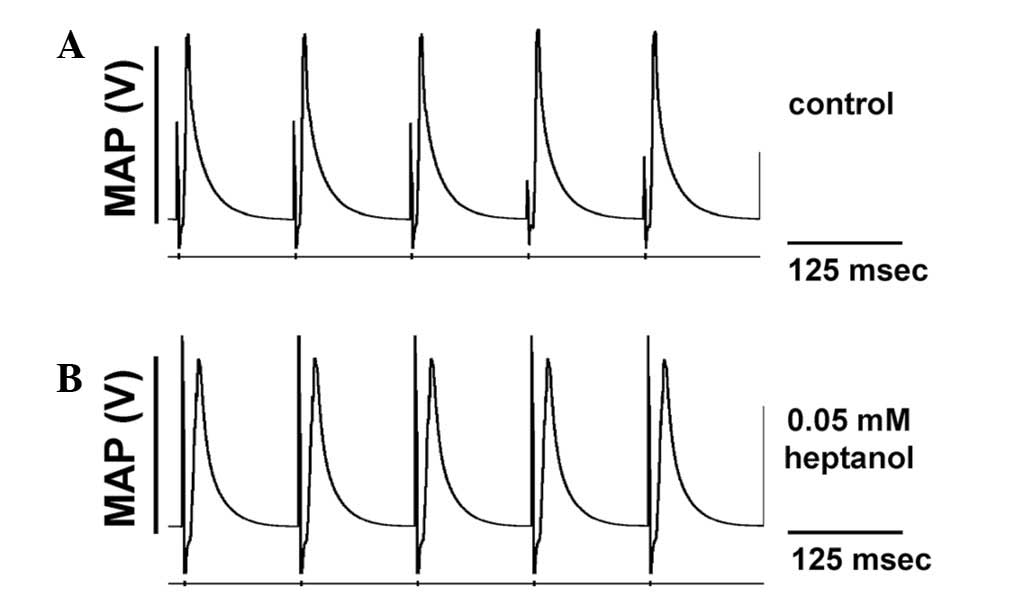
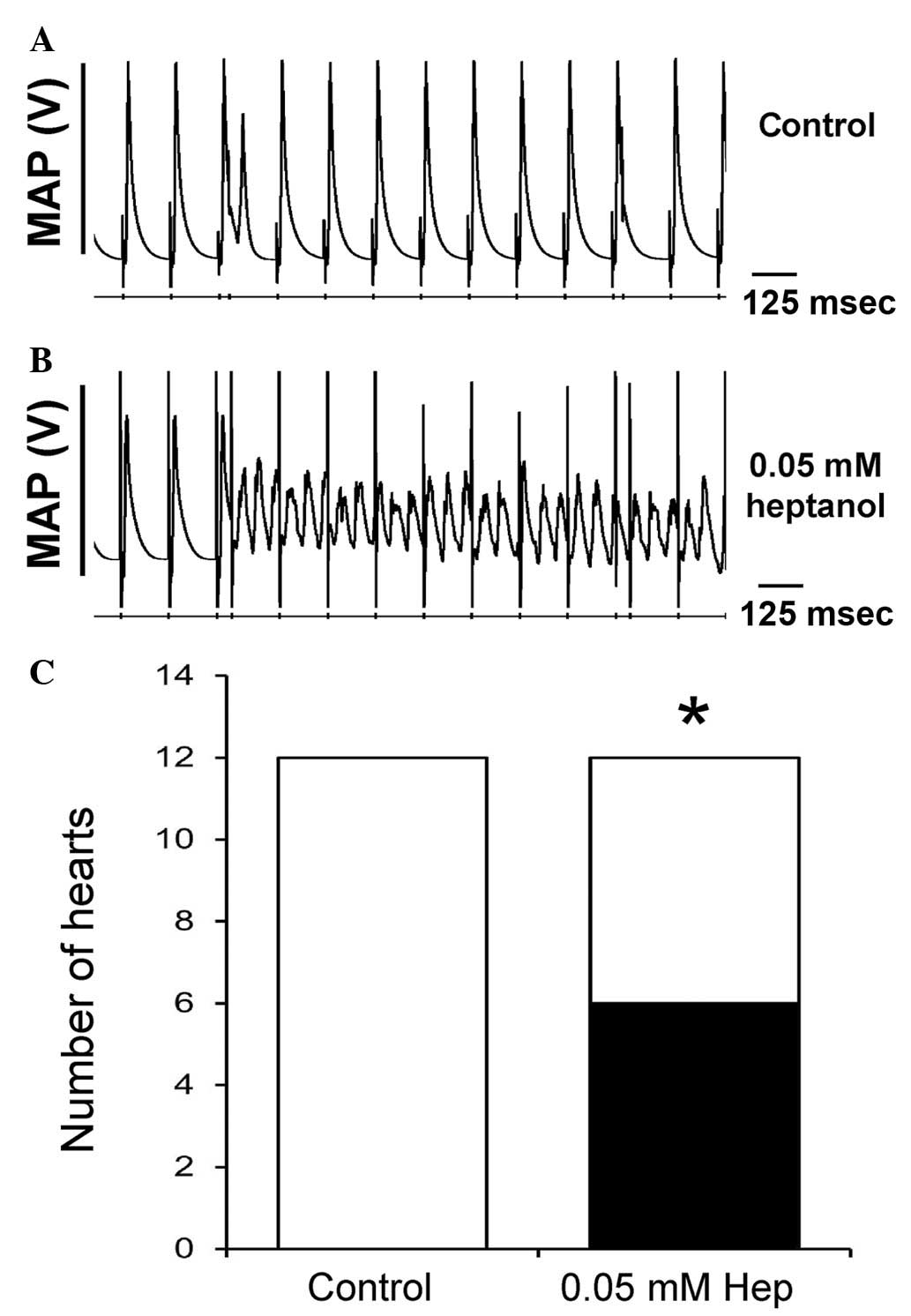
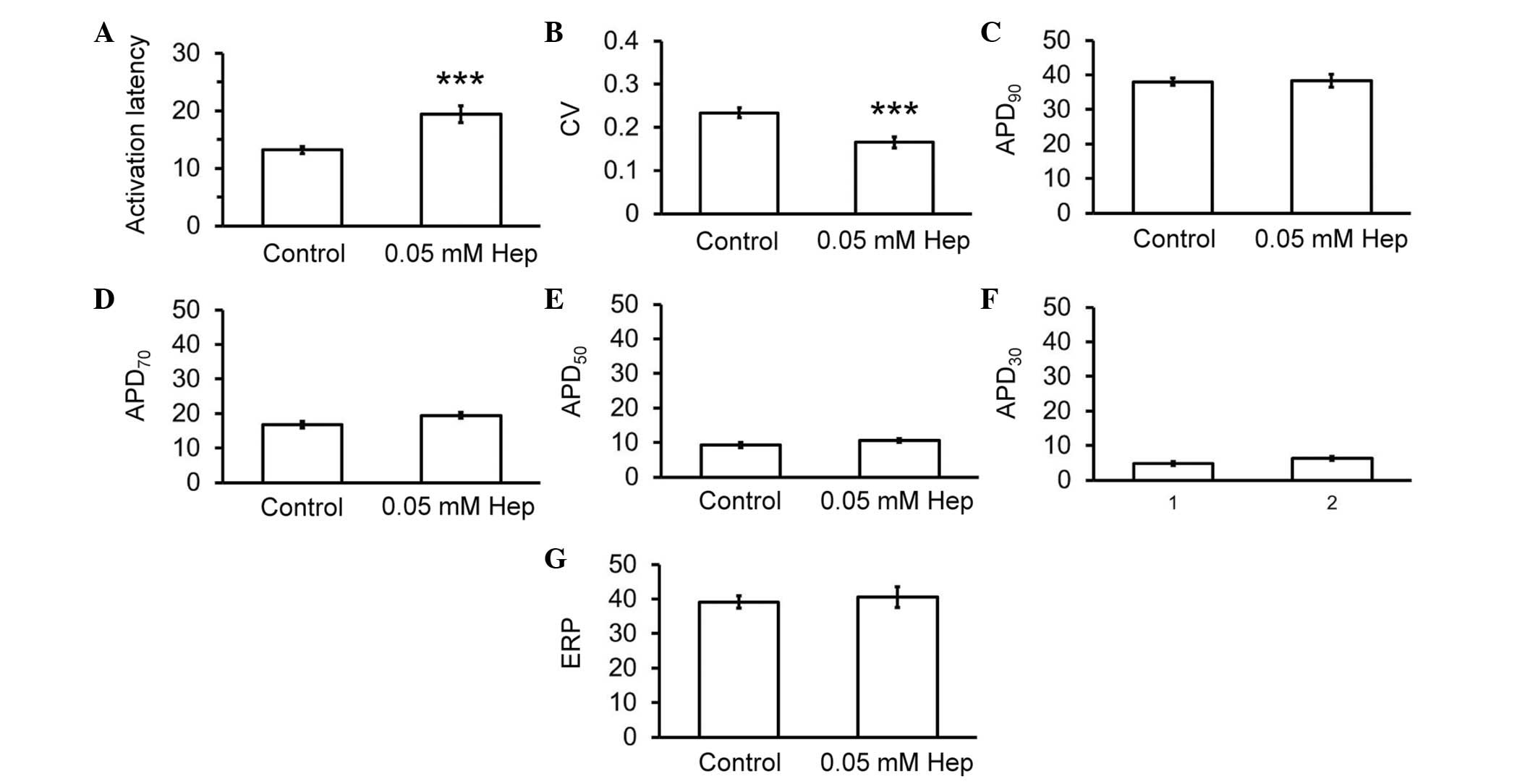
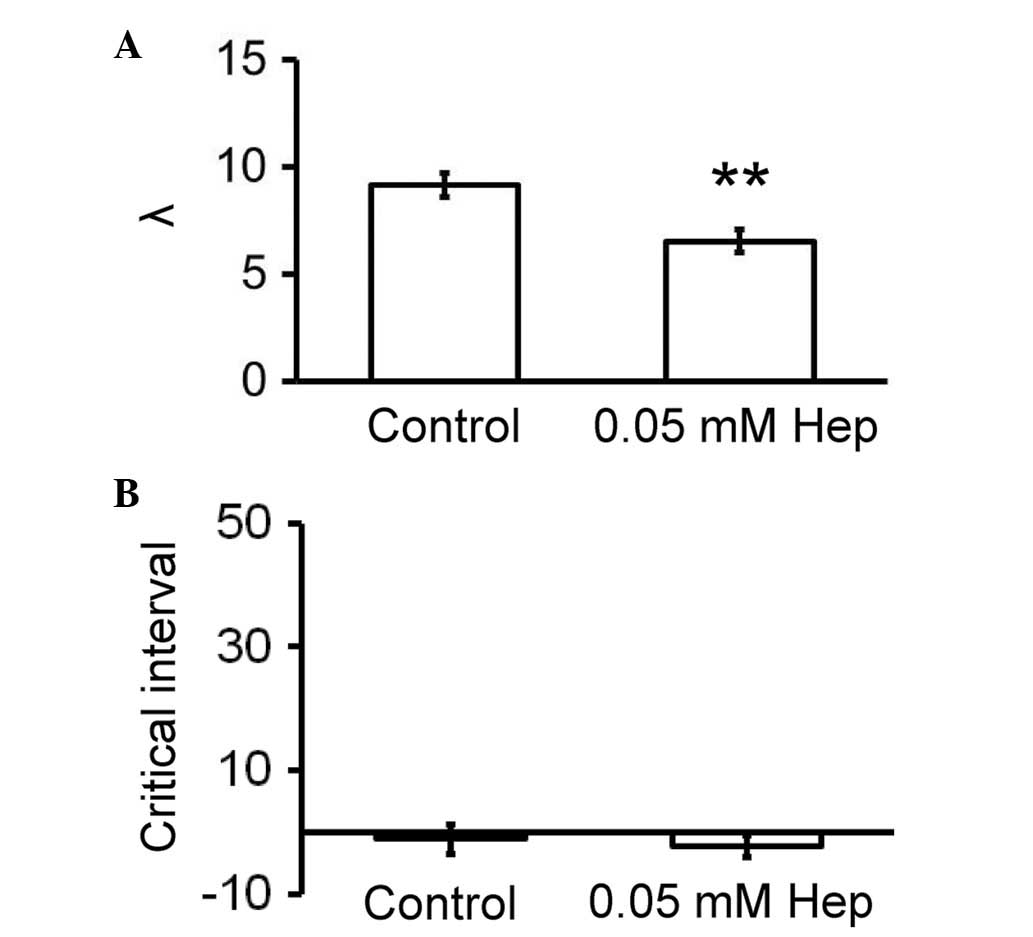
In the current study, arrhythmogenic effects of the gap junction inhibitor heptanol (0.05 mM) were examined in Langendorff-perfused mouse hearts. Monophasic action potential recordings were obtained from the left ventricular epicardium during right ventricular pacing. Regular activity was observed both prior and subsequent to application of heptanol in all of the 12 hearts studied during 8 Hz pacing. By contrast, induced ventricular tachycardia (VT) was observed after heptanol treatment in 6/12 hearts using a S1S2 protocol (Fisher's exact test; P<0.05). The arrhythmogenic effects of heptanol were associated with increased activation latencies from 13.2±0.6 to 19.4±1.3 msec (analysis of variance; P<0.001) and reduced conduction velocities (CVs) from 0.23±0.01 to 0.16±0.01 msec (analysis of variance; P<0.001) in an absence of alterations in action potential durations (ADPs) at x=90% (38.0±1.0 vs. 38.3±1.8 msec), 70% (16.8±1.0 vs. 19.5±0.9 msec), 50% (9.2±0.8 vs. 10.1±0.6 msec) or 30% (4.8±0.5 vs. 6.3±0.6 msec) repolarization (APDx) or in effective refractory period (ERPs) (39.6±1.9 vs. 40.6±3.0 msec) (all P>0.05). Consequently, excitation wavelengths (λ; CV x ERP) were reduced from 9.1±0.6 to 6.5±0.6 mm (P<0.01), however critical intervals for re‑excitation (APD90 ‑ ERP) were unaltered (‑1.1±2.4 vs. ‑2.3±1.8 msec; P>0.05). Together, these observations demonstrate for the first time, to the best of our knowledge, that inhibition of gap junctions alone using a low heptanol concentration (0.05 mM) was able to reduce CV, which alone was sufficient to permit the induction of VT using premature stimulation by reducing λ, which therefore appears central in the determination of arrhythmic tendency.
View Figures

Figure 1

Figure 2

Figure 3

Figure 4

View References

1 

Tse G: Both transmural dispersion of repolarization and transmural dispersion of refractoriness are poor predictors of arrhythmogenicity: A role for the index of Cardiac Electrophysiological Balance (QT/QRS)? J Geriatr Cardiol. 2016.

2 

Tse G, Tse V and Yeo JM: Ventricular anti-arrhythmic effects of heptanol in hypokalaemic, Langendorff-perfused mouse hearts. Biomed Rep. 4:313–324. 2016.PubMed/NCBI

3 

Tse G, Tse V, Yeo JM and Sun B: Atrial anti-arrhythmic effects of heptanol in Langendorff-perfused mouse hearts. PLoS One. 11:e01488582016. View Article : Google Scholar : PubMed/NCBI

4 

Tse G: Mechanisms of cardiac arrhythmias. J Arrhythm. 32:75–81. 2016. View Article : Google Scholar : PubMed/NCBI

5 

Tse G, Wong ST, Tse V and Yeo JM: Restitution analysis of alternans using dynamic pacing and its comparison with S1S2 restitution in heptanol-treated, hypokalaemic Langendorff-perfused mouse hearts. Biomed Rep. 4:673–680. 2016.PubMed/NCBI

6 

Tse G and Yeo JM: Conduction abnormalities and ventricular arrhythmogenesis: The roles of sodium channels and gap junctions. Int J Cardiol Heart Vasc. 9:75–82. 2015.PubMed/NCBI

7 

Tse G, Hothi SS, Grace AA and Huang CL: Ventricular arrhythmogenesis following slowed conduction in heptanol-treated, Langendorff-perfused mouse hearts. J Physiol Sci. 62:79–92. 2012. View Article : Google Scholar : PubMed/NCBI

8 

Tse G, Wong ST, Tse V and Yeo JM: Monophasic action potential recordings: Which is the recording electrode? J Basic Clin Physiol Pharmacol. 2016. View Article : Google Scholar : PubMed/NCBI

9 

Tse G, Lai TH, Yeo JM, Tse V and Wong SH: Mechanisms of electrical activation and conduction in the gastrointestinal system: Lessons from cardiac electrophysiology. Front Physiol. 7:1822016. View Article : Google Scholar : PubMed/NCBI

10 

Tse G, Wong ST, Tse V and Yeo JM: Depolarization vs. repolarization: What is the mechanism of ventricular arrhythmogenesis underlying sodium channel haploinsufficiency in mouse hearts? Acta Physiol (Oxf). 2016. View Article : Google Scholar : PubMed/NCBI

11 

Chen Z, Sun B, Tse G, Jiang J and Xu W: Reversibility of both sinus node dysfunction and reduced HCN4 mRNA expression level in an atrial tachycardia pacing model of tachycardia-bradycardia syndrome in rabbit hearts. Int J Clin Exp Pathol. 9:2016.

12 

Tse G, Sun B, Wong ST, Tse V and Yeo JM: Ventricular anti-arrhythmic effects of hypercalcaemia treatment in hyperkalaemic, Langendorff-perfused mouse hearts. Biomed Rep. 4:313–324. 2016.PubMed/NCBI

13 

Tse G, Lai ET, Tse V and Yeo JM: Molecular and electrophysiological mechanisms underlying cardiac arrhythmogenesis in diabetes mellitus. J Diabetes Res. 2016.(In press). View Article : Google Scholar : PubMed/NCBI

14 

Tse G, Wong ST, Tse V and Yeo JM: Determination of action potential wavelength restitution in Scn5a+/− mouse hearts modelling human Brugada syndrome. J Physiol. 2016.(In press).

15 

Osadchii OE: Flecainide-induced proarrhythmia is attributed to abnormal changes in repolarization and refractoriness in perfused guinea-pig heart. J Cardiovasc Pharmacol. 60:456–466. 2012. View Article : Google Scholar : PubMed/NCBI

16 

Osadchii OE: Quinidine elicits proarrhythmic changes in ventricular repolarization and refractoriness in guinea-pig. Can J Physiol Pharmacol. 91:306–315. 2013. View Article : Google Scholar : PubMed/NCBI

17 

Wilde AA, Postema PG, Di Diego JM, Viskin S, Morita H, Fish JM and Antzelevitch C: The pathophysiological mechanism underlying Brugada syndrome: Depolarization versus repolarization. J Mol Cell Cardiol. 49:543–553. 2010. View Article : Google Scholar : PubMed/NCBI

18 

Osadchii OE: Impact of hypokalemia on electromechanical window, excitation wavelength and repolarization gradients in guinea-pig and rabbit hearts. PLoS One. 9:e1055992014. View Article : Google Scholar : PubMed/NCBI

19 

Osadchii OE: Impaired epicardial activation-repolarization coupling contributes to the proarrhythmic effects of hypokalaemia and dofetilide in guinea pig ventricles. Acta Physiol (Oxf). 211:48–60. 2014. View Article : Google Scholar : PubMed/NCBI

20 

Hsieh YC, Lin JC, Hung CY, Li CH, Lin SF, Yeh HI, Huang JL, Lo CP, Haugan K, Larsen BD and Wu TJ: Gap junction modifier rotigaptide decreases the susceptibility to ventricular arrhythmia by enhancing conduction velocity and suppressing discordant alternans during therapeutic hypothermia in isolated rabbit hearts. Heart Rhythm. 13:251–261. 2016. View Article : Google Scholar : PubMed/NCBI

21 

Hsieh YC, Lin SF, Huang JL, Hung CY, Lin JC, Liao YC, Lo CP, Wang KY and Wu TJ: Moderate hypothermia (33°C) decreases the susceptibility to pacing-induced ventricular fibrillation compared with severe hypothermia (30°C) by attenuating spatially discordant alternans in isolated rabbit hearts. Zhonghua Minguo Xin Zang Xue Hui Za Zhi. 30:455–465. 2014.

22 

Hsieh YC, Lin SF, Lin TC, Ting CT and Wu TJ: Therapeutic hypothermia (30 degrees C) enhances arrhythmogenic substrates, including spatially discordant alternans, and facilitates pacing-induced ventricular fibrillation in isolated rabbit hearts. Circ J. 73:2214–2222. 2009. View Article : Google Scholar : PubMed/NCBI

23 

Choy L, Yeo JM, Tse V, Chan SP and Tse G: Cardiac disease and arrhythmogenesis: Mechanistic insights from mouse studies. Int J Cardiol Heart Vasc. 12:1–10. 2016.PubMed/NCBI

24 

Tse G, Lai ET, Chan YWF, Yeo JM and Yan BP: What is the arrhythmic substrate in viral myocarditis? Insights from clinical and animal studies. Front Physiol. 7:3082016. View Article : Google Scholar : PubMed/NCBI

25 

Stein M, van Veen TA, Remme CA, Boulaksil M, Noorman M, van Stuijvenberg L, van der Nagel R, Bezzina CR, Hauer RN, de Bakker JM and van Rijen HV: Combined reduction of intercellular coupling and membrane excitability differentially affects transverse and longitudinal cardiac conduction. Cardiovasc Res. 83:52–60. 2009. View Article : Google Scholar : PubMed/NCBI

26 

Stein M, van Veen TA, Hauer RN, de Bakker JM and van Rijen HV: A 50% reduction of excitability but not of intercellular coupling affects conduction velocity restitution and activation delay in the mouse heart. PLoS One. 6:e203102011. View Article : Google Scholar : PubMed/NCBI

27 

Morley GE, Vaidya D, Samie FH, Lo C, Delmar M and Jalife J: Characterization of conduction in the ventricles of normal and heterozygous Cx43 knockout mice using optical mapping. J Cardiovasc Electrophysiol. 10:1361–1375. 1999. View Article : Google Scholar : PubMed/NCBI

28 

George SA, Sciuto KJ, Lin J, Salama ME, Keener JP, Gourdie RG and Poelzing S: Extracellular sodium and potassium levels modulate cardiac conduction in mice heterozygous null for the Connexin43 gene. Pflugers Arch. 467:2287–2297. 2015. View Article : Google Scholar : PubMed/NCBI

29 

Vaidya D, Tamaddon HS, Lo CW, Taffet SM, Delmar M, Morley GE and Jalife J: Null mutation of connexin43 causes slow propagation of ventricular activation in the late stages of mouse embryonic development. Circ Res. 88:1196–1202. 2001. View Article : Google Scholar : PubMed/NCBI

30 

van Rijen HV, Eckardt D, Degen J, Theis M, Ott T, Willecke K, Jongsma HJ, Opthof T and de Bakker JM: Slow conduction and enhanced anisotropy increase the propensity for ventricular tachyarrhythmias in adult mice with induced deletion of connexin43. Circulation. 109:1048–1055. 2004. View Article : Google Scholar : PubMed/NCBI

31 

Guerrero PA, Schuessler RB, Davis LM, Beyer EC, Johnson CM, Yamada KA and Saffitz JE: Slow ventricular conduction in mice heterozygous for a connexin43 null mutation. J Clin Invest. 99:1991–1998. 1997. View Article : Google Scholar : PubMed/NCBI

32 

Thomas SA, Schuessler RB, Berul CI, Beardslee MA, Beyer EC, Mendelsohn ME and Saffitz JE: Disparate effects of deficient expression of connexin43 on atrial and ventricular conduction: Evidence for chamber-specific molecular determinants of conduction. Circulation. 97:686–691. 1998. View Article : Google Scholar : PubMed/NCBI

33 

Eloff BC, Lerner DL, Yamada KA, Schuessler RB, Saffitz JE and Rosenbaum DS: High resolution optical mapping reveals conduction slowing in connexin43 deficient mice. Cardiovasc Res. 51:681–690. 2001. View Article : Google Scholar : PubMed/NCBI

34 

Christ GJ, Spektor M, Brink PR and Barr L: Further evidence for the selective disruption of intercellular communication by heptanol. Am J Physiol. 276:H1911–H1917. 1999.PubMed/NCBI

35 

Rüdisüli A and Weingart R: Electrical properties of gap junction channels in guinea-pig ventricular cell pairs revealed by exposure to heptanol. Pflugers Arch. 415:12–21. 1989. View Article : Google Scholar : PubMed/NCBI

36 

Nelson WL and Makielski JC: Block of sodium current by heptanol in voltage-clamped canine cardiac Purkinje cells. Circ Res. 68:977–983. 1991. View Article : Google Scholar : PubMed/NCBI

37 

Balasubramaniam R, Grace AA, Saumarez RC, Vandenberg JI and Huang CL: Electrogram prolongation and nifedipine-suppressible ventricular arrhythmias in mice following targeted disruption of KCNE1. J Physiol. 552:535–546. 2003. View Article : Google Scholar : PubMed/NCBI

38 

Knollmann BC, Katchman AN and Franz MR: Monophasic action potential recordings from intact mouse heart: Validation, regional heterogeneity, and relation to refractoriness. J Cardiovasc Electrophysiol. 12:1286–1294. 2001. View Article : Google Scholar : PubMed/NCBI

39 

Gussak I, Chaitman BR, Kopecky SL and Nerbonne JM: Rapid ventricular repolarization in rodents: Electrocardiographic manifestations, molecular mechanisms, and clinical insights. J Electrocardiol. 33:159–170. 2000. View Article : Google Scholar : PubMed/NCBI

40 

Fabritz L, Kirchhof P, Franz MR, Eckardt L, Mönnig G, Milberg P, Breithardt G and Haverkamp W: Prolonged action potential durations, increased dispersion of repolarization, and polymorphic ventricular tachycardia in a mouse model of proarrhythmia. Basic Res Cardiol. 98:25–32. 2003. View Article : Google Scholar : PubMed/NCBI

41 

Wiener N and Rosenblueth A: The mathematical formulation of the problem of conduction of impulses in a network of connected excitable elements, specifically in cardiac muscle. Arch Inst Cardiol Mex. 16:205–265. 1946.PubMed/NCBI

42 

Implantable cardioverter defibrillators for arrhythmias, . Review of technology appraisal 11. National Institute for Health and Clinical Excellence (NICE); 2007

43 

Adabag AS, Luepker RV, Roger VL and Gersh BJ: Sudden cardiac death: Epidemiology and risk factors. Nat Rev Cardiol. 7:216–225. 2010. View Article : Google Scholar : PubMed/NCBI

44 

Chugh SS, Reinier K, Teodorescu C, Evanado A, Kehr E, Al Samara M, Mariani R, Gunson K and Jui J: Epidemiology of sudden cardiac death: Clinical and research implications. Prog Cardiovasc Dis. 51:213–228. 2008. View Article : Google Scholar : PubMed/NCBI

45 

Spray DC and Burt JM: Structure-activity relations of the cardiac gap junction channel. Am J Physiol. 258:C195–C205. 1990.PubMed/NCBI

46 

Dhillon PS, Gray R, Kojodjojo P, Jabr R, Chowdhury R, Fry CH and Peters NS: Relationship between gap-junctional conductance and conduction velocity in mammalian myocardium. Circ Arrhythm Electrophysiol. 6:1208–1214. 2013. View Article : Google Scholar : PubMed/NCBI

47 

Peters NS: Gap junctions: Clarifying the complexities of connexins and conduction. Circ Res. 99:1156–1158. 2006. View Article : Google Scholar : PubMed/NCBI

48 

Gutstein DE, Morley GE, Tamaddon H, Vaidya D, Schneider MD, Chen J, Chien KR, Stuhlmann H and Fishman GI: Conduction slowing and sudden arrhythmic death in mice with cardiac-restricted inactivation of connexin43. Circ Res. 88:333–339. 2001. View Article : Google Scholar : PubMed/NCBI

49 

Beauchamp P, Choby C, Desplantez T, de Peyer K, Green K, Yamada KA, Weingart R, Saffitz JE and Kléber AG: Electrical propagation in synthetic ventricular myocyte strands from germline connexin43 knockout mice. Circ Res. 95:170–178. 2004. View Article : Google Scholar : PubMed/NCBI

50 

Veeraraghavan R, Salama ME and Poelzing S: Interstitial volume modulates the conduction velocity-gap junction relationship. Am J Physiol Heart Circ Physiol. 302:H278–H286. 2012. View Article : Google Scholar : PubMed/NCBI

51 

Hondeghem LM: QTc prolongation as a surrogate for drug-induced arrhythmias: Fact or fallacy? Acta Cardiol. 66:685–689. 2011.PubMed/NCBI

52 

Vigmond EJ: The electrophysiological basis of MAP recordings. Cardiovasc Res. 68:502–503. 2005. View Article : Google Scholar : PubMed/NCBI

53 

Vigmond EJ and Leon LJ: Electrophysiological basis of mono-phasic action potential recordings. Med Biol Eng Comput. 37:359–365. 1999. View Article : Google Scholar : PubMed/NCBI

54 

Tse G: Novel conduction-repolarization indices for the stratification of arrhythmic risk. J Geriatr Cardiol. 2016.(Accepted).

55 

Tse G: (Tpeak-Tend)/QRS and (Tpeak-Tend)/(QT x QRS): Novel markers for predicting arrhythmic risk in Brugada syndrome. Europace. 2016.(Accepted). View Article : Google Scholar

56 

Tse G and Yan BP: Novel arrhythmic risk markers incorporating QRS dispersion: QRSd x (Tpeak-Tend)/QRS and QRSd x (Tpeak-Tend)/(QT x QRS). Ann Noninvasive Electrocardiol. 2016.(Accepted). View Article : Google Scholar : PubMed/NCBI

57 

Tse G, Lai ET, Yeo JM and Yan BP: Electrophysiological mechanisms of Bayés syndrome: Insights from clinical and mouse studies. Front Physiol. 7:1882016. View Article : Google Scholar : PubMed/NCBI

58 

Tse G, Lai ET, Lee AP, Yan BP and Wong SH: Electrophysiological mechanisms of gastrointestinal arrhythmogenesis: Lessons from the heart. Front Physiol. 7:2016. View Article : Google Scholar

59 

Tse G, Wong ST, Tse V and Yeo JM: Variability in local action potential durations, dispersion of repolarization and wavelength restitution in aged wild-type and Scn5a+/− mouse hearts modelling human Brugada syndrom. J Geriatr Cardiol. 2016.(Accepted).

60 

Tse G, Ali A, Alpendurada F, Prasad S, Raphael CE and Vassiliou V: Tuberculous constrictive pericarditis. Res Cardiovasc Med. 4:e296142015. View Article : Google Scholar : PubMed/NCBI

61 

Tse G, Ali A, Prasad SK, Vassiliou V and Raphael CE: Atypical case of post-partum cardiomyopathy: An overlap syndrome with arrhythmogenic right ventricular cardiomyopathy? BJR|case reports. 1:201501822015. View Article : Google Scholar

62 

Vassiliou V, Chin C, Perperoglou A, Tse G, Ali A, Raphael C, Jabbour A, Newby D, Pennell D, Dweck D and Prasad S: 93 ejection fraction by cardiovascular magnetic resonance predicts adverse outcomes post aortic valve replacement. Heart. 100:A53–A54. 2014. View Article : Google Scholar

63 

Ono Y and Ishiyama A: Non-invasive cardiac functional mapping on disease-model mice-development of high spatial resolution SQUID system for MCG on mice. Teion Kogaku. 40:44–50. 2005. View Article : Google Scholar

64 

Tse G and Yan BP: Traditional and novel ECG conduction and repolarization markers of sudden cardiac death. Europace. 2016.(In press).

65 

Tse G, Yan BP, Chan YW, Tian XY and Huang Y: Reactive oxygen species, endoplasmic reticulum stress and mitochondrial dysfunction: the link with cardiac arrhythmogenesis. Front Physiol. 7:3132016. View Article : Google Scholar : PubMed/NCBI

66 

Hu Z, Chen Z, Wang Y, Jiang J, Tse G, Xu W, Ge J and Sun B: Effects of granulocyte colony-stimulating factor on rabbit carotid and swine heart models of chronic obliterative arterial disease. Mol Med Rep. 2016.(Accepted).

Related Articles

  • Abstract
  • View
  • Download
  • Twitter
Copy and paste a formatted citation
Spandidos Publications style
Tse G, Yeo JM, Tse V, Kwan J and Sun B: Gap junction inhibition by heptanol increases ventricular arrhythmogenicity by reducing conduction velocity without affecting repolarization properties or myocardial refractoriness in Langendorff-perfused mouse hearts. Mol Med Rep 14: 4069-4074, 2016.
APA
Tse, G., Yeo, J.M., Tse, V., Kwan, J., & Sun, B. (2016). Gap junction inhibition by heptanol increases ventricular arrhythmogenicity by reducing conduction velocity without affecting repolarization properties or myocardial refractoriness in Langendorff-perfused mouse hearts. Molecular Medicine Reports, 14, 4069-4074. https://doi.org/10.3892/mmr.2016.5738
MLA
Tse, G., Yeo, J. M., Tse, V., Kwan, J., Sun, B."Gap junction inhibition by heptanol increases ventricular arrhythmogenicity by reducing conduction velocity without affecting repolarization properties or myocardial refractoriness in Langendorff-perfused mouse hearts". Molecular Medicine Reports 14.5 (2016): 4069-4074.
Chicago
Tse, G., Yeo, J. M., Tse, V., Kwan, J., Sun, B."Gap junction inhibition by heptanol increases ventricular arrhythmogenicity by reducing conduction velocity without affecting repolarization properties or myocardial refractoriness in Langendorff-perfused mouse hearts". Molecular Medicine Reports 14, no. 5 (2016): 4069-4074. https://doi.org/10.3892/mmr.2016.5738
Copy and paste a formatted citation
x
Spandidos Publications style
Tse G, Yeo JM, Tse V, Kwan J and Sun B: Gap junction inhibition by heptanol increases ventricular arrhythmogenicity by reducing conduction velocity without affecting repolarization properties or myocardial refractoriness in Langendorff-perfused mouse hearts. Mol Med Rep 14: 4069-4074, 2016.
APA
Tse, G., Yeo, J.M., Tse, V., Kwan, J., & Sun, B. (2016). Gap junction inhibition by heptanol increases ventricular arrhythmogenicity by reducing conduction velocity without affecting repolarization properties or myocardial refractoriness in Langendorff-perfused mouse hearts. Molecular Medicine Reports, 14, 4069-4074. https://doi.org/10.3892/mmr.2016.5738
MLA
Tse, G., Yeo, J. M., Tse, V., Kwan, J., Sun, B."Gap junction inhibition by heptanol increases ventricular arrhythmogenicity by reducing conduction velocity without affecting repolarization properties or myocardial refractoriness in Langendorff-perfused mouse hearts". Molecular Medicine Reports 14.5 (2016): 4069-4074.
Chicago
Tse, G., Yeo, J. M., Tse, V., Kwan, J., Sun, B."Gap junction inhibition by heptanol increases ventricular arrhythmogenicity by reducing conduction velocity without affecting repolarization properties or myocardial refractoriness in Langendorff-perfused mouse hearts". Molecular Medicine Reports 14, no. 5 (2016): 4069-4074. https://doi.org/10.3892/mmr.2016.5738
Follow us
  • Twitter
  • LinkedIn
  • Facebook
About
  • Spandidos Publications
  • Careers
  • Cookie Policy
  • Privacy Policy
How can we help?
  • Help
  • Live Chat
  • Contact
  • Email to our Support Team