Spandidos Publications Logo
  • About
    • About Spandidos
    • Aims and Scopes
    • Abstracting and Indexing
    • Editorial Policies
    • Reprints and Permissions
    • Job Opportunities
    • Terms and Conditions
    • Contact
  • Journals
    • All Journals
    • Oncology Letters
      • Oncology Letters
      • Information for Authors
      • Editorial Policies
      • Editorial Board
      • Aims and Scope
      • Abstracting and Indexing
      • Bibliographic Information
      • Archive
    • International Journal of Oncology
      • International Journal of Oncology
      • Information for Authors
      • Editorial Policies
      • Editorial Board
      • Aims and Scope
      • Abstracting and Indexing
      • Bibliographic Information
      • Archive
    • Molecular and Clinical Oncology
      • Molecular and Clinical Oncology
      • Information for Authors
      • Editorial Policies
      • Editorial Board
      • Aims and Scope
      • Abstracting and Indexing
      • Bibliographic Information
      • Archive
    • Experimental and Therapeutic Medicine
      • Experimental and Therapeutic Medicine
      • Information for Authors
      • Editorial Policies
      • Editorial Board
      • Aims and Scope
      • Abstracting and Indexing
      • Bibliographic Information
      • Archive
    • International Journal of Molecular Medicine
      • International Journal of Molecular Medicine
      • Information for Authors
      • Editorial Policies
      • Editorial Board
      • Aims and Scope
      • Abstracting and Indexing
      • Bibliographic Information
      • Archive
    • Biomedical Reports
      • Biomedical Reports
      • Information for Authors
      • Editorial Policies
      • Editorial Board
      • Aims and Scope
      • Abstracting and Indexing
      • Bibliographic Information
      • Archive
    • Oncology Reports
      • Oncology Reports
      • Information for Authors
      • Editorial Policies
      • Editorial Board
      • Aims and Scope
      • Abstracting and Indexing
      • Bibliographic Information
      • Archive
    • Molecular Medicine Reports
      • Molecular Medicine Reports
      • Information for Authors
      • Editorial Policies
      • Editorial Board
      • Aims and Scope
      • Abstracting and Indexing
      • Bibliographic Information
      • Archive
    • World Academy of Sciences Journal
      • World Academy of Sciences Journal
      • Information for Authors
      • Editorial Policies
      • Editorial Board
      • Aims and Scope
      • Abstracting and Indexing
      • Bibliographic Information
      • Archive
    • International Journal of Functional Nutrition
      • International Journal of Functional Nutrition
      • Information for Authors
      • Editorial Policies
      • Editorial Board
      • Aims and Scope
      • Abstracting and Indexing
      • Bibliographic Information
      • Archive
    • International Journal of Epigenetics
      • International Journal of Epigenetics
      • Information for Authors
      • Editorial Policies
      • Editorial Board
      • Aims and Scope
      • Abstracting and Indexing
      • Bibliographic Information
      • Archive
    • Medicine International
      • Medicine International
      • Information for Authors
      • Editorial Policies
      • Editorial Board
      • Aims and Scope
      • Abstracting and Indexing
      • Bibliographic Information
      • Archive
  • Articles
  • Information
    • Information for Authors
    • Information for Reviewers
    • Information for Librarians
    • Information for Advertisers
    • Conferences
  • Language Editing
Spandidos Publications Logo
  • About
    • About Spandidos
    • Aims and Scopes
    • Abstracting and Indexing
    • Editorial Policies
    • Reprints and Permissions
    • Job Opportunities
    • Terms and Conditions
    • Contact
  • Journals
    • All Journals
    • Biomedical Reports
      • Information for Authors
      • Editorial Policies
      • Editorial Board
      • Aims and Scope
      • Abstracting and Indexing
      • Bibliographic Information
      • Archive
    • Experimental and Therapeutic Medicine
      • Information for Authors
      • Editorial Policies
      • Editorial Board
      • Aims and Scope
      • Abstracting and Indexing
      • Bibliographic Information
      • Archive
    • International Journal of Epigenetics
      • Information for Authors
      • Editorial Policies
      • Editorial Board
      • Aims and Scope
      • Abstracting and Indexing
      • Bibliographic Information
      • Archive
    • International Journal of Functional Nutrition
      • Information for Authors
      • Editorial Policies
      • Editorial Board
      • Aims and Scope
      • Abstracting and Indexing
      • Bibliographic Information
      • Archive
    • International Journal of Molecular Medicine
      • Information for Authors
      • Editorial Policies
      • Editorial Board
      • Aims and Scope
      • Abstracting and Indexing
      • Bibliographic Information
      • Archive
    • International Journal of Oncology
      • Information for Authors
      • Editorial Policies
      • Editorial Board
      • Aims and Scope
      • Abstracting and Indexing
      • Bibliographic Information
      • Archive
    • Medicine International
      • Information for Authors
      • Editorial Policies
      • Editorial Board
      • Aims and Scope
      • Abstracting and Indexing
      • Bibliographic Information
      • Archive
    • Molecular and Clinical Oncology
      • Information for Authors
      • Editorial Policies
      • Editorial Board
      • Aims and Scope
      • Abstracting and Indexing
      • Bibliographic Information
      • Archive
    • Molecular Medicine Reports
      • Information for Authors
      • Editorial Policies
      • Editorial Board
      • Aims and Scope
      • Abstracting and Indexing
      • Bibliographic Information
      • Archive
    • Oncology Letters
      • Information for Authors
      • Editorial Policies
      • Editorial Board
      • Aims and Scope
      • Abstracting and Indexing
      • Bibliographic Information
      • Archive
    • Oncology Reports
      • Information for Authors
      • Editorial Policies
      • Editorial Board
      • Aims and Scope
      • Abstracting and Indexing
      • Bibliographic Information
      • Archive
    • World Academy of Sciences Journal
      • Information for Authors
      • Editorial Policies
      • Editorial Board
      • Aims and Scope
      • Abstracting and Indexing
      • Bibliographic Information
      • Archive
  • Articles
  • Information
    • For Authors
    • For Reviewers
    • For Librarians
    • For Advertisers
    • Conferences
  • Language Editing
Login Register Submit
  • This site uses cookies
  • You can change your cookie settings at any time by following the instructions in our Cookie Policy. To find out more, you may read our Privacy Policy.

    I agree
Search articles by DOI, keyword, author or affiliation
Search
Advanced Search
presentation
Molecular Medicine Reports
Join Editorial Board Propose a Special Issue
Print ISSN: 1791-2997 Online ISSN: 1791-3004
Journal Cover
December-2016 Volume 14 Issue 6

Full Size Image

Sign up for eToc alerts
Recommend to Library

Journals

International Journal of Molecular Medicine

International Journal of Molecular Medicine

International Journal of Molecular Medicine is an international journal devoted to molecular mechanisms of human disease.

International Journal of Oncology

International Journal of Oncology

International Journal of Oncology is an international journal devoted to oncology research and cancer treatment.

Molecular Medicine Reports

Molecular Medicine Reports

Covers molecular medicine topics such as pharmacology, pathology, genetics, neuroscience, infectious diseases, molecular cardiology, and molecular surgery.

Oncology Reports

Oncology Reports

Oncology Reports is an international journal devoted to fundamental and applied research in Oncology.

Experimental and Therapeutic Medicine

Experimental and Therapeutic Medicine

Experimental and Therapeutic Medicine is an international journal devoted to laboratory and clinical medicine.

Oncology Letters

Oncology Letters

Oncology Letters is an international journal devoted to Experimental and Clinical Oncology.

Biomedical Reports

Biomedical Reports

Explores a wide range of biological and medical fields, including pharmacology, genetics, microbiology, neuroscience, and molecular cardiology.

Molecular and Clinical Oncology

Molecular and Clinical Oncology

International journal addressing all aspects of oncology research, from tumorigenesis and oncogenes to chemotherapy and metastasis.

World Academy of Sciences Journal

World Academy of Sciences Journal

Multidisciplinary open-access journal spanning biochemistry, genetics, neuroscience, environmental health, and synthetic biology.

International Journal of Functional Nutrition

International Journal of Functional Nutrition

Open-access journal combining biochemistry, pharmacology, immunology, and genetics to advance health through functional nutrition.

International Journal of Epigenetics

International Journal of Epigenetics

Publishes open-access research on using epigenetics to advance understanding and treatment of human disease.

Medicine International

Medicine International

An International Open Access Journal Devoted to General Medicine.

Journal Cover
December-2016 Volume 14 Issue 6

Full Size Image

Sign up for eToc alerts
Recommend to Library

  • Article
  • Citations
    • Cite This Article
    • Download Citation
    • Create Citation Alert
    • Remove Citation Alert
    • Cited By
  • Similar Articles
    • Related Articles (in Spandidos Publications)
    • Similar Articles (Google Scholar)
    • Similar Articles (PubMed)
  • Download PDF
  • Download XML
  • View XML
Article

A novel blood-pooling MR contrast agent: Carboxymethyl-diethylaminoethyl dextran magnetite

  • Authors:
    • Akinaga Sonoda
    • Norihisa Nitta
    • Keiko Tsuchiya
    • Ayumi Nitta‑Seko
    • Shinichi Ohta
    • Hideji Otani
    • Kiyoshi Murata
  • View Affiliations / Copyright

    Affiliations: Department of Radiology, Shiga University of Medical Science, Otsu, Shiga 520‑2192, Japan
  • Pages: 5195-5198
    |
    Published online on: October 21, 2016
       https://doi.org/10.3892/mmr.2016.5874
  • Expand metrics +
Metrics: Total Views: 0 (Spandidos Publications: | PMC Statistics: )
Metrics: Total PDF Downloads: 0 (Spandidos Publications: | PMC Statistics: )
Cited By (CrossRef): 0 citations Loading Articles...

This article is mentioned in:


Abstract

Gadofosveset trisodium is available as a prolonged pooling vascular contrast agent for magnetic resonance imaging. As gadolinium (Gd)-based agents may increase the risk for nephrogenic systemic fibrosis in patients with severe renal insufficiency, the present study synthesized carboxymethyl-diethylaminoethyl dextran magnetite (CMEADM) particles as a blood-pooling, non-Gd‑based contrast agent. CMEADM particles carry a negative or positive charge due to the binding of amino and carboxyl groups to the hydroxyl group of dextran. The present study evaluated whether the degree of charge alters the blood‑pooling time. The evaluation was performed by injecting four groups of three Japanese white rabbits each with CMEADM‑, CMEADM2‑, CMEADM+ (surface charges: ‑10.4, ‑41.0 and +9.6 mV, respectively) or with ultrasmall superparamagnetic iron oxide (USPIO; ‑11.5 mV). The relative signal intensity (SIrel) of each was calculated using the following formula: SIrel = (SI post‑contrast ‑ SI pre‑contrast / SI pre‑contrast) x 100. Following injection with the CMEADMs, but not with USPIO, the in vivo pooling time was prolonged to >300 min. No significant differences were attributable to the electric charge among the CMEADM‑, CMEADM2‑ or and CMEADM+ particles when analyzed with analysis of variance and Tukey's HSD test. Taken together, all three differently‑charged CMEADM2 particles exhibited prolonged vascular enhancing effects, compared with the USPIO. The degree of charge of the contrast agents used in the present study did not result in alteration of the prolonged blood pooling time.

Introduction

Ultrasmall superparamagnetic iron-oxide nanoparticles (USPIOs) have been used as negative contrast agents. They exert T2- and T1-shortening effects, and their potential as an angiographic contrast agent has been investigated (1,2). Its long blood half-life makes it possible to use USPIO as a blood-pooling agent during the early phase of magnetic resonance angiography (MRA), however, USPIO is not suitable for the late phase of MRA, due to the presence of phagocytic Kupffer cells (3). Gadofosveset, a gadolinium (Gd)-based blood-pooling agent, has been approved by the U.S. Food and Drug Administration for aortoiliac MRA in certain patients (4). A single dose can be injected for first-pass imaging; a post-injection interval of 10 to 20 min has been suggested for optimal steady-state imaging (5). However, the use of gadofosveset trisodium may increase the risk for nephrogenic systemic fibrosis (NSF) in patients with renal impairment (6).

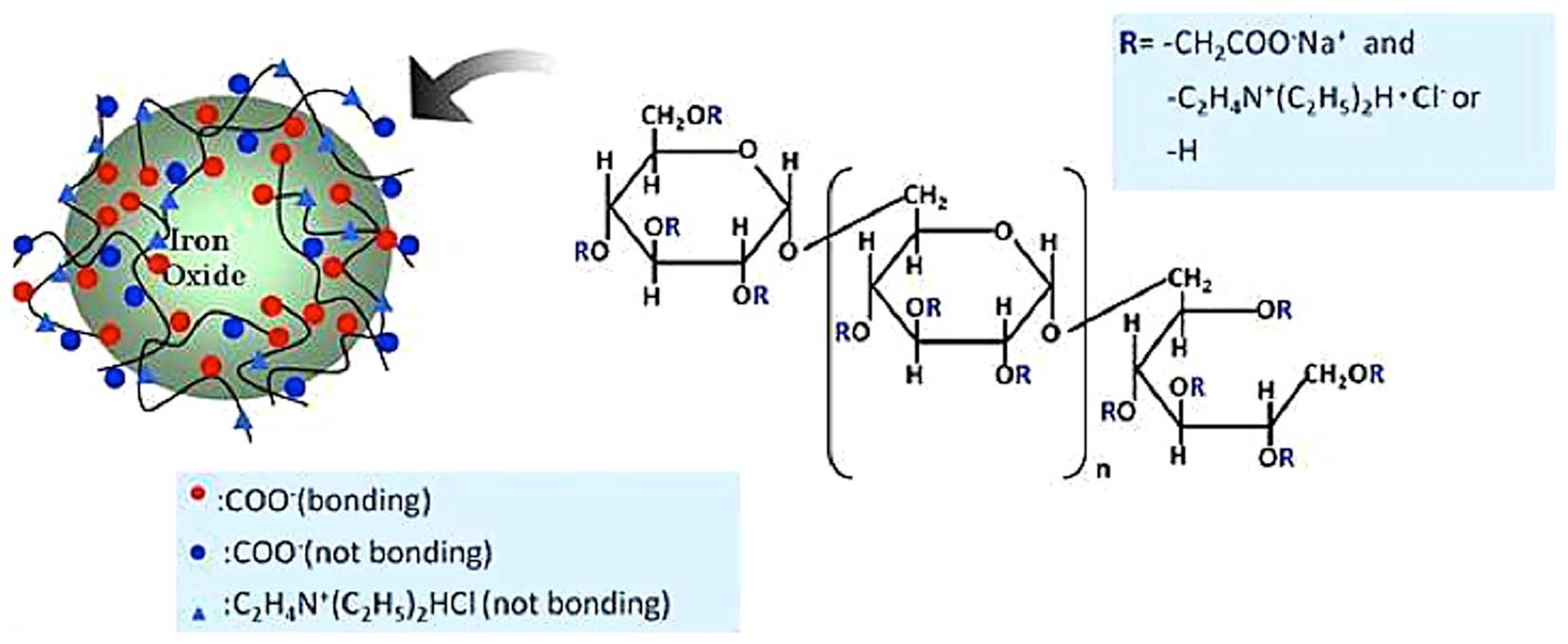
Xiao et al (7) and Nitta et al (8–10) reported a novel, long-circulating blood-pooling contrast agent, which involved iron-based substances. Nitta et al synthesized carboxymethyl-diethylaminoethyl dextran magnetite (CMEADM) particles (8–10) and used this Gd-free contrast agent in experimental magnetic resonance imaging (MRI) studies (8,9). As with superparamagnetic iron-oxide nanoparticles (SPIOs) and USPIOs, CMEADM is based on iron-oxide. As CMEADM is coated with polymers, including dextran, to prevent aggregation, its pooling time in blood vessels is longer, compared with USPIO (11–13), and its surface carries a negative or a positive charge due to the binding of amino and carboxyl groups to the hydroxyl group of dextran (Fig. 1). The present study evaluated whether the degree of charge on CMEADM altered the blood pooling time in rabbits.

Figure 1.

Surface of carboxymethyl-diethylaminoethyl dextran magnetite particles carries either a negative or positive charge due to the binding of amino and carboxyl groups to the hydroxyl group of dextran.

Materials and methods

Animals

All experiments were approved in advance by the ethical animal experiments committee of Shiga University of Medical Science (Otsu, Japan), and performed according to the Animal Care Guidelines of Shiga University of Medical Science. Female Japanese white rabbits (3.0 kg) were purchased from Japan SLC, Inc. (Tokyo, Japan). Prior to each MRI session, the rabbits were anesthetized with intramuscular injections of a mixture of ketaminehydrochloride (25 mg/kg Ketalar 50; Sankyo Yell Yakuhin Co., Ltd., Tokyo, Japan) and medetomidine hydrochloride (0.1 mg/kg; Domitor; Meiji Seika Co., Ltd., Tokyo, Japan). All animals were housed in a temperature-controlled room (24±1°C) on a 12-h light/12-h dark cycle. They had access to standard laboratory chow ad libitum.

A total of 12 Japanese white rabbits were randomly divided into four groups of three rabbits. The animals received an intravenous injection of 40 µmol Fe/kg of differently-charged CMEADM or USPIO (Table I).

Table I.

Properties of the injected differently charged CMEADM or USPIO contrast agents.

Table I.

Properties of the injected differently charged CMEADM or USPIO contrast agents.

Contrast agentParticle size (nm)Iron concentration (mg/ml)T2 relaxivity (r2: mM/s)T1 relaxivity (r1: mM/s)Surface charge (mV)
CMEADM−32.015.0114.034.0−10.4
CMEADM2−29.015.091.034.0−41.0
CMEADM+32.015.0106.033.09.6
USPIO28.015.095.034.0−11.5

[i] CMEADM, carboxymethyl-diethylaminoethyl dextran magnetite; USPIO, ultrasmall superparamagnetic iron-oxide nanoparticle.

Following pre-scanning, one of four types of iron nanoparticles, CMEADM−, CMEADM2− and CMEADM+ with surface charges of −10.4, −41.0, and +9.6 mV, respectively, or USPIO (−11.5 mV), was injected intravenously into the auricular vein. All contrast agents were obtained from Meito Sangyo Co., Ltd. (Tokyo, Japan). MRA images were obtained immediately following injection, and at 30, 60, 180 and 300 min post-injection.

MRI

MRI scanning was performed on a 1.5T MRI instrument (SIGNA Excite HDx; GE Healthcare Life Sciences, Shanghai, China) with a circularly polarized head coil and the following scanning parameters: 3D fast-spoiled gradient echo; repetition time, 9.0 ms; echo time, 1.4 ms; flip angle, 25°C; field-of-view, 320×240 mm; slice thickness, 1 mm; matrix, 256×256.

The relative signal enhancement, or relative signal intensity (SIrel), was measured at the abdominal aorta and the inferior vena cava (IVC) on 1-mm-thick coronal images. SIrel was calculated using the following formula:

SIrel = (SI post-contrast - SI pre-contrast / SI pre-contrast) × 100

These values were calculated by dividing the signal of the aorta or IVC by the background SI observed over time. Subsequent to the experiments, rabbits were sacrificed by injecting the heart with an overdose of pentobarbital (Dainippon Sumitomo Pharma Co., Ltd., Tokyo, Japan).

Statistical analysis

The results were analyzed by performing analysis of variance followed by Tukey's HSD test using IBM SPSS 20 statistical software (IBM SPSS, Armonk, NY, USA) for Windows. P<0.05 was considered to indicate a statistically significant difference.

Results

Visibility of vasculature

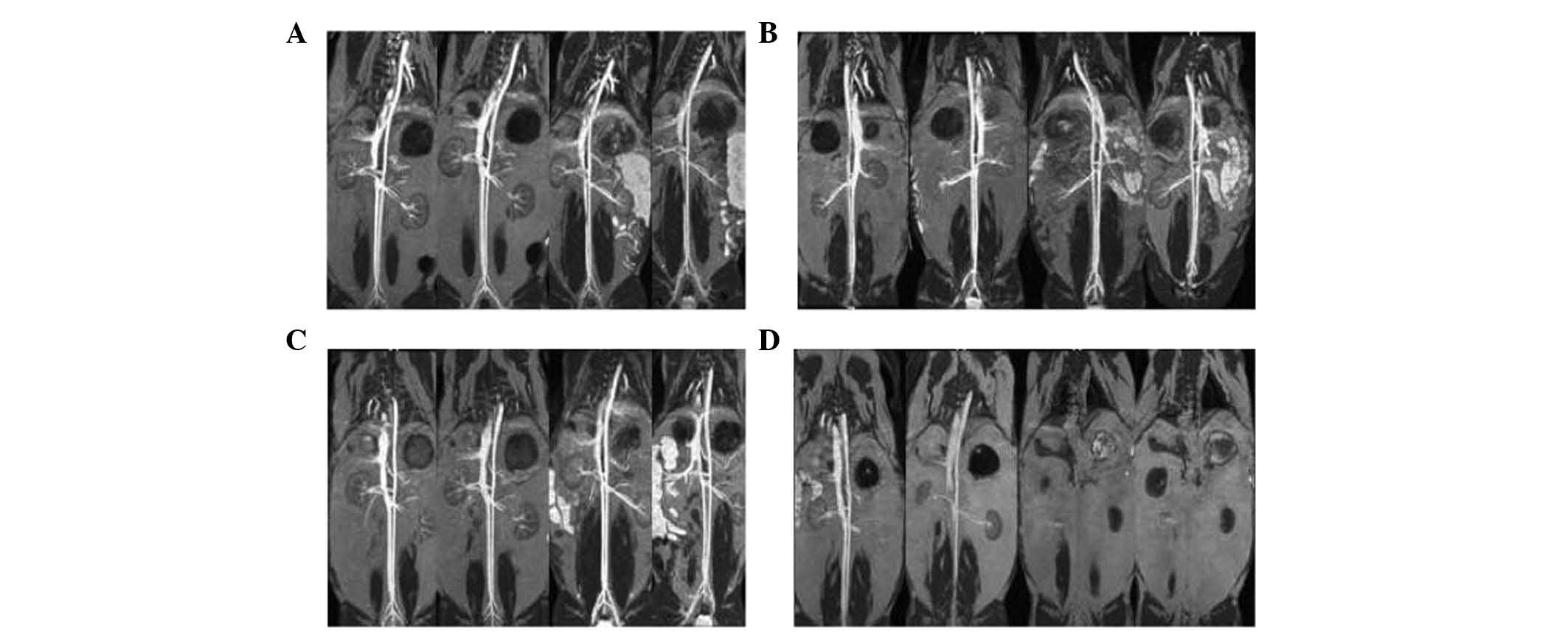
The vessels were clearly visualized. Compared with the group injected with USPIO, the thoracic and abdominal aorta, and the IVC manifested significantly higher SI values following the injection of the three types of CMEADM. Even at 300 min-post injection, the thoracic and abdominal aorta, and the IVC were clearly visible (Fig. 2).

Figure 2.

Vascular enhancement. On the magnetic resonance angiography images, the vascular enhancing effect persisted for up to 300 min with injections of (A) CMEADM−, (B) CMEADM2− and (C) CMEADM+. By contrast, with (D) conventional USPIO, intravascular signal intensity was markedly decreased and almost absent at 180 min. CMEADM, carboxymethyl-diethylaminoethyl dextran magnetite; USPIO, ultrasmall superparamagnetic iron-oxide nanoparticle.

Irrespective of their charge, with all three CMEADMs used in the present study, the vascular enhancing effect persisted for up to 300 min on the MRA images. By contrast, with the conventional USPIO, the intravascular SI was markedly decreased and had almost disappeared at 180 min.

Relative signal enhancement

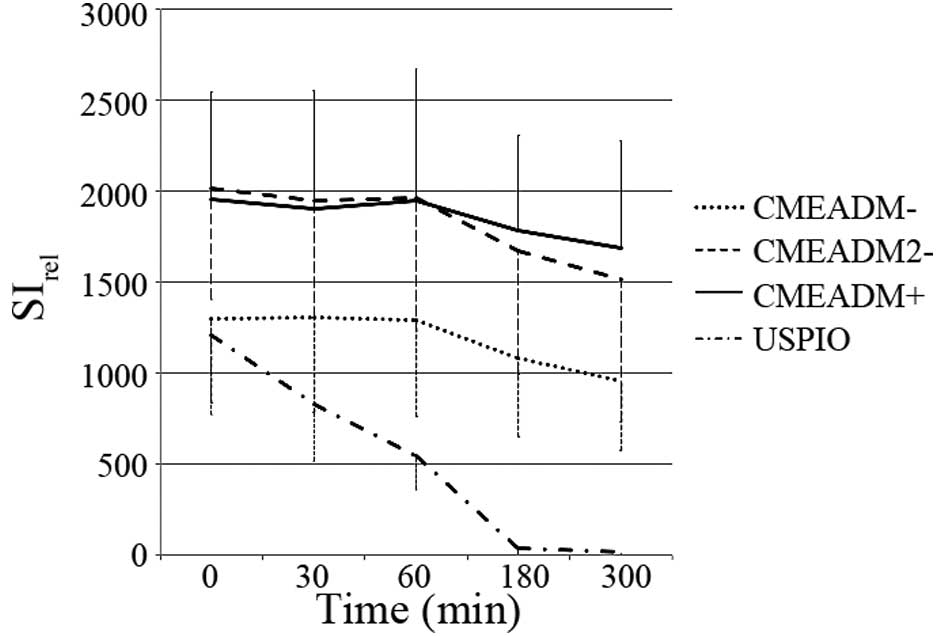
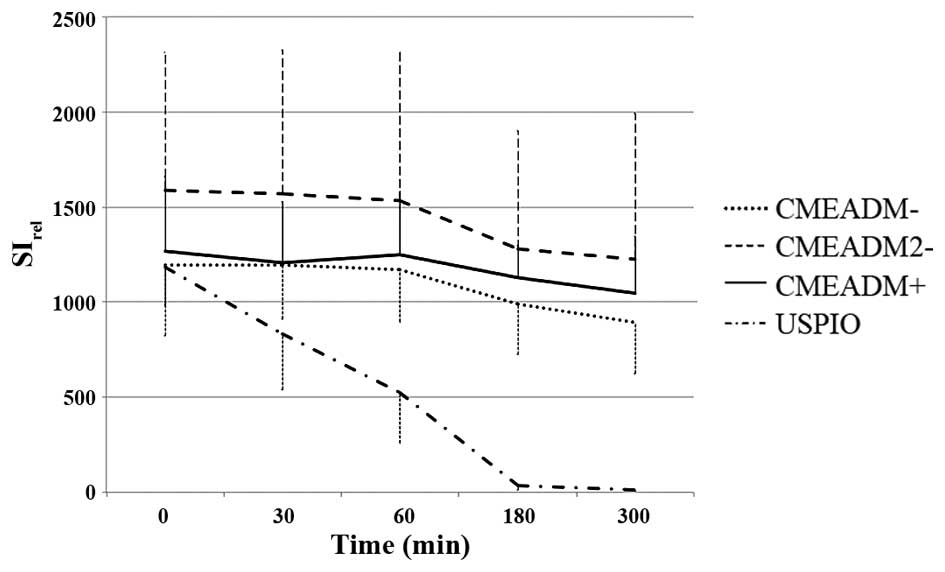
SIrel continued to be present in the abdominal aorta and IVC 30, 60, 180 and 300 min following the delivery of CMEADM−, CMEADM2− or CMEADM+ (Figs. 3 and 4). At 180 and 300 min, the elevation of SIrel persisted on all the CMEADM− images, but not on the USPIO images. No significant differences were found in the enhancing abilities of CMEADM−, CMEADM2− or CMEADM+ at 30 min post-injection.

Figure 3.

SIrel patterns in the aorta. In the aorta, the SIrel elicited by the three different CMEADMs remained high up to 60 min and then decreased. At 180 and 300 min, SIrel values were significantly higher in the CMEADM2− and CMEADM+ groups, compared with the USPIO group (P<0.05). Data are presented as the mean of the three rabbits in each group. SIrel, relative signal intensity; CMEADM, carboxymethyl-diethylaminoethyl dextran magnetite; USPIO, ultrasmall superparamagnetic iron-oxide nanoparticle.

Figure 4.

SIrel patterns in the IVC. SIrel patterns in the IVC were similar to those in the aorta. At 180 min, signal enhancement in the IVC was significantly higher in all charged CMEADMs groups, compared with the USPIO group (P<0.05). At 300 min, SIrel was significantly higher for CMEADM2−, compared with USPIO (P<0.05). Data are presented as the mean of the three rabbits in each group. SIrel, relative signal intensity; IVC, inferior vena cava; CMEADM, carboxymethyl-diethylaminoethyl dextran magnetite; USPIO, ultrasmall superparamagnetic iron-oxide nanoparticle.

Discussion

The present study compared standard USPIO and CMEADMs for their efficacy as blood-pooling MR contrast agents. All three differently-charged CMEADMs (CMEADMU−, CMEADMU2− and CMEADMU+) elicited a sufficiently prolonged vascular enhancing effect in the rabbits. Investigations are underway to determine whether these contrast agents qualify as novel blood-pooling MR contrast agents in the clinical setting.

The present study documented that, with the newly synthesized iron nanoparticles, CMEADM, the retention of SIrel in the blood vessels of the rabbits was prolonged. As these agents are Gd-free, they can be used in patients with renal impairment, including stage 4 or 5 chronic kidney disease (glomerular filtration rate <30 ml/min per 1.73 m2), who may be at risk for NSF when Gd agents are used. Although the injection of iron oxide nanoparticles may elicit cellular disorders, they may represent an alternative contrast agent for use in patients with renal impairment (14).

Conventional USPIOs have been used as negative contrast agents. However, as documented in the present study, their pooling time was shorter, compared with the durations observed in the CMEADM groups. Smaller particles are less likely to be phagocytized, compared with large particles (11,13,15), however, the sizes of CMEADM and USPIO particles are similar. According to Jo et al (16). iron oxide nanoparticles with positive surface potential interact ionically with the cell surface as it is negatively charged. Consequently, the cell internalization of nanoparticles is increased.

The present study hypothesized that the negatively charged surface may affect the pooling time as a result of the decreased likelihood of phagocytosis. The charge of the USPIO in the present study was −11.5 mV. The present study synthesized three types of CMEADM with a similar charge of −10.4 mV (CMEADM−), a lower charge of 9.6 mV (CMEADM+) and a higher charge of −41.0 mV (CMEADM2+), compared with that of USPIO, and calculated their SIrel values. It was found that with all three types of CMEADM, irrespective of their charge, the blood-pooling time was prolonged. This suggested that their surface charge, whether positive or negative, did not affect the pooling time.

Iron nanoparticles, including USPIOs, are phagocytized in the liver and spleen, and metabolized via the same metabolic pathway as hemoglobin iron. However, although CMEADM may be metabolized via a similar pathway, these particles are different from conventional USPIOs, as the iron in CMEADM is covered by an increased quantity of dextran. It may be possible to retard their clearance from vessels by rendering their surface hydrophilic with poloxamers and poloxamines, including dextran (17). Covering CMEADM particles with dextran may reduce their recognition by phagocytes and/or their entrapment by Kupffer cells (8,18). The superior pooling time of CMEADMs in the blood stream may reflect a hydrophilic effect, and investigations are underway to determine whether this is the case.

CMEADM particles are considered to have a longer half-life, compared with USPIOs, and may be more useful for long-term angiographic investigations in humans. Due to the long pooling time of CMEAD in vessels, a single administration of the agent may suffice for the pre- and post-procedure angiographic evaluation of patients undergoing percutaneous transluminal angioplasty of coronary arteries, stent placement (percutaneous coronary intervention) or aortic stent grafting (8). In addition, MRI examinations using CMEADM agents may be used for the diagnosis of patients with intermittent gastrointestinal bleeding. Although Gd contrast agents may elicit complications, including NSF, to the best of our knowledge, there have been no reports of patients with serious adverse effects elicited by the administration of iron nanoparticles to date.

The present study had a number of limitations. First, the number of rabbits included in the investigation was small. However, it was of a sufficient size to enable assessment of statistical significance, and the prolonged enhancement effect of CMEADM 180 min post-injection was clearly demonstrated. Therefore, the number of rabbits used was deemed sufficient to support the conclusions. Second, it was not possible to compare the CMEADM with emerging non-contrast MRA techniques, including quiescent-interval single-shot MRA, with respect to vessel visualization (19). Third, the present study found that visually confirmed vascular enhancement persisted for up to 300 min. This may raise concerns regarding the wash-out kinetics of these agents. Although these agents do not elicit NSF or other renal complications, for example long elimination time, this is a significant limitation. Fourth, CMEADM particles are covered with an increased quantity of dextran, compared with USPIO. The dextran used for particle covering is the same substance used for ferucarbotran. Although the present study suggested that the use of CMEADM is safe, in rare instances, dextran has been reported to elicit severe anaphylactic reactions (20). Consequently, the safety of CMEADM requires further elucidation. Investigations are underway to determine the elimination routes and kinetics, and to obtain quantitative data.

References

1 

Allkemper T, Bremer C, Matuszewski L, Ebert W and Reimer P: Contrast-enhanced blood-pool MR angiography with optimized iron oxides: Effect of size and dose on vascular contrast enhancement in rabbits. Radiology. 223:432–438. 2002. View Article : Google Scholar : PubMed/NCBI

2 

Bremerich J, Bilecen D and Reimer P: MR angiography with blood pool contrast agents. Eur Radiol. 17:3017–3024. 2007. View Article : Google Scholar : PubMed/NCBI

3 

Leung K: Ultrasmall superparamagnetic iron oxide nanoparticles conjugated with Ile-Pro-Leu-Pro-Phe-Tyr-AsnMolecular imaging and contrast agent database (MICAD). Bethesda (MD): Fed. 23–2010

4 

Bryson J, Reineke JW and Reineke TM: Macromolecular imaging agents containing lanthanides: Can conceptual promise lead to clinical potential? Macromolecules. 45:8939–8952. 2012. View Article : Google Scholar : PubMed/NCBI

5 

Grist TM, Korosec FR, Peters DC, Witte S, Walovitch RC, Dolan RP, Bridson WE, Yucel EK and Mistretta CA: Steady-state and dynamic MR angiography with MS-325: Initial experience in humans. Radiology. 207:539–544. 1998. View Article : Google Scholar : PubMed/NCBI

6 

Weller A, Barber JL and Olsen OE: Gadolinium and nephrogenic systemic fibrosis: An update. Pediatr Nephrol. 29:1927–1937. 2014. View Article : Google Scholar : PubMed/NCBI

7 

Xiao W, Lin J, Li M, Ma Y, Chen Y, Zhang C, Li D and Gu H: Prolonged in vivo circulation time by zwitterionic modification of magnetite nanoparticles for blood pool contrast agents. Contrast Media Mol Imaging. 7:320–327. 2012. View Article : Google Scholar : PubMed/NCBI

8 

Nitta N, Tsuchiya K, Sonoda A, Ota S, Ushio N, Takahashi M, Murata K and Nohara S: Negatively charged superparamagnetic iron oxide nanoparticles: A new blood-pooling magnetic resonance contrast agent. Jpn J Radiol. 30:832–839. 2012. View Article : Google Scholar : PubMed/NCBI

9 

Tsuchiya K, Nitta N, Sonoda A, Nitta-Seko A, Ohta S, Takahashi M, Murata K, Mukaisho K, Shiomi M, Tabata Y and Nohara S: Evaluation of atherosclerotic lesions using dextran- and mannan-dextran-coated USPIO: MRI analysis and pathological findings. Int J Nanomedicine. 7:2271–2280. 2012. View Article : Google Scholar : PubMed/NCBI

10 

Tsuchiya K, Nitta N, Sonoda A, Otani H, Takahashi M, Murata K, Shiomi M, Tabata Y and Nohara S: Atherosclerotic imaging using 4 types of superparamagnetic iron oxides: New possibilities for mannan-coated particles. Eur J Radiol. 82:1919–1925. 2013. View Article : Google Scholar : PubMed/NCBI

11 

Arbab AS, Liu W and Frank JA: Cellular magnetic resonance imaging: Current status and future prospects. Expert Rev Med Devices. 3:427–439. 2006. View Article : Google Scholar : PubMed/NCBI

12 

Kawaguchi T, Hanaichi T, Hasegawa M and Maruno S: Dextran-magnetite complex: Conformation of dextran chains and stability of solution. J Mater Sci Mater Med. 12:121–127. 2001. View Article : Google Scholar : PubMed/NCBI

13 

Raynal I, Prigent P, Peyramaure S, Najid A, Rebuzzi C and Corot C: Macrophage endocytosis of superparamagnetic iron oxide nanoparticles: Mechanisms and comparison of ferumoxides and ferumoxtran-10. Invest Radiol. 39:56–63. 2004. View Article : Google Scholar : PubMed/NCBI

14 

Neuwelt EA, Hamilton BE, Varallyay CG, Rooney WR, Edelman RD, Jacobs PM and Watnick SG: Ultrasmall superparamagnetic iron oxides (USPIOs): A future alternative magnetic resonance (MR) contrast agent for patients at risk for nephrogenic systemic fibrosis (NSF)? Kidney Int. 75:465–474. 2009. View Article : Google Scholar : PubMed/NCBI

15 

Corot C, Port M, Guibert I, Robert P, Raynal I, Robic C, Raynaud JS, Prigent P, Dencausse A, et al: Superparamagnetic contrast agents. 1st. London: CRC Press; pp. 59–84. 2007

16 

Jo J, Aoki I and Tabata Y: Design of iron oxide nanoparticles with different sizes and surface charges for simple and efficient labeling of mesenchymal stem cells. J Control Release. 142:465–473. 2010. View Article : Google Scholar : PubMed/NCBI

17 

Gaur U, Sahoo SK, De TK, Ghosh PC, Maitra A and Ghosh PK: Biodistribution of fluoresceinated dextran using novel nanoparticles evading reticuloendothelial system. Int J Pharm. 202:1–10. 2000. View Article : Google Scholar : PubMed/NCBI

18 

Bulte JW and Kraitchman DL: Iron oxide MR contrast agents for molecular and cellular imaging. NMR Biomed. 17:484–499. 2004. View Article : Google Scholar : PubMed/NCBI

19 

Klasen J, Blondin D, Schmitt P, Bi X, Sansone R, Wittsack HJ, Kröpil P, Quentin M, Kuhlemann J, Miese F, et al: Nonenhanced ECG-gated quiescent-interval single-shot MRA (QISS-MRA) of the lower extremities: Comparison with contrast-enhanced MRA. Clin Radiol. 67:441–446. 2012. View Article : Google Scholar : PubMed/NCBI

20 

Vaage-Nilsen O: Acute, severe and anaphylactoid reactions are very rare with low-molecular-weight iron dextran, CosmoFer. Nephrol Dial Transplant. 23:33722008. View Article : Google Scholar : PubMed/NCBI

Related Articles

  • Abstract
  • View
  • Download
  • Twitter
Copy and paste a formatted citation
Spandidos Publications style
Sonoda A, Nitta N, Tsuchiya K, Nitta‑Seko A, Ohta S, Otani H and Murata K: A novel blood-pooling MR contrast agent: Carboxymethyl-diethylaminoethyl dextran magnetite. Mol Med Rep 14: 5195-5198, 2016.
APA
Sonoda, A., Nitta, N., Tsuchiya, K., Nitta‑Seko, A., Ohta, S., Otani, H., & Murata, K. (2016). A novel blood-pooling MR contrast agent: Carboxymethyl-diethylaminoethyl dextran magnetite. Molecular Medicine Reports, 14, 5195-5198. https://doi.org/10.3892/mmr.2016.5874
MLA
Sonoda, A., Nitta, N., Tsuchiya, K., Nitta‑Seko, A., Ohta, S., Otani, H., Murata, K."A novel blood-pooling MR contrast agent: Carboxymethyl-diethylaminoethyl dextran magnetite". Molecular Medicine Reports 14.6 (2016): 5195-5198.
Chicago
Sonoda, A., Nitta, N., Tsuchiya, K., Nitta‑Seko, A., Ohta, S., Otani, H., Murata, K."A novel blood-pooling MR contrast agent: Carboxymethyl-diethylaminoethyl dextran magnetite". Molecular Medicine Reports 14, no. 6 (2016): 5195-5198. https://doi.org/10.3892/mmr.2016.5874
Copy and paste a formatted citation
x
Spandidos Publications style
Sonoda A, Nitta N, Tsuchiya K, Nitta‑Seko A, Ohta S, Otani H and Murata K: A novel blood-pooling MR contrast agent: Carboxymethyl-diethylaminoethyl dextran magnetite. Mol Med Rep 14: 5195-5198, 2016.
APA
Sonoda, A., Nitta, N., Tsuchiya, K., Nitta‑Seko, A., Ohta, S., Otani, H., & Murata, K. (2016). A novel blood-pooling MR contrast agent: Carboxymethyl-diethylaminoethyl dextran magnetite. Molecular Medicine Reports, 14, 5195-5198. https://doi.org/10.3892/mmr.2016.5874
MLA
Sonoda, A., Nitta, N., Tsuchiya, K., Nitta‑Seko, A., Ohta, S., Otani, H., Murata, K."A novel blood-pooling MR contrast agent: Carboxymethyl-diethylaminoethyl dextran magnetite". Molecular Medicine Reports 14.6 (2016): 5195-5198.
Chicago
Sonoda, A., Nitta, N., Tsuchiya, K., Nitta‑Seko, A., Ohta, S., Otani, H., Murata, K."A novel blood-pooling MR contrast agent: Carboxymethyl-diethylaminoethyl dextran magnetite". Molecular Medicine Reports 14, no. 6 (2016): 5195-5198. https://doi.org/10.3892/mmr.2016.5874
Follow us
  • Twitter
  • LinkedIn
  • Facebook
About
  • Spandidos Publications
  • Careers
  • Cookie Policy
  • Privacy Policy
How can we help?
  • Help
  • Live Chat
  • Contact
  • Email to our Support Team