Spandidos Publications Logo
  • About
    • About Spandidos
    • Aims and Scopes
    • Abstracting and Indexing
    • Editorial Policies
    • Reprints and Permissions
    • Job Opportunities
    • Terms and Conditions
    • Contact
  • Journals
    • All Journals
    • Oncology Letters
      • Oncology Letters
      • Information for Authors
      • Editorial Policies
      • Editorial Board
      • Aims and Scope
      • Abstracting and Indexing
      • Bibliographic Information
      • Archive
    • International Journal of Oncology
      • International Journal of Oncology
      • Information for Authors
      • Editorial Policies
      • Editorial Board
      • Aims and Scope
      • Abstracting and Indexing
      • Bibliographic Information
      • Archive
    • Molecular and Clinical Oncology
      • Molecular and Clinical Oncology
      • Information for Authors
      • Editorial Policies
      • Editorial Board
      • Aims and Scope
      • Abstracting and Indexing
      • Bibliographic Information
      • Archive
    • Experimental and Therapeutic Medicine
      • Experimental and Therapeutic Medicine
      • Information for Authors
      • Editorial Policies
      • Editorial Board
      • Aims and Scope
      • Abstracting and Indexing
      • Bibliographic Information
      • Archive
    • International Journal of Molecular Medicine
      • International Journal of Molecular Medicine
      • Information for Authors
      • Editorial Policies
      • Editorial Board
      • Aims and Scope
      • Abstracting and Indexing
      • Bibliographic Information
      • Archive
    • Biomedical Reports
      • Biomedical Reports
      • Information for Authors
      • Editorial Policies
      • Editorial Board
      • Aims and Scope
      • Abstracting and Indexing
      • Bibliographic Information
      • Archive
    • Oncology Reports
      • Oncology Reports
      • Information for Authors
      • Editorial Policies
      • Editorial Board
      • Aims and Scope
      • Abstracting and Indexing
      • Bibliographic Information
      • Archive
    • Molecular Medicine Reports
      • Molecular Medicine Reports
      • Information for Authors
      • Editorial Policies
      • Editorial Board
      • Aims and Scope
      • Abstracting and Indexing
      • Bibliographic Information
      • Archive
    • World Academy of Sciences Journal
      • World Academy of Sciences Journal
      • Information for Authors
      • Editorial Policies
      • Editorial Board
      • Aims and Scope
      • Abstracting and Indexing
      • Bibliographic Information
      • Archive
    • International Journal of Functional Nutrition
      • International Journal of Functional Nutrition
      • Information for Authors
      • Editorial Policies
      • Editorial Board
      • Aims and Scope
      • Abstracting and Indexing
      • Bibliographic Information
      • Archive
    • International Journal of Epigenetics
      • International Journal of Epigenetics
      • Information for Authors
      • Editorial Policies
      • Editorial Board
      • Aims and Scope
      • Abstracting and Indexing
      • Bibliographic Information
      • Archive
    • Medicine International
      • Medicine International
      • Information for Authors
      • Editorial Policies
      • Editorial Board
      • Aims and Scope
      • Abstracting and Indexing
      • Bibliographic Information
      • Archive
  • Articles
  • Information
    • Information for Authors
    • Information for Reviewers
    • Information for Librarians
    • Information for Advertisers
    • Conferences
  • Language Editing
Spandidos Publications Logo
  • About
    • About Spandidos
    • Aims and Scopes
    • Abstracting and Indexing
    • Editorial Policies
    • Reprints and Permissions
    • Job Opportunities
    • Terms and Conditions
    • Contact
  • Journals
    • All Journals
    • Biomedical Reports
      • Information for Authors
      • Editorial Policies
      • Editorial Board
      • Aims and Scope
      • Abstracting and Indexing
      • Bibliographic Information
      • Archive
    • Experimental and Therapeutic Medicine
      • Information for Authors
      • Editorial Policies
      • Editorial Board
      • Aims and Scope
      • Abstracting and Indexing
      • Bibliographic Information
      • Archive
    • International Journal of Epigenetics
      • Information for Authors
      • Editorial Policies
      • Editorial Board
      • Aims and Scope
      • Abstracting and Indexing
      • Bibliographic Information
      • Archive
    • International Journal of Functional Nutrition
      • Information for Authors
      • Editorial Policies
      • Editorial Board
      • Aims and Scope
      • Abstracting and Indexing
      • Bibliographic Information
      • Archive
    • International Journal of Molecular Medicine
      • Information for Authors
      • Editorial Policies
      • Editorial Board
      • Aims and Scope
      • Abstracting and Indexing
      • Bibliographic Information
      • Archive
    • International Journal of Oncology
      • Information for Authors
      • Editorial Policies
      • Editorial Board
      • Aims and Scope
      • Abstracting and Indexing
      • Bibliographic Information
      • Archive
    • Medicine International
      • Information for Authors
      • Editorial Policies
      • Editorial Board
      • Aims and Scope
      • Abstracting and Indexing
      • Bibliographic Information
      • Archive
    • Molecular and Clinical Oncology
      • Information for Authors
      • Editorial Policies
      • Editorial Board
      • Aims and Scope
      • Abstracting and Indexing
      • Bibliographic Information
      • Archive
    • Molecular Medicine Reports
      • Information for Authors
      • Editorial Policies
      • Editorial Board
      • Aims and Scope
      • Abstracting and Indexing
      • Bibliographic Information
      • Archive
    • Oncology Letters
      • Information for Authors
      • Editorial Policies
      • Editorial Board
      • Aims and Scope
      • Abstracting and Indexing
      • Bibliographic Information
      • Archive
    • Oncology Reports
      • Information for Authors
      • Editorial Policies
      • Editorial Board
      • Aims and Scope
      • Abstracting and Indexing
      • Bibliographic Information
      • Archive
    • World Academy of Sciences Journal
      • Information for Authors
      • Editorial Policies
      • Editorial Board
      • Aims and Scope
      • Abstracting and Indexing
      • Bibliographic Information
      • Archive
  • Articles
  • Information
    • For Authors
    • For Reviewers
    • For Librarians
    • For Advertisers
    • Conferences
  • Language Editing
Login Register Submit
  • This site uses cookies
  • You can change your cookie settings at any time by following the instructions in our Cookie Policy. To find out more, you may read our Privacy Policy.

    I agree
Search articles by DOI, keyword, author or affiliation
Search
Advanced Search
presentation
Molecular Medicine Reports
Join Editorial Board Propose a Special Issue
Print ISSN: 1791-2997 Online ISSN: 1791-3004
Journal Cover
February-2017 Volume 15 Issue 2

Full Size Image

Sign up for eToc alerts
Recommend to Library

Journals

International Journal of Molecular Medicine

International Journal of Molecular Medicine

International Journal of Molecular Medicine is an international journal devoted to molecular mechanisms of human disease.

International Journal of Oncology

International Journal of Oncology

International Journal of Oncology is an international journal devoted to oncology research and cancer treatment.

Molecular Medicine Reports

Molecular Medicine Reports

Covers molecular medicine topics such as pharmacology, pathology, genetics, neuroscience, infectious diseases, molecular cardiology, and molecular surgery.

Oncology Reports

Oncology Reports

Oncology Reports is an international journal devoted to fundamental and applied research in Oncology.

Experimental and Therapeutic Medicine

Experimental and Therapeutic Medicine

Experimental and Therapeutic Medicine is an international journal devoted to laboratory and clinical medicine.

Oncology Letters

Oncology Letters

Oncology Letters is an international journal devoted to Experimental and Clinical Oncology.

Biomedical Reports

Biomedical Reports

Explores a wide range of biological and medical fields, including pharmacology, genetics, microbiology, neuroscience, and molecular cardiology.

Molecular and Clinical Oncology

Molecular and Clinical Oncology

International journal addressing all aspects of oncology research, from tumorigenesis and oncogenes to chemotherapy and metastasis.

World Academy of Sciences Journal

World Academy of Sciences Journal

Multidisciplinary open-access journal spanning biochemistry, genetics, neuroscience, environmental health, and synthetic biology.

International Journal of Functional Nutrition

International Journal of Functional Nutrition

Open-access journal combining biochemistry, pharmacology, immunology, and genetics to advance health through functional nutrition.

International Journal of Epigenetics

International Journal of Epigenetics

Publishes open-access research on using epigenetics to advance understanding and treatment of human disease.

Medicine International

Medicine International

An International Open Access Journal Devoted to General Medicine.

Journal Cover
February-2017 Volume 15 Issue 2

Full Size Image

Sign up for eToc alerts
Recommend to Library

  • Article
  • Citations
    • Cite This Article
    • Download Citation
    • Create Citation Alert
    • Remove Citation Alert
    • Cited By
  • Similar Articles
    • Related Articles (in Spandidos Publications)
    • Similar Articles (Google Scholar)
    • Similar Articles (PubMed)
  • Download PDF
  • Download XML
  • View XML
Article

Role of tRNA selenocysteine 1 associated protein 1 in the proliferation and apoptosis of cardiomyocyte‑like H9c2 cells

  • Authors:
    • Meng‑Di Li
    • Wan‑Peng Cheng
    • Min‑Xia Shi
    • Tang‑Dong Ge
    • Xiao‑Lin Zheng
    • Dong‑Yuan Wu
    • Xiao‑Yan Hu
    • Jin‑Cheng Luo
    • Feng‑Lan Li
    • Hui Li
  • View Affiliations / Copyright

    Affiliations: Department of Biochemistry and Molecular Biology, Harbin Medical University, Harbin, Heilongjiang 150081, P.R. China
  • Pages: 988-994
    |
    Published online on: December 30, 2016
       https://doi.org/10.3892/mmr.2016.6099
  • Expand metrics +
Metrics: Total Views: 0 (Spandidos Publications: | PMC Statistics: )
Metrics: Total PDF Downloads: 0 (Spandidos Publications: | PMC Statistics: )
Cited By (CrossRef): 0 citations Loading Articles...

This article is mentioned in:


Abstract

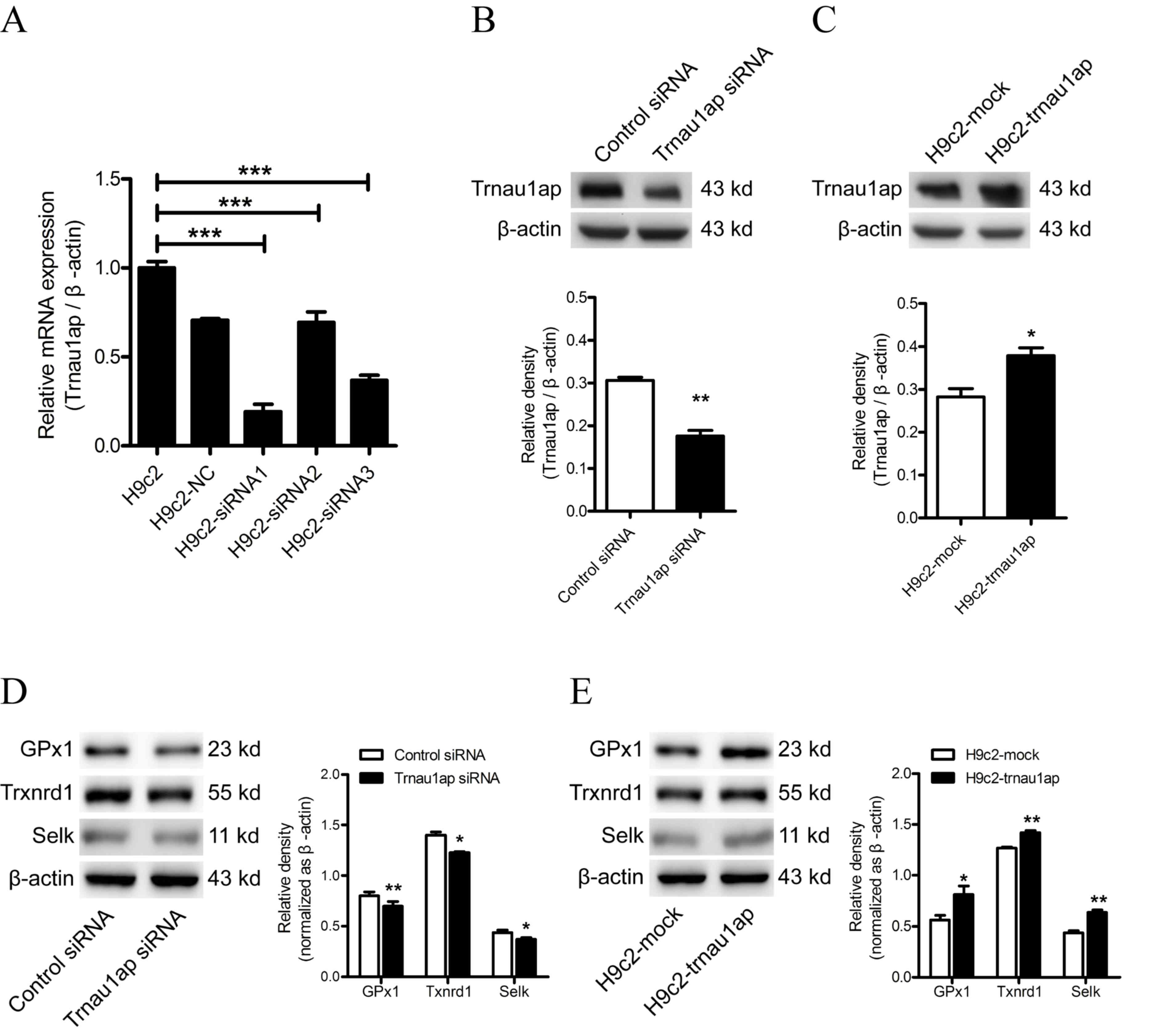
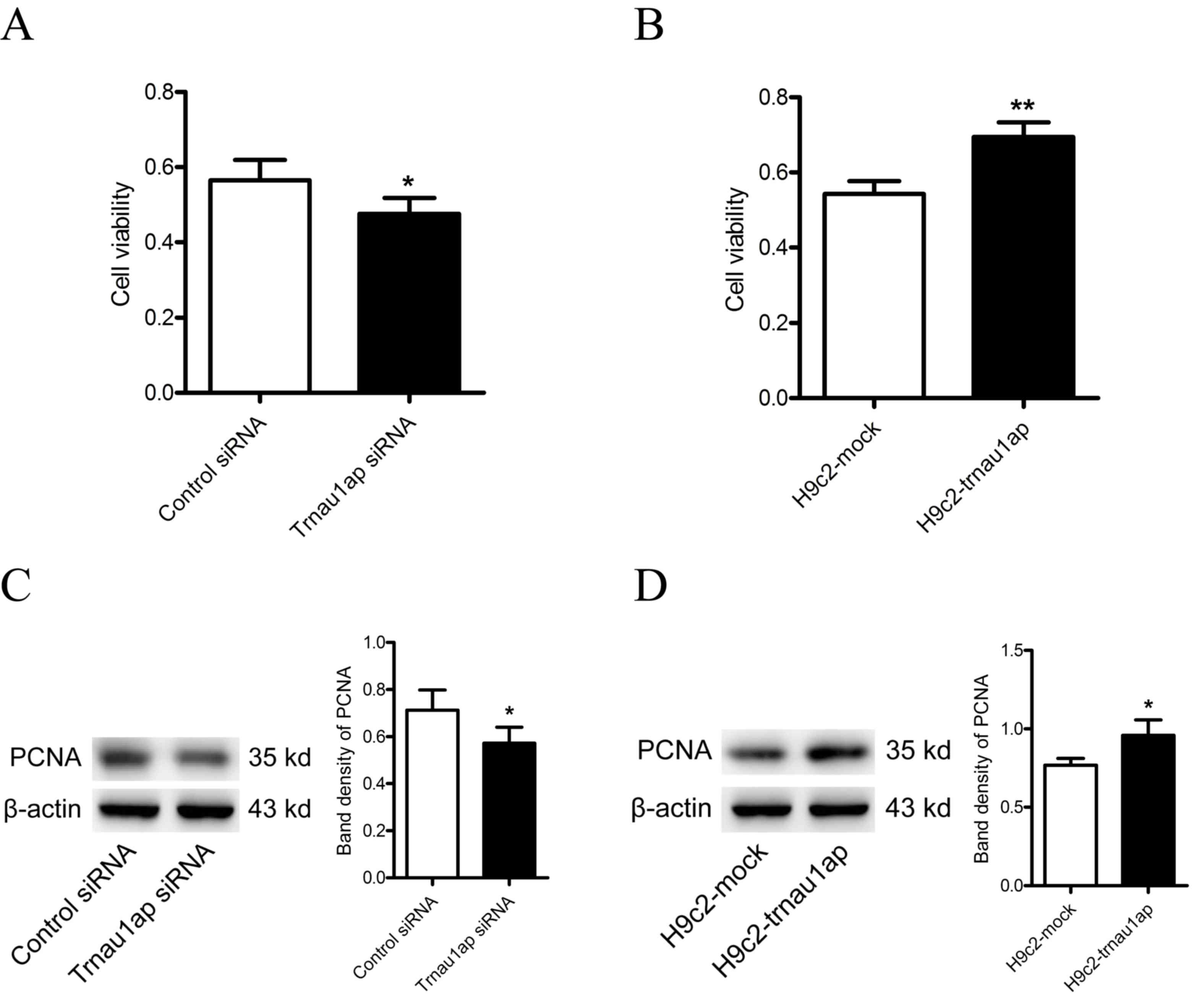
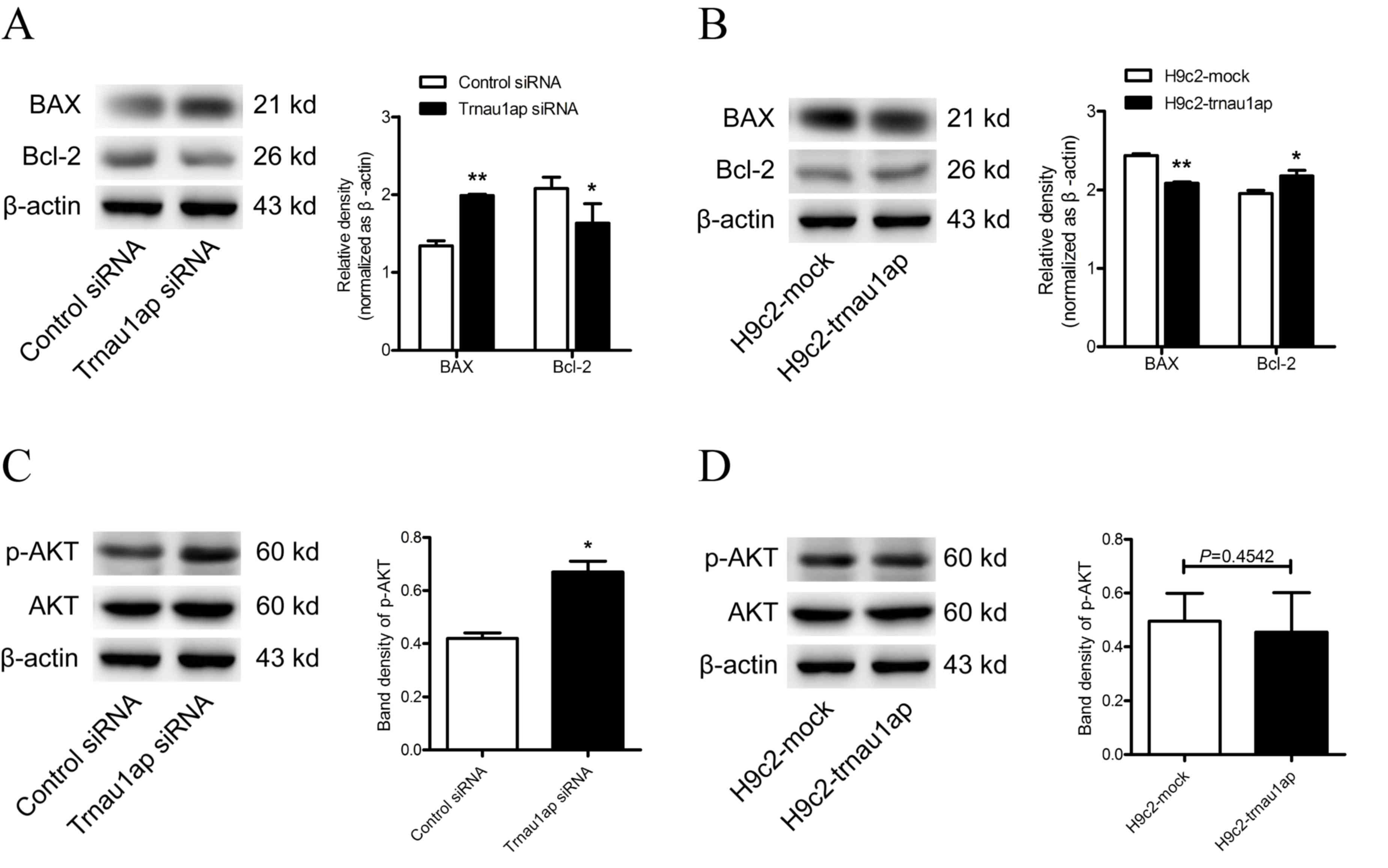
Transfer RNA selenocysteine 1 associated protein 1 (Trnau1ap) serves an essential role in the synthesis of selenoproteins, which have critical functions in numerous biological processes. Selenium deficiency results in a variety of diseases, including cardiac disease. However, the mechanisms underlying myocardial injury induced by selenium deficiency remain unclear. The present study examined the effects of Trnau1ap under‑ and overexpression in cardiomyocyte‑like H9c2 cells, by transfection with small interfering RNA and an overexpression plasmid, respectively. Expression levels of glutathione peroxidase, thioredoxin reductase and selenoprotein K were decreased in Trnau1ap‑underexpressing cells, and increased in Trnau1ap‑overexpressing cells. Using MTT, proliferating cell nuclear antigen, annexin V and caspase‑3 activity assays, it was demonstrated that reducing Trnau1ap expression levels inhibited the proliferation of H9c2 cells and induced apoptosis. Conversely, increasing Trnau1ap expression levels promoted cell growth. Western blot analysis revealed that the phosphoinositide 3‑kinase/protein kinase B signaling pathway was activated in Trnau1ap‑underexpressing cells. Furthermore, the apoptotic pathway was activated in these cells, evidenced by relatively greater expression levels of B‑cell lymphoma (Bcl‑2)‑associated X protein and reduced expression levels of Bcl‑2. Taken together, these findings suggest that Trnau1ap serves a key role in the proliferation and apoptosis of H9c2 cells. The present study provides insight into the underlying mechanisms of myocardial injury induced by selenium deficiency.
View Figures

Figure 1

Figure 2

Figure 3

Figure 4

View References

1 

Lu J and Holmgren A: Selenoproteins. J Biol Chem. 284:723–727. 2009. View Article : Google Scholar : PubMed/NCBI

2 

Combs GF Jr: Biomarkers of selenium status. Nutrients. 7:2209–2236. 2015. View Article : Google Scholar : PubMed/NCBI

3 

Rayman MP: Selenium and human health. Lancet. 379:1256–1268. 2012. View Article : Google Scholar : PubMed/NCBI

4 

Mehdi Y, Hornick JL, Istasse L and Dufrasne I: Selenium in the environment, metabolism and involvement in body functions. Molecules. 18:3292–3311. 2013. View Article : Google Scholar : PubMed/NCBI

5 

Turanov AA, Xu XM, Carlson BA, Yoo MH, Gladyshev VN and Hatfield DL: Biosynthesis of selenocysteine, the 21st amino acid in the genetic code, and a novel pathway for cysteine biosynthesis. Adv Nutr. 2:122–128. 2011. View Article : Google Scholar : PubMed/NCBI

6 

Metanis N and Hilvert D: Natural and synthetic selenoproteins. Curr Opin Chem Biol. 22:27–34. 2014. View Article : Google Scholar : PubMed/NCBI

7 

Huang Z, Rose AH and Hoffmann PR: The role of selenium in inflammation and immunity: From molecular mechanisms to therapeutic opportunities. Antioxid Redox Signal. 16:705–743. 2012. View Article : Google Scholar : PubMed/NCBI

8 

Reeves MA and Hoffmann PR: The human selenoproteome: Recent insights into functions and regulation. Cell Mol Life Sci. 66:2457–2478. 2009. View Article : Google Scholar : PubMed/NCBI

9 

Diamond AM: The subcellular location of selenoproteins and the impact on their function. Nutrients. 7:3938–3948. 2015. View Article : Google Scholar : PubMed/NCBI

10 

Squires JE and Berry MJ: Eukaryotic selenoprotein synthesis: Mechanistic insight incorporating new factors and new functions for old factors. IUBMB Life. 60:232–235. 2008. View Article : Google Scholar : PubMed/NCBI

11 

Ding F and Grabowski PJ: Identification of a protein component of a mammalian tRNA(Sec) complex implicated in the decoding of UGA as selenocysteine. RNA. 5:1561–1569. 1999. View Article : Google Scholar : PubMed/NCBI

12 

Small-Howard A, Morozova N, Stoytcheva Z, Forry EP, Mansell JB, Harney JW, Carlson BA, Xu XM, Hatfield DL and Berry MJ: Supramolecular complexes mediate selenocysteine incorporation in vivo. Mol Cell Biol. 26:2337–2346. 2006. View Article : Google Scholar : PubMed/NCBI

13 

Papp LV, Lu J, Holmgren A and Khanna KK: From selenium to selenoproteins: Synthesis, identity, and their role in human health. Antioxid Redox Signal. 9:775–806. 2007. View Article : Google Scholar : PubMed/NCBI

14 

Xu XM, Mix H, Carlson BA, Grabowski PJ, Gladyshev VN, Berry MJ and Hatfield DL: Evidence for direct roles of two additional factors, SECp43 and soluble liver antigen, in the selenoprotein synthesis machinery. J Biol Chem. 280:41568–41575. 2005. View Article : Google Scholar : PubMed/NCBI

15 

Oropeza-Moe M, Wisløff H and Bernhoft A: Selenium deficiency associated porcine and human cardiomyopathies. J Trace Elem Med Biol. 31:148–156. 2015. View Article : Google Scholar : PubMed/NCBI

16 

Rose AH and Hoffmann PR: Selenoproteins and cardiovascular stress. Thromb Haemost. 113:494–504. 2015. View Article : Google Scholar : PubMed/NCBI

17 

Cui J, Zhong R, Chu E, Zhang XF, Zhang WG, Fang CF, Dong Q, Li FL and Li H: Correlation between oxidative stress and L-type calcium channel expression in the ventricular myocardia of selenium-deficient mice. J Int Med Res. 40:1677–1687. 2012. View Article : Google Scholar : PubMed/NCBI

18 

Livak KJ and Schmittgen TD: Analysis of relative gene expression data using real-time quantitative PCR and the 2(−Delta Delta C(T)) Method. Method. 25:402–408. 2001. View Article : Google Scholar

19 

Mahdi Y, Xu XM, Carlson BA, Fradejas N, Günter P, Braun D, Southon E, Tessarollo L, Hatfield DL and Schweizer U: Expression of selenoproteins is maintained in mice carrying mutations in SECp43, the tRNA selenocysteine 1 associated protein (Trnau1ap). PLoS One. 10:e01273492015. View Article : Google Scholar : PubMed/NCBI

20 

Wang SC: PCNA: A silent housekeeper or a potential therapeutic target? Trends Pharmacol Sci. 35:178–186. 2014. View Article : Google Scholar : PubMed/NCBI

21 

Moldovan GL, Pfander B and Jentsch S: PCNA, the maestro of the replication fork. Cell. 129:665–679. 2007. View Article : Google Scholar : PubMed/NCBI

22 

Ip C, Thompson HJ and Ganther HE: Selenium modulation of cell proliferation and cell cycle biomarkers in normal and premalignant cells of the rat mammary gland. Cancer Epidemiol Biomarkers Prev. 9:49–54. 2000.PubMed/NCBI

23 

Chen JH, Tsou TC, Chiu IM and Chou CC: Proliferation inhibition, DNA damage, and cell-cycle arrest of human astrocytoma cells after acrylamide exposure. Chem Res Toxicol. 23:1449–1458. 2010. View Article : Google Scholar : PubMed/NCBI

24 

Zeng H: Selenium as an essential micronutrient: Roles in cell cycle and apoptosis. Molecules. 14:1263–1278. 2009. View Article : Google Scholar : PubMed/NCBI

25 

Buettner GR: Superoxide dismutase in redox biology: The roles of superoxide and hydrogen peroxide. Anticancer Agents Med Chem. 11:341–346. 2011. View Article : Google Scholar : PubMed/NCBI

26 

Orrenius S, Gogvadze V and Zhivotovsky B: Calcium and mitochondria in the regulation of cell death. Biochem Biophys Res Commun. 460:72–81. 2015. View Article : Google Scholar : PubMed/NCBI

27 

Hotchkiss RS, Strasser A, McDunn JE and Swanson PE: Cell death in disease: Mechanisms and emerging therapeutic concepts. N Engl J Med. 361:1570–1583. 2009. View Article : Google Scholar : PubMed/NCBI

28 

Brenner D and Mak TW: Mitochondrial cell death effectors. Curr Opin Cell Biol. 21:871–877. 2009. View Article : Google Scholar : PubMed/NCBI

29 

Zhang X, Chen Y, Gao B, Luo D, Wen Y and Ma X: Apoptotic effect of koumine on human breast cancer cells and the mechanism involved. Cell Biochem Biophys. 72:411–416. 2015. View Article : Google Scholar : PubMed/NCBI

30 

Zhang WG, Chen L, Dong Q, He J, Zhao HD, Li FL and Li H: Mmu-miR-702 functions as an anti-apoptotic mirtron by mediating ATF6 inhibition in mice. Gene. 531:235–242. 2013. View Article : Google Scholar : PubMed/NCBI

31 

Zhang W, Yu J, Dong Q, Zhao H, Li F and Li H: A mutually beneficial relationship between hepatocytes and cardiomyocytes mitigates doxorubicin-induced toxicity. Toxicol Lett. 227:157–163. 2014. View Article : Google Scholar : PubMed/NCBI

32 

Sarada SK, Himadri P, Ruma D, Sharma SK and Pauline T: Mrinalini: Selenium protects the hypoxia induced apoptosis in neuroblastoma cells through upregulation of Bcl-2. Brain Res. 1209:29–39. 2008. View Article : Google Scholar : PubMed/NCBI

33 

Rafferty TS, Beckett GJ, Walker C, Bisset YC and McKenzie RC: Selenium protects primary human keratinocytes from apoptosis induced by exposure to ultraviolet radiation. Clin Exp Dermatol. 28:294–300. 2003. View Article : Google Scholar : PubMed/NCBI

34 

Burgering BM and Coffer PJ: Protein kinase B (c-Akt) in phosphatidylinositol-3-OH kinase signal transduction. Nature. 376:599–602. 1995. View Article : Google Scholar : PubMed/NCBI

35 

Franke TF, Yang SI, Chan TO, Datta K, Kazlauskas A, Morrison DK, Kaplan DR and Tsichlis PN: The protein kinase encoded by the Akt proto-oncogene is a target of the PDGF-activated phosphatidylinositol 3-kinase. Cell. 81:727–736. 1995. View Article : Google Scholar : PubMed/NCBI

36 

Martindale JL and Holbrook NJ: Cellular response to oxidative stress: Signaling for suicide and survival. J Cell Physiol. 192:1–15. 2002. View Article : Google Scholar : PubMed/NCBI

37 

Huang JQ, Ren FZ, Jiang YY, Xiao C and Lei XG: Selenoproteins protect against avian nutritional muscular dystrophy by metabolizing peroxides and regulating redox/apoptotic signaling. Free Radic Biol Med. 83:129–138. 2015. View Article : Google Scholar : PubMed/NCBI

Related Articles

  • Abstract
  • View
  • Download
  • Twitter
Copy and paste a formatted citation
Spandidos Publications style
Li MD, Cheng WP, Shi MX, Ge TD, Zheng XL, Wu DY, Hu XY, Luo JC, Li FL, Li H, Li H, et al: Role of tRNA selenocysteine 1 associated protein 1 in the proliferation and apoptosis of cardiomyocyte‑like H9c2 cells. Mol Med Rep 15: 988-994, 2017.
APA
Li, M., Cheng, W., Shi, M., Ge, T., Zheng, X., Wu, D. ... Li, H. (2017). Role of tRNA selenocysteine 1 associated protein 1 in the proliferation and apoptosis of cardiomyocyte‑like H9c2 cells. Molecular Medicine Reports, 15, 988-994. https://doi.org/10.3892/mmr.2016.6099
MLA
Li, M., Cheng, W., Shi, M., Ge, T., Zheng, X., Wu, D., Hu, X., Luo, J., Li, F., Li, H."Role of tRNA selenocysteine 1 associated protein 1 in the proliferation and apoptosis of cardiomyocyte‑like H9c2 cells". Molecular Medicine Reports 15.2 (2017): 988-994.
Chicago
Li, M., Cheng, W., Shi, M., Ge, T., Zheng, X., Wu, D., Hu, X., Luo, J., Li, F., Li, H."Role of tRNA selenocysteine 1 associated protein 1 in the proliferation and apoptosis of cardiomyocyte‑like H9c2 cells". Molecular Medicine Reports 15, no. 2 (2017): 988-994. https://doi.org/10.3892/mmr.2016.6099
Copy and paste a formatted citation
x
Spandidos Publications style
Li MD, Cheng WP, Shi MX, Ge TD, Zheng XL, Wu DY, Hu XY, Luo JC, Li FL, Li H, Li H, et al: Role of tRNA selenocysteine 1 associated protein 1 in the proliferation and apoptosis of cardiomyocyte‑like H9c2 cells. Mol Med Rep 15: 988-994, 2017.
APA
Li, M., Cheng, W., Shi, M., Ge, T., Zheng, X., Wu, D. ... Li, H. (2017). Role of tRNA selenocysteine 1 associated protein 1 in the proliferation and apoptosis of cardiomyocyte‑like H9c2 cells. Molecular Medicine Reports, 15, 988-994. https://doi.org/10.3892/mmr.2016.6099
MLA
Li, M., Cheng, W., Shi, M., Ge, T., Zheng, X., Wu, D., Hu, X., Luo, J., Li, F., Li, H."Role of tRNA selenocysteine 1 associated protein 1 in the proliferation and apoptosis of cardiomyocyte‑like H9c2 cells". Molecular Medicine Reports 15.2 (2017): 988-994.
Chicago
Li, M., Cheng, W., Shi, M., Ge, T., Zheng, X., Wu, D., Hu, X., Luo, J., Li, F., Li, H."Role of tRNA selenocysteine 1 associated protein 1 in the proliferation and apoptosis of cardiomyocyte‑like H9c2 cells". Molecular Medicine Reports 15, no. 2 (2017): 988-994. https://doi.org/10.3892/mmr.2016.6099
Follow us
  • Twitter
  • LinkedIn
  • Facebook
About
  • Spandidos Publications
  • Careers
  • Cookie Policy
  • Privacy Policy
How can we help?
  • Help
  • Live Chat
  • Contact
  • Email to our Support Team