Introduction
Colorectal cancer (CRC) is an important contributor
to cancer mortality and morbidity (1). It is estimated that ~50–60% of
patients diagnosed with CRC develop colorectal metastasis, which is
the primary cause of mortality (2). Several molecules that promote
metastasis have been investigated and considered as potential
useful tumor biomarkers, such as KRAS proto-oncogene, GTPase,
vascular endothelial growth factor and v-myc avian myelocytomatosis
viral oncogene homolog (3–5). The basic process of progression and
metastasis of CRC remains to be elucidated (6). Therefore, it is necessary to identify
novel gene targets and develop target-specific therapies for
CRC.
Tripartite motif containing 37 (TRIM37) is located
on chromosome 17q23, encoding a protein with an estimated molecular
weight of 130 kDa (7). TRIM37
contains a really interesting new gene (RING) finger domain, a
hallmark of E3 ubiquitin ligases, and a recent study determined
that histone H2A was a substrate (8). TRIM37 was also revealed to be
associated with polycomb repressive complex 2, and may lead to
extensive changes in gene expression, including the silencing of
some tumor suppressor genes (8).
Previous studies revealed that TRIM37 may undergo amplification in
ovarian cancer (9) and may promote
transformation in breast cancer (8). Additionally, the upregulation of
TRIM37 promoted the growth and migration of cancer cells of
pancreatic cancer (10). TRIM37
was also identified to be an independent prognostic factor of
hepatocellular carcinoma (HCC), and it may promote the migration
and metastasis of HCC cells by activation of Wnt/β-catenin
signaling (11). However, the
expression pattern and the biological functions of TRIM37 in CRC
remain to be elucidated.
Epithelial-mesenchymal transition (EMT) is a
critical step of metastasis, and is considered to facilitate tumor
invasion (12). In colon
carcinoma, EMT occurs at the invasive front, and produces single
migratory cells that lose E-cadherin expression (13). These cells are considered to be the
cells that eventually enter into subsequent steps of the
invasion-metastasis cascade, including intravasation, transport
through the circulation, extravasation, formation of
micrometastasis and, ultimately, colonization, the growth of small
colonies into macroscopic metastasis (14,15).
Several key proteins that regulate EMT have previously been
identified, such as snail family transcriptional repressor 1, twist
family bHLH transcription factor 1 and zinc finger E-box binding
homeobox 1 (16–18). However, the complex molecular
network and various steps of this mechanistic model require direct
experimental validation (19).
Therefore, in the present study, in vitro experiments were
performed by inducing overexpression and interference using short
hairpin RNA (shRNA) to determine that TRIM37 contributed to CRC
cell migration and invasion. In addition, in vitro
metastasis assays were performed in the present study, which
confirmed that the overexpression of TRIM37 increased the motility
of CRC cells via EMT signaling.
Materials and methods
Cell culture
SW480 and SW620 CRC cell lines were obtained from
the American Type Culture Collection (Manassas, VA, USA). Cells
were cultured in Dulbecco's modified Eagle's medium supplemented
with 10% fetal bovine serum (FBS), 100 U/ml penicillin and 100
µg/ml streptomycin, incubated at 37°C in a humidified incubator in
an atmosphere of 5% CO2. The cell culture media and
supplements were from Gibco; Thermo Fisher Scientific, Inc.
(Waltham, MA, USA).
Tissue samples
A total of 30 CRC tissues and paired non-cancerous
tissues were obtained from the Department of General Surgery,
Huashan Hospital (Shanghai, China). Written informed consent was
obtained from all patients. The protocol for the current study was
approved by the Human Research Ethics Committee of Huashan
Hospital. None of the patients with cancer received any treatment
prior to surgery, such as radiation therapy, chemotherapy or
immunotherapy. CRC tissues and paired non-cancerous tissues were
stored at −80°C until required for further processing.
Reverse transcription-quantitative
polymerase reaction (RT-qPCR)
Total RNA from 30 CRC cancer and adjacent
non-cancerous mucosa were extracted according to the manufacturer's
protocol using TRIzol® reagent (Invitrogen; Thermo
Fisher Scientific, Inc.). Total RNA was reverse-transcribed into
cDNA by PrimeScript® 1st Strand cDNA Synthesis kit
(Takara Biotechnology Company, Ltd., Dalian, China) and used as a
template with SYBR-Green PCR kit (Takara Biotechnology Company,
Ltd.). The following primers were used for TRIM37: Forward
5′-TCAGCTGTATTAGGCGCTGG-3′ and reverse 5′-ACTTCTTCTGCCCAACGACA-3′.
β-actin mRNA was amplified using a sense primer,
5′-CTGGGACGACATGGAGAAAA-3′ and an antisense primer
5′-AAGGAAGGCTGGAAGAGTGC-3′. The PCR conditions were as follows:
Initial denaturation at 95°C for 10 min, followed by 40 cycles of
denaturation at 95°C for 10 sec, annealing at 58°C for 15 sec, and
elongation at 72°C for 1 min. The relative mRNA level
2∆∆Cq of TRIM37 were obtained by normalizing to β-actin
(20).
Immunohistochemical staining
Clinical CRC tissues and paired non-cancerous
tissues (n=30) were fixed in formalin, embedded in paraffin, and
cut into 5-µm-thick consecutive sections. Slides were dewaxed,
rehydrated, and the epitope was subsequently retrieved. After
blocking the enzymatic activity of endogenous peroxidase, slides
were immunolabeled using TRIM37 primary antibody (1:200; cat. no.
sc-49548, Santa Cruz Biotechnology, Inc., Dallas, TX, USA).
Subsequently, the slides were washed with PBS and incubated with
secondary antibody (1:1,000; cat. no. GK500705; Dako; Aligent
Technologies, Santa Clara, CA, USA) and 3,3′-diaminobenzidine using
the Dako EnVision Detection System (Dako; Aligent Technologies).
The slides were then counterstained with hematoxylin.
Protein extraction and western
blotting
A cocktail of proteinase inhibitors and phosphatase
inhibitors were added to the radioimmunoprecipitation assay lysis
buffer (Thermo Fisher Scientific, Inc.), which was used to extract
total protein from tumor cells according to the manufacturer's
protocol. Equivalent quantities of protein (30 µg) from each sample
were electrophoresed on a 10% SDS-PAGE gel, and then transferred to
0.2 mm polyvinylidene fluoride membranes (Merck Millipore,
Darmstadt, Germany). Primary antibodies for TRIM37 (1:500; cat. no.
sc-49548, Santa Cruz Biotechnology, Inc.), GAPDH (1:1,000; cat. no.
sc-293335, Santa Cruz Biotechnology, Inc.), E-cadherin (1:500; cat.
no. ab76055, Abcam, Cambridge, UK), N-cadherin (1:500; cat. no.
ab12221, Abcam) and vimentin (1;500; cat. no. ab72547, Abcam) were
incubated overnight at 4°C. Following incubation with secondary
goat anti-mouse/rabbit-horseradish peroxidase antibody (1:5,000;
Santa Cruz Biotechnology, USA), the proteins were detected using an
enhanced chemiluminescence kit (Pierce; Thermo Fisher Scientific,
Inc.), and then exposed on an X-ray film visualizer (Thermo Fisher
Scientific, Inc.).
TRIM37 knockdown and
overexpression
Commercially available TRIM37 shRNA and
overexpression constructs were obtained from Genechem Co. Ltd.
(Shanghai, China) and used to knock down TRIM37 in SW620 cells
(TRIM37-KD) and to overexpress TRIM37 in SW480 cells (TRIM37-OV).
Scrambled sequences were used as a control. Cell transfection was
performed using Lipofectamine 2000 reagent (Invitrogen; Thermo
Fisher Scientific, Inc.).
Cell proliferation and colony
formation assays
CRC cell proliferation was measured with Cell
Counting Kit 8 (CCK8; Dojindo Molecular Technologies, Inc.,
Kumamoto, Japan). Each group of cells was seeded in 96-well plates
at a density of 1,500 cells/well and cultured in a humidified 5%
CO2 atmosphere at 37°C for 24, 48, 72, and 96 h. CCK8
solution was added to the wells and cultured for 2 h, and cell
viability was determined by measuring the absorbance at 570 nm
using Gen5 microplate reader (Bio-Rad Laboratories, Hercules, CA,
USA). A cell growth curve was generated by using the growth data,
which was expressed as the mean ± standard deviation. In order to
evaluate colony formation ability, equal quantities of control
cells and experimental cells were seeded at a density of 1,000
cells/well in 12-well plates and cultured in Dulbecco's modified
Eagle's medium (DMEM, Gibco; Thermo Fishers Scientific, Inc.)
supplemented with 10% FBS. Cells were cultured for 14 days, and
subsequently they were fixed and stained with 0.5% crystal violet.
Colonies were then counted in 10 randomly selected fields and
images captured using used Nikon Digital ECLIPSE C1 system (Nikon
Corporation, Tokyo, Japan). The tests were independently performed
in triplicates.
Wound healing assay
Cells (5×10⁵) were cultured in 6-well
plates until they reached 90% confluence. A wound was generated by
scraping the plate with a 200 µl tip. Images of the wounded
monolayer were captured, and cell migration was assessed by
quantifying the gap sizes at 3 fields between 0 and 48 h and ImageJ
(version 1.48; imagej.nih.gov/ij/) was used to compare the difference
between groups.
Matrigel invasion assay
The invasion assay was performed using a specialized
Chemicon invasion chamber (Merck Millipore). The inserts contained
an 8 µm pore-size polycarbonate membrane with a precoated thin
layer of ECMatrix basement membrane matrix. Cells were seeded at a
density of 1×10⁴ cells/well, starved in serum-free
medium for 24 h and plated on the top chambers. The bottom chambers
were filled with medium containing 10% FBS. Cells which invaded the
lower surface of the membrane and the ECMatrix had migrated through
the polycarbonate membrane, were fixed in 4% paraformaldehyde and
stained with crystal violet. Next, these cells were counted and 10
fields were randomly selected and captured at a magnification of
×200 by phase-contrast microscope (Nikon Digital ECLIPSE C1 system,
Nikon Corporation).
Statistical analysis
The differences between two experimental groups were
analyzed by using a two-tailed Student's t-test. P<0.05 was
considered indicate a statistically significant difference. All
analyses were performed using SPSS version 21.0 (IBM SPSS, Armonk,
NY, USA). Data are presented as the mean ± standard error.
Results
TRIM37 levels increase in CRC
tissues
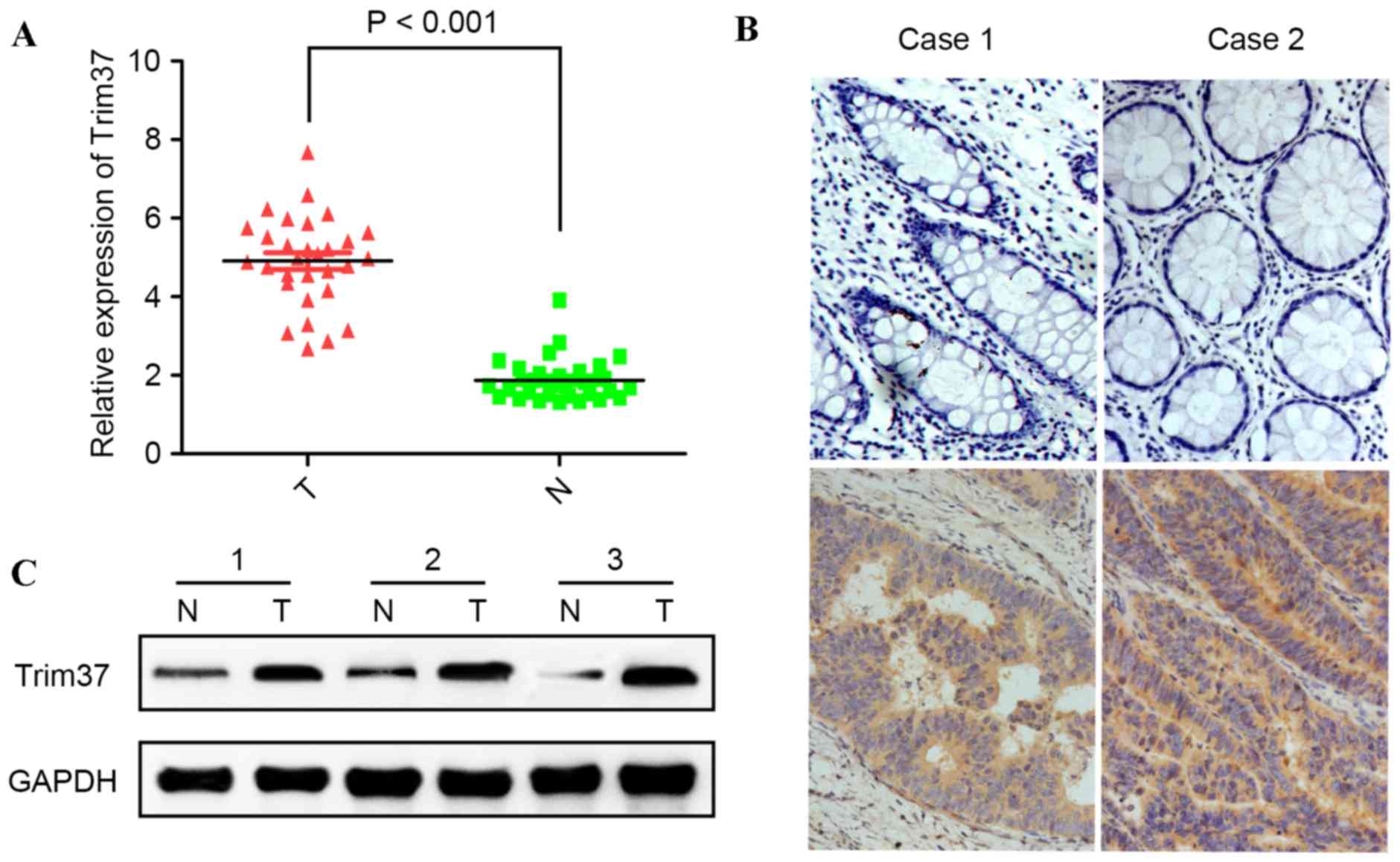
In order to determine the expression of TRIM37 in
CRC, TRIM37 expression levels in 30 CRC tissues and paired adjacent
normal tissues were quantified using RT-qPCR. It was determined
that TRIM37 was significantly upregulated in CRC tissues compared
with the matched adjacent normal tissues (P<0.001; Fig. 1A). Next, TRIM37 protein expression
was evaluated in primary colorectal cancerous tissue and paired
normal colorectal mucosa using western blotting and
immunohistochemistry. It was revealed that TRIM37 was highly
expressed in cancerous tissue compared with non-cancerous mucosa
(Fig. 1B and C). These
observations suggested that TRIM37 may have an oncogenic function
in CRC.
Knockdown of TRIM37 expression reduces
the proliferation and migration of CRC cells
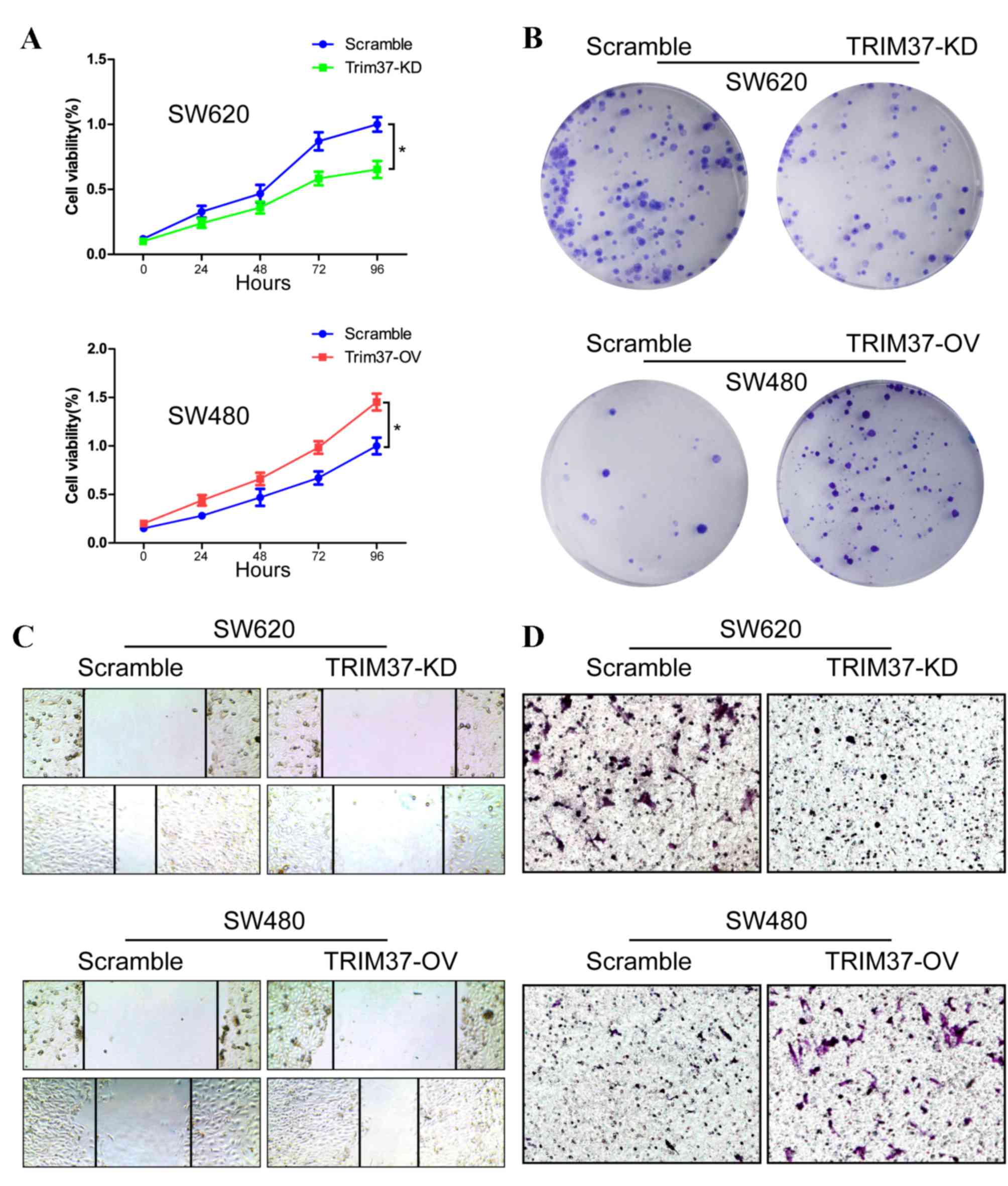
In order to investigate the function of TRIM37, its
expression was downregulated in SW620 cells (the TRIM37-KD group).
Reduced expression of TRIM37 in SW620 cells significantly inhibited
their growth rate compared with the scramble cell group (P<0.05;
Fig. 2A). Colony formation assays
also revealed reduction in the number of colonies in the TRIM37-KD
group compared with the scramble group (Fig. 2B). To determine the effect of
TRIM37-KD on migration, cells were wounded by scratching, and then
maintained at 37°C for an additional 48 h. Downregulation of TRIM37
attenuated the flattening and spreading of SW620 cells (Fig. 2C). These observations were
confirmed by invasion assays, as the invasion ability of cells in
the TRIM37-KD group was reduced (Fig.
2D).
Overexpression of TRIM37 promotes the
growth and migration of CRC cells
The effects of TRIM37 overexpression (TRIM37-OV
group) on the viability of the CRC cells was also investigated.
CCK8 and colony formation assays revealed that TRIM37-OV cells had
significantly increased cell viability (P<0.05; Fig. 2A and B). The levels of migration
and invasion in the TRIM37-OV SW480 cells were higher compared with
the control cells in the wound healing and Matrigel chamber assay
(Fig. 2C and D). Therefore,
overexpression of TRIM37 increased the growth, migratory and
invasive properties of CRC cells.
TRIM37 promotes the migration of CRC
cells by EMT
The underlying molecular mechanisms through which
TRIM37 promoted the migration and invasion of CRC cells were
investigated in the present study. EMT is considered to be the
critical mechanism contributing to cancer metastasis (16). To determine the effect of altered
TRIM37 expression on the induction of EMT in CRC cells, RT-qPCR and
western blot analyses were performed in order to determine the
changes in mRNA and protein expression levels of EMT markers. It
was determined that, in the TRIM37-KD group, vimentin and
N-cadherin mRNA levels were significantly reduced compared with the
scramble group (P<0.05; Fig.
3A). However, the E-cadherin mRNA expression level was
significantly increased in the TRIM37-KD group compared with the
scramble group (P<0.05; Fig.
3A). In contrast with the TRIM37-OV group, vimentin and
N-cadherin mRNA expression levels were significantly increased
compared with the scramble group (P<0.05; Fig. 3B). The E-cadherin mRNA expression
level was significantly reduced in the TRIM37-OV group compared
with the scramble group (P<0.05; Fig. 3B). The identical patterns were
evident for protein expression levels of the EMT markers in the
TRIM37-KD (Fig. 3C) and TRIM37-OV
(Fig. 3D) groups. These results
clearly indicated that altered TRIM37 expression levels affected
the epithelial and mesenchymal phenotype of the CRC cells.
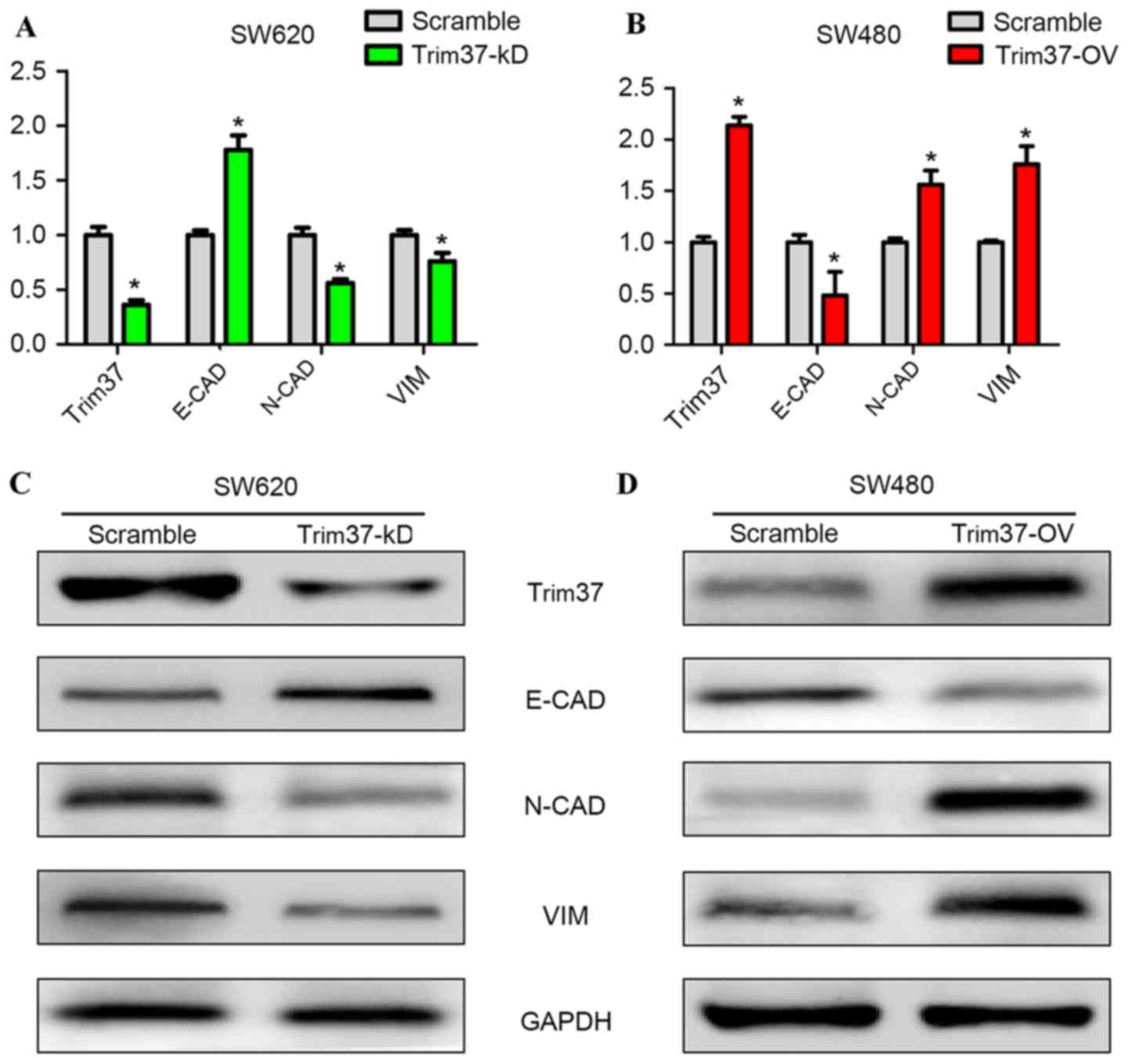 | Figure 3.TRIM37 promotes the invasion of
colorectal cancer cells via EMT. (A) Reverse
transcription-quantitative polymerase chain reaction was performed
to determine the levels of several components that were involved in
EMT. In the TRIM37-KD SW620 cells, N-CAD and VIM were
downregulated, whereas E-CAD was upregulated. *P<0.05. (B) In
the TRIM37-OV SW480 cells, N-CAD and VIM were upregulated, whereas
E-CAD was downregulated. *P<0.05. (C) Western blot analysis
demonstrated that, in TRIM37-KD SW620 cells, the epithelial marker
E-CAD was upregulated, whereas N-CAD and VIM, the mesenchymal
markers, were downregulated. (D) In TRIM37-OV SW480 cells, E-CAD
was downregulated, whereas N-CAD and VIM were upregulated. TRIM37,
tripartite motif containing 37; TRIM 37-KD, TRIM37 knockdown;
TRIM37-OV, TRIM37 overexpression; E-CAD, E-cadherin; N-CAD,
N-cadherin; VIM, vimentin. |
Discussion
The primary cause of mortality in patients with CRC
is metastasis (21). The TRIMs
family has been identified to be involved in the progression,
transformation, autophagy and metastasis of cancer (22–26).
Previous studies have demonstrated altered expression levels of
TRIM37 in breast and ovarian cancer, which confirmed its oncogenic
function (8,9). The present study used RT-qPCR,
immunostaining and western blotting to determine that the increased
expression of TRIM37 occurred at the transcriptional and
post-transcriptional levels in CRC, suggesting that it may
contribute to the progression of malignancies.
Previous studies revealed that TRIM37 may interact
with β-catenin and promote growth and metastasis in pancreatic and
hepatocellular carcinoma, suggesting that there may be co-operation
between TRIM37 and the β-catenin/transcription factor complex in
the regulation of cancer progression (10,11).
Additionally, the present study revealed that TRIM37 positively
regulated the proliferation and migration of CRC cells. The
TRIM37-OV cells were more effective in wound repair, and their
invasive ability was improved, whereas the TRIM37-KD cells had
reduced wound healing and invasive capacity, which supported the
notion that TRIM37 is an oncogene that contributes to the
progression of malignancies.
The present study determined that TRIM37 promoted
cell migration and invasion by inducing EMT. Previous studies have
determined that the expression levels of epithelial cell markers,
such as E-cadherin and cytokeratins, were reduced, whereas
upregulation of mesenchymal cell markers, including vimentin and
N-cadherin, was observed (27,28).
The present study revealed that overexpression of TRIM37 may be
accompanied by an increased mesenchymal phenotype and reduced
expression of E-cadherin, whereas, by contrast, the knockdown of
TRIM37 may lead to an increase in E-cadherin and a decrease in the
levels of mesenchymal markers. When cells undergo EMT, they express
anchorage-independent growth and obtain the capacity to travel
throughout the body, which may lead to metastasis (29–31).
The present study may be improved by increasing the clinical sample
size to determine the expression of TRIM3. Future studies should
focus on discussing the correlation between the expression of
TRIM37 and the survival of patients with CRC.
In conclusion, the findings of the present study
have supported the notion that TRIM37 upregulation leads to
increased vimentin and N-cadherin expression levels, and a reduced
expression of E-cadherin. This has provided novel insights into the
function of TRIM37 in CRC. Additionally, when TRIM37 was
overexpressed in CRC cells, they were more aggressive, with higher
tumorigenicity and increased migratory and invasive capability. As
TRIM37 has been revealed to contribute to EMT, inhibition of EMT
may involve the downregulation of TRIM37 expression. Therefore,
TRIM37 may be an effective therapeutic target in the treatment of
the progression of CRC.
References
|
1
|
Siegel RL, Miller KD and Jemal A: Cancer
statistics, 2015. CA Cancer J Clin. 65:5–29. 2015. View Article : Google Scholar : PubMed/NCBI
|
|
2
|
Siegel R, Desantis C and Jemal A:
Colorectal cancer statistics, 2014. CA Cancer J Clin. 64:104–117.
2014. View Article : Google Scholar : PubMed/NCBI
|
|
3
|
Fu B, Yachida S, Morgan R, Zhong Y,
Montgomery EA and Iacobuzio-Donahue CA: Clinicopathologic and
genetic characterization of traditional serrated adenomas of the
colon. Am J Clin Pathol. 138:356–366. 2012. View Article : Google Scholar : PubMed/NCBI
|
|
4
|
Bertucci F, Salas S, Eysteries S, Nasser
V, Finetti P, Ginestier C, Charafe-Jauffret E, Loriod B, Bachelart
L, Montfort J, et al: Gene expression profiling of colon cancer by
DNA microarrays and correlation with histoclinical parameters.
Oncogene. 23:1377–1391. 2004. View Article : Google Scholar : PubMed/NCBI
|
|
5
|
Wang Y, Jatkoe T, Zhang Y, Mutch MG,
Talantov D, Jiang J, McLeod HL and Atkins D: Gene expression
profiles and molecular markers to predict recurrence of Dukes' B
colon cancer. J Clin Oncol. 22:1564–1571. 2004. View Article : Google Scholar : PubMed/NCBI
|
|
6
|
Tejpar S, Bertagnolli M, Bosman F, Lenz
HJ, Garraway L, Waldman F, Warren R, Bild A, Collins-Brennan D,
Hahn H, et al: Prognostic and predictive biomarkers in resected
colon cancer: Current status and future perspectives for
integrating genomics into biomarker discovery. The oncologist.
15:390–404. 2010. View Article : Google Scholar : PubMed/NCBI
|
|
7
|
Kallijarvi J, Avela K, Lipsanen-Nyman M,
Ulmanen I and Lehesjoki AE: The TRIM37 gene encodes a peroxisomal
RING-B-box-coiled-coil protein: Classification of mulibrey nanism
as a new peroxisomal disorder. Am J Hum Genet. 70:1215–1228. 2002.
View Article : Google Scholar : PubMed/NCBI
|
|
8
|
Bhatnagar S, Gazin C, Chamberlain L, Ou J,
Zhu X, Tushir JS, Virbasius CM, Lin L, Zhu LJ, Wajapeyee N and
Green MR: TRIM37 is a new histone H2A ubiquitin ligase and breast
cancer oncoprotein. Nature. 516:116–120. 2014.PubMed/NCBI
|
|
9
|
Karlberg S, Lipsanen-Nyman M, Lassus H,
Kallijärvi J, Lehesjoki AE and Butzow R: Gynecological tumors in
Mulibrey nanism and role for RING finger protein TRIM37 in the
pathogenesis of ovarian fibrothecomas. Mod Pathol. 22:570–578.
2009. View Article : Google Scholar : PubMed/NCBI
|
|
10
|
Jiang J, Tian S, Yu C, Chen M and Sun C:
TRIM37 promoted the growth and migration of the pancreatic cancer
cells. Tumour Biol. 37:2629–2634. 2016. View Article : Google Scholar : PubMed/NCBI
|
|
11
|
Jiang J, Yu C, Chen M, Tian S and Sun C:
Over-expression of TRIM37 promotes cell migration and metastasis in
hepatocellular carcinoma by activating Wnt/β-catenin signaling.
Biochem Biophys Res Commun. 464:1120–1127. 2015. View Article : Google Scholar : PubMed/NCBI
|
|
12
|
Ye X and Weinberg RA:
Epithelial-mesenchymal plasticity: A central regulator of cancer
progression. Trends in cell biology. 25:675–686. 2015. View Article : Google Scholar : PubMed/NCBI
|
|
13
|
Cao H, Xu E, Liu H, Wan L and Lai M:
Epithelial-mesenchymal transition in colorectal cancer metastasis:
A system review. Pathol Res Pract. 211:557–569. 2015. View Article : Google Scholar : PubMed/NCBI
|
|
14
|
Pasquier J, Abu-Kaoud N, Al Thani H and
Rafii A: Epithelial to mesenchymal transition in a clinical
perspective. J Oncol. 2015:7921822015. View Article : Google Scholar : PubMed/NCBI
|
|
15
|
Yang J and Weinberg RA:
Epithelial-mesenchymal transition: At the crossroads of development
and tumor metastasis. Dev Cell. 14:818–829. 2008. View Article : Google Scholar : PubMed/NCBI
|
|
16
|
Lamouille S, Xu J and Derynck R: Molecular
mechanisms of epithelial-mesenchymal transition. Nat Rev Mol Cell
Biol. 15:178–196. 2014. View
Article : Google Scholar : PubMed/NCBI
|
|
17
|
Fan Q, Qiu MT, Zhu Z, Zhou JH, Chen L,
Zhou Y, Gu W, Wang LH, Li ZN, Xu Y, et al: Twist induces
epithelial-mesenchymal transition in cervical carcinogenesis by
regulating the TGF-β/Smad3 signaling pathway. Oncol Rep.
34:1787–1794. 2015.PubMed/NCBI
|
|
18
|
Zhang P, Sun Y and Ma L: ZEB1: At the
crossroads of epithelial-mesenchymal transition, metastasis, and
therapy resistance. Cell Cycle. 14:481–487. 2015. View Article : Google Scholar : PubMed/NCBI
|
|
19
|
Zoni E, van der Pluijm G, Gray PC and
Kruithof-de Julio M: Epithelial plasticity in cancer: Unmasking a
MicroRNA network for TGF-β-, Notch-, and Wnt-Mediated EMT. J Oncol.
2015:1989672015. View Article : Google Scholar : PubMed/NCBI
|
|
20
|
Livak KJ and Schmittgen TD: Analysis of
relative gene expression data using real-time quantitative PCR and
the 2(−Delta Delta C(T)) method. Methods. 25:402–408. 2001.
View Article : Google Scholar : PubMed/NCBI
|
|
21
|
Rubin MA: Insights into the mechanism of
organ-specific cancer metastasis. Cancer Discov. 4:1262–1264. 2014.
View Article : Google Scholar : PubMed/NCBI
|
|
22
|
Mandell MA, Jain A, Arko-Mensah J, Chauhan
S, Kimura T, Dinkins C, Silvestri G, Münch J, Kirchhoff F, Simonsen
A, et al: TRIM proteins regulate autophagy and can target
autophagic substrates by direct recognition. Dev Cell. 30:394–409.
2014. View Article : Google Scholar : PubMed/NCBI
|
|
23
|
Mandell MA, Kimura T, Jain A, Johansen T
and Deretic V: TRIM proteins regulate autophagy: TRIM5 is a
selective autophagy receptor mediating HIV-1 restriction.
Autophagy. 10:2387–2388. 2014. View Article : Google Scholar : PubMed/NCBI
|
|
24
|
Lee OH, Lee J, Lee KH, Woo YM, Kang JH,
Yoon HG, Bae SK, Songyang Z, Oh SH and Choi Y: Role of the focal
adhesion protein TRIM15 in colon cancer development. Biochim
Biophys Acta. 1853:409–421. 2015. View Article : Google Scholar : PubMed/NCBI
|
|
25
|
Qiu F, Xiong JP, Deng J and Xiang XJ:
TRIM29 functions as an oncogene in gastric cancer and is regulated
by miR-185. Int J Clin Exp Pathol. 8:5053–5061. 2015.PubMed/NCBI
|
|
26
|
Wang Y and He D, Yang L, Wen B, Dai J,
Zhang Q, Kang J, He W, Ding Q and He D: TRIM26 functions as a novel
tumor suppressor of hepatocellular carcinoma and its downregulation
contributes to worse prognosis. Biochem Biophys Res Commun.
463:458–465. 2015. View Article : Google Scholar : PubMed/NCBI
|
|
27
|
Kalluri R and Weinberg RA: The basics of
epithelial-mesenchymal transition. J Clin Invest. 119:1420–1428.
2009. View
Article : Google Scholar : PubMed/NCBI
|
|
28
|
Wicki A, Lehembre F, Wick N, Hantusch B,
Kerjaschki D and Christofori G: Tumor invasion in the absence of
epithelial-mesenchymal transition: Podoplanin-mediated remodeling
of the actin cytoskeleton. Cancer cell. 9:261–272. 2006. View Article : Google Scholar : PubMed/NCBI
|
|
29
|
Thiery JP and Sleeman JP: Complex networks
orchestrate epithelial-mesenchymal transitions. Nat Rev Mol Cell
Biol. 7:131–142. 2006. View
Article : Google Scholar : PubMed/NCBI
|
|
30
|
Godde NJ, Galea RC, Elsum IA and Humbert
PO: Cell polarity in motion: Redefining mammary tissue organization
through EMT and cell polarity transitions. J Mammary Gland Biol
Neoplasia. 15:149–168. 2010. View Article : Google Scholar : PubMed/NCBI
|
|
31
|
Baum B, Settleman J and Quinlan MP:
Transitions between epithelial and mesenchymal states in
development and disease. Semin Cell Dev Biol. 19:294–308. 2008.
View Article : Google Scholar : PubMed/NCBI
|