Spandidos Publications Logo
  • About
    • About Spandidos
    • Aims and Scopes
    • Abstracting and Indexing
    • Editorial Policies
    • Reprints and Permissions
    • Job Opportunities
    • Terms and Conditions
    • Contact
  • Journals
    • All Journals
    • Oncology Letters
      • Oncology Letters
      • Information for Authors
      • Editorial Policies
      • Editorial Board
      • Aims and Scope
      • Abstracting and Indexing
      • Bibliographic Information
      • Archive
    • International Journal of Oncology
      • International Journal of Oncology
      • Information for Authors
      • Editorial Policies
      • Editorial Board
      • Aims and Scope
      • Abstracting and Indexing
      • Bibliographic Information
      • Archive
    • Molecular and Clinical Oncology
      • Molecular and Clinical Oncology
      • Information for Authors
      • Editorial Policies
      • Editorial Board
      • Aims and Scope
      • Abstracting and Indexing
      • Bibliographic Information
      • Archive
    • Experimental and Therapeutic Medicine
      • Experimental and Therapeutic Medicine
      • Information for Authors
      • Editorial Policies
      • Editorial Board
      • Aims and Scope
      • Abstracting and Indexing
      • Bibliographic Information
      • Archive
    • International Journal of Molecular Medicine
      • International Journal of Molecular Medicine
      • Information for Authors
      • Editorial Policies
      • Editorial Board
      • Aims and Scope
      • Abstracting and Indexing
      • Bibliographic Information
      • Archive
    • Biomedical Reports
      • Biomedical Reports
      • Information for Authors
      • Editorial Policies
      • Editorial Board
      • Aims and Scope
      • Abstracting and Indexing
      • Bibliographic Information
      • Archive
    • Oncology Reports
      • Oncology Reports
      • Information for Authors
      • Editorial Policies
      • Editorial Board
      • Aims and Scope
      • Abstracting and Indexing
      • Bibliographic Information
      • Archive
    • Molecular Medicine Reports
      • Molecular Medicine Reports
      • Information for Authors
      • Editorial Policies
      • Editorial Board
      • Aims and Scope
      • Abstracting and Indexing
      • Bibliographic Information
      • Archive
    • World Academy of Sciences Journal
      • World Academy of Sciences Journal
      • Information for Authors
      • Editorial Policies
      • Editorial Board
      • Aims and Scope
      • Abstracting and Indexing
      • Bibliographic Information
      • Archive
    • International Journal of Functional Nutrition
      • International Journal of Functional Nutrition
      • Information for Authors
      • Editorial Policies
      • Editorial Board
      • Aims and Scope
      • Abstracting and Indexing
      • Bibliographic Information
      • Archive
    • International Journal of Epigenetics
      • International Journal of Epigenetics
      • Information for Authors
      • Editorial Policies
      • Editorial Board
      • Aims and Scope
      • Abstracting and Indexing
      • Bibliographic Information
      • Archive
    • Medicine International
      • Medicine International
      • Information for Authors
      • Editorial Policies
      • Editorial Board
      • Aims and Scope
      • Abstracting and Indexing
      • Bibliographic Information
      • Archive
  • Articles
  • Information
    • Information for Authors
    • Information for Reviewers
    • Information for Librarians
    • Information for Advertisers
    • Conferences
  • Language Editing
Spandidos Publications Logo
  • About
    • About Spandidos
    • Aims and Scopes
    • Abstracting and Indexing
    • Editorial Policies
    • Reprints and Permissions
    • Job Opportunities
    • Terms and Conditions
    • Contact
  • Journals
    • All Journals
    • Biomedical Reports
      • Information for Authors
      • Editorial Policies
      • Editorial Board
      • Aims and Scope
      • Abstracting and Indexing
      • Bibliographic Information
      • Archive
    • Experimental and Therapeutic Medicine
      • Information for Authors
      • Editorial Policies
      • Editorial Board
      • Aims and Scope
      • Abstracting and Indexing
      • Bibliographic Information
      • Archive
    • International Journal of Epigenetics
      • Information for Authors
      • Editorial Policies
      • Editorial Board
      • Aims and Scope
      • Abstracting and Indexing
      • Bibliographic Information
      • Archive
    • International Journal of Functional Nutrition
      • Information for Authors
      • Editorial Policies
      • Editorial Board
      • Aims and Scope
      • Abstracting and Indexing
      • Bibliographic Information
      • Archive
    • International Journal of Molecular Medicine
      • Information for Authors
      • Editorial Policies
      • Editorial Board
      • Aims and Scope
      • Abstracting and Indexing
      • Bibliographic Information
      • Archive
    • International Journal of Oncology
      • Information for Authors
      • Editorial Policies
      • Editorial Board
      • Aims and Scope
      • Abstracting and Indexing
      • Bibliographic Information
      • Archive
    • Medicine International
      • Information for Authors
      • Editorial Policies
      • Editorial Board
      • Aims and Scope
      • Abstracting and Indexing
      • Bibliographic Information
      • Archive
    • Molecular and Clinical Oncology
      • Information for Authors
      • Editorial Policies
      • Editorial Board
      • Aims and Scope
      • Abstracting and Indexing
      • Bibliographic Information
      • Archive
    • Molecular Medicine Reports
      • Information for Authors
      • Editorial Policies
      • Editorial Board
      • Aims and Scope
      • Abstracting and Indexing
      • Bibliographic Information
      • Archive
    • Oncology Letters
      • Information for Authors
      • Editorial Policies
      • Editorial Board
      • Aims and Scope
      • Abstracting and Indexing
      • Bibliographic Information
      • Archive
    • Oncology Reports
      • Information for Authors
      • Editorial Policies
      • Editorial Board
      • Aims and Scope
      • Abstracting and Indexing
      • Bibliographic Information
      • Archive
    • World Academy of Sciences Journal
      • Information for Authors
      • Editorial Policies
      • Editorial Board
      • Aims and Scope
      • Abstracting and Indexing
      • Bibliographic Information
      • Archive
  • Articles
  • Information
    • For Authors
    • For Reviewers
    • For Librarians
    • For Advertisers
    • Conferences
  • Language Editing
Login Register Submit
  • This site uses cookies
  • You can change your cookie settings at any time by following the instructions in our Cookie Policy. To find out more, you may read our Privacy Policy.

    I agree
Search articles by DOI, keyword, author or affiliation
Search
Advanced Search
presentation
Molecular Medicine Reports
Join Editorial Board Propose a Special Issue
Print ISSN: 1791-2997 Online ISSN: 1791-3004
Journal Cover
May-2017 Volume 15 Issue 5

Full Size Image

Sign up for eToc alerts
Recommend to Library

Journals

International Journal of Molecular Medicine

International Journal of Molecular Medicine

International Journal of Molecular Medicine is an international journal devoted to molecular mechanisms of human disease.

International Journal of Oncology

International Journal of Oncology

International Journal of Oncology is an international journal devoted to oncology research and cancer treatment.

Molecular Medicine Reports

Molecular Medicine Reports

Covers molecular medicine topics such as pharmacology, pathology, genetics, neuroscience, infectious diseases, molecular cardiology, and molecular surgery.

Oncology Reports

Oncology Reports

Oncology Reports is an international journal devoted to fundamental and applied research in Oncology.

Experimental and Therapeutic Medicine

Experimental and Therapeutic Medicine

Experimental and Therapeutic Medicine is an international journal devoted to laboratory and clinical medicine.

Oncology Letters

Oncology Letters

Oncology Letters is an international journal devoted to Experimental and Clinical Oncology.

Biomedical Reports

Biomedical Reports

Explores a wide range of biological and medical fields, including pharmacology, genetics, microbiology, neuroscience, and molecular cardiology.

Molecular and Clinical Oncology

Molecular and Clinical Oncology

International journal addressing all aspects of oncology research, from tumorigenesis and oncogenes to chemotherapy and metastasis.

World Academy of Sciences Journal

World Academy of Sciences Journal

Multidisciplinary open-access journal spanning biochemistry, genetics, neuroscience, environmental health, and synthetic biology.

International Journal of Functional Nutrition

International Journal of Functional Nutrition

Open-access journal combining biochemistry, pharmacology, immunology, and genetics to advance health through functional nutrition.

International Journal of Epigenetics

International Journal of Epigenetics

Publishes open-access research on using epigenetics to advance understanding and treatment of human disease.

Medicine International

Medicine International

An International Open Access Journal Devoted to General Medicine.

Journal Cover
May-2017 Volume 15 Issue 5

Full Size Image

Sign up for eToc alerts
Recommend to Library

  • Article
  • Citations
    • Cite This Article
    • Download Citation
    • Create Citation Alert
    • Remove Citation Alert
    • Cited By
  • Similar Articles
    • Related Articles (in Spandidos Publications)
    • Similar Articles (Google Scholar)
    • Similar Articles (PubMed)
  • Download PDF
  • Download XML
  • View XML
Article Open Access

Toxicity study of oxalicumone A, derived from a marine-derived fungus Penicillium oxalicum, in cultured renal epithelial cells

  • Authors:
    • Si Shi
    • Kunbin Guo
    • Xiangyu Wang
    • Hao Chen
    • Jianbin Min
    • Shuhua Qi
    • Wei Zhao
    • Weirong Li
  • View Affiliations / Copyright

    Affiliations: Institute of Clinical Pharmacology, Guangzhou University of Chinese Medicine, Guangzhou, Guangdong 510405, P.R. China, Key Laboratory of Tropical Marine Bioresources and Ecology, Guangdong Key Laboratory of Marine Materia Medica, RNAM Center for Marine Microbiology, South China Sea Institute of Oceanology, Chinese Academy of Sciences, Guangzhou, Guangdong 510301, P.R. China
    Copyright: © Shi et al. This is an open access article distributed under the terms of Creative Commons Attribution License.
  • Pages: 2611-2619
    |
    Published online on: March 3, 2017
       https://doi.org/10.3892/mmr.2017.6283
  • Expand metrics +
Metrics: Total Views: 0 (Spandidos Publications: | PMC Statistics: )
Metrics: Total PDF Downloads: 0 (Spandidos Publications: | PMC Statistics: )
Cited By (CrossRef): 0 citations Loading Articles...

This article is mentioned in:


Abstract

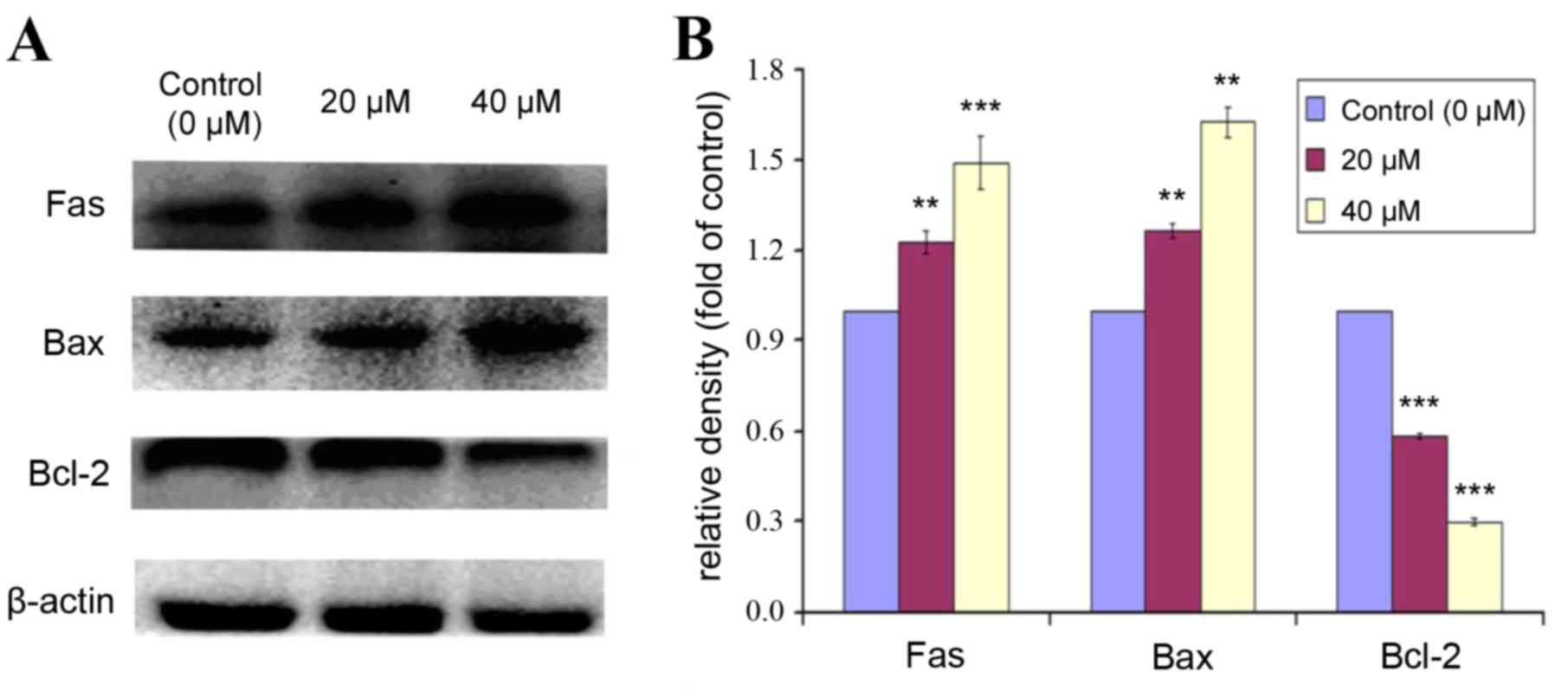
Oxalicumone A (POA), a novel dihydrothiophene-condensed chromone, was isolated from the marine‑derived fungus Penicillium oxalicum. Previous reports demonstrated that POA exhibits strong activity against human carcinoma cells, thus it has been suggested as a bioactive anticancer agent. To research the toxic effect of POA on cultured normal epithelial human kidney‑2 (HK‑2) cells and evaluate its clinical safety, cell survival was evaluated by the Cell Counting Kit-8 assay and apoptosis was evaluated by Hoechst 33258 staining, flow cytometry, caspase‑3 activity assay and western blotting. 2',7'-Dichlorofluorescin diacetate and JC‑1 dye staining was used to evaluate reactive oxygen species (ROS) production and mitochondrial membrane potential (MMP), respectively. The results indicated that POA inhibited HK-2 cell growth and promoted apoptosis, by increasing levels of Fas cell surface cell receptor and the B‑cell lymphoma 2 associated protein X apoptosis regulator (Bax)/B‑cell lymphoma 2 apoptosis regulator (Bcl-2) ratio. POA treatment also induced release of ROS and loss of MMP in HK‑2 cells. Compared with untreated control, a significant decrease was also demonstrated in superoxide dismutase activity and glutathione content with POA treatment, accompanied by enhanced release of N‑acetyl‑β‑D‑glucosaminidase, increased leakage of lactate dehydrogenase, increased malondialdehyde formation and increased release of nitric oxide. In conclusion, the present in vitro study revealed that POA exhibits antiproliferation activity on HK‑2 cells, through stimulation of apoptosis and oxidative stress injury, which may be relevant to its clinical application. The present study may, therefore, offer valuable new information regarding the use of POA as a candidate novel antitumor drug for clinical use.
View Figures

Figure 1

Figure 2

Figure 3

Figure 4

Figure 5

Figure 6

Figure 7

Figure 8

Figure 9

View References

1 

Blunt JW, Copp BR, Keyzers RA, Munro MH and Prinsep MR: Marine natural products. Nat Prod Rep. 29:144–222. 2012. View Article : Google Scholar : PubMed/NCBI

2 

Qi SH: Bioactive compounds from marine gorgonian coralsStudies In Natural Products Chemistry. Rahman A: 38. 1st. Elsevier; Oxford: pp. 325–352. 2012, View Article : Google Scholar

3 

Zhang XY, Bao J, Wang GH, He F, Xu XY and Qi SH: Diversity and antimicrobial activity of culturable fungi isolated from six species of the South China Sea gorgonians. Microb Ecol. 64:617–627. 2012. View Article : Google Scholar : PubMed/NCBI

4 

Sun YL, He F, Liu KS, Zhang XY, Bao J, Wang YF, Nong HX, Xu XY and Qi SH: Cytotoxic dihydrothiophene-condensed chromones from marine-derived fungus Penicillium oxalicum. Planta Med. 78:1957–1961. 2012. View Article : Google Scholar : PubMed/NCBI

5 

Sun YL, Bao J, Liu KS, Zhang XY, He F, Wang YF, Nong XH and Qi SH: Cytotoxic dihydrothiophene-condensed chromones from the marine-derived fungus Penicillium oxalicum. Planta Med. 79:1474–1479. 2013. View Article : Google Scholar : PubMed/NCBI

6 

Wu Y, Connors D, Barber L, Jayachandra S, Hanumegowda UM and Adams SP: Multiplexed assay panel of cytotoxicity in HK-2 cells for detection of renal proximal tubule injury potential of compounds. Toxicol In Vitro. 23:1170–1178. 2009. View Article : Google Scholar : PubMed/NCBI

7 

Wang J, Jia L, Kuang Z, Wu T, Hong Y, Chen X, Leung WK, Xia J and Cheng B: The in vitro and in vivo antitumor effects of clotrimazole on oral squamous cell carcinoma. PLoS One. 9:e988852014. View Article : Google Scholar : PubMed/NCBI

8 

Tripathi M, Singh BK, Mishra C, Raisuddin S and Kakkar P: Involvement of mitochondria mediated pathways in hepatoprotection conferred by Fumaria parviflora Lam. extract against nimesulide induced apoptosis in vitro. Toxicol In Vitro. 24:495–508. 2010. View Article : Google Scholar : PubMed/NCBI

9 

Nigam N, George J, Srivastava S, Roy P, Bhui K, Singh M and Shukla Y: Induction of apoptosis by (6)-gingerol associated with the modulation of p53 and involvement of mitochondrial signaling pathway in B(a)P-induced mouse skin tumorigenesis. Cancer Chemother Pharmacol. 65:687–696. 2010. View Article : Google Scholar : PubMed/NCBI

10 

Terada Y, Inoshita S, Hanada S, Shimamura H, Kuwahara M, Ogawa W, Kasuga M, Sasaki S and Marumo F: Hyperosmolality activates Akt and regulates apoptosis in renal tubular cells. Kidney Int. 60:553–567. 2001. View Article : Google Scholar : PubMed/NCBI

11 

Zhang JQ, Shen M, Zhu CC, Yu FX, Liu ZQ, Ally N, Sun SC, Li K and Liu HL: 3-Nitropropionic acid induces ovarian oxidative stress and impairs follicle in mouse. PLoS One. 9:e865892014. View Article : Google Scholar : PubMed/NCBI

12 

Lund AK, Knuckles TL, Akata Obot C, Shohet R, McDonald JD, Gigliotti A, Seagrave JC and Campen MJ: Gasoline exhaust emissions induce vascular remodeling pathways involved in atherosclerosis. Toxicol Sci. 95:485–494. 2007. View Article : Google Scholar : PubMed/NCBI

13 

Zhu CP, Hu W, Wu H and Hu X: No evident dose-response relationship between cellular ROS level and its cytotoxicity-a paradoxical issue in ROS-based cancer therapy. Sci Rep. 4:50292014.PubMed/NCBI

14 

Yuste JE, Tarragon E, Campuzano CM and RosBernal F: Implications of glial nitric oxide in neurodegenerative diseases. Front Cell Neurosci. 9:3222015. View Article : Google Scholar : PubMed/NCBI

15 

Chiu JS: Models used to assess renal function. Drug Dev Res. 32:247–255. 1994. View Article : Google Scholar

16 

Ali RJ, Al-Obaidi FH and Arif HS: The role of urinary N-acetyl Beta-D-glucosaminidase in children with urological problems. Oman Med J. 29:285–288. 2014. View Article : Google Scholar : PubMed/NCBI

17 

Prasad NR, Menon VP, Vasudev V and Pugalendi KV: Radioprotective effect of sesamol on gamma-radiation induced DNA damage, lipid peroxidation and antioxidants levels in cultured human lymphocytes. Toxicology. 209:225–235. 2005. View Article : Google Scholar : PubMed/NCBI

18 

Sharikabad MN, Ostbye KM, Lyberg T and Brørs O: Effect of extracellular Mg(2+) on ROS and Ca(2+) accumulation during reoxygenation of rat cardiomyocytes. Am J Physiol Heart Circ Physiol. 280:H344–H353. 2001.PubMed/NCBI

19 

Cossarizza A, Baccarani-Contri M, Kalashnikova G and Franceschi C: A new method for the cytofluorimetric analysis of mitochondrial membrane potential using the J-aggregate forming lipophilic cation 5,5′,6,6′-tetrachloro-1,1′,3,3′-tetraethylbenzimidazolcarbocyanine iodide (JC-1). Biochem Biophys Res Commun. 197:40–45. 1993. View Article : Google Scholar : PubMed/NCBI

20 

Yao J, Jiang Z, Duan W, Huang J, Zhang L, Hu L, He L, Li F, Xiao Y, Shu B and Liu C: Involvement of mitochondrial pathway in triptolide-induced cytotoxicity in human normal liver L-02 cells. Biol Pharm Bull. 31:592–597. 2008. View Article : Google Scholar : PubMed/NCBI

21 

Fadok VA, Voelker DR, Campbell PA, Cohen JJ, Bratton DL and Henson PM: Exposure of phosphatidylserine on the surface of apoptotic lymphocytes triggers specific recognition and removal by macrophages. J Immunol. 148:2207–2216. 1992.PubMed/NCBI

22 

Zamai L, Falcieri E, Marhefka G and Vitale M: Supravital exposure to propidium iodide identifies apoptotic cells in the absence of nucleosomal DNA fragmentation. Cytometry. 23:303–311. 1996. View Article : Google Scholar : PubMed/NCBI

23 

Wilson MR: Apoptotic signal transduction: Emerging pathways. Biochem Cell Biol. 76:573–582. 1998. View Article : Google Scholar : PubMed/NCBI

24 

Bonnes-Taourel D, Guérin MC and Torreilles J: Is malonaldehyde a valuable indicator of lipid peroxidation. Biochem Pharmacol. 44:985–988. 1992. View Article : Google Scholar : PubMed/NCBI

25 

Yamashita T, Doi K, Hamasaki Y, Matsubara T, Ishii T, Yahagi N, Nangaku M and Noiri E: Evaluation of urinary tissue inhibitor of metalloproteinase-2 in acute kidney injury: A prospective observational study. Crit Care. 18:7162014. View Article : Google Scholar : PubMed/NCBI

26 

Sinha K, Das J, Pal PB and Sil PC: Oxidative stress: The mitochondria-dependent andmitochondria-independent pathways of apoptosis. Arch Toxicol. 87:1157–1180. 2013. View Article : Google Scholar : PubMed/NCBI

27 

Ly JD, Grubb DR and Lawen A: The mitochondrial membrane potential (deltapsi (m)) in apoptosis; an update. Apoptosis. 8:115–128. 2003. View Article : Google Scholar : PubMed/NCBI

28 

Jacobson MD, Weil M and Raff MC: Programmed cell death in the animal development. Cell. 88:347–354. 1997. View Article : Google Scholar : PubMed/NCBI

29 

Scaffidi C, Kirchhoff S, Krammer PH and Peter ME: Apoptosis signaling in lymphocytes. Curr Opin Immunol. 11:277–285. 1999. View Article : Google Scholar : PubMed/NCBI

30 

Pirocanac EC, Nassirpour R, Yang M, Wang J, Nardin SR, Gu J, Fang B, Moossa AR, Hoffman RM and Bouvet M: Bax-induction gene therapy of pancreatic cancer. J Surg Res. 106:346–351. 2002. View Article : Google Scholar : PubMed/NCBI

31 

Waring P and Müllbacher A: Cell death induced by the Fas/Fas ligand pathway and its role in pathology. Immunol Cell Biol. 77:312–317. 1999. View Article : Google Scholar : PubMed/NCBI

32 

Certo M, Del Gaizo Moore V, Nishino M, Wei G, Korsmeyer S, Armstrong SA and Letai A: Mitochondria primed by death signals determine cellular addiction to antiapoptotic BCL-2 family members. Cancer Cell. 9:351–365. 2006. View Article : Google Scholar : PubMed/NCBI

33 

Nakazawa Y, Kamijo T, Koike K and Noda T: ARF tumor suppressor induces mitochondria-dependent apoptosis by modulation of mitochondrial Bcl-2 family proteins. J Biol Chem. 278:27888–27895. 2003. View Article : Google Scholar : PubMed/NCBI

34 

Antonsson B, Conti F, Ciavatta A, Montessuit S, Lewis S, Martinou I, Bernasconi L, Bernard A, Mermod JJ, Mazzei G, et al: Inhibition of Bax channel- forming activity by Bcl-2. Science. 277:370–372. 1997. View Article : Google Scholar : PubMed/NCBI

35 

Borner C: The Bcl-2 protein family: Sensors and checkpoints for life-or-death decisions. Mol Immunol. 39:615–647. 2003. View Article : Google Scholar : PubMed/NCBI

36 

Lanave C, Santamaria M and Saccone C: Comparative genomics: The evolutionary history of the Bcl-2 family. Gene. 333:71–79. 2004. View Article : Google Scholar : PubMed/NCBI

37 

Zorov DB, Juhaszova M and Sollott SJ: Mitochondrial reactive oxygen species (ROS) and ROS-induced ROS release. Physiol Rev. 94:909–950. 2014. View Article : Google Scholar : PubMed/NCBI

38 

Urra FA, Cordova-Delgado M, Pessoa-Mahana H, Ramírez-Rodriguez O, Weiss-Lopez B, Ferreira J and Araya-Maturana R: Mitochondria: A promising target for anticancer alkaloids. Curr Top Med Chem. 13:2171–2183. 2013. View Article : Google Scholar : PubMed/NCBI

39 

Rosas HD, Doros G, Bhasin S, Thomas B, Gevorkian S, Malarick K, Matson W and Hersch SM: A systems-level ‘misunderstanding’: The plasma metabolome in Huntington's disease. Ann Clin Transl Neurol. 2:756–768. 2015. View Article : Google Scholar : PubMed/NCBI

40 

Brzović-Šarić V, Landeka I, Šarić B, Barberić M, Andrijašević L, Cerovski B, Oršolić N and Đikić D: Levels of selected oxidative stress markers in the vitreous and serum of diabetic retinopathy patients. Mol Vis. 21:649–664. 2015.PubMed/NCBI

41 

Schmitt B, Vicenzi M, Garrel C and Denis FM: Effects of N-acetylcysteine, oral glutathione (GSH) and a novel sublingual form of GSH on oxidative stress markers: A comparative crossover study. Redox Biol. 6:198–205. 2015. View Article : Google Scholar : PubMed/NCBI

42 

Valko M, Jomova K, Rhodes CJ, Kuca K and Musílek K: Redox- and non-redox-metal-induced formation of free radicals and their role in human disease. Arch Toxicol. 90:1–37. 2016. View Article : Google Scholar : PubMed/NCBI

43 

Dubner D, Gisone P, Jaitovich I and Perez M: Free radicals production and estimation of oxidative stress related to gamma irradiation. Biol Trace Elem Res. 47:265–270. 1995. View Article : Google Scholar : PubMed/NCBI

44 

Förstermann U and Sessa WC: Nitric oxide synthases: Regulation and function. Eur Heart J. 33:829–837. 2012. View Article : Google Scholar : PubMed/NCBI

45 

Xie H, Valera VA, Merino MJ, Amato AM, Signoretti S, Linehan WM, Sukhatme VP and Seth P: LDH-A Inhibition, a therapeutic strategy for treatment of hereditary leiomyomatosis and renal cell cancer (HLRCC). Mol Cancer Ther. 8:626–635. 2009. View Article : Google Scholar : PubMed/NCBI

46 

Laina A and Schwartz D: Renal tubular and molecular events in acute renal failure. Nephron. 68:413–418. 1994.PubMed/NCBI

47 

Jongman RM, van Klarenbosch J, Molema G, Zijlstra JG, de Vries AJ and van Meurs M: Angiopoietin/Tie2 dysbalance is associated with acute kidney injury after cardiac surgery assisted by cardiopulmonary bypass. PLoS One. 10:e01362052015. View Article : Google Scholar : PubMed/NCBI

Related Articles

  • Abstract
  • View
  • Download
  • Twitter
Copy and paste a formatted citation
Spandidos Publications style
Shi S, Guo K, Wang X, Chen H, Min J, Qi S, Zhao W and Li W: Toxicity study of oxalicumone A, derived from a marine-derived fungus Penicillium oxalicum, in cultured renal epithelial cells. Mol Med Rep 15: 2611-2619, 2017.
APA
Shi, S., Guo, K., Wang, X., Chen, H., Min, J., Qi, S. ... Li, W. (2017). Toxicity study of oxalicumone A, derived from a marine-derived fungus Penicillium oxalicum, in cultured renal epithelial cells. Molecular Medicine Reports, 15, 2611-2619. https://doi.org/10.3892/mmr.2017.6283
MLA
Shi, S., Guo, K., Wang, X., Chen, H., Min, J., Qi, S., Zhao, W., Li, W."Toxicity study of oxalicumone A, derived from a marine-derived fungus Penicillium oxalicum, in cultured renal epithelial cells". Molecular Medicine Reports 15.5 (2017): 2611-2619.
Chicago
Shi, S., Guo, K., Wang, X., Chen, H., Min, J., Qi, S., Zhao, W., Li, W."Toxicity study of oxalicumone A, derived from a marine-derived fungus Penicillium oxalicum, in cultured renal epithelial cells". Molecular Medicine Reports 15, no. 5 (2017): 2611-2619. https://doi.org/10.3892/mmr.2017.6283
Copy and paste a formatted citation
x
Spandidos Publications style
Shi S, Guo K, Wang X, Chen H, Min J, Qi S, Zhao W and Li W: Toxicity study of oxalicumone A, derived from a marine-derived fungus Penicillium oxalicum, in cultured renal epithelial cells. Mol Med Rep 15: 2611-2619, 2017.
APA
Shi, S., Guo, K., Wang, X., Chen, H., Min, J., Qi, S. ... Li, W. (2017). Toxicity study of oxalicumone A, derived from a marine-derived fungus Penicillium oxalicum, in cultured renal epithelial cells. Molecular Medicine Reports, 15, 2611-2619. https://doi.org/10.3892/mmr.2017.6283
MLA
Shi, S., Guo, K., Wang, X., Chen, H., Min, J., Qi, S., Zhao, W., Li, W."Toxicity study of oxalicumone A, derived from a marine-derived fungus Penicillium oxalicum, in cultured renal epithelial cells". Molecular Medicine Reports 15.5 (2017): 2611-2619.
Chicago
Shi, S., Guo, K., Wang, X., Chen, H., Min, J., Qi, S., Zhao, W., Li, W."Toxicity study of oxalicumone A, derived from a marine-derived fungus Penicillium oxalicum, in cultured renal epithelial cells". Molecular Medicine Reports 15, no. 5 (2017): 2611-2619. https://doi.org/10.3892/mmr.2017.6283
Follow us
  • Twitter
  • LinkedIn
  • Facebook
About
  • Spandidos Publications
  • Careers
  • Cookie Policy
  • Privacy Policy
How can we help?
  • Help
  • Live Chat
  • Contact
  • Email to our Support Team