Spandidos Publications Logo
  • About
    • About Spandidos
    • Aims and Scopes
    • Abstracting and Indexing
    • Editorial Policies
    • Reprints and Permissions
    • Job Opportunities
    • Terms and Conditions
    • Contact
  • Journals
    • All Journals
    • Oncology Letters
      • Oncology Letters
      • Information for Authors
      • Editorial Policies
      • Editorial Board
      • Aims and Scope
      • Abstracting and Indexing
      • Bibliographic Information
      • Archive
    • International Journal of Oncology
      • International Journal of Oncology
      • Information for Authors
      • Editorial Policies
      • Editorial Board
      • Aims and Scope
      • Abstracting and Indexing
      • Bibliographic Information
      • Archive
    • Molecular and Clinical Oncology
      • Molecular and Clinical Oncology
      • Information for Authors
      • Editorial Policies
      • Editorial Board
      • Aims and Scope
      • Abstracting and Indexing
      • Bibliographic Information
      • Archive
    • Experimental and Therapeutic Medicine
      • Experimental and Therapeutic Medicine
      • Information for Authors
      • Editorial Policies
      • Editorial Board
      • Aims and Scope
      • Abstracting and Indexing
      • Bibliographic Information
      • Archive
    • International Journal of Molecular Medicine
      • International Journal of Molecular Medicine
      • Information for Authors
      • Editorial Policies
      • Editorial Board
      • Aims and Scope
      • Abstracting and Indexing
      • Bibliographic Information
      • Archive
    • Biomedical Reports
      • Biomedical Reports
      • Information for Authors
      • Editorial Policies
      • Editorial Board
      • Aims and Scope
      • Abstracting and Indexing
      • Bibliographic Information
      • Archive
    • Oncology Reports
      • Oncology Reports
      • Information for Authors
      • Editorial Policies
      • Editorial Board
      • Aims and Scope
      • Abstracting and Indexing
      • Bibliographic Information
      • Archive
    • Molecular Medicine Reports
      • Molecular Medicine Reports
      • Information for Authors
      • Editorial Policies
      • Editorial Board
      • Aims and Scope
      • Abstracting and Indexing
      • Bibliographic Information
      • Archive
    • World Academy of Sciences Journal
      • World Academy of Sciences Journal
      • Information for Authors
      • Editorial Policies
      • Editorial Board
      • Aims and Scope
      • Abstracting and Indexing
      • Bibliographic Information
      • Archive
    • International Journal of Functional Nutrition
      • International Journal of Functional Nutrition
      • Information for Authors
      • Editorial Policies
      • Editorial Board
      • Aims and Scope
      • Abstracting and Indexing
      • Bibliographic Information
      • Archive
    • International Journal of Epigenetics
      • International Journal of Epigenetics
      • Information for Authors
      • Editorial Policies
      • Editorial Board
      • Aims and Scope
      • Abstracting and Indexing
      • Bibliographic Information
      • Archive
    • Medicine International
      • Medicine International
      • Information for Authors
      • Editorial Policies
      • Editorial Board
      • Aims and Scope
      • Abstracting and Indexing
      • Bibliographic Information
      • Archive
  • Articles
  • Information
    • Information for Authors
    • Information for Reviewers
    • Information for Librarians
    • Information for Advertisers
    • Conferences
  • Language Editing
Spandidos Publications Logo
  • About
    • About Spandidos
    • Aims and Scopes
    • Abstracting and Indexing
    • Editorial Policies
    • Reprints and Permissions
    • Job Opportunities
    • Terms and Conditions
    • Contact
  • Journals
    • All Journals
    • Biomedical Reports
      • Information for Authors
      • Editorial Policies
      • Editorial Board
      • Aims and Scope
      • Abstracting and Indexing
      • Bibliographic Information
      • Archive
    • Experimental and Therapeutic Medicine
      • Information for Authors
      • Editorial Policies
      • Editorial Board
      • Aims and Scope
      • Abstracting and Indexing
      • Bibliographic Information
      • Archive
    • International Journal of Epigenetics
      • Information for Authors
      • Editorial Policies
      • Editorial Board
      • Aims and Scope
      • Abstracting and Indexing
      • Bibliographic Information
      • Archive
    • International Journal of Functional Nutrition
      • Information for Authors
      • Editorial Policies
      • Editorial Board
      • Aims and Scope
      • Abstracting and Indexing
      • Bibliographic Information
      • Archive
    • International Journal of Molecular Medicine
      • Information for Authors
      • Editorial Policies
      • Editorial Board
      • Aims and Scope
      • Abstracting and Indexing
      • Bibliographic Information
      • Archive
    • International Journal of Oncology
      • Information for Authors
      • Editorial Policies
      • Editorial Board
      • Aims and Scope
      • Abstracting and Indexing
      • Bibliographic Information
      • Archive
    • Medicine International
      • Information for Authors
      • Editorial Policies
      • Editorial Board
      • Aims and Scope
      • Abstracting and Indexing
      • Bibliographic Information
      • Archive
    • Molecular and Clinical Oncology
      • Information for Authors
      • Editorial Policies
      • Editorial Board
      • Aims and Scope
      • Abstracting and Indexing
      • Bibliographic Information
      • Archive
    • Molecular Medicine Reports
      • Information for Authors
      • Editorial Policies
      • Editorial Board
      • Aims and Scope
      • Abstracting and Indexing
      • Bibliographic Information
      • Archive
    • Oncology Letters
      • Information for Authors
      • Editorial Policies
      • Editorial Board
      • Aims and Scope
      • Abstracting and Indexing
      • Bibliographic Information
      • Archive
    • Oncology Reports
      • Information for Authors
      • Editorial Policies
      • Editorial Board
      • Aims and Scope
      • Abstracting and Indexing
      • Bibliographic Information
      • Archive
    • World Academy of Sciences Journal
      • Information for Authors
      • Editorial Policies
      • Editorial Board
      • Aims and Scope
      • Abstracting and Indexing
      • Bibliographic Information
      • Archive
  • Articles
  • Information
    • For Authors
    • For Reviewers
    • For Librarians
    • For Advertisers
    • Conferences
  • Language Editing
Login Register Submit
  • This site uses cookies
  • You can change your cookie settings at any time by following the instructions in our Cookie Policy. To find out more, you may read our Privacy Policy.

    I agree
Search articles by DOI, keyword, author or affiliation
Search
Advanced Search
presentation
Molecular Medicine Reports
Join Editorial Board Propose a Special Issue
Print ISSN: 1791-2997 Online ISSN: 1791-3004
Journal Cover
May-2017 Volume 15 Issue 5

Full Size Image

Sign up for eToc alerts
Recommend to Library

Journals

International Journal of Molecular Medicine

International Journal of Molecular Medicine

International Journal of Molecular Medicine is an international journal devoted to molecular mechanisms of human disease.

International Journal of Oncology

International Journal of Oncology

International Journal of Oncology is an international journal devoted to oncology research and cancer treatment.

Molecular Medicine Reports

Molecular Medicine Reports

Covers molecular medicine topics such as pharmacology, pathology, genetics, neuroscience, infectious diseases, molecular cardiology, and molecular surgery.

Oncology Reports

Oncology Reports

Oncology Reports is an international journal devoted to fundamental and applied research in Oncology.

Experimental and Therapeutic Medicine

Experimental and Therapeutic Medicine

Experimental and Therapeutic Medicine is an international journal devoted to laboratory and clinical medicine.

Oncology Letters

Oncology Letters

Oncology Letters is an international journal devoted to Experimental and Clinical Oncology.

Biomedical Reports

Biomedical Reports

Explores a wide range of biological and medical fields, including pharmacology, genetics, microbiology, neuroscience, and molecular cardiology.

Molecular and Clinical Oncology

Molecular and Clinical Oncology

International journal addressing all aspects of oncology research, from tumorigenesis and oncogenes to chemotherapy and metastasis.

World Academy of Sciences Journal

World Academy of Sciences Journal

Multidisciplinary open-access journal spanning biochemistry, genetics, neuroscience, environmental health, and synthetic biology.

International Journal of Functional Nutrition

International Journal of Functional Nutrition

Open-access journal combining biochemistry, pharmacology, immunology, and genetics to advance health through functional nutrition.

International Journal of Epigenetics

International Journal of Epigenetics

Publishes open-access research on using epigenetics to advance understanding and treatment of human disease.

Medicine International

Medicine International

An International Open Access Journal Devoted to General Medicine.

Journal Cover
May-2017 Volume 15 Issue 5

Full Size Image

Sign up for eToc alerts
Recommend to Library

  • Article
  • Citations
    • Cite This Article
    • Download Citation
    • Create Citation Alert
    • Remove Citation Alert
    • Cited By
  • Similar Articles
    • Related Articles (in Spandidos Publications)
    • Similar Articles (Google Scholar)
    • Similar Articles (PubMed)
  • Download PDF
  • Download XML
  • View XML
Article Open Access

Telmisartan suppresses cardiac hypertrophy by inhibiting cardiomyocyte apoptosis via the NFAT/ANP/BNP signaling pathway

  • Authors:
    • Xiurong Li
    • Yuhuai Lan
    • Yan Wang
    • Minghao Nie
    • Yanhong Lu
    • Eryang Zhao
  • View Affiliations / Copyright

    Affiliations: Department of Pathology, Heilongjiang Provincial Hospital, Harbin, Heilongjiang 150036, P.R. China, Intensive Care Unit, Heilongjiang Provincial Hospital, Harbin, Heilongjiang 150036, P.R. China, Department of Oral Pathology, Stomatological Hospital, Harbin Medical University, Harbin, Heilongjiang 150036, P.R. China
    Copyright: © Li et al. This is an open access article distributed under the terms of Creative Commons Attribution License.
  • Pages: 2574-2582
    |
    Published online on: March 14, 2017
       https://doi.org/10.3892/mmr.2017.6318
  • Expand metrics +
Metrics: Total Views: 0 (Spandidos Publications: | PMC Statistics: )
Metrics: Total PDF Downloads: 0 (Spandidos Publications: | PMC Statistics: )
Cited By (CrossRef): 0 citations Loading Articles...

This article is mentioned in:


Abstract

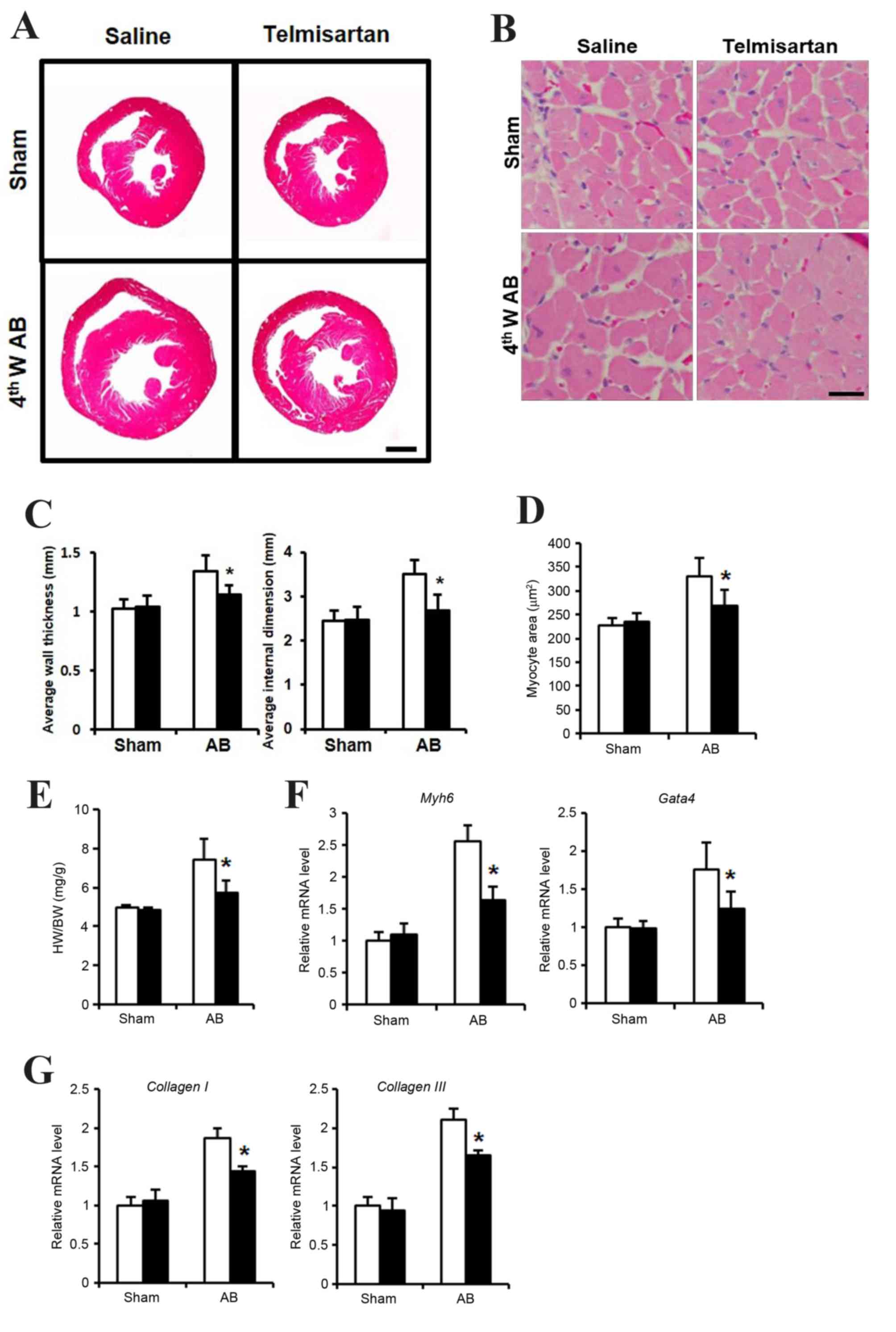
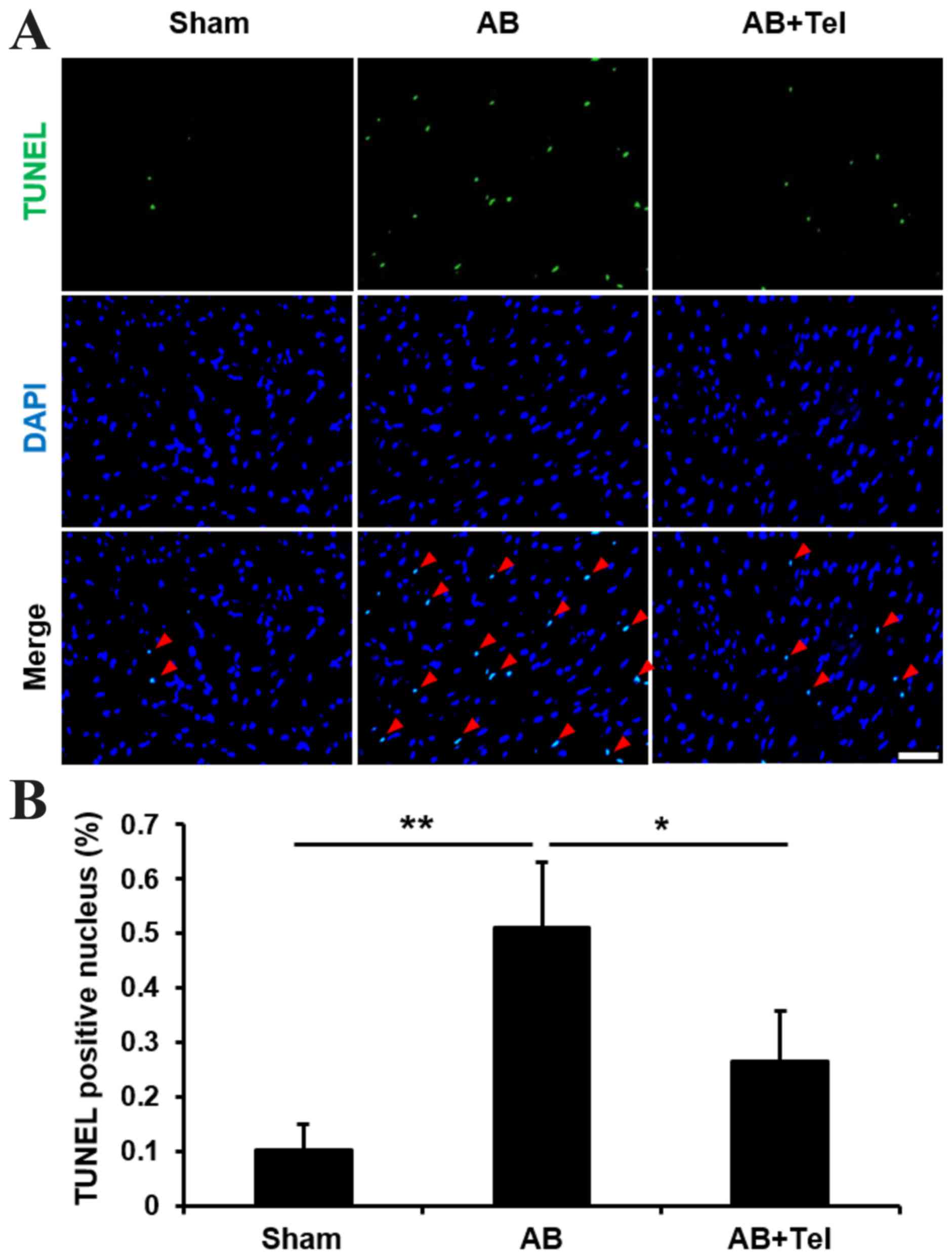
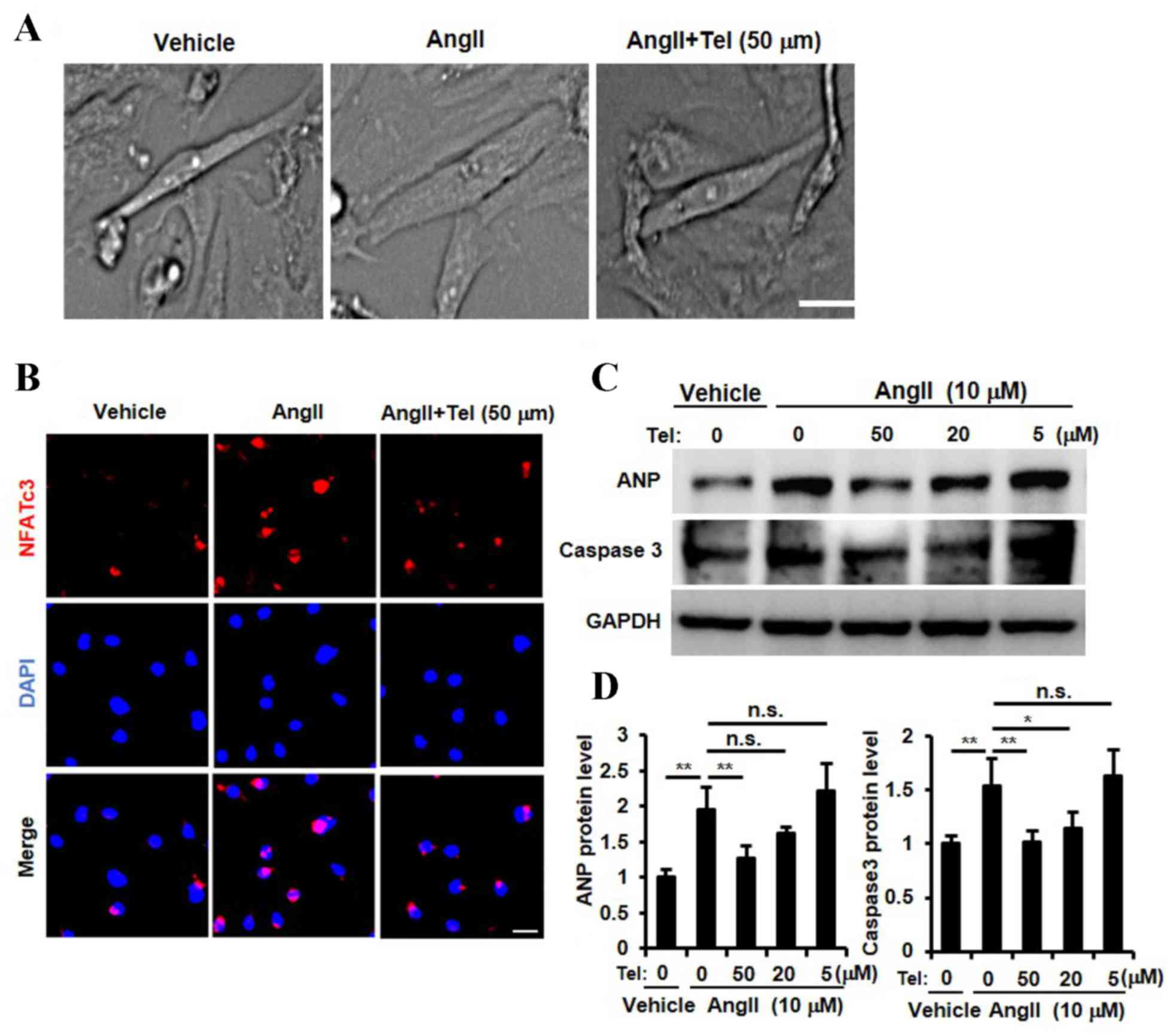
Telmisartan, a type of angiotensin II (Ang II) receptor inhibitor, is a common agent used to treat hypertension in the clinic. Hypertension increases cardiac afterload and promotes cardiac hypertrophy. However, the ventricular Ang II receptor may be activated in the absence of hypertension. Therefore, telmisartan may reduce cardiac hypertrophy by indirectly ameliorating hypertensive symptoms and directly inhibiting the cardiac Ang II receptor. Nuclear factor of activated T‑cells (NFAT) contributes to cardiac hypertrophy via nuclear translocation, which induces a cascade of atrial natriuretic peptide (ANP) and brain/B‑type natriuretic peptide (BNP) expression and cardiomyocyte apoptosis. However, NFAT-mediated inhibition of cardiac hypertrophy by telmisartan remains poorly understood. The present study demonstrated that telmisartan suppressed cardiomyocyte hypertrophy in a mouse model of cardiac afterload and in cultured cardiomyocytes by inhibiting NFAT nuclear translocation, as well as by inhibiting ANP and BNP expression and cardiomyocyte apoptosis, in a dose‑dependent manner. The present study provides a novel insight into the potential underlying mechanisms of telmisartan-induced inhibition of cardiomyocyte hypertrophy, which involves inhibition of NFAT activation, nuclear translocation and the ANP/BNP cascade.
View Figures

Figure 1

Figure 2

Figure 3

Figure 4

View References

1 

Frohlich ED, Apstein C, Chobanian AV, Devereux RB, Dustan HP, Dzau V, Fauad-Tarazi F, Horan MJ, Marcus M, Massie B, et al: The heart in hypertension. N Engl J Med. 327:998–1008. 1992. View Article : Google Scholar : PubMed/NCBI

2 

Curtiss C, Cohn JN, Vrobel T and Franciosa JA: Role of the renin-angiotensin system in the systemic vasoconstriction of chronic congestive heart failure. Circulation. 58:763–770. 1978. View Article : Google Scholar : PubMed/NCBI

3 

McClellan KJ and Markham A: Telmisartan. Drugs. 56:1039–1046. 1998. View Article : Google Scholar : PubMed/NCBI

4 

Wienen W, Hauel N, Van Meel JC, Narr B, Ries U and Entzeroth M: Pharmacological characterization of the novel nonpeptide angiotensin II receptor antagonist, BIBR 277. Br J Pharmacol. 110:245–252. 1993. View Article : Google Scholar : PubMed/NCBI

5 

Amerena J, Pappas S, Ouellet JP, Williams L and O'Shaughnessy D: ABPM comparison of the anti-hypertensive profiles of telmisartan and enalapril in patients with mild-to-moderate essential hypertension. J Int Med Res. 30:543–552. 2002. View Article : Google Scholar : PubMed/NCBI

6 

Saha L: Comparison of the efficacy and tolerability of telmisartan and enalapril in patients of mild to moderate essential hypertension. Indian J Pharmacol. 43:3602011. View Article : Google Scholar : PubMed/NCBI

7 

Neutel JM, Littlejohn TW, Chrysant SG and Singh A: Telmisartan Study Group: Telmisartan/Hydrochlorothiazide in comparison with losartan/hydrochlorothiazide in managing patients with mild-to-moderate hypertension. Hypertens Res. 28:555–563. 2005. View Article : Google Scholar : PubMed/NCBI

8 

Wienen W and Entzeroth M: Effects on binding characteristics and renal function of the novel, non-peptide angiotensin II antagonist BIBR277 in the rat. J Hypertens. 12:119–128. 1994. View Article : Google Scholar : PubMed/NCBI

9 

Makino H, Haneda M, Babazono T, Moriya T, Ito S, Iwamoto Y, Kawamori R, Takeuchi M and Katayama S: INNOVATION Study Group: Prevention of transition from incipient to overt nephropathy with telmisartan in patients with type 2 diabetes. Diabetes Care. 30:1577–1578. 2007. View Article : Google Scholar : PubMed/NCBI

10 

Derosa G, Ragonesi PD, Mugellini A, Ciccarelli L and Fogari R: Effects of telmisartan compared with eprosartan on blood pressure control, glucose metabolism and lipid profile in hypertensive, type 2 diabetic patients: A randomized, double-blind, placebo-controlled 12-month study. Hypertens Res. 27:457–464. 2004. View Article : Google Scholar : PubMed/NCBI

11 

Honjo S, Nichi Y, Wada Y, Hamamoto Y and Koshiyama H: Possible beneficial effect of telmisartan on glycemic control in diabetic subjects. Diabetes Care. 28:4982005. View Article : Google Scholar : PubMed/NCBI

12 

Nagel JM, Tietz AB, Göke B and Parhofer KG: The effect of telmisartan on glucose and lipid metabolism in nondiabetic, insulin-resistant subjects. Metabolism. 55:1149–1154. 2006. View Article : Google Scholar : PubMed/NCBI

13 

Gohlke P, Weiss S, Jansen A, Wienen W, Stangier J, Rascher W, Culman J and Unger T: AT1 receptor antagonist telmisartan administered peripherally inhibits central responses to angiotensin II in conscious rats. J Pharmacol Exp Ther. 298:62–70. 2001.PubMed/NCBI

14 

Mogi M, Li JM, Tsukuda K, Iwanami J, Min LJ, Sakata A, Fujita T, Iwai M and Horiuchi M: Telmisartan prevented cognitive decline partly due to PPAR-gamma activation. Biochem Biophys Res Commun. 375:446–449. 2008. View Article : Google Scholar : PubMed/NCBI

15 

Böhm M, Lippoldt A, Wienen W, Ganten D and Bader M: Reduction of cardiac hypertrophy in TGR(mREN2)27 by angiotensin II receptor blockade. Mol Cell Biochem. 163–164:217–221. 1996. View Article : Google Scholar

16 

Mattioli AV, Zennaro M, Bonatti S, Bonetti L and Mattioli G: Regression of left ventricular hypertrophy and improvement of diastolic function in hypertensive patients treated with telmisartan. Int J Cardiol. 97:383–388. 2004. View Article : Google Scholar : PubMed/NCBI

17 

Maejima Y, Okada H, Haraguchi G, Onai Y, Kosuge H, Suzuki J and Isobe M: Telmisartan, a unique ARB, improves left ventricular remodeling of infarcted heart by activating PPAR gamma. Lab Invest. 91:932–944. 2011. View Article : Google Scholar : PubMed/NCBI

18 

Siragy H: Angiotensin II receptor blockers: Review of the binding characteristics. Am J Cardiol. 84:3S–8S. 1999. View Article : Google Scholar : PubMed/NCBI

19 

D'Ascenzi F, Pelliccia A, Corrado D, Cameli M, Curci V, Alvino F, Natali BM, Focardi M, Bonifazi M and Mondillo S: Right ventricular remodelling induced by exercise training in competitive athletes. Eur Heart J Cardiovasc Imaging. 17:301–307. 2016. View Article : Google Scholar : PubMed/NCBI

20 

Bernardo BC, Weeks KL, Pretorius L and McMullen JR: Molecular distinction between physiological and pathological cardiac hypertrophy: Experimental findings and therapeutic strategies. Pharmacol Ther. 128:191–227. 2010. View Article : Google Scholar : PubMed/NCBI

21 

Heineke J and Molkentin JD: Regulation of cardiac hypertrophy by intracellular signalling pathways. Nat Rev Mol Cell Biol. 7:589–600. 2006. View Article : Google Scholar : PubMed/NCBI

22 

Irani RA, Zhang Y, Blackwell SC, Zhou CC, Ramin SM, Kellems RE and Xia Y: The detrimental role of angiotensin receptor agonistic autoantibodies in intrauterine growth restriction seen in preeclampsia. J Exp Med. 206:2809–2822. 2009. View Article : Google Scholar : PubMed/NCBI

23 

Rockman HA, Ross RS, Harris AN, Knowlton KU, Steinhelper ME, Field LJ, Ross J Jr and Chien KR: Segregation of atrial-specific and inducible expression of an atrial natriuretic factor transgene in an in vivo murine model of cardiac hypertrophy. Proc Natl Acad Sci USA. 88:8277–8281. 1991. View Article : Google Scholar : PubMed/NCBI

24 

Chlopcíková S, Psotová J and Miketová P: Neonatal rat cardiomyocytes-a model for the study of morphological, biochemical and electrophysiological characteristics of the heart. Biomed Pap Med Fac Univ Palacky Olomouc Czech Repub. 145:49–55. 2001. View Article : Google Scholar : PubMed/NCBI

25 

Livak KJ and Schmittgen TD: Analysis of relative gene expression data using real-time quantitative PCR and the 2(−Delta Delta C(T)) Method. Methods. 25:402–408. 2001. View Article : Google Scholar : PubMed/NCBI

26 

Molkentin JD: Calcineurin-NFAT signaling regulates the cardiac hypertrophic response in coordination with the MAPKs. Cardiovasc Res. 63:467–475. 2004. View Article : Google Scholar : PubMed/NCBI

27 

Pu WT, Ma Q and Izumo S: NFAT transcription factors are critical survival factors that inhibit cardiomyocyte apoptosis during phenylephrine stimulation in vitro. Circ Res. 92:725–731. 2003. View Article : Google Scholar : PubMed/NCBI

28 

Tokudome T, Horio T, Kishimoto I, Soeki T, Mori K, Kawano Y, Kohno M, Garbers DL, Nakao K and Kangawa K: Calcineurin-nuclear factor of activated T cells pathway-dependent cardiac remodeling in mice deficient in guanylyl cyclase A, a receptor for atrial and brain natriuretic peptides. Circulation. 111:3095–3104. 2005. View Article : Google Scholar : PubMed/NCBI

29 

Liang F, Lu S and Gardner DG: Endothelin-dependent and -independent components of strain-activated brain natriuretic peptide gene transcription require extracellular signal regulated kinase and p38 mitogen-activated protein kinase. Hypertension. 35:188–192. 2000. View Article : Google Scholar : PubMed/NCBI

30 

Wu CF, Bishopric NH and Pratt RE: Atrial natriuretic peptide induces apoptosis in neonatal rat cardiac myocytes. J Biol Chem. 272:14860–14866. 1997. View Article : Google Scholar : PubMed/NCBI

31 

Suenobu N, Shichiri M, Iwashina M, Marumo F and Hirata Y: Natriuretic peptides and nitric oxide induce endothelial apoptosis via a cGMP-dependent mechanism. Arterioscler Thromb Vasc Biol. 19:140–146. 1999. View Article : Google Scholar : PubMed/NCBI

32 

Diep QN, El Mabrouk M, Yue P and Schiffrin EL: Effect of AT(1) receptor blockade on cardiac apoptosis in angiotensin II-induced hypertension. Am J Physiol Heart Circ Physiol. 282:H1635–H1641. 2002. View Article : Google Scholar : PubMed/NCBI

33 

Porter AG and Jänicke RU: Emerging roles of caspase-3 in apoptosis. Cell Death Differ. 6:99–104. 1999. View Article : Google Scholar : PubMed/NCBI

34 

Telmisartan Randomised AssessmeNt Study in ACE iNtolerant subjects with cardiovascular Disease (TRANSCEND) Investigators. Yusuf S, Teo K, Anderson C, Pogue J, Dyal L, Copland I, Schumacher H, Dagenais G and Sleight P: Effects of the angiotensin-receptor blocker telmisartan on cardiovascular events in high-risk patients intolerant to angiotensin-converting enzyme inhibitors: A randomised controlled trial. Lancet. 372:1174–1183. 2008. View Article : Google Scholar : PubMed/NCBI

35 

Zou Y, Akazawa H, Qin Y, Sano M, Takano H, Minamino T, Makita N, Iwanaga K, Zhu W, Kudoh S, et al: Mechanical stress activates angiotensin II type 1 receptor without the involvement of angiotensin II. Nat Cell Biol. 6:499–506. 2004. View Article : Google Scholar : PubMed/NCBI

36 

Li L, Zhou N, Gong H, Wu J, Lin L, Komuro I, Ge J and Zou Y: Comparison of angiotensin II type 1-receptor blockers to regress pressure overload-induced cardiac hypertrophy in mice. Hypertens Res. 33:1289–1297. 2010. View Article : Google Scholar : PubMed/NCBI

37 

Chang WH, Yan JJ, Li X, Guo HY and Liu Y: Effects of telmisartan on angiotensin II-induced cardiomyocyte hypertrophy and p-ERK1/2 phosphorylation in rat cultured cardiomyocytes. Asian Biomed. 5:459–465. 2011.

38 

Muller P, Kazakov A, Semenov A, Jagoda P, Friedrich EB, Böhm M and Laufs U: Ramipril and telmisartan exhibit differential effects in cardiac pressure overload-induced hypertrophy without an additional benefit of the combination of both drugs. J Cardiovasc Pharmacol Ther. 18:87–93. 2013. View Article : Google Scholar : PubMed/NCBI

39 

Wilkins BJ, Dai YS, Bueno OF, Parsons SA, Xu J, Plank DM, Jones F, Kimball TR and Molkentin JD: Calcineurin/NFAT coupling participates in pathological, but not physiological, cardiac hypertrophy. Circ Res. 94:110–118. 2004. View Article : Google Scholar : PubMed/NCBI

40 

Sanna B, Bueno OF, Dai YS, Wilkins BJ and Molkentin JD: Direct and indirect interactions between calcineurin-NFAT and MEK1-extracellular signal-regulated kinase 1/2 signaling pathways regulate cardiac gene expression and cellular growth. Mol Cell Biol. 25:865–878. 2005. View Article : Google Scholar : PubMed/NCBI

41 

Robbs BK, Lucena PI and Viola JP: The transcription factor NFAT1 induces apoptosis through cooperation with Ras/Raf/MEK/ERK pathway and upregulation of TNF-α expression. Biochim Biophys Acta. 1833:2016–2028. 2013. View Article : Google Scholar : PubMed/NCBI

42 

Yamagishi S and Takeuchi M: Telmisartan is a promising cardiometabolic sartan due to its unique PPAR-gamma-inducing property. Med Hypotheses. 64:476–478. 2005. View Article : Google Scholar : PubMed/NCBI

43 

Bao Y, Li R, Jiang J, Cai B, Gao J, Le K, Zhang F, Chen S and Liu P: Activation of peroxisome proliferator-activated receptor gamma inhibits endothelin-1-induced cardiac hypertrophy via the calcineurin/NFAT signaling pathway. Mol Cell Biochem. 317:189–196. 2008. View Article : Google Scholar : PubMed/NCBI

44 

Molkentin JD, Lu JR, Antos CL, Markham B, Richardson J, Robbins J, Grant SR and Olson EN: A calcineurin-dependent transcriptional pathway for cardiac hypertrophy. Cell. 93:215–228. 1998. View Article : Google Scholar : PubMed/NCBI

Related Articles

  • Abstract
  • View
  • Download
  • Twitter
Copy and paste a formatted citation
Spandidos Publications style
Li X, Lan Y, Wang Y, Nie M, Lu Y and Zhao E: Telmisartan suppresses cardiac hypertrophy by inhibiting cardiomyocyte apoptosis via the NFAT/ANP/BNP signaling pathway. Mol Med Rep 15: 2574-2582, 2017.
APA
Li, X., Lan, Y., Wang, Y., Nie, M., Lu, Y., & Zhao, E. (2017). Telmisartan suppresses cardiac hypertrophy by inhibiting cardiomyocyte apoptosis via the NFAT/ANP/BNP signaling pathway. Molecular Medicine Reports, 15, 2574-2582. https://doi.org/10.3892/mmr.2017.6318
MLA
Li, X., Lan, Y., Wang, Y., Nie, M., Lu, Y., Zhao, E."Telmisartan suppresses cardiac hypertrophy by inhibiting cardiomyocyte apoptosis via the NFAT/ANP/BNP signaling pathway". Molecular Medicine Reports 15.5 (2017): 2574-2582.
Chicago
Li, X., Lan, Y., Wang, Y., Nie, M., Lu, Y., Zhao, E."Telmisartan suppresses cardiac hypertrophy by inhibiting cardiomyocyte apoptosis via the NFAT/ANP/BNP signaling pathway". Molecular Medicine Reports 15, no. 5 (2017): 2574-2582. https://doi.org/10.3892/mmr.2017.6318
Copy and paste a formatted citation
x
Spandidos Publications style
Li X, Lan Y, Wang Y, Nie M, Lu Y and Zhao E: Telmisartan suppresses cardiac hypertrophy by inhibiting cardiomyocyte apoptosis via the NFAT/ANP/BNP signaling pathway. Mol Med Rep 15: 2574-2582, 2017.
APA
Li, X., Lan, Y., Wang, Y., Nie, M., Lu, Y., & Zhao, E. (2017). Telmisartan suppresses cardiac hypertrophy by inhibiting cardiomyocyte apoptosis via the NFAT/ANP/BNP signaling pathway. Molecular Medicine Reports, 15, 2574-2582. https://doi.org/10.3892/mmr.2017.6318
MLA
Li, X., Lan, Y., Wang, Y., Nie, M., Lu, Y., Zhao, E."Telmisartan suppresses cardiac hypertrophy by inhibiting cardiomyocyte apoptosis via the NFAT/ANP/BNP signaling pathway". Molecular Medicine Reports 15.5 (2017): 2574-2582.
Chicago
Li, X., Lan, Y., Wang, Y., Nie, M., Lu, Y., Zhao, E."Telmisartan suppresses cardiac hypertrophy by inhibiting cardiomyocyte apoptosis via the NFAT/ANP/BNP signaling pathway". Molecular Medicine Reports 15, no. 5 (2017): 2574-2582. https://doi.org/10.3892/mmr.2017.6318
Follow us
  • Twitter
  • LinkedIn
  • Facebook
About
  • Spandidos Publications
  • Careers
  • Cookie Policy
  • Privacy Policy
How can we help?
  • Help
  • Live Chat
  • Contact
  • Email to our Support Team