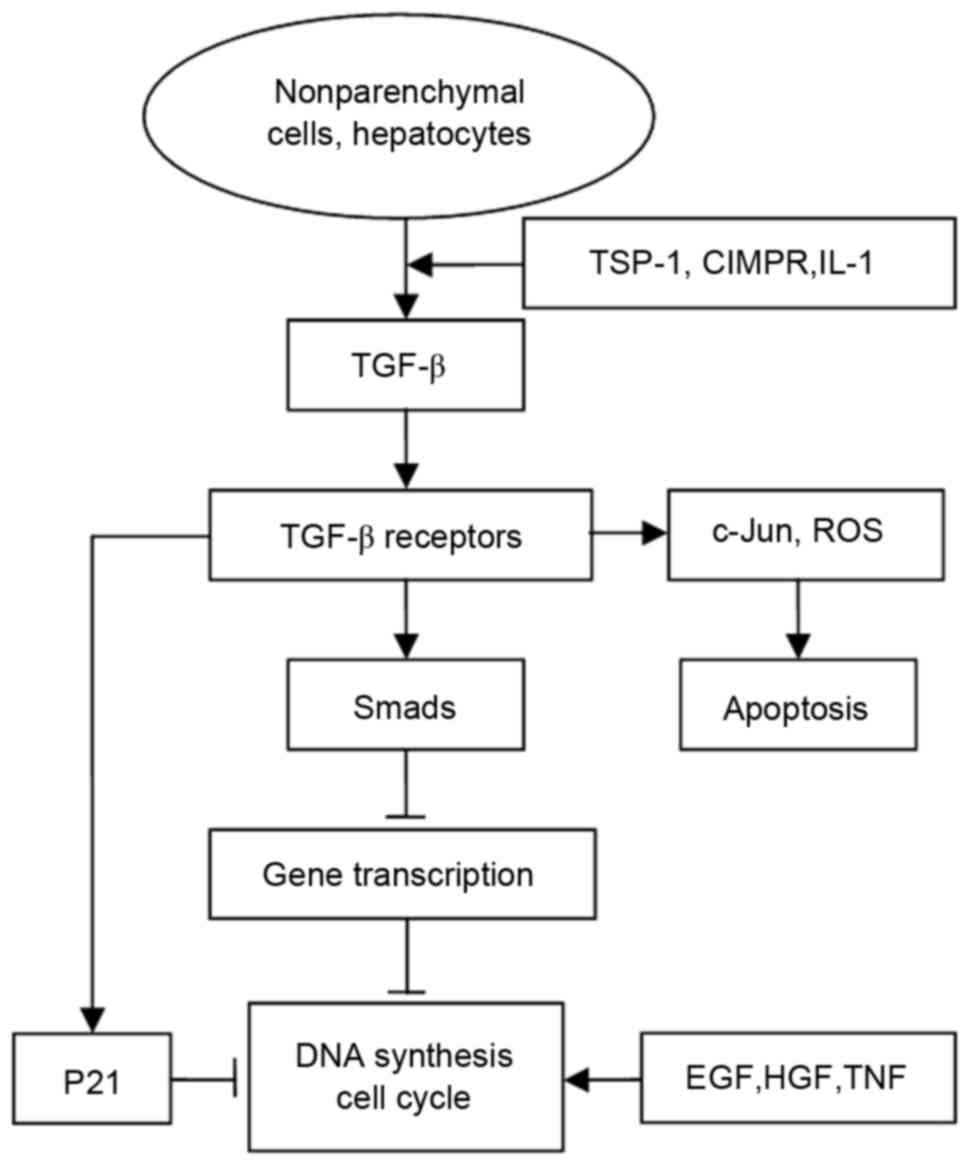
|
1
|
Jia C: Advances in the regulation of liver
regeneration. Expert Rev Gastroenterol Hepatol. 5:105–121. 2011.
View Article : Google Scholar : PubMed/NCBI
|
|
2
|
Elliott J: SOCS3 in liver regeneration and
hepatocarcinoma. Mol Interv. 8:19–21. 2008. View Article : Google Scholar : PubMed/NCBI
|
|
3
|
Willenbring H, Sharma AD, Vogel A, Lee AY,
Rothfuss A, Wang Z, Finegold M and Grompe M: Loss of p21 permits
carcinogenesis from chronically damaged liver and kidney epithelial
cells despite unchecked apoptosis. Cancer cell. 14:59–67. 2008.
View Article : Google Scholar : PubMed/NCBI
|
|
4
|
Nakamura T, Tomita Y, Hirai R, Yamaoka K,
Kaji K and Ichihara A: Inhibitory effect of transforming growth
factor-beta on DNA synthesis of adult rat hepatocytes in primary
culture. Biochem Biophys Res Commun. 133:1042–1050. 1985.
View Article : Google Scholar : PubMed/NCBI
|
|
5
|
Russell WE, Coffey RJ Jr, Ouellette AJ and
Moses HL: Type beta transforming growth factor reversibly inhibits
the early proliferative response to partial hepatectomy in the rat.
Proc Natl Acad Sci USA. 85:5126–5130. 1988. View Article : Google Scholar : PubMed/NCBI
|
|
6
|
Liska V, Treska V, Mirka H, Kobr J, Sykora
R, Skalicky T, Sutnar A, Vycital O, Bruha J, Pitule P, et al:
Inhibition of transforming growth factor beta-1 augments liver
regeneration after partial portal vein ligation in a porcine
experimental model. Hepatogastroenterology. 59:235–240.
2012.PubMed/NCBI
|
|
7
|
Karkampouna S, Goumans MJ, Ten Dijke P,
Dooley S and Kruithof-de Julio M: Inhibition of TGFβ type I
receptor activity facilitates liver regeneration upon acute CCl
intoxication in mice. Arch Toxicol. 90:347–357. 2016. View Article : Google Scholar : PubMed/NCBI
|
|
8
|
Braun L, Mead JE, Panzica M, Mikumo R,
Bell GI and Fausto N: Transforming growth factor beta mRNA
increases during liver regeneration: A possible paracrine mechanism
of growth regulation. Proc Natl Acad Sci USA. 85:1539–1543. 1988.
View Article : Google Scholar : PubMed/NCBI
|
|
9
|
Fausto N, Mead JE, Braun L, Thompson NL,
Panzica M, Goyette M, Bell GI and Shank PR: Proto-oncogene
expression and growth factors during liver regeneration. Symp
Fundam Cancer Res. 39:69–86. 1986.PubMed/NCBI
|
|
10
|
Bissell DM, Wang SS, Jarnagin WR and Roll
FJ: Cell-specific expression of transforming growth factor-beta in
rat liver. Evidence for autocrine regulation of hepatocyte
proliferation. J Clin Invest. 96:447–455. 1995. View Article : Google Scholar : PubMed/NCBI
|
|
11
|
Nishikawa Y, Wang M and Carr BI: Changes
in TGF-beta receptors of rat hepatocytes during primary culture and
liver regeneration: Increased expression of TGF-beta receptors
associated with increased sensitivity to TGF-beta-mediated growth
inhibition. J Cell Physiol. 176:612–623. 1998. View Article : Google Scholar : PubMed/NCBI
|
|
12
|
Jakowlew SB, Mead JE, Danielpour D, Wu J,
Roberts AB and Fausto N: Transforming growth factor-beta (TGF-beta)
isoforms in rat liver regeneration: Messenger RNA expression and
activation of latent TGF-beta. Cell Regul. 2:535–548.
1991.PubMed/NCBI
|
|
13
|
Bottinger EP, Factor VM, Tsang ML,
Weatherbee JA, Kopp JB, Qian SW, Wakefield LM, Roberts AB,
Thorgeirsson SS and Sporn MB: The recombinant proregion of
transforming growth factor beta1 (latency-associated peptide)
inhibits active transforming growth factor beta1 in transgenic
mice. Proc Natl Acad Sci USA. 93:5877–5882. 1996. View Article : Google Scholar : PubMed/NCBI
|
|
14
|
Strain AJ, Frazer A, Hill DJ and Milner
RD: Transforming growth factor beta inhibits DNA synthesis in
hepatocytes isolated from normal and regenerating rat liver.
Biochem Biophys Res Commun. 145:436–442. 1987. View Article : Google Scholar : PubMed/NCBI
|
|
15
|
Miyazono K, Kusanagi K and Inoue H:
Divergence and convergence of TGF-beta/BMP signaling. J Cell
Physiol. 187:265–276. 2001. View Article : Google Scholar : PubMed/NCBI
|
|
16
|
Attisano L and Wrana JL: Signal
transduction by the TGF-beta superfamily. Science. 296:1646–1647.
2002. View Article : Google Scholar : PubMed/NCBI
|
|
17
|
Pañeda C, Gorospe I, Herrera B, Nakamura
T, Fabregat I and Varela-Nieto I: Liver cell proliferation requires
methionine adenosyltransferase 2A mRNA up-regulation. Hepatology.
35:1381–1391. 2002. View Article : Google Scholar : PubMed/NCBI
|
|
18
|
Ten Dijke P, Goumans MJ, Itoh F and Itoh
S: Regulation of cell proliferation by Smad proteins. J Cell
Physiol. 191:1–16. 2002. View Article : Google Scholar : PubMed/NCBI
|
|
19
|
Macias-Silva M, Li W, Leu JI, Crissey MA
and Taub R: Up-regulated transcriptional repressors SnoN and Ski
bind Smad proteins to antagonize transforming growth factor-beta
signals during liver regeneration. J Biol Chem. 277:28483–28490.
2002. View Article : Google Scholar : PubMed/NCBI
|
|
20
|
Hines IN, Kremer M, Isayama F, Perry AW,
Milton RJ, Black AL, Byrd CL and Wheeler MD: Impaired liver
regeneration and increased oval cell numbers following T
cell-mediated hepatitis. Hepatology. 46:229–241. 2007. View Article : Google Scholar : PubMed/NCBI
|
|
21
|
Zhong Z, Tsukada S, Rehman H, Parsons CJ,
Theruvath TP, Rippe RA, Brenner DA and Lemasters JJ: Inhibition of
transforming growth factor-beta/Smad signaling improves
regeneration of small-for-size rat liver grafts. Liver Transpl.
16:181–190. 2010. View Article : Google Scholar : PubMed/NCBI
|
|
22
|
Schrum LW, Bird MA, Salcher O, Burchardt
ER, Grisham JW, Brenner DA, Rippe RA and Behrns KE: Autocrine
expression of activated transforming growth factor-beta(1) induces
apoptosis in normal rat liver. Am J Physiol Gastrointest Liver
Physiol. 280:G139–G148. 2001.PubMed/NCBI
|
|
23
|
Hayashi H, Sakai K, Baba H and Sakai T:
Thrombospondin-1 is a novel negative regulator of liver
regeneration after partial hepatectomy through transforming growth
factor-beta1 activation in mice. Hepatology. 55:1562–1573. 2012.
View Article : Google Scholar : PubMed/NCBI
|
|
24
|
Gohda E, Matsunaga T, Kataoka H and
Yamamoto I: TGF-beta is a potent inhibitor of hepatocyte growth
factor secretion by human fibroblasts. Cell Biol Int Rep.
16:917–926. 1992. View Article : Google Scholar : PubMed/NCBI
|
|
25
|
Satoh M and Yamazaki M: Tumor necrosis
factor stimulates DNA synthesis of mouse hepatocytes in primary
culture and is suppressed by transforming growth factor beta and
interleukin 6. J Cell Physiol. 150:134–139. 1992. View Article : Google Scholar : PubMed/NCBI
|
|
26
|
Bouzahzah B, Fu M, Iavarone A, Factor VM,
Thorgeirsson SS and Pestell RG: Transforming growth factor-beta1
recruits histone deacetylase 1 to a p130 repressor complex in
transgenic mice in vivo. Cancer Res. 60:4531–4537. 2000.PubMed/NCBI
|
|
27
|
Moriuchi A, Hirono S, Ido A, Ochiai T,
Nakama T, Uto H, Hori T, Hayashi K and Tsubouchi H: Additive and
inhibitory effects of simultaneous treatment with growth factors on
DNA synthesis through MAPK pathway and G1 cyclins in rat
hepatocytes. Biochem Biophys Res Commun. 280:368–373. 2001.
View Article : Google Scholar : PubMed/NCBI
|
|
28
|
Takiya S, Tagaya T, Takahashi K, Kawashima
H, Kamiya M, Fukuzawa Y, Kobayashi S, Fukatsu A, Katoh K and Kakumu
S: Role of transforming growth factor beta 1 on hepatic
regeneration and apoptosis in liver diseases. J Clin Pathol.
48:1093–1097. 1995. View Article : Google Scholar : PubMed/NCBI
|
|
29
|
Ueberham E, Löw R, Ueberham U, Schönig K,
Bujard H and Gebhardt R: Conditional tetracycline-regulated
expression of TGF-beta1 in liver of transgenic mice leads to
reversible intermediary fibrosis. Hepatology. 37:1067–1078. 2003.
View Article : Google Scholar : PubMed/NCBI
|
|
30
|
Leu JI, Crissey MA and Taub R: Massive
hepatic apoptosis associated with TGF-beta1 activation after Fas
ligand treatment of IGF binding protein-1-deficient mice. J Clin
Invest. 111:129–139. 2003. View Article : Google Scholar : PubMed/NCBI
|
|
31
|
Samson CM, Schrum LW, Bird MA, Lange PA,
Brenner DA, Rippe RA and Behrns KE: Transforming growth
factor-beta1 induces hepatocyte apoptosis by a c-Jun independent
mechanism. Surgery. 132:441–449. 2002. View Article : Google Scholar : PubMed/NCBI
|
|
32
|
Albright CD, Salganik RI, Craciunescu CN,
Mar MH and Zeisel SH: Mitochondrial and microsomal derived reactive
oxygen species mediate apoptosis induced by transforming growth
factor-beta1 in immortalized rat hepatocytes. J Cell Biochem.
89:254–261. 2003. View Article : Google Scholar : PubMed/NCBI
|
|
33
|
Villevalois-Cam L, Rescan C, Gilot D, Ezan
F, Loyer P, Desbuquois B, Guguen-Guillouzo C and Baffet G: The
hepatocyte is a direct target for transforming-growth factor beta
activation via the insulin-like growth factor II/mannose
6-phosphate receptor. J Hepatol. 38:156–163. 2003. View Article : Google Scholar : PubMed/NCBI
|
|
34
|
Yasuda H, Mine T, Shibata H, Eto Y,
Hasegawa Y, Takeuchi T, Asano S and Kojima I: Activin A: An
autocrine inhibitor of initiation of DNA synthesis in rat
hepatocytes. J Clin Invest. 92:1491–1496. 1993. View Article : Google Scholar : PubMed/NCBI
|
|
35
|
Schwall RH, Robbins K, Jardieu P, Chang L,
Lai C and Terrell TG: Activin induces cell death in hepatocytes in
vivo and in vitro. Hepatology. 18:347–356. 1993. View Article : Google Scholar : PubMed/NCBI
|
|
36
|
Hillier SG and Miró F: Inhibin, activin,
and follistatin. Potential roles in ovarian physiology. Ann N Y
Acad Sci. 687:29–38. 1993. View Article : Google Scholar : PubMed/NCBI
|
|
37
|
Kogure K, Zhang YQ, Kanzaki M, Omata W,
Mine T and Kojima I: Intravenous administration of follistatin:
Delivery to the liver and effect on liver regeneration after
partial hepatectomy. Hepatology. 24:361–366. 1996. View Article : Google Scholar : PubMed/NCBI
|
|
38
|
Ichikawa T, Zhang YQ, Kogure K, Hasegawa
Y, Takagi H, Mori M and Kojima I: Transforming growth factor beta
and activin tonically inhibit DNA synthesis in the rat liver.
Hepatology. 34:918–925. 2001. View Article : Google Scholar : PubMed/NCBI
|
|
39
|
Takahashi H, Takeshita T and Yokomuro K:
Suppression of liver regeneration resulting from intravenous
injection of splenic glass adherent cells activated by poly I:C.
Immunobiology. 176:217–227. 1988. View Article : Google Scholar : PubMed/NCBI
|
|
40
|
Nakamura T, Arakaki R and Ichihara A:
Interleukin-1 beta is a potent growth inhibitor of adult rat
hepatocytes in primary culture. Exp Cell Res. 179:488–497. 1988.
View Article : Google Scholar : PubMed/NCBI
|
|
41
|
Ichihara A: Growth and differentiation of
neonatal rat hepatocytes in primary culture. Nihon Sanka Fujinka
Gakkai Zasshi. 41:1021–1026. 1989.(In Japanese). PubMed/NCBI
|
|
42
|
Ichihara A: Mechanisms controlling growth
of hepatocytes in primary culture. Dig Dis Sci. 36:489–493. 1991.
View Article : Google Scholar : PubMed/NCBI
|
|
43
|
Beyer HS and Theologides A: Tumor necrosis
factor-alpha is a direct hepatocyte mitogen in the rat. Biochem Mol
Biol Int. 29:1–4. 1993.PubMed/NCBI
|
|
44
|
Okamura N, Tsukada K, Sakaguchi T, Ohtake
M, Yoshida K and Muto T: Enhanced liver regeneration by FK 506 can
be blocked by interleukin-1 alpha and interleukin-2. Transplant
Proc. 24:413–415. 1992.PubMed/NCBI
|
|
45
|
Nagata Y, Tanaka N and Orita K:
Endotoxin-induced liver injury after extended hepatectomy and the
role of Kupffer cells in the rat. Surg Today. 24:441–448. 1994.
View Article : Google Scholar : PubMed/NCBI
|
|
46
|
Boulton R, Woodman A, Calnan D, Selden C,
Tam F and Hodgson H: Nonparenchymal cells from regenerating rat
liver generate interleukin-1alpha and -1beta: A mechanism of
negative regulation of hepatocyte proliferation. Hepatology.
26:49–58. 1997. View Article : Google Scholar : PubMed/NCBI
|
|
47
|
Scotte M, Masson S, Lyoumi S, Hiron M,
Ténière P, Lebreton JP and Daveau M: Cytokine gene expression in
liver following minor or major hepatectomy in rat. Cytokine.
9:859–867. 1997. View Article : Google Scholar : PubMed/NCBI
|
|
48
|
Uemura T, Miyazaki M, Hirai R, Matsumoto
H, Ota T, Ohashi R, Shimizu N, Tsuji T, Inoue Y and Namba M:
Different expression of positive and negative regulators of
hepatocyte growth in growing and shrinking hepatic lobes after
portal vein branch ligation in rats. Int J Mol Med. 5:173–179.
2000.PubMed/NCBI
|
|
49
|
Stärkel P, Lambotte L, Sempoux C, De
Saeger C, Saliez A, Maiter D and Horsmans Y: After portal branch
ligation in the rat, cellular proliferation is associated with
selective induction of c-Ha-ras, p53, cyclin E, and Cdk2. Gut.
49:119–130. 2001. View Article : Google Scholar : PubMed/NCBI
|
|
50
|
Anderson SP, Yoon L, Richard EB, Dunn CS,
Cattley RC and Corton JC: Delayed liver regeneration in peroxisome
proliferator-activated receptor-alpha-null mice. Hepatology.
36:544–554. 2002. View Article : Google Scholar : PubMed/NCBI
|
|
51
|
Tsutsumi R, Kamohara Y, Eguchi S, Azuma T,
Fujioka H, Okudaira S, Yanaga K and Kanematsu T: Selective
suppression of initial cytokine response facilitates liver
regeneration after extensive hepatectomy in rats.
Hepatogastroenterology. 51:701–704. 2004.PubMed/NCBI
|
|
52
|
Hou Z, Yanaga K, Kamohara Y, Eguchi S,
Tsutsumi R, Furui J and Kanematsu T: A new suppressive agent
against interleukin-1beta and tumor necrosis factor-alpha enhances
liver regeneration after partial hepatectomy in rats. Hepatol Res.
26:40–46. 2003. View Article : Google Scholar : PubMed/NCBI
|
|
53
|
Zhu RZ, Xiang D, Xie C, Li JJ, Hu JJ, He
HL, Yuan YS, Gao J, Han W and Yu Y: Protective effect of
recombinant human IL-1Ra on CCl4-induced acute liver injury in
mice. World J Gastroenterol. 16:2771–2779. 2010. View Article : Google Scholar : PubMed/NCBI
|
|
54
|
Goss JA, Mangino MJ and Flye MW: Kupffer
cell autoregulation of IL-1 production by PGE2 during hepatic
regeneration. J Surg Res. 52:422–428. 1992. View Article : Google Scholar : PubMed/NCBI
|
|
55
|
Goss JA, Mangino MJ, Callery MP and Flye
MW: Prostaglandin E2 downregulates Kupffer cell production of IL-1
and IL-6 during hepatic regeneration. Am J Physiol. 264:G601–G608.
1993.PubMed/NCBI
|
|
56
|
Higashitsuji H, Arii S, Furutani M, Mise
M, Monden K, Fujita S, Ishiguro S, Kitao T, Nakamura T, Nakayama H,
et al: Expression of cytokine genes during liver regeneration after
partial hepatectomy in rats. J Surg Res. 58:267–274. 1995.
View Article : Google Scholar : PubMed/NCBI
|
|
57
|
Sgroi A, Gonelle-Gispert C, Morel P,
Baertschiger RM, Niclauss N, Mentha G, Majno P, Serre-Beinier V and
Buhler L: Interleukin-1 receptor antagonist modulates the early
phase of liver regeneration after partial hepatectomy in mice. PLoS
One. 6:e254422011. View Article : Google Scholar : PubMed/NCBI
|
|
58
|
Zheng YB, Zhang XH, Huang ZL, Lin CS, Lai
J, Gu YR, Lin BL, Xie DY, Xie SB, Peng L and Gao ZL:
Amniotic-fluid-derived mesenchymal stem cells overexpressing
interleukin-1 receptor antagonist improve fulminant hepatic
failure. PLoS One. 7:e413922012. View Article : Google Scholar : PubMed/NCBI
|
|
59
|
Franco-Gou R, Roselló-Catafau J,
Casillas-Ramirez A, Massip-Salcedo M, Rimola A, Calvo N, Bartrons R
and Peralta C: How ischaemic preconditioning protects small liver
grafts. J Pathol. 208:62–73. 2006. View Article : Google Scholar : PubMed/NCBI
|
|
60
|
Zhao Y, Meng C, Wang Y, Huang H, Liu W,
Zhang JF, Zhao H, Feng B, Leung PS and Xia Y: IL-1β inhibits
β-Klotho expression and FGF19 signaling in hepatocytes. Am J
Physiol Endocrinol Metab. 310:E289–E300. 2016. View Article : Google Scholar : PubMed/NCBI
|
|
61
|
Streetz KL, Luedde T, Manns MP and
Trautwein C: Interleukin 6 and liver regeneration. Gut. 47:309–312.
2000. View Article : Google Scholar : PubMed/NCBI
|
|
62
|
Sun R, Jaruga B, Kulkarni S, Sun H and Gao
B: IL-6 modulates hepatocyte proliferation via induction of
HGF/p21cip1: Regulation by SOCS3. Biochem Biophys Res Commun.
338:1943–1949. 2005. View Article : Google Scholar : PubMed/NCBI
|
|
63
|
Kamohara Y, Sugiyama N, Mizuguchi T,
Inderbitzin D, Lilja H, Middleton Y, Neuman T, Demetriou AA and
Rozga J: Inhibition of signal transducer and activator
transcription factor 3 in rats with acute hepatic failure. Biochem
Biophys Res Commun. 273:129–135. 2000. View Article : Google Scholar : PubMed/NCBI
|
|
64
|
Wustefeld T, Rakemann T, Kubicka S, Manns
MP and Trautwein C: Hyperstimulation with interleukin 6 inhibits
cell cycle progression after hepatectomy in mice. Hepatology.
32:514–522. 2000. View Article : Google Scholar : PubMed/NCBI
|
|
65
|
Torbenson M, Yang SQ, Liu HZ, Huang J,
Gage W and Diehl AM: STAT-3 overexpression and p21 up-regulation
accompany impaired regeneration of fatty livers. Am J Pathol.
161:155–161. 2002. View Article : Google Scholar : PubMed/NCBI
|
|
66
|
Quétier I, Brezillon N, Duriez M, Massinet
H, Giang E, Ahodantin J, Lamant C, Brunelle MN, Soussan P and
Kremsdorf D: Hepatitis B virus HBx protein impairs liver
regeneration through enhanced expression of IL-6 in transgenic
mice. J Hepatol. 59:285–291. 2013. View Article : Google Scholar : PubMed/NCBI
|
|
67
|
Kakumu S, Fukatsu A, Shinagawa T, Kurokawa
S and Kusakabe A: Localisation of intrahepatic interleukin 6 in
patients with acute and chronic liver disease. J Clin Pathol.
45:408–411. 1992. View Article : Google Scholar : PubMed/NCBI
|
|
68
|
Napoli J, Bishop GA and McCaughan GW:
Increased intrahepatic messenger RNA expression of interleukins 2,
6, and 8 in human cirrhosis. Gastroenterology. 107:789–798. 1994.
View Article : Google Scholar : PubMed/NCBI
|
|
69
|
Malaguarnera M, Di Fazio I, Romeo MA,
Restuccia S, Laurino A and Trovato BA: Elevation of interleukin 6
levels in patients with chronic hepatitis due to hepatitis C virus.
J Gastroenterol. 32:211–215. 1997. View Article : Google Scholar : PubMed/NCBI
|
|
70
|
Tangkijvanich P, Vimolket T, Theamboonlers
A, Kullavanijaya P, Suwangool P and Poovorawan Y: Serum
interleukin-6 and interferon-gamma levels in patients with
hepatitis B-associated chronic liver disease. Asian Pac J Allergy
Immunol. 18:109–114. 2000.PubMed/NCBI
|
|
71
|
Suh HN, Lee SH, Lee MY, Lee YJ, Lee JH and
Han HJ: Role of Interleukin-6 in the control of DNA synthesis of
hepatocytes: Involvement of PKC, p44/42 MAPKs, and PPARdelta. Cell
Physiol Biochem. 22:673–684. 2008. View Article : Google Scholar : PubMed/NCBI
|
|
72
|
Liu M, Liu H, Wang X, Chen P and Chen H:
IL-6 induction of hepatocyte proliferation through the
Tmub1-regulated gene pathway. Int J Mol Med. 29:1106–1112.
2012.PubMed/NCBI
|
|
73
|
Campbell JS, Prichard L, Schaper F,
Schmitz J, Stephenson-Famy A, Rosenfeld ME, Argast GM, Heinrich PC
and Fausto N: Expression of suppressors of cytokine signaling
during liver regeneration. J Clin Invest. 107:1285–1292. 2001.
View Article : Google Scholar : PubMed/NCBI
|
|
74
|
Sakuda S, Tamura S, Yamada A, Miyagawa Ji,
Yamamoto K, Kiso S, Ito N, Imanaka K, Wada A, Naka T, et al:
Activation of signal transducer and activator transcription 3 and
expression of suppressor of cytokine signal 1 during liver
regeneration in rats. J Hepatol. 36:378–384. 2002. View Article : Google Scholar : PubMed/NCBI
|
|
75
|
Luedde T, Wuestefeld T and Trautwein C: A
new player in the team: SOCS-3 socks it to cytokine signaling in
the regenerating liver. Hepatology. 34:1254–1256. 2001. View Article : Google Scholar : PubMed/NCBI
|
|
76
|
Heinrich PC, Behrmann I, Haan S, Hermanns
HM, Müller-Newen G and Schaper F: Principles of interleukin
(IL)-6-type cytokine signalling and its regulation. Biochem J.
374:1–20. 2003. View Article : Google Scholar : PubMed/NCBI
|
|
77
|
Riehle KJ, Campbell JS, McMahan RS,
Johnson MM, Beyer RP, Bammler TK and Fausto N: Regulation of liver
regeneration and hepatocarcinogenesis by suppressor of cytokine
signaling 3. J Exp Med. 205:91–103. 2008. View Article : Google Scholar : PubMed/NCBI
|
|
78
|
Seki E, Kondo Y, Iimuro Y, Naka T, Son G,
Kishimoto T, Fujimoto J, Tsutsui H and Nakanishi K: Demonstration
of cooperative contribution of MET- and EGFR-mediated STAT3
phosphorylation to liver regeneration by exogenous suppressor of
cytokine signalings. J Hepatol. 48:237–245. 2008. View Article : Google Scholar : PubMed/NCBI
|
|
79
|
Brand S, Dambacher J, Beigel F, Zitzmann
K, Heeg MH, Weiss TS, Prüfer T, Olszak T, Steib CJ, Storr M, et al:
IL-22-mediated liver cell regeneration is abrogated by SOCS-1/3
overexpression in vitro. Am J Physiol Gastrointest Liver Physiol.
292:G1019–G1028. 2007. View Article : Google Scholar : PubMed/NCBI
|
|
80
|
Yang XP, Schaper F, Teubner A, Lammert F,
Heinrich PC, Matern S and Siewert E: Interleukin-6 plays a crucial
role in the hepatic expression of SOCS3 during acute inflammatory
processes in vivo. J Hepatol. 43:704–710. 2005. View Article : Google Scholar : PubMed/NCBI
|
|
81
|
Aydemir TB, Chang SM, Guthrie GJ, Maki AB,
Ryu MS, Karabiyik A and Cousins RJ: Zinc transporter ZIP14
functions in hepatic zinc, iron and glucose homeostasis during the
innate immune response (endotoxemia). PLoS One. 7:e486792012.
View Article : Google Scholar : PubMed/NCBI
|
|
82
|
Gui Y, Yeganeh M, Ramanathan S, Leblanc C,
Pomerleau V, Ferbeyre G, Saucier C and Ilangumaran S: SOCS1
controls liver regeneration by regulating HGF signaling in
hepatocytes. J Hepatol. 55:1300–1308. 2011. View Article : Google Scholar : PubMed/NCBI
|
|
83
|
Sun R, Park O, Horiguchi N, Kulkarni S,
Jeong WI, Sun HY, Radaeva S and Gao B: STAT1 contributes to dsRNA
inhibition of liver regeneration after partial hepatectomy in mice.
Hepatology. 44:955–966. 2006. View Article : Google Scholar : PubMed/NCBI
|
|
84
|
Yin S, Wang H, Bertola A, Feng D, Xu MJ,
Wang Y and Gao B: Activation of invariant natural killer T cells
impedes liver regeneration by way of both IFN-γ- and IL-4-dependent
mechanisms. Hepatology. 60:1356–1366. 2014. View Article : Google Scholar : PubMed/NCBI
|
|
85
|
Cosgrove BD, Cheng C, Pritchard JR, Stolz
DB, Lauffenburger DA and Griffith LG: An inducible autocrine
cascade regulates rat hepatocyte proliferation and apoptosis
responses to tumor necrosis factor-alpha. Hepatology. 48:276–288.
2008. View Article : Google Scholar : PubMed/NCBI
|
|
86
|
Theocharis SE, Margeli AP and Tsokos MG:
Alpha 2b-interferon inhibits rat liver regeneration after partial
hepatectomy without affecting thymidine kinase activity. J Lab Clin
Med. 125:588–596. 1995.PubMed/NCBI
|
|
87
|
Theocharis SE, Margeli AP, Skaltsas SD,
Skopelitou AS, Mykoniatis MG and Kittas CN: Effect of
interferon-alpha2b administration on rat liver regeneration after
partial hepatectomy. Dig Dis Sci. 42:1981–1986. 1997. View Article : Google Scholar : PubMed/NCBI
|
|
88
|
Ogiso T, Nagaki M, Takai S, Tsukada Y,
Mukai T, Kimura K and Moriwaki H: Granulocyte colony-stimulating
factor impairs liver regeneration in mice through the up-regulation
of interleukin-1beta. J Hepatol. 47:816–825. 2007. View Article : Google Scholar : PubMed/NCBI
|
|
89
|
Vaquero J, Campbell JS, Haque J, McMahan
RS, Riehle KJ, Bauer RL and Fausto N: Toll-Like Receptor 4 and
myeloid differentiation factor 88 provide mechanistic insights into
the cause and effects of interleukin-6 activation in mouse liver
regeneration. Hepatology. 54:597–608. 2011. View Article : Google Scholar : PubMed/NCBI
|
|
90
|
Thompson NL, Mead JE, Braun L, Goyette M,
Shank PR and Fausto N: Sequential protooncogene expression during
rat liver regeneration. Cancer Res. 46:3111–3117. 1986.PubMed/NCBI
|
|
91
|
Drazan KE, Shen XD, Csete ME, Zhang WW,
Roth JA, Busuttil RW and Shaked A: In vivo adenoviral-mediated
human p53 tumor suppressor gene transfer and expression in rat
liver after resection. Surgery. 116:197–204. 1994.PubMed/NCBI
|
|
92
|
Lennartsson P, Stenius U and Högberg J:
p53 expression and TGF-alpha-induced replication of hepatocytes
isolated from rats exposed to the carcinogen diethylnitrosamine.
Cell Biol Toxicol. 15:31–39. 1999. View Article : Google Scholar : PubMed/NCBI
|
|
93
|
Inoue Y, Tomiya T, Yanase M, Arai M, Ikeda
H, Tejima K, Ogata I, Kimura S, Omata M and Fujiwara K: p53 May
positively regulate hepatocyte proliferation in rats. Hepatology.
36:336–344. 2002. View Article : Google Scholar : PubMed/NCBI
|
|
94
|
Tsuji K and Ogawa K: Recovery from
ultraviolet-induced growth arrest of primary rat hepatocytes by p53
antisense oligonucleotide treatment. Mol Carcinog. 9:167–174. 1994.
View Article : Google Scholar : PubMed/NCBI
|
|
95
|
Arora V, Iversen PL and Ebadi M:
Manipulation of metallothionein expression in the regenerating rat
liver using antisense oligonucleotides. Biochem Biophys Res Commun.
246:711–718. 1998. View Article : Google Scholar : PubMed/NCBI
|
|
96
|
Arora V and Iversen PL: Antisense
oligonucleotides targeted to the p53 gene modulate liver
regeneration in vivo. Drug Metab Dispos. 28:131–138.
2000.PubMed/NCBI
|
|
97
|
Kurinna S, Stratton SA, Coban Z,
Schumacher JM, Grompe M, Duncan AW and Barton MC: p53 regulates a
mitotic transcription program and determines ploidy in normal mouse
liver. Hepatology. 57:2004–2013. 2013. View Article : Google Scholar : PubMed/NCBI
|
|
98
|
Zhang L, Liu L, He Z, Li G, Liu J, Song Z,
Jin H, Rudolph KL, Yang H, Mao Y, et al: Inhibition of wild-type
p53-induced phosphatase 1 promotes liver regeneration in mice by
direct activation of mammalian target of rapamycin. Hepatology.
61:2030–2041. 2015. View Article : Google Scholar : PubMed/NCBI
|
|
99
|
Ohlson LC, Koroxenidou L and Hällström IP:
Inhibition of in vivo rat liver regeneration by
2-acetylaminofluorene affects the regulation of cell cycle-related
proteins. Hepatology. 27:691–696. 1998. View Article : Google Scholar : PubMed/NCBI
|
|
100
|
Stepniak E, Ricci R, Eferl R, Sumara G,
Sumara I, Rath M, Hui L and Wagner EF: c-Jun/AP-1 controls liver
regeneration by repressing p53/p21 and p38 MAPK activity. Genes
Dev. 20:2306–2314. 2006. View Article : Google Scholar : PubMed/NCBI
|
|
101
|
Li CC, Chu HY, Yang CW, Chou CK and Tsai
TF: Aurora-A overexpression in mouse liver causes p53-dependent
premitotic arrest during liver regeneration. Mol Cancer Res.
7:678–688. 2009. View Article : Google Scholar : PubMed/NCBI
|
|
102
|
Fan X, Jiang Y, Wang Y, Tan H, Zeng H,
Wang Y, Chen P, Qu A, Gonzalez FJ, Huang M and Bi H: Wuzhi tablet
(Schisandra Sphenanthera extract) protects against
acetaminophen-induced hepatotoxicity by inhibition of CYP-mediated
bioactivation and regulation of NRF2-ARE and p53/p21 pathways. Drug
Metab Dispos. 42:1982–1990. 2014. View Article : Google Scholar : PubMed/NCBI
|
|
103
|
Wang Y, Jiang Y, Fan X, Tan H, Zeng H,
Wang Y, Chen P, Huang M and Bi H: Hepato-protective effect of
resveratrol against acetaminophen-induced liver injury is
associated with inhibition of CYP-mediated bioactivation and
regulation of SIRT1-p53 signaling pathways. Toxicol Lett.
236:82–89. 2015. View Article : Google Scholar : PubMed/NCBI
|
|
104
|
Zeng H, Li D, Qin X, Chen P, Tan H, Zeng
X, Li X, Fan X, Jiang Y, Zhou Y, et al: Hepatoprotective effects of
schisandra sphenanthera extract against lithocholic acid-induced
cholestasis in male mice are associated with activation of the
pregnane X receptor pathway and promotion of liver regeneration.
Drug Metab Dispos. 44:337–342. 2016. View Article : Google Scholar : PubMed/NCBI
|
|
105
|
Shih TY and Weeks MO: Oncogenes and
cancer: The p21 ras genes. Cancer Invest. 2:109–123. 1984.
View Article : Google Scholar : PubMed/NCBI
|
|
106
|
el-Deiry WS, Tokino T, Velculescu VE, Levy
DB, Parsons R, Trent JM, Lin D, Mercer WE, Kinzler KW and
Vogelstein B: WAF1, a potential mediator of p53 tumor suppression.
Cell. 75:817–825. 1993. View Article : Google Scholar : PubMed/NCBI
|
|
107
|
Harper JW, Adami GR, Wei N, Keyomarsi K
and Elledge SJ: The p21 Cdk-interacting protein Cip1 is a potent
inhibitor of G1 cyclin-dependent kinases. Cell. 75:805–816. 1993.
View Article : Google Scholar : PubMed/NCBI
|
|
108
|
Albrecht JH, Poon RY, Ahonen CL, Rieland
BM, Deng C and Crary GS: Involvement of p21 and p27 in the
regulation of CDK activity and cell cycle progression in the
regenerating liver. Oncogene. 16:2141–2150. 1998. View Article : Google Scholar : PubMed/NCBI
|
|
109
|
Sasaki Y, Hayashi N, Morita Y, Ito T,
Kasahara A, Fusamoto H, Sato N, Tohyama M and Kamada T: Cellular
analysis of c-Ha-ras gene expression in rat liver after CCl4
administration. Hepatology. 10:494–500. 1989. View Article : Google Scholar : PubMed/NCBI
|
|
110
|
Hui TT, Mizuguchi T, Sugiyama N, Avital I,
Rozga J and Demetriou AA: Immediate early genes and p21 regulation
in liver of rats with acute hepatic failure. Am J Surg.
183:457–463. 2002. View Article : Google Scholar : PubMed/NCBI
|
|
111
|
Nango R, Terada C and Tsukamoto I: Jun
N-terminal kinase activation and upregulation of p53 and
p21(WAF1/CIP1) in selenite-induced apoptosis of regenerating liver.
Eur J Pharmacol. 471:1–8. 2003. View Article : Google Scholar : PubMed/NCBI
|
|
112
|
Chang ML, Chen TH, Chang MY and Yeh CT:
Cell cycle perturbation in the hepatocytes of HCV core transgenic
mice following common bile duct ligation is associated with
enhanced p21 expression. J Med Virol. 81:467–472. 2009. View Article : Google Scholar : PubMed/NCBI
|
|
113
|
Weymann A, Hartman E, Gazit V, Wang C,
Glauber M, Turmelle Y and Rudnick DA: p21 is required for
dextrose-mediated inhibition of mouse liver regeneration.
Hepatology. 50:207–215. 2009. View Article : Google Scholar : PubMed/NCBI
|
|
114
|
Lehmann K, Tschuor C, Rickenbacher A, Jang
JH, Oberkofler CE, Tschopp O, Schultze SM, Raptis DA, Weber A, Graf
R, et al: Liver failure after extended hepatectomy in mice is
mediated by a p21-dependent barrier to liver regeneration.
Gastroenterology. 143:1609–1619.e4. 2012. View Article : Google Scholar : PubMed/NCBI
|
|
115
|
Buitrago-Molina LE, Marhenke S, Longerich
T, Sharma AD, Boukouris AE, Geffers R, Guigas B, Manns MP and Vogel
A: The degree of liver injury determines the role of p21 in liver
regeneration and hepatocarcinogenesis in mice. Hepatology.
58:1143–1152. 2013. View Article : Google Scholar : PubMed/NCBI
|
|
116
|
Albrecht JH, Meyer AH and Hu MY:
Regulation of cyclin-dependent kinase inhibitor p21(WAF1/Cip1/Sdi1)
gene expression in hepatic regeneration. Hepatology. 25:557–563.
1997. View Article : Google Scholar : PubMed/NCBI
|
|
117
|
Serfas MS, Goufman E, Feuerman MH, Gartel
AL and Tyner AL: p53-independent induction of p21WAF1/CIP1
expression in pericentral hepatocytes following carbon
tetrachloride intoxication. Cell Growth Differ. 8:951–961.
1997.PubMed/NCBI
|
|
118
|
Wu H, Wade M, Krall L, Grisham J, Xiong Y
and Van Dyke T: Targeted in vivo expression of the cyclin-dependent
kinase inhibitor p21 halts hepatocyte cell-cycle progression,
postnatal liver development and regeneration. Genes Dev.
10:245–260. 1996. View Article : Google Scholar : PubMed/NCBI
|
|
119
|
Jaime M, Pujol MJ, Serratosa J, Pantoja C,
Canela N, Casanovas O, Serrano M, Agell N and Bachs O: The
p21(Cip1) protein, a cyclin inhibitor, regulates the levels and the
intracellular localization of CDC25A in mice regenerating livers.
Hepatology. 35:1063–1071. 2002. View Article : Google Scholar : PubMed/NCBI
|
|
120
|
Trautwein C, Will M, Kubicka S, Rakemann
T, Flemming P and Manns MP: 2-acetaminofluorene blocks cell cycle
progression after hepatectomy by p21 induction and lack of cyclin E
expression. Oncogene. 18:6443–6453. 1999. View Article : Google Scholar : PubMed/NCBI
|
|
121
|
Fan X, Chen P, Tan H, Zeng H, Jiang Y,
Wang Y, Wang Y, Hou X, Bi H and Huang M: Dynamic and coordinated
regulation of KEAP1-NRF2-ARE and p53/p21 signaling pathways is
associated with acetaminophen injury responsive liver regeneration.
Drug Metab Dispos. 42:1532–1539. 2014. View Article : Google Scholar : PubMed/NCBI
|
|
122
|
Timchenko NA, Harris TE, Wilde M, Bilyeu
TA, Burgess-Beusse BL, Finegold MJ and Darlington GJ:
CCAAT/enhancer binding protein alpha regulates p21 protein and
hepatocyte proliferation in newborn mice. Mol Cell Biol.
17:7353–7361. 1997. View Article : Google Scholar : PubMed/NCBI
|
|
123
|
Vail ME, Chaisson ML, Thompson J and
Fausto N: Bcl-2 expression delays hepatocyte cell cycle progression
during liver regeneration. Oncogene. 21:1548–1555. 2002. View Article : Google Scholar : PubMed/NCBI
|
|
124
|
Chen S, Zheng J, Hao Q, Yang S, Wang J,
Chen H, Chen L, Zhou Y, Yu C, Jiao B and Cai Z: p53-insensitive
PUMA down-regulation is essential in the early phase of liver
regeneration after partial hepatectomy in mice. J Hepatol.
52:864–871. 2010. View Article : Google Scholar : PubMed/NCBI
|
|
125
|
Bailly-Maitre B, Bard-Chapeau E, Luciano
F, Droin N, Bruey JM, Faustin B, Kress C, Zapata JM and Reed JC:
Mice lacking bi-1 gene show accelerated liver regeneration. Cancer
Res. 67:1442–1450. 2007. View Article : Google Scholar : PubMed/NCBI
|
|
126
|
Wyllie AH: Apoptosis and carcinogenesis.
Eur J Cell Biol. 73:189–197. 1997.PubMed/NCBI
|
|
127
|
Kiba T, Saito S, Numata K and Sekihara H:
Fas (APO-1/CD95) mRNA is down-regulated in liver regeneration after
hepatectomy in rats. J Gastroenterol. 35:34–38. 2000. View Article : Google Scholar : PubMed/NCBI
|
|
128
|
Hu W, Fan C, Jiang P, Ma Z, Yan X, Di S,
Jiang S, Li T, Cheng Y and Yang Y: Emerging role of N-myc
downstream-regulated gene 2 (NDRG2) in cancer. Oncotarget.
7:209–223. 2016.PubMed/NCBI
|
|
129
|
Yang JD, Li Y, Wu L, Zhang Z, Han T, Guo
H, Jiang N, Tao K, Ti Z, Liu X, et al: NDRG2 in rat liver
regeneration: Role in proliferation and apoptosis. Wound Repair
Regen. 18:524–531. 2010. View Article : Google Scholar : PubMed/NCBI
|
|
130
|
Mischoulon D, Rana B, Bucher NL and Farmer
SR: Growth-dependent inhibition of CCAAT enhancer-binding protein
(C/EBP alpha) gene expression during hepatocyte proliferation in
the regenerating liver and in culture. Mol Cell Biol. 12:2553–2560.
1992. View Article : Google Scholar : PubMed/NCBI
|
|
131
|
Iakova P, Awad SS and Timchenko NA: Aging
reduces proliferative capacities of liver by switching pathways of
C/EBPalpha growth arrest. Cell. 113:495–506. 2003. View Article : Google Scholar : PubMed/NCBI
|
|
132
|
Pauta M, Rotllan N, Fernández-Hernando A,
Langhi C, Ribera J, Lu M, Boix L, Bruix J, Jimenez W, Suárez Y, et
al: Akt-mediated foxo1 inhibition is required for liver
regeneration. Hepatology. 63:1660–1674. 2016. View Article : Google Scholar : PubMed/NCBI
|
|
133
|
Chen X, Zhao Y, Wang F, Bei Y, Xiao J and
Yang C: MicroRNAs in liver regeneration. Cell Physiol Biochem.
37:615–628. 2015. View Article : Google Scholar : PubMed/NCBI
|
|
134
|
Revuelta-Cervantes J, Mayoral R, Miranda
S, González-Rodríguez A, Fernández M, Martín-Sanz P and Valverde
AM: Protein tyrosine phosphatase 1B (PTP1B) deficiency accelerates
hepatic regeneration in mice. Am J Pathol. 178:1591–1604. 2011.
View Article : Google Scholar : PubMed/NCBI
|
|
135
|
Hong L, Cai Y, Jiang M, Zhou D and Chen L:
The Hippo signaling pathway in liver regeneration and
tumorigenesis. Acta Biochim Biophys Sin (Shanghai). 47:46–52. 2015.
View Article : Google Scholar : PubMed/NCBI
|
|
136
|
Grijalva JL, Huizenga M, Mueller K,
Rodriguez S, Brazzo J, Camargo F, Sadri-Vakili G and Vakili K:
Dynamic alterations in Hippo signaling pathway and YAP activation
during liver regeneration. Am J Physiol Gastrointest Liver Physiol.
307:G196–G204. 2014. View Article : Google Scholar : PubMed/NCBI
|
|
137
|
Pondugula SR, Flannery PC, Apte U, Babu
JR, Geetha T, Rege SD, Chen T and Abbott KL: Mg2+/Mn2+-dependent
phosphatase 1A is involved in regulating pregnane X
receptor-mediated cytochrome p450 3A4 gene expression. Drug Metab
Dispos. 43:385–391. 2015. View Article : Google Scholar : PubMed/NCBI
|
|
138
|
Keeton AB, Xu J, Franklin JL and Messina
JL: Regulation of Gene33 expression by insulin requires MEK-ERK
activation. Biochim Biophys Acta. 1679:248–255. 2004. View Article : Google Scholar : PubMed/NCBI
|
|
139
|
Ballaro C, Ceccarelli S, Tiveron C,
Tatangelo L, Salvatore AM, Segatto O and Alemà S: Targeted
expression of RALT in mouse skin inhibits epidermal growth factor
receptor signalling and generates a Waved-like phenotype. EMBO Rep.
6:755–761. 2005. View Article : Google Scholar : PubMed/NCBI
|
|
140
|
Reschke M, Ferby I, Stepniak E, Seitzer N,
Horst D, Wagner EF and Ullrich A: Mitogen-inducible gene-6 is a
negative regulator of epidermal growth factor receptor signaling in
hepatocytes and human hepatocellular carcinoma. Hepatology.
51:1383–1390. 2010. View Article : Google Scholar : PubMed/NCBI
|
|
141
|
Leffert HL and Weinstein DB: Growth
control of differentiated fetal rat hepatocytes in primary
monolayer culture. IX. Specific inhibition of DNA synthesis
initiation by very low density lipoprotein and possible
significance to the problem of liver regeneration. J Cell Biol.
70:20–32. 1976. View Article : Google Scholar : PubMed/NCBI
|
|
142
|
Chanda S and Mehendale HM: Nutritional
impact on the final outcome of liver injury inflicted by model
hepatotoxicants: Effect of glucose loading. FASEB J. 9:240–245.
1995.PubMed/NCBI
|
|
143
|
Vazquez-Chantada M, Ariz U, Varela-Rey M,
Embade N, Martínez-Lopez N, Fernández-Ramos D, Gómez-Santos L,
Lamas S, Lu SC, Martínez-Chantar ML and Mato JM: Evidence for
LKB1/AMP-activated protein kinase/endothelial nitric oxide synthase
cascade regulated by hepatocyte growth factor,
S-adenosylmethionine, and nitric oxide in hepatocyte proliferation.
Hepatology. 49:608–617. 2009. View Article : Google Scholar : PubMed/NCBI
|
|
144
|
Varela-Rey M, Beraza N, Lu SC, Mato JM and
Martinez-Chantar ML: Role of AMP-activated protein kinase in the
control of hepatocyte priming and proliferation during liver
regeneration. Exp Biol Med (Maywood). 236:402–408. 2011. View Article : Google Scholar : PubMed/NCBI
|
|
145
|
Garcia-Rodriguez JL, Barbier-Torres L,
Fernández-Álvarez S, Gutiérrez-de Juan V, Monte MJ, Halilbasic E,
Herranz D, Álvarez L, Aspichueta P, Marín JJ, et al: SIRT1 controls
liver regeneration by regulating bile acid metabolism through
farnesoid X receptor and mammalian target of rapamycin signaling.
Hepatology. 59:1972–1983. 2014. View Article : Google Scholar : PubMed/NCBI
|
|
146
|
Leffert HL: Growth control of
differentiated fetal rat hepatocytes in primary monolayer culture.
VII. Hormonal control of DNA synthesis and its possible
significance to the problem of liver regeneration. J Cell Biol.
62:792–801. 1974. View Article : Google Scholar : PubMed/NCBI
|
|
147
|
Houck KA, Cruise JL and Michalopoulos G:
Norepinephrine modulates the growth-inhibitory effect of
transforming growth factor-beta in primary rat hepatocyte cultures.
J Cell Physiol. 135:551–555. 1988. View Article : Google Scholar : PubMed/NCBI
|
|
148
|
Barbason H, Bouzahzah B, Herens C,
Marchandise J, Sulon J and Van Cantfort J: Circadian
synchronization of liver regeneration in adult rats: The role
played by adrenal hormones. Cell Tissue Kinet. 22:451–460.
1989.PubMed/NCBI
|
|
149
|
Spector MS, Auer KL, Jarvis WD, Ishac EJ,
Gao B, Kunos G and Dent P: Differential regulation of the
mitogen-activated protein and stress-activated protein kinase
cascades by adrenergic agonists in quiescent and regenerating adult
rat hepatocytes. Mol Cell Biol. 17:3556–3565. 1997. View Article : Google Scholar : PubMed/NCBI
|
|
150
|
Krasil'nikov MA, Bogdanova NN and Adler
VV: Inhibition of proliferation of normal and neoplastic liver
cells under conditions of prolonged hormonal stimulation.
Biokhimiia. 54:656–661. 1989.(In Russian). PubMed/NCBI
|
|
151
|
Nagy P, Kiss A, Schnur J and Thorgeirsson
SS: Dexamethasone inhibits the proliferation of hepatocytes and
oval cells but not bile duct cells in rat liver. Hepatology.
28:423–429. 1998. View Article : Google Scholar : PubMed/NCBI
|
|
152
|
Yager JD, Zurlo J, Sewall CH, Lucier GW
and He H: Growth stimulation followed by growth inhibition in
livers of female rats treated with ethinyl estradiol.
Carcinogenesis. 15:2117–2123. 1994. View Article : Google Scholar : PubMed/NCBI
|
|
153
|
Kokudo N, Kothary PC, Eckhauser FE,
Nakamura T and Raper SE: Inhibition of DNA synthesis by
somatostatin in rat hepatocytes stimulated by hepatocyte growth
factor or epidermal growth factor. Am J Surg. 163:169–173. 1992.
View Article : Google Scholar : PubMed/NCBI
|
|
154
|
Corpechot C, Barbu V, Wendum D, Chignard
N, Housset C, Poupon R and Rosmorduc O: Hepatocyte growth factor
and c-Met inhibition by hepatic cell hypoxia: A potential mechanism
for liver regeneration failure in experimental cirrhosis. Am J
Pathol. 160:613–620. 2002. View Article : Google Scholar : PubMed/NCBI
|
|
155
|
Kuo WL, Yu MC, Lee JF, Tsai CN, Chen TC
and Chen MF: Imatinib mesylate improves liver regeneration and
attenuates liver fibrogenesis in CCL4-treated mice. J Gastrointest
Surg. 16:361–369. 2012. View Article : Google Scholar : PubMed/NCBI
|
|
156
|
Akerman PA, Cote PM, Yang SQ, McClain C,
Nelson S, Bagby G and Diehl AM: Long-term ethanol consumption
alters the hepatic response to the regenerative effects of tumor
necrosis factor-alpha. Hepatology. 17:1066–1073. 1993. View Article : Google Scholar : PubMed/NCBI
|
|
157
|
Lumpkin CK Jr, Moore TL, Tarpley MD,
Taylor JM, Badger TM and McClung JK: Acute ethanol and selected
growth suppressor transcripts in regenerating rat liver. Alcohol.
12:357–362. 1995. View Article : Google Scholar : PubMed/NCBI
|
|
158
|
Chen J, Ishac EJ, Dent P, Kunos G and Gao
B: Effects of ethanol on mitogen-activated protein kinase and
stress-activated protein kinase cascades in normal and regenerating
liver. Biochem J. 334:669–676. 1998. View Article : Google Scholar : PubMed/NCBI
|
|
159
|
Zhang MN, Gong Y and Minuk GY: The effects
of acute ethanol exposure on inhibitors of hepatic regenerative
activity in the rat. Mol Cell Biochem. 207:109–114. 2000.
View Article : Google Scholar : PubMed/NCBI
|
|
160
|
Silverman AL, Smith MR, Sasaki D,
Mutchnick MG and Diehl AM: Altered levels of prothymosin
immunoreactive peptide, a growth-related gene product, during liver
regeneration after chronic ethanol feeding. Alcohol Clin Exp Res.
18:616–619. 1994. View Article : Google Scholar : PubMed/NCBI
|
|
161
|
Koteish A, Yang S, Lin H, Huang J and
Diehl AM: Ethanol induces redox-sensitive cell-cycle inhibitors and
inhibits liver regeneration after partial hepatectomy. Alcohol Clin
Exp Res. 26:1710–1718. 2002. View Article : Google Scholar : PubMed/NCBI
|
|
162
|
Yang SQ, Lin HZ, Mandal AK, Huang J and
Diehl AM: Disrupted signaling and inhibited regeneration in obese
mice with fatty livers: Implications for nonalcoholic fatty liver
disease pathophysiology. Hepatology. 34:694–706. 2001. View Article : Google Scholar : PubMed/NCBI
|
|
163
|
Koch KS and Leffert HL: Increased sodium
ion influx is necessary to initiate rat hepatocyte proliferation.
Cell. 18:153–163. 1979. View Article : Google Scholar : PubMed/NCBI
|
|
164
|
Ramalho FS, Ramalho LN, Castro-E-Silva
Júnior O, Zucoloto S and Corrêa FM: Angiotensin-converting enzyme
inhibition by lisinopril enhances liver regeneration in rats. Braz
J Med Biol Res. 34:125–127. 2001. View Article : Google Scholar : PubMed/NCBI
|
|
165
|
LeBoeuf RA, Laishes BA and Hoekstra WG:
Effects of selenium on cell proliferation in rat liver and
mammalian cells as indicated by cytokinetic and biochemical
analysis. Cancer Res. 45:5496–5504. 1985.PubMed/NCBI
|
|
166
|
Theocharis SE, Margeli AP, Spiliopoulou C,
Skaltsas S, Kittas C and Koutselinis A: Hepatic stimulator
substance administration enhances regenerative capacity of
hepatocytes in cadmium-pretreated partially hepatectomized rats.
Dig Dis Sci. 41:1475–1480. 1996. View Article : Google Scholar : PubMed/NCBI
|
|
167
|
Yamaguchi M and Kanayama Y:
Calcium-binding protein regucalcin inhibits deoxyribonucleic acid
synthesis in the nuclei of regenerating rat liver. Mol Cell
Biochem. 162:121–126. 1996. View Article : Google Scholar : PubMed/NCBI
|
|
168
|
Yamamoto Y, Ono T, Dhar DK, Yamanoi A,
Tachibana M, Tanaka T and Nagasue N: Role of peroxisome
proliferator-activated receptor-gamma (PPARgamma) during liver
regeneration in rats. J Gastroenterol Hepatol. 23:930–937. 2008.
View Article : Google Scholar : PubMed/NCBI
|
|
169
|
Kwon HJ, Won YS, Yoon YD, Yoon WK, Nam KH,
Choi IP, Kim DY and Kim HC: Vitamin D3 up-regulated protein 1
deficiency accelerates liver regeneration after partial hepatectomy
in mice. J Hepatol. 54:1168–1176. 2011. View Article : Google Scholar : PubMed/NCBI
|
|
170
|
Liu M, Yuan T, Liu H and Chen P:
CCAAT/enhancer-binding protein β regulates interleukin-6-induced
transmembrane and ubiquitin-like domain containing 1 gene
expression in hepatocytes. Mol Med Rep. 10:2177–2183.
2014.PubMed/NCBI
|