Spandidos Publications Logo
  • About
    • About Spandidos
    • Aims and Scopes
    • Abstracting and Indexing
    • Editorial Policies
    • Reprints and Permissions
    • Job Opportunities
    • Terms and Conditions
    • Contact
  • Journals
    • All Journals
    • Oncology Letters
      • Oncology Letters
      • Information for Authors
      • Editorial Policies
      • Editorial Board
      • Aims and Scope
      • Abstracting and Indexing
      • Bibliographic Information
      • Archive
    • International Journal of Oncology
      • International Journal of Oncology
      • Information for Authors
      • Editorial Policies
      • Editorial Board
      • Aims and Scope
      • Abstracting and Indexing
      • Bibliographic Information
      • Archive
    • Molecular and Clinical Oncology
      • Molecular and Clinical Oncology
      • Information for Authors
      • Editorial Policies
      • Editorial Board
      • Aims and Scope
      • Abstracting and Indexing
      • Bibliographic Information
      • Archive
    • Experimental and Therapeutic Medicine
      • Experimental and Therapeutic Medicine
      • Information for Authors
      • Editorial Policies
      • Editorial Board
      • Aims and Scope
      • Abstracting and Indexing
      • Bibliographic Information
      • Archive
    • International Journal of Molecular Medicine
      • International Journal of Molecular Medicine
      • Information for Authors
      • Editorial Policies
      • Editorial Board
      • Aims and Scope
      • Abstracting and Indexing
      • Bibliographic Information
      • Archive
    • Biomedical Reports
      • Biomedical Reports
      • Information for Authors
      • Editorial Policies
      • Editorial Board
      • Aims and Scope
      • Abstracting and Indexing
      • Bibliographic Information
      • Archive
    • Oncology Reports
      • Oncology Reports
      • Information for Authors
      • Editorial Policies
      • Editorial Board
      • Aims and Scope
      • Abstracting and Indexing
      • Bibliographic Information
      • Archive
    • Molecular Medicine Reports
      • Molecular Medicine Reports
      • Information for Authors
      • Editorial Policies
      • Editorial Board
      • Aims and Scope
      • Abstracting and Indexing
      • Bibliographic Information
      • Archive
    • World Academy of Sciences Journal
      • World Academy of Sciences Journal
      • Information for Authors
      • Editorial Policies
      • Editorial Board
      • Aims and Scope
      • Abstracting and Indexing
      • Bibliographic Information
      • Archive
    • International Journal of Functional Nutrition
      • International Journal of Functional Nutrition
      • Information for Authors
      • Editorial Policies
      • Editorial Board
      • Aims and Scope
      • Abstracting and Indexing
      • Bibliographic Information
      • Archive
    • International Journal of Epigenetics
      • International Journal of Epigenetics
      • Information for Authors
      • Editorial Policies
      • Editorial Board
      • Aims and Scope
      • Abstracting and Indexing
      • Bibliographic Information
      • Archive
    • Medicine International
      • Medicine International
      • Information for Authors
      • Editorial Policies
      • Editorial Board
      • Aims and Scope
      • Abstracting and Indexing
      • Bibliographic Information
      • Archive
  • Articles
  • Information
    • Information for Authors
    • Information for Reviewers
    • Information for Librarians
    • Information for Advertisers
    • Conferences
  • Language Editing
Spandidos Publications Logo
  • About
    • About Spandidos
    • Aims and Scopes
    • Abstracting and Indexing
    • Editorial Policies
    • Reprints and Permissions
    • Job Opportunities
    • Terms and Conditions
    • Contact
  • Journals
    • All Journals
    • Biomedical Reports
      • Information for Authors
      • Editorial Policies
      • Editorial Board
      • Aims and Scope
      • Abstracting and Indexing
      • Bibliographic Information
      • Archive
    • Experimental and Therapeutic Medicine
      • Information for Authors
      • Editorial Policies
      • Editorial Board
      • Aims and Scope
      • Abstracting and Indexing
      • Bibliographic Information
      • Archive
    • International Journal of Epigenetics
      • Information for Authors
      • Editorial Policies
      • Editorial Board
      • Aims and Scope
      • Abstracting and Indexing
      • Bibliographic Information
      • Archive
    • International Journal of Functional Nutrition
      • Information for Authors
      • Editorial Policies
      • Editorial Board
      • Aims and Scope
      • Abstracting and Indexing
      • Bibliographic Information
      • Archive
    • International Journal of Molecular Medicine
      • Information for Authors
      • Editorial Policies
      • Editorial Board
      • Aims and Scope
      • Abstracting and Indexing
      • Bibliographic Information
      • Archive
    • International Journal of Oncology
      • Information for Authors
      • Editorial Policies
      • Editorial Board
      • Aims and Scope
      • Abstracting and Indexing
      • Bibliographic Information
      • Archive
    • Medicine International
      • Information for Authors
      • Editorial Policies
      • Editorial Board
      • Aims and Scope
      • Abstracting and Indexing
      • Bibliographic Information
      • Archive
    • Molecular and Clinical Oncology
      • Information for Authors
      • Editorial Policies
      • Editorial Board
      • Aims and Scope
      • Abstracting and Indexing
      • Bibliographic Information
      • Archive
    • Molecular Medicine Reports
      • Information for Authors
      • Editorial Policies
      • Editorial Board
      • Aims and Scope
      • Abstracting and Indexing
      • Bibliographic Information
      • Archive
    • Oncology Letters
      • Information for Authors
      • Editorial Policies
      • Editorial Board
      • Aims and Scope
      • Abstracting and Indexing
      • Bibliographic Information
      • Archive
    • Oncology Reports
      • Information for Authors
      • Editorial Policies
      • Editorial Board
      • Aims and Scope
      • Abstracting and Indexing
      • Bibliographic Information
      • Archive
    • World Academy of Sciences Journal
      • Information for Authors
      • Editorial Policies
      • Editorial Board
      • Aims and Scope
      • Abstracting and Indexing
      • Bibliographic Information
      • Archive
  • Articles
  • Information
    • For Authors
    • For Reviewers
    • For Librarians
    • For Advertisers
    • Conferences
  • Language Editing
Login Register Submit
  • This site uses cookies
  • You can change your cookie settings at any time by following the instructions in our Cookie Policy. To find out more, you may read our Privacy Policy.

    I agree
Search articles by DOI, keyword, author or affiliation
Search
Advanced Search
presentation
Molecular Medicine Reports
Join Editorial Board Propose a Special Issue
Print ISSN: 1791-2997 Online ISSN: 1791-3004
Journal Cover
September-2017 Volume 16 Issue 3

Full Size Image

Sign up for eToc alerts
Recommend to Library

Journals

International Journal of Molecular Medicine

International Journal of Molecular Medicine

International Journal of Molecular Medicine is an international journal devoted to molecular mechanisms of human disease.

International Journal of Oncology

International Journal of Oncology

International Journal of Oncology is an international journal devoted to oncology research and cancer treatment.

Molecular Medicine Reports

Molecular Medicine Reports

Covers molecular medicine topics such as pharmacology, pathology, genetics, neuroscience, infectious diseases, molecular cardiology, and molecular surgery.

Oncology Reports

Oncology Reports

Oncology Reports is an international journal devoted to fundamental and applied research in Oncology.

Experimental and Therapeutic Medicine

Experimental and Therapeutic Medicine

Experimental and Therapeutic Medicine is an international journal devoted to laboratory and clinical medicine.

Oncology Letters

Oncology Letters

Oncology Letters is an international journal devoted to Experimental and Clinical Oncology.

Biomedical Reports

Biomedical Reports

Explores a wide range of biological and medical fields, including pharmacology, genetics, microbiology, neuroscience, and molecular cardiology.

Molecular and Clinical Oncology

Molecular and Clinical Oncology

International journal addressing all aspects of oncology research, from tumorigenesis and oncogenes to chemotherapy and metastasis.

World Academy of Sciences Journal

World Academy of Sciences Journal

Multidisciplinary open-access journal spanning biochemistry, genetics, neuroscience, environmental health, and synthetic biology.

International Journal of Functional Nutrition

International Journal of Functional Nutrition

Open-access journal combining biochemistry, pharmacology, immunology, and genetics to advance health through functional nutrition.

International Journal of Epigenetics

International Journal of Epigenetics

Publishes open-access research on using epigenetics to advance understanding and treatment of human disease.

Medicine International

Medicine International

An International Open Access Journal Devoted to General Medicine.

Journal Cover
September-2017 Volume 16 Issue 3

Full Size Image

Sign up for eToc alerts
Recommend to Library

  • Article
  • Citations
    • Cite This Article
    • Download Citation
    • Create Citation Alert
    • Remove Citation Alert
    • Cited By
  • Similar Articles
    • Related Articles (in Spandidos Publications)
    • Similar Articles (Google Scholar)
    • Similar Articles (PubMed)
  • Download PDF
  • Download XML
  • View XML
Article

Identification of a compound heterozygous mutation of ABCC2 in a patient with hyperbilirubinemia

  • Authors:
    • Rong Xiang
    • Jing‑Jing Li
    • Liang‑Liang Fan
    • Jie‑Yuan Jin
    • Kun Xia
    • Fang Wang
  • View Affiliations / Copyright

    Affiliations: Department of Endocrinology, The Third Xiangya Hospital of Central South University, Changsha, Hunan 410013, P.R. China, Department of Cellular Biology, School of Life Sciences, Central South University and State Key Laboratory of Medical Genetics, Changsha, Hunan 410013, P.R. China
  • Pages: 2830-2834
    |
    Published online on: July 5, 2017
       https://doi.org/10.3892/mmr.2017.6926
  • Expand metrics +
Metrics: Total Views: 0 (Spandidos Publications: | PMC Statistics: )
Metrics: Total PDF Downloads: 0 (Spandidos Publications: | PMC Statistics: )
Cited By (CrossRef): 0 citations Loading Articles...

This article is mentioned in:


Abstract

Bilirubin is the end product of heme catabolism, which is produced primarily from the breakdown of erythrocyte hemoglobin in the reticuloendothelial system. Hyperbilirubinemia is induced not only by increased bilirubin synthesis, but can also be caused by decreased bilirubin clearance. There are several disorders, which can contribute to hyperbilirubinemia, including Dubin‑Johnson syndrome (DJS). DJS is a rare autosomal recessive disorder, which is characterized by predominantly conjugated hyperbilirubinemia without progression to end‑stage liver disease. Previous studies have demonstrated that defects in multidrug resistance proteins ATP‑binding cassette C2 (ABCC2)/multidrug resistance‑associated protein 2 (MRP2) contribute to DJS. In the present study, a case of a patient with hyperbilirubinemia was examined and identified a compound heterozygous mutation in the ABCC2 gene (p.T435P and W442X). These were predicted to be deleterious by three bioinformatics programs (Polymorphism Phenotyping‑2, Sorting Intolerant From Tolerant and MutationTaster). These finding expand on the spectrum of ABCC2 mutations and provide additional evidence that ABCC2 is key in the development of DJS.

Introduction

Bilirubin is the end product of heme catabolism, which is produced primarily from the breakdown of erythrocyte hemoglobin in the reticuloendothelial system. There are several major steps in the hepatic clearance of bilirubin, including hepatocytes ingesting and storing unconjugated bilirubin, the conjugation of bilirubin to bilirubin glucuronides, the excretion of conjugated bilirubin into bile, and hepatocytes resorbing the conjugated bilirubin (1). Hyperbilirubinemia is not only induced by increased bilirubin synthesis, but it can also be caused by decreased bilirubin clearance (2). There are several inherited disorders, which can contribute to hyperbilirubinemia (3), including Dubin-Johnson syndrome (DJS), Crigler-Najjar syndrome, Gilbert syndrome and Lucey-Driscoll syndrome. As a rare autosomal recessive disorder, DJS is characterized by predominantly conjugated hyperbilirubinemia without progression to end-stage liver disease (4–6).

To date, there are several genes, which have been identified to contribute to hyperbilirubinemia, including UGT1A1, SLCO1B1/OATP1B1, SLCO1B3/OATP1B3, MRP2/ABCC2 and ABCG2/BCRP (1,7,8). At present, at least 24 ABCC2/MRP2 point mutations have been reported in DJS, a number of which are predicted to result in truncated proteins. In the present study, the possible causative gene was investigated in a patient with hyperbilirubinemia. The results revealed two novel mutations (c.1303A>C/p.T435P and c.1326G>A/p.W442X) in exon 10 of ABCC2. To the best of our knowledge, these mutations have not been reported in previous studies, neither have they been presented in the single nucleotide polymorphism (dbSNP) databases (https://www.ncbi.nlm.nih.gov/projects/SNP/) and Exome Variant Server databases (http://evs.gs.washington.edu/EVS/).

Materials and methods

Patients

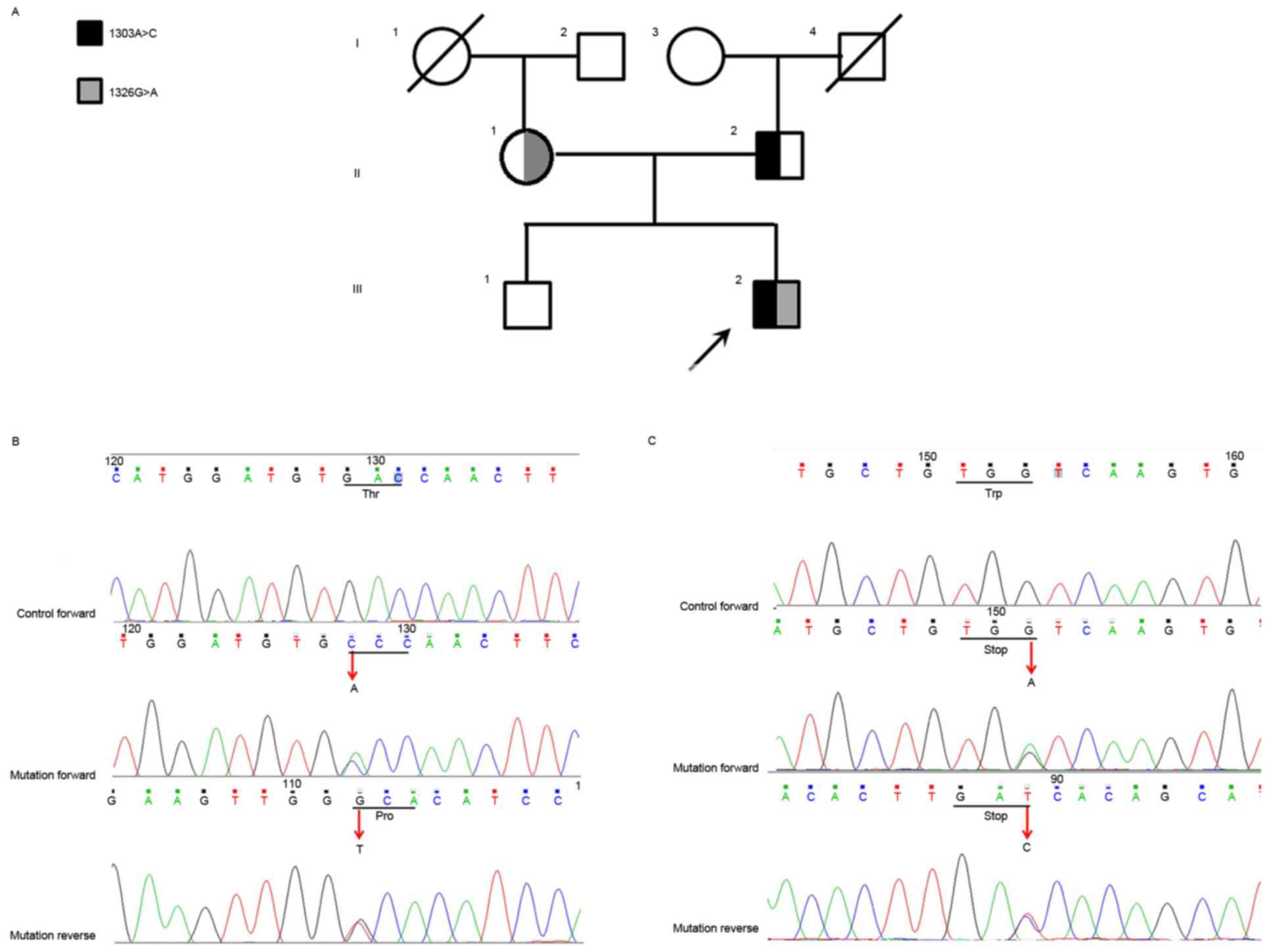
In the present study, a family from Hunan province comprising six members across three generations, which were admitted to the Second Xiangya Hospital in October, 2015 (Changsha, China), was included (Fig. 1A; Table I). The proband was diagnosed with hyperbilirubinemia (III2) with a total bilirubin level of 30.6 µmol/l and a direct bilirubin level of 10.5 µmol/l. No hyperbilirubinemia was present in the other family members. Details of the family are listed in Table I. The present study was approved by the Second Xiangya Hospital of Central South University (Changsha, China). All subjects provided consent prior to commencement of the study.

Figure 1.

(A) Pedigree of the family examined in the present study. Squares represent males; circles represent females; horizontal lines indicate that the individual is deceased; the white/grey circle represents the affected member with c.1326G>A/p.W442X; the black/white square represents the affected member with c.1303A>C/p.T435P; the black/grey square represents the proband with c.1326G>A/p.W442X and c.1303A>C/p.T435P. (B) Analysis of ABCC2. The chromatograms show the partial sequence of ABCC2, c.1326G>A. (C) Analysis of ABCC2. The chromatograms show the partial sequence of ABCC2, c.1303A>C. ABCC2, ATP-binding cassette C2.

Table I.

Summary of the family with Dubin-Johnson syndrome investigated.

Table I.

Summary of the family with Dubin-Johnson syndrome investigated.

Program prediction

Family memberTBIL/DBIL (µmol/l)Age (years)ABCC2 DNAProteinPolyphen-2SIFTMutationTaster
III2 (proband)30.6/10.5191303A>CT435PPossibly damagingDeleteriousDisease-causing
1326G>AW442XPossibly damagingDeleteriousDisease-causing
I216.0/5.070–––––
I313.7/5.569–––––
II115.9/4.9431326G>AW442X–––
II214.9/4.9441303A>CT435P–––
III113.5/3.820–––––

[i] TBIL, total bilirubin; DBIL, direct bilirubin; ABCC2, ATP-binding cassette C2; Polyphen-2, Polmorphism Phenotyping-2; SIFT, Sorting Intolerant From Tolerant.

DNA extraction

Genomic DNA was extracted from the peripheral blood of the proband and other family members using a DNeasy Blood & Tissue kit (Qiagen, Inc., Valencia, CA, USA) according to the manufacturer's protocol, on the QIAcube automated DNA extraction robot (Qiagen, Inc.), as previously described (9).

Mutation sequencing

Through the use of polymerase chain reaction (PCR), several genes were amplified, including UGT1A1 (Refseq: NM_000463), ABCC2 (Refseq: NM_000392) and OATP1B1 (Refseq: NM_0,06446). PCR was performed using 25 µl reaction volumes, containing 0.3 mM dNTPs, 1X PCR buffer (10 mM Tris-HCl pH 9.0, 50 mM KCl, 0.1% Triton X-100 and 0.01% w/v gelatin), 2.0 mM MgCl2, 0.5 µM of each primer (forward and reverse), 1.5 U of Taq polymerase (Thermo Fisher Scientific, Inc., Waltham, MA, USA), and 50 ng of genomic DNA. Thermocycling conditions were as follows: Initial denaturation at 95°C for 5 min, followed by 35 cycles of amplification consisting of denaturation at 95°C for 30 sec, annealing at 55–61°C for 30 sec and extension at 72°C for 1 min. A final extension step was performed at 72°C for 7 min. The sequences of the PCR products were obtained using the ABI 3100 genetic analyzer (Applied Biosystems; Thermo Fisher Scientific, Inc.). Results were compared with normal control samples, as defined in our previous study (9).

Bioinformatics sequence analysis and mutation prediction

In several species, the multiple ABCC2 protein sequences were aligned (version 3.6; http://www.ncbi.nlm.nih.gov). Polymorphism Phenotyping-2 (Polyphen 2; http://genetics.bwh.harvard.edu/pph2/) (10), Sorting Intolerant From Tolerant (SIFT; http://sift.bii.astar.edu.sg/) (11) and MutationTaster (www.mutationtaster.org) (12) were used to predict the effects of these sequence variants on the function of the protein.

Results

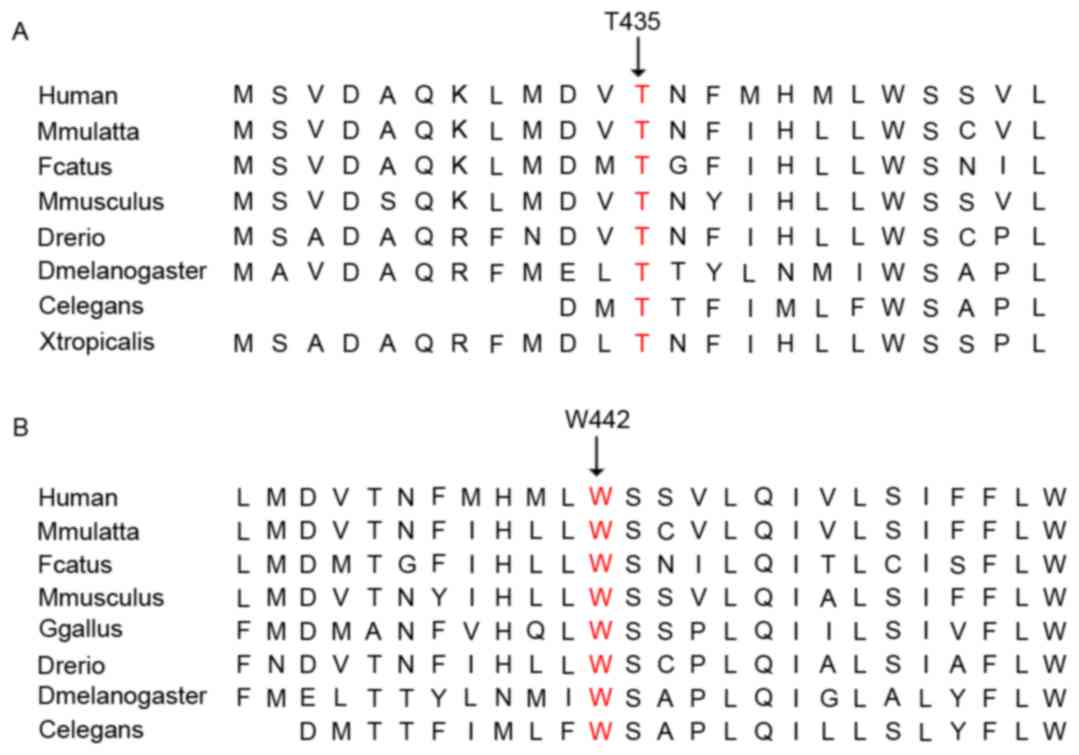
The present study reported on a patient with hyperbilirubinemia with a total bilirubin level of 30.6 µmol/l and direct bilirubin of 10.5 µmol/l, whereas the reference standard values are 5.1–17.1 and 0–6.0 µmol/l, respectively. The possibility of the induction of hyperbilirubinemia by known genes was investigated. Using Sanger sequencing, a missense mutation (c.1303A>C/p.T435P) and a nonsense mutation (c.1326G>A/p.W442X) in ABCC2 were identified and co-segregated with the affected members. (Fig. 1B and C). The allelic segregation analysis revealed that the missense mutation was carried by the mother, whereas the nonsense mutation was inherited from the father. These newly identified missense mutations c.1303A>C and c.1326G>A were not found in a cohort of 200 controls, as described in our previous study (9). In addition, these two mutations were not present in the dbSNP and Exome Variant Server databases. In humans, macaques, cats, mice and zebrafish, the amino acid sequences of ABCC2 were found to be aligned, which revealed that the affected amino acids were evolutionarily conserved (Fig. 2A and B). Three programs were used for analyzing the protein functions of ABCC2; polyphen2, SIFT and Mutation Taster, predicted that the two variants were likely to be damaging, deleterious and disease-causing, respectively. The consistent findings of the detrimental effects of the variants by all these bioinformatics programs suggested that these mutations are important in the function of ABCC2.

Figure 2.

Conservation analysis of ATP-binding cassette C2. (A) T435 sites are highlighted in red. This locus was found to be highly conserved at the protein level across different species. (B) W442 sites are highlighted in blue. This locus was found to be highly conserved at the protein level across different species.

Discussion

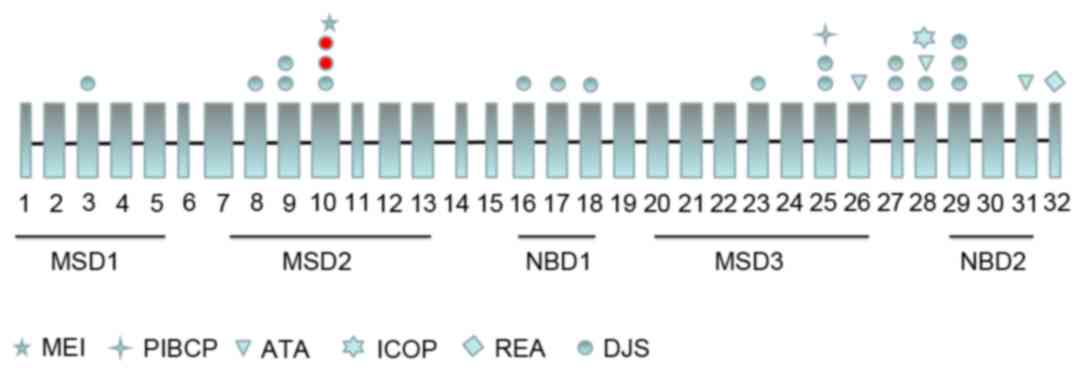
The present study presented a case of hyperbilirubinemia associated with a compound heterozygous mutation (c.1303A>C/p.T435P and c.1326G>A/p.W442X) in exon 10 of ABCC2. A previous study found that mutations in ABCC2 may cause DJS, and this syndrome was characterized by biphasic, predominantly conjugated, hyperbilirubinemia. At present, ~17 point mutations of ABCC2 have been reported in patients with DJS (Fig. 3). The outcome of the molecular genetic investigations performed in the present study was consistent with and confirmed the clinical diagnosis of DJS.

Figure 3.

Summary of missense or nonsense mutations in ATP-binding cassette C2 and the associated diseases. Mutations identified in the present study are indicated in red. MSD, membrane spanning domain; NBD, nucleotide-donmain; MEI, methotrexate elimination, impaired; PIBCP, pruritis in biliary cirrhosis patients; ATA, altered transport activity; ICOP, intrahepatic cholestasis of pregnancy; REA, reduced efflux activity; DJS, Dubin-Johnson syndrome.

Under normal conditions, hepatocytes take up unconjugated bilirubin by transporters of the organic anion-transporting polypeptide family, followed by conjugation with glucuronic acid and ATP-dependent transport into bile. This efflux across the canalicular membrane is mediated by ABCC2/MRP2, which has a high affinity and efficiency for monoglucuronosyl and bisglucuronosyl bilirubin into bile. Therefore, mutations in ABCC2 may lead to DJS (13,14).

In the present study, the missense and nonsense mutations were located in a conserved membrane-spanning domain (MSD), namely MSD2, of the ABCC2 protein (15). The nonsense mutation can also lead to the absence of the complete nucleotide-binding domain (NBD)-1, MSD3 and NBD2. Mutations in MSD2 may affect the subcellular localization of ABCC2, and the truncated mutation may cause the functional defect of ABCC2. These two point mutations were present in patients, and this compound heterozygous mutation was associated with DJS recessive hereditary mode.

Among the compound heterozygous mutations in DJS, 13 cases have been reported, including that identified in the present study (5,16). At present, a total of 24 MRP2/ABCC2 point mutations have been reported, 17 of which are associated with DJS (17–19) (Fig. 3). In the last 25 years, different types of viral vectors have been used in clinical trials for the treatment of a variety of monogenetic disorders. It has been suggested that this technique may be used to treat hereditary hyperbilirubinemia (20,21), however, further investigation and improvements are required (22).

In conclusion, the present study identified an ABCC2 compound heterozygous mutation (c.1303A>C/p.T435P and c.1326G>A/p.W442X) in a patient with DJS. To the best of our knowledge, this may be the first report of these two mutations worldwide. The results of the present study offer further support for the significant involvement of ABCC2 in DJS. The results also expand on the spectrum of ABCC2 mutations, and contribute to the genetic diagnosis and counseling of families with DJS.

Acknowledgements

The authors would like to thank the State Key Laboratory of Medical Genetics of China for their technical assistance. This study was supported by the National Natural Science Foundation of China (grant nos. 81370394 and 81400831).

References

1 

Keppler D: The roles of MRP2, MRP3, OATP1B1, and OATP1B3 in conjugated hyperbilirubinemia. Drug Metab Dispos. 42:561–565. 2014. View Article : Google Scholar : PubMed/NCBI

2 

Memon N, Weinberger BI, Hegyi T and Aleksunes LM: Inherited disorders of bilirubin clearance. Pediatr Res. 79:378–386. 2016. View Article : Google Scholar : PubMed/NCBI

3 

Radlovic N: Hereditary hyperbilirubinemias. Srp Arh Celok Lek. 142:257–260. 2014. View Article : Google Scholar : PubMed/NCBI

4 

Sticova E, Elleder M, Hulkova H, Luksan O, Sauer M, Wunschova-Moudra I, Novotny J and Jirsa M: Dubin-Johnson syndrome coinciding with colon cancer and atherosclerosis. World J Gastroenterol. 19:946–950. 2013. View Article : Google Scholar : PubMed/NCBI

5 

Uchiumi T, Tanamachi H, Kuchiwaki K, Kajita M, Matsumoto S, Yagi M, Kanki T and Kang D: Mutation and functional analysis of ABCC2/multidrug resistance protein 2 in a Japanese patient with Dubin-Johnson syndrome. Hepatol Res. 43:569–575. 2013. View Article : Google Scholar : PubMed/NCBI

6 

Li P, Wang Y, Zhang J, Geng M and Li Z: Dubin-Johnson syndrome with multiple liver cavernous hemangiomas: Report of a familial case. Int J Clin Exp Pathol. 6:2636–2639. 2013.PubMed/NCBI

7 

Chen ZS and Tiwari AK: Multidrug resistance proteins (MRPs/ABCCs) in cancer chemotherapy and genetic diseases. FEBS J. 278:3226–3245. 2011. View Article : Google Scholar : PubMed/NCBI

8 

Sticova E and Jirsa M: New insights in bilirubin metabolism and their clinical implications. World J Gastroenterol. 19:6398–6407. 2013. View Article : Google Scholar : PubMed/NCBI

9 

Xiang R, Fan LL, Huang H, Cao BB, Li XP, Peng DQ and Xia K: A novel mutation of GATA4 (K319E) is responsible for familial atrial septal defect and pulmonary valve stenosis. Gene. 534:320–323. 2014. View Article : Google Scholar : PubMed/NCBI

10 

Sunyaev S, Ramensky V and Bork P: Towards a structural basis of human non-synonymous single nucleotide polymorphisms. Trends Genet. 16:198–200. 2000. View Article : Google Scholar : PubMed/NCBI

11 

Ng PC and Henikoff S: SIFT: Predicting amino acid changes that affect protein function. Nucleic Acids Res. 31:3812–3814. 2003. View Article : Google Scholar : PubMed/NCBI

12 

Schwarz JM, Rödelsperger C, Schuelke M and Seelow D: MutationTaster evaluates disease-causing potential of sequence alterations. Nat Methods. 7:575–576. 2010. View Article : Google Scholar : PubMed/NCBI

13 

Fujiwara R, Maruo Y, Chen S and Tukey RH: Role of extrahepatic UDP-glucuronosyltransferase 1A1: Advances in understanding breast milk-induced neonatal hyperbilirubinemia. Toxicol Appl Pharmacol. 289:124–132. 2015. View Article : Google Scholar : PubMed/NCBI

14 

Christensen RD and Yaish HM: Hemolytic disorders causing severe neonatal hyperbilirubinemia. Clin Perinatol. 42:515–527. 2015. View Article : Google Scholar : PubMed/NCBI

15 

Emi Y, Yasuda Y and Sakaguchi M: A cis-acting five-amino-acid motif controls targeting of ABCC2 to the apical plasma membrane domain. J Cell Sci. 125:3133–3143. 2012. View Article : Google Scholar : PubMed/NCBI

16 

Okada H, Kusaka T, Fuke N, Kunikata J, Kondo S, Iwase T, Nan W, Hirota T, Ieiri I and Itoh S: Neonatal Dubin-Johnson syndrome: Novel compound heterozygous mutation in the ABCC2 gene. Pediatr Int. 56:e62–e64. 2014. View Article : Google Scholar : PubMed/NCBI

17 

Devgun MS, El-Nujumi AM, O'Dowd GJ, Barbu V and Poupon R: Novel mutations in the Dubin-Johnson syndrome gene ABCC2/MRP2 and associated biochemical changes. Ann Clin Biochem. 49:609–612. 2012. View Article : Google Scholar : PubMed/NCBI

18 

Lee JH, Chen HL, Chen HL, Ni YH, Hsu HY and Chang MH: Neonatal Dubin-Johnson syndrome: Long-term follow-up and MRP2 mutations study. Pediatr Res. 59:584–589. 2006. View Article : Google Scholar : PubMed/NCBI

19 

Kruer MC, Jepperson T, Dutta S, Steiner RD, Cottenie E, Sanford L, Merkens M, Russman BS, Blasco PA, Fan G, et al: Mutations in gamma adducin are associated with inherited cerebral palsy. Ann Neurol. 74:805–814. 2013. View Article : Google Scholar : PubMed/NCBI

20 

Kaufmann KB, Büning H, Galy A, Schambach A and Grez M: Gene therapy on the move. EMBO Mol Med. 5:1642–1661. 2013. View Article : Google Scholar : PubMed/NCBI

21 

van Dijk R, Beuers U and Bosma PJ: Gene replacement therapy for genetic hepatocellular jaundice. Clin Rev Allergy Immunol. 48:243–253. 2015. View Article : Google Scholar : PubMed/NCBI

22 

Stapelbroek JM, van Erpecum KJ, Klomp LW and Houwen RH: Liver disease associated with canalicular transport defects: Current and future therapies. J Hepatol. 52:258–271. 2010. View Article : Google Scholar : PubMed/NCBI

Related Articles

  • Abstract
  • View
  • Download
  • Twitter
Copy and paste a formatted citation
Spandidos Publications style
Xiang R, Li JJ, Fan LL, Jin JY, Xia K and Wang F: Identification of a compound heterozygous mutation of ABCC2 in a patient with hyperbilirubinemia. Mol Med Rep 16: 2830-2834, 2017.
APA
Xiang, R., Li, J., Fan, L., Jin, J., Xia, K., & Wang, F. (2017). Identification of a compound heterozygous mutation of ABCC2 in a patient with hyperbilirubinemia. Molecular Medicine Reports, 16, 2830-2834. https://doi.org/10.3892/mmr.2017.6926
MLA
Xiang, R., Li, J., Fan, L., Jin, J., Xia, K., Wang, F."Identification of a compound heterozygous mutation of ABCC2 in a patient with hyperbilirubinemia". Molecular Medicine Reports 16.3 (2017): 2830-2834.
Chicago
Xiang, R., Li, J., Fan, L., Jin, J., Xia, K., Wang, F."Identification of a compound heterozygous mutation of ABCC2 in a patient with hyperbilirubinemia". Molecular Medicine Reports 16, no. 3 (2017): 2830-2834. https://doi.org/10.3892/mmr.2017.6926
Copy and paste a formatted citation
x
Spandidos Publications style
Xiang R, Li JJ, Fan LL, Jin JY, Xia K and Wang F: Identification of a compound heterozygous mutation of ABCC2 in a patient with hyperbilirubinemia. Mol Med Rep 16: 2830-2834, 2017.
APA
Xiang, R., Li, J., Fan, L., Jin, J., Xia, K., & Wang, F. (2017). Identification of a compound heterozygous mutation of ABCC2 in a patient with hyperbilirubinemia. Molecular Medicine Reports, 16, 2830-2834. https://doi.org/10.3892/mmr.2017.6926
MLA
Xiang, R., Li, J., Fan, L., Jin, J., Xia, K., Wang, F."Identification of a compound heterozygous mutation of ABCC2 in a patient with hyperbilirubinemia". Molecular Medicine Reports 16.3 (2017): 2830-2834.
Chicago
Xiang, R., Li, J., Fan, L., Jin, J., Xia, K., Wang, F."Identification of a compound heterozygous mutation of ABCC2 in a patient with hyperbilirubinemia". Molecular Medicine Reports 16, no. 3 (2017): 2830-2834. https://doi.org/10.3892/mmr.2017.6926
Follow us
  • Twitter
  • LinkedIn
  • Facebook
About
  • Spandidos Publications
  • Careers
  • Cookie Policy
  • Privacy Policy
How can we help?
  • Help
  • Live Chat
  • Contact
  • Email to our Support Team