Spandidos Publications Logo
  • About
    • About Spandidos
    • Aims and Scopes
    • Abstracting and Indexing
    • Editorial Policies
    • Reprints and Permissions
    • Job Opportunities
    • Terms and Conditions
    • Contact
  • Journals
    • All Journals
    • Oncology Letters
      • Oncology Letters
      • Information for Authors
      • Editorial Policies
      • Editorial Board
      • Aims and Scope
      • Abstracting and Indexing
      • Bibliographic Information
      • Archive
    • International Journal of Oncology
      • International Journal of Oncology
      • Information for Authors
      • Editorial Policies
      • Editorial Board
      • Aims and Scope
      • Abstracting and Indexing
      • Bibliographic Information
      • Archive
    • Molecular and Clinical Oncology
      • Molecular and Clinical Oncology
      • Information for Authors
      • Editorial Policies
      • Editorial Board
      • Aims and Scope
      • Abstracting and Indexing
      • Bibliographic Information
      • Archive
    • Experimental and Therapeutic Medicine
      • Experimental and Therapeutic Medicine
      • Information for Authors
      • Editorial Policies
      • Editorial Board
      • Aims and Scope
      • Abstracting and Indexing
      • Bibliographic Information
      • Archive
    • International Journal of Molecular Medicine
      • International Journal of Molecular Medicine
      • Information for Authors
      • Editorial Policies
      • Editorial Board
      • Aims and Scope
      • Abstracting and Indexing
      • Bibliographic Information
      • Archive
    • Biomedical Reports
      • Biomedical Reports
      • Information for Authors
      • Editorial Policies
      • Editorial Board
      • Aims and Scope
      • Abstracting and Indexing
      • Bibliographic Information
      • Archive
    • Oncology Reports
      • Oncology Reports
      • Information for Authors
      • Editorial Policies
      • Editorial Board
      • Aims and Scope
      • Abstracting and Indexing
      • Bibliographic Information
      • Archive
    • Molecular Medicine Reports
      • Molecular Medicine Reports
      • Information for Authors
      • Editorial Policies
      • Editorial Board
      • Aims and Scope
      • Abstracting and Indexing
      • Bibliographic Information
      • Archive
    • World Academy of Sciences Journal
      • World Academy of Sciences Journal
      • Information for Authors
      • Editorial Policies
      • Editorial Board
      • Aims and Scope
      • Abstracting and Indexing
      • Bibliographic Information
      • Archive
    • International Journal of Functional Nutrition
      • International Journal of Functional Nutrition
      • Information for Authors
      • Editorial Policies
      • Editorial Board
      • Aims and Scope
      • Abstracting and Indexing
      • Bibliographic Information
      • Archive
    • International Journal of Epigenetics
      • International Journal of Epigenetics
      • Information for Authors
      • Editorial Policies
      • Editorial Board
      • Aims and Scope
      • Abstracting and Indexing
      • Bibliographic Information
      • Archive
    • Medicine International
      • Medicine International
      • Information for Authors
      • Editorial Policies
      • Editorial Board
      • Aims and Scope
      • Abstracting and Indexing
      • Bibliographic Information
      • Archive
  • Articles
  • Information
    • Information for Authors
    • Information for Reviewers
    • Information for Librarians
    • Information for Advertisers
    • Conferences
  • Language Editing
Spandidos Publications Logo
  • About
    • About Spandidos
    • Aims and Scopes
    • Abstracting and Indexing
    • Editorial Policies
    • Reprints and Permissions
    • Job Opportunities
    • Terms and Conditions
    • Contact
  • Journals
    • All Journals
    • Biomedical Reports
      • Information for Authors
      • Editorial Policies
      • Editorial Board
      • Aims and Scope
      • Abstracting and Indexing
      • Bibliographic Information
      • Archive
    • Experimental and Therapeutic Medicine
      • Information for Authors
      • Editorial Policies
      • Editorial Board
      • Aims and Scope
      • Abstracting and Indexing
      • Bibliographic Information
      • Archive
    • International Journal of Epigenetics
      • Information for Authors
      • Editorial Policies
      • Editorial Board
      • Aims and Scope
      • Abstracting and Indexing
      • Bibliographic Information
      • Archive
    • International Journal of Functional Nutrition
      • Information for Authors
      • Editorial Policies
      • Editorial Board
      • Aims and Scope
      • Abstracting and Indexing
      • Bibliographic Information
      • Archive
    • International Journal of Molecular Medicine
      • Information for Authors
      • Editorial Policies
      • Editorial Board
      • Aims and Scope
      • Abstracting and Indexing
      • Bibliographic Information
      • Archive
    • International Journal of Oncology
      • Information for Authors
      • Editorial Policies
      • Editorial Board
      • Aims and Scope
      • Abstracting and Indexing
      • Bibliographic Information
      • Archive
    • Medicine International
      • Information for Authors
      • Editorial Policies
      • Editorial Board
      • Aims and Scope
      • Abstracting and Indexing
      • Bibliographic Information
      • Archive
    • Molecular and Clinical Oncology
      • Information for Authors
      • Editorial Policies
      • Editorial Board
      • Aims and Scope
      • Abstracting and Indexing
      • Bibliographic Information
      • Archive
    • Molecular Medicine Reports
      • Information for Authors
      • Editorial Policies
      • Editorial Board
      • Aims and Scope
      • Abstracting and Indexing
      • Bibliographic Information
      • Archive
    • Oncology Letters
      • Information for Authors
      • Editorial Policies
      • Editorial Board
      • Aims and Scope
      • Abstracting and Indexing
      • Bibliographic Information
      • Archive
    • Oncology Reports
      • Information for Authors
      • Editorial Policies
      • Editorial Board
      • Aims and Scope
      • Abstracting and Indexing
      • Bibliographic Information
      • Archive
    • World Academy of Sciences Journal
      • Information for Authors
      • Editorial Policies
      • Editorial Board
      • Aims and Scope
      • Abstracting and Indexing
      • Bibliographic Information
      • Archive
  • Articles
  • Information
    • For Authors
    • For Reviewers
    • For Librarians
    • For Advertisers
    • Conferences
  • Language Editing
Login Register Submit
  • This site uses cookies
  • You can change your cookie settings at any time by following the instructions in our Cookie Policy. To find out more, you may read our Privacy Policy.

    I agree
Search articles by DOI, keyword, author or affiliation
Search
Advanced Search
presentation
Molecular Medicine Reports
Join Editorial Board Propose a Special Issue
Print ISSN: 1791-2997 Online ISSN: 1791-3004
Journal Cover
November-2017 Volume 16 Issue 5

Full Size Image

Sign up for eToc alerts
Recommend to Library

Journals

International Journal of Molecular Medicine

International Journal of Molecular Medicine

International Journal of Molecular Medicine is an international journal devoted to molecular mechanisms of human disease.

International Journal of Oncology

International Journal of Oncology

International Journal of Oncology is an international journal devoted to oncology research and cancer treatment.

Molecular Medicine Reports

Molecular Medicine Reports

Covers molecular medicine topics such as pharmacology, pathology, genetics, neuroscience, infectious diseases, molecular cardiology, and molecular surgery.

Oncology Reports

Oncology Reports

Oncology Reports is an international journal devoted to fundamental and applied research in Oncology.

Experimental and Therapeutic Medicine

Experimental and Therapeutic Medicine

Experimental and Therapeutic Medicine is an international journal devoted to laboratory and clinical medicine.

Oncology Letters

Oncology Letters

Oncology Letters is an international journal devoted to Experimental and Clinical Oncology.

Biomedical Reports

Biomedical Reports

Explores a wide range of biological and medical fields, including pharmacology, genetics, microbiology, neuroscience, and molecular cardiology.

Molecular and Clinical Oncology

Molecular and Clinical Oncology

International journal addressing all aspects of oncology research, from tumorigenesis and oncogenes to chemotherapy and metastasis.

World Academy of Sciences Journal

World Academy of Sciences Journal

Multidisciplinary open-access journal spanning biochemistry, genetics, neuroscience, environmental health, and synthetic biology.

International Journal of Functional Nutrition

International Journal of Functional Nutrition

Open-access journal combining biochemistry, pharmacology, immunology, and genetics to advance health through functional nutrition.

International Journal of Epigenetics

International Journal of Epigenetics

Publishes open-access research on using epigenetics to advance understanding and treatment of human disease.

Medicine International

Medicine International

An International Open Access Journal Devoted to General Medicine.

Journal Cover
November-2017 Volume 16 Issue 5

Full Size Image

Sign up for eToc alerts
Recommend to Library

  • Article
  • Citations
    • Cite This Article
    • Download Citation
    • Create Citation Alert
    • Remove Citation Alert
    • Cited By
  • Similar Articles
    • Related Articles (in Spandidos Publications)
    • Similar Articles (Google Scholar)
    • Similar Articles (PubMed)
  • Download PDF
  • Download XML
  • View XML
Article Open Access

ING2, a tumor associated gene, enhances PAI‑1 and HSPA1A expression with HDAC1 and mSin3A through the PHD domain and C‑terminal

  • Authors:
    • Chiyo Ohkouchi
    • Kensuke Kumamoto
    • Motonobu Saito
    • Teruhide Ishigame
    • Shin‑Ichi Suzuki
    • Seiichi Takenoshita
    • Cutis C. Harris
  • View Affiliations / Copyright

    Affiliations: Department of Thyroid and Endocrinology, Fukushima Medical University School of Medicine, Fukushima 960‑1295, Japan, Department of Coloproctology, Aizu Medical Center, Fukushima Medical University, Aizuwakamatsu, Fukushima 969‑3492, Japan, Laboratory of Human Carcinogenesis, Center for Cancer Research, National Cancer Institute, National Institutes of Health, Bethesda, MD 20892, USA, Department of Organ Regulatory Surgery, Fukushima Medical University School of Medicine, Fukushima 960‑1295, Japan
    Copyright: © Ohkouchi et al. This is an open access article distributed under the terms of Creative Commons Attribution License.
  • Pages: 7367-7374
    |
    Published online on: September 20, 2017
       https://doi.org/10.3892/mmr.2017.7553
  • Expand metrics +
Metrics: Total Views: 0 (Spandidos Publications: | PMC Statistics: )
Metrics: Total PDF Downloads: 0 (Spandidos Publications: | PMC Statistics: )
Cited By (CrossRef): 0 citations Loading Articles...

This article is mentioned in:


Abstract

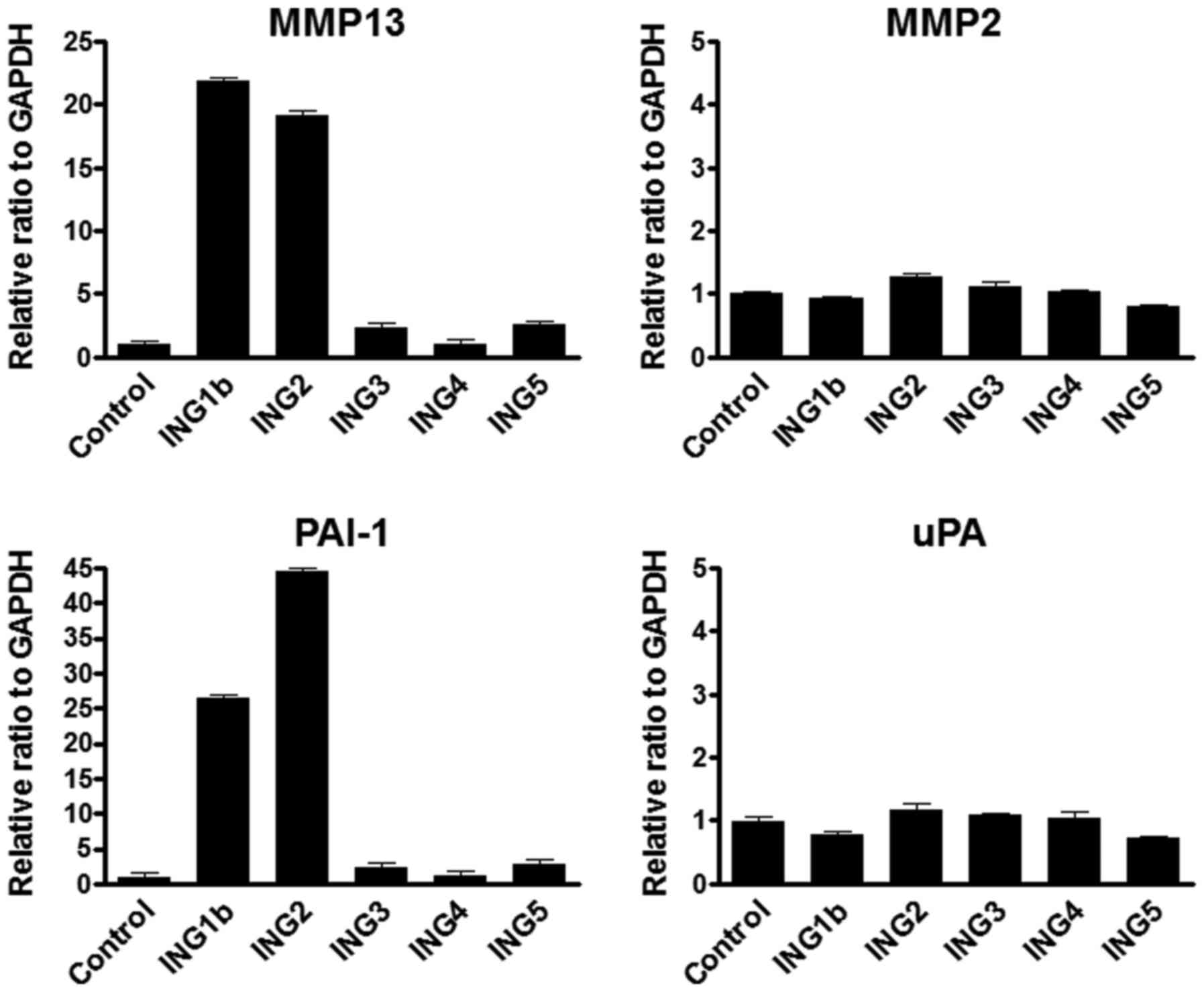
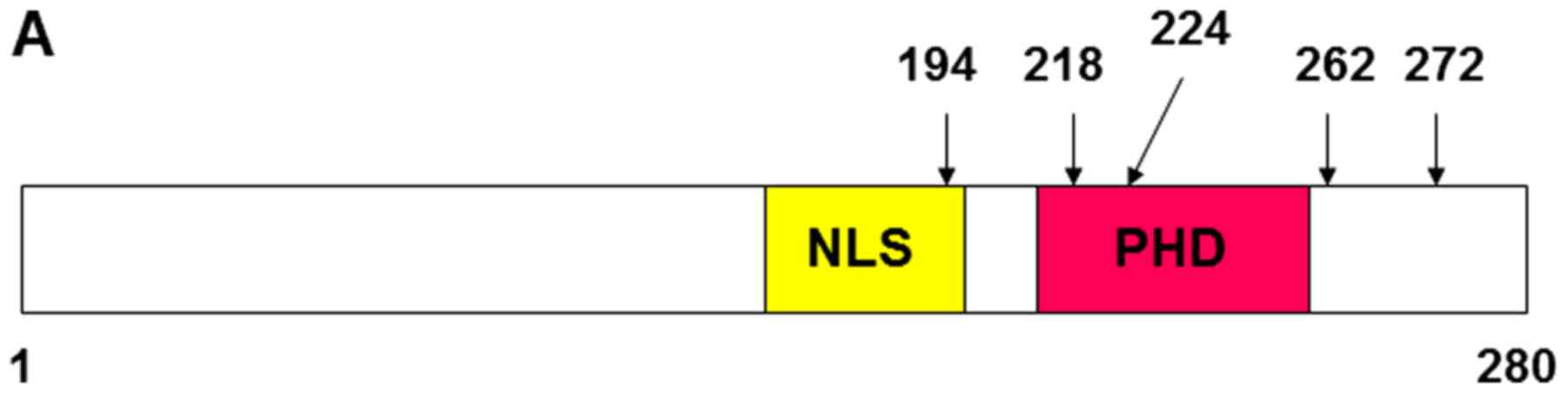
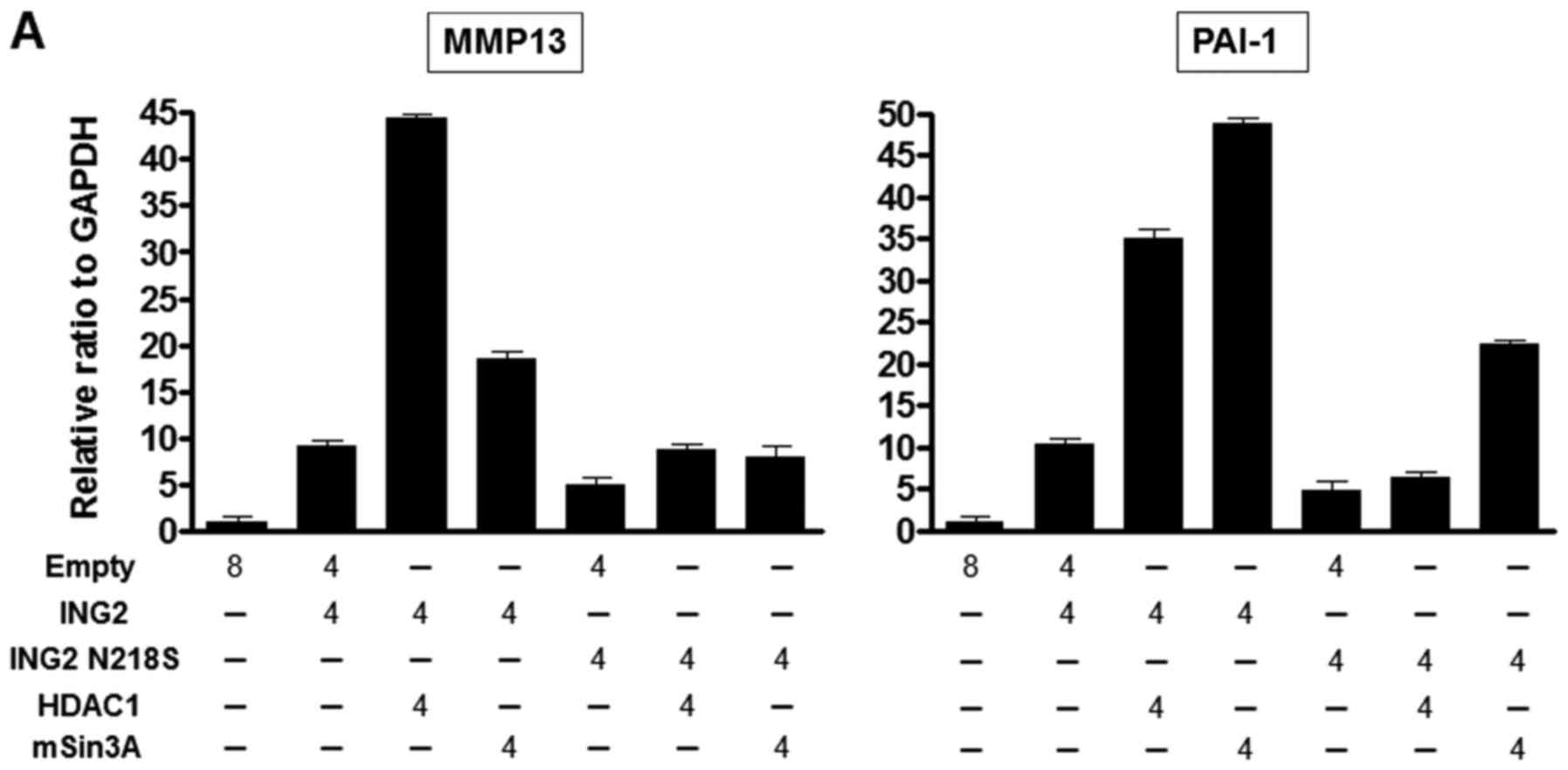
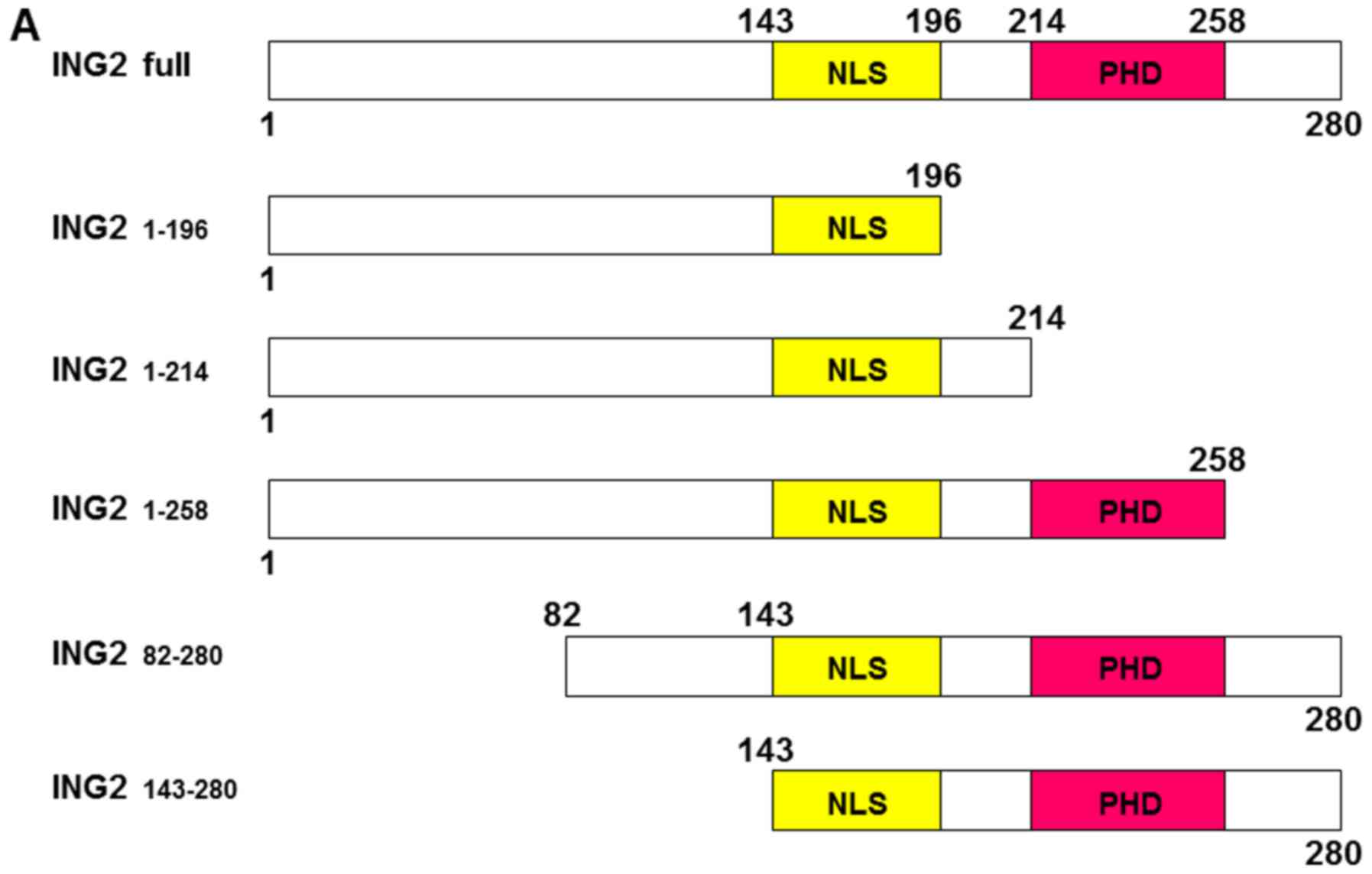
Inhibitor of growth 2 (ING2) is involved in chromatin remodeling and it has previously been suggested that ING2 may regulate gene expression. The authors previously identified matrix metalloproteinase 13 (MMP13) as a target gene of ING2 in colorectal cancer. The aim of the present study was to identify novel genes regulated by ING2 and histone deacetylase 1 (HDAC1) and to clarify the biological significance of the ING2 structure. The present study generated the point mutant constructs of ING2 and deletion constructs consisting of partial ING2 to investigate the effect on gene expression and verify the interaction with HDAC1, mSin3A and sap30. A microarray was performed to find novel ING2/HDAC1 target genes using cell co‑overexpression of ING2 and HDAC1. Plasminogen activator inhibitor‑1 (PAI‑1) was upregulated with overexpression of ING1b and ING2. The mutation of the PHD domain at 218 significantly attenuated the MMP13 and PAI‑1 expression, whereas the mutation at 224 resulted in increased expression. Furthermore, the expression levels were slightly reduced by the mutation of the C‑terminal. The lack of the PHD domain and the C‑terminal in ING2 resulted in a decreased ability to induce gene expression. The C‑terminal with PHD domain, which lacked the N‑terminal, maintained the transactive function for regulating the target genes. In addition to MMP13 and PAI‑1, eight genes [heat shock protein family A member 1A (HSPA1A), MIR7‑3 host gene, chorionic somatomammotropin hormone 1, growth arrest and DNA damage inducible b, dehydrogenase/reductase 2, galectin 1, myosin light chain 1, and VGF nerve growth factor inducible] were demonstrated to be associated with ING2/HDAC1. The present study demonstrated that ING2/HDAC1 regulated PAI‑1 and HSPA1A expression and the PHD domain and the C‑terminal of ING2, which are binding sites of HDAC1 and mSin3A, are essential regions for the regulation of gene expression.
View Figures

Figure 1

Figure 2

Figure 3

Figure 4

Figure 5

Figure 6

View References

1 

Garkavtsev I, Kazarov A, Gudkov A and Riabowol K: Suppression of the novel growth inhibitor p33ING1 promotes neoplastic transformation. Nat Genet. 14:415–420. 1996. View Article : Google Scholar : PubMed/NCBI

2 

Shimada Y, Saito A, Suzuki M, Takahashi E and Horie M: Cloning of a novel gene (ING1L) homologous to ING1, a candidate tumor suppressor. Cytogenet Cell Genet. 83:232–235. 1998. View Article : Google Scholar : PubMed/NCBI

3 

Nagashima M, Shiseki M, Miura K, Hagiwara K, Linke SP, Pedeux R, Wang XW, Yokota J, Riabowol K and Harris CC: DNA damage-inducible gene p33ING2 negatively regulates cell proliferation through acetylation of p53. Proc Natl Acad Sci USA. 98:9671–9676. 2001; View Article : Google Scholar : PubMed/NCBI

4 

Nagashima M, Shiseki M, Pedeux RM, Okamura S, Kitahama-Shiseki M, Miura K, Yokota J and Harris CC: A novel PHD-finger motif protein, p47ING3, modulates p53-mediated transcription, cell cycle control, and apoptosis. Oncogene. 22:343–350. 2003. View Article : Google Scholar : PubMed/NCBI

5 

Shiseki M, Nagashima M, Pedeux RM, Kitahama-Shiseki M, Miura K, Okamura S, Onogi H, Higashimoto Y, Appella E, Yokota J and Harris CC: p29ING4 and p28ING5 bind to p53 and p300, and enhance p53 activity. Cancer Res. 63:2373–2378. 2003.PubMed/NCBI

6 

He GH, Helbing CC, Wagner MJ, Sensen CW and Riabowol K: Phylogenetic analysis of the ING family of PHD finger proteins. Mol Biol Evol. 22:104–116. 2005. View Article : Google Scholar : PubMed/NCBI

7 

Unoki M, Shen JC, Zheng ZM and Harris CC: Novel splice variants of ING4 and their possible roles in the regulation of cell growth and motility. J Biol Chem. 281:34677–34686. 2006. View Article : Google Scholar : PubMed/NCBI

8 

Scott M, Bonnefin P, Vieyra D, Boisvert FM, Young D, Bazett-Jones DP and Riabowol K: UV-induced binding of ING1 to PCNA regulates the induction of apoptosis. J Cell Sci. 114:3455–3462. 2001.PubMed/NCBI

9 

Skowyra D, Zeremski M, Neznanov N, Li M, Choi Y, Uesugi M, Hauser CA, Gu W, Gudkov AV and Qin J: Differential association of products of alternative transcripts of the candidate tumor suppressor ING1 with the mSin3/HDAC1 transcriptional corepressor complex. J Biol Chem. 276:8734–8739. 2001. View Article : Google Scholar : PubMed/NCBI

10 

Kuzmichev A, Zhang Y, Erdjument-Bromage H, Tempst P and Reinberg D: Role of the Sin3-histone deacetylase complex in growth regulation by the candidate tumor suppressor p33(ING1). Mol Cell Biol. 22:835–848. 2002. View Article : Google Scholar : PubMed/NCBI

11 

Feng X, Hara Y and Riabowol K: Different HATS of the ING1 gene family. Trends Cell Biol. 12:532–538. 2002. View Article : Google Scholar : PubMed/NCBI

12 

Doyon Y, Cayrou C, Ullah M, Landry AJ, Côté V, Selleck W, Lane WS, Tan S, Yang XJ and Côté J: ING tumor suppressor proteins are critical regulators of chromatin acetylation required for genome expression and perpetuation. Mol Cell. 21:51–64. 2006. View Article : Google Scholar : PubMed/NCBI

13 

Peña PV, Davrazou F, Shi X, Walter KL, Verkhusha VV, Gozani O, Zhao R and Kutateladze TG: Molecular mechanism of histone H3K4me3 recognition by plant homeodomain of ING2. Nature. 442:100–103. 2006.PubMed/NCBI

14 

Shi X, Hong T, Walter KL, Ewalt M, Michishita E, Hung T, Carney D, Peña P, Lan F, Kaadige MR, et al: ING2 PHD domain links histone H3 lysine 4 methylation to active gene repression. Nature. 442:96–99. 2006.PubMed/NCBI

15 

Santos-Rosa H, Schneider R, Bannister AJ, Sherriff J, Bernstein BE, Emre NC, Schreiber SL, Mellor J and Kouzarides T: Active genes are tri-methylated at K4 of histone H3. Nature. 419:407–411. 2002. View Article : Google Scholar : PubMed/NCBI

16 

Bernstein BE, Kamal M, Lindblad-Toh K, Bekiranov S, Bailey DK, Huebert DJ, McMahon S, Karlsson EK, Kulbokas EJ III, Gingeras TR, et al: Genomic maps and comparative analysis of histone modifications in human and mouse. Cell. 120:169–181. 2005. View Article : Google Scholar : PubMed/NCBI

17 

Berger SL: The complex language of chromatin regulation during transcription. Nature. 447:407–412. 2007. View Article : Google Scholar : PubMed/NCBI

18 

Kumamoto K, Fujita K, Kurotani R, Saito M, Unoki M, Hagiwara N, Shiga H, Bowman ED, Yanaihara N, Okamura S, et al: ING2 is upregulated in colon cancer and increases invasion by enhanced MMP13 expression. Int J Cancer. 125:1306–1315. 2009. View Article : Google Scholar : PubMed/NCBI

19 

Gozani O, Karuman P, Jones DR, Ivanov D, Cha J, Lugovskoy AA, Baird CL, Zhu H, Field SJ, Lessnick SL, et al: The PHD finger of the chromatin-associated protein ING2 functions as a nuclear phosphoinositide receptor. Cell. 114:99–111. 2003. View Article : Google Scholar : PubMed/NCBI

20 

Clarke JH, Letcher AJ, D'santos CS, Halstead JR, Irvine RF and Divecha N: Inositol lipids are regulated during cell cycle progression in the nuclei of murine erythroleukaemia cells. Biochem J. 357:905–910. 2001. View Article : Google Scholar : PubMed/NCBI

21 

Roberts HF, Clarke JH, Letcher AJ, Irvine RF and Hinchliffe KA: Effects of lipid kinase expression and cellular stimuli on phosphatidylinositol 5-phosphate levels in mammalian cell lines. FEBS Lett. 579:2868–2872. 2005. View Article : Google Scholar : PubMed/NCBI

22 

Bunce MW, Gonzales ML and Anderson RA: Stress-ING out: Phosphoinositides mediate the cellular stress response. Sci STKE. 2006:pe462006. View Article : Google Scholar : PubMed/NCBI

23 

Jones DR, Bultsma Y, Keune WJ, Halstead JR, Elouarrat D, Mohammed S, Heck AJ, D'Santos CS and Divecha N: Nuclear PtdIns5P as a transducer of stress signaling: An in vivo role for PIP4Kbeta. Mol Cell. 23:685–695. 2006. View Article : Google Scholar : PubMed/NCBI

24 

Huang W, Zhang H, Davrazou F, Kutateladze TG, Shi X, Gozani O and Prestwich GD: Stabilized phosphatidylinositol-5-phosphate analogues as ligands for the nuclear protein ING2: Chemistry, biology, and molecular modeling. J Am Chem Soc. 129:6498–6506. 2007. View Article : Google Scholar : PubMed/NCBI

25 

Unoki M, Kumamoto K and Harris CC: ING proteins as potential anticancer drug targets. Curr Drug Targets. 10:442–454. 2009. View Article : Google Scholar : PubMed/NCBI

26 

Zhong J, Yang L, Liu N, Zheng J and Lin CY: Knockdown of inhibitor of growth protein 2 inhibits cell invasion and enhances chemosensitivity to 5-FU in human gastric cancer cells. Dig Dis Sci. 58:3189–3197. 2013. View Article : Google Scholar : PubMed/NCBI

27 

Staib F, Robles AI, Varticovski L, Wang XW, Zeeberg BR, Sirotin M, Zhurkin VB, Hofseth LJ, Hussain SP, Weinstein JN, et al: The p53 tumor suppressor network is a key responder to microenvironmental components of chronic inflammatory stress. Cancer Res. 65:10255–10264. 2005. View Article : Google Scholar : PubMed/NCBI

28 

Koong AC, Denko NC, Hudson KM, Schindler C, Swiersz L, Koch C, Evans S, Ibrahim H, Le QT, Terris DJ and Giaccia AJ: Candidate genes for the hypoxic tumor phenotype. Cancer Res. 60:883–887. 2000.PubMed/NCBI

29 

Higuchi C, Tanihata Y, Nishimura H, Naito T and Sanaka T: Effects of glucose and plasminogen activator inhibitor-1 on collagen metabolism in the peritoneum. Ther Apher Dial. 9:173–181. 2005. View Article : Google Scholar : PubMed/NCBI

30 

Diehl P, Hantke B, Hennig M, Tschesche H, Mittelmeier W, Schmitt M and Muehlenweg B: Protein expression of MMP-13, uPA, and PAI-1 in pseudocapsular and interface tissue around implants of loose artificial hip joints and in osteoarthritis. Int J Mol Med. 13:711–715. 2004.PubMed/NCBI

31 

Nouman GS, Anderson JJ, Lunec J and Angus B: The role of the tumour suppressor p33 ING1b in human neoplasia. J Clin Pathol. 56:491–496. 2003. View Article : Google Scholar : PubMed/NCBI

32 

Qiu Y, Zhao Y, Becker M, John S, Parekh BS, Huang S, Hendarwanto A, Martinez ED, Chen Y, Lu H, et al: HDAC1 acetylation is linked to progressive modulation of steroid receptor-induced gene transcription. Mol Cell. 22:669–679. 2006. View Article : Google Scholar : PubMed/NCBI

33 

Wang XQ, Alfaro ML, Evans GF and Zuckerman SH: Histone deacetylase inhibition results in decreased macrophage CD9 expression. Biochem Biophys Res Commun. 294:660–666. 2002. View Article : Google Scholar : PubMed/NCBI

34 

Ferguson M, Henry PA and Currie RA: Histone deacetylase inhibition is associated with transcriptional repression of the Hmga2 gene. Nucleic Acids Res. 31:3123–3133. 2003. View Article : Google Scholar : PubMed/NCBI

35 

Feng X, Bonni S and Riabowol K: HSP70 induction by ING proteins sensitizes cells to tumor necrosis factor alpha receptor-mediated apoptosis. Mol Cell Biol. 26:9244–9255. 2006. View Article : Google Scholar : PubMed/NCBI

36 

Fujii T, Obara T, Tanno S, Ura H and Kohgo Y: Urokinase-type plasminogen activator and plasminogen activator inhibitor-1 as a prognostic factor in human colorectal carcinomas. Hepatogastroenterology. 46:2299–2308. 1999.PubMed/NCBI

37 

Wang L, Xiao X, Li D, Chi Y, Wei P, Wang Y, Ni S, Tan C, Zhou X and Du X: Abnormal expression of GADD45B in human colorectal carcinoma. J Transl Med. 10:2152012. View Article : Google Scholar : PubMed/NCBI

38 

Hittelet A, Legendre H, Nagy N, Bronckart Y, Pector JC, Salmon I, Yeaton P, Gabius HJ, Kiss R and Camby I: Upregulation of galectins-1 and −3 in human colon cancer and their role in regulating cell migration. Int J Cancer. 103:370–379. 2003. View Article : Google Scholar : PubMed/NCBI

39 

Kim JH, Qu A, Reddy JK, Gao B and Gonzalez FJ: Hepatic oxidative stress activates the Gadd45b gene by way of degradation of the transcriptional repressor STAT3. Hepatology. 59:695–704. 2014. View Article : Google Scholar : PubMed/NCBI

40 

Zhao XY, Chen TT, Xia L, Guo M, Xu Y, Yue F, Jiang Y, Chen GQ and Zhao KW: Hypoxia inducible factor-1 mediates expression of galectin-1: The potential role in migration/invasion of colorectal cancer cells. Carcinogenesis. 31:1367–1375. 2010. View Article : Google Scholar : PubMed/NCBI

Related Articles

  • Abstract
  • View
  • Download
  • Twitter
Copy and paste a formatted citation
Spandidos Publications style
Ohkouchi C, Kumamoto K, Saito M, Ishigame T, Suzuki SI, Takenoshita S and Harris CC: ING2, a tumor associated gene, enhances PAI‑1 and HSPA1A expression with HDAC1 and mSin3A through the PHD domain and C‑terminal. Mol Med Rep 16: 7367-7374, 2017.
APA
Ohkouchi, C., Kumamoto, K., Saito, M., Ishigame, T., Suzuki, S., Takenoshita, S., & Harris, C.C. (2017). ING2, a tumor associated gene, enhances PAI‑1 and HSPA1A expression with HDAC1 and mSin3A through the PHD domain and C‑terminal. Molecular Medicine Reports, 16, 7367-7374. https://doi.org/10.3892/mmr.2017.7553
MLA
Ohkouchi, C., Kumamoto, K., Saito, M., Ishigame, T., Suzuki, S., Takenoshita, S., Harris, C. C."ING2, a tumor associated gene, enhances PAI‑1 and HSPA1A expression with HDAC1 and mSin3A through the PHD domain and C‑terminal". Molecular Medicine Reports 16.5 (2017): 7367-7374.
Chicago
Ohkouchi, C., Kumamoto, K., Saito, M., Ishigame, T., Suzuki, S., Takenoshita, S., Harris, C. C."ING2, a tumor associated gene, enhances PAI‑1 and HSPA1A expression with HDAC1 and mSin3A through the PHD domain and C‑terminal". Molecular Medicine Reports 16, no. 5 (2017): 7367-7374. https://doi.org/10.3892/mmr.2017.7553
Copy and paste a formatted citation
x
Spandidos Publications style
Ohkouchi C, Kumamoto K, Saito M, Ishigame T, Suzuki SI, Takenoshita S and Harris CC: ING2, a tumor associated gene, enhances PAI‑1 and HSPA1A expression with HDAC1 and mSin3A through the PHD domain and C‑terminal. Mol Med Rep 16: 7367-7374, 2017.
APA
Ohkouchi, C., Kumamoto, K., Saito, M., Ishigame, T., Suzuki, S., Takenoshita, S., & Harris, C.C. (2017). ING2, a tumor associated gene, enhances PAI‑1 and HSPA1A expression with HDAC1 and mSin3A through the PHD domain and C‑terminal. Molecular Medicine Reports, 16, 7367-7374. https://doi.org/10.3892/mmr.2017.7553
MLA
Ohkouchi, C., Kumamoto, K., Saito, M., Ishigame, T., Suzuki, S., Takenoshita, S., Harris, C. C."ING2, a tumor associated gene, enhances PAI‑1 and HSPA1A expression with HDAC1 and mSin3A through the PHD domain and C‑terminal". Molecular Medicine Reports 16.5 (2017): 7367-7374.
Chicago
Ohkouchi, C., Kumamoto, K., Saito, M., Ishigame, T., Suzuki, S., Takenoshita, S., Harris, C. C."ING2, a tumor associated gene, enhances PAI‑1 and HSPA1A expression with HDAC1 and mSin3A through the PHD domain and C‑terminal". Molecular Medicine Reports 16, no. 5 (2017): 7367-7374. https://doi.org/10.3892/mmr.2017.7553
Follow us
  • Twitter
  • LinkedIn
  • Facebook
About
  • Spandidos Publications
  • Careers
  • Cookie Policy
  • Privacy Policy
How can we help?
  • Help
  • Live Chat
  • Contact
  • Email to our Support Team