Spandidos Publications Logo
  • About
    • About Spandidos
    • Aims and Scopes
    • Abstracting and Indexing
    • Editorial Policies
    • Reprints and Permissions
    • Job Opportunities
    • Terms and Conditions
    • Contact
  • Journals
    • All Journals
    • Oncology Letters
      • Oncology Letters
      • Information for Authors
      • Editorial Policies
      • Editorial Board
      • Aims and Scope
      • Abstracting and Indexing
      • Bibliographic Information
      • Archive
    • International Journal of Oncology
      • International Journal of Oncology
      • Information for Authors
      • Editorial Policies
      • Editorial Board
      • Aims and Scope
      • Abstracting and Indexing
      • Bibliographic Information
      • Archive
    • Molecular and Clinical Oncology
      • Molecular and Clinical Oncology
      • Information for Authors
      • Editorial Policies
      • Editorial Board
      • Aims and Scope
      • Abstracting and Indexing
      • Bibliographic Information
      • Archive
    • Experimental and Therapeutic Medicine
      • Experimental and Therapeutic Medicine
      • Information for Authors
      • Editorial Policies
      • Editorial Board
      • Aims and Scope
      • Abstracting and Indexing
      • Bibliographic Information
      • Archive
    • International Journal of Molecular Medicine
      • International Journal of Molecular Medicine
      • Information for Authors
      • Editorial Policies
      • Editorial Board
      • Aims and Scope
      • Abstracting and Indexing
      • Bibliographic Information
      • Archive
    • Biomedical Reports
      • Biomedical Reports
      • Information for Authors
      • Editorial Policies
      • Editorial Board
      • Aims and Scope
      • Abstracting and Indexing
      • Bibliographic Information
      • Archive
    • Oncology Reports
      • Oncology Reports
      • Information for Authors
      • Editorial Policies
      • Editorial Board
      • Aims and Scope
      • Abstracting and Indexing
      • Bibliographic Information
      • Archive
    • Molecular Medicine Reports
      • Molecular Medicine Reports
      • Information for Authors
      • Editorial Policies
      • Editorial Board
      • Aims and Scope
      • Abstracting and Indexing
      • Bibliographic Information
      • Archive
    • World Academy of Sciences Journal
      • World Academy of Sciences Journal
      • Information for Authors
      • Editorial Policies
      • Editorial Board
      • Aims and Scope
      • Abstracting and Indexing
      • Bibliographic Information
      • Archive
    • International Journal of Functional Nutrition
      • International Journal of Functional Nutrition
      • Information for Authors
      • Editorial Policies
      • Editorial Board
      • Aims and Scope
      • Abstracting and Indexing
      • Bibliographic Information
      • Archive
    • International Journal of Epigenetics
      • International Journal of Epigenetics
      • Information for Authors
      • Editorial Policies
      • Editorial Board
      • Aims and Scope
      • Abstracting and Indexing
      • Bibliographic Information
      • Archive
    • Medicine International
      • Medicine International
      • Information for Authors
      • Editorial Policies
      • Editorial Board
      • Aims and Scope
      • Abstracting and Indexing
      • Bibliographic Information
      • Archive
  • Articles
  • Information
    • Information for Authors
    • Information for Reviewers
    • Information for Librarians
    • Information for Advertisers
    • Conferences
  • Language Editing
Spandidos Publications Logo
  • About
    • About Spandidos
    • Aims and Scopes
    • Abstracting and Indexing
    • Editorial Policies
    • Reprints and Permissions
    • Job Opportunities
    • Terms and Conditions
    • Contact
  • Journals
    • All Journals
    • Biomedical Reports
      • Information for Authors
      • Editorial Policies
      • Editorial Board
      • Aims and Scope
      • Abstracting and Indexing
      • Bibliographic Information
      • Archive
    • Experimental and Therapeutic Medicine
      • Information for Authors
      • Editorial Policies
      • Editorial Board
      • Aims and Scope
      • Abstracting and Indexing
      • Bibliographic Information
      • Archive
    • International Journal of Epigenetics
      • Information for Authors
      • Editorial Policies
      • Editorial Board
      • Aims and Scope
      • Abstracting and Indexing
      • Bibliographic Information
      • Archive
    • International Journal of Functional Nutrition
      • Information for Authors
      • Editorial Policies
      • Editorial Board
      • Aims and Scope
      • Abstracting and Indexing
      • Bibliographic Information
      • Archive
    • International Journal of Molecular Medicine
      • Information for Authors
      • Editorial Policies
      • Editorial Board
      • Aims and Scope
      • Abstracting and Indexing
      • Bibliographic Information
      • Archive
    • International Journal of Oncology
      • Information for Authors
      • Editorial Policies
      • Editorial Board
      • Aims and Scope
      • Abstracting and Indexing
      • Bibliographic Information
      • Archive
    • Medicine International
      • Information for Authors
      • Editorial Policies
      • Editorial Board
      • Aims and Scope
      • Abstracting and Indexing
      • Bibliographic Information
      • Archive
    • Molecular and Clinical Oncology
      • Information for Authors
      • Editorial Policies
      • Editorial Board
      • Aims and Scope
      • Abstracting and Indexing
      • Bibliographic Information
      • Archive
    • Molecular Medicine Reports
      • Information for Authors
      • Editorial Policies
      • Editorial Board
      • Aims and Scope
      • Abstracting and Indexing
      • Bibliographic Information
      • Archive
    • Oncology Letters
      • Information for Authors
      • Editorial Policies
      • Editorial Board
      • Aims and Scope
      • Abstracting and Indexing
      • Bibliographic Information
      • Archive
    • Oncology Reports
      • Information for Authors
      • Editorial Policies
      • Editorial Board
      • Aims and Scope
      • Abstracting and Indexing
      • Bibliographic Information
      • Archive
    • World Academy of Sciences Journal
      • Information for Authors
      • Editorial Policies
      • Editorial Board
      • Aims and Scope
      • Abstracting and Indexing
      • Bibliographic Information
      • Archive
  • Articles
  • Information
    • For Authors
    • For Reviewers
    • For Librarians
    • For Advertisers
    • Conferences
  • Language Editing
Login Register Submit
  • This site uses cookies
  • You can change your cookie settings at any time by following the instructions in our Cookie Policy. To find out more, you may read our Privacy Policy.

    I agree
Search articles by DOI, keyword, author or affiliation
Search
Advanced Search
presentation
Molecular Medicine Reports
Join Editorial Board Propose a Special Issue
Print ISSN: 1791-2997 Online ISSN: 1791-3004
Journal Cover
February-2018 Volume 17 Issue 2

Full Size Image

Sign up for eToc alerts
Recommend to Library

Journals

International Journal of Molecular Medicine

International Journal of Molecular Medicine

International Journal of Molecular Medicine is an international journal devoted to molecular mechanisms of human disease.

International Journal of Oncology

International Journal of Oncology

International Journal of Oncology is an international journal devoted to oncology research and cancer treatment.

Molecular Medicine Reports

Molecular Medicine Reports

Covers molecular medicine topics such as pharmacology, pathology, genetics, neuroscience, infectious diseases, molecular cardiology, and molecular surgery.

Oncology Reports

Oncology Reports

Oncology Reports is an international journal devoted to fundamental and applied research in Oncology.

Experimental and Therapeutic Medicine

Experimental and Therapeutic Medicine

Experimental and Therapeutic Medicine is an international journal devoted to laboratory and clinical medicine.

Oncology Letters

Oncology Letters

Oncology Letters is an international journal devoted to Experimental and Clinical Oncology.

Biomedical Reports

Biomedical Reports

Explores a wide range of biological and medical fields, including pharmacology, genetics, microbiology, neuroscience, and molecular cardiology.

Molecular and Clinical Oncology

Molecular and Clinical Oncology

International journal addressing all aspects of oncology research, from tumorigenesis and oncogenes to chemotherapy and metastasis.

World Academy of Sciences Journal

World Academy of Sciences Journal

Multidisciplinary open-access journal spanning biochemistry, genetics, neuroscience, environmental health, and synthetic biology.

International Journal of Functional Nutrition

International Journal of Functional Nutrition

Open-access journal combining biochemistry, pharmacology, immunology, and genetics to advance health through functional nutrition.

International Journal of Epigenetics

International Journal of Epigenetics

Publishes open-access research on using epigenetics to advance understanding and treatment of human disease.

Medicine International

Medicine International

An International Open Access Journal Devoted to General Medicine.

Journal Cover
February-2018 Volume 17 Issue 2

Full Size Image

Sign up for eToc alerts
Recommend to Library

  • Article
  • Citations
    • Cite This Article
    • Download Citation
    • Create Citation Alert
    • Remove Citation Alert
    • Cited By
  • Similar Articles
    • Related Articles (in Spandidos Publications)
    • Similar Articles (Google Scholar)
    • Similar Articles (PubMed)
  • Download PDF
  • Download XML
  • View XML
Article

IRF3 signaling pathway serves an important role in poly(I:C)-induced procollagen reduction in human skin fibroblasts

  • Authors:
    • Cheng Yao
    • Sangbum Han
    • Chi‑Hyun Park
    • Ye‑Ji Kim
    • Dong Hun Lee
    • Jin Ho Chung
  • View Affiliations / Copyright

    Affiliations: Department of Dermatology, Seoul National University College of Medicine, Seoul 110‑744, Republic of Korea
  • Pages: 2581-2585
    |
    Published online on: November 22, 2017
       https://doi.org/10.3892/mmr.2017.8136
  • Expand metrics +
Metrics: Total Views: 0 (Spandidos Publications: | PMC Statistics: )
Metrics: Total PDF Downloads: 0 (Spandidos Publications: | PMC Statistics: )
Cited By (CrossRef): 0 citations Loading Articles...

This article is mentioned in:


Abstract

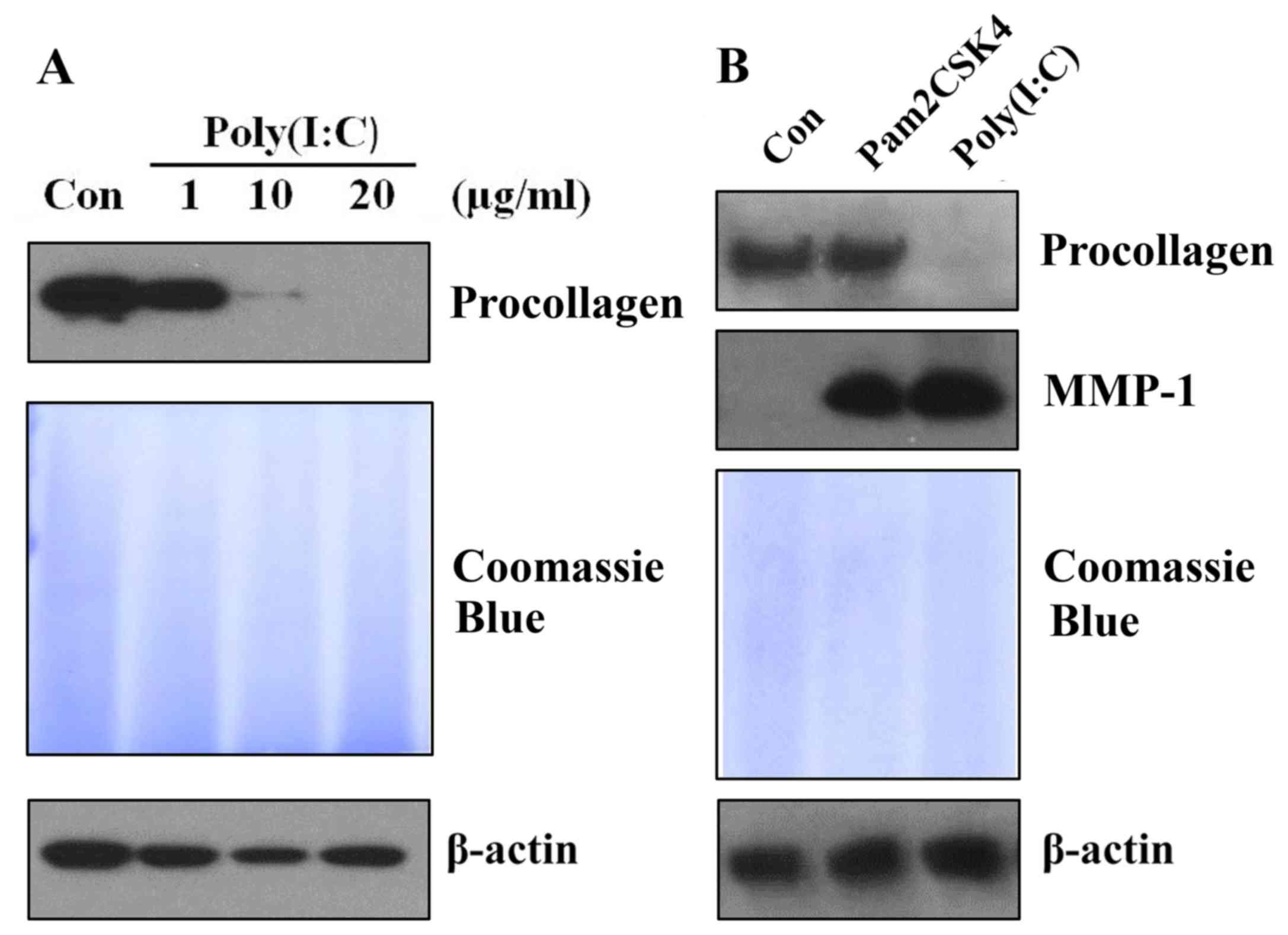
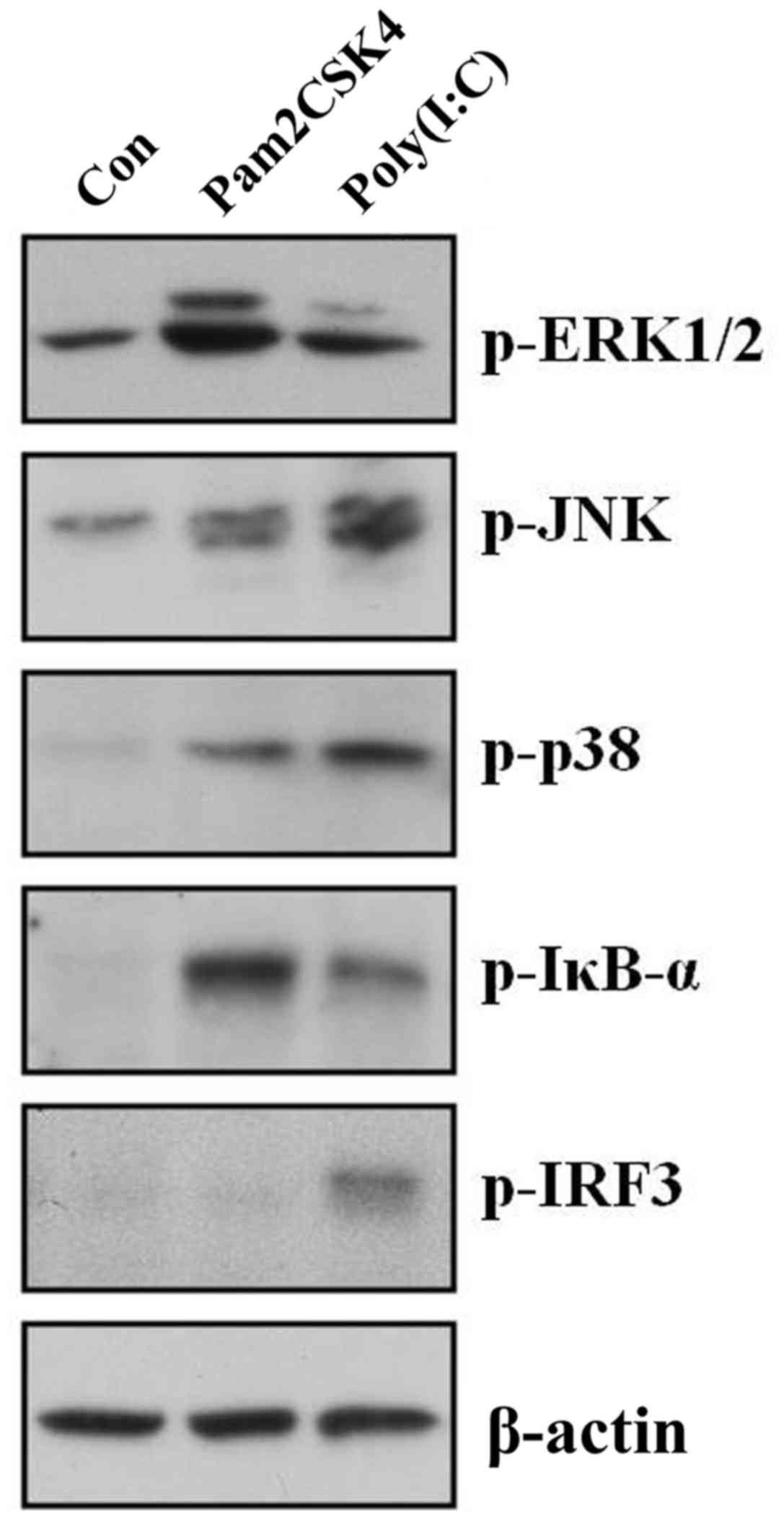
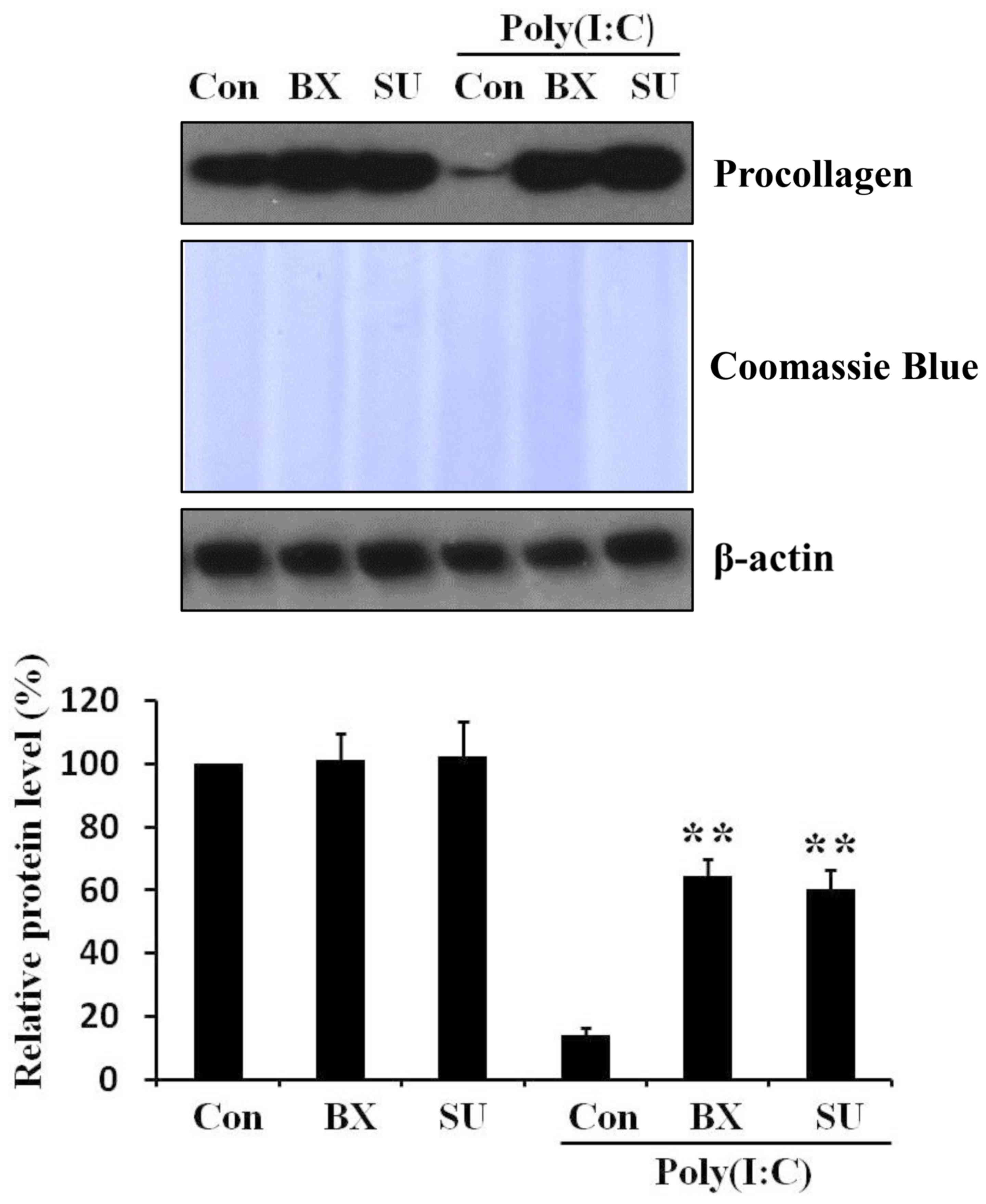
Pattern recognition receptors (PRRs) are part of the immune system. They can recognize pathogen‑associated molecular patterns (PAMPs). Toll‑like receptors (TLRs) and retinoic acid‑inducible gene 1 (RIG‑1)‑like receptors (RLRs) are 2 types of PRR in the innate immune system. Double‑stranded RNA (dsRNA) can exist as a PAMP, including dsRNA viruses. dsRNA is known as a ligand not only for TLR3 but also for RLRs, including melanoma differentiation‑associated gene 5 and RIG‑1. Collagen is the main structural protein in the extracellular space in the skin. Recently, it was reported that treatment of a synthetic dsRNA, poly(I:C), decreases procollagen expression in skin fibroblasts. However, signaling pathways involved in this process have not yet been fully elucidated. The present study further explored the underlying signaling pathways involved in the processes. It was demonstrated by western blotting that treatment of poly(I:C), but not another PAMP, Pam3CSK4, inhibited procollagen expression in cultured human skin fibroblasts. Treatment of poly(I:C)and Pam3CSK4 induced activation of the mitogen‑activated protein kinases and the nuclear factor‑κB pathways. However, only poly(I:C), but not Pam3CSK4, induced the activation of the interferon regulatory factor 3 (IRF3) pathway. By using specific inhibitors, it was demonstrated that inhibition of IRF3 pathway relieved poly(I:C)‑induced procollagen reduction. In conclusion, IRF3 signaling pathway serves an important role in poly(I:C)‑induced procollagen reduction in skin fibroblasts. This suggests that the IRF3 signaling pathway may be a key target for collagen regulation in the skin.
View Figures

Figure 1

Figure 2

Figure 3

View References

1 

Chen K, Huang J, Gong W, Iribarren P, Dunlop NM and Wang JM: Toll-like receptors in inflammation, infection and cancer. Int Immunopharmacol. 7:1271–1285. 2007. View Article : Google Scholar : PubMed/NCBI

2 

Ermertcan AT, Öztürk F and Gündüz K: Toll-like receptors and skin. J Eur Acad Dermatol Venereol. 25:997–1006. 2011. View Article : Google Scholar : PubMed/NCBI

3 

Medzhitov R: Toll-like receptors and innate immunity. Nat Rev Immunol. 1:135–145. 2001. View Article : Google Scholar : PubMed/NCBI

4 

Miller LS and Modlin RL: Toll-like receptors in the skin. Semin Immunopathol. 29:15–26. 2007. View Article : Google Scholar : PubMed/NCBI

5 

Takeuchi O, Kaufmann A, Grote K, Kawai T, Hoshino K, Morr M, Mühlradt PF and Akira S: Cutting edge: Preferentially the R-stereoisomer of the mycoplasmal lipopeptide macrophage-activating lipopeptide-2 activates immune cells through a toll-like receptor 2- and MyD88-dependent signaling pathway. J Immunol. 164:554–557. 2000. View Article : Google Scholar : PubMed/NCBI

6 

Takeuchi O, Sato S, Horiuchi T, Hoshino K, Takeda K, Dong Z, Modlin RL and Akira S: Cutting edge: Role of Toll-like receptor 1 in mediating immune response to microbial lipoproteins. J Immunol. 169:10–14. 2002. View Article : Google Scholar : PubMed/NCBI

7 

Takeuchi O, Kawai T, Mühlradt PF, Morr M, Radolf JD, Zychlinsky A, Takeda K and Akira S: Discrimination of bacterial lipoproteins by Toll-like receptor 6. Int Immunol. 13:933–940. 2001. View Article : Google Scholar : PubMed/NCBI

8 

Kalali BN, Köllisch G, Mages J, Müller T, Bauer S, Wagner H, Ring J, Lang R, Mempel M and Ollert M: Double-stranded RNA induces an antiviral defense status in epidermal keratinocytes through TLR3-, PKR-, and MDA5/RIG-I-mediated differential signaling. J Immunol. 181:2694–2704. 2008. View Article : Google Scholar : PubMed/NCBI

9 

Tanner NK and Linder P: DExD/H box RNA helicases: From generic motors to specific dissociation functions. Mol Cell. 8:251–262. 2001. View Article : Google Scholar : PubMed/NCBI

10 

Sloane JA, Blitz D, Margolin Z and Vartanian T: A clear and present danger: Endogenous ligands of Toll-like receptors. Neuromolecular Med. 12:149–163. 2010. View Article : Google Scholar : PubMed/NCBI

11 

Lester SN and Li K: Toll-like receptors in antiviral innate immunity. J Mol Biol. 426:1246–1264. 2014. View Article : Google Scholar : PubMed/NCBI

12 

Pattanaik D, Brown M, Postlethwaite BC and Postlethwaite AE: Pathogenesis of systemic sclerosis. Front Immunol. 6:2722015. View Article : Google Scholar : PubMed/NCBI

13 

Rittié L and Fisher GJ: UV-light-induced signal cascades and skin aging. Ageing Res Rev. 1:705–720. 2002. View Article : Google Scholar : PubMed/NCBI

14 

Farina GA, York MR, Di Marzio M, Collins CA, Meller S, Homey B, Rifkin IR, Marshak-Rothstein A, Radstake TR and Lafyatis R: Poly(I:C) drives type I IFN- and TGFβ-mediated inflammation and dermal fibrosis simulating altered gene expression in systemic sclerosis. J Invest Dermatol. 130:2583–2593. 2010. View Article : Google Scholar : PubMed/NCBI

15 

Sugiura H, Ichikawa T, Koarai A, Yanagisawa S, Minakata Y, Matsunaga K, Hirano T, Akamatsu K and Ichinose M: Activation of Toll-like receptor 3 augments myofibroblast differentiation. Am J Respir Cell Mol Biol. 40:654–662. 2009. View Article : Google Scholar : PubMed/NCBI

16 

Lee Y, Kim H, Kim S, Kim KH and Chung JH: Activation of toll-like receptors 2, 3 or 5 induces matrix metalloproteinase-1 and −9 expression with the involvement of MAPKs and NF-kappaB in human epidermal keratinocytes. Exp Dermatol. 19:e44–e49. 2010. View Article : Google Scholar : PubMed/NCBI

17 

Reimer T, Schweizer M and Jungi TW: Stimulation-specific contribution of p38 and JNK to IFN-beta gene expression in human macrophages. J Interferon Cytokine Res. 27:751–755. 2007. View Article : Google Scholar : PubMed/NCBI

18 

Fang F, Ooka K, Sun X, Shah R, Bhattacharyya S, Wei J and Varga J: A synthetic TLR3 ligand mitigates profibrotic fibroblast responses by inducing autocrine IFN signaling. J Immunol. 191:2956–2966. 2013. View Article : Google Scholar : PubMed/NCBI

19 

Kinnier CV, Martinu T, Gowdy KM, Nugent JL, Kelly FL and Palmer SM: Innate immune activation by the viral PAMP poly I:C potentiates pulmonary graft-versus-host disease after allogeneic hematopoietic cell transplant. Transpl Immunol. 24:83–93. 2011. View Article : Google Scholar : PubMed/NCBI

20 

Yao C, Oh JH, Lee DH, Bae JS, Jin CL, Park CH and Chung JH: Toll-like receptor family members in skin fibroblasts are functional and have a higher expression compared to skin keratinocytes. Int J Mol Med. 35:1443–1450. 2015. View Article : Google Scholar : PubMed/NCBI

21 

Yao C, Lee DH, Oh JH, Kim MK, Kim KH, Park CH and Chung JH: Poly(I:C) induces expressions of MMP-1, −2, and −3 through various signaling pathways including IRF3 in human skin fibroblasts. J Dermatol Sci. 80:54–60. 2015. View Article : Google Scholar : PubMed/NCBI

22 

Chiappinelli KB, Strissel PL, Desrichard A, Li H, Henke C, Akman B, Hein A, Rote NS, Cope LM, Snyder A, et al: Inhibiting DNA methylation causes an interferon response in cancer via dsRNA including endogenous retroviruses. Cell. 169:3612017. View Article : Google Scholar : PubMed/NCBI

23 

Bernard JJ, Cowing-Zitron C, Nakatsuji T, Muehleisen B, Muto J, Borkowski AW, Martinez L, Greidinger EL, Yu BD and Gallo RL: Ultraviolet radiation damages self noncoding RNA and is detected by TLR3. Nat Med. 18:1286–1290. 2012. View Article : Google Scholar : PubMed/NCBI

24 

Hyde DM and Giri SN: Polyinosinic-polycytidylic acid, an interferon inducer, ameliorates bleomycin-induced lung fibrosis in mice. Exp Lung Res. 16:533–546. 1990. View Article : Google Scholar : PubMed/NCBI

25 

Hou X, Yu F, Man S, Huang D, Zhang Y, Liu M, Ren C and Shen J: Polyinosinic-polycytidylic acid attenuates hepatic fibrosis in C57BL/6 mice with Schistosoma japonicum infection. Acta Trop. 121:99–104. 2012. View Article : Google Scholar : PubMed/NCBI

26 

Ni MM, Xu T, Wang YR, He YH, Zhou Q, Huang C, Meng XM and Li J: Inhibition of IRF3 expression reduces TGF-β1-induced proliferation of hepatic stellate cells. J Physiol Biochem. 72:9–23. 2016. View Article : Google Scholar : PubMed/NCBI

27 

Xu P, Bailey-Bucktrout S, Xi Y, Xu D, Du D, Zhang Q, Xiang W, Liu J, Melton A, Sheppard D, et al: Innate antiviral host defense attenuates TGF-β function through IRF3-mediated suppression of Smad signaling. Mol Cell. 56:723–737. 2014. View Article : Google Scholar : PubMed/NCBI

Related Articles

  • Abstract
  • View
  • Download
  • Twitter
Copy and paste a formatted citation
Spandidos Publications style
Yao C, Han S, Park CH, Kim YJ, Lee DH and Chung JH: IRF3 signaling pathway serves an important role in poly(I:C)-induced procollagen reduction in human skin fibroblasts. Mol Med Rep 17: 2581-2585, 2018.
APA
Yao, C., Han, S., Park, C., Kim, Y., Lee, D.H., & Chung, J.H. (2018). IRF3 signaling pathway serves an important role in poly(I:C)-induced procollagen reduction in human skin fibroblasts. Molecular Medicine Reports, 17, 2581-2585. https://doi.org/10.3892/mmr.2017.8136
MLA
Yao, C., Han, S., Park, C., Kim, Y., Lee, D. H., Chung, J. H."IRF3 signaling pathway serves an important role in poly(I:C)-induced procollagen reduction in human skin fibroblasts". Molecular Medicine Reports 17.2 (2018): 2581-2585.
Chicago
Yao, C., Han, S., Park, C., Kim, Y., Lee, D. H., Chung, J. H."IRF3 signaling pathway serves an important role in poly(I:C)-induced procollagen reduction in human skin fibroblasts". Molecular Medicine Reports 17, no. 2 (2018): 2581-2585. https://doi.org/10.3892/mmr.2017.8136
Copy and paste a formatted citation
x
Spandidos Publications style
Yao C, Han S, Park CH, Kim YJ, Lee DH and Chung JH: IRF3 signaling pathway serves an important role in poly(I:C)-induced procollagen reduction in human skin fibroblasts. Mol Med Rep 17: 2581-2585, 2018.
APA
Yao, C., Han, S., Park, C., Kim, Y., Lee, D.H., & Chung, J.H. (2018). IRF3 signaling pathway serves an important role in poly(I:C)-induced procollagen reduction in human skin fibroblasts. Molecular Medicine Reports, 17, 2581-2585. https://doi.org/10.3892/mmr.2017.8136
MLA
Yao, C., Han, S., Park, C., Kim, Y., Lee, D. H., Chung, J. H."IRF3 signaling pathway serves an important role in poly(I:C)-induced procollagen reduction in human skin fibroblasts". Molecular Medicine Reports 17.2 (2018): 2581-2585.
Chicago
Yao, C., Han, S., Park, C., Kim, Y., Lee, D. H., Chung, J. H."IRF3 signaling pathway serves an important role in poly(I:C)-induced procollagen reduction in human skin fibroblasts". Molecular Medicine Reports 17, no. 2 (2018): 2581-2585. https://doi.org/10.3892/mmr.2017.8136
Follow us
  • Twitter
  • LinkedIn
  • Facebook
About
  • Spandidos Publications
  • Careers
  • Cookie Policy
  • Privacy Policy
How can we help?
  • Help
  • Live Chat
  • Contact
  • Email to our Support Team