Spandidos Publications Logo
  • About
    • About Spandidos
    • Aims and Scopes
    • Abstracting and Indexing
    • Editorial Policies
    • Reprints and Permissions
    • Job Opportunities
    • Terms and Conditions
    • Contact
  • Journals
    • All Journals
    • Oncology Letters
      • Oncology Letters
      • Information for Authors
      • Editorial Policies
      • Editorial Board
      • Aims and Scope
      • Abstracting and Indexing
      • Bibliographic Information
      • Archive
    • International Journal of Oncology
      • International Journal of Oncology
      • Information for Authors
      • Editorial Policies
      • Editorial Board
      • Aims and Scope
      • Abstracting and Indexing
      • Bibliographic Information
      • Archive
    • Molecular and Clinical Oncology
      • Molecular and Clinical Oncology
      • Information for Authors
      • Editorial Policies
      • Editorial Board
      • Aims and Scope
      • Abstracting and Indexing
      • Bibliographic Information
      • Archive
    • Experimental and Therapeutic Medicine
      • Experimental and Therapeutic Medicine
      • Information for Authors
      • Editorial Policies
      • Editorial Board
      • Aims and Scope
      • Abstracting and Indexing
      • Bibliographic Information
      • Archive
    • International Journal of Molecular Medicine
      • International Journal of Molecular Medicine
      • Information for Authors
      • Editorial Policies
      • Editorial Board
      • Aims and Scope
      • Abstracting and Indexing
      • Bibliographic Information
      • Archive
    • Biomedical Reports
      • Biomedical Reports
      • Information for Authors
      • Editorial Policies
      • Editorial Board
      • Aims and Scope
      • Abstracting and Indexing
      • Bibliographic Information
      • Archive
    • Oncology Reports
      • Oncology Reports
      • Information for Authors
      • Editorial Policies
      • Editorial Board
      • Aims and Scope
      • Abstracting and Indexing
      • Bibliographic Information
      • Archive
    • Molecular Medicine Reports
      • Molecular Medicine Reports
      • Information for Authors
      • Editorial Policies
      • Editorial Board
      • Aims and Scope
      • Abstracting and Indexing
      • Bibliographic Information
      • Archive
    • World Academy of Sciences Journal
      • World Academy of Sciences Journal
      • Information for Authors
      • Editorial Policies
      • Editorial Board
      • Aims and Scope
      • Abstracting and Indexing
      • Bibliographic Information
      • Archive
    • International Journal of Functional Nutrition
      • International Journal of Functional Nutrition
      • Information for Authors
      • Editorial Policies
      • Editorial Board
      • Aims and Scope
      • Abstracting and Indexing
      • Bibliographic Information
      • Archive
    • International Journal of Epigenetics
      • International Journal of Epigenetics
      • Information for Authors
      • Editorial Policies
      • Editorial Board
      • Aims and Scope
      • Abstracting and Indexing
      • Bibliographic Information
      • Archive
    • Medicine International
      • Medicine International
      • Information for Authors
      • Editorial Policies
      • Editorial Board
      • Aims and Scope
      • Abstracting and Indexing
      • Bibliographic Information
      • Archive
  • Articles
  • Information
    • Information for Authors
    • Information for Reviewers
    • Information for Librarians
    • Information for Advertisers
    • Conferences
  • Language Editing
Spandidos Publications Logo
  • About
    • About Spandidos
    • Aims and Scopes
    • Abstracting and Indexing
    • Editorial Policies
    • Reprints and Permissions
    • Job Opportunities
    • Terms and Conditions
    • Contact
  • Journals
    • All Journals
    • Biomedical Reports
      • Information for Authors
      • Editorial Policies
      • Editorial Board
      • Aims and Scope
      • Abstracting and Indexing
      • Bibliographic Information
      • Archive
    • Experimental and Therapeutic Medicine
      • Information for Authors
      • Editorial Policies
      • Editorial Board
      • Aims and Scope
      • Abstracting and Indexing
      • Bibliographic Information
      • Archive
    • International Journal of Epigenetics
      • Information for Authors
      • Editorial Policies
      • Editorial Board
      • Aims and Scope
      • Abstracting and Indexing
      • Bibliographic Information
      • Archive
    • International Journal of Functional Nutrition
      • Information for Authors
      • Editorial Policies
      • Editorial Board
      • Aims and Scope
      • Abstracting and Indexing
      • Bibliographic Information
      • Archive
    • International Journal of Molecular Medicine
      • Information for Authors
      • Editorial Policies
      • Editorial Board
      • Aims and Scope
      • Abstracting and Indexing
      • Bibliographic Information
      • Archive
    • International Journal of Oncology
      • Information for Authors
      • Editorial Policies
      • Editorial Board
      • Aims and Scope
      • Abstracting and Indexing
      • Bibliographic Information
      • Archive
    • Medicine International
      • Information for Authors
      • Editorial Policies
      • Editorial Board
      • Aims and Scope
      • Abstracting and Indexing
      • Bibliographic Information
      • Archive
    • Molecular and Clinical Oncology
      • Information for Authors
      • Editorial Policies
      • Editorial Board
      • Aims and Scope
      • Abstracting and Indexing
      • Bibliographic Information
      • Archive
    • Molecular Medicine Reports
      • Information for Authors
      • Editorial Policies
      • Editorial Board
      • Aims and Scope
      • Abstracting and Indexing
      • Bibliographic Information
      • Archive
    • Oncology Letters
      • Information for Authors
      • Editorial Policies
      • Editorial Board
      • Aims and Scope
      • Abstracting and Indexing
      • Bibliographic Information
      • Archive
    • Oncology Reports
      • Information for Authors
      • Editorial Policies
      • Editorial Board
      • Aims and Scope
      • Abstracting and Indexing
      • Bibliographic Information
      • Archive
    • World Academy of Sciences Journal
      • Information for Authors
      • Editorial Policies
      • Editorial Board
      • Aims and Scope
      • Abstracting and Indexing
      • Bibliographic Information
      • Archive
  • Articles
  • Information
    • For Authors
    • For Reviewers
    • For Librarians
    • For Advertisers
    • Conferences
  • Language Editing
Login Register Submit
  • This site uses cookies
  • You can change your cookie settings at any time by following the instructions in our Cookie Policy. To find out more, you may read our Privacy Policy.

    I agree
Search articles by DOI, keyword, author or affiliation
Search
Advanced Search
presentation
Molecular Medicine Reports
Join Editorial Board Propose a Special Issue
Print ISSN: 1791-2997 Online ISSN: 1791-3004
Journal Cover
July-2018 Volume 18 Issue 1

Full Size Image

Sign up for eToc alerts
Recommend to Library

Journals

International Journal of Molecular Medicine

International Journal of Molecular Medicine

International Journal of Molecular Medicine is an international journal devoted to molecular mechanisms of human disease.

International Journal of Oncology

International Journal of Oncology

International Journal of Oncology is an international journal devoted to oncology research and cancer treatment.

Molecular Medicine Reports

Molecular Medicine Reports

Covers molecular medicine topics such as pharmacology, pathology, genetics, neuroscience, infectious diseases, molecular cardiology, and molecular surgery.

Oncology Reports

Oncology Reports

Oncology Reports is an international journal devoted to fundamental and applied research in Oncology.

Experimental and Therapeutic Medicine

Experimental and Therapeutic Medicine

Experimental and Therapeutic Medicine is an international journal devoted to laboratory and clinical medicine.

Oncology Letters

Oncology Letters

Oncology Letters is an international journal devoted to Experimental and Clinical Oncology.

Biomedical Reports

Biomedical Reports

Explores a wide range of biological and medical fields, including pharmacology, genetics, microbiology, neuroscience, and molecular cardiology.

Molecular and Clinical Oncology

Molecular and Clinical Oncology

International journal addressing all aspects of oncology research, from tumorigenesis and oncogenes to chemotherapy and metastasis.

World Academy of Sciences Journal

World Academy of Sciences Journal

Multidisciplinary open-access journal spanning biochemistry, genetics, neuroscience, environmental health, and synthetic biology.

International Journal of Functional Nutrition

International Journal of Functional Nutrition

Open-access journal combining biochemistry, pharmacology, immunology, and genetics to advance health through functional nutrition.

International Journal of Epigenetics

International Journal of Epigenetics

Publishes open-access research on using epigenetics to advance understanding and treatment of human disease.

Medicine International

Medicine International

An International Open Access Journal Devoted to General Medicine.

Journal Cover
July-2018 Volume 18 Issue 1

Full Size Image

Sign up for eToc alerts
Recommend to Library

  • Article
  • Citations
    • Cite This Article
    • Download Citation
    • Create Citation Alert
    • Remove Citation Alert
    • Cited By
  • Similar Articles
    • Related Articles (in Spandidos Publications)
    • Similar Articles (Google Scholar)
    • Similar Articles (PubMed)
  • Download PDF
  • Download XML
  • View XML
Article

TLR4/PKCα/occludin signaling pathway may be related to blood‑brain barrier damage

  • Authors:
    • Zhixian Tang
    • Dan Guo
    • Liang Xiong
    • Bing Wu
    • Xuehua Xu
    • Jinfeng Fu
    • Liyun Kong
    • Ziyou Liu
    • Chunfa Xie
  • View Affiliations / Copyright

    Affiliations: Department of Cardiothoracic Surgery, Heart Center, The First Affiliated Hospital of Gannan Medical University, Ganzhou, Jiangxi 341000, P.R. China, Department of Histology and Embryology, Gannan Medical University, Ganzhou, Jiangxi 341000, P.R. China, Department of Preventive Medicine, Gannan Medical University, Ganzhou, Jiangxi 341000, P.R. China, Department of Anatomy, Gannan Medical University, Ganzhou, Jiangxi 341000, P.R. China, Department of Operation Room, Heart Center, The First Affiliated Hospital of Gannan Medical University, Ganzhou, Jiangxi 341000, P.R. China
  • Pages: 1051-1057
    |
    Published online on: May 16, 2018
       https://doi.org/10.3892/mmr.2018.9025
  • Expand metrics +
Metrics: Total Views: 0 (Spandidos Publications: | PMC Statistics: )
Metrics: Total PDF Downloads: 0 (Spandidos Publications: | PMC Statistics: )
Cited By (CrossRef): 0 citations Loading Articles...

This article is mentioned in:


Abstract

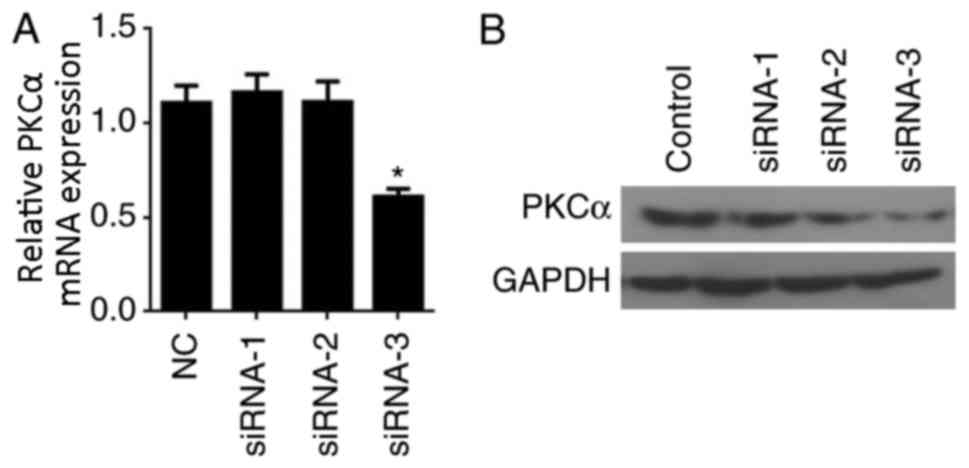
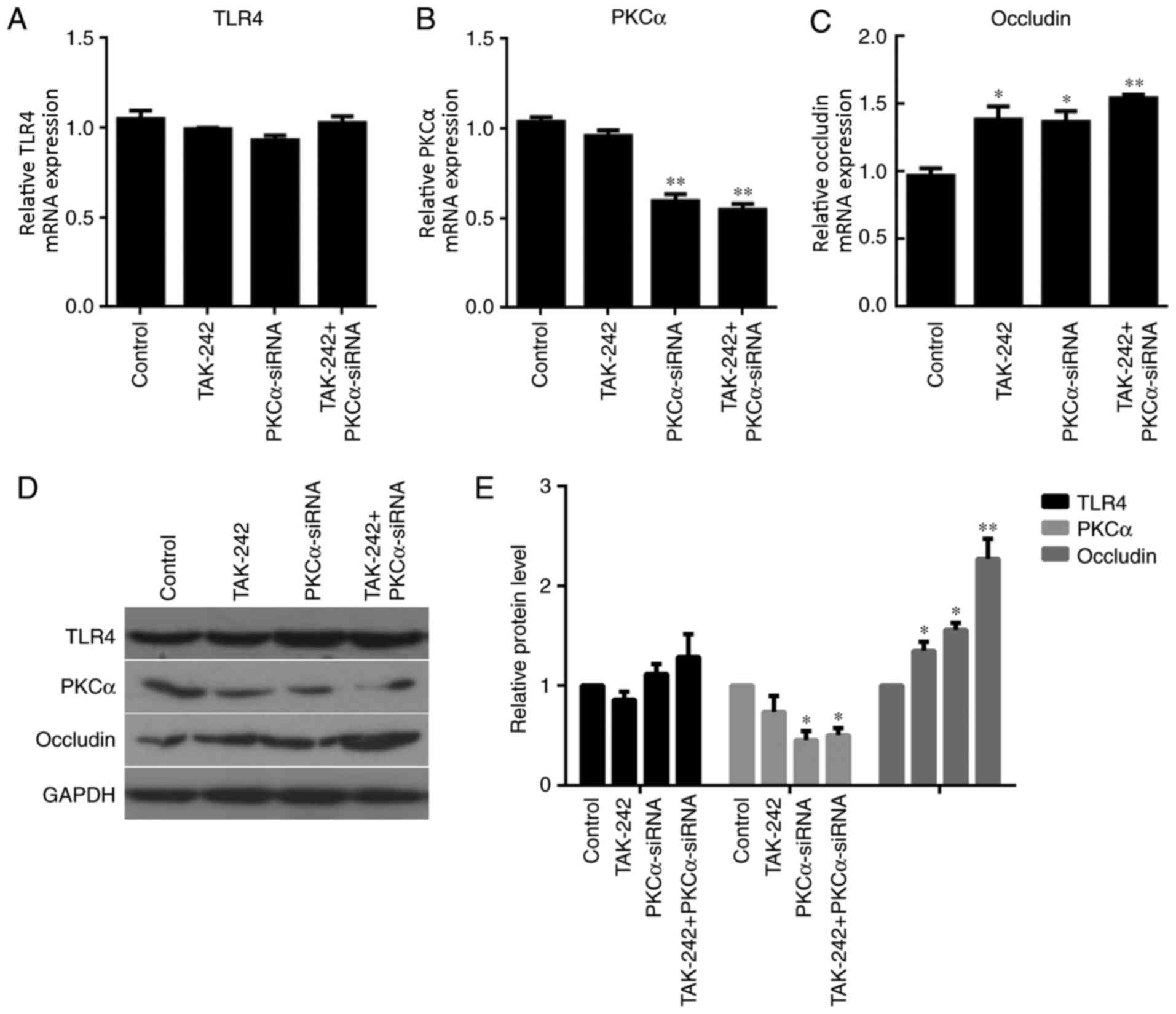
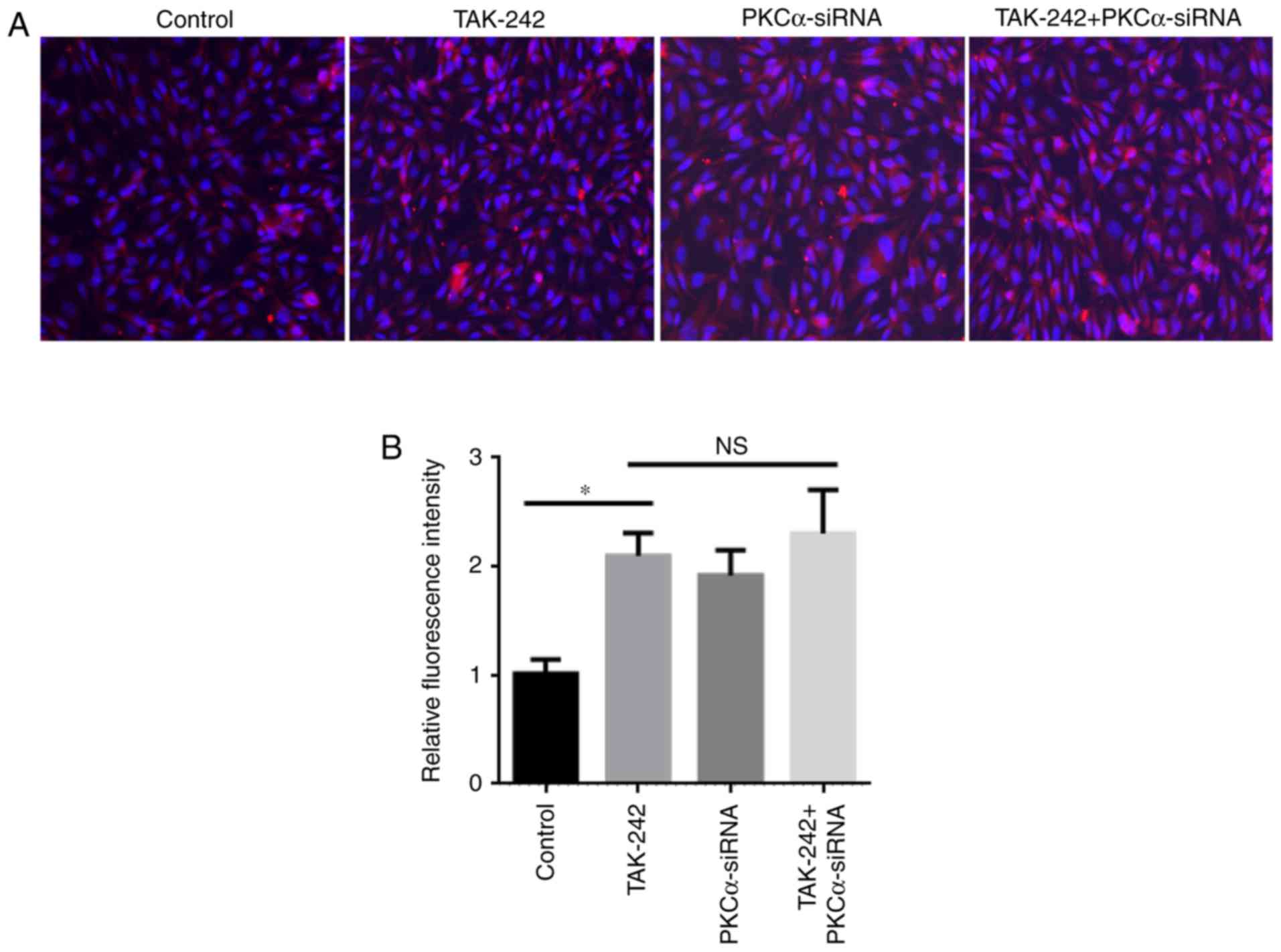
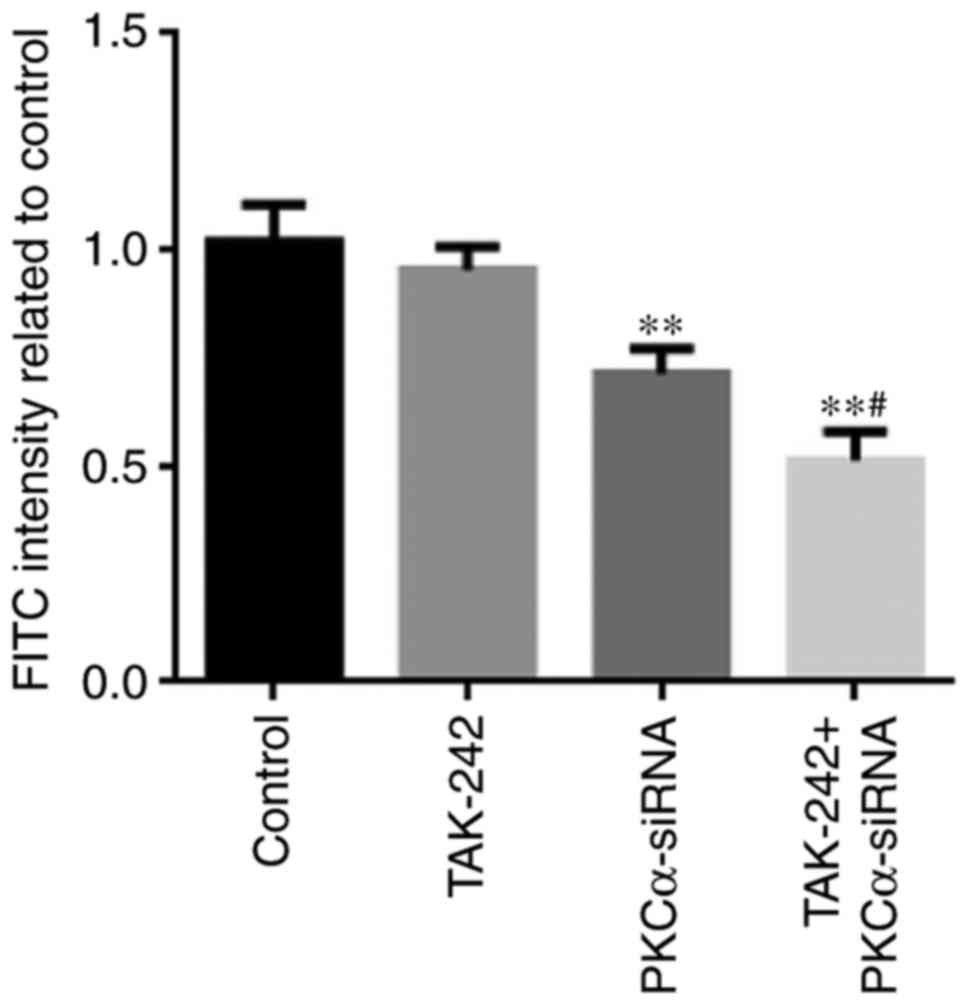
Abnormal blood-brain barrier (BBB) is a common pathological feature in brain damage. In the present study, a brain microvascular endothelial cell (BMEC) model was established to determine the role of the toll‑like receptor 4 (TLR4)/protein kinase Cα (PKCα)/occludin signaling pathway in BBB dysfunction. Three small interfering (si)RNAs directed against PKCα were designed to investigate the molecular mechanisms of PKCα underlying BBB damage. BMECs were divided into 4 groups: Control group, TAK‑242 (a TLR4 inhibitor) group, PKCα‑siRNA group and TAK‑242+PKCα‑siRNA group. The results indicated that siRNA‑3 was the most effective at silencing PKCα gene expression. Reverse transcription‑quantitative polymerase chain reaction (RT‑qPCR) analysis indicated no significant difference of TLR4 mRNA expression levels between three different treated groups and the Control group. However, PKCα mRNA expression in the PKCα‑siRNA and TAK‑242+PKCα‑siRNA groups were significantly decreased compared with that in Control and TAK‑242 groups. In addition, occludin mRNA expression in PKCα‑siRNA and TAK‑242+PKCα‑siRNA groups were significantly higher compared with the Control group. Meanwhile, occluding expressions in three treated groups were also significantly higher compared with the Control group. Furthermore, TAK‑242 treatment, PKCα‑siRNA treatment, and TAK‑242+PKCα‑siRNA treatment could promote occludin junctional labeling compared with the Control group. The permeability of PKCα‑siRNA and TAK‑242+PKCα‑siRNA groups was significantly promoted compared with the control group. The TLR4/PKCα/occludin signaling pathway was closely related to BBB damage. The present study will lead to an improved molecular understanding of BBB damage in the future.
View Figures

Figure 1

Figure 2

Figure 3

Figure 4

View References

1 

Griepp RB, Stinson EB, Hollingsworth JF and Buehler D: Prosthetic replacement of the aortic arch. J Thorac Cardiovasc Surg. 70:1051–1063. 1975.PubMed/NCBI

2 

Wypij D, Newburger JW, Rappaport LA, duPlessis AJ, Jonas RA, Wernovsky G, Lin M and Bellinger DC: The effect of duration of deep hypothermic circulatory arrest in infant heart surgery on late neurodevelopment: The boston circulatory arrest trial. J Thorac Cardiovasc Surg. 126:1397–1403. 2003. View Article : Google Scholar : PubMed/NCBI

3 

Ronaldson PT and Davis TP: Blood-brain barrier integrity and glial support: Mechanisms that can be targeted for novel therapeutic approaches in stroke. Curr Pharm Des. 18:3624–3644. 2012. View Article : Google Scholar : PubMed/NCBI

4 

Liu WY, Wang ZB, Zhang LC, Wei X and Li L: Tight junction in blood-brain barrier: An overview of structure, regulation, and regulator substances. CNS Neurosci Ther. 18:609–615. 2012. View Article : Google Scholar : PubMed/NCBI

5 

Shin K, Fogg VC and Margolis B: Tight junctions and cell polarity. Annu Rev Cell Dev Biol. 22:207–235. 2006. View Article : Google Scholar : PubMed/NCBI

6 

Fanning AS and Anderson JM: Zonula occludens-1 and −2 are cytosolic scaffolds that regulate the assembly of cellular junctions. Ann N Y Acad Sci. 1165:113–120. 2009. View Article : Google Scholar : PubMed/NCBI

7 

Runkle EA and Mu D: Tight junction proteins: From barrier to tumorigenesis. Cancer Lett. 337:41–48. 2013. View Article : Google Scholar : PubMed/NCBI

8 

Minagar A, Maghzi AH, McGee JC and Alexander JS: Emerging roles of endothelial cells in multiple sclerosis pathophysiology and therapy. Neurol Res. 34:738–745. 2012. View Article : Google Scholar : PubMed/NCBI

9 

Cummins PM: Occludin: One protein, many forms. Mol Cell Biol. 32:242–250. 2012. View Article : Google Scholar : PubMed/NCBI

10 

Gerber J, Heinrich J and Brehm R: Blood-testis barrier and Sertoli cell function: Lessons from SCCx43KO mice. Reproduction. 151:R15–R27. 2016. View Article : Google Scholar : PubMed/NCBI

11 

Capaldo CT and Nusrat A: Cytokine regulation of tight junctions. Biochim Biophys Acta. 1788:864–871. 2009. View Article : Google Scholar : PubMed/NCBI

12 

Krause G, Winkler L, Mueller SL, Haseloff RF, Piontek J and Blasig IE: Structure and function of claudins. Biochim Biophys Acta. 1778:631–645. 2008. View Article : Google Scholar : PubMed/NCBI

13 

Vandenbroucke St Amant E, Tauseef M, Vogel SM, Gao XP, Mehta D, Komarova YA and Malik AB: PKCα activation of p120-catenin serine 879 phospho-switch disassembles VE-cadherin junctions and disrupts vascular integrity. Circ Res. 111:739–749. 2012. View Article : Google Scholar : PubMed/NCBI

14 

Singh I, Knezevic N, Ahmmed GU, Kini V, Malik AB and Mehta D: Galphaq-TRPC6-mediated Ca2+ entry induces RhoA activation and resultant endothelial cell shape change in response to thrombin. J Biol Chem. 282:7833–7843. 2007. View Article : Google Scholar : PubMed/NCBI

15 

Hutchinson TE, Zhang J, Xia SL, Kuchibhotla S, Block ER and Patel JM: Enhanced phosphorylation of caveolar PKC-α limits peptide internalization in lung endothelial cells. Mol Cell Biochem. 360:309–320. 2012. View Article : Google Scholar : PubMed/NCBI

16 

Alonso A and Gonzalez C: Neuroprotective role of estrogens: Relationship with insulin/IGF-1 signaling. Front Biosci (Elite Ed). 4:607–619. 2012. View Article : Google Scholar : PubMed/NCBI

17 

Melkamu T, Squillace D, Kita H and O'Grady SM: Regulation of TLR2 expression and function in human airway epithelial cells. J Membr Biol. 229:101–113. 2009. View Article : Google Scholar : PubMed/NCBI

18 

Su W, Mruk DD and Cheng CY: Regulation of actin dynamics and protein trafficking during spermatogenesis-insights into a complex process. Crit Rev Biochem Mol Biol. 48:153–172. 2013. View Article : Google Scholar : PubMed/NCBI

19 

Cuschieri J, Billigren J and Maier RV: Endotoxin tolerance attenuates LPS-induced TLR4 mobilization to lipid rafts: A condition reversed by PKC activation. J Leukoc Biol. 80:1289–1297. 2006. View Article : Google Scholar : PubMed/NCBI

20 

Li X, Wang C, Nie J, Lv D, Wang T and Xu Y: Toll-like receptor 4 increases intestinal permeability through up-regulation of membrane PKC activity in alcoholic steatohepatitis. Alcohol. 47:459–465. 2013. View Article : Google Scholar : PubMed/NCBI

21 

Peng Y, Sigua CA, Rideout D and Murr MM: Deletion of toll-like receptor-4 downregulates protein kinase C-zeta and attenuates liver injury in experimental pancreatitis. Surgery. 143:679–685. 2008. View Article : Google Scholar : PubMed/NCBI

22 

Zhang Y, Chen H and Yang L: Toll-like receptor 4 participates in gastric mucosal protection through Cox-2 and PGE2. Dig Liver Dis. 42:472–476. 2010. View Article : Google Scholar : PubMed/NCBI

23 

Molnár K, Vannay A, Szebeni B, Bánki NF, Sziksz E, Cseh A, Győrffy H, Lakatos PL, Papp M, Arató A and Veres G: Intestinal alkaline phosphatase in the colonic mucosa of children with inflammatory bowel disease. World J Gastroenterol. 18:3254–3259. 2012.PubMed/NCBI

24 

Eun CS, Han DS, Lee SH, Paik CH, Chung YW, Lee J and Hahm JS: Attenuation of colonic inflammation by PPARgamma in intestinal epithelial cells: Effect on Toll-like receptor pathway. Dig Dis Sci. 51:693–697. 2006. View Article : Google Scholar : PubMed/NCBI

25 

Rigor RR, Beard RS Jr, Litovka OP and Yuan SY: Interleukin-1β-induced barrier dysfunction is signaled through PKC-θ in human brain microvascular endothelium. Am J Physiol Cell Physiol. 302:C1513–C1522. 2012. View Article : Google Scholar : PubMed/NCBI

26 

Naik P and Cucullo L: In vitro blood-brain barrier models: Current and perspective technologies. J Pharm Sci. 101:1337–1354. 2012. View Article : Google Scholar : PubMed/NCBI

27 

Irie N, Sakai N, Ueyama T, Kajimoto T, Shirai Y and Saito N: Subtype- and species-specific knockdown of PKC using short interfering RNA. Biochem Biophys Res Commun. 298:738–743. 2002. View Article : Google Scholar : PubMed/NCBI

28 

Chen C, Mei H, Shi W, Deng J, Zhang B, Guo T, Wang H and Hu Y: EGFP-EGF1-conjugated PLGA nanoparticles for targeted delivery of siRNA into injured brain microvascular endothelial cells for efficient RNA interference. PLoS One. 8:e608602013. View Article : Google Scholar : PubMed/NCBI

29 

Ii M, Matsunaga N, Hazeki K, Nakamura K, Takashima K, Seya T, Hazeki O, Kitazaki T and Iizawa Y: A novel cyclohexene derivative, ethyl (6R)-6-[N-(2-Chloro-4-fluorophenyl)sulfamoyl]cyclohex-1-ene-1-carboxylate (TAK-242), selectively inhibits toll-like receptor 4-mediated cytokine production through suppression of intracellular signaling. Mol Pharmacol. 69:1288–1295. 2006. View Article : Google Scholar : PubMed/NCBI

30 

Livak KJ and Schmittgen TD: Analysis of relative gene expression data using real-time quantitative PCR and the 2(-Delta Delta C(T)) method. Methods. 25:402–408. 2001. View Article : Google Scholar : PubMed/NCBI

31 

Daneman R: The blood-brain barrier in health and disease. Ann Neurol. 72:648–672. 2012. View Article : Google Scholar : PubMed/NCBI

32 

You K, Xu X, Fu J, Xu S, Yue X, Yu Z and Xue X: Hyperoxia disrupts pulmonary epithelial barrier in newborn rats via the deterioration of occludin and ZO-1. Respir Res. 13:362012. View Article : Google Scholar : PubMed/NCBI

33 

Fleegal MA, Hom S, Borg LK and Davis TP: Activation of PKC modulates blood-brain barrier endothelial cell permeability changes induced by hypoxia and posthypoxic reoxygenation. Am J Physiol Heart Circ Physiol. 289:H2012–H2019. 2005. View Article : Google Scholar : PubMed/NCBI

34 

Willis CL, Meske DS and Davis TP: Protein kinase C activation modulates reversible increase in cortical blood-brain barrier permeability and tight junction protein expression during hypoxia and posthypoxic reoxygenation. J Cereb Blood Flow Metab. 30:1847–1859. 2010. View Article : Google Scholar : PubMed/NCBI

35 

Lameris AL, Huybers S, Kaukinen K, Mäkelä TH, Bindels RJ, Hoenderop JG and Nevalainen PI: Expression profiling of claudins in the human gastrointestinal tract in health and during inflammatory bowel disease. Scand J Gastroenterol. 48:58–69. 2013. View Article : Google Scholar : PubMed/NCBI

36 

dela Paz NG, Walshe TE, Leach LL, Saint-Geniez M and D'Amore PA: Role of shear-stress-induced VEGF expression in endothelial cell survival. J Cell Sci. 125:831–843. 2012. View Article : Google Scholar : PubMed/NCBI

37 

Buschmann MM, Shen L, Rajapakse H, Raleigh DR, Wang Y, Wang Y, Lingaraju A, Zha J, Abbott E, McAuley EM, et al: Occludin OCEL-domain interactions are required for maintenance and regulation of the tight junction barrier to macromolecular flux. Mol Biol Cell. 24:3056–3068. 2013. View Article : Google Scholar : PubMed/NCBI

38 

Schmidt E, Kelly SM and van der Walle CF: Tight junction modulation and biochemical characterisation of the zonula occludens toxin C-and N-termini. FEBS Lett. 581:2974–2980. 2007. View Article : Google Scholar : PubMed/NCBI

39 

Lee WL and Liles WC: Endothelial activation, dysfunction and permeability during severe infections. Curr Opin Hematol. 18:191–196. 2011. View Article : Google Scholar : PubMed/NCBI

40 

Speyer CL and Ward PA: Role of endothelial chemokines and their receptors during inflammation. J Invest Surg. 24:18–27. 2011. View Article : Google Scholar : PubMed/NCBI

41 

Lamalice L, Le Boeuf F and Huot J: Endothelial cell migration during angiogenesis. Circ Res. 100:782–794. 2007. View Article : Google Scholar : PubMed/NCBI

42 

Tremblay PL, Auger FA and Huot J: Regulation of transendothelial migration of colon cancer cells by E-selectin-mediated activation of p38 and ERK MAP kinases. Oncogene. 25:6563–6573. 2006. View Article : Google Scholar : PubMed/NCBI

43 

Schulz E, Gori T and Munzel T: Oxidative stress and endothelial dysfunction in hypertension. Hypertens Res. 34:665–673. 2011. View Article : Google Scholar : PubMed/NCBI

44 

Ulluwishewa D, Anderson RC, McNabb WC, Moughan PJ, Wells JM and Roy NC: Regulation of tight junction permeability by intestinal bacteria and dietary components. J Nutr. 141:769–776. 2011. View Article : Google Scholar : PubMed/NCBI

45 

González-Mariscal L, Tapia R and Chamorro D: Crosstalk of tight junction components with signaling pathways. Biochim Biophys Acta. 1778:729–756. 2008. View Article : Google Scholar : PubMed/NCBI

46 

Wardill HR, Gibson RJ, Logan RM and Bowen JM: TLR4/PKC-mediated tight junction modulation: A clinical marker of chemotherapy-induced gut toxicity? Int J Cancer. 135:2483–2792. 2014. View Article : Google Scholar : PubMed/NCBI

47 

Matsunaga N, Tsuchimori N, Matsumoto T and Ii M: TAK-242 (resatorvid), a small-molecule inhibitor of Toll-like receptor (TLR) 4 signaling, binds selectively to TLR4 and interferes with interactions between TLR4 and its adaptor molecules. Mol Pharmacol. 79:34–41. 2011. View Article : Google Scholar : PubMed/NCBI

Related Articles

  • Abstract
  • View
  • Download
  • Twitter
Copy and paste a formatted citation
Spandidos Publications style
Tang Z, Guo D, Xiong L, Wu B, Xu X, Fu J, Kong L, Liu Z and Xie C: TLR4/PKCα/occludin signaling pathway may be related to blood‑brain barrier damage. Mol Med Rep 18: 1051-1057, 2018.
APA
Tang, Z., Guo, D., Xiong, L., Wu, B., Xu, X., Fu, J. ... Xie, C. (2018). TLR4/PKCα/occludin signaling pathway may be related to blood‑brain barrier damage. Molecular Medicine Reports, 18, 1051-1057. https://doi.org/10.3892/mmr.2018.9025
MLA
Tang, Z., Guo, D., Xiong, L., Wu, B., Xu, X., Fu, J., Kong, L., Liu, Z., Xie, C."TLR4/PKCα/occludin signaling pathway may be related to blood‑brain barrier damage". Molecular Medicine Reports 18.1 (2018): 1051-1057.
Chicago
Tang, Z., Guo, D., Xiong, L., Wu, B., Xu, X., Fu, J., Kong, L., Liu, Z., Xie, C."TLR4/PKCα/occludin signaling pathway may be related to blood‑brain barrier damage". Molecular Medicine Reports 18, no. 1 (2018): 1051-1057. https://doi.org/10.3892/mmr.2018.9025
Copy and paste a formatted citation
x
Spandidos Publications style
Tang Z, Guo D, Xiong L, Wu B, Xu X, Fu J, Kong L, Liu Z and Xie C: TLR4/PKCα/occludin signaling pathway may be related to blood‑brain barrier damage. Mol Med Rep 18: 1051-1057, 2018.
APA
Tang, Z., Guo, D., Xiong, L., Wu, B., Xu, X., Fu, J. ... Xie, C. (2018). TLR4/PKCα/occludin signaling pathway may be related to blood‑brain barrier damage. Molecular Medicine Reports, 18, 1051-1057. https://doi.org/10.3892/mmr.2018.9025
MLA
Tang, Z., Guo, D., Xiong, L., Wu, B., Xu, X., Fu, J., Kong, L., Liu, Z., Xie, C."TLR4/PKCα/occludin signaling pathway may be related to blood‑brain barrier damage". Molecular Medicine Reports 18.1 (2018): 1051-1057.
Chicago
Tang, Z., Guo, D., Xiong, L., Wu, B., Xu, X., Fu, J., Kong, L., Liu, Z., Xie, C."TLR4/PKCα/occludin signaling pathway may be related to blood‑brain barrier damage". Molecular Medicine Reports 18, no. 1 (2018): 1051-1057. https://doi.org/10.3892/mmr.2018.9025
Follow us
  • Twitter
  • LinkedIn
  • Facebook
About
  • Spandidos Publications
  • Careers
  • Cookie Policy
  • Privacy Policy
How can we help?
  • Help
  • Live Chat
  • Contact
  • Email to our Support Team