Spandidos Publications Logo
  • About
    • About Spandidos
    • Aims and Scopes
    • Abstracting and Indexing
    • Editorial Policies
    • Reprints and Permissions
    • Job Opportunities
    • Terms and Conditions
    • Contact
  • Journals
    • All Journals
    • Oncology Letters
      • Oncology Letters
      • Information for Authors
      • Editorial Policies
      • Editorial Board
      • Aims and Scope
      • Abstracting and Indexing
      • Bibliographic Information
      • Archive
    • International Journal of Oncology
      • International Journal of Oncology
      • Information for Authors
      • Editorial Policies
      • Editorial Board
      • Aims and Scope
      • Abstracting and Indexing
      • Bibliographic Information
      • Archive
    • Molecular and Clinical Oncology
      • Molecular and Clinical Oncology
      • Information for Authors
      • Editorial Policies
      • Editorial Board
      • Aims and Scope
      • Abstracting and Indexing
      • Bibliographic Information
      • Archive
    • Experimental and Therapeutic Medicine
      • Experimental and Therapeutic Medicine
      • Information for Authors
      • Editorial Policies
      • Editorial Board
      • Aims and Scope
      • Abstracting and Indexing
      • Bibliographic Information
      • Archive
    • International Journal of Molecular Medicine
      • International Journal of Molecular Medicine
      • Information for Authors
      • Editorial Policies
      • Editorial Board
      • Aims and Scope
      • Abstracting and Indexing
      • Bibliographic Information
      • Archive
    • Biomedical Reports
      • Biomedical Reports
      • Information for Authors
      • Editorial Policies
      • Editorial Board
      • Aims and Scope
      • Abstracting and Indexing
      • Bibliographic Information
      • Archive
    • Oncology Reports
      • Oncology Reports
      • Information for Authors
      • Editorial Policies
      • Editorial Board
      • Aims and Scope
      • Abstracting and Indexing
      • Bibliographic Information
      • Archive
    • Molecular Medicine Reports
      • Molecular Medicine Reports
      • Information for Authors
      • Editorial Policies
      • Editorial Board
      • Aims and Scope
      • Abstracting and Indexing
      • Bibliographic Information
      • Archive
    • World Academy of Sciences Journal
      • World Academy of Sciences Journal
      • Information for Authors
      • Editorial Policies
      • Editorial Board
      • Aims and Scope
      • Abstracting and Indexing
      • Bibliographic Information
      • Archive
    • International Journal of Functional Nutrition
      • International Journal of Functional Nutrition
      • Information for Authors
      • Editorial Policies
      • Editorial Board
      • Aims and Scope
      • Abstracting and Indexing
      • Bibliographic Information
      • Archive
    • International Journal of Epigenetics
      • International Journal of Epigenetics
      • Information for Authors
      • Editorial Policies
      • Editorial Board
      • Aims and Scope
      • Abstracting and Indexing
      • Bibliographic Information
      • Archive
    • Medicine International
      • Medicine International
      • Information for Authors
      • Editorial Policies
      • Editorial Board
      • Aims and Scope
      • Abstracting and Indexing
      • Bibliographic Information
      • Archive
  • Articles
  • Information
    • Information for Authors
    • Information for Reviewers
    • Information for Librarians
    • Information for Advertisers
    • Conferences
  • Language Editing
Spandidos Publications Logo
  • About
    • About Spandidos
    • Aims and Scopes
    • Abstracting and Indexing
    • Editorial Policies
    • Reprints and Permissions
    • Job Opportunities
    • Terms and Conditions
    • Contact
  • Journals
    • All Journals
    • Biomedical Reports
      • Information for Authors
      • Editorial Policies
      • Editorial Board
      • Aims and Scope
      • Abstracting and Indexing
      • Bibliographic Information
      • Archive
    • Experimental and Therapeutic Medicine
      • Information for Authors
      • Editorial Policies
      • Editorial Board
      • Aims and Scope
      • Abstracting and Indexing
      • Bibliographic Information
      • Archive
    • International Journal of Epigenetics
      • Information for Authors
      • Editorial Policies
      • Editorial Board
      • Aims and Scope
      • Abstracting and Indexing
      • Bibliographic Information
      • Archive
    • International Journal of Functional Nutrition
      • Information for Authors
      • Editorial Policies
      • Editorial Board
      • Aims and Scope
      • Abstracting and Indexing
      • Bibliographic Information
      • Archive
    • International Journal of Molecular Medicine
      • Information for Authors
      • Editorial Policies
      • Editorial Board
      • Aims and Scope
      • Abstracting and Indexing
      • Bibliographic Information
      • Archive
    • International Journal of Oncology
      • Information for Authors
      • Editorial Policies
      • Editorial Board
      • Aims and Scope
      • Abstracting and Indexing
      • Bibliographic Information
      • Archive
    • Medicine International
      • Information for Authors
      • Editorial Policies
      • Editorial Board
      • Aims and Scope
      • Abstracting and Indexing
      • Bibliographic Information
      • Archive
    • Molecular and Clinical Oncology
      • Information for Authors
      • Editorial Policies
      • Editorial Board
      • Aims and Scope
      • Abstracting and Indexing
      • Bibliographic Information
      • Archive
    • Molecular Medicine Reports
      • Information for Authors
      • Editorial Policies
      • Editorial Board
      • Aims and Scope
      • Abstracting and Indexing
      • Bibliographic Information
      • Archive
    • Oncology Letters
      • Information for Authors
      • Editorial Policies
      • Editorial Board
      • Aims and Scope
      • Abstracting and Indexing
      • Bibliographic Information
      • Archive
    • Oncology Reports
      • Information for Authors
      • Editorial Policies
      • Editorial Board
      • Aims and Scope
      • Abstracting and Indexing
      • Bibliographic Information
      • Archive
    • World Academy of Sciences Journal
      • Information for Authors
      • Editorial Policies
      • Editorial Board
      • Aims and Scope
      • Abstracting and Indexing
      • Bibliographic Information
      • Archive
  • Articles
  • Information
    • For Authors
    • For Reviewers
    • For Librarians
    • For Advertisers
    • Conferences
  • Language Editing
Login Register Submit
  • This site uses cookies
  • You can change your cookie settings at any time by following the instructions in our Cookie Policy. To find out more, you may read our Privacy Policy.

    I agree
Search articles by DOI, keyword, author or affiliation
Search
Advanced Search
presentation
Molecular Medicine Reports
Join Editorial Board Propose a Special Issue
Print ISSN: 1791-2997 Online ISSN: 1791-3004
Journal Cover
August-2018 Volume 18 Issue 2

Full Size Image

Sign up for eToc alerts
Recommend to Library

Journals

International Journal of Molecular Medicine

International Journal of Molecular Medicine

International Journal of Molecular Medicine is an international journal devoted to molecular mechanisms of human disease.

International Journal of Oncology

International Journal of Oncology

International Journal of Oncology is an international journal devoted to oncology research and cancer treatment.

Molecular Medicine Reports

Molecular Medicine Reports

Covers molecular medicine topics such as pharmacology, pathology, genetics, neuroscience, infectious diseases, molecular cardiology, and molecular surgery.

Oncology Reports

Oncology Reports

Oncology Reports is an international journal devoted to fundamental and applied research in Oncology.

Experimental and Therapeutic Medicine

Experimental and Therapeutic Medicine

Experimental and Therapeutic Medicine is an international journal devoted to laboratory and clinical medicine.

Oncology Letters

Oncology Letters

Oncology Letters is an international journal devoted to Experimental and Clinical Oncology.

Biomedical Reports

Biomedical Reports

Explores a wide range of biological and medical fields, including pharmacology, genetics, microbiology, neuroscience, and molecular cardiology.

Molecular and Clinical Oncology

Molecular and Clinical Oncology

International journal addressing all aspects of oncology research, from tumorigenesis and oncogenes to chemotherapy and metastasis.

World Academy of Sciences Journal

World Academy of Sciences Journal

Multidisciplinary open-access journal spanning biochemistry, genetics, neuroscience, environmental health, and synthetic biology.

International Journal of Functional Nutrition

International Journal of Functional Nutrition

Open-access journal combining biochemistry, pharmacology, immunology, and genetics to advance health through functional nutrition.

International Journal of Epigenetics

International Journal of Epigenetics

Publishes open-access research on using epigenetics to advance understanding and treatment of human disease.

Medicine International

Medicine International

An International Open Access Journal Devoted to General Medicine.

Journal Cover
August-2018 Volume 18 Issue 2

Full Size Image

Sign up for eToc alerts
Recommend to Library

  • Article
  • Citations
    • Cite This Article
    • Download Citation
    • Create Citation Alert
    • Remove Citation Alert
    • Cited By
  • Similar Articles
    • Related Articles (in Spandidos Publications)
    • Similar Articles (Google Scholar)
    • Similar Articles (PubMed)
  • Download PDF
  • Download XML
  • View XML
Article

Epithelial‑mesenchymal transition was identified as a potential marker for breast cancer aggressiveness using reverse transcription‑quantitative polymerase chain reaction

  • Authors:
    • Ulrich Andergassen
    • Kristina Schlenk
    • Udo Jeschke
    • Harald Sommer
    • Alexandra Kölbl
  • View Affiliations / Copyright

    Affiliations: Department of Gynecology and Obstetrics, LMU Munich, D‑80337 Munich, Germany
  • Pages: 1733-1739
    |
    Published online on: May 29, 2018
       https://doi.org/10.3892/mmr.2018.9091
  • Expand metrics +
Metrics: Total Views: 0 (Spandidos Publications: | PMC Statistics: )
Metrics: Total PDF Downloads: 0 (Spandidos Publications: | PMC Statistics: )
Cited By (CrossRef): 0 citations Loading Articles...

This article is mentioned in:


Abstract

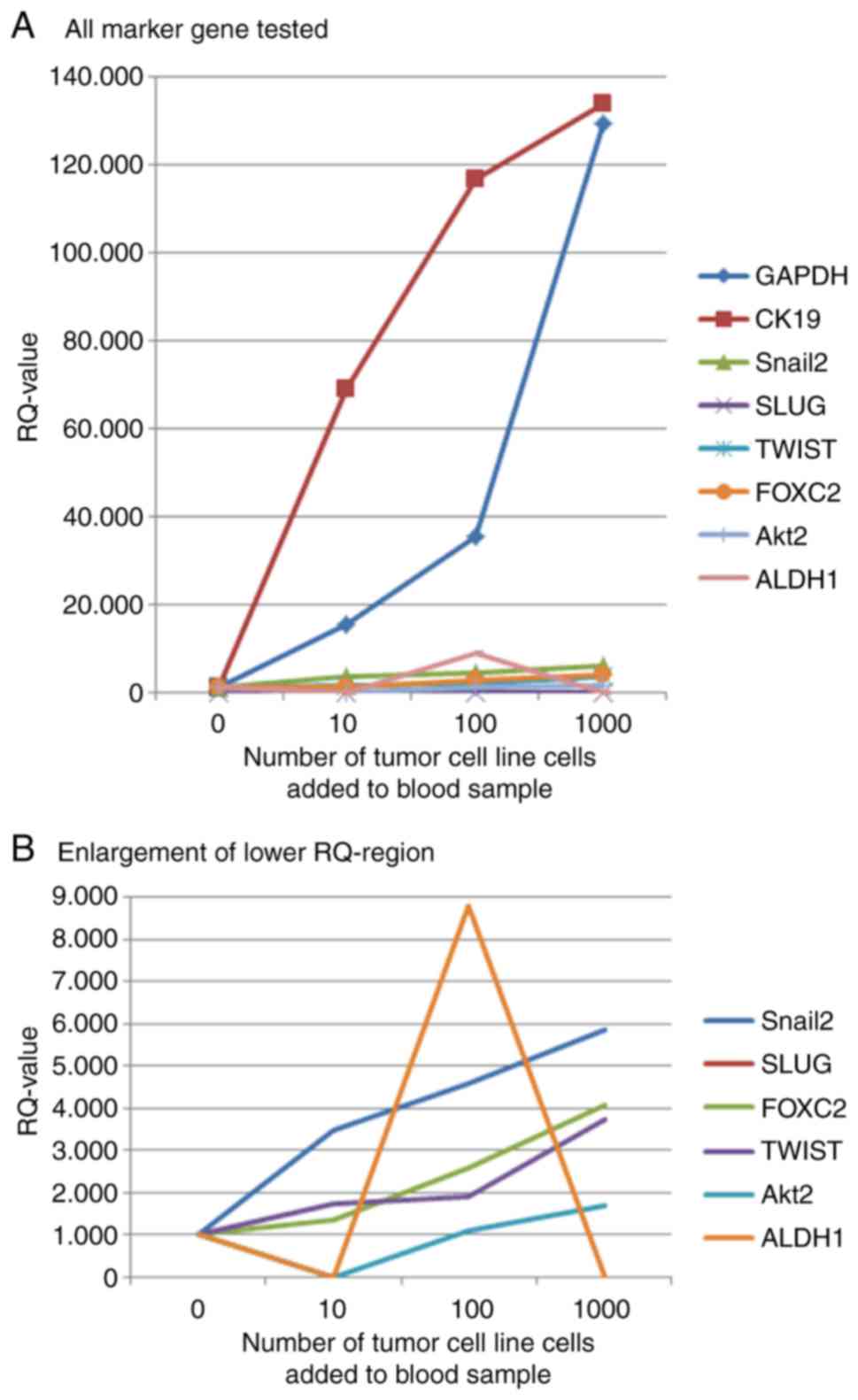
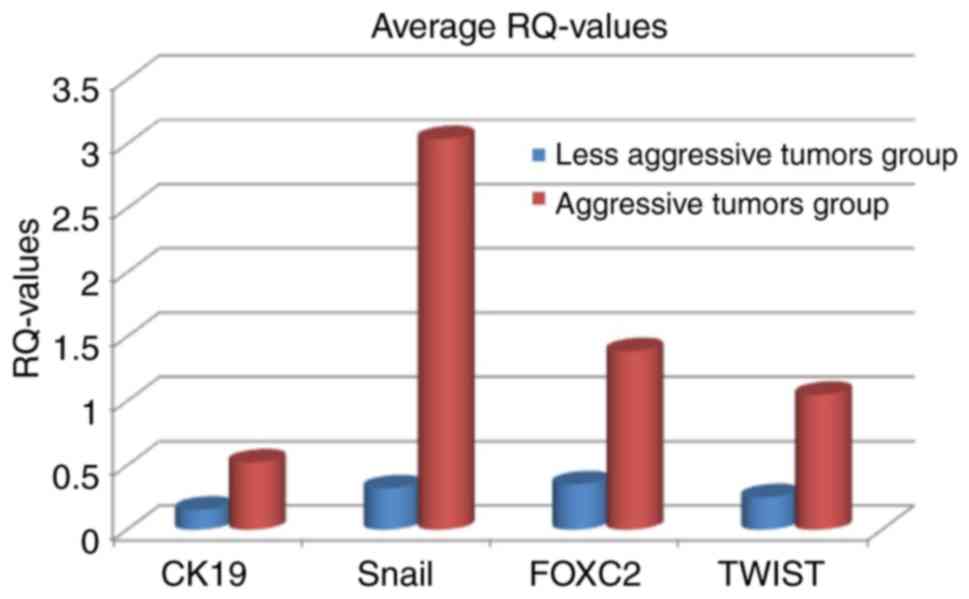
The primary cause of breast cancer‑associated mortality is the formation of distant metastasis. During the metastatic process, single tumor cells dissolve from the primary tumor site and undergo various changes in cell adhesion and motility properties. The tumor cells invade the blood stream and travel to different sites of the body, where they may initiate outgrowth. These cells are referred to as circulating tumor cells (CTCs). The process of changing cellular properties is known as epithelial to mesenchymal transition (EMT). As a different set of genes is upregulated during EMT, such genes may serve as marker genes for the detection of CTCs based on reverse transcription‑quantitative polymerase chain reaction (RT‑qPCR). Therefore, EMT‑ and breast cancer‑related genes were selected as RT‑qPCR markers. These genes were tested for performance in a model system of blood samples from healthy donors, to which a number of various breast cancer cell lines were added. The genes with optimal performance were subsequently used in RT‑qPCR with 35 breast cancer patient samples. The genes which showed the highest and most consistent increase in gene expression with the increase in the number of cancer cell line cells added were CK19, Snail, FoxC2 and Twist. Following RT‑qPCR for all patient samples, two subgroups were arranged: One group in which all genes were downregulated and the second group with at least one gene indicated an upregulation of gene expression. Comparisons were made between the tumour characteristics from these two groups. Results suggested that carcinomas of the first group exhibited a less aggressive tumor biology compared with those in the second group. The present study indicated a novel RT‑qPCR based test for tumor malignancy.
View Figures

Figure 1

Figure 2

View References

1 

Alix-Panabieres C and Pantel K: Circulating tumor cells: Liquid biopsy of cancer. Clin Chem. 59:110–118. 2013. View Article : Google Scholar : PubMed/NCBI

2 

Bragado P, Sosa MS, Keely P, Condeelis J and Aguirre-Ghiso JA: Microenvironments dictating tumor cell dormancy. Recent Results Cancer Res. 195:25–39. 2012. View Article : Google Scholar : PubMed/NCBI

3 

Andergassen U, Hofmann S, Kölbl AC, Schindlbeck C, Neugebauer J, Hutter S, Engelstädter V, Ilmer M, Friese K and Jeschke U: Detection of tumor cell-specific mRNA in the peripheral blood of patients with breast cancer-evaluation of several markers with real-time reverse transcription-PCR. Int J Mol Sci. 14:1093–1104. 2013. View Article : Google Scholar : PubMed/NCBI

4 

Andreopoulou E, Yang LY, Rangel KM, Reuben JM, Hsu L, Krishnamurthy S, Valero V, Fritsche HA and Cristofanilli M: Comparison of assay methods for detection of circulating tumor cells in metastatic breast cancer: AdnaGen adna test breast cancer select/detect versus veridex cell search™ system. Int J Cancer. 130:1590–1597. 2012. View Article : Google Scholar : PubMed/NCBI

5 

Bednarz-Knoll N, Alix-Panabières C and Pantel K: Clinical relevance and biology of circulating tumor cells. Breast Cancer Res. 13:2282011. View Article : Google Scholar : PubMed/NCBI

6 

Diel IJ, Solomayer EF, Costa SD, Gollan C, Goerner R, Wallwiener D, Kaufmann M and Bastert G: Reduction in new metastases in breast cancer with adjuvant clodronate treatment. N Engl J Med. 339:357–363. 1998. View Article : Google Scholar : PubMed/NCBI

7 

Dowsett M and Dunbier AK: Emerging biomarkers and new understanding of traditional markers in personalized therapy for breast cancer. Clin Cancer Res. 14:8019–8026. 2008. View Article : Google Scholar : PubMed/NCBI

8 

Dowsett M, Procter M, McCaskill-Stevens W, de Azambuja E, Dafni U, Rueschoff J, Jordan B, Dolci S, Abramovitz M, Stoss O, et al: Disease-free survival according to degree of HER2 amplification for patients treated with adjuvant chemotherapy with or without 1 year of trastuzumab: The HERA trial. J Clin Oncol. 27:2962–2969. 2009. View Article : Google Scholar : PubMed/NCBI

9 

Dunnwald LK, Rossing MA and Li CI: Hormone receptor status, tumor characteristics and prognosis: A prospective cohort of breast cancer patients. Breast Cancer Res. 9:R62007. View Article : Google Scholar : PubMed/NCBI

10 

Franken B, de Groot MR, Mastboom WJ, Vermes I, van der Palen J, Tibbe AG and Terstappen LW: Circulating tumor cells, disease recurrence and survival in newly diagnosed breast cancer. Breast Cancer Res. 14:R1332012. View Article : Google Scholar : PubMed/NCBI

11 

Braun S, Vogl FD, Naume B, Janni W, Osborne MP, Coombes RC, Schlimok G, Diel IJ, Gerber B, Gebauer G, et al: A pooled analysis of bone marrow micrometastasis in breast cancer. N Engl J Med. 353:793–802. 2005. View Article : Google Scholar : PubMed/NCBI

12 

Graves H and Czerniecki BJ: Circulating tumor cells in breast cancer patients: An evolving role in patient prognosis and disease progression. Patholog Res Int. 2011:6210902011.PubMed/NCBI

13 

Guarino M: Epithelial-mesenchymal transition and tumour invasion. Int J Biochem Cell Biol. 39:2153–2160. 2007. View Article : Google Scholar : PubMed/NCBI

14 

Kölbl AC, Jeschke U and Andergassen U: The significance of epithelial-to-mesenchymal transition for circulating tumor cells. Int J Mol Sci. 17:E13082016. View Article : Google Scholar : PubMed/NCBI

15 

Tiwari N, Gheldof A, Tatari M and Christofori G: EMT as the ultimate survival mechanism of cancer cells. Semin Cancer Biol. 22:194–207. 2012. View Article : Google Scholar : PubMed/NCBI

16 

Gorges TM, Tinhofer I, Drosch M, Röse L, Zollner TM, Krahn T and von Ahsen O: Circulating tumour cells escape from EpCAM-based detection due to epithelial-to-mesenchymal transition. BMC Cancer. 12:1782012. View Article : Google Scholar : PubMed/NCBI

17 

Raimondi C, Gradilone A, Naso G, Vincenzi B, Petracca A, Nicolazzo C, Palazzo A, Saltarelli R, Spremberg F, Cortesi E and Gazzaniga P: Epithelial-mesenchymal transition and stemness features in circulating tumor cells from breast cancer patients. Breast Cancer Res Treat. 130:449–455. 2011. View Article : Google Scholar : PubMed/NCBI

18 

Hugo H, Ackland ML, Blick T, Lawrence MG, Clements JA, Williams ED and Thompson EW: Epithelial-mesenchymal and mesenchymal-epithelial transitions in carcinoma progression. J Cell Physiol. 213:374–383. 2007. View Article : Google Scholar : PubMed/NCBI

19 

Nieto MA: Epithelial plasticity: A common theme in embryonic and cancer cells. Science. 342:12348502013. View Article : Google Scholar : PubMed/NCBI

20 

Yao D, Dai C and Peng S: Mechanism of the mesenchymal-epithelial transition and its relationship with metastatic tumor formation. Mol Cancer Res. 9:1608–1620. 2011. View Article : Google Scholar : PubMed/NCBI

21 

Kurec AS, Baltrucki L, Mason DY and Davey FR: Use of the APAAP method in the classification and diagnosis of hematologic disorders. Clin Lab Med. 8:223–236. 1988.PubMed/NCBI

22 

Noack F, Schmitt M, Bauer J, Helmecke D, Krüger W, Thorban S, Sandherr M, Kuhn W, Graeff H and Harbeck N: A new approach to phenotyping disseminated tumor cells: Methodological advances and clinical implications. Int J Biol Markers. 15:100–104. 2000. View Article : Google Scholar : PubMed/NCBI

23 

Ignatiadis M, Kallergi G, Ntoulia M, Perraki M, Apostolaki S, Kafousi M, Chlouverakis G, Stathopoulos E, Lianidou E, Georgoulias V and Mavroudis D: Prognostic value of the molecular detection of circulating tumor cells using a multimarker reverse transcription-PCR assay for cytokeratin 19, mammaglobin A and HER2 in early breast cancer. Clin Cancer Res. 14:2593–2600. 2008. View Article : Google Scholar : PubMed/NCBI

24 

Ignatiadis M, Xenidis N, Perraki M, Apostolaki S, Politaki E, Kafousi M, Stathopoulos EN, Stathopoulou A, Lianidou E, Chlouverakis G, et al: Different prognostic value of cytokeratin-19 mRNA positive circulating tumor cells according to estrogen receptor and HER2 status in early-stage breast cancer. J Clin Oncol. 25:5194–5202. 2007. View Article : Google Scholar : PubMed/NCBI

25 

Saloustros E and Mavroudis D: CTCs in primary breast cancer (II). Recent Results Cancer Res. 195:187–192. 2012. View Article : Google Scholar : PubMed/NCBI

26 

Saloustros E, Perraki M, Apostolaki S, Kallergi G, Xyrafas A, Kalbakis K, Agelaki S, Kalykaki A, Georgoulias V and Mavroudis D: Cytokeratin-19 mRNA-positive circulating tumor cells during follow-up of patients with operable breast cancer: Prognostic relevance for late relapse. Breast Cancer Res. 13:R602011. View Article : Google Scholar : PubMed/NCBI

27 

Soltani S, Mokarian F and Panjehpour M: The expression of CK-19 gene in circulating tumor cells of blood samples of metastatic breast cancer women. Res Pharm Sci. 10:485–496. 2015.PubMed/NCBI

28 

Zhao S, Yang H, Zhang M, Zhang D, Liu Y, Liu Y, Song Y, Zhang X, Li H, Ma W and Zhang Q: Circulating tumor cells (CTCs) detected by triple-marker EpCAM, CK19 and hMAM RT-PCR and their relation to clinical outcome in metastatic breast cancer patients. Cell Biochem Biophys. 65:263–273. 2013. View Article : Google Scholar : PubMed/NCBI

29 

Tunca B, Egeli U, Cecener G, Tezcan G, Gökgöz S, Tasdelen I, Bayram N, Tolunay S, Umut G, Demirdogen E, et al: CK19, CK20, EGFR and HER2 status of circulating tumor cells in patients with breast cancer. Tumori. 98:243–251. 2012. View Article : Google Scholar : PubMed/NCBI

30 

Kallergi G, Papadaki MA, Politaki E, Mavroudis D, Georgoulias V and Agelaki S: Epithelial to mesenchymal transition markers expressed in circulating tumour cells of early and metastatic breast cancer patients. Breast Cancer Res. 13:R592011. View Article : Google Scholar : PubMed/NCBI

31 

Blanco MJ, Moreno-Bueno G, Sarrio D, Locascio A, Cano A, Palacios J and Nieto MA: Correlation of Snail expression with histological grade and lymph node status in breast carcinomas. Oncogene. 21:3241–3246. 2002. View Article : Google Scholar : PubMed/NCBI

32 

Peinado H, Olmeda D and Cano A: Snail, Zeb and bHLH factors in tumour progression: an alliance against the epithelial phenotype? Nat Rev Cancer. 7:415–428. 2007. View Article : Google Scholar : PubMed/NCBI

33 

Vega S, Morales AV, Ocaña OH, Valdés F, Fabregat I and Nieto MA: Snail blocks the cell cycle and confers resistance to cell death. Genes Dev. 18:1131–1143. 2004. View Article : Google Scholar : PubMed/NCBI

34 

Moody SE, Perez D, Pan TC, Sarkisian CJ, Portocarrero CP, Sterner CJ, Notorfrancesco KL, Cardiff RD and Chodosh LA: The transcriptional repressor Snail promotes mammary tumor recurrence. Cancer Cell. 8:197–209. 2005. View Article : Google Scholar : PubMed/NCBI

35 

Hajra KM, Chen DY and Fearon ER: The SLUG zinc-finger protein represses E-cadherin in breast cancer. Cancer Res. 62:1613–1618. 2002.PubMed/NCBI

36 

Villarejo A, Cortes-Cabrera A, Molina-Ortiz P, Portillo F and Cano A: Differential role of Snail1 and Snail2 zinc fingers in E-cadherin repression and epithelial to mesenchymal transition. J Biol Chem. 289:930–941. 2014. View Article : Google Scholar : PubMed/NCBI

37 

Dai J, Wang JY, Yang LL, Xiao Y, Qu ZL, Qin SH and Ruan QR: Correlation of Forkhead Box c2 with subtypes and invasive ability of invasive breast cancer. J Huazhong Univ Sci Technolog Med Sci. 34:896–901. 2014. View Article : Google Scholar : PubMed/NCBI

38 

Lim JC, Koh VC, Tan JS, Tan WJ, Thike AA and Tan PH: Prognostic significance of epithelial-mesenchymal transition proteins Twist and Foxc2 in phyllodes tumours of the breast. Breast Cancer Res Treat. 150:19–29. 2015. View Article : Google Scholar : PubMed/NCBI

39 

Taube JH, Herschkowitz JI, Komurov K, Zhou AY, Gupta S, Yang J, Hartwell K, Onder TT, Gupta PB, Evans KW, et al: Core epithelial-to-mesenchymal transition interactome gene-expression signature is associated with claudin-low and metaplastic breast cancer subtypes. Proc Natl Acad Sci USA. 107:15449–15454. 2010. View Article : Google Scholar : PubMed/NCBI

40 

Mani SA, Yang J, Brooks M, Schwaninger G, Zhou A, Miura N, Kutok JL, Hartwell K, Richardson AL and Weinberg RA: Mesenchyme forkhead 1 (FOXC2) plays a key role in metastasis and is associated with aggressive basal-like breast cancers. Proc Natl Acad Sci USA. 104:10069–10074. 2007. View Article : Google Scholar : PubMed/NCBI

41 

Kume T: Foxc2 transcription factor: A newly described regulator of angiogenesis. Trends Cardiovasc Med. 18:224–228. 2008. View Article : Google Scholar : PubMed/NCBI

42 

Finlay J, Roberts CM, Lowe G, Loeza J, Rossi JJ and Glackin CA: RNA-based TWIST1 inhibition via dendrimer complex to reduce breast cancer cell metastasis. Biomed Res Int. 2015:3827452015. View Article : Google Scholar : PubMed/NCBI

43 

Tang H, Massi D, Hemmings BA, Mandalà M, Hu Z, Wicki A and Xue G: AKT-ions with a TWIST between EMT and MET. Oncotarget. 7:62767–62777. 2016. View Article : Google Scholar : PubMed/NCBI

44 

Yang J, Mani SA, Donaher JL, Ramaswamy S, Itzykson RA, Come C, Savagner P, Gitelman I, Richardson A and Weinberg RA: Twist, a master regulator of morphogenesis, plays an essential role in tumor metastasis. Cell. 117:927–939. 2004. View Article : Google Scholar : PubMed/NCBI

45 

Watanabe O, Imamura H, Shimizu T, Kinoshita J, Okabe T, Hirano A, Yoshimatsu K, Konno S, Aiba M and Ogawa K: Expression of twist and wnt in human breast cancer. Anticancer Res. 24:3851–3856. 2004.PubMed/NCBI

46 

Giordano A, Gao H, Anfossi S, Cohen E, Mego M, Lee BN, Tin S, De Laurentiis M, Parker CA and Alvarez RH: Epithelial-mesenchymal transition and stem cell markers in patients with HER2-positive metastatic breast cancer. Mol Cancer Ther. 11:2526–2534. 2012. View Article : Google Scholar : PubMed/NCBI

47 

Micalizzi DS, Farabaugh SM and Ford HL: Epithelial-mesenchymal transition in cancer: Parallels between normal development and tumor progression. J Mammary Gland Biol Neoplasia. 15:117–134. 2010. View Article : Google Scholar : PubMed/NCBI

48 

Cheng GZ, Chan J, Wang Q, Zhang W, Sun CD and Wang LH: Twist transcriptionally up-regulates AKT2 in breast cancer cells leading to increased migration, invasion and resistance to paclitaxel. Cancer Res. 67:1979–1987. 2007. View Article : Google Scholar : PubMed/NCBI

49 

Arboleda MJ, Lyons JF, Kabbinavar FF, Bray MR, Snow BE, Ayala R, Danino M, Karlan BY and Slamon DJ: Overexpression of AKT2/protein kinase Bbeta leads to up-regulation of beta1 integrins, increased invasion, and metastasis of human breast and ovarian cancer cells. Cancer Res. 63:196–206. 2003.PubMed/NCBI

50 

Irie HY, Pearline RV, Grueneberg D, Hsia M, Ravichandran P, Kothari N, Natesan S and Brugge JS: Distinct roles of Akt1 and Akt2 in regulating cell migration and epithelial-mesenchymal transition. J Cell Biol. 171:1023–1034. 2005. View Article : Google Scholar : PubMed/NCBI

51 

Kasimir-Bauer S, Hoffmann O, Wallwiener D, Kimmig R and Fehm T: Expression of stem cell and epithelial-mesenchymal transition markers in primary breast cancer patients with circulating tumor cells. Breast Cancer Res. 14:R152012. View Article : Google Scholar : PubMed/NCBI

52 

Ginestier C, Hur MH, Charafe-Jauffret E, Monville F, Dutcher J, Brown M, Jacquemier J, Viens P, Kleer CG, Liu S, et al: ALDH1 is a marker of normal and malignant human mammary stem cells and a predictor of poor clinical outcome. Cell Stem Cell. 1:555–567. 2007. View Article : Google Scholar : PubMed/NCBI

53 

Liu Y, Lv DL, Duan JJ, Xu SL, Zhang JF, Yang XJ, Zhang X, Cui YH, Bian XW and Yu SC: ALDH1A1 expression correlates with clinicopathologic features and poor prognosis of breast cancer patients: A systematic review and meta-analysis. BMC Cancer. 14:4442014. View Article : Google Scholar : PubMed/NCBI

54 

Morimoto K, Kim SJ, Tanei T, Shimazu K, Tanji Y, Taguchi T, Tamaki Y, Terada N and Noguchi S: Stem cell marker aldehyde dehydrogenase 1-positive breast cancers are characterized by negative estrogen receptor, positive human epidermal growth factor receptor type 2 and high Ki67 expression. Cancer Sci. 100:1062–1068. 2009. View Article : Google Scholar : PubMed/NCBI

55 

Pan H, Wu N, Huang Y, Li Q, Liu C, Liang M, Zhou W, Liu X and Wang S: Aldehyde dehydrogenase 1 expression correlates with the invasion of breast cancer. Diagn Pathol. 10:662015. View Article : Google Scholar : PubMed/NCBI

56 

Aktas B, Tewes M, Fehm T, Hauch S, Kimmig R and Kasimir-Bauer S: Stem cell and epithelial-mesenchymal transition markers are frequently overexpressed in circulating tumor cells of metastatic breast cancer patients. Breast Cancer Res. 11:R462009. View Article : Google Scholar : PubMed/NCBI

57 

Livak KJ and Schmittgen TD: Analysis of relative gene expression data using real-time quantitative PCR and the 2(-Delta Delta C(T)) method. Methods. 25:402–408. 2001. View Article : Google Scholar : PubMed/NCBI

Related Articles

  • Abstract
  • View
  • Download
  • Twitter
Copy and paste a formatted citation
Spandidos Publications style
Andergassen U, Schlenk K, Jeschke U, Sommer H and Kölbl A: Epithelial‑mesenchymal transition was identified as a potential marker for breast cancer aggressiveness using reverse transcription‑quantitative polymerase chain reaction. Mol Med Rep 18: 1733-1739, 2018.
APA
Andergassen, U., Schlenk, K., Jeschke, U., Sommer, H., & Kölbl, A. (2018). Epithelial‑mesenchymal transition was identified as a potential marker for breast cancer aggressiveness using reverse transcription‑quantitative polymerase chain reaction. Molecular Medicine Reports, 18, 1733-1739. https://doi.org/10.3892/mmr.2018.9091
MLA
Andergassen, U., Schlenk, K., Jeschke, U., Sommer, H., Kölbl, A."Epithelial‑mesenchymal transition was identified as a potential marker for breast cancer aggressiveness using reverse transcription‑quantitative polymerase chain reaction". Molecular Medicine Reports 18.2 (2018): 1733-1739.
Chicago
Andergassen, U., Schlenk, K., Jeschke, U., Sommer, H., Kölbl, A."Epithelial‑mesenchymal transition was identified as a potential marker for breast cancer aggressiveness using reverse transcription‑quantitative polymerase chain reaction". Molecular Medicine Reports 18, no. 2 (2018): 1733-1739. https://doi.org/10.3892/mmr.2018.9091
Copy and paste a formatted citation
x
Spandidos Publications style
Andergassen U, Schlenk K, Jeschke U, Sommer H and Kölbl A: Epithelial‑mesenchymal transition was identified as a potential marker for breast cancer aggressiveness using reverse transcription‑quantitative polymerase chain reaction. Mol Med Rep 18: 1733-1739, 2018.
APA
Andergassen, U., Schlenk, K., Jeschke, U., Sommer, H., & Kölbl, A. (2018). Epithelial‑mesenchymal transition was identified as a potential marker for breast cancer aggressiveness using reverse transcription‑quantitative polymerase chain reaction. Molecular Medicine Reports, 18, 1733-1739. https://doi.org/10.3892/mmr.2018.9091
MLA
Andergassen, U., Schlenk, K., Jeschke, U., Sommer, H., Kölbl, A."Epithelial‑mesenchymal transition was identified as a potential marker for breast cancer aggressiveness using reverse transcription‑quantitative polymerase chain reaction". Molecular Medicine Reports 18.2 (2018): 1733-1739.
Chicago
Andergassen, U., Schlenk, K., Jeschke, U., Sommer, H., Kölbl, A."Epithelial‑mesenchymal transition was identified as a potential marker for breast cancer aggressiveness using reverse transcription‑quantitative polymerase chain reaction". Molecular Medicine Reports 18, no. 2 (2018): 1733-1739. https://doi.org/10.3892/mmr.2018.9091
Follow us
  • Twitter
  • LinkedIn
  • Facebook
About
  • Spandidos Publications
  • Careers
  • Cookie Policy
  • Privacy Policy
How can we help?
  • Help
  • Live Chat
  • Contact
  • Email to our Support Team