Introduction
Many physiological changes have been observed after
peripheral nerve injury including degeneration of nerve cell,
dedifferentiation, disintegration of axon, and dedifferentiation of
Schwann cell (1). Peripheral nerve
injury is a common disease in clinic practice and damage to the
nervous system is impacting approximately 20 million people in
United States (2). Nerve
regeneration plays an important role after peripheral nerve injury
in both the central and peripheral nervous systems (3). However, adult mammalian central
nervous system axons generally do not regenerate or repair the
damaged neuron (4). Therefore,
exploring nerve regeneration strategies should invested, including
a deep fundamental understanding of the nerve regeneration process
and potential mechanism in the processes of natural regeneration of
axon.
Berberine is an alkaloid extracted from plants,
which presents antibiotic and anti-inflammatory effects (5). Currently, berberine also exerts
neuroprotective effects and protects neurons against neurotoxicity
by promoting axonal regeneration in the injured nerves of the
peripheral nervous system (6).
Findings have provided further understanding that berberine action
highlighted the therapeutic potential in the treatment of a wide
range of neurological disorders by decreasing the 4-AP-induced
phosphorylation of extracellular signal-regulated kinase 1 and 2
(ERK1/2) and synapsin I (7). In
addition, study has indicated that berberine increased the survival
of hippocampal precursor cells and differentiated neurons by
promoting neuronal differentiation (8). Furthermore, Study has reported that
berberine has therapeutic ability for central nervous system
disorders such as Alzheimer's disease and cerebral ischemia.
However, the potential mechanism mediated by berberine in nerve
regeneration has not been investigated.
In the present study, we investigated the role of
berberine in nerve regeneration and analyzed the potential
mechanism mediated by berberine in hippocampal pyramidal neurons.
We also evaluated the role of berberine on growth, viability and
apoptosis of hippocampal pyramidal neurons.
Materials and methods
Animals study
A total of 12 male facial nerve axotomy injury mice
model (9) (C57BL/6, 8 weeks old,
body weight, 20–25 g) was obtained from the Experimental Animal
Center of Jinzhou Medical University. All experiments were
conducted under the supervision and with the approval of the Ethic
Committee of the Second Hospital of Jilin University (approval no:
TSHJLU20140521X). All mice were housed at 23±1°C, 50±5% humidity
with a 12-h light/dark cycle and free access to food and water. All
mice were randomly divided into two groups and received treatment
with berberine (2 mg/kg/day, Sigma-Aldrich) or the same volume of
PBS (Control). The treatments were continued to 20 days. Previous
study has found that 5 mg/kg/day of berberine showed protective
effect of on doxorubicin-induced acute hepatoraenal toxicity in
rats (10). Therefore, we chose 2
mg/kg/day of berberine for the treatment of experimental mice due
to the diarrhea caused by high dose of berberine as described
previously (11). Berberine did
not induce weight gain/loss for the experimental animals during the
treatment period (data not shown).
Cells isolation and culture
On day 21, mice were anesthetized using IV
Pentobarbital (35 mg/kg) and then sacrificed using cervical
decapitation. Hippocampal pyramidal neurons were isolated from
berberine- or PBS-treated mice as described previously (12). A total of 3 healthy male C57BL/6
mice (8 weeks old, body weight, 20–25 g) was obtained from the
Experimental Animal Center of Jinzhou Medical University and used
as control group in cells viability and growth assays cells. Cells
were cultured in RPMI 1640 medium (Thermo Fisher Scientific, Inc.,
Waltham, MA, USA) supplemented with 10% heat-inactivated fetal
bovine serum (FBS; Thermo Fisher Scientific, Inc.).
Cells viability assay
Hippocampal pyramidal neurons (2×10³
cells/well) were seeded in 96-well plates and cultured at 37°C for
12 h. Cells were then treated with 10 µl of MTT (5 mg/ml;
Sigma-Aldrich; Merck KGaA, Darmstadt, Germany) for 3 h at 37°C.
After incubation, purple formazan crystals were dissolved using
isopropanol (15 µl, isopropanol). The absorbance was recorded on a
microplate reader (Multiskan FC; Thermo Fisher Scientific, Inc.) at
a wavelength of 570 nm. Cells viability was determined by percent
of cell viability calculated as the ratio between mean absorbance
of three samples and mean absorbance of controls. Cells' morphology
was captured using light microscope (Carl Zeiss Microscopy,
Göttingen, Germany) at magnification, ×400.
Cells growth
Hippocampal pyramidal neurons (1×10²
cells) isolated from berberine- or PBS-treated mice as described
above were seeded in 96-well plates and treated with insulin-like
growth factor receptor (IGFR)antagonist (IGFRAG; Sigma-Aldrich;
Merck KGaA) or PBS 37°C for 12 h. After incubation, cells were
fixed with 10% paraformaldehyde for 30 min at 37°C and then stained
with 2% crystal violet for 30 min at 37°C. Cells number was
cultured at least three random views under a light microscope at
magnification, ×40.
Western blot analysis
Hippocampal pyramidal neurons (1×10⁷)
were lysed in RIPA buffer (M-PER reagent for the cells and T-PER
reagent for the tissues; Thermo Fisher Scientific, Inc.) followed
homogenized at 4°C for 10 min. Protein concentration was measured
by a BCA protein assay kit (Thermo Fisher Scientific, Inc.). A
total of 30 µg protein extracts was electrophoresed on 12%
polyacrylamide gradient gels and then transferred to polyvinylidene
fluoride (PVDF) membrane (EMD Millipore, Billerica, MA, USA). The
membranes were incubated in blocking buffer (5% milk) prior to
incubation with primary antibodies at 4°C overnight. The primary
rabbit anti-rat antibodies used in the immunoblotting assays were:
Bcl-2 (1:1,000, cat. no: ab692; Abcam, Cambridge, MA, USA), Bcl-w
(1:1,200, cat. no: ab32370; Abcam), JUK (1:1,000, cat. no: ab25901;
Abcam), IGFR (1:1,200, cat. no: ab182408; Abcam), AKT (1:500, cat.
no: ab151279; Abcam), ATG5 (1:1,000, cat. no: ab108327; Abcam),
TNFα (1:1,000, cat. no: ab6671; Abcam), IL1β (1:1,000, cat. no:
ab9722; Abcam), IL6 (1:1,000, cat. no: ab7737; Abcam), LC3B
(1:1,000, cat. no: ab48394; Abcam), ATG16 L (1:1,000, cat. no:
ab187671; Abcam), ATG7 (1:1,000, cat. no: 8558; Cell Signaling
Technology, Inc., Danvers, MA, USA) and β-actin (1:2,000, cat. no:
ab8226; Abcam). After the incubation, membrane was washed three
times in TBST and incubated with HRP-conjugated goat anti-rabbit
IgG mAb (PV-6001; ZSGB-Bio, Beijing, China) for 1 h at 37°C. After
three-time washing in TBST, membrane was developed using a
chemiluminescence assay system (Roche) and exposed to Kodak
exposure films. Densitometric quantification of the immunoblot data
was performed by using the software of Quantity-One (Bio-Rad
Laboratories, Inc., Hercules, CA, USA).
TUNEL assay
Apoptosis of hippocampal pyramidal neurons were
analyzed using terminal deoxynucleotidyl transferase-mediated dUTP
nick end labeling (TUNEL) assay (DeadEnd™ Colorimetric Tunel
System; Promega Corporation, Madison, WI, USA) according to the
manufacturer's instructions. Hippocampal pyramidal neurons
(1×10⁵) were incubated TUNE (DeadEnd™ Colorimetric Tunel
System; Promega Corporation). Cells were washed with PBST
(Sigma-Aldrich) three times for 5 min at 37°C followed by incubated
with 5% DPAI (Sigma-Aldrich; Merck KGaA) for 15 min at 37°C.
Finally, images were captured with a ZEISS LSM 510 confocal
microscope at 488 nm. The apoptosis rate was calculated by using
the software of Developer XD 1.2 (Definiens AG, Munich,
Germany).
Immunofluorescence staining
Hippocampal pyramidal neurons (1×10⁴)
were fixed with 10% paraformaldehyde for 30 min at 37°C. Cells were
washed with PBST for 10 min at 37°C and blocked with blocking
buffer (0.01 M PBS, 0.1% Triton X-100, and 1% bovine serum albumin)
for 30 min at 37°C. Cells were then incubated with primary
antibodies: CNPase (1:11,000, cat no: 5665; Cell Signaling
Technology, Inc.) or ATG5 ATG5 (1:1,000, cat no: ab108327; Abcam)
in blocking buffer at 4°C for 12 h. After washing with PBS for 3×10
min, the cells were incubated Alexa Fluor 488/568 FITC goat
anti-rabbit secondary antibody (1:1,000, Alexa Fluor®
488; Abcam) for 2 h at 37°C. After three washes with PBS for 3×10
min. Images of cells were captured on Leica DMI4000B microscope and
analysed using the software of Quantity-One (Bio-Rad Laboratories,
Inc.).
Statistical analysis
Data are presented as means ± SD of triplicate. All
data were analyzed by SPSS v.17.0 software (SPSS, Chicago, IL,
USA). Significant differences between two groups were analyzed by
two-tail unpaired Student's t-test. Multiple groups differences
were analyzed using one-way analysis of variance (ANOVA) followed
Tukey HSD test. P<0.05 was considered to indicate a
statistically significant difference.
Results
Berberine increases growth and
viability of hippocampal pyramidal neurons
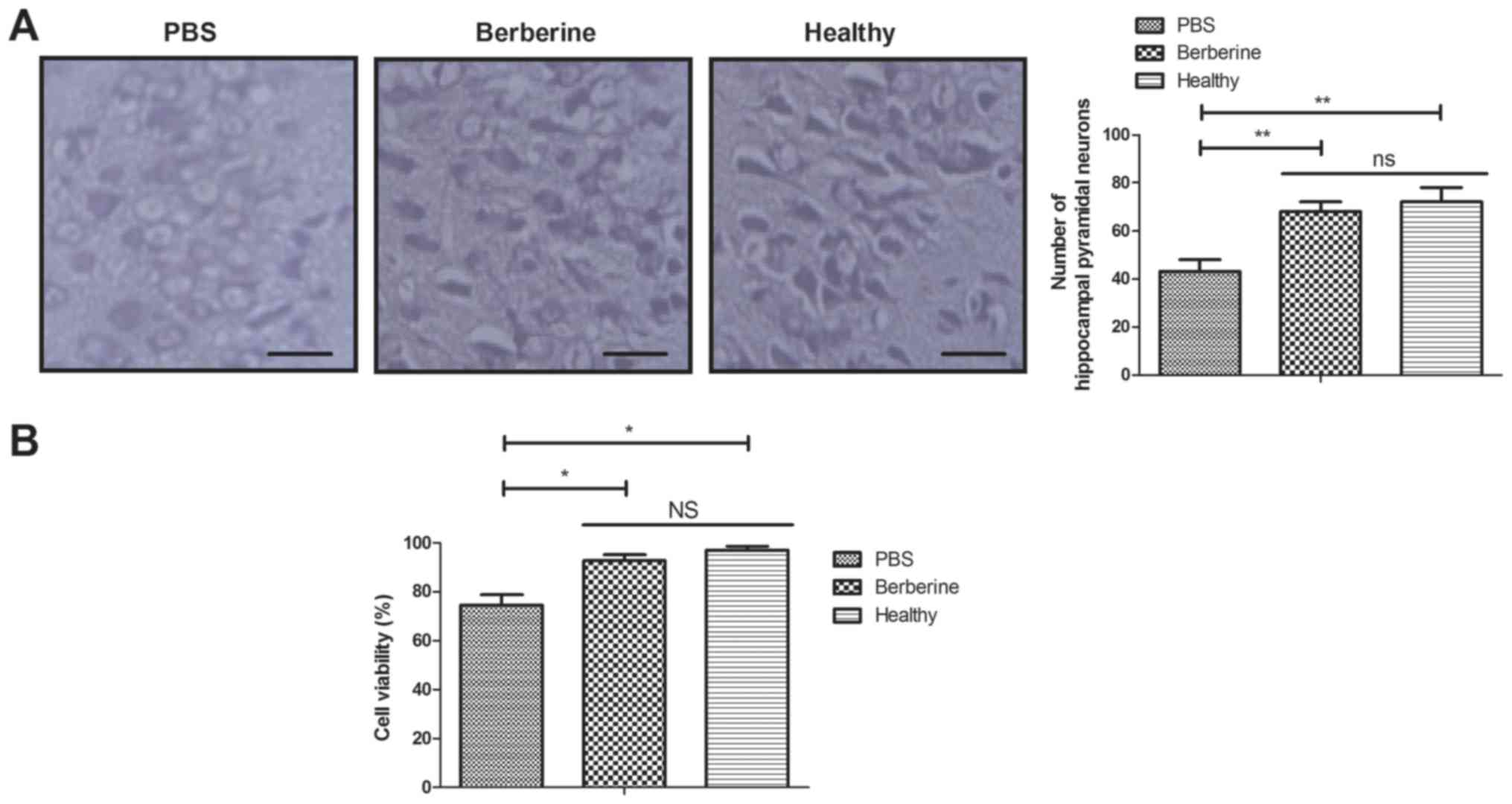
We investigated whether berberine could improve
viability of hippocampal pyramidal neurons. Berberine increased
growth of hippocampal pyramidal neurons compared to control
(Fig. 1A). We found that viability
of hippocampal pyramidal neurons was increased determined by MTT
assay (Fig. 1B).
Berberine inhibits apoptosis of
hippocampal pyramidal neurons
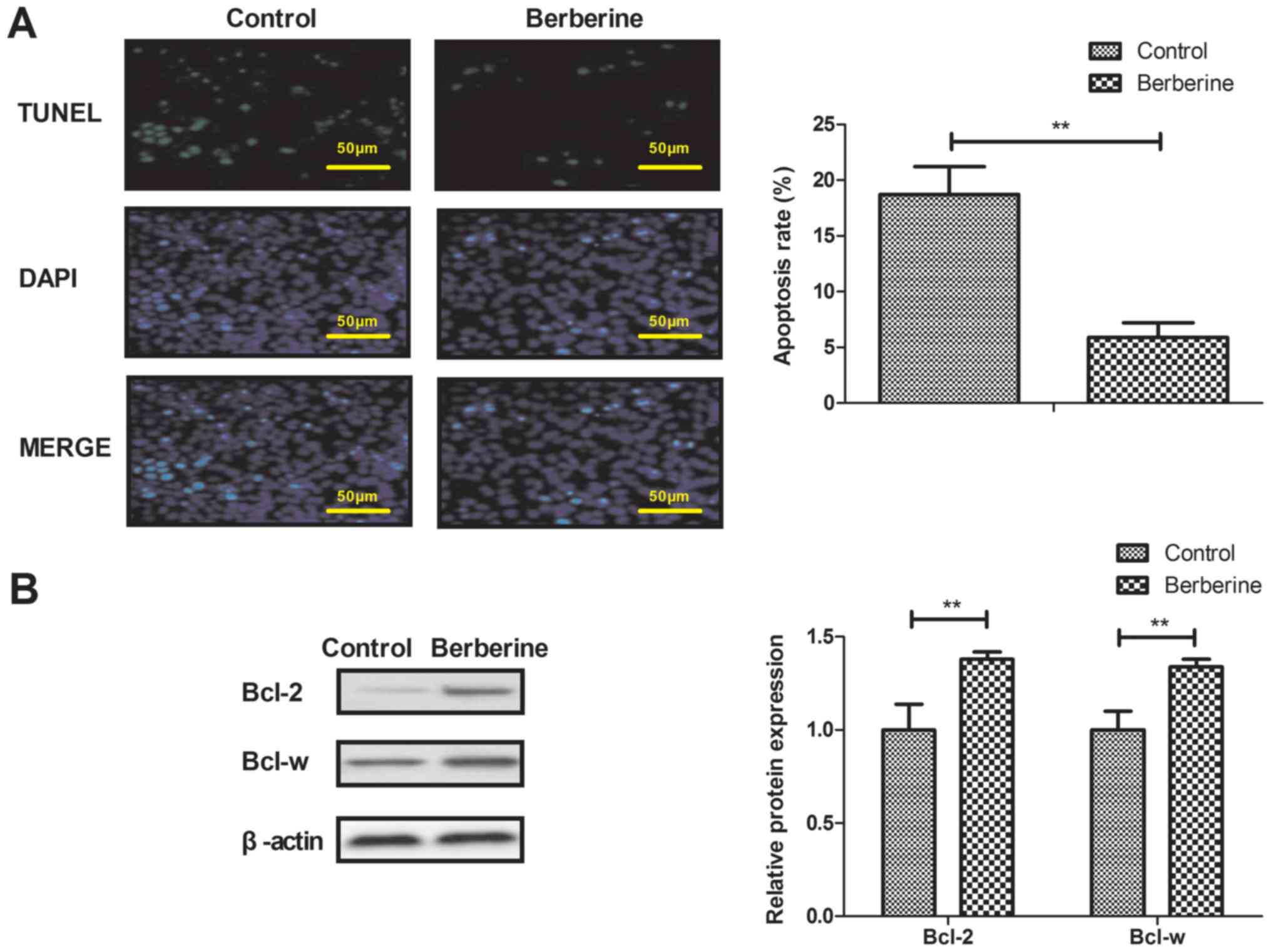
We further analyzed the role of berberine on
apoptosis of hippocampal pyramidal neurons. We observed that
berberine decreased apoptosis of hippocampal pyramidal neurons
(Fig. 2A). Western blot
demonstrated that anti-apoptosis protein Bcl-2 and Bcl-w expression
levels were increased by berberine in hippocampal pyramidal neurons
(Fig. 2B).
Berberine inhibits neuroinflammation
in hippocampal pyramidal neurons
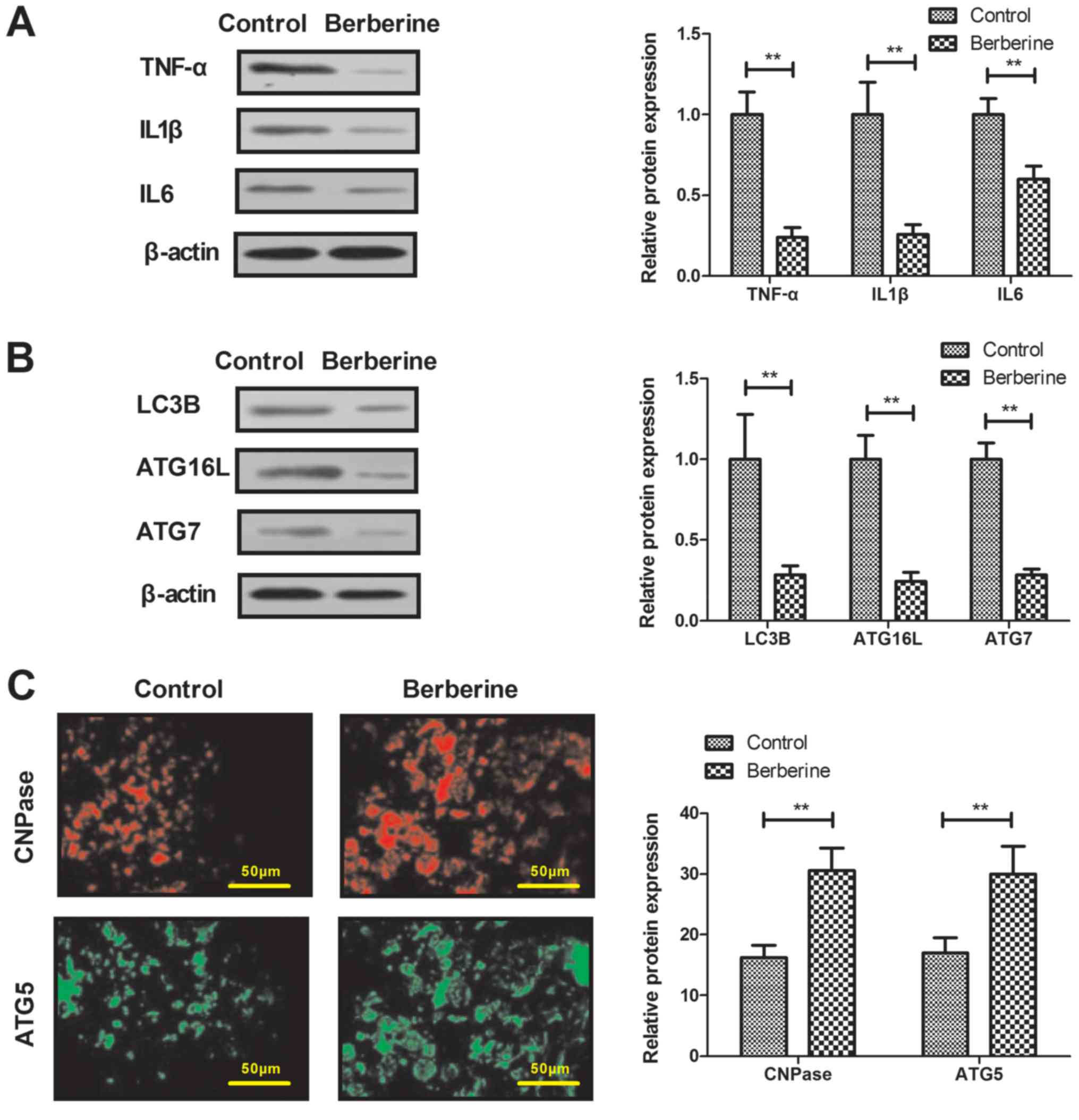
The neuroinflammation level was analyzed in
hippocampal pyramidal neurons. We observed that berberine decreased
TNFα, IL1β and IL6 protein level in hippocampal pyramidal neurons
(Fig. 3A). Results demonstrated
that berberine decreased autophagy-related proteins LC3B, ATG16L
and ATG7 in hippocampal pyramidal neurons (Fig. 3B). We also found that berberine
increased CNPase positive oligodendrocyte expressing ATG5 (Fig. 3C).
Berberine promotes nerve regeneration
through IGFR-mediated c-Jun N-terminal kinase (JNK) and protein
kinase B (AKT) signal pathway
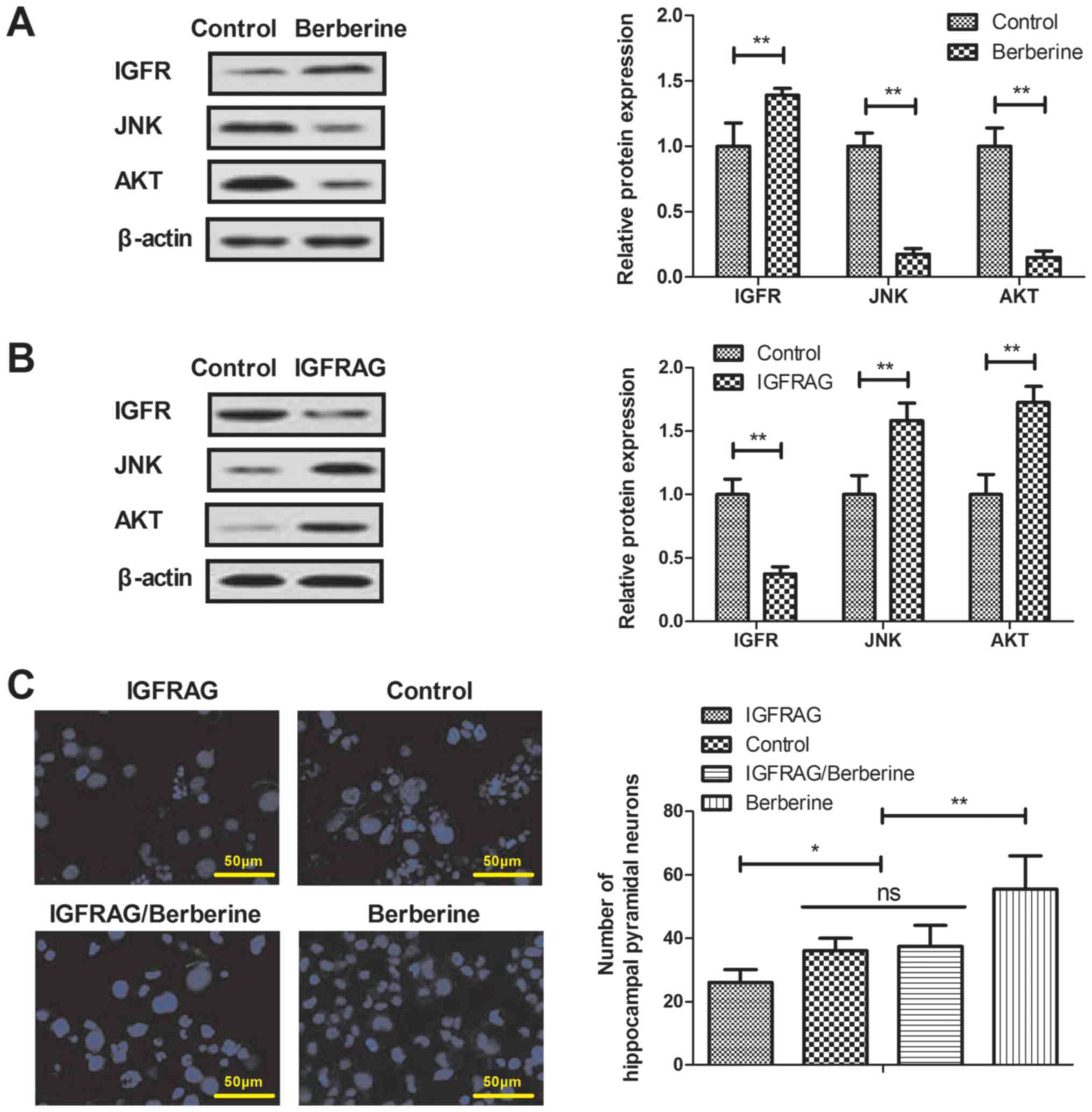
Finally, we explored potential mechanism mediated by
berberine for nerve regeneration in hippocampal pyramidal neurons.
Results found that berberine increased IGFR and decreased JNK and
AKT expression in hippocampal pyramidal neurons (Fig. 4A). IGFR antagonist (IGFRAG)
decreased IGFR and increased JNK and AKT expression (Fig. 4B) and abolished berberine-increased
growth of hippocampal pyramidal neurons (Fig. 4C).
Discussion
Nerve regeneration plays an important role in the
functional recovery after peripheral nerve injury in adulthood
(13). Evidences have indicated
that berberine possesses anti-inflammation and anti-apoptosis
function and has protective function in neuronal degeneration and
central nervous system injury (14–16).
In this study, we showed that berberine increased the viability
hippocampal pyramidal neurons and promoted regeneration of
hippocampal pyramidal neurons. We reported that berberine treatment
decreased the neuroinflammation and autophagy-related protein in
hippocampal pyramidal neurons. Notably, results indicate that
berberine promotes nerve regeneration through IGFR-mediated JNK-AKT
signal pathway.
Currently, repair of peripheral nerve defects is
hampered, which is a serious problem and significantly affects
patients' life (17). Study has
showed that berberine acts as a stimulus of preconditioning that
exhibits neuroprotection via promoting autophagy and decreasing
anoxia-induced apoptosis (18).
Research has observed that berberine prolonged gastrointestinal
transit and time to diarrhea in a dose-dependent manner, and
significantly reduced visceral pain in the mouse models mimicking
diarrhea (19). However,
toxicology effects of Berberis, including nausea, emesis,
salivation, diarrhea, muscular tremor and paralysis, also have
reported in a review (11).
Therefore, this study chose 2 mg/kg/day of berberine for the
treatment of facial nerve axotomy injury mice, which did not appear
diarrhea for all mice. Previous report also found that berberine
could reduce traumatic brain injury-induced brain damage by
limiting the production of inflammatory mediators by glial cells,
rather than by a direct neuroprotective effect (20). In this study, results indicated
that berberine inhibited neuroinflammation TNFα, IL1β and IL6 and
decreased apoptosis of hippocampal pyramidal neurons. Furthermore,
berberine stimulated autophagy and inhibited apoptosis via
modulating the autophagy-associated proteins and
apoptosis-modulating proteins, which exhibited neuroprotection via
promoting autophagy and decreasing anoxia-induced apoptosis
(18). Our results showed that
berberine promoted autophagy-related proteins LC3B, ATG16L and ATG7
in hippocampal pyramidal neurons. Report has indicated that
berberine upregulated CNPase positive oligodendrocyte expressing
ATG5, which promoted neuronal survival (21). Findings in this study showed that
berberine increased CNPase positive oligodendrocyte expressing
ATG5, which might contribute to the growth of hippocampal pyramidal
neurons.
Previously, activation of IGFR-PI3K/Akt signaling
can induce Schwann cell proliferation and sciatic nerve
regeneration (22). This study
demonstrated that berberine decreased IGFR expression in
hippocampal pyramidal neurons. Data suggest that JNK is involved in
cavernosal apoptosis during the acute phase after partial
cavernosal nerve damage (23).
Findings indicated that berberine decreased JNK expression and IGFR
antagonist abolished berberine-inhibited JNK expression in
hippocampal pyramidal neurons. Gong et al have suggested
that inhibiting the activation of JNK/Akt signaling pathway could
protect hippocampal neurons from apoptosis in ischemic brain injury
(24). In this study, results
showed that IGFR antagonist increased JNK and AKT expression and
abolished berberine-increased growth of hippocampal pyramidal
neurons, suggesting that berberine may promote neuronal cells
growth during facial nerve axotomy injury mice model. However, this
study only analyzed the relationships between berberine and
IGFR-mediated JNK-AKT signal pathway, which is a limitation of this
study. Further investigations should analyze the associations
between berberine and IGFR-mediated signal pathways in hippocampal
neurons in ischemic brain injury.
In conclusion, the current study showed the
neuroprotective effect of berberine on hippocampal pyramidal
neurons apoptosis in facial nerve axotomy injury mice model.
Berberine attenuated the neuroinflammation factors, TNFα, IL1β and
IL6 in hippocampal pyramidal neurons. We first demonstrated that
berberine treatment promoted growth of hippocampal pyramidal
neurons. Notably, experimental data implied that berberine may
promote nerve regeneration through IGFR-mediated JNK-AKT signal
pathway, which may be a potential therapeutic agent for nerve
injuries therapy and need to be studied for clinical
investigations.
Acknowledgements
Not applicable.
Funding
The present study was supported by the Natural
Science Fund of Jilin Province Science and Technology Department
(grant no. 20180101340JC).
Availability of data and materials
The analyzed data sets generated during the study
are available from the corresponding author on reasonable
request.
Authors' contributions
ZHN and SYJ performed all experiments in the present
study. HHQ, LHY, XQL and LZM analyzed the experimental data. XGM
and DLH designed all experiments in the present study.
Ethics approval and consent to
participate
This study was approved by the Ethic Committee of
the Second Hospital of Jilin University (approval number:
TSHJLU20140521X).
Patient consent for publication
Not applicable.
Competing interests
The authors declare that they have no competing
interests.
References
|
1
|
Liu F, Wang Z, Qiu Y, Wei M, Li C, Xie Y,
Shen L, Huang Y and Ma C: Suppression of MyD88-dependent signaling
alleviates neuropathic pain induced by peripheral nerve injury in
the rat. J Neuroinflammation. 14:702017. View Article : Google Scholar : PubMed/NCBI
|
|
2
|
Sieber BA, Landis S, Koroshetz W, Bateman
R, Siderowf A, Galpern WR, Dunlop J, Finkbeiner S, Sutherland M,
Wang H, et al: Prioritized research recommendations from the
National Institute of Neurological Disorders and Stroke Parkinson's
Disease 2014 conference. Ann Neurol. 76:469–472. 2014. View Article : Google Scholar : PubMed/NCBI
|
|
3
|
Song J, Sun B, Liu S, Chen W, Zhang Y,
Wang C, Mo X, Che J, Ouyang Y, Yuan W and Fan C: Polymerizing
pyrrole coated poly (l-lactic acid-co-epsilon-caprolactone) (PLCL)
conductive nanofibrous conduit combined with electric stimulation
for long-range peripheral nerve regeneration. Front Mol Neurosci.
9:1172016. View Article : Google Scholar : PubMed/NCBI
|
|
4
|
Patel AK, Park KK and Hackam AS: Wnt
signaling promotes axonal regeneration following optic nerve injury
in the mouse. Neuroscience. 343:372–383. 2017. View Article : Google Scholar : PubMed/NCBI
|
|
5
|
Shin DH, Yu H and Hsu WH: A paradoxical
stimulatory effect of berberine on guinea-pig ileum contractility:
Possible involvement of acetylcholine release from the
postganglionic parasympathetic nerve and cholinesterase inhibition.
Life Sci. 53:1495–1500. 1993. View Article : Google Scholar : PubMed/NCBI
|
|
6
|
Han AM, Heo H and Kwon YK: Berberine
promotes axonal regeneration in injured nerves of the peripheral
nervous system. J Med Food. 15:413–417. 2012. View Article : Google Scholar : PubMed/NCBI
|
|
7
|
Lin TY, Lin YW, Lu CW, Huang SK and Wang
SJ: Berberine inhibits the release of glutamate in nerve terminals
from rat cerebral cortex. PLoS One. 8:e672152013. View Article : Google Scholar : PubMed/NCBI
|
|
8
|
Zhou XQ, Zeng XN, Kong H and Sun XL:
Neuroprotective effects of berberine on stroke models in vitro and
in vivo. Neurosci Lett. 447:31–36. 2008. View Article : Google Scholar : PubMed/NCBI
|
|
9
|
Huang HT, Sun ZG, Liu HW, Ma JT and Hu M:
ERK/MAPK and PI3K/AKT signal channels simultaneously activated in
nerve cell and axon after facial nerve injury. Saudi J Biol Sci.
24:1853–1858. 2017. View Article : Google Scholar : PubMed/NCBI
|
|
10
|
Chen X, Zhang Y, Zhu Z, Liu H, Guo H,
Xiong C, Xie K, Zhang X and Su S: Protective effect of berberine on
doxorubicininduced acute hepatorenal toxicity in rats. Mol Med Rep.
13:3953–3960. 2016. View Article : Google Scholar : PubMed/NCBI
|
|
11
|
Rad SZK, Rameshrad M and Hosseinzadeh H:
Toxicology effects of Berberis vulgaris (barberry) and its active
constituent, berberine: A review. Iran J Basic Med Sci. 20:516–529.
2017.PubMed/NCBI
|
|
12
|
Silva-Gòmez AB, Rojas D, Juárez I and
Flores G: Decreased dendritic spine density on prefrontal cortical
and hippocampal pyramidal neurons in postweaning social isolation
rats. Brain Res. 983:128–136. 2003. View Article : Google Scholar : PubMed/NCBI
|
|
13
|
Cobianchi S, Jaramillo J, Luvisetto S,
Pavone F and Navarro X: Botulinum neurotoxin A promotes functional
recovery after peripheral nerve injury by increasing regeneration
of myelinated fibers. Neuroscience. 359:82–91. 2017. View Article : Google Scholar : PubMed/NCBI
|
|
14
|
Kim HJ: Berberine ameliorates allodynia
induced by chronic constriction injury of the sciatic nerve in
rats. J Med Food. 18:909–915. 2015. View Article : Google Scholar : PubMed/NCBI
|
|
15
|
Lin K, Liu S, Shen Y and Li Q: Berberine
attenuates cigarette smoke-induced acute lung inflammation.
Inflammation. 36:1079–1086. 2013. View Article : Google Scholar : PubMed/NCBI
|
|
16
|
Eom KS, Kim HJ, So HS, Park R and Kim TY:
Berberine-induced apoptosis in human glioblastoma T98G cells is
mediated by endoplasmic reticulum stress accompanying reactive
oxygen species and mitochondrial dysfunction. Biol Pharm Bull.
33:1644–1649. 2010. View Article : Google Scholar : PubMed/NCBI
|
|
17
|
de Luca AC, Lacour SP, Raffoul W and di
Summa PG: Extracellular matrix components in peripheral nerve
repair: How to affect neural cellular response and nerve
regeneration? Neural Regen Res. 9:1943–1948. 2014.PubMed/NCBI
|
|
18
|
Zhang Q, Bian H, Guo L and Zhu H:
Pharmacologic preconditioning with berberine attenuating
ischemia-induced apoptosis and promoting autophagy in neuron. Am J
Transl Res. 8:1197–1207. 2016.PubMed/NCBI
|
|
19
|
Chen C, Lu M, Pan Q, Fichna J, Zheng L,
Wang K, Yu Z, Li Y, Li K, Song A, et al: Berberine improves
intestinal motility and visceral pain in the mouse models mimicking
diarrhea-predominant irritable bowel syndrome (IBS-D) symptoms in
an opioid-receptor dependent manner. PLoS One. 10:e01455562015.
View Article : Google Scholar : PubMed/NCBI
|
|
20
|
Chen CC, Hung TH, Lee CY, Wang LF, Wu CH,
Ke CH and Chen SF: Berberine protects against neuronal damage via
suppression of glia-mediated inflammation in traumatic brain
injury. PLoS One. 9:e1156942014. View Article : Google Scholar : PubMed/NCBI
|
|
21
|
Wang H, Liu C, Mei X, Cao Y, Guo Z, Yuan
Y, Zhao Z, Song C, Guo Y and Shen Z: Berberine attenuated
pro-inflammatory factors and protect against neuronal damage via
triggering oligodendrocyte autophagy in spinal cord injury.
Oncotarget. 8:98312–98321. 2017.PubMed/NCBI
|
|
22
|
Chang YM, Chang HH, Tsai CC, Lin HJ, Ho
TJ, Ye CX, Chiu PL, Chen YS, Chen RJ, Huang CY and Lin CC: Alpinia
oxyphylla Miq. fruit extract activates IGFR-PI3K/Akt signaling to
induce Schwann cell proliferation and sciatic nerve regeneration.
BMC Complement Altern Med. 17:1842017. View Article : Google Scholar : PubMed/NCBI
|
|
23
|
Song WH, Son H, Kim SW, Paick JS and Cho
MC: Role of Jun amino-terminal kinase (JNK) in apoptosis of
cavernosal tissue during acute phase after cavernosal nerve injury.
Asian J Androl. 20:50–55. 2018. View Article : Google Scholar : PubMed/NCBI
|
|
24
|
Gong HY, Zheng F, Zhang C, Chen XY, Liu JJ
and Yue XQ: Propofol protects hippocampal neurons from apoptosis in
ischemic brain injury by increasing GLT-1 expression and inhibiting
the activation of NMDAR via the JNK/Akt signaling pathway. Int J
Mol Med. 38:943–950. 2016. View Article : Google Scholar : PubMed/NCBI
|