Spandidos Publications Logo
  • About
    • About Spandidos
    • Aims and Scopes
    • Abstracting and Indexing
    • Editorial Policies
    • Reprints and Permissions
    • Job Opportunities
    • Terms and Conditions
    • Contact
  • Journals
    • All Journals
    • Oncology Letters
      • Oncology Letters
      • Information for Authors
      • Editorial Policies
      • Editorial Board
      • Aims and Scope
      • Abstracting and Indexing
      • Bibliographic Information
      • Archive
    • International Journal of Oncology
      • International Journal of Oncology
      • Information for Authors
      • Editorial Policies
      • Editorial Board
      • Aims and Scope
      • Abstracting and Indexing
      • Bibliographic Information
      • Archive
    • Molecular and Clinical Oncology
      • Molecular and Clinical Oncology
      • Information for Authors
      • Editorial Policies
      • Editorial Board
      • Aims and Scope
      • Abstracting and Indexing
      • Bibliographic Information
      • Archive
    • Experimental and Therapeutic Medicine
      • Experimental and Therapeutic Medicine
      • Information for Authors
      • Editorial Policies
      • Editorial Board
      • Aims and Scope
      • Abstracting and Indexing
      • Bibliographic Information
      • Archive
    • International Journal of Molecular Medicine
      • International Journal of Molecular Medicine
      • Information for Authors
      • Editorial Policies
      • Editorial Board
      • Aims and Scope
      • Abstracting and Indexing
      • Bibliographic Information
      • Archive
    • Biomedical Reports
      • Biomedical Reports
      • Information for Authors
      • Editorial Policies
      • Editorial Board
      • Aims and Scope
      • Abstracting and Indexing
      • Bibliographic Information
      • Archive
    • Oncology Reports
      • Oncology Reports
      • Information for Authors
      • Editorial Policies
      • Editorial Board
      • Aims and Scope
      • Abstracting and Indexing
      • Bibliographic Information
      • Archive
    • Molecular Medicine Reports
      • Molecular Medicine Reports
      • Information for Authors
      • Editorial Policies
      • Editorial Board
      • Aims and Scope
      • Abstracting and Indexing
      • Bibliographic Information
      • Archive
    • World Academy of Sciences Journal
      • World Academy of Sciences Journal
      • Information for Authors
      • Editorial Policies
      • Editorial Board
      • Aims and Scope
      • Abstracting and Indexing
      • Bibliographic Information
      • Archive
    • International Journal of Functional Nutrition
      • International Journal of Functional Nutrition
      • Information for Authors
      • Editorial Policies
      • Editorial Board
      • Aims and Scope
      • Abstracting and Indexing
      • Bibliographic Information
      • Archive
    • International Journal of Epigenetics
      • International Journal of Epigenetics
      • Information for Authors
      • Editorial Policies
      • Editorial Board
      • Aims and Scope
      • Abstracting and Indexing
      • Bibliographic Information
      • Archive
    • Medicine International
      • Medicine International
      • Information for Authors
      • Editorial Policies
      • Editorial Board
      • Aims and Scope
      • Abstracting and Indexing
      • Bibliographic Information
      • Archive
  • Articles
  • Information
    • Information for Authors
    • Information for Reviewers
    • Information for Librarians
    • Information for Advertisers
    • Conferences
  • Language Editing
Spandidos Publications Logo
  • About
    • About Spandidos
    • Aims and Scopes
    • Abstracting and Indexing
    • Editorial Policies
    • Reprints and Permissions
    • Job Opportunities
    • Terms and Conditions
    • Contact
  • Journals
    • All Journals
    • Biomedical Reports
      • Information for Authors
      • Editorial Policies
      • Editorial Board
      • Aims and Scope
      • Abstracting and Indexing
      • Bibliographic Information
      • Archive
    • Experimental and Therapeutic Medicine
      • Information for Authors
      • Editorial Policies
      • Editorial Board
      • Aims and Scope
      • Abstracting and Indexing
      • Bibliographic Information
      • Archive
    • International Journal of Epigenetics
      • Information for Authors
      • Editorial Policies
      • Editorial Board
      • Aims and Scope
      • Abstracting and Indexing
      • Bibliographic Information
      • Archive
    • International Journal of Functional Nutrition
      • Information for Authors
      • Editorial Policies
      • Editorial Board
      • Aims and Scope
      • Abstracting and Indexing
      • Bibliographic Information
      • Archive
    • International Journal of Molecular Medicine
      • Information for Authors
      • Editorial Policies
      • Editorial Board
      • Aims and Scope
      • Abstracting and Indexing
      • Bibliographic Information
      • Archive
    • International Journal of Oncology
      • Information for Authors
      • Editorial Policies
      • Editorial Board
      • Aims and Scope
      • Abstracting and Indexing
      • Bibliographic Information
      • Archive
    • Medicine International
      • Information for Authors
      • Editorial Policies
      • Editorial Board
      • Aims and Scope
      • Abstracting and Indexing
      • Bibliographic Information
      • Archive
    • Molecular and Clinical Oncology
      • Information for Authors
      • Editorial Policies
      • Editorial Board
      • Aims and Scope
      • Abstracting and Indexing
      • Bibliographic Information
      • Archive
    • Molecular Medicine Reports
      • Information for Authors
      • Editorial Policies
      • Editorial Board
      • Aims and Scope
      • Abstracting and Indexing
      • Bibliographic Information
      • Archive
    • Oncology Letters
      • Information for Authors
      • Editorial Policies
      • Editorial Board
      • Aims and Scope
      • Abstracting and Indexing
      • Bibliographic Information
      • Archive
    • Oncology Reports
      • Information for Authors
      • Editorial Policies
      • Editorial Board
      • Aims and Scope
      • Abstracting and Indexing
      • Bibliographic Information
      • Archive
    • World Academy of Sciences Journal
      • Information for Authors
      • Editorial Policies
      • Editorial Board
      • Aims and Scope
      • Abstracting and Indexing
      • Bibliographic Information
      • Archive
  • Articles
  • Information
    • For Authors
    • For Reviewers
    • For Librarians
    • For Advertisers
    • Conferences
  • Language Editing
Login Register Submit
  • This site uses cookies
  • You can change your cookie settings at any time by following the instructions in our Cookie Policy. To find out more, you may read our Privacy Policy.

    I agree
Search articles by DOI, keyword, author or affiliation
Search
Advanced Search
presentation
Molecular Medicine Reports
Join Editorial Board Propose a Special Issue
Print ISSN: 1791-2997 Online ISSN: 1791-3004
Journal Cover
October-2019 Volume 20 Issue 4

Full Size Image

Sign up for eToc alerts
Recommend to Library

Journals

International Journal of Molecular Medicine

International Journal of Molecular Medicine

International Journal of Molecular Medicine is an international journal devoted to molecular mechanisms of human disease.

International Journal of Oncology

International Journal of Oncology

International Journal of Oncology is an international journal devoted to oncology research and cancer treatment.

Molecular Medicine Reports

Molecular Medicine Reports

Covers molecular medicine topics such as pharmacology, pathology, genetics, neuroscience, infectious diseases, molecular cardiology, and molecular surgery.

Oncology Reports

Oncology Reports

Oncology Reports is an international journal devoted to fundamental and applied research in Oncology.

Experimental and Therapeutic Medicine

Experimental and Therapeutic Medicine

Experimental and Therapeutic Medicine is an international journal devoted to laboratory and clinical medicine.

Oncology Letters

Oncology Letters

Oncology Letters is an international journal devoted to Experimental and Clinical Oncology.

Biomedical Reports

Biomedical Reports

Explores a wide range of biological and medical fields, including pharmacology, genetics, microbiology, neuroscience, and molecular cardiology.

Molecular and Clinical Oncology

Molecular and Clinical Oncology

International journal addressing all aspects of oncology research, from tumorigenesis and oncogenes to chemotherapy and metastasis.

World Academy of Sciences Journal

World Academy of Sciences Journal

Multidisciplinary open-access journal spanning biochemistry, genetics, neuroscience, environmental health, and synthetic biology.

International Journal of Functional Nutrition

International Journal of Functional Nutrition

Open-access journal combining biochemistry, pharmacology, immunology, and genetics to advance health through functional nutrition.

International Journal of Epigenetics

International Journal of Epigenetics

Publishes open-access research on using epigenetics to advance understanding and treatment of human disease.

Medicine International

Medicine International

An International Open Access Journal Devoted to General Medicine.

Journal Cover
October-2019 Volume 20 Issue 4

Full Size Image

Sign up for eToc alerts
Recommend to Library

  • Article
  • Citations
    • Cite This Article
    • Download Citation
    • Create Citation Alert
    • Remove Citation Alert
    • Cited By
  • Similar Articles
    • Related Articles (in Spandidos Publications)
    • Similar Articles (Google Scholar)
    • Similar Articles (PubMed)
  • Download PDF
  • Download XML
  • View XML
Article Open Access

MicroRNA‑155 inhibits the proliferation of CD8+ T cells via upregulating regulatory T cells in vitiligo

  • Authors:
    • Mingfen Lv
    • Zhengjun Li
    • Jingjing Liu
    • Fan Lin
    • Qianwen Zhang
    • Zhiming Li
    • Yi Wang
    • Keyu Wang
    • Yunsheng Xu
  • View Affiliations / Copyright

    Affiliations: Department of Dermatology, Qilu Hospital, Shandong University, Jinan, Shandong 250012, P.R. China, Department of Dermatology, The First Affiliated Hospital of Wenzhou Medical University, Wenzhou, Zhejiang 325000, P.R. China, Department of Dermatology, The First Affiliated Hospital of Wenzhou Medical University, Wenzhou, Zhejiang 325000, P.R. ChinaDepartment of Dermatology, The First Affiliated Hospital of Wenzhou Medical University, Wenzhou, Zhejiang 325000, P.R. China, Department of Dermatology, Jinan Central Hospital, Jinan, Shandong 250013, P.R. China
    Copyright: © Lv et al. This is an open access article distributed under the terms of Creative Commons Attribution License.
  • Pages: 3617-3624
    |
    Published online on: August 23, 2019
       https://doi.org/10.3892/mmr.2019.10607
  • Expand metrics +
Metrics: Total Views: 0 (Spandidos Publications: | PMC Statistics: )
Metrics: Total PDF Downloads: 0 (Spandidos Publications: | PMC Statistics: )
Cited By (CrossRef): 0 citations Loading Articles...

This article is mentioned in:


Abstract

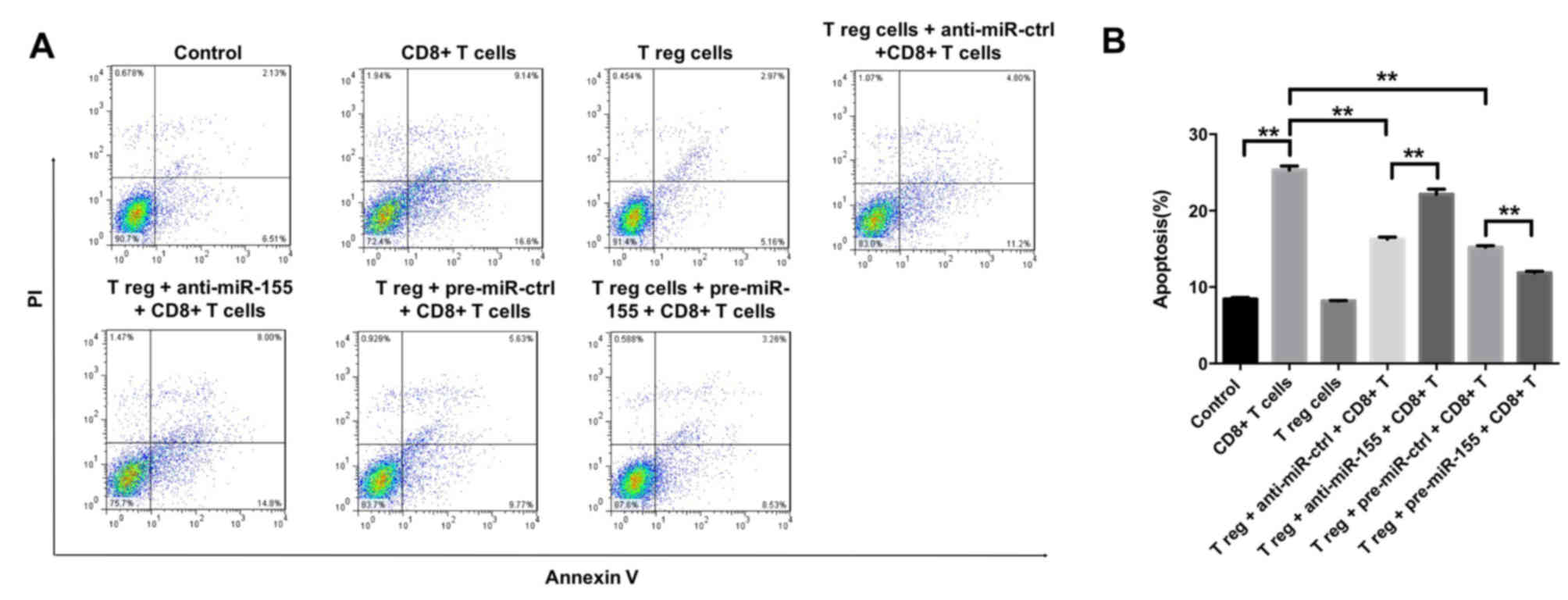
It has been reported that loss and degradation of epidermal melanocytes is closely associated with the pathogenesis of vitiligo. In addition, CD8+ T and regulatory T (Treg) cells serve an important role during these two processes. MicroRNA‑155 (miR‑155) is known to contribute to the pathogenesis of vitiligo; however, the mechanism by which miR‑155 regulates the development of vitiligo remains unclear. In the present study, naïve T and CD8+ T cells were isolated from a patient with non‑segmental vitiligo by flow cytometry. The cells were differentiated into Treg cells by treatment with interleukin‑2, transforming growth factor‑β and retinoic acid. In addition, miR‑155 agonists and antagonists were used to investigate the effect of miR‑155 on the proliferation of CD8+ T cells, Treg cells and melanocytes. The results demonstrated that the miR‑155 agonist significantly decreased the rate of CD8+ T cell growth, as well as promoted the proliferation of melanocytes by inducing an increase in the percentage of Treg cells. By contrast, the miR‑155 antagonist inhibited the proliferation of melanocytes by decreasing the percentage of Treg cells. miR‑155 protected melanocyte survival by increasing the number of Treg cells and by decreasing the number of CD8+ T cells. Therefore, these data may provide a new prospect for the treatment of vitiligo.
View Figures

Figure 1

Figure 2

Figure 3

Figure 4

Figure 5

View References

1 

Krüger C and Schallreuter KU: A review of the worldwide prevalence of vitiligo in children/adolescents and adults. Int J Dermatol. 51:1206–1212. 2012. View Article : Google Scholar : PubMed/NCBI

2 

Jin Y, Birlea SA, Fain PR, Ferrara TM, Ben S, Riccardi SL, Cole JB, Gowan K, Holland PJ, Bennett DC, et al: Genome-wide association analyses identify 13 new susceptibility loci for generalized vitiligo. Nat Genet. 44:676–680. 2012. View Article : Google Scholar : PubMed/NCBI

3 

Ezzedine K, Eleftheriadou V, Whitton M and van Geel N: Vitiligo. Lancet. 386:74–84. 2015. View Article : Google Scholar : PubMed/NCBI

4 

Gey A, Diallo A, Seneschal J, Leaute-Labreze C, Boralevi F, Jouary T, Taieb A and Ezzedine K: Autoimmune thyroid disease in vitiligo: multivariate analysis indicates intricate pathomechanisms. Br J Dermatol. 168:756–761. 2013. View Article : Google Scholar : PubMed/NCBI

5 

Shi Q, Zhang W, Guo S, Jian Z, Li S, Li K, Ge R, Dai W, Wang G, Gao T and Li C: Oxidative stress-induced overexpression of miR-25: The mechanism underlying the degeneration of melanocytes in vitiligo. Cell Death Differ. 23:496–508. 2016. View Article : Google Scholar : PubMed/NCBI

6 

Lu W, Zhao Y, Kong Y, Zhang W, Ma W, Li W and Wang K: Geniposide prevents H2 O2 -induced oxidative damage in melanocytes by activating the PI3K-Akt signalling pathway. Clin Exp Dermatol. 43:667–674. 2018. View Article : Google Scholar : PubMed/NCBI

7 

Patel S, Rauf A, Khan H, Meher BR and Hassan SSU: A holistic review on the autoimmune disease vitiligo with emphasis on the causal factors. Biomed Pharmacother. 92:501–508. 2017. View Article : Google Scholar : PubMed/NCBI

8 

Strassner JP and Harris JE: Understanding mechanisms of autoimmunity through translational research in vitiligo. Curr Opin Immunol. 43:81–88. 2016. View Article : Google Scholar : PubMed/NCBI

9 

van den Boorn JG, Konijnenberg D, Dellemijn TA, van der Veen JP, Bos JD, Melief CJ, Vyth-Dreese FA and Luiten RM: Autoimmune destruction of skin melanocytes by perilesional T cells from vitiligo patients. J Invest Dermatol. 129:2220–2232. 2009. View Article : Google Scholar : PubMed/NCBI

10 

Wankowicz-Kalinska A, van den Wijngaard RM, Tigges BJ, Westerhof W, Ogg GS, Cerundolo V, Storkus WJ and Das PK: Immunopolarization of CD4+ and CD8+ T cells to Type-1-like is associated with melanocyte loss in human vitiligo. Lab Invest. 83:683–695. 2003. View Article : Google Scholar : PubMed/NCBI

11 

Kleinewietfeld M and Hafler DA: Regulatory T cells in autoimmune neuroinflammation. Immunol Rev. 259:231–244. 2014. View Article : Google Scholar : PubMed/NCBI

12 

Askenasy N, Kaminitz A and Yarkoni S: Mechanisms of tregulatory cell function. Autoimmun Rev. 7:370–375. 2008. View Article : Google Scholar : PubMed/NCBI

13 

Lan Q, Zhou X, Fan H, Chen M, Wang J, Ryffel B, Brand D, Ramalingam R, Kiela PR, Horwitz DA, et al: Polyclonal CD4+Foxp3+ Treg cells induce TGFβ-dependent tolerogenic dendritic cells that suppress the murine lupus-like syndrome. J Mol Cell Biol. 4:409–419. 2012. View Article : Google Scholar : PubMed/NCBI

14 

Dwivedi M, Laddha NC, Arora P, Marfatia YS and Begum R: Decreased regulatory T-cells and CD4(+) /CD8(+) ratio correlate with disease onset and progression in patients with generalized vitiligo. Pigment Cell Melanoma Res. 26:586–591. 2013. View Article : Google Scholar : PubMed/NCBI

15 

Ben Ahmed M, Zaraa I, Rekik R, Elbeldi-Ferchiou A, Kourda N, Belhadj Hmida N, Abdeladhim M, Karoui O, Ben Osman A, Mokni M and Louzir H: Functional defects of peripheral regulatory T lymphocytes in patients with progressive vitiligo. Pigment Cell Melanoma Res. 25:99–109. 2012. View Article : Google Scholar : PubMed/NCBI

16 

Pauley KM, Cha S and Chan EK: MicroRNA in autoimmunity and autoimmune diseases. J Autoimmun. 32:189–194. 2009. View Article : Google Scholar : PubMed/NCBI

17 

Malmhäll C, Alawieh S, Lu Y, Sjöstrand M, Bossios A, Eldh M and Rådinger M: MicroRNA-155 is essential for T(H)2-mediated allergen-induced eosinophilic inflammation in the lung. J Allergy Clin Immunol. 133:1429–1438, 1438.e1421-1427. 2014. View Article : Google Scholar : PubMed/NCBI

18 

Dudda JC, Salaun B, Ji Y, Palmer DC, Monnot GC, Merck E, Boudousquie C, Utzschneider DT, Escobar TM, Perret R, et al: MicroRNA-155 is required for effector CD8+ T cell responses to virus infection and cancer. Immunity. 38:742–753. 2013. View Article : Google Scholar : PubMed/NCBI

19 

Liston A, Lu LF, O'Carroll D, Tarakhovsky A and Rudensky AY: Dicer-dependent microRNA pathway safeguards regulatory T cell function. J Exp Med. 205:1993–2004. 2008. View Article : Google Scholar : PubMed/NCBI

20 

Kempinska-Podhorodecka A, Milkiewicz M, Wasik U, Ligocka J, Zawadzki M, Krawczyk M and Milkiewicz P: Decreased expression of vitamin D receptor affects an immune response in primary biliary cholangitis via the VDR-miRNA155-SOCS1 pathway. Int J Mol Sci. 18:E2892017. View Article : Google Scholar : PubMed/NCBI

21 

Šahmatova L, Tankov S, Prans E, Aab A, Hermann H, Reemann P, Pihlap M, Karelson M, Abram K, Kisand K, et al: MicroRNA-155 is dysregulated in the skin of patients with vitiligo and inhibits melanogenesis-associated genes in melanocytes and keratinocytes. Acta Derm Venereol. 96:742–747. 2016.PubMed/NCBI

22 

Yao R, Ma YL, Liang W, Li HH, Ma ZJ, Yu X and Liao YH: MicroRNA-155 modulates treg and Th17 cells differentiation and Th17 cell function by targeting SOCS1. PLoS One. 7:e460822012. View Article : Google Scholar : PubMed/NCBI

23 

Karagiannidis C, Akdis M, Holopainen P, Woolley NJ, Hense G, Ruckert B, Mantel PY, Menz G, Akdis CA, Blaser K and Schmidt-Weber CB: Glucocorticoids upregulate FOXP3 expression and regulatory T cells in asthma. J Allergy Clin Immunol. 114:1425–1433. 2004. View Article : Google Scholar : PubMed/NCBI

24 

Ganesh BB, Bhattacharya P, Gopisetty A, Sheng J, Vasu C and Prabhakar BS: IL-1β promotes TGF-β1 and IL-2 dependent Foxp3 expression in regulatory T cells. PLoS One. 6:e219492011. View Article : Google Scholar : PubMed/NCBI

25 

Polanczyk MJ, Walker E, Haley D, Guerrouahen BS and Akporiaye ET: Blockade of TGF-β signaling to enhance the antitumor response is accompanied by dysregulation of the functional activity of CD4 + CD25 + Foxp3 + and CD4 + CD25 - Foxp3 + T cells. J Transl Med. 17:2192019. View Article : Google Scholar : PubMed/NCBI

26 

Mucida D, Pino-Lagos K, Kim G, Nowak E, Benson MJ, Kronenberg M, Noelle RJ and Cheroutre H: Retinoic acid can directly promote TGF-beta-mediated Foxp3(+) Treg cell conversion of naive T cells. Immunity. 30:471–472. 2009. View Article : Google Scholar : PubMed/NCBI

27 

Livak KJ and Schmittgen TD: Analysis of relative gene expression data using real-time quantitative PCR and the 2(-Delta Delta C(T)) method. Methods. 25:402–408. 2001. View Article : Google Scholar : PubMed/NCBI

28 

Klarquist J, Eby JM, Henning SW, Li M, Wainwright DA, Westerhof W, Luiten RM, Nishimura MI and Le Poole IC: Functional cloning of a gp100-reactive T-cell receptor from vitiligo patient skin. Pigment Cell Melanoma Res. 29:379–384. 2016. View Article : Google Scholar : PubMed/NCBI

29 

Nigam PK, Patra PK, Khodiar PK and Gual J: A study of blood CD3+, CD4+, and CD8+ T cell levels and CD4+:CD8+ ratio in vitiligo patients. Indian J Dermatol Venereol Leprol. 77:1112011. View Article : Google Scholar : PubMed/NCBI

30 

Lili Y, Yi W, Ji Y, Yue S, Weimin S and Ming L: Global activation of CD8+ cytotoxic T lymphocytes correlates with an impairment in regulatory T cells in patients with generalized vitiligo. PLoS One. 7:e375132012. View Article : Google Scholar : PubMed/NCBI

31 

Le Poole IC and Mehrotra S: Replenishing regulatory T cells to halt depigmentation in vitiligo. J Investig Dermatol Symp Proc. 18:S38–S45. 2017. View Article : Google Scholar : PubMed/NCBI

32 

Gracias DT, Stelekati E, Hope JL, Boesteanu AC, Doering TA, Norton J, Mueller YM, Fraietta JA, Wherry EJ, Turner M and Katsikis PD: The microRNA miR-155 controls CD8(+) T cell responses by regulating interferon signaling. Nat Immunol. 14:593–602. 2013. View Article : Google Scholar : PubMed/NCBI

33 

Wu J, Zhou M, Wan Y and Xu A: CD8+ T cells from vitiligo perilesional margins induce autologous melanocyte apoptosis. Mol Med Rep. 7:237–241. 2013. View Article : Google Scholar : PubMed/NCBI

34 

Glassman SJ: Vitiligo, reactive oxygen species and T-cells. Clin Sci (Lond). 120:99–120. 2011. View Article : Google Scholar : PubMed/NCBI

35 

Yang L, Yang S, Lei J, Hu W, Chen R, Lin F and Xu AE: Role of chemokines and the corresponding receptors in vitiligo: A pilot study. J Dermatol. 45:31–38. 2018. View Article : Google Scholar : PubMed/NCBI

36 

Guan C, Li Q, Song X, Xu W, Li L and Xu A: Antroquinonol exerts immunosuppressive effect on CD8(+) T Cell proliferation and activation to resist depigmentation induced by H2O2. Oxid Med Cell Longev. 2017:93030542017. View Article : Google Scholar : PubMed/NCBI

37 

Arneth BM: Activation of CD4 and CD8 T cell receptors and regulatory T cells in response to human proteins. PeerJ. 6:e44622018. View Article : Google Scholar : PubMed/NCBI

Related Articles

  • Abstract
  • View
  • Download
  • Twitter
Copy and paste a formatted citation
Spandidos Publications style
Lv M, Li Z, Liu J, Lin F, Zhang Q, Li Z, Wang Y, Wang K and Xu Y: MicroRNA‑155 inhibits the proliferation of CD8+ T cells via upregulating regulatory T cells in vitiligo. Mol Med Rep 20: 3617-3624, 2019.
APA
Lv, M., Li, Z., Liu, J., Lin, F., Zhang, Q., Li, Z. ... Xu, Y. (2019). MicroRNA‑155 inhibits the proliferation of CD8+ T cells via upregulating regulatory T cells in vitiligo. Molecular Medicine Reports, 20, 3617-3624. https://doi.org/10.3892/mmr.2019.10607
MLA
Lv, M., Li, Z., Liu, J., Lin, F., Zhang, Q., Li, Z., Wang, Y., Wang, K., Xu, Y."MicroRNA‑155 inhibits the proliferation of CD8+ T cells via upregulating regulatory T cells in vitiligo". Molecular Medicine Reports 20.4 (2019): 3617-3624.
Chicago
Lv, M., Li, Z., Liu, J., Lin, F., Zhang, Q., Li, Z., Wang, Y., Wang, K., Xu, Y."MicroRNA‑155 inhibits the proliferation of CD8+ T cells via upregulating regulatory T cells in vitiligo". Molecular Medicine Reports 20, no. 4 (2019): 3617-3624. https://doi.org/10.3892/mmr.2019.10607
Copy and paste a formatted citation
x
Spandidos Publications style
Lv M, Li Z, Liu J, Lin F, Zhang Q, Li Z, Wang Y, Wang K and Xu Y: MicroRNA‑155 inhibits the proliferation of CD8+ T cells via upregulating regulatory T cells in vitiligo. Mol Med Rep 20: 3617-3624, 2019.
APA
Lv, M., Li, Z., Liu, J., Lin, F., Zhang, Q., Li, Z. ... Xu, Y. (2019). MicroRNA‑155 inhibits the proliferation of CD8+ T cells via upregulating regulatory T cells in vitiligo. Molecular Medicine Reports, 20, 3617-3624. https://doi.org/10.3892/mmr.2019.10607
MLA
Lv, M., Li, Z., Liu, J., Lin, F., Zhang, Q., Li, Z., Wang, Y., Wang, K., Xu, Y."MicroRNA‑155 inhibits the proliferation of CD8+ T cells via upregulating regulatory T cells in vitiligo". Molecular Medicine Reports 20.4 (2019): 3617-3624.
Chicago
Lv, M., Li, Z., Liu, J., Lin, F., Zhang, Q., Li, Z., Wang, Y., Wang, K., Xu, Y."MicroRNA‑155 inhibits the proliferation of CD8+ T cells via upregulating regulatory T cells in vitiligo". Molecular Medicine Reports 20, no. 4 (2019): 3617-3624. https://doi.org/10.3892/mmr.2019.10607
Follow us
  • Twitter
  • LinkedIn
  • Facebook
About
  • Spandidos Publications
  • Careers
  • Cookie Policy
  • Privacy Policy
How can we help?
  • Help
  • Live Chat
  • Contact
  • Email to our Support Team