Mol Med Rep 18: [Related article:] 4051-4057, 2018; DOI:
10.3892/mmr.2018.9385
Following the publication of the above article, an
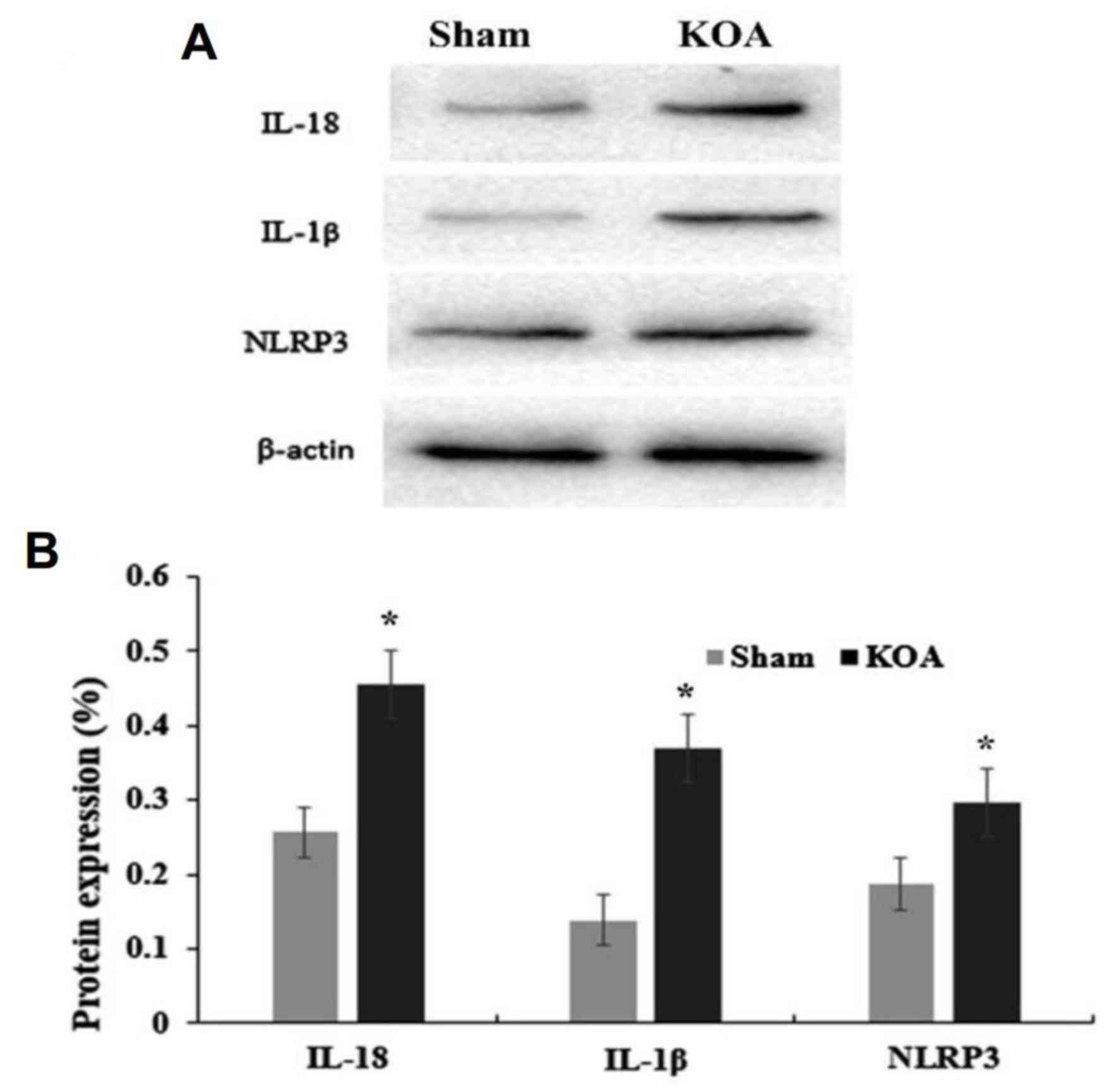
interested reader drew to our attention that, in Fig. 4A, in which the authors had
presented a western blot image depicting protein expression of
IL-18, IL-1β, NLRP3 and β-actin from synovial tissue lysates from
osteoarthritic rats, upon close examination of the figure a
striking similarity was noted between the bands shown for the
IL-18- and NLRP3-stained Sham group experiments, although the bands
appeared in an inverted position relative to each other. Following
an enquiry with the authors, they realized that they had included
incorrect data for this figure; an amended version of Fig. 4, showing the correct data for
NLRP3, is shown opposite.
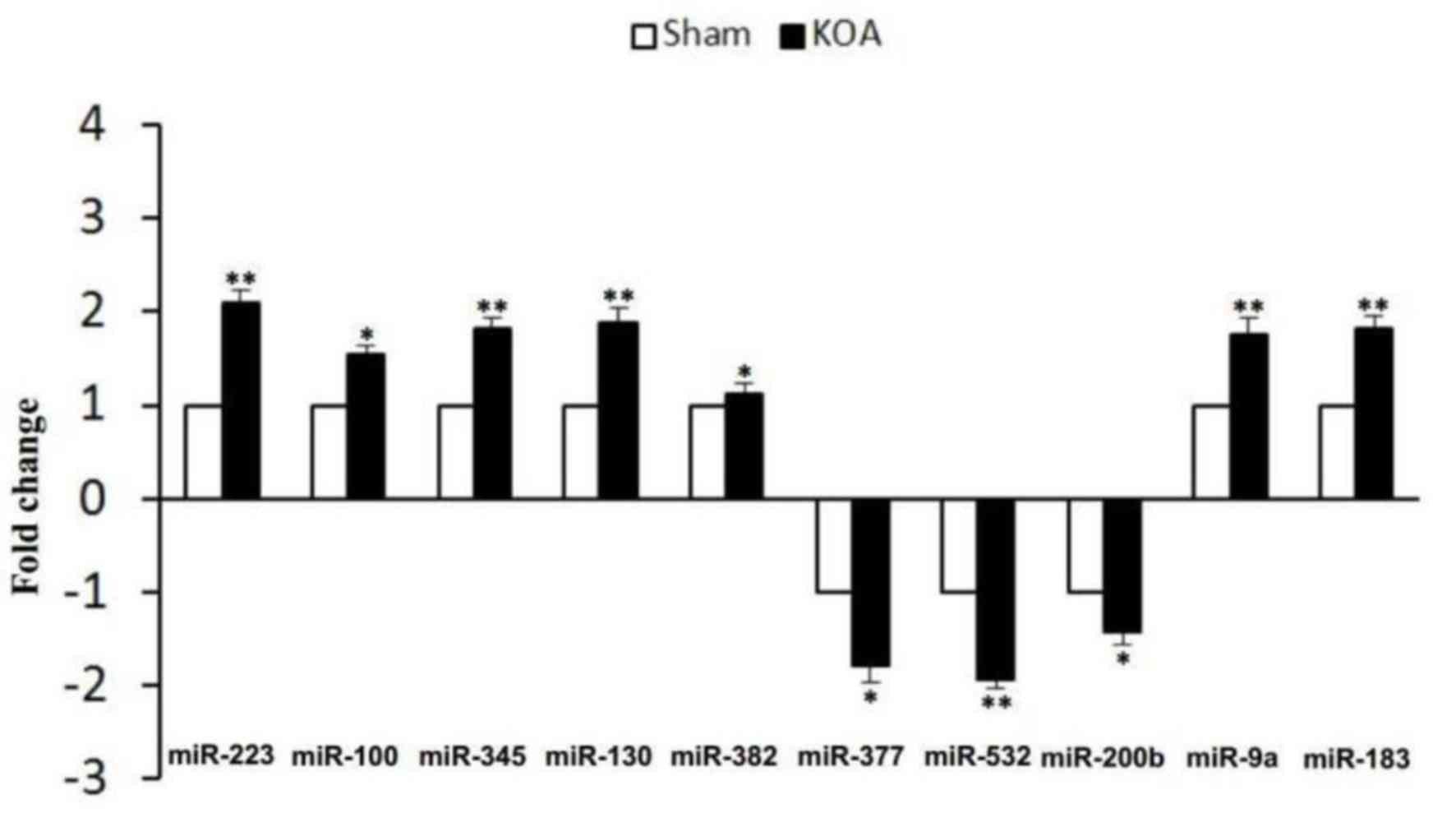
Secondly, the authors have realized that, at various
points throughout the paper, two miRNAs were written incorrectly:
Specifically, references to an ‘miR-352’ should have appeared as
miR-532, and ‘miR-233’ should have been written as
miR-223. This error affected the presentation of Fig. 2; therefore, a revised version of
this figure, with the miRNAs correctly labelled as miR-532 and
miR-223 respectively, is also shown opposite. Furthermore, mi-233
should have been written as miR-223 at the following places in the
text: p. 4051, right-hand column (RHC), line 10 (“Furthermore, the
miR-223-regulated…); p. 4054, Results section, left-hand column
(LHC), third subheading (“miR-223 negatively regulates the
expression of NLRP3.”); and in the concluding paragraph of the
Discussion on p. 4056, LHC, miR-233 should have been written as
miR-223 in all five instances where this occurred (lines 4, 7, 8,
9, and 10 of this paragraph). Finally, the second sentence featured
in the subsection of the Results section entitled “Expression
validation of miRs by RT-qPCR” on p. 4054 contained additional
errors. This sentence should have appeared as follows (changed text
is highlighted in bold): “The expression of miR-223, −100, −345,
−130, −382, −9a and 183 were upregulated, whereas miR-377, −532,
−200b were downregulated with a fold change of ≥1.5, similar to
the microarray data (Fig. 2).
All the authors agree to the contents of this
Corrigendum, and apologize to the Editor of Molecular Medicine
Reports and to the readership for any inconvenience caused.