Introduction
Prostate carcinoma is a type of malignancy that
develops from the prostate and one of the most common types of
cancer in males (1). Prostate
tumors usually grow slowly, without evident clinical symptoms at
the early stages. Therefore, treatment of prostate carcinoma
without distant metastasis usually yields satisfactory outcomes
(2,3). However, once metastasis affects other
parts of the body, such as the lymph nodes, soft tissues, bone
tissues or even the brain, mortality is comparable to that of other
types of aggressive malignancies (4,5).
Mortality of metastatic prostate cancer ranks in the top among all
malignancies in Europe (6). In
developing countries, such as China, the incidence of prostate
carcinoma exhibits an increasing trend, possibly due to lifestyle
changes (7). Therefore, increasing
the early diagnostic rate and improving treatment outcomes remains
a major task for clinical personnel.
In spite of the lack of evident clinical symptoms
during the early stages of the disease, the development of prostate
carcinoma affects the expression of a large set of microRNAs
(miRNAs or miRs) (8), indicating
their involvement in the pathogenesis of this disease. miR-122 has
been reported to serve a role as a tumor suppressor, inhibiting the
progression of different types of cancer, including hepatocellular
carcinoma (9) and oropharyngeal
cancer (10). However, the
involvement of miR-122 in prostate carcinoma remains unknown.
Rho-associated protein kinase 2 (ROCK2) signaling serves pivotal
roles in the development of various types of malignancies,
including prostate carcinoma, and inhibition of ROCK2 inhibits the
development of prostate carcinoma (11).
Our preliminary microarray data revealed the inverse
correlation between expression levels of ROCK2 and miR-122 in
prostate carcinoma tissues (data not shown). Thus, in the present
study, the aim was to examine the roles of miR-122 and ROCK2 in
this tumor. It was observed that miR-122 was downregulated in
prostate carcinoma tissues, while miR-122 overexpression in
prostate carcinoma cells led to inhibited proliferation and
downregulated ROCK2 expression.
Materials and methods
Specimens
Clinical data of 54 patients with prostate carcinoma
who were diagnosed and treated at the Union Hospital, Tongji
Medical College, Huazhong University of Science and Technology
(Wuhan, China) between January 2011 and January 2013 were
retrospectively analyzed. Cancer tissues, adjacent healthy tissues
and serum samples of these patients were obtained. All tissues were
stored in liquid nitrogen prior to use. The age range of these
patients was between 27 and 71 years, with a mean age of 50.2±6.2
years. Subjects were selected according to the following inclusion
criteria: i) Patients with prostate carcinoma diagnosed through
pathological examination; ii) patients with complete clinical and
follow-up data; and iii) patients diagnosed and treated for the
first time. The exclusion criteria were as follows: i) Patients who
suffered from other malignancies at the time of the study or
previously; ii) patients with other prostate diseases; iii)
patients who had received treatment prior to admission; and iv)
cases of mortality caused by other reasons. Furthermore, serum
samples were also collected from 49 healthy volunteers who received
routine physiological examinations in Union Hospital during the
same time period to serve as the control group. The age of these
heathy subjects ranged between 30 and 68 years, with a mean age of
49.2±6.3 years. The age distribution of patients and healthy
controls was similar. All participants and/or their families
provided written informed consent prior to participation. The
current study was approved by the Ethics Committee of Union
Hospital, Tongji Medical College, Huazhong University of Science
and Technology.
Cell culture and transfection
Human prostate carcinoma cell lines 22Rv1
(ATCC® CRL-2505™) and DU145 (ATCC® HTB-81™),
and a human normal prostate epithelial cell line HPrEC
(ATCC® PCS-440-010™) were purchased from ATCC (Manassas,
VA, USA). Cells were cultured with Eagle's minimum essential medium
(ATCC) containing 10% fetal bovine serum (ATCC) in an incubator at
37°C with 5% CO2. A total of 5×10⁵ cells in
each well of a 6-well plate were transfected with 10 nM miR-122
mimics (HMI0068-5NMOL; Sigma-Aldrich; Merck KGaA, Darmstadt,
Germany) or negative control mimics (HMC0002; Sigma-Aldrich; Merck
KGaA) using Lipofectamine® 2000 reagent (cat. no.
11668-019; Invitrogen; Thermo Fisher Scientific, Inc., Waltham, MA,
USA). Overexpression of miR-122 in the transfected cells was
confirmed by reverse transcription-quantitative polymerase chain
reaction (RT-qPCR), and an overexpression rate between 190 and 250%
was achieved prior to use in subsequent experiments. In case of
ROCK2 treatment, cells were treated with ROCK2 (5–554; cat. no.
R1156; Sigma-Aldrich; Merck KGaA) at a dose of 10 ng/ml for 24 h
after the transfection of miR-122 mimic.
Cell Counting Kit-8 (CCK-8) assay
The control and two tumor cell lines were collected
during the logarithmic phase, and single cell suspensions with a
cell density of 4×10⁴ cells per ml were constructed.
Next, 100 µl of the cell suspension (4×10³ cells) was
added into each well of a 96-well plate. Cells were then cultured
at 37°C with 5% CO2, and 10 µl CCK-8 solution
(Sigma-Aldrich; Merck KGaA) was added and mixed with cell
suspension after 24, 48, 72 and 96 h of incubation. Cell culture
was performed for a further 4 h, following which a Fisherbrand™
accuSkan™ GO UV/Vis microplate spectrophotometer (Thermo Fisher
Scientific, Inc.) was used to measure the optical density values at
450 nm in order to determine the cell proliferation.
RT-qPCR
Total RNA was extracted from cancer tissues,
adjacent healthy tissues and serum samples in addition to in
vitro cultivated cells using TRIzol reagent (Invitrogen; Thermo
Fisher Scientific, Inc.), and miRNAs were isolated using mirVana
miRNA Isolation kit (Thermo Fisher Scientific, Inc.). RNA
concentrations were measured using NanoDrop™ 2000c
Spectrophotometers (Thermo Fisher Scientific, Inc.). All procedures
were performed in strict accordance with the manufacturer's
protocol. Total RNA and miRNAs were then reverse transcribed into
cDNA using SuperScript III Reverse Transcriptase (Thermo Fisher
Scientific, Inc.) and TaqMan MicroRNA Reverse Transcription kit
(Thermo Fisher Scientific, Inc.), respectively. Subsequently, qPCR
analysis was conducted with Applied Biosystems™ PowerUp™ SYBR™
Green Master Mix (Thermo Fisher Scientific, Inc.) or
MystiCq® microRNA® SYBR® Green
qPCR ReadyMix™ (Sigma-Aldrich; Merck KGaA). For the detection of
miR-122 expression, the primers used for miR-122 were obtained from
Applied Biological Materials, Inc. (cat. no. MPH01045; Richmond,
BC, Canada), while the primers of the U6 RNA endogenous control
were as follows: 5′-CTCGCTTCGGCAGCACA-3′ (forward) and
5′-AACGCTTCACGAATTTGCGT-3′ (reverse). For the detection of ROCK2
mRNA expression, the ROCK2 primers were obtained from Sino
Biological, Inc. (cat. no. HP104705; Wayne, PA, USA). Sequences of
GAPDH endogenous control were: 5′-CTGACTTCAACAGCGACACC-3′ (reverse)
and 5′-TAGCCAAATTCGTTGTCATACC-3′ (reverse). PCR reactions were
performed under following conditions: 50 sec at 95°C, followed by
40 cycles of 15 sec at 95°C and 35 sec at 60°C. miR-122 and ROCK2
expression levels were normalized to the U6 and GAPDH endogenous
control, respectively, using the 2−ΔΔCq method (12).
Enzyme-linked immunosorbent assay
(ELISA)
The serum levels of ROCK2 were measured using a
human ROCK2 ELISA kit (LS-F22011; LifeSpan BioSciences, Inc.,
Seattle, WA, USA). All procedures were performed in strict
accordance with the manufacturer's protocol.
Western blot analysis
Following total protein extraction from in
vitro cultivated cells using radioimmunoprecipitation assay
solution (Thermo Fisher Scientific, Inc.), protein concentration
was measured by the bicinchoninic acid method, and 20 µg protein
was then subjected to 10% SDS-PAGE to separate proteins with
different molecular weights. Next, gel transfer was performed, and
5% skimmed milk was used to block the polyvinylidene difluoride
membranes for 1 h at room temperature. Membranes were then
incubated with primary antibodies, including rabbit anti-ROCK2
antibody (1:1,200; ab71598; Abcam, Cambridge, MA, USA) and
anti-GAPDH antibody (1:1,400; ab9485; Abcam) at 4°C overnight. The
following day, membranes were further incubated with anti-rabbit
IgG-HRP secondary antibody (1:1,000; MBS435036; MyBioSource, Inc.,
San Diego, CA, USA) for 2.5 h at room temperature. Signal
development was performed using enhanced chemiluminescence
(Sigma-Aldrich; Merck KGaA), and membranes were scanned using
MYECL™ Imager (Thermo Fisher Scientific, Inc.). The expression of
ROCK2 was normalized to that of the GAPDH endogenous control using
ImageJ software (version 1.6; National Institutes of Health,
Bethesda, MD, USA).
Statistical analysis
All statistical analyses were performed using SPSS
software (version 19.0; IBM Corp., Armonk, NY, USA). Protein and
mRNA expression levels were expressed as the mean ± standard
deviation. Comparisons between two groups were performed using
unpaired t-test, while comparisons among multiple groups were
examined by one-way analysis of variance followed by the least
significant difference test. Patients were considered to be in the
drinking group if they consumed alcohol twice or times more than
twice per week, and patients in the smoking group were those who
smoked more than 10 cigarettes per day. Correlations between the
serum miR-122 level and clinicopathological data of patients were
analyzed by χ2 test. Diagnostic value of serum miR-122
in prostate carcinoma was analyzed using receiver operating
characteristic (ROC) curve analysis. According to the median serum
level of miR-122, the 54 patients with prostate carcinoma were
divided into the high (n=27) and low (n=27) expression groups.
Survival curves were plotted using the Kaplan-Meier method and
compared using the log rank t-test. Differences with P<0.05 were
considered as statistically significant.
Results
Expression levels of miR-122 and ROCK2
mRNA in tumor tissues and adjacent healthy tissues
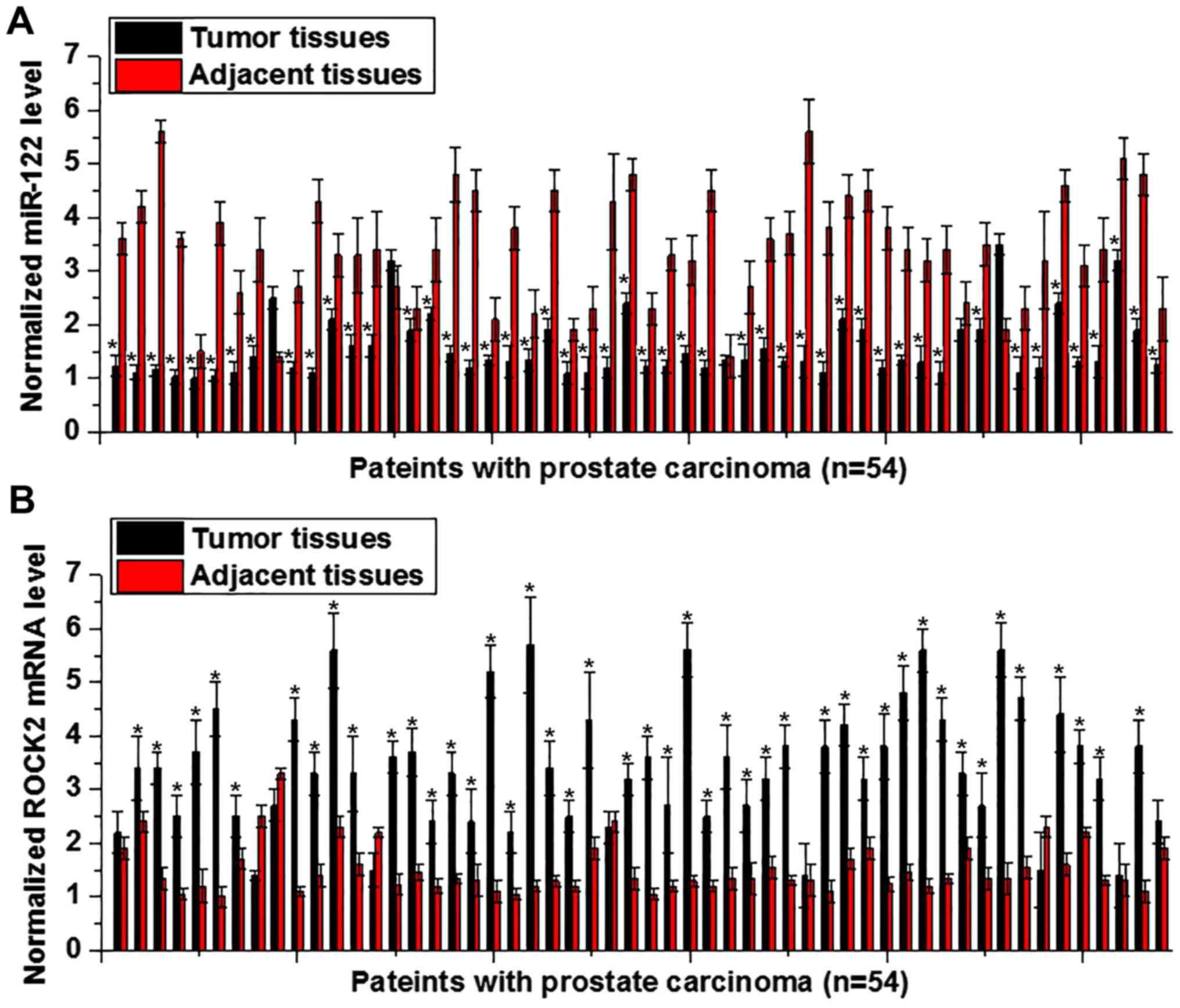
The expression levels of miR-122 and ROCK2 mRNA in
tumor and adjacent healthy tissues of 54 prostate carcinoma
patients were detected by RT-qPCR. As shown in Fig. 1A, a significantly lower expression
level of miR-122 in tumor tissues in comparison with that in
adjacent tissues was detected in 49 out of 54 patients (P<0.05),
accounting for 90.7% of cases. By contrast, a significantly higher
expression level of ROCK2 mRNA in tumor tissues as compared with
that in adjacent tissues was observed in 46 out of 54 patients
(P<0.05), accounting for 85.2% of cases. These data suggest that
downregulation of miR-122 and upregulation of ROCK2 are likely to
be involved in the pathogenesis of prostate carcinoma.
Comparison of serum miR-122 and ROCK2
levels between patients and controls
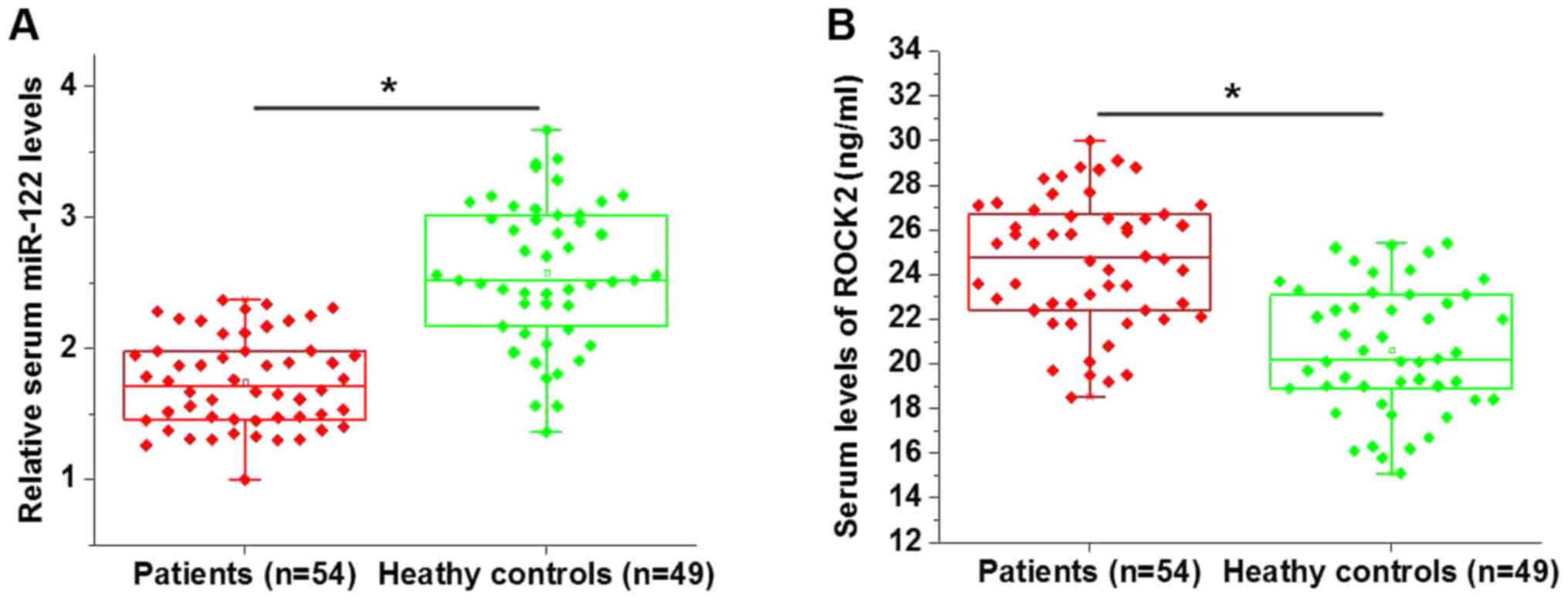
The serum levels of miR-122 and ROCK2 in prostate
carcinoma patients and healthy controls were measured by RT-qPCR
and ELISA, respectively. As shown in Fig. 2, the serum levels of miR-122 were
significantly lower (Fig. 2A) and
those of ROCK2 were significantly higher (Fig. 2B) in prostate carcinoma patients as
compared with those in healthy controls (P<0.05).
Diagnostic and prognostic value of
serum miR-122 level in prostate carcinoma
Data in Fig. 2
indicated that miR-122 was differentially expressed in the serum of
prostate carcinoma patients and healthy controls. Therefore, the
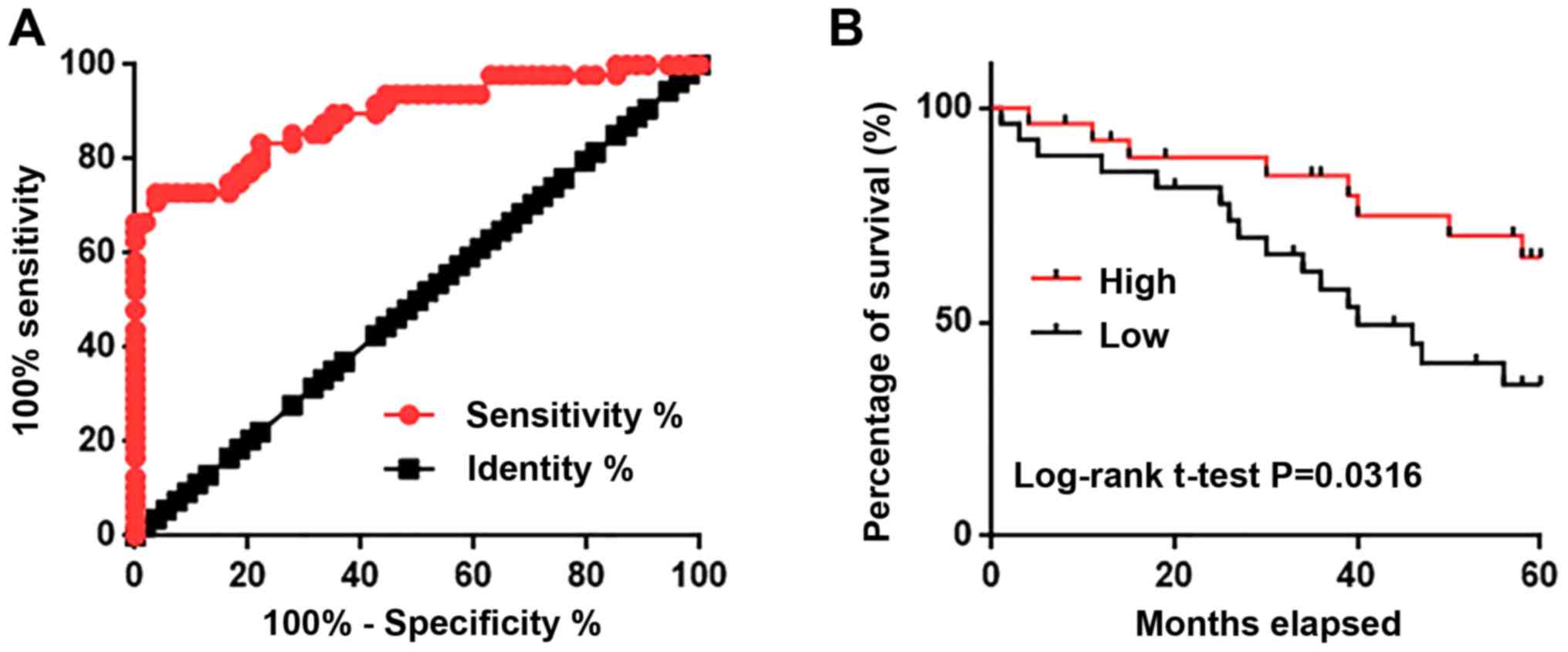
current study further evaluated the diagnostic value of serum
miR-122 in prostate carcinoma using ROC curve analysis. As shown in
Fig. 3A, the area under the curve
was 0.8954 with a standard error of 0.03186 and a 95% confidence
interval of 0.8330–0.9579. According to the median serum level of
miR-122, the 54 patients with prostate carcinoma were divided into
the high (n=27) and low (n=27) expression groups. Survival curves
were plotted using the Kaplan-Meier method and compared using the
log rank t-test. As shown in Fig.
3B, the survival time of patient with low serum level of
miR-122 was significantly shorter in comparison with that of
patients with high serum level of miR-122.
Correlation analysis of serum levels
of miR-122 with the clinicopathological data of patients
Correlations between the serum levels of miR-122 and
the clinicopathological data of prostate carcinoma patients were
analyzed by χ2 test. The results demonstrated that the
serum levels of miR-122 were not closely correlated with the
patient age, drinking and smoking habits, or distant tumor
metastasis. However, the serum levels of miR-122 were significantly
correlated with the tumor size.
Effects of miR-122 overexpression on
ROCK2 expression
Based on data shown in Table I, it is concluded that miR-122 may
be involved in the growth of prostate carcinoma. ROCK2 has been
reported to serve a pivotal role in regulating prostate tumor
growth (13). Therefore, the
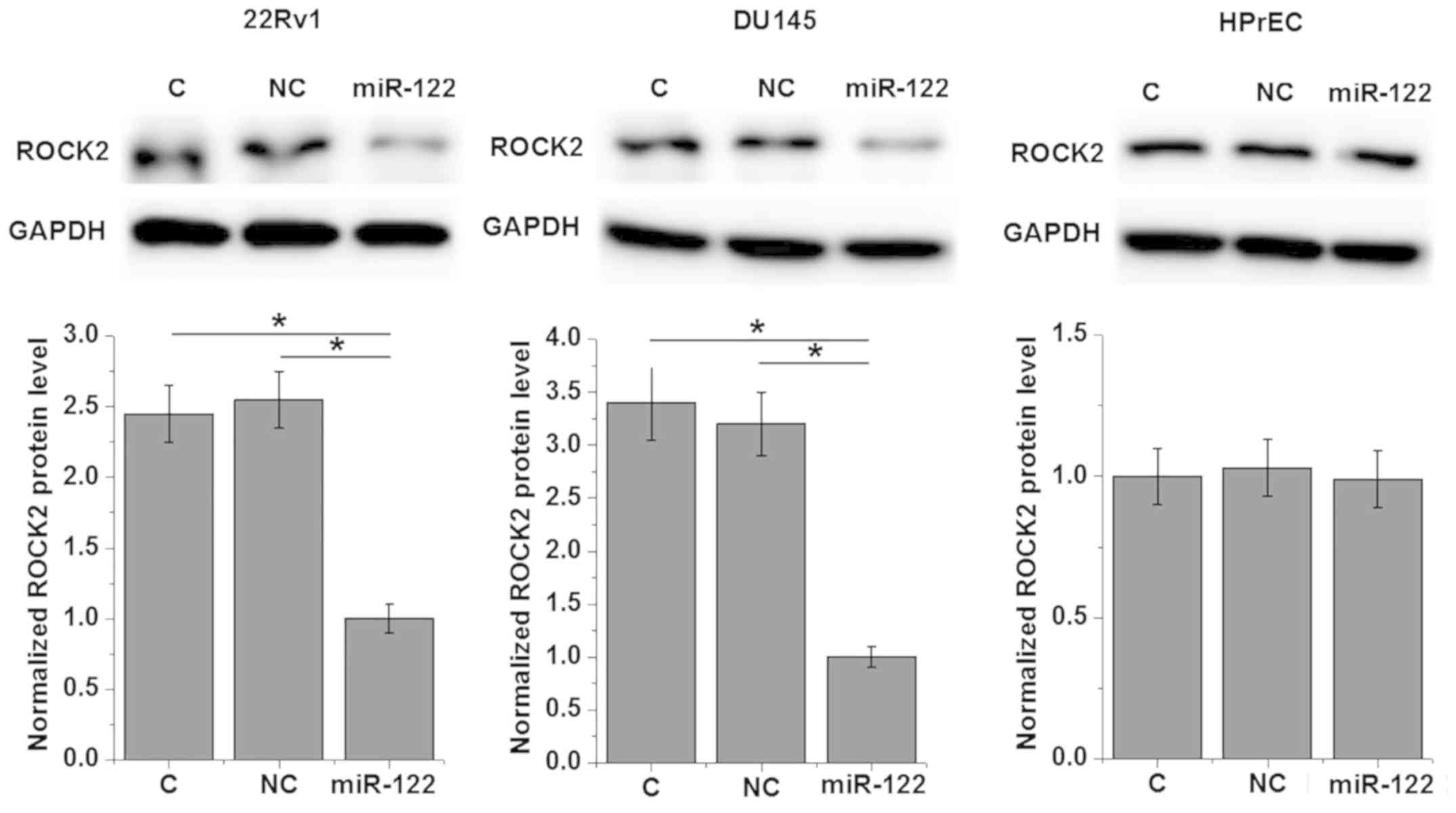
effects of miR-122 overexpression on ROCK2 expression were then
explored. As compared with the human normal prostate epithelial
cell line HPrEC, the expression levels of miR-122 were
significantly lower, and those of ROCK2 protein were significantly
higher in the human prostate carcinoma cell lines 22Rv1 and DU145
(data not shown). As shown in Fig.
4, miR-122 overexpression in 22Rv1 and DU145 prostate carcinoma
cells significantly inhibited the expression of ROCK2 protein, but
had no marked effect in normal prostate cells HPrEC.
 | Table I.χ2 analysis of the correlation between
the serum levels of miR-122 and the clinicopathological data of
patients. |
Table I.
χ2 analysis of the correlation between
the serum levels of miR-122 and the clinicopathological data of
patients.
|
|
|
| miR-122
expression |
|
|
|---|
|
|
|
|
|
|
|
|---|
| Parameter | Group | No. of cases | High | Low |
χ2-value | P-value |
|---|
| Age, years | >50 | 25 | 11 | 14 | 0.67 | 0.41 |
|
| <50 | 29 | 16 | 13 |
|
|
| Drinking | Yes | 40 | 18 | 22 | 1.54 | 0.21 |
|
| No | 14 | 9 | 5 |
|
|
| Smoking | Yes | 38 | 17 | 21 | 0.32 | 0.57 |
|
| No | 16 | 10 | 6 |
|
|
| Primary tumor
diameter, cm | >5 | 22 | 7 | 15 | 4.91 | 0.03 |
|
| <5 | 32 | 20 | 12 |
|
|
| Tumor distant
metastasis | Yes | 21 | 9 | 12 | 0.70 | 0.40 |
|
| No | 33 | 18 | 15 |
|
|
Effects of miR-122 overexpression and
ROCK2 treatment on cell proliferation
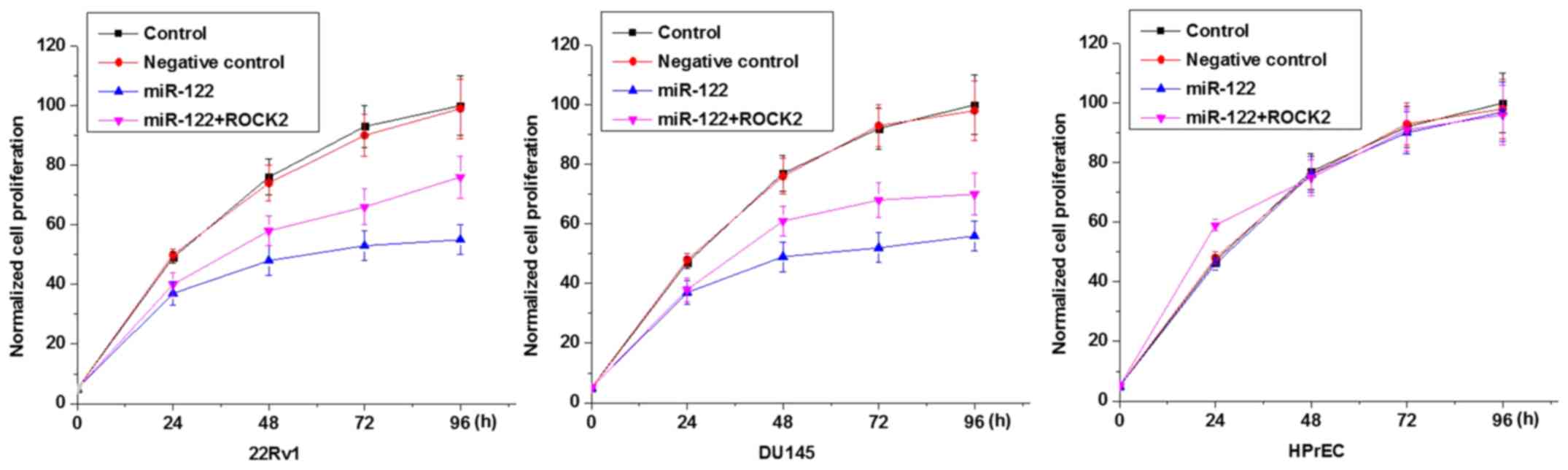
As shown in Fig. 5,
miR-122 over-expression significantly inhibited the proliferation
of human prostate carcinoma 22Rv1 and DU145 cells, whereas it had
no marked effect on the normal prostate epithelial cell line HPrEC.
In addition, treatment with ROCK2 at a dose of 10 ng/ml
significantly reduced the inhibitory effects of miR-122
overexpression on cell proliferation.
Discussion
The role of miR-122 has been reported in several
malignancies, including hepatocellular carcinoma (9) and oropharyngeal cancer (10); however, its effect in prostate
carcinoma remains unclear. The key finding of the present study was
that miR-122 also serves a role as a tumor suppressor gene in
prostate carcinoma, and the functionality of miR-122 in this
disease may be achieved by inhibiting cell proliferation through
the downregulation of ROCK2 expression.
Development of prostate carcinoma is accompanied by
changes in the expression pattern of a large set of miRNAs
(8), and different miRNAs
participate in different stages of prostate carcinoma to promote or
inhibit tumor progression (14).
It has been reported that miR-96 expression is significantly
upregulated in tumor tissues as compared with its expression in
adjacent healthy tissues in prostate carcinoma patients, and
upregulation of miR-96 is associated with the growth of tumor
(15). By contrast, miR-338-3p
(16) and miR-195 (17) were downregulated during the
development of prostate carcinoma, and overexpression of these two
miRNAs exerted tumor suppression effects. Furthermore,
significantly downregulated expression of miR-122 in tumor tissues
as compared with that in adjacent healthy tissues was observed in
patients with hepatocellular carcinoma (9). In the present study, a lower
expression level of miR-122 was observed in tumor tissues in
comparison with that in paired adjacent tissues in the majority of
patients with prostate carcinoma. Therefore, miR-122 may serve as a
tumor suppressor miRNA in prostate carcinoma.
miR-122 has been detected in the blood, and
circulating miR-122 has been proven to be an effective diagnostic
biomarker for hepatocellular carcinoma (18). In the current study, serum levels
of miR-122 were also found to be significantly lower in patients
with prostate carcinoma as compared with those in healthy controls.
The diagnostic potential of this miRNA was evaluated by ROC curve
analysis, which revealed that serum miR-122 levels can be used to
effectively distinguish patients with prostate carcinoma from
normal healthy controls. In addition, low serum levels of miR-122
were proven to be significantly correlated with shorter survival
time. These data suggest that serum miR-122 may serve as a
potential diagnostic and prognostic biomarker for prostate
carcinoma. The current study also demonstrated that the serum
levels of miR-122 were not affected by the patient age, or smoking
and drinking habits, indicating the high stability of serum miR-122
as a biomarker.
Serum levels of miR-122 were observed to be
significantly correlated with tumor size in the present study, but
not with distant tumor metastasis, indicating the involvement of
miR-122 in the regulation of tumor growth. Subsequent in
vitro cell proliferation assay indicated that miR-122 is an
inhibitor of prostate carcinoma cell proliferation. ROCK2 signaling
has been reported to serve pivotal roles in the tumor development,
and upregulated ROCK2 expression was observed in the development of
various malignancies, including prostate carcinoma (11,19).
The present study results also demonstrated that ROCK2 expression
level was higher in tumor tissues when compared with that in
adjacent tissues in the majority of patients with prostate
carcinoma. The expression of ROCK2 is known to be regulated by
several miRNAs, such as miR-144 (20) and miR-135a (11). In the present study, miR-122
overexpression significantly inhibited the expression of ROCK2 in
prostate carcinoma cells, while ROCK2 treatment significantly
reduced the effects of miR-122 overexpression on cell
proliferation. Therefore, miR-122 may inhibit the growth of
prostate carcinoma by inhibiting cancer cell proliferation through
the down-regulation of ROCK2 expression. However, ROCK2 may not be
a direct target of miR-122 due to the lack of targeting site on its
gene sequence (data not shown). Therefore, disease-associated
mediators may exist between ROCK2 and miR-122.
Finally, it is worth noting that miR-122
overexpression only affected the human prostate carcinoma cell
lines 22Rv1 and DU145, but had no marked effect on the human normal
prostate epithelial cell line HPrEC. Therefore, miR-122 may serve
as a potential therapeutic target for prostate carcinoma.
In conclusion, the current study reported that
miR-122 expression was downregulated and ROCK2 expression was
upregulated in prostate carcinoma. Thus, low serum level of miR-122
may serve as a marker for prostate carcinoma and an indicator of
poor prognosis. Furthermore, miR-122 overexpression inhibited the
proliferation of prostate carcinoma cells and the expression of
ROCK2, while treatment with ROCK2 attenuated this effect.
Therefore, miR-122 may inhibit the proliferation of prostate
carcinoma cells possibly by downregulating ROCK2 expression.
Acknowledgements
Not applicable.
Funding
The authors would like to thank the National Natural
Science Fund (grant no. 30300348) for the financial support
provided.
Availability of data and materials
All data generated or analyzed during the present
study are included in this published article.
Authors' contributions
HL, TH, WJ, YX, XZ and JY were responsible for the
conception and design of the study. HL, TH and WJ performed the
experiments. YX and XZ analyzed and interpreted the data. HL and TH
drafted the manuscript. HL, TH and JY were responsible for the
revision of the manuscript. All authors read and approved the final
manuscript.
Ethics approval and consent to
participate
The protocol of the present study was approved by
the Ethics Review Committee of Union Hospital, Tongji Medical
College, Huazhong University of Science and Technology (Wuhan,
China). All participants signed informed consent.
Patient consent for publication
Not applicable.
Competing interests
The authors declare that they have no competing
interests.
References
|
1
|
DeSantis CE, Lin CC, Mariotto AB, Siegel
RL, Stein KD, Kramer JL, Alteri R, Robbins AS and Jemal A: Cancer
treatment and survivorship statistics, 2014. CA Cancer J Clin.
64:252–271. 2014. View Article : Google Scholar : PubMed/NCBI
|
|
2
|
Nyquist MD and Dehm SM: Interplay between
genomic alterations and androgen receptor signaling during prostate
cancer development and progression. Horm Cancer. 4:61–69. 2013.
View Article : Google Scholar : PubMed/NCBI
|
|
3
|
Hamid AR, Hoogland AM, Smit F, Jannink S,
van Rijt-van de Westerlo C, Jansen CF, van Leenders GJ, Verhaegh GW
and Schalken JA: The role of HOXC6 in prostate cancer development.
Prostate. 75:1868–1876. 2015. View Article : Google Scholar : PubMed/NCBI
|
|
4
|
Crawford ED, Stone NN, Evan YY, Koo PJ,
Freedland SJ, Slovin SF, Gomella LG, Berger ER, Keane TE, Sieber P,
et al: Challenges and recommendations for early identification of
metastatic disease in prostate cancer. Urology. 83:664–669. 2014.
View Article : Google Scholar : PubMed/NCBI
|
|
5
|
Ruddon RW: Cancer biology. Oxford
University Press; Oxford: 2007
|
|
6
|
Schröder FH, Hugosson J, Roobol MJ,
Tammela TL, Zappa M, Nelen V, Kwiatkowski M, Lujan M, Määttänen L,
Lilja H, et al: Screening and prostate cancer mortality: Results of
the European randomised study of screening for prostate cancer
(ERSPC) at 13 years of follow-up. Lancet. 384:2027–2035. 2014.
View Article : Google Scholar : PubMed/NCBI
|
|
7
|
Chen W, Zheng R, Baade PD, Zhang S, Zeng
H, Bray F, Jemal A, Yu XQ and He J: Cancer statistics in China,
2015. CA Cancer J Clin. 66:115–132. 2016. View Article : Google Scholar : PubMed/NCBI
|
|
8
|
Szczyrba J, Löprich E, Wach S, Jung V,
Unteregger G, Barth S, Grobholz R, Wieland W, Stöhr R, Hartmann A,
et al: The microRNA profile of prostate carcinoma obtained by deep
sequencing. Mol Cancer Res. 8:529–538. 2010. View Article : Google Scholar : PubMed/NCBI
|
|
9
|
Xu J, Zhu X, Wu L, Yang R, Yang Z, Wang Q
and Wu F: MicroRNA-122 suppresses cell proliferation and induces
cell apoptosis in hepatocellular carcinoma by directly targeting
Wnt/β-catenin pathway. Liver Int. 32:752–760. 2012. View Article : Google Scholar : PubMed/NCBI
|
|
10
|
Zhang Y, Sturgis EM, Sun Y, Sun C, Wei Q,
Huang Z and Li G: A functional variant at miRNA-122 binding site in
IL-1α 3′ UTR predicts risk and HPV-positive tumours of
oropharyngeal cancer. Eur J Cancer. 51:1415–1423. 2015. View Article : Google Scholar : PubMed/NCBI
|
|
11
|
Kroiss A, Vincent S, Decaussin-Petrucci M,
Meugnier E, Viallet J, Ruffion A, Chalmel F, Samarut J and Allioli
N: Androgen-regulated microRNA-135a decreases prostate cancer cell
migration and invasion through downregulating ROCK1 and ROCK2.
Oncogene. 34:2846–2855. 2015. View Article : Google Scholar : PubMed/NCBI
|
|
12
|
Livak KJ and Schmittgen TD: Analysis of
relative gene expression data using real-time quantitative PCR and
the 2(-Delta Delta C(T)) method. Methods. 25:402–408. 2001.
View Article : Google Scholar : PubMed/NCBI
|
|
13
|
Zhang C, Zhang S, Zhang Z, He J, Xu Y and
Liu S: ROCK has a crucial role in regulating prostate tumor growth
through interaction with c-Myc. Oncogene. 33:5582–5591. 2014.
View Article : Google Scholar : PubMed/NCBI
|
|
14
|
Hart M, Nolte E, Wach S, Szczyrba J,
Taubert H, Rau TT, Hartmann A, Grässer FA and Wullich B:
Comparative microRNA profiling of prostate carcinomas with
increasing tumor stage by deep sequencing. Mol Cancer Res.
12:250–263. 2014. View Article : Google Scholar : PubMed/NCBI
|
|
15
|
Xu L, Zhong J, Guo B, Zhu Q, Liang H, Wen
N, Yun W and Zhang L: miR-96 promotes the growth of prostate
carcinoma cells by suppressing MTSS1. Tumour Biol. 37:12023–12032.
2016. View Article : Google Scholar : PubMed/NCBI
|
|
16
|
Bakkar A, Alshalalfa M, Petersen LF,
Abou-Ouf H, Al-Mami A, Hegazy SA, Feng F, Alhajj R, Bijian K,
Alaoui-Jamali MA and Bismar TA: microRNA 338-3p exhibits tumor
suppressor role and its down-regulation is associated with adverse
clinical outcome in prostate cancer patients. Mol Biol Rep.
43:229–240. 2016. View Article : Google Scholar : PubMed/NCBI
|
|
17
|
Guo J, Wang M and Liu X: MicroRNA-195
suppresses tumor cell proliferation and metastasis by directly
targeting BCOX1 in prostate carcinoma. J Exp Clin Cancer Res.
34:912015. View Article : Google Scholar : PubMed/NCBI
|
|
18
|
El-Abd NE, Fawzy NA, El-Sheikh SM and
Soliman ME: Circulating miRNA-122, miRNA-199a, and miRNA-16 as
biomarkers for early detection of hepatocellular carcinoma in
egyptian patients with chronic hepatitis C virus infection. Mol
Diagn Ther. 19:213–220. 2015. View Article : Google Scholar : PubMed/NCBI
|
|
19
|
Li M, Ke J, Wang Q, Qian H, Yang L, Zhang
X, Xiao J, Ding H, Shan X, Liu Q, et al: Upregulation of ROCK2 in
gastric cancer cell promotes tumor cell proliferation, metastasis
and invasion. Clin Exp Med. 17:519–529. 2017. View Article : Google Scholar : PubMed/NCBI
|
|
20
|
Wang W, Zhou X and Wei M: MicroRNA-144
suppresses osteosarcoma growth and metastasis by targeting ROCK1
and ROCK2. Oncotarget. 6:10297–10308. 2015.PubMed/NCBI
|