Spandidos Publications Logo
  • About
    • About Spandidos
    • Aims and Scopes
    • Abstracting and Indexing
    • Editorial Policies
    • Reprints and Permissions
    • Job Opportunities
    • Terms and Conditions
    • Contact
  • Journals
    • All Journals
    • Oncology Letters
      • Oncology Letters
      • Information for Authors
      • Editorial Policies
      • Editorial Board
      • Aims and Scope
      • Abstracting and Indexing
      • Bibliographic Information
      • Archive
    • International Journal of Oncology
      • International Journal of Oncology
      • Information for Authors
      • Editorial Policies
      • Editorial Board
      • Aims and Scope
      • Abstracting and Indexing
      • Bibliographic Information
      • Archive
    • Molecular and Clinical Oncology
      • Molecular and Clinical Oncology
      • Information for Authors
      • Editorial Policies
      • Editorial Board
      • Aims and Scope
      • Abstracting and Indexing
      • Bibliographic Information
      • Archive
    • Experimental and Therapeutic Medicine
      • Experimental and Therapeutic Medicine
      • Information for Authors
      • Editorial Policies
      • Editorial Board
      • Aims and Scope
      • Abstracting and Indexing
      • Bibliographic Information
      • Archive
    • International Journal of Molecular Medicine
      • International Journal of Molecular Medicine
      • Information for Authors
      • Editorial Policies
      • Editorial Board
      • Aims and Scope
      • Abstracting and Indexing
      • Bibliographic Information
      • Archive
    • Biomedical Reports
      • Biomedical Reports
      • Information for Authors
      • Editorial Policies
      • Editorial Board
      • Aims and Scope
      • Abstracting and Indexing
      • Bibliographic Information
      • Archive
    • Oncology Reports
      • Oncology Reports
      • Information for Authors
      • Editorial Policies
      • Editorial Board
      • Aims and Scope
      • Abstracting and Indexing
      • Bibliographic Information
      • Archive
    • Molecular Medicine Reports
      • Molecular Medicine Reports
      • Information for Authors
      • Editorial Policies
      • Editorial Board
      • Aims and Scope
      • Abstracting and Indexing
      • Bibliographic Information
      • Archive
    • World Academy of Sciences Journal
      • World Academy of Sciences Journal
      • Information for Authors
      • Editorial Policies
      • Editorial Board
      • Aims and Scope
      • Abstracting and Indexing
      • Bibliographic Information
      • Archive
    • International Journal of Functional Nutrition
      • International Journal of Functional Nutrition
      • Information for Authors
      • Editorial Policies
      • Editorial Board
      • Aims and Scope
      • Abstracting and Indexing
      • Bibliographic Information
      • Archive
    • International Journal of Epigenetics
      • International Journal of Epigenetics
      • Information for Authors
      • Editorial Policies
      • Editorial Board
      • Aims and Scope
      • Abstracting and Indexing
      • Bibliographic Information
      • Archive
    • Medicine International
      • Medicine International
      • Information for Authors
      • Editorial Policies
      • Editorial Board
      • Aims and Scope
      • Abstracting and Indexing
      • Bibliographic Information
      • Archive
  • Articles
  • Information
    • Information for Authors
    • Information for Reviewers
    • Information for Librarians
    • Information for Advertisers
    • Conferences
  • Language Editing
Spandidos Publications Logo
  • About
    • About Spandidos
    • Aims and Scopes
    • Abstracting and Indexing
    • Editorial Policies
    • Reprints and Permissions
    • Job Opportunities
    • Terms and Conditions
    • Contact
  • Journals
    • All Journals
    • Biomedical Reports
      • Information for Authors
      • Editorial Policies
      • Editorial Board
      • Aims and Scope
      • Abstracting and Indexing
      • Bibliographic Information
      • Archive
    • Experimental and Therapeutic Medicine
      • Information for Authors
      • Editorial Policies
      • Editorial Board
      • Aims and Scope
      • Abstracting and Indexing
      • Bibliographic Information
      • Archive
    • International Journal of Epigenetics
      • Information for Authors
      • Editorial Policies
      • Editorial Board
      • Aims and Scope
      • Abstracting and Indexing
      • Bibliographic Information
      • Archive
    • International Journal of Functional Nutrition
      • Information for Authors
      • Editorial Policies
      • Editorial Board
      • Aims and Scope
      • Abstracting and Indexing
      • Bibliographic Information
      • Archive
    • International Journal of Molecular Medicine
      • Information for Authors
      • Editorial Policies
      • Editorial Board
      • Aims and Scope
      • Abstracting and Indexing
      • Bibliographic Information
      • Archive
    • International Journal of Oncology
      • Information for Authors
      • Editorial Policies
      • Editorial Board
      • Aims and Scope
      • Abstracting and Indexing
      • Bibliographic Information
      • Archive
    • Medicine International
      • Information for Authors
      • Editorial Policies
      • Editorial Board
      • Aims and Scope
      • Abstracting and Indexing
      • Bibliographic Information
      • Archive
    • Molecular and Clinical Oncology
      • Information for Authors
      • Editorial Policies
      • Editorial Board
      • Aims and Scope
      • Abstracting and Indexing
      • Bibliographic Information
      • Archive
    • Molecular Medicine Reports
      • Information for Authors
      • Editorial Policies
      • Editorial Board
      • Aims and Scope
      • Abstracting and Indexing
      • Bibliographic Information
      • Archive
    • Oncology Letters
      • Information for Authors
      • Editorial Policies
      • Editorial Board
      • Aims and Scope
      • Abstracting and Indexing
      • Bibliographic Information
      • Archive
    • Oncology Reports
      • Information for Authors
      • Editorial Policies
      • Editorial Board
      • Aims and Scope
      • Abstracting and Indexing
      • Bibliographic Information
      • Archive
    • World Academy of Sciences Journal
      • Information for Authors
      • Editorial Policies
      • Editorial Board
      • Aims and Scope
      • Abstracting and Indexing
      • Bibliographic Information
      • Archive
  • Articles
  • Information
    • For Authors
    • For Reviewers
    • For Librarians
    • For Advertisers
    • Conferences
  • Language Editing
Login Register Submit
  • This site uses cookies
  • You can change your cookie settings at any time by following the instructions in our Cookie Policy. To find out more, you may read our Privacy Policy.

    I agree
Search articles by DOI, keyword, author or affiliation
Search
Advanced Search
presentation
Molecular Medicine Reports
Join Editorial Board Propose a Special Issue
Print ISSN: 1791-2997 Online ISSN: 1791-3004
Journal Cover
July-2020 Volume 22 Issue 1

Full Size Image

Sign up for eToc alerts
Recommend to Library

Journals

International Journal of Molecular Medicine

International Journal of Molecular Medicine

International Journal of Molecular Medicine is an international journal devoted to molecular mechanisms of human disease.

International Journal of Oncology

International Journal of Oncology

International Journal of Oncology is an international journal devoted to oncology research and cancer treatment.

Molecular Medicine Reports

Molecular Medicine Reports

Covers molecular medicine topics such as pharmacology, pathology, genetics, neuroscience, infectious diseases, molecular cardiology, and molecular surgery.

Oncology Reports

Oncology Reports

Oncology Reports is an international journal devoted to fundamental and applied research in Oncology.

Experimental and Therapeutic Medicine

Experimental and Therapeutic Medicine

Experimental and Therapeutic Medicine is an international journal devoted to laboratory and clinical medicine.

Oncology Letters

Oncology Letters

Oncology Letters is an international journal devoted to Experimental and Clinical Oncology.

Biomedical Reports

Biomedical Reports

Explores a wide range of biological and medical fields, including pharmacology, genetics, microbiology, neuroscience, and molecular cardiology.

Molecular and Clinical Oncology

Molecular and Clinical Oncology

International journal addressing all aspects of oncology research, from tumorigenesis and oncogenes to chemotherapy and metastasis.

World Academy of Sciences Journal

World Academy of Sciences Journal

Multidisciplinary open-access journal spanning biochemistry, genetics, neuroscience, environmental health, and synthetic biology.

International Journal of Functional Nutrition

International Journal of Functional Nutrition

Open-access journal combining biochemistry, pharmacology, immunology, and genetics to advance health through functional nutrition.

International Journal of Epigenetics

International Journal of Epigenetics

Publishes open-access research on using epigenetics to advance understanding and treatment of human disease.

Medicine International

Medicine International

An International Open Access Journal Devoted to General Medicine.

Journal Cover
July-2020 Volume 22 Issue 1

Full Size Image

Sign up for eToc alerts
Recommend to Library

  • Article
  • Citations
    • Cite This Article
    • Download Citation
    • Create Citation Alert
    • Remove Citation Alert
    • Cited By
  • Similar Articles
    • Related Articles (in Spandidos Publications)
    • Similar Articles (Google Scholar)
    • Similar Articles (PubMed)
  • Download PDF
  • Download XML
  • View XML
Article Open Access

Combination of HSP90 and autophagy inhibitors promotes hepatocellular carcinoma apoptosis following incomplete thermal ablation

  • Authors:
    • Fen Chen
    • Haiyang Xie
    • Haiwei Bao
    • Laurencia Violetta
    • Shusen Zheng
  • View Affiliations / Copyright

    Affiliations: Department of Ultrasound, The First Affiliated Hospital of Zhejiang Chinese Medical University, Hangzhou, Zhejiang 310002, P.R. China, Key Laboratory of Combined Multi‑organ Transplantation, Ministry of Public Health, Division of Hepatobiliary and Pancreatic Surgery, First Affiliated Hospital, School of Medicine, Zhejiang University, Hangzhou, Zhejiang 310002, P.R. China, State Key Laboratory for Diagnosis and Treatment of Infectious Disease, Zhejiang University, Hangzhou, Zhejiang 310002, P.R. China, Division of Hepatobiliary and Pancreatic Surgery, Department of Surgery, First Affiliated Hospital, School of Medicine, Zhejiang University, Hangzhou, Zhejiang 310002, P.R. China
    Copyright: © Chen et al. This is an open access article distributed under the terms of Creative Commons Attribution License.
  • Pages: 337-343
    |
    Published online on: April 21, 2020
       https://doi.org/10.3892/mmr.2020.11080
  • Expand metrics +
Metrics: Total Views: 0 (Spandidos Publications: | PMC Statistics: )
Metrics: Total PDF Downloads: 0 (Spandidos Publications: | PMC Statistics: )
Cited By (CrossRef): 0 citations Loading Articles...

This article is mentioned in:


Abstract

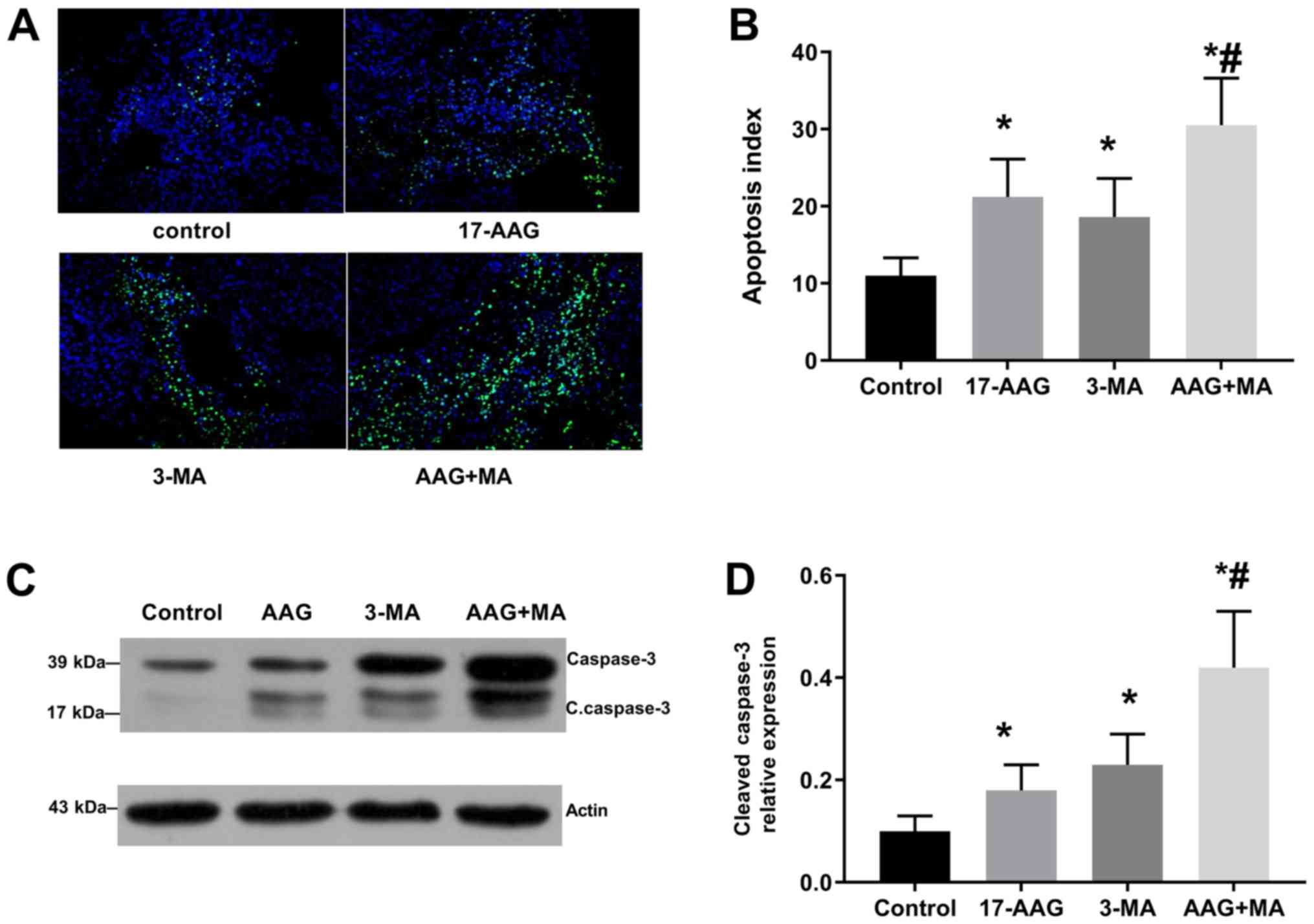
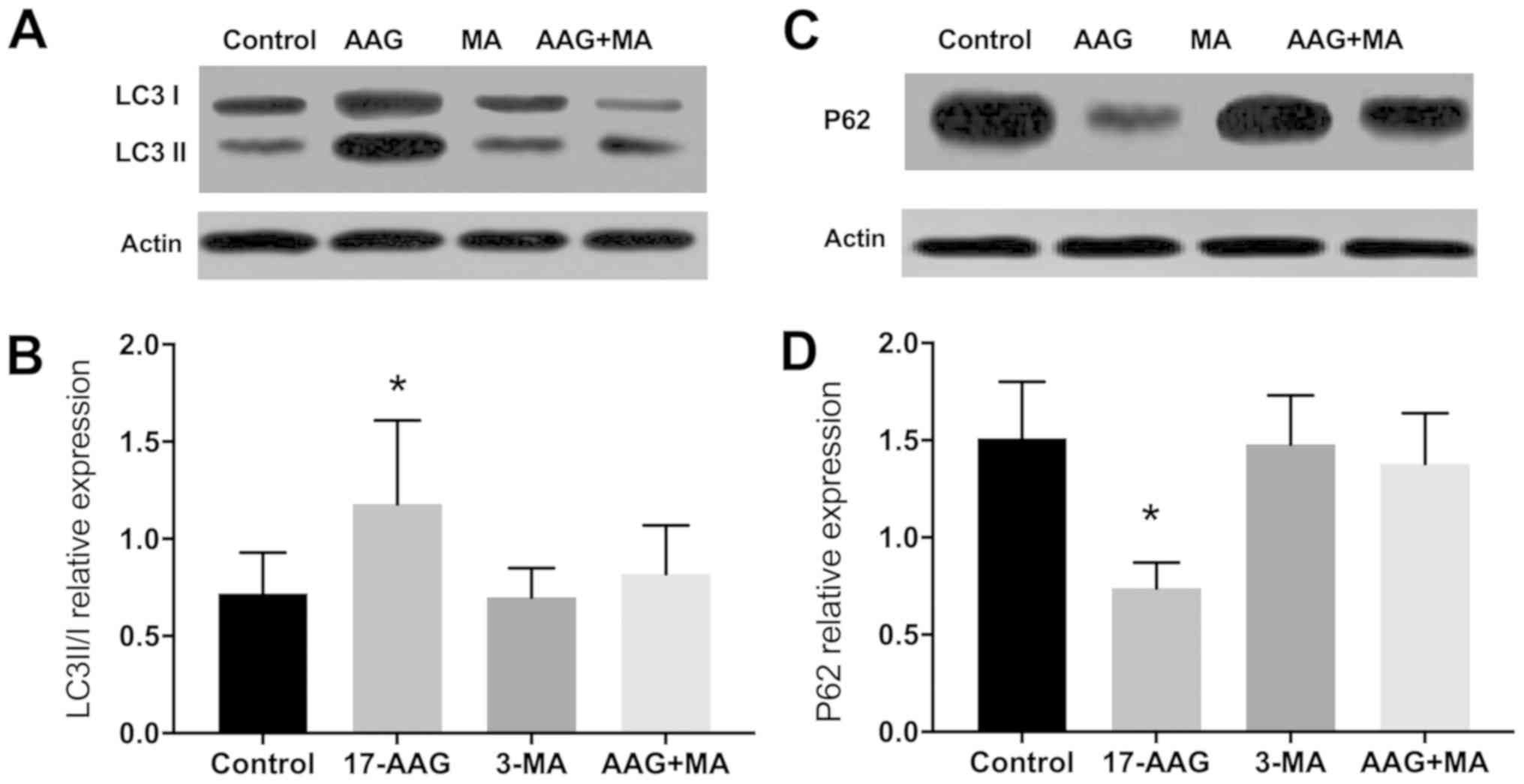
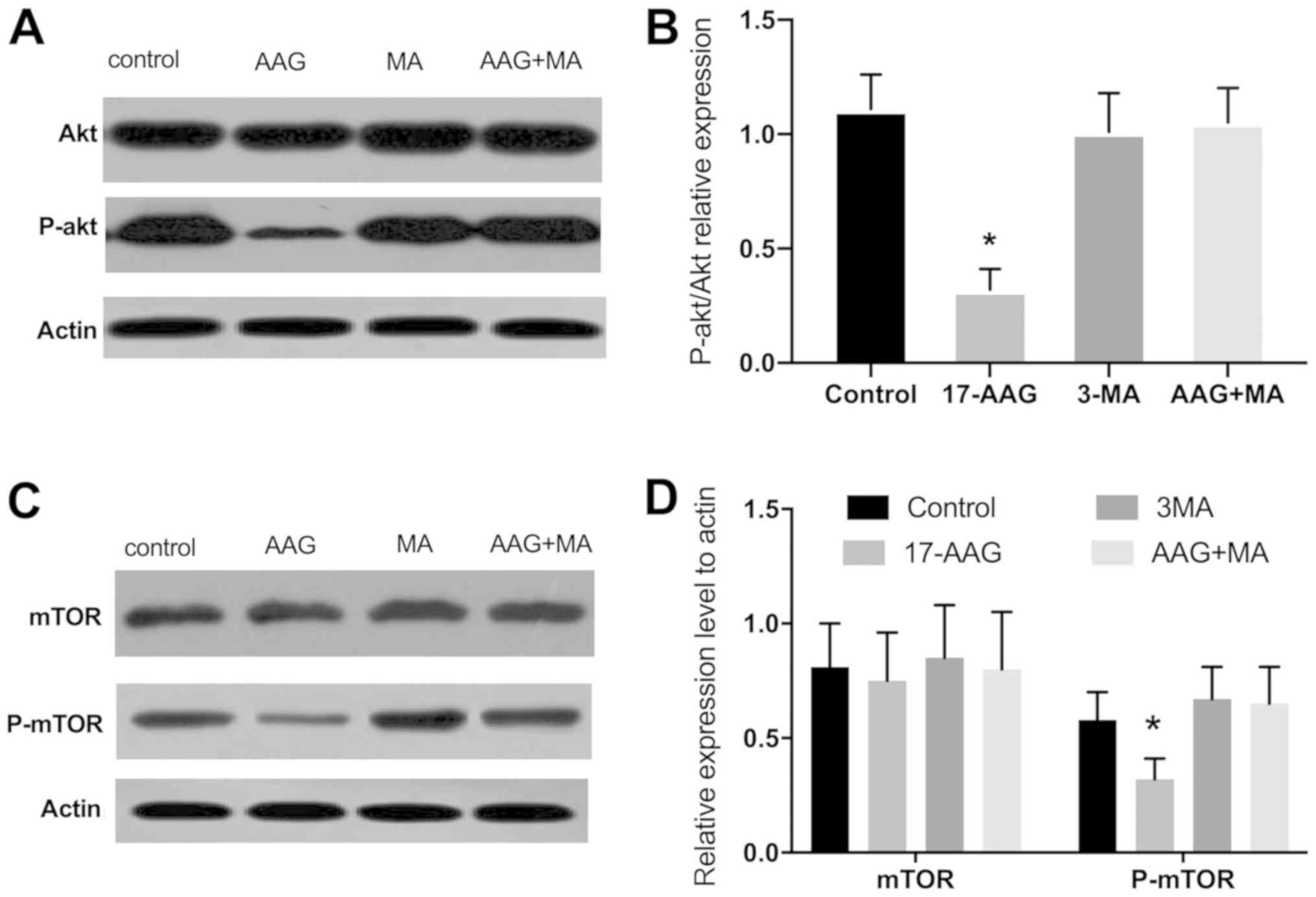
The present study evaluated the effect of combining inhibitors (17‑AAG) of heat shock protein 90 (HSP90) and autophagy (3‑MA) on apoptosis using an incomplete thermal ablation animal model. A total of 28 orthotopic mice with hepatocellular carcinoma were randomly divided into 4 groups to receive different drug interventions. Following palliative laser ablation, changes in autophagy, apoptosis and Akt/mTOR expression levels were assessed in tumors. Compared with the controls, the 17‑AAG‑treated mice exhibited significantly decreased expression levels of phosphorylated (p)‑Akt and p‑mTOR with enhanced autophagy and apoptosis; no marked increases in the expression levels of p‑Akt and p‑mTOR were observed in the 3‑MA‑treated mice, with no significant changes in autophagy; however, apoptosis was enhanced. No significant decreases in p‑Akt and p‑mTOR or any increase in autophagy were observed in the mice receiving a combination of 17‑AAG and 3‑MA, but they did exhibit a marked increase in apoptosis. Compared with 17‑AAG alone, the combination of 17‑AAG and 3‑MA resulted in a marked increase in apoptosis without enhanced autophagy. In the incomplete ablation model, the effects of autophagy and apoptosis are antagonistic. The combined use of 17‑AAG and 3‑MA can significantly promote apoptosis and is worthy of further study.
View Figures

Figure 1

Figure 2

Figure 3

View References

1 

Yun KC, Rhim H and Noh S: Radiofrequency ablation versus surgical resection as primary treatment of hepatocellular carcinoma meeting the Milan criteria: A systematic review. J Gastroenterol Hepatol. 26:1354–1360. 2011.PubMed/NCBI

2 

Hermida M, Cassinotto C, Piron L, Assenat E, Pageaux GP, Escal L, Pierredon-Foulongne MA, Verzilli D, Jaber S and Guiu B: Percutaneous thermal ablation of hepatocellular carcinomas located in the hepatic dome using artificial carbon dioxide pneumothorax: Retrospective evaluation of safety and efficacy. Int J Hyperthemia. 35:90–96. 2018. View Article : Google Scholar

3 

Medhat E, Abdel Aziz A, Nabeel M, Elbaz T, Zakaria Z, Shousha H, Amer A, Fouad Fathalah W, Maher R and Musa S: Value of microwave ablation in treatment of large lesions of hepatocellular carcinoma. J Dig Dis. 16:456–463. 2015. View Article : Google Scholar : PubMed/NCBI

4 

Schueller G, Kettenbach J, Sedivy R, Stift A, Friedl J, Gnant M and Lammer J: Heat shock protein expression induced by percutaneous radiofrequency ablation of hepatocellular carcinoma in vivo. Int J Oncol. 24:609–613. 2004.PubMed/NCBI

5 

Hinz S, Tepel J, Röder C, Kalthoff H and Becker T: Profile of serum factors and disseminated tumor cells before and after radiofrequency ablation compared to resection of colorectal liver metastases-a pilot study. Anticancer Res. 35:2961–2967. 2015.PubMed/NCBI

6 

Rai R, Richardson C, Flecknell P, Robertson H, Burt A and Manas DM: Study of apoptosis and heat shock protein (HSP) expression in hepatocytes following radiofrequency ablation (RFA). J Surg Res. 129:147–151. 2005. View Article : Google Scholar : PubMed/NCBI

7 

Yang W, Ahmed M, Tasawwar B, Levchenko T, Sawant RR, Collins M, Signoretti S, Torchilin V and Goldberg SN: Radiofrequency ablation combined with liposomal quercetin to increase tumour destruction by modulation of heat shock protein production in a small animal model. Int J Hyperthermia. 27:527–538. 2011. View Article : Google Scholar : PubMed/NCBI

8 

Schueller G, Kettenbach J, Sedivy R, Bergmeister H, Stift A, Fried J, Gnant M and Lammer J: Expression of heat shock proteins in human hepatocellular carcinoma after radiofrequency ablation in an animal model. Oncol Rep. 12:495–499. 2004.PubMed/NCBI

9 

He W, Ye X, Huang X, Lel W, You L, Wang L, Chen X and Qian W: Hsp90 inhibitor, BIIB021, induces apoptosis and autophagy by regulating mTOR-Ulk1 pathway in imatinib-sensitive and-resistant chronic myeloid leukemia cells. Int J Oncol. 48:1710–1720. 2016. View Article : Google Scholar : PubMed/NCBI

10 

Leng AM, Liu T, Yang J, Cui JF, Li XH, Zhu YN, Xiong T, Zhang G and Chen Y: The apoptotic effect and associated signalling of HSP90 inhibitor 17-DMAG in hepatocellular carcinoma cells. Cell Biol Int. 36:893–899. 2012. View Article : Google Scholar : PubMed/NCBI

11 

Liu X, Chen S, Tu J, Cai W and Xu Q: HSP90 inhibits apoptosis and promotes growth by regulating HIF-1α abundance in hepatocellular carcinoma. Int J Mol Med. 37:825–835. 2016. View Article : Google Scholar : PubMed/NCBI

12 

Liu X, Ban LL, Luo G, Li ZY, Li YF, Zhou YC, Wang XC, Jin CG, Ye JG, Ma DD, et al: Acquired resistance to HSP90 inhibitor 17-AAG and increased metastatic potential are associated with MUC1 expression in colon carcinoma cells. Anticancer Drugs. 27:417–426. 2016. View Article : Google Scholar : PubMed/NCBI

13 

Chen Y, Youn P, Pysher TJ, Scaife CL and Furgeson DY: Tumour eradication using synchronous thermal ablation and Hsp90 chemotherapy with protein engineered triblock biopolymer-geldanamycin conjugates. Int J Hyperthermia. 30:550–564. 2014. View Article : Google Scholar : PubMed/NCBI

14 

Lang SA, Moser C, Fichnter-Feigl S, Schachtschneider P, Hellerbrand C, Schmitz V, Schlitt HJ, Geissler EK and Stoeltzing O: Targeting heat-shock protein 90 improves efficacy of rapamycin in a model of hepatocellular carcinoma in mice. Hepatology. 49:523–532. 2009. View Article : Google Scholar : PubMed/NCBI

15 

Webber PJ, Park C, Qui M, Ramalingam SS, Khuri FR, Fu H and Du Y: Combination of heat shock protein 90 and focal adhesion kinase inhibitors synergistically inhibits the growth of non-small cell lung cancer cells. Oncoscience. 2:765–776. 2015.PubMed/NCBI

16 

Yang R, Tang Q, Miao F, An Y, Li M, Han Y, Wang X, Wang J, Liu P and Chen R: Inhibition of heat-shock protein 90 sensitizes liver cancer stem-like cells to magnetic hyperthermia and enhances anti-tumor effect on hepatocellular carcinoma-burdened nude mice. Int J Nanomedicine. 10:7345–7358. 2015. View Article : Google Scholar : PubMed/NCBI

17 

Moussa M, Goldberg SN, Kumar G, Sawant RR, Levchenko T, Torchilin V and Ahmed M: Radiofrequency ablation-induced upregulation of hypoxia-inducible factor-1α can be suppressed with adjuvant bortezomib or liposomal chemotherapy. J Vasc Interv Radiol. 25:1972–1982. 2014. View Article : Google Scholar : PubMed/NCBI

18 

Chen F, Bao H, Xie H, Tian G and Jiang T: Heat shock protein expression and autophagy after incomplete thermal ablation and their correlation. Int J Hyperthermia. 36:95–103. 2019. View Article : Google Scholar : PubMed/NCBI

19 

Zhang R, Luo D, Miao R, Bai L, Ge Q, Sessa WC and Min W: Hsp90-Akt phosphorylates ASK1 and inhibits ASK1-mediated apoptosis. Oncogene. 24:3954–3963. 2005. View Article : Google Scholar : PubMed/NCBI

20 

Sato S, Fujita N and Tsuruo T: Modulation of Akt kinase activity by binding to Hsp90. Proc Natl Acad Sci USA. 97:10832–10837. 2000. View Article : Google Scholar : PubMed/NCBI

21 

Oral O, Akkoc Y, Bayraktar O and Gozuacik D: Physiological and pathological significance of the molecular cross-talk between autophagy and apoptosis. Histol Histopathol. 31:479–498. 2016.PubMed/NCBI

22 

Heras-Sandoval D, Pérez-Rojas JM, Hernández-Damián J and Pedraza-Chaverri J: The role of PI3K/AKT/mTOR pathway in the modulation of autophagy and the clearance of protein aggregates in neurodegeneration. Cell Signal. 26:2694–2701. 2014. View Article : Google Scholar : PubMed/NCBI

23 

Nazim UM and Park SY: Attenuation of autophagy flux by 6-shogaol sensitizes human liver cancer cells to TRAIL-induced apoptosis via p53 and ROS. Int J Mol Med. 43:701–708. 2019.PubMed/NCBI

24 

Mukhopadhyay S, Panda PK, Sinha N, Das DN and Bhutia SK: Autophagy and apoptosis: Where do they meet? Apoptosis. 19:555–566. 2014. View Article : Google Scholar : PubMed/NCBI

25 

Mariño G, Niso-Santano M, Baehrecke EH and Kroemer G: Self-consumption: The interplay of autophagy and apoptosis. Nat Rev Mol Cell Biol. 15:81–94. 2014. View Article : Google Scholar : PubMed/NCBI

26 

Talaei S, Mellatyar H, Asadi A, Akbarzadeh A, Sheervalilou R and Zarghami N: Spotlight on 17-AAG as an Hsp90 inhibitor for molecular targeted cancer treatment. Chem Biol Drug Des. 93:760–786. 2019. View Article : Google Scholar : PubMed/NCBI

27 

Walker AR, Klisovic R, Johnston JS, Jiang Y, Geyer S, Kefauver C, Binkley P, Byrd JC, Grever MR, Garzon R, et al: Pharmacokinetics and dose escalation of the heat shock protein inhibitor 17-allyamino-17-demethoxygeldanamycin in combination with bortezomib in relapsed or refractory acute myeloid leukemia. Leuk Lymphoma. 54:1996–2002. 2013. View Article : Google Scholar : PubMed/NCBI

28 

Kaufmann SH, Karp JE, Litzow MR, Mesa RA, Hogan W, Steensma DP, Flatten KS, Loegering DA, Schneider PA, Peterson KL, et al: Phase I and pharmacological study of cytarabine and tanespimycin in relapsed and refractory acute leukemia. Haematologica. 96:1619–1626. 2011. View Article : Google Scholar : PubMed/NCBI

29 

Heath EI, Hillman DW, Vaishampayan U, Sheng S, Sarkar F, Harper F, Gaskins M, Pitot HC, Tan W, Ivy SP, et al: A phase II trial of 17-allylamino-17-demethoxygeldanamycin in patients with hormone-refractory metastatic prostate cancer. Clin Cancer Res. 14:7940–7946. 2018. View Article : Google Scholar

30 

Pacey S, Gore M, Chao D, Banerji U, Larkin J, Sarker S, Owen K, Asad Y, Raynaud F, Walton M, et al: A Phase II trial of 17-allylamino, 17-demethoxygeldanamycin (17-AAG, tanespimycin) in patients with metastatic melanoma. Invest New Drugs. 30:341–349. 2012. View Article : Google Scholar : PubMed/NCBI

31 

Strozyk E and Kulms D: The role of AKT/mTOR pathway in stress response to UV-irradiation: Implication in skin carcinogenesis by regulation of apoptosis, autophagy and senescence. Int J Mol Sci. 14:15260–15285. 2013. View Article : Google Scholar : PubMed/NCBI

32 

Janku F, Mcconkey DJ, Hong DS and Kurzrock R: Autophagy as a target for anticancer therapy. Nat Rev Clin Oncol. 8:528–539. 2011. View Article : Google Scholar : PubMed/NCBI

Related Articles

  • Abstract
  • View
  • Download
  • Twitter
Copy and paste a formatted citation
Spandidos Publications style
Chen F, Xie H, Bao H, Violetta L and Zheng S: Combination of HSP90 and autophagy inhibitors promotes hepatocellular carcinoma apoptosis following incomplete thermal ablation. Mol Med Rep 22: 337-343, 2020.
APA
Chen, F., Xie, H., Bao, H., Violetta, L., & Zheng, S. (2020). Combination of HSP90 and autophagy inhibitors promotes hepatocellular carcinoma apoptosis following incomplete thermal ablation. Molecular Medicine Reports, 22, 337-343. https://doi.org/10.3892/mmr.2020.11080
MLA
Chen, F., Xie, H., Bao, H., Violetta, L., Zheng, S."Combination of HSP90 and autophagy inhibitors promotes hepatocellular carcinoma apoptosis following incomplete thermal ablation". Molecular Medicine Reports 22.1 (2020): 337-343.
Chicago
Chen, F., Xie, H., Bao, H., Violetta, L., Zheng, S."Combination of HSP90 and autophagy inhibitors promotes hepatocellular carcinoma apoptosis following incomplete thermal ablation". Molecular Medicine Reports 22, no. 1 (2020): 337-343. https://doi.org/10.3892/mmr.2020.11080
Copy and paste a formatted citation
x
Spandidos Publications style
Chen F, Xie H, Bao H, Violetta L and Zheng S: Combination of HSP90 and autophagy inhibitors promotes hepatocellular carcinoma apoptosis following incomplete thermal ablation. Mol Med Rep 22: 337-343, 2020.
APA
Chen, F., Xie, H., Bao, H., Violetta, L., & Zheng, S. (2020). Combination of HSP90 and autophagy inhibitors promotes hepatocellular carcinoma apoptosis following incomplete thermal ablation. Molecular Medicine Reports, 22, 337-343. https://doi.org/10.3892/mmr.2020.11080
MLA
Chen, F., Xie, H., Bao, H., Violetta, L., Zheng, S."Combination of HSP90 and autophagy inhibitors promotes hepatocellular carcinoma apoptosis following incomplete thermal ablation". Molecular Medicine Reports 22.1 (2020): 337-343.
Chicago
Chen, F., Xie, H., Bao, H., Violetta, L., Zheng, S."Combination of HSP90 and autophagy inhibitors promotes hepatocellular carcinoma apoptosis following incomplete thermal ablation". Molecular Medicine Reports 22, no. 1 (2020): 337-343. https://doi.org/10.3892/mmr.2020.11080
Follow us
  • Twitter
  • LinkedIn
  • Facebook
About
  • Spandidos Publications
  • Careers
  • Cookie Policy
  • Privacy Policy
How can we help?
  • Help
  • Live Chat
  • Contact
  • Email to our Support Team