Mol Med Rep 12: [Related article:] 4291-4297, 2015; DOI:
10.3892/mmr.2015.3964
Subsequently to the publication of the above paper,
an interested reader has drawn to the authors' attention that, in
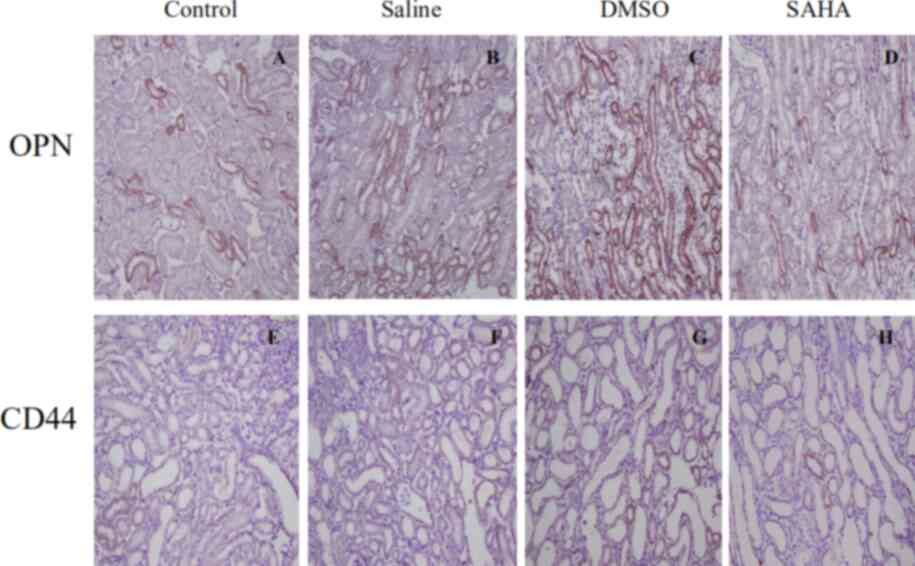
Fig. 4, there appeared to be an
overlap between the data shown in the 4B (OPN/saline) and the 4C
(OPN/DMSO) panels, such that these data may have been derived from
the same original source even though different experimental
conditions were described in the Figure; furthermore, the Fig. 4F (saline) and 4G (DMSO) panels
appeared to be very similar, as if they were tissue sections from
the same specimen.
Upon examining the final proofs of this article, the
authors have determined that the immunohistochemical images of the
saline groups were incorrectly selected. A further examination of
the original data files disclosed that an error had been made in
the labelling of some of the original images.
The corrected version of Fig. 4, including the correct data for
Fig. 4B and F (for the
immunostaining of OPN and CD44, respectively, under saline
conditions), is shown opposite. Note that these errors did not
affect either the results or the conclusions reported in this
paper, and all the authors agree to this Corrigendum. The authors
are grateful to the Editor of Molecular Medicine Reports for
allowing them the opportunity to publish this Corrigendum, and
apologize to the readership for any inconvenience caused.