|
1
|
Frazier K, Manzoor S, Carroll K, DeLeon O,
Miyoshi S, Miyoshi J, St George M, Tan A, Chrisler EA, Izumo M, et
al: Gut microbes and the liver circadian clock partition glucose
and lipid metabolism. J Clin Invest. 133:e1625152023. View Article : Google Scholar : PubMed/NCBI
|
|
2
|
Sinha RA, Singh BK and Yen PM: Direct
effects of thyroid hormones on hepatic lipid metabolism. Nat Rev
Endocrinol. 14:259–269. 2018. View Article : Google Scholar : PubMed/NCBI
|
|
3
|
Sun J, Yu X, Weng Z, Jin L and Yang J,
Zhang H, Gu J, Wang N and Yang J: The impact of hepatotoxic drugs
on the outcome of patients with acute deterioration of hepatitis B
virus-related chronic disease. Eur J Gastroenterol Hepatol.
34:782–790. 2022.PubMed/NCBI
|
|
4
|
Devarbhavi H, Asrani SK, Arab JP, Nartey
YA, Pose E and Kamath PS: Global burden of liver disease: 2023
update. J Hepatol. 79:516–537. 2023. View Article : Google Scholar : PubMed/NCBI
|
|
5
|
Pate J, Gutierrez JA, Frenette CT, Goel A,
Kumar S, Manch RA, Mena EA, Pockros PJ, Satapathy SK, Yimam KK and
Gish RG: Practical strategies for pruritus management in the
obeticholic acid-treated patient with PBC: Proceedings from the
2018 expert panel. BMJ Open Gastroenterol. 6:e0002562019.
View Article : Google Scholar : PubMed/NCBI
|
|
6
|
Zhu YJ, Zheng B, Wang HY and Chen L: New
knowledge of the mechanisms of sorafenib resistance in liver
cancer. Acta Pharmacol Sin. 38:614–622. 2017. View Article : Google Scholar : PubMed/NCBI
|
|
7
|
Semwal DK, Semwal RB, Combrinck S and
Viljoen A: Myricetin: A dietary molecule with diverse biological
activities. Nutrients. 8:902016. View Article : Google Scholar : PubMed/NCBI
|
|
8
|
Nardini M and Garaguso I: Characterization
of bioactive compounds and antioxidant activity of fruit beers.
Food Chem. 305:1254372020. View Article : Google Scholar : PubMed/NCBI
|
|
9
|
Jiang C, Xie L, Wang Y, Liang J, Li H, Luo
L, Li T, Liang Z, Tang L, Ning D, et al: Highly sensitive
electrochemical detection of myricetin in food samples based on the
enhancement effect of Al-MOFs. Anal Methods. 14:3521–3528. 2022.
View Article : Google Scholar : PubMed/NCBI
|
|
10
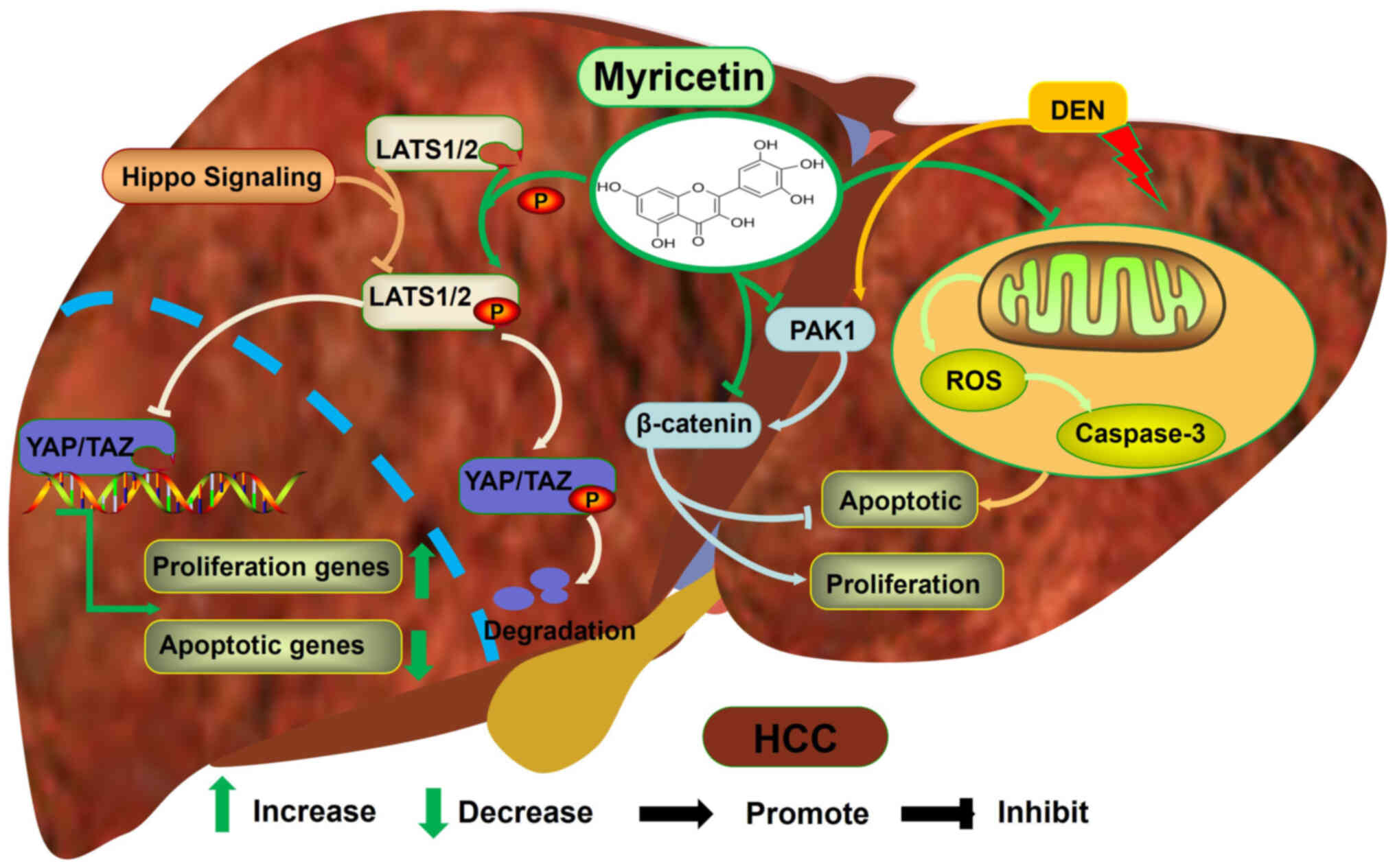
|
Klimek-Szczykutowicz M, Gaweł-Bęben K,
Rutka A, Blicharska E, Tatarczak-Michalewska M, Kulik-Siarek K,
Kukula-Koch W, Malinowska MA and Szopa A: Moringa oleifera
(drumstick tree)-nutraceutical, cosmetological and medicinal
importance: A review. Front Pharmacol. 15:12883822024. View Article : Google Scholar : PubMed/NCBI
|
|
11
|
Wang M, Ren S, Bi Z, Zhang L, Cui M, Sun
R, Bao J, Gao D, Yang B, Li X, et al: Myricetin reverses
epithelial-endothelial transition and inhibits vasculogenic mimicry
and angiogenesis of hepatocellular carcinoma by directly targeting
PAR1. Phytother Res. 36:1807–1821. 2022. View Article : Google Scholar : PubMed/NCBI
|
|
12
|
Rostami A, Baluchnejadmojarad T and
Roghani M: Hepatoprotective effect of myricetin following
Lipopolysaccharide/DGalactosamine: Involvement of autophagy and
sirtuin 1. Curr Mol Pharmacol. 16:419–433. 2023. View Article : Google Scholar : PubMed/NCBI
|
|
13
|
Perkin AG and Hummel JJ: LXXVI-The
colouring principle contained in the bark of Myrica nagi part I. J
Chem Soc Trans. 69:1287–1294. 1896. View Article : Google Scholar
|
|
14
|
Ozcan C and Yaman M: Determination of
Myricetin in medicinal plants by high-performance liquid
chromatography. In strum Sci Technol. 43:44–52. 2015.
|
|
15
|
Perkin AG: XXI.-Myricetin. Part II. J Chem
Soc Trans. 81:203–210. 1902. View Article : Google Scholar
|
|
16
|
He J, Wang Y, Chang AK, Xu L, Wang N,
Chong X, Li H, Zhang B, Jones GW and Song Y: Myricetin prevents
fibrillogenesis of hen egg white lysozyme. J Agric Food Chem.
62:9442–9449. 2014. View Article : Google Scholar : PubMed/NCBI
|
|
17
|
Jiang M, Zhu M, Wang L and Yu S:
Anti-tumor effects and associated molecular mechanisms of
myricetin. Biomed Pharmacother. 120:1095062019. View Article : Google Scholar : PubMed/NCBI
|
|
18
|
Zhou JL, Chen HH, Xu J, Huang MY, Wang JF,
Shen HJ, Shen SX, Gao CX and Qian CD: Myricetin acts as an
inhibitor of type II NADH Dehydrogenase from Staphylococcus aureus.
Molecules. 29:23542024. View Article : Google Scholar : PubMed/NCBI
|
|
19
|
Hou DD, Gu YJ, Wang DC, Niu Y, Xu ZR, Jin
ZQ, Wang XX and Li SJ: Therapeutic effects of myricetin on atopic
dermatitis in vivo and in vitro. Phytomedicine. 102:1542002022.
View Article : Google Scholar : PubMed/NCBI
|
|
20
|
Li Q, Tan Q, Ma Y, Gu Z and Chen S:
Myricetin suppresses ovarian cancer in vitro by activating the
p38/Sapla signaling pathway and suppressing intracellular oxidative
stress. Front Oncol. 12:9033942022. View Article : Google Scholar : PubMed/NCBI
|
|
21
|
Shrivastava R and Chng SS: Lipid
trafficking across the Gram-negative cell envelope. J Biol Chem.
294:14175–14184. 2019. View Article : Google Scholar : PubMed/NCBI
|
|
22
|
Wang P, Han X, Mo B, Huang G and Wang C:
LPS enhances TLR4 expression and IFN-γ production via the
TLR4/IRAK/NF-κB signaling pathway in rat pulmonary arterial smooth
muscle cells. Mol Med Rep. 16:3111–3116. 2017. View Article : Google Scholar : PubMed/NCBI
|
|
23
|
Fuchs O: Transcription factor NF-κB
inhibitors as single therapeutic agents or in combination with
classical chemotherapeutic agents for the treatment of hematologic
malignancies. Curr Mol Pharmacol. 3:98–122. 2010. View Article : Google Scholar : PubMed/NCBI
|
|
24
|
Xiao P, Li M, Zhou M, Zhao X, Wang C, Qiu
J, Fang Q, Jiang H, Dong H and Zhou R: TTP protects against acute
liver failure by regulating CCL2 and CCL5 through m6A RNA
methylation. JCI Insight. 6:e1492762021. View Article : Google Scholar : PubMed/NCBI
|
|
25
|
Berköz M, Ünal S, Karayakar F, Yunusoğlu
O, Özkan-Yılmaz F, Özlüer-Hunt A and Aslan A: Prophylactic effect
of myricetin and apigenin against lipopolysaccharide-induced acute
liver injury. Mol Biol Rep. 48:6363–6373. 2021. View Article : Google Scholar : PubMed/NCBI
|
|
26
|
Kim JM, Cho SS, Kang S, Moon C, Yang JH
and Ki SH: Castanopsis sieboldii extract alleviates acute liver
injury by antagonizing inflammasome-mediated pyroptosis. Int J Mol
Sci. 24:119822023. View Article : Google Scholar : PubMed/NCBI
|
|
27
|
Lv H, An B, Yu Q, Cao Y, Liu Y and Li S:
Prophylactic effect of myricetin and apigenin against
lipopolysaccharide-induced acute liver injury lipopolysaccharide
and D-galactosamine-induced fulminant hepatitis. Int J Biol
Macromol. 155:1092–1104. 2020. View Article : Google Scholar : PubMed/NCBI
|
|
28
|
Lee HJ, Oh YK, Rhee M, Lim JY, Hwang JY,
Park YS, Kwon Y, Choi KH, Jo I, Park SI, et al: The role of
STAT1/IRF-1 on synergistic ROS production and loss of mitochondrial
transmembrane potential during hepatic cell death induced by
LPS/d-GalN. J Mol Biol. 369:967–984. 2007. View Article : Google Scholar : PubMed/NCBI
|
|
29
|
Sheftel AD, Kim SF and Ponka P: Non-heme
induction of heme oxygenase-1 does not alter cellular iron
metabolism. J Biol Chem. 282:10480–10486. 2007. View Article : Google Scholar : PubMed/NCBI
|
|
30
|
Lin L, Wu Q, Lu F, Lei J, Zhou Y, Liu Y,
Zhu N, Yu Y, Ning Z, She T and Hu M: Nrf2 signaling pathway:
Current status and potential therapeutic targetable role in human
cancers. Front Oncol. 13:11840792023. View Article : Google Scholar : PubMed/NCBI
|
|
31
|
Huang J, Wu L, Tashiro S, Onodera S and
Ikejima T: Reactive oxygen species mediate oridonin-induced HepG2
apoptosis through p53, MAPK, and mitochondrial signaling pathways.
J Pharmacol Sci. 107:370–379. 2008. View Article : Google Scholar : PubMed/NCBI
|
|
32
|
Miyashita T, Krajewski S, Krajewska M,
Wang HG, Lin HK, Liebermann DA, Hoffman B and Reed JC: Tumor
suppressor p53 is a regulator of bcl-2 and bax gene expression in
vitro and in vivo. Oncogene. 9:1799–1805. 1994.PubMed/NCBI
|
|
33
|
Garrido C, Galluzzi L, Brunet M, Puig PE,
Didelot C and Kroemer G: Mechanisms of cytochrome c release from
mitochondria. Cell Death Differ. 13:1423–1433. 2006. View Article : Google Scholar : PubMed/NCBI
|
|
34
|
Nagata S, Nagase H, Kawane K, Mukae N and
Fukuyama H: Degradation of chromosomal DNA during apoptosis. Cell
Death Differ. 10:108–116. 2003. View Article : Google Scholar : PubMed/NCBI
|
|
35
|
Shih PC: The role of the STAT3 signaling
transduction pathways in radioresistance. Pharmacol Ther.
234:1081182022. View Article : Google Scholar : PubMed/NCBI
|
|
36
|
Matić S, Stanić S, Bogojević D, Vidaković
M, Grdović N, Dinić S, Solujić S, Mladenović M, Stanković N and
Mihailović M: Methanol extract from the stem of Cotinus coggygria
Scop., and its major bioactive phytochemical constituent myricetin
modulate pyrogallol-induced DNA damage and liver injury. Mutat Res.
755:81–89. 2013. View Article : Google Scholar : PubMed/NCBI
|
|
37
|
Chang CJ, Tzeng TF, Liou SS, Chang YS and
Liu IM: myricetin increases hepatic peroxisome
proliferator-activated receptor α protein expression and decreases
plasma lipids and adiposity in rats. Evid Based Complement Alternat
Med. 2012:7871522012. View Article : Google Scholar : PubMed/NCBI
|
|
38
|
Guo C, Xue G, Pan B, Zhao M, Chen S, Gao
J, Chen T and Qiu L: Myricetin ameliorates ethanol-induced lipid
accumulation in liver cells by reducing fatty acid biosynthesis.
Mol Nutr Food Res. 63:e18013932019. View Article : Google Scholar : PubMed/NCBI
|
|
39
|
Wang W, Zhai T, Luo P, Miao X, Wang J and
Chen Y: Beneficial effects of silibinin on serum lipids, bile
acids, and gut microbiota in methionine-choline-deficient
diet-induced mice. Front Nutr. 10:12571582023. View Article : Google Scholar : PubMed/NCBI
|
|
40
|
Wang C, Gong B, Peng D, Liu Y, Wu Y and
Wei J: Agarwood extract mitigates alcoholic fatty liver in C57 mice
via anti oxidation and anti inflammation. Mol Med Rep. 28:2102023.
View Article : Google Scholar : PubMed/NCBI
|
|
41
|
Osna NA, Rasineni K, Ganesan M, Donohue TM
Jr and Kharbanda KK: Pathogenesis of alcohol-associated liver
disease. J Clin Exp Hepatol. 12:1492–1513. 2022. View Article : Google Scholar : PubMed/NCBI
|
|
42
|
Leung TM and Nieto N: CYP2E1 and oxidant
stress in alcoholic and non-alcoholic fatty liver disease. J
Hepatol. 58:395–398. 2013. View Article : Google Scholar : PubMed/NCBI
|
|
43
|
Ahmad SB, Rashid SM, Wali AF, Ali S,
Rehman MU, Maqbool MT, Nadeem A, Ahmad SF and Siddiqui N: Myricetin
(3,3′,4′,5,5′,7-hexahydroxyflavone) prevents ethanol-induced
biochemical and inflammatory damage in the liver of Wistar rats.
Hum Exp Toxicol. 41:96032712110668432022. View Article : Google Scholar : PubMed/NCBI
|
|
44
|
Schlaepfer IR and Joshi M: CPT1A-mediated
fat oxidation, mechanisms, and therapeutic potential.
Endocrinology. 161:bqz0462020. View Article : Google Scholar : PubMed/NCBI
|
|
45
|
Fang C, Pan J, Qu N, Lei Y, Han J, Zhang J
and Han D: The AMPK pathway in fatty liver disease. Front Physiol.
13:9702922022. View Article : Google Scholar : PubMed/NCBI
|
|
46
|
Ludwig J, Viggiano TR, McGill DB and Oh
BJ: Nonalcoholic steatohepatitis: Mayo Clinic experiences with a
hitherto unnamed disease. Mayo Clin Proc. 55:434–438. 1980.
View Article : Google Scholar : PubMed/NCBI
|
|
47
|
Lian CY, Zhai ZZ, Li ZF and Wang L: High
fat diet-triggered non-alcoholic fatty liver disease: A review of
proposed mechanisms. Chem Biol Interact. 330:1091992020. View Article : Google Scholar : PubMed/NCBI
|
|
48
|
Li L, Sun H, Chen J, Ding C, Yang X, Han H
and Sun Q: Mitigation of non-alcoholic steatohepatitis via
recombinant Orosomucoid 2, an acute phase protein modulating the
Erk1/2-PPARγ-Cd36 pathway. Cell Rep. 42:1126972023. View Article : Google Scholar : PubMed/NCBI
|
|
49
|
Chen H, Tan H, Wan J, Zeng Y, Wang J, Wang
H and Lu X: PPAR-γ signaling in nonalcoholic fatty liver disease:
Pathogenesis and therapeutic targets. Pharmacol Ther.
245:1083912023. View Article : Google Scholar : PubMed/NCBI
|
|
50
|
Xia SF, Qiu YY, Chen LM, Jiang YY, Huang
W, Xie ZX, Tang and Sun J: Myricetin alleviated hepatic steatosis
by acting on microRNA-146b/thyroid hormone receptor b pathway in
high-fat diet fed C57BL/6J mice. Food Funct. 10:1465–1477. 2019.
View Article : Google Scholar : PubMed/NCBI
|
|
51
|
Choi HN, Shin JY and Kim JI: Ameliorative
effect of myricetin on nonalcoholic fatty liver disease in ob/ob
Mice. J Med Food. 24:1092–1099. 2021. View Article : Google Scholar : PubMed/NCBI
|
|
52
|
Lei ZY, Li ZH, Lin DN, Cao J, Chen JF,
Meng SB, Wang JL, Liu J, Zhang J and Lin BL: Med1 inhibits
ferroptosis and alleviates liver injury in acute liver failure via
Nrf2 activation. Cell Biosci. 14:542024. View Article : Google Scholar : PubMed/NCBI
|
|
53
|
Xia SF, Le GW, Wang P, Qiu YY, Jiang YY
and Tang X: Regressive effect of myricetin on hepatic steatosis in
mice fed a high-fat diet. Nutrients. 8:7992016. View Article : Google Scholar : PubMed/NCBI
|
|
54
|
Tang WHW, Li DY and Hazen SL: Dietary
metabolism, the gut microbiome, and heart failure. Nat Rev Cardiol.
16:137–154. 2019. View Article : Google Scholar : PubMed/NCBI
|
|
55
|
van der Hee B and Wells JM: Microbial
regulation of host physiology by short-chain fatty acids. Trends
Microbiol. 29:700–712. 2021. View Article : Google Scholar : PubMed/NCBI
|
|
56
|
Beauvieux MC, Tissier P, Gin H, Canioni P
and Gallis JL: Butyrate impairs energy metabolism in isolated
perfused liver of fed rats. J Nutr. 131:1986–1992. 2001. View Article : Google Scholar : PubMed/NCBI
|
|
57
|
Zhang L, Chen N, Zhan L, Bi T, Zhou W,
Zhang L and Zhu L: Erchen Decoction alleviates obesity-related
hepatic steatosis via modulating gut microbiota-drived butyric acid
contents and promoting fatty acid β-oxidation. J Ethnopharmacol.
317:1168112023. View Article : Google Scholar : PubMed/NCBI
|
|
58
|
Sun WL, Li XY, Dou HY, Wang XD, Li JD,
Shen L and Ji HF: Myricetin supplementation decreases hepatic lipid
synthesis and inflammation by modulating gut microbiota. Cell Rep.
36:1096412021. View Article : Google Scholar : PubMed/NCBI
|
|
59
|
Chelakkot C, Ghim J and Ryu SH: Mechanisms
regulating intestinal barrier integrity and its pathological
implications. Exp Mol Med. 50:1–9. 2018. View Article : Google Scholar : PubMed/NCBI
|
|
60
|
Xu M, Luo K, Li J, Li Y, Zhang Y, Yuan Z,
Xu Q and Wu X: Role of intestinal microbes in chronic liver
diseases. Int J Mol Sci. 23:126612022. View Article : Google Scholar : PubMed/NCBI
|
|
61
|
Peña-Rodríguez M, Vega-Magaña N,
García-Benavides L, Zepeda-Nuño JS, Gutierrez-Silerio GY,
González-Hernández LA, Andrade-Villanueva JF, Del Toro-Arreola S,
Pereira-Suárez AL and Bueno-Topete MR: Butyrate administration
strengthens the intestinal epithelium and improves intestinal
dysbiosis in a cholestasis fibrosis model. J Appl Microbiol.
132:571–583. 2022. View Article : Google Scholar : PubMed/NCBI
|
|
62
|
Hirschfeld M, Weis JJ, Toshchakov V,
Salkowski CA, Cody MJ, Ward DC, Qureshi N, Michalek SM and Vogel
SN: Signaling by toll-like receptor 2 and 4 agonists results in
differential gene expression in murine macrophages. Infect Immun.
69:1477–1482. 2001. View Article : Google Scholar : PubMed/NCBI
|
|
63
|
Yao Q, Li S, Li X, Wang F and Tu C:
myricetin modulates macrophage polarization and mitigates liver
inflammation and fibrosis in a murine model of nonalcoholic
steatohepatitis. Front Med (Lausanne). 7:712020. View Article : Google Scholar : PubMed/NCBI
|
|
64
|
Yuan S, Wei C, Liu G, Zhang L, Li J, Li L,
Cai S and Fang L: Sorafenib attenuates liver fibrosis by triggering
hepatic stellate cell ferroptosis via HIF-1α/SLC7A11 pathway. Cell
Prolif. 55:e131582022. View Article : Google Scholar : PubMed/NCBI
|
|
65
|
Yakymovych I, Yakymovych M, Hamidi A,
Landström M and Heldin CH: The type II TGF-β receptor
phosphorylates Tyr182 in the type I receptor to activate downstream
Src signaling. Sci Signal. 15:eabp95212022. View Article : Google Scholar : PubMed/NCBI
|
|
66
|
Hu Y, Li Z, Gong L and Song Z: β-Asarone
suppresses TGF-β/Smad signaling to reduce the invasive properties
in esophageal squamous cancer cells. Med Oncol. 39:2432022.
View Article : Google Scholar : PubMed/NCBI
|
|
67
|
Dewidar B, Meyer C, Dooley S and
Meindl-Beinker AN: TGF-β in hepatic stellate cell activation and
liver fibrogenesis-updated 2019. Cells. 8:14192019. View Article : Google Scholar : PubMed/NCBI
|
|
68
|
Huang P, Zhou M, Cheng S, Hu Y, Gao M, Ma
Y, Limpanont Y, Zhou H, Dekumyoy P, Cheng Y and Lv Z: myricetin
possesses anthelmintic activity and attenuates hepatic fibrosis via
modulating TGFβ1 and Akt signaling and shifting Th1/Th2 balance in
schistosoma japonicum-infected mice. Front Immunol. 11:5932020.
View Article : Google Scholar : PubMed/NCBI
|
|
69
|
Li HG, You PT, Xia Y, Cai Y, Tu YJ, Wang
MH, Song WC, Quan TM, Ren HY, Liu YW, et al: Yu Gan Long
ameliorates hepatic fibrosis by inhibiting PI3K/AKT, Ras/ERK and
JAK1/STAT3 signaling pathways in CCl4-induced liver fibrosis rats.
Curr Med Sci. 40:539–547. 2020. View Article : Google Scholar : PubMed/NCBI
|
|
70
|
Geng Y, Sun Q, Li W, Lu ZM, Xu HY, Shi JS
and Xu ZH: The common dietary flavonoid myricetin attenuates liver
fibrosis in carbon tetrachloride treated mice. Mol Nutr Food Res.
61:2016003922017. View Article : Google Scholar
|
|
71
|
Domitrović R, Rashed K, Cvijanović O,
Vladimir-Knežević S, Škoda M and Višnić A: Myricitrin exhibits
antioxidant, anti-inflammatory and antifibrotic activity in carbon
tetrachloride-intoxicated mice. Chem Biol Interact. 230:21–29.
2015. View Article : Google Scholar : PubMed/NCBI
|
|
72
|
Lee NH, Kim SJ and Hyun J: MicroRNAs
regulating Hippo-YAP signaling in liver cancer. Biomedicines.
9:3472021. View Article : Google Scholar : PubMed/NCBI
|
|
73
|
Li M, Chen J, Yu X, Xu S, Li D, Zheng Q
and Yin Y: Myricetin suppresses the propagation of hepatocellular
carcinoma via down-regulating expression of YAP. Cells. 8:3582019.
View Article : Google Scholar : PubMed/NCBI
|
|
74
|
He H, Huynh N, Liu KH, Malcontenti-Wilson
C, Zhu J, Christophi C, Shulkes A and Baldwin GS: P-21 activated
kinase 1 knockdown inhibits β-catenin signalling and blocks
colorectal cancer growth. Cancer Lett. 317:65–71. 2012. View Article : Google Scholar : PubMed/NCBI
|
|
75
|
Iyer SC, Gopal A and Halagowder D:
Myricetin induces apoptosis by inhibiting P21 activated kinase 1
(PAK1) signaling cascade in hepatocellular carcinoma. Mol Cell
Biochem. 407:223–237. 2015. View Article : Google Scholar : PubMed/NCBI
|
|
76
|
Lee HY, Nga HT, Tian J and Yi HS:
Mitochondrial metabolic signatures in hepatocellular carcinoma.
Cells. 10:19012021. View Article : Google Scholar : PubMed/NCBI
|
|
77
|
Cardin R, Piciocchi M, Bortolami M,
Kotsafti A, Barzon L, Lavezzo E, Sinigaglia A, Rodriguez-Castro KI,
Rugge M and Farinati F: Oxidative damage in the progression of
chronic liver disease to hepatocellular carcinoma: An intricate
pathway. World J Gastroenterol. 20:3078–3086. 2014. View Article : Google Scholar : PubMed/NCBI
|
|
78
|
Chandel NS and Tuveson DA: The promise and
perils of antioxidants for cancer patients. N Engl J Med.
371:177–178. 2014. View Article : Google Scholar : PubMed/NCBI
|
|
79
|
Seydi E, Rasekh HR, Salimi A, Mohsenifar Z
and Pourahmad J: Myricetin selectively induces apoptosis on
cancerous hepatocytes by directly targeting their mitochondria.
Basic Clin Pharmacol Toxicol. 119:249–258. 2016. View Article : Google Scholar : PubMed/NCBI
|
|
80
|
Yang Y, Choi JK, Jung CH, Koh HJ, Heo P,
Shin JY, Kim S, Park WS, Shin HJ and Kweon DH: SNARE-wedging
polyphenols as small molecular botox. Planta Med. 8:233–236. 2012.
View Article : Google Scholar : PubMed/NCBI
|
|
81
|
Kim JD, Liu L, Guo W and Meydani M:
Chemical structure of flavonols in relation to modulation of
angiogenesis and immune-endothelial cell adhesion. J Nutr Biochem.
7:165–176. 2006. View Article : Google Scholar
|
|
82
|
Canada AT, Watkins WD and Nguyen TD: The
toxicity of flavonoids to guinea pig enterocytes. Toxicol Appl
Pharmacol. 99:357–361. 1989. View Article : Google Scholar : PubMed/NCBI
|
|
83
|
Canada AT, Giannella E, Nguyen TD and
Mason RP: The production of reactive oxygen species by dietary
flavonols. Free Radic Biol Med. 9:441–449. 1990. View Article : Google Scholar : PubMed/NCBI
|