Spandidos Publications Logo
  • About
    • About Spandidos
    • Aims and Scopes
    • Abstracting and Indexing
    • Editorial Policies
    • Reprints and Permissions
    • Job Opportunities
    • Terms and Conditions
    • Contact
  • Journals
    • All Journals
    • Oncology Letters
      • Oncology Letters
      • Information for Authors
      • Editorial Policies
      • Editorial Board
      • Aims and Scope
      • Abstracting and Indexing
      • Bibliographic Information
      • Archive
    • International Journal of Oncology
      • International Journal of Oncology
      • Information for Authors
      • Editorial Policies
      • Editorial Board
      • Aims and Scope
      • Abstracting and Indexing
      • Bibliographic Information
      • Archive
    • Molecular and Clinical Oncology
      • Molecular and Clinical Oncology
      • Information for Authors
      • Editorial Policies
      • Editorial Board
      • Aims and Scope
      • Abstracting and Indexing
      • Bibliographic Information
      • Archive
    • Experimental and Therapeutic Medicine
      • Experimental and Therapeutic Medicine
      • Information for Authors
      • Editorial Policies
      • Editorial Board
      • Aims and Scope
      • Abstracting and Indexing
      • Bibliographic Information
      • Archive
    • International Journal of Molecular Medicine
      • International Journal of Molecular Medicine
      • Information for Authors
      • Editorial Policies
      • Editorial Board
      • Aims and Scope
      • Abstracting and Indexing
      • Bibliographic Information
      • Archive
    • Biomedical Reports
      • Biomedical Reports
      • Information for Authors
      • Editorial Policies
      • Editorial Board
      • Aims and Scope
      • Abstracting and Indexing
      • Bibliographic Information
      • Archive
    • Oncology Reports
      • Oncology Reports
      • Information for Authors
      • Editorial Policies
      • Editorial Board
      • Aims and Scope
      • Abstracting and Indexing
      • Bibliographic Information
      • Archive
    • Molecular Medicine Reports
      • Molecular Medicine Reports
      • Information for Authors
      • Editorial Policies
      • Editorial Board
      • Aims and Scope
      • Abstracting and Indexing
      • Bibliographic Information
      • Archive
    • World Academy of Sciences Journal
      • World Academy of Sciences Journal
      • Information for Authors
      • Editorial Policies
      • Editorial Board
      • Aims and Scope
      • Abstracting and Indexing
      • Bibliographic Information
      • Archive
    • International Journal of Functional Nutrition
      • International Journal of Functional Nutrition
      • Information for Authors
      • Editorial Policies
      • Editorial Board
      • Aims and Scope
      • Abstracting and Indexing
      • Bibliographic Information
      • Archive
    • International Journal of Epigenetics
      • International Journal of Epigenetics
      • Information for Authors
      • Editorial Policies
      • Editorial Board
      • Aims and Scope
      • Abstracting and Indexing
      • Bibliographic Information
      • Archive
    • Medicine International
      • Medicine International
      • Information for Authors
      • Editorial Policies
      • Editorial Board
      • Aims and Scope
      • Abstracting and Indexing
      • Bibliographic Information
      • Archive
  • Articles
  • Information
    • Information for Authors
    • Information for Reviewers
    • Information for Librarians
    • Information for Advertisers
    • Conferences
  • Language Editing
Spandidos Publications Logo
  • About
    • About Spandidos
    • Aims and Scopes
    • Abstracting and Indexing
    • Editorial Policies
    • Reprints and Permissions
    • Job Opportunities
    • Terms and Conditions
    • Contact
  • Journals
    • All Journals
    • Biomedical Reports
      • Information for Authors
      • Editorial Policies
      • Editorial Board
      • Aims and Scope
      • Abstracting and Indexing
      • Bibliographic Information
      • Archive
    • Experimental and Therapeutic Medicine
      • Information for Authors
      • Editorial Policies
      • Editorial Board
      • Aims and Scope
      • Abstracting and Indexing
      • Bibliographic Information
      • Archive
    • International Journal of Epigenetics
      • Information for Authors
      • Editorial Policies
      • Editorial Board
      • Aims and Scope
      • Abstracting and Indexing
      • Bibliographic Information
      • Archive
    • International Journal of Functional Nutrition
      • Information for Authors
      • Editorial Policies
      • Editorial Board
      • Aims and Scope
      • Abstracting and Indexing
      • Bibliographic Information
      • Archive
    • International Journal of Molecular Medicine
      • Information for Authors
      • Editorial Policies
      • Editorial Board
      • Aims and Scope
      • Abstracting and Indexing
      • Bibliographic Information
      • Archive
    • International Journal of Oncology
      • Information for Authors
      • Editorial Policies
      • Editorial Board
      • Aims and Scope
      • Abstracting and Indexing
      • Bibliographic Information
      • Archive
    • Medicine International
      • Information for Authors
      • Editorial Policies
      • Editorial Board
      • Aims and Scope
      • Abstracting and Indexing
      • Bibliographic Information
      • Archive
    • Molecular and Clinical Oncology
      • Information for Authors
      • Editorial Policies
      • Editorial Board
      • Aims and Scope
      • Abstracting and Indexing
      • Bibliographic Information
      • Archive
    • Molecular Medicine Reports
      • Information for Authors
      • Editorial Policies
      • Editorial Board
      • Aims and Scope
      • Abstracting and Indexing
      • Bibliographic Information
      • Archive
    • Oncology Letters
      • Information for Authors
      • Editorial Policies
      • Editorial Board
      • Aims and Scope
      • Abstracting and Indexing
      • Bibliographic Information
      • Archive
    • Oncology Reports
      • Information for Authors
      • Editorial Policies
      • Editorial Board
      • Aims and Scope
      • Abstracting and Indexing
      • Bibliographic Information
      • Archive
    • World Academy of Sciences Journal
      • Information for Authors
      • Editorial Policies
      • Editorial Board
      • Aims and Scope
      • Abstracting and Indexing
      • Bibliographic Information
      • Archive
  • Articles
  • Information
    • For Authors
    • For Reviewers
    • For Librarians
    • For Advertisers
    • Conferences
  • Language Editing
Login Register Submit
  • This site uses cookies
  • You can change your cookie settings at any time by following the instructions in our Cookie Policy. To find out more, you may read our Privacy Policy.

    I agree
Search articles by DOI, keyword, author or affiliation
Search
Advanced Search
presentation
Molecular Medicine Reports
Join Editorial Board Propose a Special Issue
Print ISSN: 1791-2997 Online ISSN: 1791-3004
Journal Cover
September-2025 Volume 32 Issue 3

Full Size Image

Sign up for eToc alerts
Recommend to Library

Journals

International Journal of Molecular Medicine

International Journal of Molecular Medicine

International Journal of Molecular Medicine is an international journal devoted to molecular mechanisms of human disease.

International Journal of Oncology

International Journal of Oncology

International Journal of Oncology is an international journal devoted to oncology research and cancer treatment.

Molecular Medicine Reports

Molecular Medicine Reports

Covers molecular medicine topics such as pharmacology, pathology, genetics, neuroscience, infectious diseases, molecular cardiology, and molecular surgery.

Oncology Reports

Oncology Reports

Oncology Reports is an international journal devoted to fundamental and applied research in Oncology.

Experimental and Therapeutic Medicine

Experimental and Therapeutic Medicine

Experimental and Therapeutic Medicine is an international journal devoted to laboratory and clinical medicine.

Oncology Letters

Oncology Letters

Oncology Letters is an international journal devoted to Experimental and Clinical Oncology.

Biomedical Reports

Biomedical Reports

Explores a wide range of biological and medical fields, including pharmacology, genetics, microbiology, neuroscience, and molecular cardiology.

Molecular and Clinical Oncology

Molecular and Clinical Oncology

International journal addressing all aspects of oncology research, from tumorigenesis and oncogenes to chemotherapy and metastasis.

World Academy of Sciences Journal

World Academy of Sciences Journal

Multidisciplinary open-access journal spanning biochemistry, genetics, neuroscience, environmental health, and synthetic biology.

International Journal of Functional Nutrition

International Journal of Functional Nutrition

Open-access journal combining biochemistry, pharmacology, immunology, and genetics to advance health through functional nutrition.

International Journal of Epigenetics

International Journal of Epigenetics

Publishes open-access research on using epigenetics to advance understanding and treatment of human disease.

Medicine International

Medicine International

An International Open Access Journal Devoted to General Medicine.

Journal Cover
September-2025 Volume 32 Issue 3

Full Size Image

Sign up for eToc alerts
Recommend to Library

  • Article
  • Citations
    • Cite This Article
    • Download Citation
    • Create Citation Alert
    • Remove Citation Alert
    • Cited By
  • Similar Articles
    • Related Articles (in Spandidos Publications)
    • Similar Articles (Google Scholar)
    • Similar Articles (PubMed)
  • Download PDF
  • Download XML
  • View XML
Article Open Access

Roles of human SPATA3 in cell proliferation and expression pattern of Spata3 in mouse testis

  • Authors:
    • Li Fu
    • Baixu Zhou
    • Xia Jiang
    • Jingliang Cheng
    • Qiang Wu
    • Junjiang Fu
  • View Affiliations / Copyright

    Affiliations: Key Laboratory of Epigenetics and Oncology, The Research Center for Preclinical Medicine, Southwest Medical University, Luzhou, Sichuan 646000, P.R. China, The State Key Laboratory of Quality Research in Chinese Medicine and Faculty of Chinese Medicine, Macau University of Science and Technology, Macau SAR 999078, P.R. China
    Copyright: © Fu et al. This is an open access article distributed under the terms of Creative Commons Attribution License.
  • Article Number: 255
    |
    Published online on: July 10, 2025
       https://doi.org/10.3892/mmr.2025.13620
  • Expand metrics +
Metrics: Total Views: 0 (Spandidos Publications: | PMC Statistics: )
Metrics: Total PDF Downloads: 0 (Spandidos Publications: | PMC Statistics: )
Cited By (CrossRef): 0 citations Loading Articles...

This article is mentioned in:


Abstract

Male infertility predominantly manifests as abnormal spermatogenesis and maturation, abnormal semen quality, chromosomal abnormalities, and endocrine dysfunction. The present study aimed to explore the role, expression pattern and localization of spermatogenesis‑associated protein 3 (SPATA3) in the testis, and to analyze its spatiotemporal expression and function. Using previously acquired plasmids as templates, recombinant plasmids of different SPATA3 isoforms were constructed. Cell Counting Kit‑8 assay was used to analyze cell proliferation. Reverse transcription‑PCR and western blotting were used to determine the mRNA and protein expression levels, respectively. Different SPATA3 isoforms were induced to be overexpressed, among which SPATA3‑I1 and SPATA3‑I2 promoted cell proliferation. The subcellular localization results indicated that the green fluorescent protein fusion proteins of various isoforms were mainly localized in the nucleus. However, the fluorescence of the fusion proteins pEGFP‑C3‑SPATA3‑I3 and pEGFP‑C3‑SPATA3‑I4 tended to be distributed in the cytoplasm, accompanied by a decrease in nuclear fluorescence. Additionally, the SPATA3‑I2 isoform protein displayed notable tissue‑specific expression in testes. Notably, the SPATA3‑I2 isoform protein was not expressed in embryos or during the early development stage of the mice, yet it was highly expressed in the testes of mice aged 23‑57 days (3‑8 weeks). Immunohistochemistry revealed that the SPATA3‑I2 isoform protein was located mainly in round and elongated spermatids within the spermatogenic epithelial cells. In conclusion, the findings highlighted that SPATA3 isoforms had differential subcellular localizations and that SPATA3‑I2 exhibited a specific spatiotemporal expression pattern, suggesting its association with spermatogenesis and sperm maturation.
View Figures

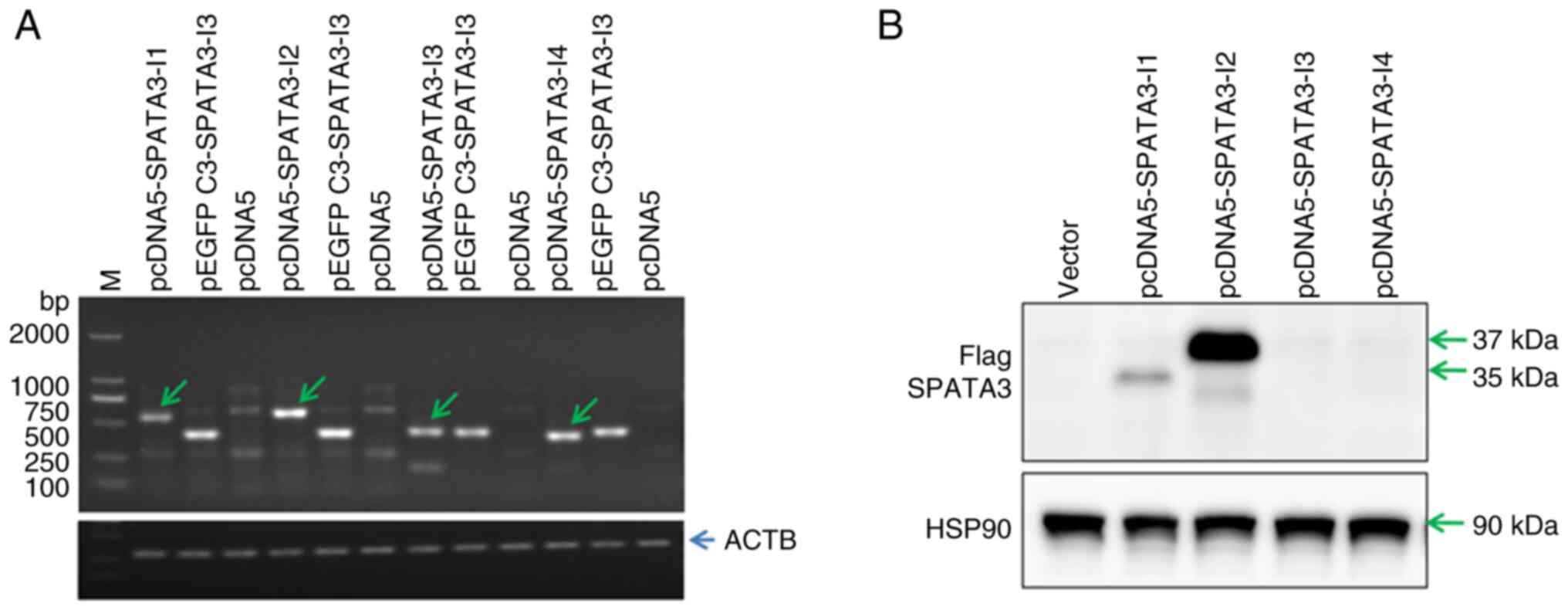
Figure 1

RT-PCR and western blotting results
for SPATA3 isoform expression in HeLa cells transfected with pcDNA5
or pEGFP-C3 vectors containing SPATA3 isoforms. (A) RT-PCR analysis
of SPATA3 isoform mRNA expression in HeLa transfected with pcDNA5
or pEGFP-C3 vectors containing SPATA3 isoforms. The green arrows
indicate the expression of SPATA3-I1, SPATA3-I2, SPATA3-I3 and
SPATA3-I4 mRNAs, and the corresponding fragment sizes are 552, 576,
418 and 418 bp, respectively. The pcDNA5 vector served as a
negative control. ACTB served as an internal control. (B) Western
blotting results of SPATA3 isoform protein expression in HeLa cells
transfected with pcDNA5 vectors containing SPATA3 isoforms. Hsp90
served as an internal control. Vector, overexpression of the empty
vector pcDNA5; RT-PCR, reverse transcription-PCR; SPATA3,
spermatogenesis-associated protein 3; HSP90, heat shock protein
90.

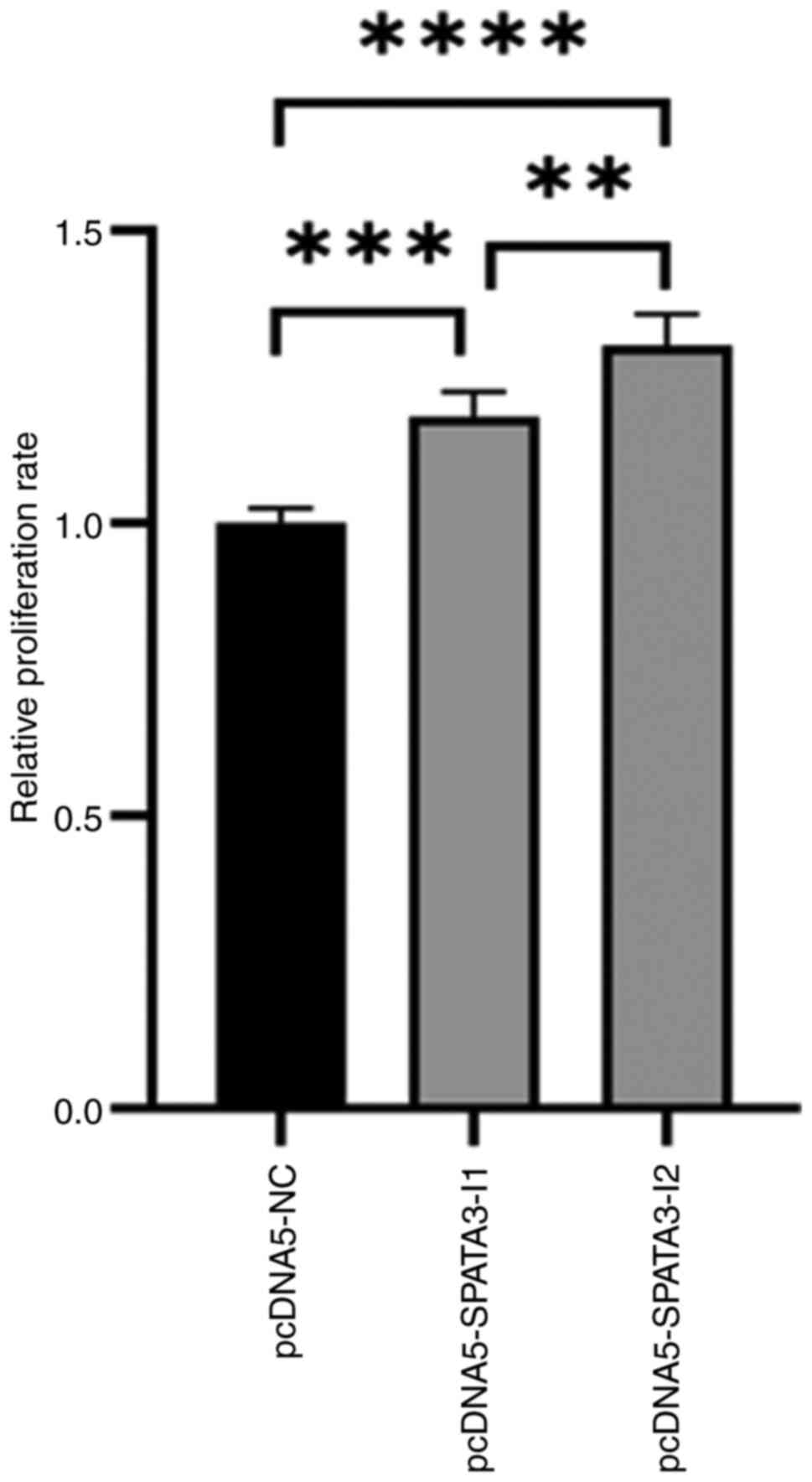
Figure 2

SPATA3 promotes HeLa cell
proliferation in vitro. Relative proliferation rates of HeLa
cells transfected with pcDNA5-SPATA3-I1, pcDNA5-SPATA3-I2 or the
empty vector pcDNA5 at 48 h post-transfection. **P<0.01,
***P<0.001, ****P<0.0001. SPATA3, spermatogenesis-associated
protein 3; NC, negative control.

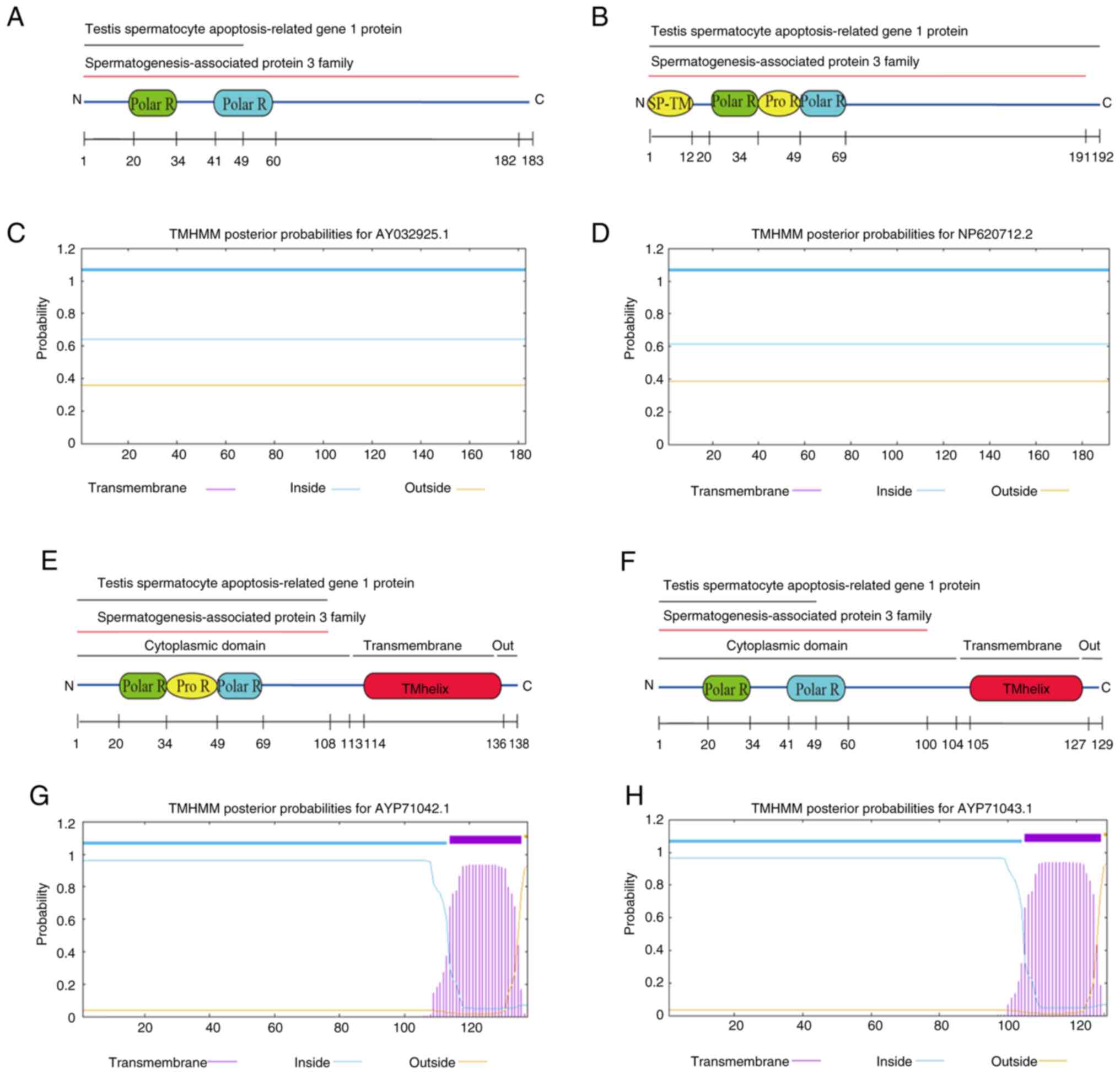
Figure 3

Domains, families and other features
of SPATA3 isoforms. Schematic representation of domains, families
and features in (A) SPATA3-I1. (B) Schematic representation of
domains, families, and features in SPATA3-I2. (C) Transmembrane
topology prediction for SPATA3-I1 generated by TMHMM 2.0. (D)
Transmembrane topology prediction for SPATA3-I2 generated by TMHMM
2.0. (E) Schematic representation of domains, families, and
features in SPATA3-I3. (F) Schematic representation of domains,
families, and features in SPATA3-I4. (G) Transmembrane topology
prediction for SPATA3-I3 generated by TMHMM 2.0. (H) Transmembrane
topology prediction for SPATA3-I4 generated by TMHMM 2.0. SPATA3,
spermatogenesis-associated protein 3; Polar R, polar residues; Pro
R, pro residues; SP-TM, SignalP-TM; TMhelix, Transmembrane
Helix.

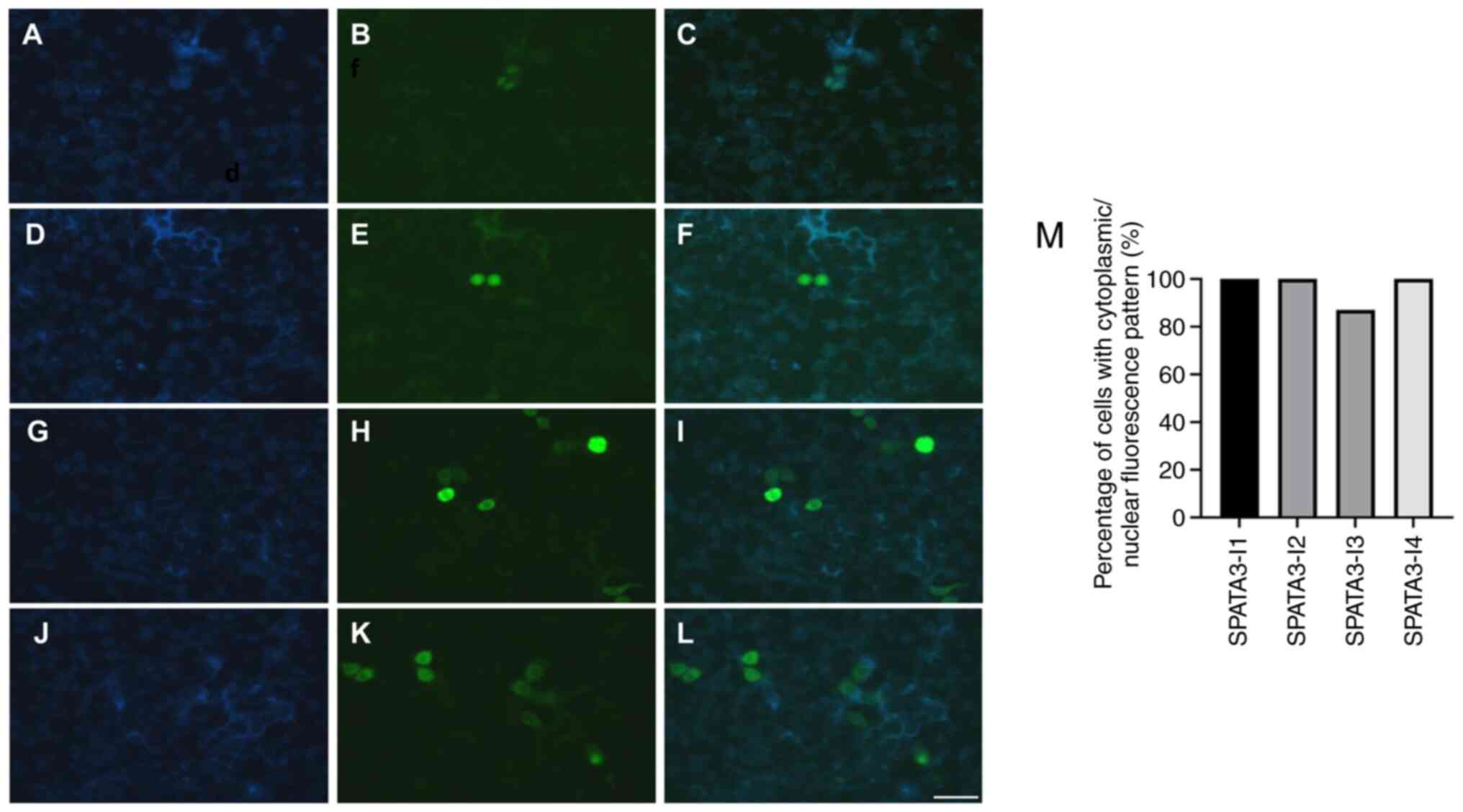
Figure 4

Subcellular localization of
overexpressed SPATA3 isoforms in HeLa cells. Cells overexpressing
the pEGFP-C3-SPATA3-I1 isoform. (A) Hoechst 33258 staining. (B) GFP
signals for overexpression of pEGFP-C3-SPATA3-I1 isoform; (C)
Merged images of Hoechst 33258 staining and GFP signals. Cells
overexpressing the pEGFP-C3-SPATA3-I2 isoform. (D) Hoechst 33258
staining; (E) GFP signals for overexpression of pEGFP-C3-SPATA3-I2
isoform; (F) Merged images of Hoechst 33258 staining and GFP
signals. (G-I) Cells overexpressing the pEGFP-C3-SPATA3-I3 isoform.
(G) Hoechst 33258 staining; (H) GFP signals for overexpression of
pEGFP-C3-SPATA3-I3 isoform; (I) Merged images of Hoechst 33258
staining and GFP signals. (J-L) Cells overexpressing the
pEGFP-C3-SPATA3-I4 isoform. (J) Hoechst 33258 staining; (K) GFP
signals for overexpression of pEGFP-C3-SPATA3-I4 isoform; (L)
Merged images of Hoechst 33258 staining and GFP signals. Scale bar,
50 µm. (M) Quantitative analysis of the sub-cellular localization
of different SPATA3 isoforms. SPATA3, sperma to genesis-associated
protein 3.

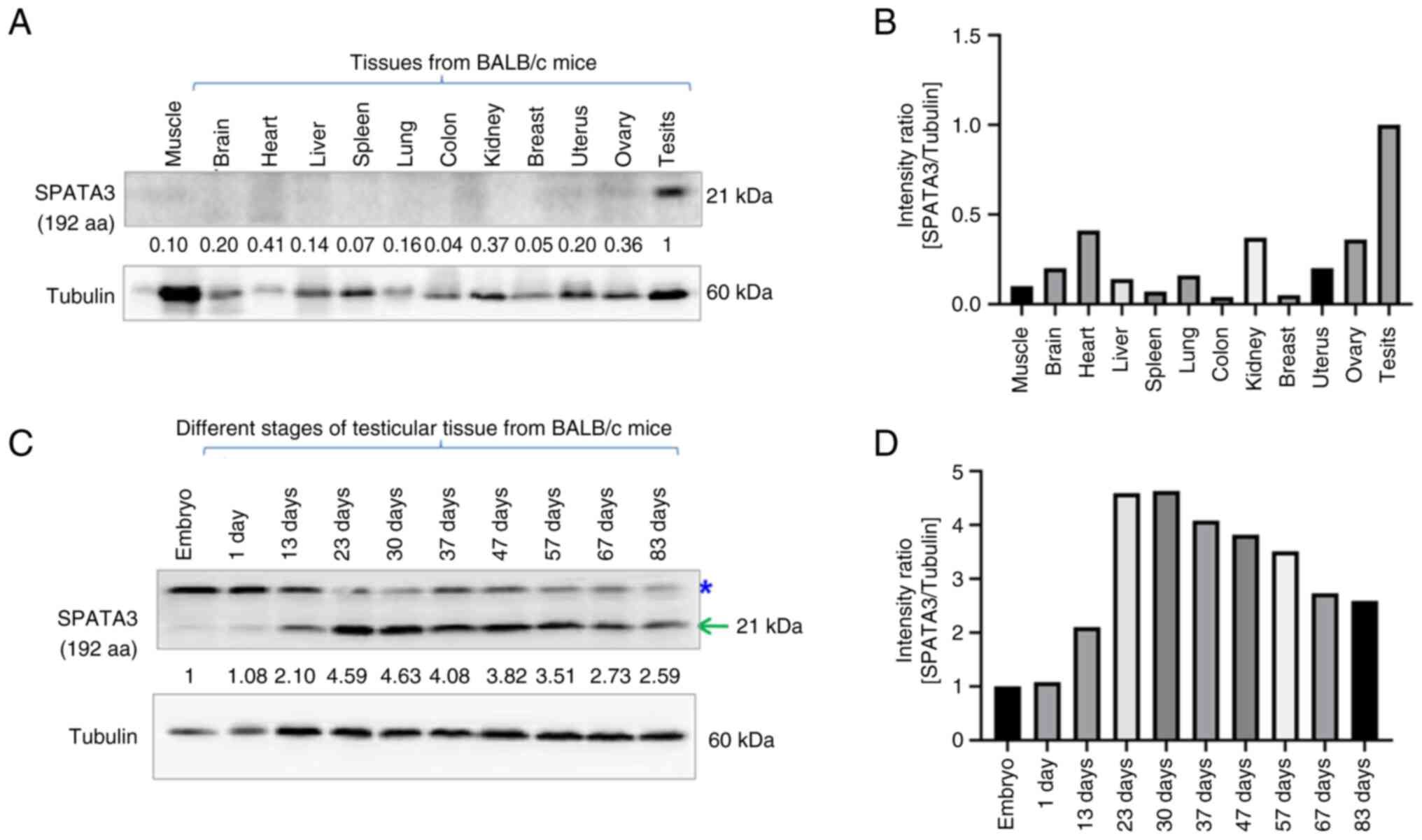
Figure 5

Western blot analysis of
tissue-specific and stage-specific SPATA3 protein expression. (A)
SPATA3 protein expression in various tissues of BALB/c mice and (B)
semi-quantitative analysis. (C) SPATA3 protein expression in the
testicular tissue of BALB/c mice at different developmental stages
and (D) the associated semi-quantitative analysis. The arrow
indicates the SPATA3 protein. The asterisk indicates nonspecific
bands. SPATA3, spermatogenesis-associated protein 3.

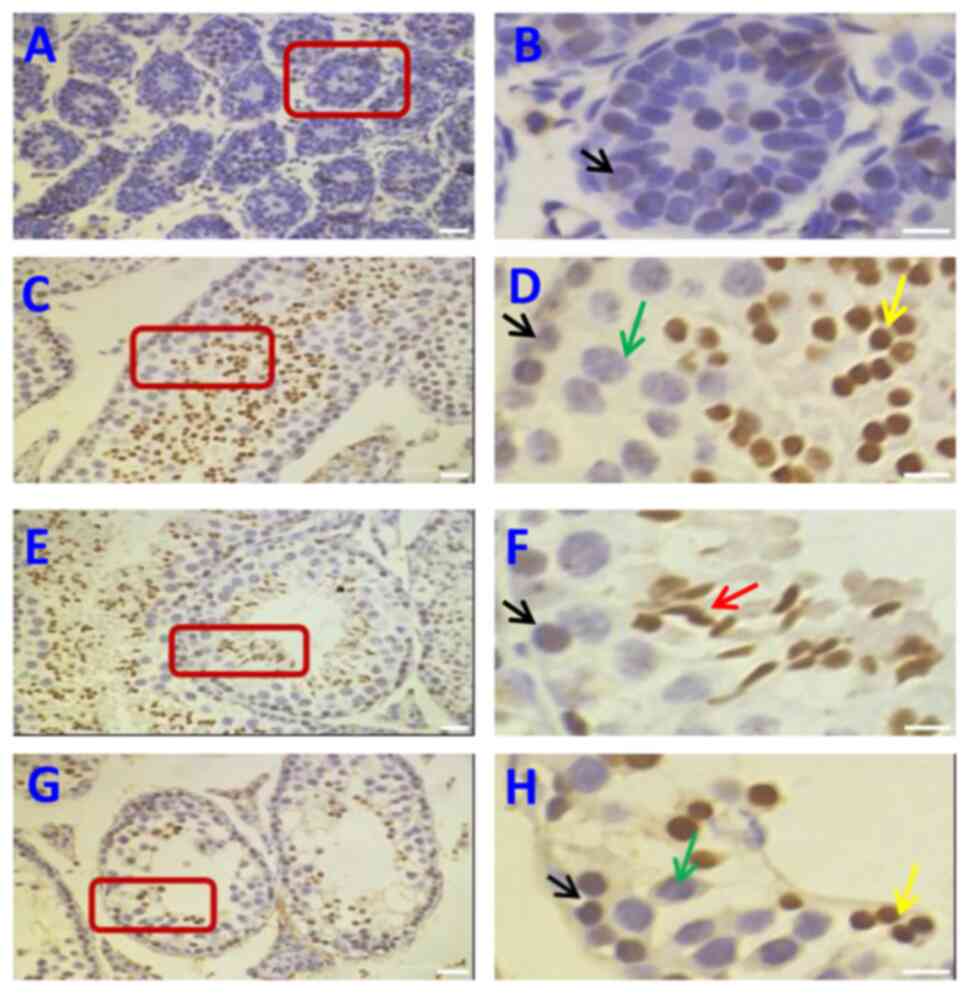
Figure 6

Immunohistochemistry results of
spermatogenesis-associated protein 3 in the testes of BALB/c mice.
(A) General expression pattern in the testicular tissue of 2 - week
- old mice. (B) The images show a higher magnification of an area
within red boxes in the left images. (C) The images show a general
expression pattern in the testicular tissue of 8 - week - old mice.
(D) The images show a higher magnification of an area within red
boxes in the left images. (E) The images show a general expression
pattern in the testicular tissue of 8 - week - old mice. (F) The
images show a higher magnification of an area within red boxes in
the left images. (G) The images show a general expression pattern
in the testicular tissue of 19 - week - old mice. (H) The images
show a higher magnification of an area within red boxes in the left
images. The black arrows indicate spermatogonia, the green arrows
indicate spermatocytes, the yellow arrows indicate round spermatids
and the red arrow indicates elongated spermatids. Scale bar, 50 µm.
(B, D, F and H) Scale bar, 20 µm.
View References

1 

Rowe PJ, Comhaire FH, Hargreave B and Mahmoud AMA: WHO Manual for the Standardized Investigation, Diagnosis and Management of the Infertile Male. Cambridge University Press; Cambridge, UK: pp. pp912000

2 

Minhas S, Bettocchi C, Boeri L, Capogrosso P, Carvalho J, Cilesiz NC, Cocci A, Corona G, Dimitropoulos K, Gül M, et al: European association of urology guidelines on male sexual and reproductive health: 2021 update on male infertility. Eur Urol. 80:603–620. 2021. View Article : Google Scholar : PubMed/NCBI

3 

Agarwal A, Baskaran S, Parekh N, Cho CL, Henkel R, Vij S, Arafa M, Panner Selvam MK and Shah R: Male infertility. Lancet. 397:319–333. 2021. View Article : Google Scholar : PubMed/NCBI

4 

Fu L, Wu Q and Fu J: Exploring the biological roles of DHX36, a DNA/RNA G-quadruplex helicase, highlights functions in male infertility: A comprehensive review. Int J Biol Macromol. 268((Pt 2)): 1318112024. View Article : Google Scholar : PubMed/NCBI

5 

Eisenberg ML, Esteves SC, Lamb DJ, Hotaling JM, Giwercman A, Hwang K and Cheng YS: Male infertility. Nat Rev Dis Primers. 9:492023. View Article : Google Scholar : PubMed/NCBI

6 

Fu J, Li L and Lu G: Relationship between microdeletion on Y chromosome and patients with idiopathic azoospermia and severe oligozoospermia in the Chinese. Chin Med J (Engl). 115:72–75. 2002.PubMed/NCBI

7 

Fu L, Xiong DK, Ding XP, Li C, Zhang LY, Ding M, Nie SS and Quan Q: Genetic screening for chromosomal abnormalities and Y chromosome microdeletions in Chinese infertile men. J Assist Reprod Genet. 29:521–527. 2012. View Article : Google Scholar : PubMed/NCBI

8 

Kuroda S, Usui K, Sanjo H, Takeshima T, Kawahara T, Uemura H and Yumura Y: Genetic disorders and male infertility. Reprod Med Biol. 19:314–322. 2020. View Article : Google Scholar : PubMed/NCBI

9 

Tüttelmann F, Ruckert C and Röpke A: Disorders of spermatogenesis: Perspectives for novel genetic diagnostics after 20 years of unchanged routine. Med Genet. 30:12–20. 2018.PubMed/NCBI

10 

Gül M, Russo GI, Kandil H, Boitrelle F, Saleh R, Chung E, Kavoussi P, Mostafa T, Shah R and Agarwal A: Male infertility: New developments, current challenges, and future directions. World J Mens Health. 42:502–517. 2024. View Article : Google Scholar : PubMed/NCBI

11 

Wang Y, Li R, Yang R, Zheng D, Zeng L, Lian Y, Zhu Y, Zhao J, Liang X, Li W, et al: Intracytoplasmic sperm injection versus conventional in-vitro fertilisation for couples with infertility with non-severe male factor: A multicentre, open-label, randomised controlled trial. Lancet. 403:924–934. 2024. View Article : Google Scholar : PubMed/NCBI

12 

Palermo G, Joris H, Devroey P and Van Steirteghem AC: Pregnancies after intracytoplasmic injection of single spermatozoon into an oocyte. Lancet. 340:17–18. 1992. View Article : Google Scholar : PubMed/NCBI

13 

Schlegel PN: Testicular sperm extraction: Microdissection improves sperm yield with minimal tissue excision. Hum Reprod. 14:131–135. 1999. View Article : Google Scholar : PubMed/NCBI

14 

Griswold MD: Spermatogenesis: The commitment to meiosis. Physiol Rev. 96:1–17. 2016. View Article : Google Scholar : PubMed/NCBI

15 

Zhu X, Hu K, Cheng H, Wu H, Li K, Gao Y, Lv M, Xu C, Geng H, Shen Q, et al: Novel MEIOB pathogenic variants including a homozygous non-canonical splicing variant, cause meiotic arrest and human non-obstructive azoospermia. Clin Genet. 105:99–105. 2024. View Article : Google Scholar : PubMed/NCBI

16 

Lee TH, Song SH, Kim DK, Shim SH, Jeong D and Kim DS: An analysis of Y-chromosome microdeletion in infertile Korean men with severe oligozoospermia or azoospermia. Investig Clin Urol. 65:77–83. 2024. View Article : Google Scholar : PubMed/NCBI

17 

Tsai-Morris CH, Sheng Y, Lee E, Lei KJ and Dufau ML: Gonadotropin-regulated testicular RNA helicase (GRTH/Ddx25) is essential for spermatid development and completion of spermatogenesis. Proc Natl Acad Sci USA. 101:6373–6378. 2004. View Article : Google Scholar : PubMed/NCBI

18 

Liman N: Heat shock proteins are differentially expressed in the domestic cat (Felis catus) testis, epididymis, and vas deferens. Microsc Microanal. 29:713–738. 2023. View Article : Google Scholar : PubMed/NCBI

19 

Zhang X, Wang L, Ma Y, Wang Y, Liu H, Liu M, Qin L, Li J, Jiang C, Zhang X, et al: CEP128 is involved in spermatogenesis in humans and mice. Nat Commun. 13:13952022. View Article : Google Scholar : PubMed/NCBI

20 

Song H, Wang L, Chen D and Li F: The function of Pre-mRNA alternative splicing in mammal spermatogenesis. Int J Biol Sci. 16:38–48. 2020. View Article : Google Scholar : PubMed/NCBI

21 

Yan W, Suominen J, Samson M, Jégou B and Toppari J: Involvement of Bcl-2 family proteins in germ cell apoptosis during testicular development in the rat and pro-survival effect of stem cell factor on germ cells in vitro. Mol Cell Endocrinol. 165:115–129. 2000. View Article : Google Scholar : PubMed/NCBI

22 

Xiao B, Li X, Feng XY, Gong S, Li ZB, Zhang J, Yuan HJ and Tan JH: Restraint stress of male mice induces apoptosis in spermatozoa and spermatogenic cells: role of the FasL/Fas system†. Biol Reprod. 101:235–247. 2019. View Article : Google Scholar : PubMed/NCBI

23 

Li YQ, He QH, Zhou Q, Zhou X, Bin DH, Liu CS and Guo JH: Impact of Ureaplasma urealyticum infection on the MRPS22 protein expression in rat spermatogenic cells and intervening effect of Zhibai Dihuang Decoction. Zhonghua Nan Ke Xue. 25:55–61. 2019.(In Chinese). PubMed/NCBI

24 

Feng Y, Shi J, Li M, Duan H and Shao B: Evaluation of the cytotoxic activity of triphenyl phosphate on mouse spermatocytes cells. Toxicol In Vitro. 90:1056072023. View Article : Google Scholar : PubMed/NCBI

25 

Turunen HT, Sipilä P, Strauss L, Björkgren I, Huhtaniemi I and Poutanen M: Loss of Bmyc results in increased apoptosis associated with upregulation of Myc expression in juvenile murine testis. Reproduction. 144:495–503. 2012. View Article : Google Scholar : PubMed/NCBI

26 

Fu JJ, Lu GX, Li LY, Liu G, Xing XW and Liu SF: Molecular cloning for testis spermatogenesis cell apoptosis related gene TSARG1 and Mtsarg1 and expression analysis for Mtsarg1 gene. Yi Chuan Xue Bao. 30:25–29. 2003.(In Chinese). PubMed/NCBI

27 

Malcher A, Rozwadowska N, Stokowy T, Kolanowski T, Jedrzejczak P, Zietkowiak W and Kurpisz M: Potential biomarkers of nonobstructive azoospermia identified in microarray gene expression analysis. Fertil Steril. 100:1686–1694.e1-7. 2013. View Article : Google Scholar : PubMed/NCBI

28 

Zhou B, Wei C, Khan MA, Chen H and Fu J: Characterization and molecular cloning of novel isoforms of human spermatogenesis associated gene SPATA3. Mol Biol Rep. 46:3827–3834. 2019. View Article : Google Scholar : PubMed/NCBI

29 

Girault MS, Dupuis S, Ialy-Radio C, Stouvenel L, Viollet C, Pierre R, Favier M, Ziyyat A and Barbaux S: Deletion of the Spata3 gene induces sperm alterations and in vitro hypofertility in mice. Int J Mol Sci. 22:19592021. View Article : Google Scholar : PubMed/NCBI

30 

Li M, Ma Q, Gong T, Zhang Y, Yan P, Zhai X and Guo R: Bioinformatics analysis and primary identification of the structure and function of mouse Spata3 protein. Acta Laboratorium Animalis Scientia Sinica. 30:767–776. 2022.(In Chinese).

31 

Li L, Liu G, Fu JJ, Li LY, Tan XJ, Yang S and Lu GX: Molecular cloning and characterization of a novel transcript variant of Mtsarg1 gene. Mol Biol Rep. 36:1023–1032. 2009. View Article : Google Scholar : PubMed/NCBI

32 

Wang Y, Wen L, Bai X, Cao R, Wang H and Guo R: Novel expression of spermatogenesis-associated protein 3 gene in mouse spermatogenic cells and its influence upon apoptosis and autophagy in HEK 293T cells. Acta Anatomica Sinica. 1:41–48. 2018.(In Chinese).

33 

Choi S, Cho N and Kim KK: The implications of alternative pre-mRNA splicing in cell signal transduction. Exp Mol Med. 55:755–766. 2023. View Article : Google Scholar : PubMed/NCBI

34 

Carey KT and Wickramasinghe VO: Regulatory potential of the RNA processing machinery: Implications for human disease. Trends Genet. 34:279–290. 2018. View Article : Google Scholar : PubMed/NCBI

35 

Venables JP: Alternative splicing in the testes. Curr Opin Genet Dev. 12:615–619. 2002. View Article : Google Scholar : PubMed/NCBI

36 

Zhao F, Yan Y, Wang Y, Liu Y and Yang R: Splicing complexity as a pivotal feature of alternative exons in mammalian species. BMC Genomics. 24:1982023. View Article : Google Scholar : PubMed/NCBI

37 

Yang X, Coulombe-Huntington J, Kang S, Sheynkman GM, Hao T, Richardson A, Sun S, Yang F, Shen YA, Murray RR, et al: Widespread expansion of protein interaction capabilities by alternative splicing. Cell. 164:805–817. 2016. View Article : Google Scholar : PubMed/NCBI

38 

Romeo-Cardeillac C, Trovero MF, Radío S, Smircich P, Rodríguez-Casuriaga R, Geisinger A and Sotelo-Silveira J: Uncovering a multitude of stage-specific splice variants and putative protein isoforms generated along mouse spermatogenesis. BMC Genomics. 25:2952024. View Article : Google Scholar : PubMed/NCBI

39 

Baralle FE and Giudice J: Alternative splicing as a regulator of development and tissue identity. Nat Rev Mol Cell Biol. 18:437–451. 2017. View Article : Google Scholar : PubMed/NCBI

40 

Naro C, Cesari E and Sette C: Splicing regulation in brain and testis: Common themes for highly specialized organs. Cell Cycle. 20:480–489. 2021. View Article : Google Scholar : PubMed/NCBI

41 

Li Q, Li T, Xiao X, Ahmad DW, Zhang N, Li H, Chen Z, Hou J and Liao M: Specific expression and alternative splicing of mouse genes during spermatogenesis. Mol Omics. 16:258–267. 2020. View Article : Google Scholar : PubMed/NCBI

42 

Legrand JMD and Hobbs RM: RNA processing in the male germline: Mechanisms and implications for fertility. Semin Cell Dev Biol. 79:80–91. 2018. View Article : Google Scholar : PubMed/NCBI

43 

Fu J, Cheng J, Zhou Q, Khan MA, Duan C, Peng J, Lv H and Fu J: Novel compound heterozygous nonsense variants, p.L150* and p.Y3565*, of the USH2A gene in a Chinese pedigree are associated with Usher syndrome type IIA. Mol Med Rep. 22:3464–3472. 2020.PubMed/NCBI

44 

Alzahayqa M, Jamous A, Khatib AAH and Salah Z: TET1 isoforms have distinct expression pattern, localization and regulation in breast cancer. Front Oncol. 12:8485442022. View Article : Google Scholar : PubMed/NCBI

45 

Pereira CD, Serrano JB, Martins F, da Cruz E Silva OAB and Rebelo S: Nuclear envelope dynamics during mammalian spermatogenesis: New insights on male fertility. Biol Rev Camb Philos Soc. 94:1195–1219. 2019. View Article : Google Scholar : PubMed/NCBI

46 

Ohkura H: Meiosis: An overview of key differences from mitosis. Cold Spring Harb Perspect Biol. 7:a0158592015. View Article : Google Scholar : PubMed/NCBI

47 

Waclawska A and Kurpisz M: Key functional genes of spermatogenesis identified by microarray analysis. Syst Biol Reprod Med. 58:229–235. 2012. View Article : Google Scholar : PubMed/NCBI

48 

Ramm SA, Schärer L, Ehmcke J and Wistuba J: Sperm competition and the evolution of spermatogenesis. Mol Hum Reprod. 20:1169–1179. 2014. View Article : Google Scholar : PubMed/NCBI

49 

Guo X: Localized proteasomal degradation: From the nucleus to cell periphery. Biomolecules. 12:2292022. View Article : Google Scholar : PubMed/NCBI

50 

Brooks P, Fuertes G, Murray RZ, Bose S, Knecht E, Rechsteiner MC, Hendil KB, Tanaka K, Dyson J and Rivett J: Subcellular localization of proteasomes and their regulatory complexes in mammalian cells. Biochem J. 346((Pt 1)): 155–161. 2000. View Article : Google Scholar : PubMed/NCBI

51 

Morgan M, Kumar L, Li Y and Baptissart M: Post-transcriptional regulation in spermatogenesis: All RNA pathways lead to healthy sperm. Cell Mol Life Sci. 78:8049–8071. 2021. View Article : Google Scholar : PubMed/NCBI

52 

Bettegowda A and Wilkinson MF: Transcription and post-transcriptional regulation of spermatogenesis. Philos Trans R Soc Lond B Biol Sci. 365:1637–1651. 2010. View Article : Google Scholar : PubMed/NCBI

53 

Boulikas T: Putative nuclear localization signals (NLS) in protein transcription factors. J Cell Biochem. 55:32–58. 1994. View Article : Google Scholar : PubMed/NCBI

54 

Jiang X, Wu M, Albo J and Rao Q: Non-specific binding and cross-reaction of ELISA: A case study of porcine hemoglobin detection. Foods. 10:17082021. View Article : Google Scholar : PubMed/NCBI

55 

Lander ES, Linton LM, Birren B, Nusbaum C, Zody MC, Baldwin J, Devon K, Dewar K, Doyle M, FitzHugh W, et al: Initial sequencing and analysis of the human genome. Nature. 409:860–921. 2001. View Article : Google Scholar : PubMed/NCBI

56 

Moritz L and Hammoud SS: The art of packaging the sperm genome: Molecular and structural basis of the histone-to-protamine exchange. Front Endocrinol (Lausanne). 13:8955022022. View Article : Google Scholar : PubMed/NCBI

57 

Zhou J, Du YR, Qin WH, Hu YG, Huang YN, Bao L, Han D, Mansouri A and Xu GL: RIM-BP3 is a manchette-associated protein essential for spermiogenesis. Development. 136:373–382. 2009. View Article : Google Scholar : PubMed/NCBI

58 

Piechka A, Sparanese S, Witherspoon L, Hach F and Flannigan R: Molecular mechanisms of cellular dysfunction in testes from men with non-obstructive azoospermia. Nat Rev Urol. 21:67–90. 2024. View Article : Google Scholar : PubMed/NCBI

59 

Martianov I, Fimia GM, Dierich A, Parvinen M, Sassone-Corsi P and Davidson I: Late arrest of spermiogenesis and germ cell apoptosis in mice lacking the TBP-like TLF/TRF2 gene. Mol Cell. 7:509–515. 2001. View Article : Google Scholar : PubMed/NCBI

60 

Xu L, Lu Y, Han D, Yao R, Wang H, Zhong S, Luo Y, Han R, Li K, Fu J, et al: Rnf138 deficiency promotes apoptosis of spermatogonia in juvenile male mice. Cell Death Dis. 8:e27952017. View Article : Google Scholar : PubMed/NCBI

61 

Siebert-Kuss LM, Krenz H, Tekath T, Wöste M, Di Persio S, Terwort N, Wyrwoll MJ, Cremers JF, Wistuba J, Dugas M, et al: Transcriptome analyses in infertile men reveal germ cell-specific expression and splicing patterns. Life Sci Alliance. 6:e2022016332022. View Article : Google Scholar : PubMed/NCBI

62 

Giassetti MI, Miao D, Law NC, Oatley MJ, Park J, Robinson LD, Maddison LA, Bernhardt ML and Oatley JM: ARRDC5 expression is conserved in mammalian testes and required for normal sperm morphogenesis. Nat Commun. 14:21112023. View Article : Google Scholar : PubMed/NCBI

63 

Hermann BP, Cheng K, Singh A, Roa-De La Cruz L, Mutoji KN, Chen IC, Gildersleeve H, Lehle JD, Mayo M, Westernströer B, et al: The mammalian spermatogenesis single-cell transcriptome, from spermatogonial stem cells to spermatids. Cell Rep. 25:1650–1667.e1658. 2018. View Article : Google Scholar : PubMed/NCBI

64 

Anbazhagan R, Kavarthapu R, Dale R, Campbell K, Faucz FR and Dufau ML: miRNA expression profiles of mouse round spermatids in GRTH/DDX25-mediated spermiogenesis: mRNA-miRNA network analysis. Cells. 12:7562023. View Article : Google Scholar : PubMed/NCBI

Related Articles

  • Abstract
  • View
  • Download
  • Twitter
Copy and paste a formatted citation
Spandidos Publications style
Fu L, Zhou B, Jiang X, Cheng J, Wu Q and Fu J: Roles of human SPATA3 in cell proliferation and expression pattern of <em>Spata3</em> in mouse testis. Mol Med Rep 32: 255, 2025.
APA
Fu, L., Zhou, B., Jiang, X., Cheng, J., Wu, Q., & Fu, J. (2025). Roles of human SPATA3 in cell proliferation and expression pattern of <em>Spata3</em> in mouse testis. Molecular Medicine Reports, 32, 255. https://doi.org/10.3892/mmr.2025.13620
MLA
Fu, L., Zhou, B., Jiang, X., Cheng, J., Wu, Q., Fu, J."Roles of human SPATA3 in cell proliferation and expression pattern of <em>Spata3</em> in mouse testis". Molecular Medicine Reports 32.3 (2025): 255.
Chicago
Fu, L., Zhou, B., Jiang, X., Cheng, J., Wu, Q., Fu, J."Roles of human SPATA3 in cell proliferation and expression pattern of <em>Spata3</em> in mouse testis". Molecular Medicine Reports 32, no. 3 (2025): 255. https://doi.org/10.3892/mmr.2025.13620
Copy and paste a formatted citation
x
Spandidos Publications style
Fu L, Zhou B, Jiang X, Cheng J, Wu Q and Fu J: Roles of human SPATA3 in cell proliferation and expression pattern of <em>Spata3</em> in mouse testis. Mol Med Rep 32: 255, 2025.
APA
Fu, L., Zhou, B., Jiang, X., Cheng, J., Wu, Q., & Fu, J. (2025). Roles of human SPATA3 in cell proliferation and expression pattern of <em>Spata3</em> in mouse testis. Molecular Medicine Reports, 32, 255. https://doi.org/10.3892/mmr.2025.13620
MLA
Fu, L., Zhou, B., Jiang, X., Cheng, J., Wu, Q., Fu, J."Roles of human SPATA3 in cell proliferation and expression pattern of <em>Spata3</em> in mouse testis". Molecular Medicine Reports 32.3 (2025): 255.
Chicago
Fu, L., Zhou, B., Jiang, X., Cheng, J., Wu, Q., Fu, J."Roles of human SPATA3 in cell proliferation and expression pattern of <em>Spata3</em> in mouse testis". Molecular Medicine Reports 32, no. 3 (2025): 255. https://doi.org/10.3892/mmr.2025.13620
Follow us
  • Twitter
  • LinkedIn
  • Facebook
About
  • Spandidos Publications
  • Careers
  • Cookie Policy
  • Privacy Policy
How can we help?
  • Help
  • Live Chat
  • Contact
  • Email to our Support Team