|
1
|
Costa S, La Rocca G and Cavalieri V:
Epigenetic regulation of chromatin functions by MicroRNAs and Long
Noncoding RNAs and implications in human diseases. Biomedicines.
13:7252025. View Article : Google Scholar : PubMed/NCBI
|
|
2
|
Godden AM, Silva WTAF, Kiehl B, Jolly C,
Folkes L, Alavioon G and Immler S: Environmentally induced
variation in sperm sRNAs is linked to gene expression and
transposable elements in zebrafish offspring. Heredity (Edinb). Mar
22–2025.(Epub ahead of print). View Article : Google Scholar : PubMed/NCBI
|
|
3
|
Oliveira-Rizzo C, Colantuono CL,
Fernández-Alvarez AJ, Boccaccio GL, Garat B, Sotelo-Silveira JR,
Khan S, Ignatchenko V, Lee YS, Kislinger T, et al: Multi-omics
study reveals Nc886/vtRNA2-1 as a positive regulator of prostate
cancer cell immunity. J Proteome Res. 24:433–448. 2025. View Article : Google Scholar : PubMed/NCBI
|
|
4
|
Estravís M, García-Sánchez A, Martin MJ,
Pérez-Pazos J, Isidoro-García M, Dávila I and Sanz C: RNY3
modulates cell proliferation and IL13 mRNA levels in a T lymphocyte
model: A possible new epigenetic mechanism of IL-13 regulation. J
Physiol Biochem. 79:59–69. 2023. View Article : Google Scholar : PubMed/NCBI
|
|
5
|
Fabbri M, Paone A, Calore F, Galli R,
Gaudio E, Santhanam R, Lovat F, Fadda P, Mao C, Nuovo GJ, et al:
MicroRNAs bind to Toll-like receptors to induce prometastatic
inflam-matory response. Proc Natl Acad Sci USA. 109:E2110–E2116.
2012. View Article : Google Scholar : PubMed/NCBI
|
|
6
|
Wallach T, Wetzel M, Dembny P, Staszewski
O, Krüger C, Buonfiglioli A, Prinz M and Lehnardt S: Identification
of CNS Injury-Related microRNAs as Novel Toll-Like Receptor 7/8
Signaling Activators by Small RNA Sequencing. Cells. 9:1862020.
View Article : Google Scholar : PubMed/NCBI
|
|
7
|
Greidinger EL, Zang YJ, Martinez L, Jaimes
K, Nassiri M, Bejarano P, Barber GN and Hoffman RW: Differential
tissue targeting of autoimmunity manifestations by
autoantigen-associated Y RNAs. Arthritis Rheum. 56:1589–1597. 2007.
View Article : Google Scholar : PubMed/NCBI
|
|
8
|
Oldenburg M, Krüger A, Ferstl R, Kaufmann
A, Nees G, Sigmund A, Bathke B, Lauterbach H, Suter M, Dreher S, et
al: TLR13 recognizes bacterial 23S rRNA devoid of erythromycin
resistance-forming modification. Science. 337:1111–1115. 2012.
View Article : Google Scholar : PubMed/NCBI
|
|
9
|
Alvarez-Carbonell D, Garcia-Mesa Y, Milne
S, Das B, Dobrowolski C, Rojas R and Karn J: Toll-like receptor 3
activation selectively reverses HIV latency in microglial cells.
Retrovirology. 14:92017. View Article : Google Scholar : PubMed/NCBI
|
|
10
|
Rodríguez-Corona JM, Ruiz Esparza-Garrido
R, Horta-Vega JV and Velázquez-Flores M: Circulating Y-RNAs: A
predicted function mainly in controlling the innate immune system,
cell signaling and DNA replication in pediatric patients with
pilocytic and diffuse astrocytoma. Clin Pediatr. 8:1–9. 2023.
|
|
11
|
Akira S, Takeda K and Kaisho T: Toll-like
receptors: Critical proteins linking innate and acquired immunity.
Nature Immunology. 2:675–680. 2001. View
Article : Google Scholar : PubMed/NCBI
|
|
12
|
Feng Y, Zou L, Yan D, Chen H, Xu G, Jian
W, Ping Cui and Chao W: Extracellular MicroRNAs induce potent
innate immune responses via TLR7/MyD88-dependent mechanisms. J
Immunol. 199:2106–2117. 2017. View Article : Google Scholar : PubMed/NCBI
|
|
13
|
Wiese MD, Manning-Bennett AT and Abuhelwa
AY: Investigational IRAK-4 Inhibitors for the treatment of
rheumatoid arthritis. Expert Opin invest Drugs. 29:475–482. 2020.
View Article : Google Scholar : PubMed/NCBI
|
|
14
|
Xiao L, Liu Y and Wang N: New paradigms in
inflammatory signaling in vascular endothelial cells. Am J Physiol
Heart Circ Physiol. 306:H317–H325. 2014. View Article : Google Scholar : PubMed/NCBI
|
|
15
|
Van Tassell BW, Seropian IM, Toldo S,
Salloum FN, Smithson L, Varma A, Hoke NN, Gelwix C, Chau V and
Abbate A: Pharmacologic inhibition of myeloid differentiation
factor 88 (MyD88) prevents left ventricular dilation and
hypertrophy after experimental acute myocardial infarction in the
mouse. J Cardiovasc Pharmacol. 55:385–390. 2010. View Article : Google Scholar : PubMed/NCBI
|
|
16
|
Rakoff-Nahoum S, Paglino J,
Eslami-Varzaneh F, Edberg S and Medzhitov R: Recognition of
commensal microflora by Toll-like receptors is required for
intestinal homeostasis. Cell. 118:229–241. 2004. View Article : Google Scholar : PubMed/NCBI
|
|
17
|
Tsan MF and Gao B: Endogenous ligands of
Toll-like receptors. J Leukoc Biol. 76:514–519. 2004. View Article : Google Scholar : PubMed/NCBI
|
|
18
|
Rock FL, Hardiman G, Timans JC, Kastelein
RA and Bazan JF: A family of human receptors structurally related
to Drosophila Toll. Proc Natl Acad Sci USA. 95:588–593. 1998.
View Article : Google Scholar : PubMed/NCBI
|
|
19
|
Takeda K and Akira S: Toll-like receptors
in innate immunity. Int Immunol. 17:1–14. 2005. View Article : Google Scholar : PubMed/NCBI
|
|
20
|
Mussari CP, Dodd DS, Sreekantha RK,
Pasunoori L, Wan H, Posy SL, Critton D, Ruepp S, Subramanian M,
Watson A, et al: Discovery of potent and orally bioavailable small
molecule antagonists of toll-like receptors 7/8/9 (TLR7/8/9). ACS
Med Chem Lett. 11:1751–1758. 2020. View Article : Google Scholar : PubMed/NCBI
|
|
21
|
Balak DM, van Doorn MB, Arbeit RD,
Rijneveld R, Klaassen E, Sullivan T, Brevard J, Thio HB, Prens EP,
Burggraaf J and Rissmann R: IMO-8400, a toll-like receptor 7, 8,
and 9 antagonist, demonstrates clinical activity in a phase 2a,
randomized, placebo-controlled trial in patients with
moderate-to-severe plaque psoriasis. Clin Immunol. 174:63–72. 2017.
View Article : Google Scholar : PubMed/NCBI
|
|
22
|
Patra MC, Achek A, Kim GY, Panneerselvam
S, Shin HJ, Baek WY, Lee WH, Sung J, Jeong U, Cho EY, et al: A
novel small-molecule inhibitor of endosomal TLRs reduces
inflammation and alleviates autoimmune disease symptoms in Murine
models. Cells. 9:16482020. View Article : Google Scholar : PubMed/NCBI
|
|
23
|
Winckelmann AA, Munk-Petersen LV,
Rasmussen TA, Melchjorsen J, Hjelholt TJ, Montefiori D, Østergaard
L, Søgaard OS and Tolstrup M: Administration of a Toll-like
receptor 9 agonist decreases the pro viral reservoir in
virologically suppressed HIV-infected patients. PLoS One.
8:e620742013. View Article : Google Scholar : PubMed/NCBI
|
|
24
|
Christensen S, Shupe J, Nickerson K,
Kashgarian M, Flavell R and Shlomchik M: Toll-like receptor 7 and
TLR9 dictate autoantibody specificity and have opposing
inflammatory and regulatory roles in a murine model of lupus.
Immunity. 25:417–428. 2006. View Article : Google Scholar : PubMed/NCBI
|
|
25
|
Komal A, Noreen M and El-Kott AF: TLR3
agonists: RGC100, ARNAX, and poly-IC: A comparative review. Immunol
Res. 69:312–322. 2021. View Article : Google Scholar : PubMed/NCBI
|
|
26
|
LeNaour J, Thierry S, Scuderi SA,
Boucard-Jourdin M, Liu P, Bonnin M, Pan Y, Perret C, Zhao L, Mao M,
et al: A chemically defined TLR3 agonist with anticancer activity.
Oncoimmunology. 12:22275102023. View Article : Google Scholar : PubMed/NCBI
|
|
27
|
Singh M, Khong H, Dai Z, Huang XF, Wargo
JA, Cooper ZA, Vasilakos JP, Hwu P and Overwijk WW: Effective
innate and adaptive anti-melanoma immunity through localized
TLR-7/8 activation. J Immunol. 193:4722–4731. 2014. View Article : Google Scholar : PubMed/NCBI
|
|
28
|
Fuge O, Vasdev N, Allchorne P and Green
JS: Immunotherapy for bladder cancer. Res Rep Urol. 7:65–79.
2015.PubMed/NCBI
|
|
29
|
Morales A, Eidinger D and Bruce AW:
Intracavitary Bacillus Calmette-Guerin in the treatment of
superficial bladder tumors. J Urol. 116:180–183. 2017. View Article : Google Scholar : PubMed/NCBI
|
|
30
|
Bayraktar R, Bertilaccio MTS and Calin GA:
The interaction between two worlds: MicroRNAs and Toll-like
receptors. Front Immunol. 14:10532019. View Article : Google Scholar : PubMed/NCBI
|
|
31
|
Yu J, Zhang X, Cai C, Zhou T and Chen Q:
Small RNA and Toll-like receptor interactions: Origins and disease
mechanisms. Trends Biochem Sci. Feb 15–2025.doi:
10.1016/j.tibs.2025.01.004 (Epub ahead of print). View Article : Google Scholar : PubMed/NCBI
|
|
32
|
He WA, Calore F, Londhe P, Canella A,
Guttridge DC and Croce CM: Microvesicles containing miRNAs promote
muscle cell death in cancer cachexia via TLR7. Proc Natl Acad Sci
USA. 111:4525–4529. 2014. View Article : Google Scholar : PubMed/NCBI
|
|
33
|
Donzelli J, Proestler E, Riedel A,
Nevermann S, Hertel B, Guenther A, Gattenlöhner S, Savai R, Larsson
K and Saul MJ: Small extracellular vesicle-derived miR-574-5p
regulates PGE2-biosynthesis via TLR7/8 in lung cancer. J Extracell
Vesicles. 10:e121432021. View Article : Google Scholar : PubMed/NCBI
|
|
34
|
Huang X, Ma Z and Qin W: Screening and
bioinformatics analyses of key miRNAs associated with Toll-like
receptor activation in gastric cancer cells. Medicina (Kaunas).
59:5112023. View Article : Google Scholar : PubMed/NCBI
|
|
35
|
Clancy RM, Alvarez D, Komissarova E,
Barrat FJ, Swartz J and Buyon JP: Ro60-associated single-stranded
RNA links inflammation with fetal cardiac fibrosis via ligation of
TLRs: A novel pathway to autoimmune-associated heart block. J
Immunol. 184:2148–2155. 2010. View Article : Google Scholar : PubMed/NCBI
|
|
36
|
Li XD and Chen ZJ: Sequence specific
detection of bacterial 23S ribosomal RNA by TLR13. Elife.
1:e001022012. View Article : Google Scholar : PubMed/NCBI
|
|
37
|
Krüger A, Oldenburg M, Chebrolu C, Beisser
D, Kolter J, Sigmund AM, Steinmann J, Schäfer S, Hochrein H,
Rahmann S, et al: Human TLR8 senses UR/URR motifs in bacterial and
mitochondrial RNA. EMBO Rep. 16:1656–1663. 2015. View Article : Google Scholar : PubMed/NCBI
|
|
38
|
Yang Z, Ji S, Liu L, Liu S, Wang B, Ma Y
and Cao X: Promotion of TLR7-MyD88-dependent inflammation and
autoimmunity in mice through stem-loop changes in Lnc-Atg16l1. Nat
Commun. 15:102242024. View Article : Google Scholar : PubMed/NCBI
|
|
39
|
Liu B, Sun Y, Geng T, Wang H, Wu Z, Xu L,
Zhang M, Niu X, Zhao C, Shang J and Shang F: C5AR1-induced TLR1/2
pathway activation drives proliferation and metastasis in
anaplastic thyroid cancer. Mol Carcinog. 63:1938–1952. 2024.
View Article : Google Scholar : PubMed/NCBI
|
|
40
|
Yang D, Wan X, Dennis AT, Bektik E, Wang
Z, Costa MGS, Fagnen C, Vénien-Bryan C, Xu X, Gratz DH, et al:
MicroRNA biophysically modulates cardiac action potential by direct
binding to ion channel. Circulation. 143:1597–1613. 2021.
View Article : Google Scholar : PubMed/NCBI
|
|
41
|
Lee RC, Feinbaum RL and Ambros V: The
C. elegans heterochronic gene lin-4 encodes small RNAs with
antisense complementarity to lin-14. Cell. 75:843–854. 1993.
View Article : Google Scholar : PubMed/NCBI
|
|
42
|
Wightman B, Ha I and Ruvkun G:
Posttranscriptional regulation of the heterochronic gene lin-14 by
lin-4 mediates temporal pattern formation in C. elegans.
Cell. 75:855–862. 1993. View Article : Google Scholar : PubMed/NCBI
|
|
43
|
Llave C, Kasschau KD, Rector MA and
Carrington JC: Endogenous and silencing-associated small RNAs in
plants. Plant Cell. 14:1605–1619. 2002. View Article : Google Scholar : PubMed/NCBI
|
|
44
|
Hansen TB, Venø MT, Jensen TI, Schaefer A,
Damgaard CK and Kjems J: Argonaute-associated short introns are a
novel class of gene regulators. Nat Commun. 7:115382016. View Article : Google Scholar : PubMed/NCBI
|
|
45
|
Smalheiser NR and Torvik VI: Mammalian
microRNAs derived from genomic repeats. Trends Genet. 21:318–322.
2005. View Article : Google Scholar : PubMed/NCBI
|
|
46
|
Borchert GM, Lanier W and Davidson BL: RNA
polymerase III transcribes human microRNAs. Nat Struct Mol Biol.
13:1097–1101. 2006. View Article : Google Scholar : PubMed/NCBI
|
|
47
|
Chung W, Agius P, Westholm JO, Chen M,
Okamura K, Robine N, Leslie CS and Lai EC: Computational and
experimental identification of mirtrons in Drosophila melanogaster
and Caenorhabditis elegans. Genome Res. 21:286–300. 2011.
View Article : Google Scholar : PubMed/NCBI
|
|
48
|
Lai EC: MicroRNAs are complementary to
3′UTR sequence motifs that mediate negative post-transcriptional
regulation. Nat Genet. 30:363–364. 2002. View Article : Google Scholar : PubMed/NCBI
|
|
49
|
Drinnenberg IA, Weinberg DE, Xie KT, Mower
JP, Wolfe KH, Fink GR and Bartel DP: RNAi in budding yeast.
Science. 326:544–550. 2009. View Article : Google Scholar : PubMed/NCBI
|
|
50
|
Zardo G, Ciolfi A, Vian L, Starnes LM,
Billi M, Racanicchi S, Maresca C, Fazi F, Travaglini L, Noguera N,
et al: Polycombs and microRNA-223 regulate human granulopoiesis by
transcriptional control of target gene expression. Blood.
119:4034–4046. 2012. View Article : Google Scholar : PubMed/NCBI
|
|
51
|
Di Mauro V, Crasto S, Colombo FS, Di
Pasquale E and Catalucci D: Wnt signalling mediates miR-133a
nuclear re-localization for the transcriptional control of Dnmt3b
in cardiac cells. Sci Rep. 9:1–15. 2019. View Article : Google Scholar : PubMed/NCBI
|
|
52
|
Leucci E, Patella F, Waage J, Holmstrøm K,
Lindow M, Porse B, Kauppinen S and Lund AH: MicroRNA-9 targets the
long non-coding RNA MALAT1 for degradation in the nucleus. Sci Rep.
3:25352013. View Article : Google Scholar : PubMed/NCBI
|
|
53
|
van Beijnum JR, Buurman WA and Griffioen
AW: Convergence and amplification of toll-like receptor (TLR) and
receptor for advanced glycation end products (RAGE) signaling
pathways via high mobility group B1 (HMGB1). Angiogenesis.
11:91–99. 2008. View Article : Google Scholar : PubMed/NCBI
|
|
54
|
Mardente S, Mari E, Consorti F, Gioia CD,
Negri R, Etna M, Zicari A and Antonaci A: HMGB1 induces the
overexpression of miR-222 and miR-221 and increases growth and
motility in papillary thyroid cancer cells. Oncol Rep.
28:2285–2289. 2012. View Article : Google Scholar : PubMed/NCBI
|
|
55
|
Ronkainen H, Hirvikoski P, Kauppila S,
Vuopala KS, Paavonen TK, Selander KS and Vaarala MH: Absent
Toll-like receptor-9 expression predicts poor prognosis in renal
cell carcinoma. J Exp Clin Cancer Res. 30:842011. View Article : Google Scholar : PubMed/NCBI
|
|
56
|
Hao B, Chen Z, Bi B, Yu M, Yao S, Feng Y,
Yu Y, Pan L, Di D, Luo G and Zhang X: Role of TLR4 as a prognostic
factor for survival in various cancers: A meta-analysis.
Oncotarget. 9:13088–13099. 2018. View Article : Google Scholar : PubMed/NCBI
|
|
57
|
Kabelitz D: Expression and function of
toll-like receptors in T lymphocytes. Curr Opin Immunol. 19:39–45.
2007. View Article : Google Scholar : PubMed/NCBI
|
|
58
|
Elliott DRF, Perner J, Li X, Symmons MF,
Verstak B, Eldridge M, Bower L, O'Donovan M and Gay NJ; OCCAMS
Consortium; Fitzgerald RC, : Impact of mutations in Toll-like
receptor pathway genes on esophageal carcinogenesis. PLoS Genet.
13:e10068082017. View Article : Google Scholar : PubMed/NCBI
|
|
59
|
Ngo VN, Young RM, Schmitz R, Jhavar S,
Xiao W, Lim KH, Kohlhammer H, Xu W, Yang Y, Zhao H, et al:
Oncogenically active MYD88 mutations in human lymphoma. Nature.
470:115–119. 2011. View Article : Google Scholar : PubMed/NCBI
|
|
60
|
Li R, Hao Y, Pan W, Wang W and Min Y:
Monophosphoryl lipid A-assembled nanovaccines enhance tumor
immunotherapy. Acta Biomater. 171:482–944. 2023. View Article : Google Scholar : PubMed/NCBI
|
|
61
|
Zhao BG, Vasilakos JP, Tross D, Smirnov D
and Klinman DM: Combination therapy targeting toll like receptors
7, 8 and 9 eliminates large established tumors. J Immunother
Cancer. 2:122014. View Article : Google Scholar : PubMed/NCBI
|
|
62
|
Sato-Kaneko F, Yao S, Ahmadi A, Zhang SS,
Hosoya T, Kaneda MM, Varner JA, Pu M, Messer KS, Guiducci C, et al:
Combination immunotherapy with TLR agonists and checkpoint
inhibitors suppresses head and neck cancer. JCI Insight.
2:933972017. View Article : Google Scholar : PubMed/NCBI
|
|
63
|
Takeda Y, Kataoka K, Yamagishi J, Ogawa S,
Seya T and Matsumoto M: A TLR3-specific adjuvant relieves innate
resistance to PD-L1 blockade without cytokine toxicity in tumor
vaccine immunotherapy. Cell Rep. 19:1874–1887. 2017. View Article : Google Scholar : PubMed/NCBI
|
|
64
|
Adams S: Toll-like receptor agonists in
cancer therapy. Immunotherapy. 1:949–964. 2009. View Article : Google Scholar : PubMed/NCBI
|
|
65
|
Heil F, Hemmi H, Hochrein H, Ampeberger F,
Kirchning C, Akira S, Lipford G, Wagner H and Bauer S:
Species-specific recognition of single-stranded RNA via toll-like
receptor 7 and 8. Science. 303:1526–1529. 2004. View Article : Google Scholar : PubMed/NCBI
|
|
66
|
Yoshida T, Miura T, Matsumiya T, Yoshida
H, Morohashi H, Sakamoto Y, Kurose A, Imaizumi T and Hakamada K:
Toll-like receptor 3 as a recurrence risk factor and a potential
molecular therapeutic target in colorectal cancer. Clin Exp
Gastroenterol. 13:427–438. 2020. View Article : Google Scholar : PubMed/NCBI
|
|
67
|
Bianchi F, Milione M, Casalini P, Centonze
G, Le Noci VM, Storti C, Alexiadis S, Truini M, Sozzi G, Patorino
U, et al: Toll-like receptor 3 as a new marker to detect high risk
early stage Non-small-cell Lung Cancer patients. Sci Rep.
9:142882019. View Article : Google Scholar : PubMed/NCBI
|
|
68
|
Yuan MM, Xu YY, Chen L, Li XY, Qin J and
Shen Y: TLR3 expression correlates with apoptosis, proliferation
and angiogenesis in hepatocellular carcinoma and predicts
prognosis. BMC Cancer. 15:2452015. View Article : Google Scholar : PubMed/NCBI
|
|
69
|
Ceccarelli S, Marzolesi VP, Vannucci J,
Bellezza G, Floridi C, Nocentini G, Cari L, Traina G, Petri D, Puma
F and Conte C: Toll-like receptor 4 and 8 are overexpressed in lung
biopsies of human Non-small cell lung carcinoma. Lung. 203:382025.
View Article : Google Scholar : PubMed/NCBI
|
|
70
|
Gonzalez-Reyes S, Fernandez JM, Gonzalez
LO, Aguirre A, Suarez A, Gonzalez JM, Escaff S and Vizoso FJ: Study
of TLR3, TLR4, and TLR9 in prostate carcinomas and their
association with biochemical recurrence. Cancer Immunol Immunother.
60:217–226. 2011. View Article : Google Scholar : PubMed/NCBI
|
|
71
|
Chuang HC, Huang CC, Chien CY and Chuang
JH: Toll-like receptor 3-mediated tumor invasion in head and neck
cancer. Oral Oncol. 48:226–232. 2012. View Article : Google Scholar : PubMed/NCBI
|
|
72
|
Chen C, Feng Y, Zou L, Wang L, Chen HH,
Cai JY, Xu JM, Sosnovik DE and Chao W: Role of extracellular RNA
and TLR3-trif signaling in myocardial Ischemia-reperfusion injury.
J Am Heart Assoc. 3:e0006832014. View Article : Google Scholar : PubMed/NCBI
|
|
73
|
Cabrera-Fuentes HA, Ruiz-Meana M,
Simsekyilmaz S, Kostin S, Inserte J, Saffarzadeh M, Galuska SP,
Vijayan V, Barba I, Barreto G, et al: RNase1 prevents the damaging
interplay between extracellular RNA and tumour necrosis factor
alpha in cardiac ischaemia/reperfusion injury. Thromb Haemost.
112:1110–1119. 2014. View Article : Google Scholar : PubMed/NCBI
|
|
74
|
Shimada BK, Yang Y, Zhu J, Wang S, Suen A,
Kronstadt SM, Jeyaram A, Jay SM, Zou L and Chao W: Extracellular
miR-146a-5p induces cardiac innate immune response and
cardiomyocyte dysfunction. Immunohorizons. 4:561–572. 2020.
View Article : Google Scholar : PubMed/NCBI
|
|
75
|
Xu J, Feng Y, Jeyaram A, Jay SM, Zou L and
Chao W: Circulating plasma extracellular vesicles from septic mice
induce inflammation via MicroRNA- and TLR7-Dependent mechanisms. J
Immunol. 201:3392–3400. 2018. View Article : Google Scholar : PubMed/NCBI
|
|
76
|
Huang H, Zhu J, Gu L, Hu J, Feng X, Huang
W, Wang S, Yang Y, Cui P, Lin SH, et al: TLR7 Mediates acute
respiratory distress syndrome in sepsis by sensing extracellular
miR-146a. Am J Respir Cell Mol Biol. 67:375–388. 2022. View Article : Google Scholar : PubMed/NCBI
|
|
77
|
Georges HM, Cassin C, Tong M and Abrahams
VM: TLR8-activating miR-146a-3p is an intermediate signal
contributing to fetal membrane inflammation in response to
bacterial LPS. Immunology. 172:577–587. 2024. View Article : Google Scholar : PubMed/NCBI
|
|
78
|
Hannestad UlF, Allard A, Nilsson K and
Rosén A: Prevalence of EBV, HHV6, HCMV, HAdV, SARS-CoV-2, and
Autoantibodies to Type I Interferon in Sputum from Myalgic
Encephalomyelitis/Chronic Fatigue Syndrome Patients. Viruses.
17:4222025. View Article : Google Scholar : PubMed/NCBI
|
|
79
|
Simpkin AJ, McNicholas BA, Hannon D,
Bartlett R, Chiumello D, Dalton HJ, Gibbons K, White N, Merson L,
Fan E, et al: Correction: Effect of early and later prone
positioning on outcomes in invasively ventilated COVID-19 patients
with acute respiratory distress syndrome: Analysis of the
prospective COVID-19 critical care consortium cohort study. Ann
Intensive Care. 15:442025. View Article : Google Scholar : PubMed/NCBI
|
|
80
|
Fakhraei R, Song Y, Kazi DS, Wadhera RK,
Lemos JA, Das SR, Morrow DA, Dahabreh IJ, Rutan CM, Thomas K and
Yeh RW: Social vulnerability and Long-term cardiovascular outcomes
after COVID-19 hospitalization: An analysis of the american heart
association COVID-19 registry linked with medicare claims data. J
Am Heart Assoc. 14:e0380732025. View Article : Google Scholar : PubMed/NCBI
|
|
81
|
Wallach T, Raden M, Hinkelmann L, Brehm M,
Rabsch D, Weidling H, Krüger C, Kettenmann H, Backofen R and
Lehnardt S: Distinct SARS-CoV-2 RNA fragments activate Toll-like
receptors 7 and 8 and induce cytokine release from human
macrophages and microglia. Front Immunol. 13:10664562023.
View Article : Google Scholar : PubMed/NCBI
|
|
82
|
Liao TL, Liu HJ, Chen DY, Tang KT, Chen YM
and Liu PY: SARS-CoV-2 primed platelets-derived microRNAs enhance
NETs formation by extracellular vesicle transmission and TLR7/8
activation. Cell Commun Signal. 21:3042023. View Article : Google Scholar : PubMed/NCBI
|
|
83
|
Guedes JR, Santana I, Cunha C, Duro D,
Almeida MR, Cardoso AM, de Lima MCP and Cardoso AL: MicroRNA
deregulation and chemotaxis and phagocytosis impairment in
Alzheimer's disease. Alzheimers Dement (Amst). 3:7–17. 2016.
View Article : Google Scholar : PubMed/NCBI
|
|
84
|
Évora A, Garcia G, Rubi A, De Vitis E,
Matos AT, Vaz AR, Gervaso F, Gigli G, Polini A and Brites D:
Exosomes enriched with miR-124-3p show therapeutic potential in a
new microfluidic triculture model that recapitulates neuron-glia
crosstalk in Alzheimer's disease. Front Pharmacol. 16:14740122025.
View Article : Google Scholar : PubMed/NCBI
|
|
85
|
Kazemi M, Sanati M, Shekari Khaniani M and
Ghafouri-Fard S: A review on the lncRNA-miRNA-mRNA regulatory
networks involved in inflammatory processes in Alzheimer's disease.
Brain Res. 1856:1495952025. View Article : Google Scholar : PubMed/NCBI
|
|
86
|
Ravanidis S, Bougea A, Papagiannakis N,
Koros C, Simitsi AM, Pachi I, Breza M, Stefanis L and Doxakis E:
Validation of differentially expressed brain-enriched microRNAs in
the plasma of PD patients. Ann Clin Transl Neurol. 7:1594–1607.
2020. View Article : Google Scholar : PubMed/NCBI
|
|
87
|
Currim F, Brown-Leung J, Syeda T, Corson
M, Schumann S, Qi W, Baloni P, Shannahan JH, Rochet JC, Singh R and
Cannon JR: Rotenone induced acute miRNA alterations in
extracellular vesicles produce mitochondrial dysfunction and cell
death. NPJ Parkinsons Dis. 11:592025. View Article : Google Scholar : PubMed/NCBI
|
|
88
|
Ishtiaq B, Paracha RZ, Nisar M, Ejaz S and
Hussain Z: Discovering promising drug candidates for Parkinson's
disease: Integrating miRNA and DEG analysis with molecular dynamics
and MMPBSA. J Comput Aided Mol Des. 39:82025. View Article : Google Scholar : PubMed/NCBI
|
|
89
|
Wallach T, Mossmann ZJ, Szczepek M, Wetzel
M, Machado R, Raden M, Miladi M, Kleinau G, Krüger C, Dembny P, et
al: MicroRNA-100-5p and microRNA-298-5p released from apoptotic
cortical neurons are endogenous Toll-like receptor 7/8 ligands that
contribute to neurodegeneration. Mol Neurodegener. 16:802021.
View Article : Google Scholar : PubMed/NCBI
|
|
90
|
Park C, Lei Z, Li Y, Ren B, He J, Huang H,
Chen F, Li H, Brunner K, Zhu J, et al: Extracellular vesicles in
sepsis plasma mediate neuronal inflammation in the brain through
miRNAs and innate immune signaling. J Neuroinflammation.
21:2522024. View Article : Google Scholar : PubMed/NCBI
|
|
91
|
Deng L, Gao R, Chen H, Jiao B, Zhang C,
Wei L, Yan C, Ye-Lehmann S, Zhu T and Chen C: Let-7b-TLR7 signaling
axis contributes to the Anesthesia/Surgery-induced cognitive
impairment. Mol Neurobiol. 61:1818–1832. 2024. View Article : Google Scholar : PubMed/NCBI
|
|
92
|
Wu N, Morsey BM, Emanuel KM and Fox HS:
Sequence-specific extracellular microRNAs activate TLR7 and induce
cytokine secretion and leukocyte migration. Mol Cell Biochem.
476:4139–4151. 2021. View Article : Google Scholar : PubMed/NCBI
|
|
93
|
Tanji H, Ohto U, Shibata T, Taoka M,
Yamauchi Y, Isobe T, Miyake K and Shimizu T: Toll-like receptor 8
senses degradation products of single-stranded RNA. Nat Struct Mol
Biol. 22:109–115. 2015. View Article : Google Scholar : PubMed/NCBI
|
|
94
|
Tanji H, Ohto U, Shibata T, Miyake K and
Shimizu T: Structural reorganization of the Toll-like receptor 8
dimer induced by agonistic ligands. Science. 339:1426–1429. 2013.
View Article : Google Scholar : PubMed/NCBI
|
|
95
|
Shibata T, Ohto U, Nomura S, Kibata K,
Motoi Y, Zhang Y, Murakami Y, Fukui R, Ishimoto T, Sano S, et al:
Guanosine and its modified derivatives are endogenous ligands for
TLR7. Int Immunol. 28:211–222. 2016. View Article : Google Scholar : PubMed/NCBI
|
|
96
|
Davenne T, Bridgeman A, Rigby RE and
Rehwinkel J: Deoxyguanosine is a TLR7 agonist. Eur J Immunol.
50:56–62. 2020. View Article : Google Scholar : PubMed/NCBI
|
|
97
|
Wang J, Chai J and Wang H: Structure of
the mouse toll-like receptor 13 ectodomain in complex with a
conserved sequence from bacterial 23S ribosomal RNA. FEBS J.
283:1631–1635. 2016. View Article : Google Scholar : PubMed/NCBI
|
|
98
|
Boccitto M and Wolin SL: Ro60 and Y RNAs:
Structure, functions, and roles in autoimmunity. Crit Rev Biochem
Mol Biol. 54:133–152. 2019. View Article : Google Scholar : PubMed/NCBI
|
|
99
|
Kowalski MP and Krude T: Functional roles
of non-coding Y RNAs. Int J Biochem Cell Biol. 66:20–29. 2015.
View Article : Google Scholar : PubMed/NCBI
|
|
100
|
Onafuwa-Nuga AA, King SR and Telesnitsky
A: Nonrandom packaging of host RNAs in moloney murine leukemia
virus. J Virol. 79:13528–13537. 2005. View Article : Google Scholar : PubMed/NCBI
|
|
101
|
Perreault J, Noël JF, Brière F, Cousineau
B, Lucier JF, Perreault JP and Boire G: Retropseudogenes derived
from the human Ro/SS-A autoantigen-associated hY RNAs. Nucleic
Acids Res. 33:2032–2041. 2005. View Article : Google Scholar : PubMed/NCBI
|
|
102
|
Telesnitsky A and Wolin SL: The host RNAs
in retroviral particles. Viruses. 8:1–15. 2016. View Article : Google Scholar
|
|
103
|
Haderk F, Schulz R, Iskar M, Cid LL, Worst
T, Willmund KV, Schulz A, Warnken U, Seiler J, Benner A, et al:
Tumor-derived exosomes modulate PD-L1 expression in monocytes. Sci
Immunol. 2:eaah55092017. View Article : Google Scholar : PubMed/NCBI
|
|
104
|
Irimie AI, Zimta AA, Ciocan C, Mehterov N,
Dudea D, Braicu C and Berindan-Neagoe I: The Unforeseen Non-Coding
RNAs in head and neck cancer. Genes (Basel). 9:1342018. View Article : Google Scholar : PubMed/NCBI
|
|
105
|
Apolonia L, Schulz R, Curk T, Rocha P,
Swanson CM, Schaller T, Ule J and Malim MH: Promiscuous RNA binding
ensures effective encapsidation of APOBEC3 proteins by HIV-1. PLoS
Pathog. 11:e10046092015. View Article : Google Scholar : PubMed/NCBI
|
|
106
|
Gao FY, Pang JC, Wang M, Lu MX, Liu ZG,
Cao JM, Ke XL and Yi MM: Structurally diverse genes encode TLR13 in
Nile tilapia: The two receptors can recognize Streptococcus 23S RNA
and conduct signal transduction through MyD88. Mol Immunol.
132:60–78. 2021. View Article : Google Scholar : PubMed/NCBI
|
|
107
|
Grote K, Nicolai M, Schubert U, Schieffer
B, Troidl C, Preissner KT, Bauer S and Fischer S: Extracellular
ribosomal RNA acts synergistically with Toll-like receptor 2
agonists to promote inflammation. Cells. 11:14402022. View Article : Google Scholar : PubMed/NCBI
|
|
108
|
Ren C, Cheng L, Sun Y, Zhang Q, de Haan
BJ, Zhang H, Faas MM and de Vos P: Lactic acid bacteria secrete
toll like receptor 2 stimulating and macrophage immunomodulating
bioactive factors. J Functional Foods. 66:1037832020. View Article : Google Scholar
|
|
109
|
Kanmani P and Kim H: Protective effects of
lactic acid bacteria against TLR4 induced inflammatory response in
hepatoma HepG2 cells through modulation of Toll-like receptor
negative regulators of Mitogen-activated protein kinase and NF-κB
signaling. Front Immunol. 9:15372018. View Article : Google Scholar : PubMed/NCBI
|
|
110
|
Yamasaki-Yashiki S, Shiraishi T, Gyobu M,
Sasaki H, Kunisawa J, Yokota SI and Katakura Y: Immunostimulatory
activity of lipoteichoic acid with three fatty acid residues
derived from Limosilactobacillus antri JCM
15950T. Appl Environ Microbiol. 90:e01197242024.
View Article : Google Scholar : PubMed/NCBI
|
|
111
|
Nishibayashi R, Inoue R, Harada Y,
Watanabe T, Makioka Y and Ushida K: RNA of enterococcus faecalis
Strain EC-12 Is a major component inducing Interleukin-12
production from human monocytic cells. PLoS One. 10:e01298062015.
View Article : Google Scholar : PubMed/NCBI
|
|
112
|
Mattick JS, Amaral PP, Carninci P,
Carpenter S, Chang HY, Chen LL, Chen R, Dean C, Dinger ME,
Fitzgerald KA, et al: Long non-coding RNAs: Definitions, functions,
challenges and recommendations. Nat Rev Mol Cell Biol. 24:430–447.
2023. View Article : Google Scholar : PubMed/NCBI
|
|
113
|
Velázquez-Flores MÁ, Rodríguez-Corona JM,
López-Aguilar JE, Siordia-Reyes G, Ramírez-Reyes G,
Sánchez-Rodríguez G and Ruiz Esparza-Garrido R: Noncoding RNAs as
potential biomarkers for DIPG diagnosis and prognosis: XIST and
XIST-210 involvement. Clin Transl Oncol. 23:501–513. 2021.
View Article : Google Scholar : PubMed/NCBI
|
|
114
|
Bowman CM, Dahlberg JE, Ikemura T, Konisky
J and Nomura M: Specific inactivation of 16S ribosomal RNA induced
by colicin E3 in vivo. Proc Natl Acad Sci USA. 8:964–968. 1971.
View Article : Google Scholar
|
|
115
|
Borek E, Baliga BS, Gehrke CW, Kuo CW,
Belman S, Troll W and Waalkes TP: High turnover rate of transfer
RNA in tumor tissue. Cancer Res. 37:3362–3366. 1977.PubMed/NCBI
|
|
116
|
Li S, Xu Z and Sheng J: tRNA-derived small
RNA: A novel regulatory small non-coding RNA. Genes (Basel).
9:e2462018. View Article : Google Scholar
|
|
117
|
Couvillion MT, Sachidanandam R and Collins
K: A growth essential Tetrahymena Piwi protein carries tRNA
fragment cargo. Genes Dev. 24:2742–2747. 2010. View Article : Google Scholar : PubMed/NCBI
|
|
118
|
Pawar K, Shigematsu M, Sharbati S and
Kirino Y: Infection-induced 5′-half molecules of tRNAHisGUG
activate Toll-like receptor 7. PLoS Biol. 18:e30009822020.
View Article : Google Scholar : PubMed/NCBI
|
|
119
|
Nicolas FE, Hall AE, Csorba T, Turnbull C
and Dalmay T: Biogenesis of YRNA derived small RNAs is independent
of the microRNA pathway. FEBS Lett. 586:1226–1230. 2012. View Article : Google Scholar : PubMed/NCBI
|
|
120
|
Driedonks TAP and Nolte-'t Hoen ENM:
Circulating Y-RNAs in extracellular vesicles and ribonucleoprotein
complexes; implications for the immune system. Front Immunol.
9:31642018. View Article : Google Scholar : PubMed/NCBI
|
|
121
|
Thompson DM, Lu C, Green PJ and Parker R:
tRNA cleavage is a conserved response to oxidative stress in
eukaryotes. RNA. 14:2095–2103. 2008. View Article : Google Scholar : PubMed/NCBI
|
|
122
|
Di Fazio A, Schlackow M, Pong SK, Alagia A
and Gullerova M: Dicer dependent tRNA derived small RNAs promote
nascent RNA silencing. Nucleic Acids Res. 50:1734–1752. 2022.
View Article : Google Scholar : PubMed/NCBI
|
|
123
|
Yeung ML, Bennasser Y, Watashi K, Le SY,
Houzet L and Jeang KT: Pyrosequencing of small non-coding RNAs in
HIV-1 infected cells: Evidence for the processing of a
viral-cellular double stranded RNA hybrid. Nucleic Acids Res.
37:6575–6586. 2009. View Article : Google Scholar : PubMed/NCBI
|
|
124
|
Pawar K, Kawamura T and Kirino Y: The
tRNAVal half: A strong endogenous Toll-like receptor 7
ligand with a 5′-terminal universal sequence signature. Proc Natl
Acad Sci USA. 121:e23195691212024. View Article : Google Scholar : PubMed/NCBI
|
|
125
|
Ventola CL: The Antibiotic Resistance
Crisis Part 1: Causes and Threats. PT. 40:277–283. 2015.PubMed/NCBI
|
|
126
|
Mori V, Grant G and Hattingh L: Evaluation
of antimicrobial resistance surveillance data sources in primary
care setting: A scoping review. Fam Pract. 42:cmaf0132025.
View Article : Google Scholar : PubMed/NCBI
|
|
127
|
Verhagen AP and Pruijn GJ: Are the Ro
RNP-associated Y RNAs concealing microRNAs? Y RNA-derived miRNAs
may be involved in autoimmunity. Bioessays. 33:674–682. 2011.
View Article : Google Scholar : PubMed/NCBI
|
|
128
|
Hizir Z, Bottini S, Grandjean V, Trabucchi
M and Repetto E: RNY (YRNA)-derived small RNAs regulate cell death
and inflammation in monocytes/macrophages. Cell Death Dis.
8:e25302017. View Article : Google Scholar : PubMed/NCBI
|
|
129
|
Giraldez MD, Spengler RM, Etheridge A,
Goicochea AJ, Tuck M, Choi SW, Galas DJ and Tewari M:
Phospho-RNA-seq: A modified small RNA-seq method that reveals
circulating mRNA and lncRNA fragments as potential biomarkers in
human plasma. EMBO J. 38:e1016952019. View Article : Google Scholar : PubMed/NCBI
|
|
130
|
Harharan M, Scaria V and Brahmachari SK:
DbSMR: A novel resource of genome-wide SNPs affecting microRNA
mediated regulation. BMC Bioinformatics. 10:1082009. View Article : Google Scholar : PubMed/NCBI
|
|
131
|
Belter A, Gudanis D, Rolle K, Piwecka M,
Gdaniec Z, Naskręt-Barciszewska MZ and Barciszewski J: Mature
miRNAs form secondary structure, which suggests their function
beyond RISC. PLoS One. 9:e1138482014. View Article : Google Scholar : PubMed/NCBI
|
|
132
|
Du K, Liu J, Broering R, Zhang X, Yang D,
Dittmer U and Lu M: Recent advances in the discovery and
development of TLR ligands as novel therapeutics for chronic HBV
and HIV infections. Expert. Opin. Drug Discov. 13:661–670.
2018.
|
|
133
|
Christensen S, Shupe J, Nickerson K,
Kashgarian M, Flavell R and Shlomchik M: Toll-like receptor 7 and
TLR9 dictate autoantibody specificity and have opposing
inflammatory and regulatory roles in a murine model of lupus.
Immunity. 25:417–428. 2006. View Article : Google Scholar : PubMed/NCBI
|
|
134
|
Cheng Z, Lin P and Cheng N: HBV/HIV
coinfection: Impact on the development and clinical treatment of
liver diseases. Front Med (Lausanne). 8:7139812021. View Article : Google Scholar : PubMed/NCBI
|
|
135
|
Mullins SR, Vasilakos JP, Deschler K,
Grigsby I, Gillis P, John J, Elder MJ, Swales J, Timosenko E,
Cooper Z, et al: Intratumoral immunotherapy with TLR7/8 agonist
MEDI9197 modulates the tumor microenvironment leading to enhanced
activity when combined with other immunotherapies. J Immunother
Cancer. 7:2442019. View Article : Google Scholar : PubMed/NCBI
|
|
136
|
Siu L, Brody J, Gupta S, Marabelle A,
Jimeno A, Munster P, Grilley-Olson J, Rook AH, Hollebecque A, Wong
RKS, et al: Safety and clinical activity of intratumoral MEDI9197
alone and in combination with durvalumab and/or palliative
radiation therapy in patients with advanced solid tumors. J
Immunother Cancer. 8:e0010952020. View Article : Google Scholar : PubMed/NCBI
|
|
137
|
Baba A, Wakao M, Shinchi H, Chan M,
Hayashi T, Yao S, Cottam HB, Carson DA and Suda Y: Synthesis and
immunostimulatory activity of sugar-conjugated TLR7 ligands. Bioorg
Med Chem Lett. 30:1268402020. View Article : Google Scholar : PubMed/NCBI
|

















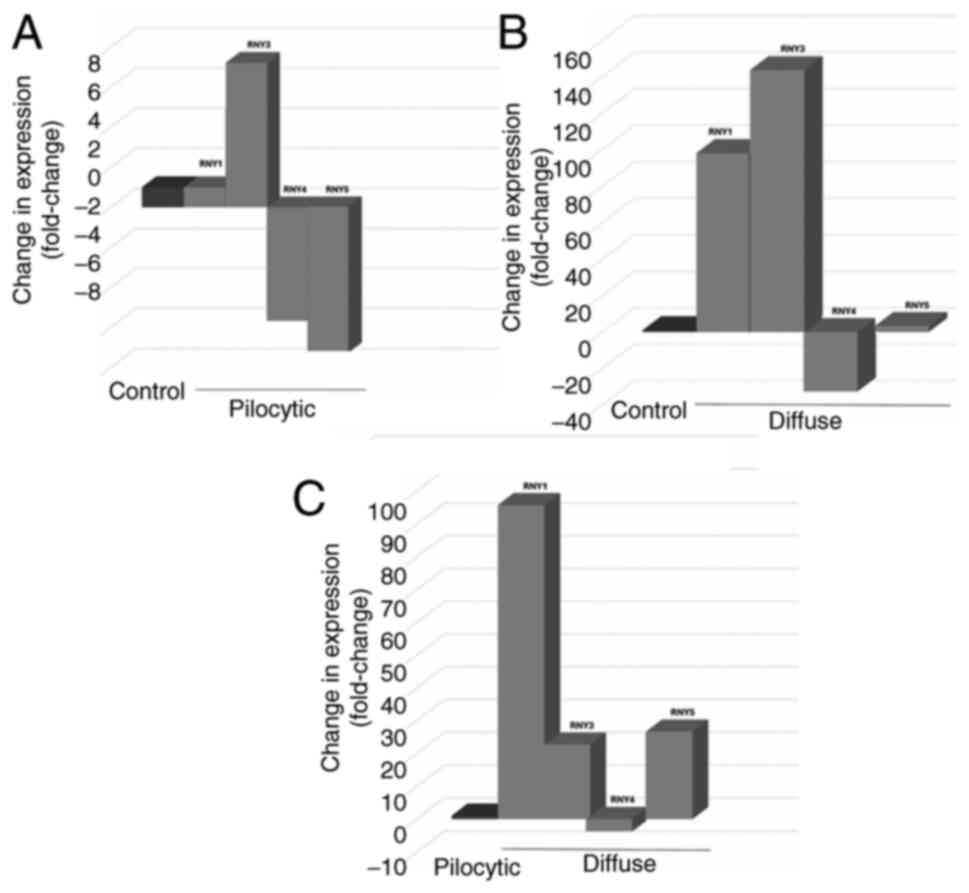
![Predicted functions for circulating
RNYs in pediatric patients with astrocytoma. Differential
expression of the four human RNYs was detected in exosomes of
pediatric patients with astrocytoma. Bioinformatic analyses
indicate that RNYs potentially interact with various protein
receptors. The establishment of protein-protein interaction
networks for these receptors [HIPPIE database
(cbdm-01.zdv.uni-mainz.de/~mschaefer/hippie)] and subsequent
analysis with the PANTHER database (pantherdb.org) showed the
potential involvement of RNYs-receptors in the control of
apoptosis, angiogenesis, cholecystokinin receptor and p53 signaling
pathways, and in Parkinson's disease. RNYs are a class of
non-coding RNAs that are components of the Ro60 ribonucleoprotein
particle. Data obtained from Rodríguez-Corona et al
(10). The data were analyzed with
the Hippie and Panther databases. Interactome images were obtained
from the Hippie database.](/article_images/mmr/32/4/mmr-32-04-13650-g02.jpg)


