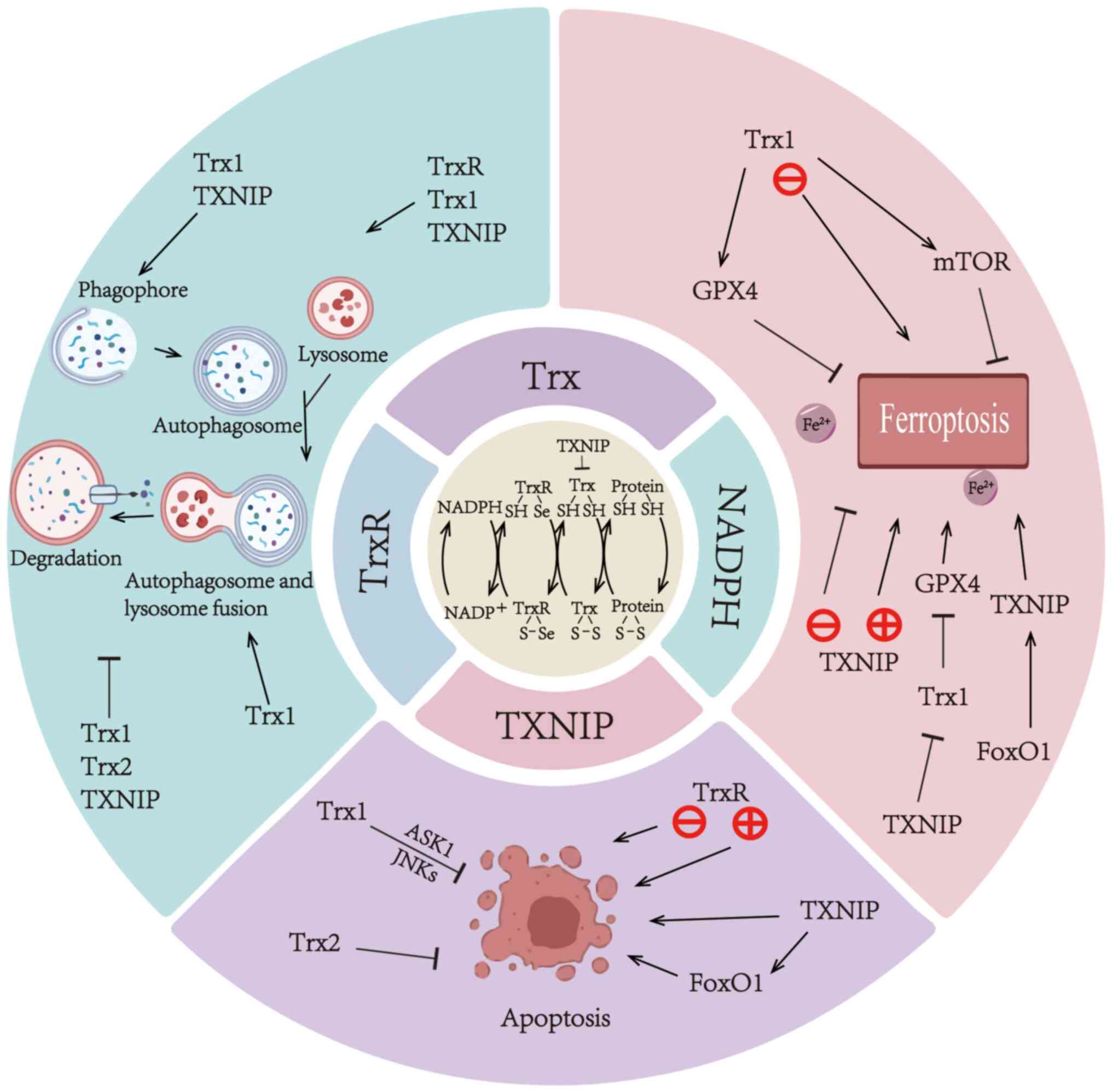
|
1
|
Hasan AA, Kalinina E, Tatarskiy V and
Shtil A: The thioredoxin system of mammalian cells and its
modulators. Biomedicines. 10:17572022. View Article : Google Scholar : PubMed/NCBI
|
|
2
|
Lee S, Kim SM and Lee RT: Thioredoxin and
thioredoxin target proteins: From molecular mechanisms to
functional significance. Antioxid Redox Signal. 18:1165–1207. 2013.
View Article : Google Scholar : PubMed/NCBI
|
|
3
|
Seitz R, Tümen D, Kunst C, Heumann P,
Schmid S, Kandulski A, Müller M and Gülow K: Exploring the
thioredoxin system as a therapeutic target in cancer: Mechanisms
and implications. Antioxidants (Basel). 13:10782024. View Article : Google Scholar : PubMed/NCBI
|
|
4
|
Muri J and Kopf M: The thioredoxin system:
Balancing redox responses in immune cells and tumors. Eur J
Immunol. 53:e22499482023. View Article : Google Scholar : PubMed/NCBI
|
|
5
|
Yang B, Lin Y, Huang Y, Shen YQ and Chen
Q: Thioredoxin (Trx): A redox target and modulator of cellular
senescence and aging-related diseases. Redox Biol. 70:1030322024.
View Article : Google Scholar : PubMed/NCBI
|
|
6
|
Dagah OMA, Silaa BB, Zhu M, Pan Q, Qi L,
Liu X, Liu Y, Peng W, Ullah Z, Yudas AF, et al: Exploring immune
redox modulation in bacterial infections: Insights into
thioredoxin-mediated interactions and implications for
understanding host-pathogen dynamics. Antioxidants (Basel).
13:5452024. View Article : Google Scholar : PubMed/NCBI
|
|
7
|
Lu J and Holmgren A: Thioredoxin system in
cell death progression. Antioxid Redox Signal. 17:1738–1747. 2012.
View Article : Google Scholar : PubMed/NCBI
|
|
8
|
Jiang C, Krzyzanowski G, Chandel DS, Tom
WA, Fernando N, Olou A and Fernando MR: Inhibition of thioredoxin
reductase activity and oxidation of cellular thiols by
antimicrobial agent, 2-bromo-2-nitro-1,3-propanediol, causes
oxidative stress and cell death in cultured noncancer and cancer
cells. Biology (Basel). 14:5092025.PubMed/NCBI
|
|
9
|
Oberacker T, Kraft L, Schanz M, Latus J
and Schricker S: The importance of thioredoxin-1 in health and
disease. Antioxidants (Basel). 12:10782023. View Article : Google Scholar : PubMed/NCBI
|
|
10
|
Yu G and Klionsky DJ: Life and death
decisions-the many faces of autophagy in cell survival and cell
death. Biomolecules. 12:8662022. View Article : Google Scholar : PubMed/NCBI
|
|
11
|
Jiang X, Stockwell BR and Conrad M:
Ferroptosis: Mechanisms, biology and role in disease. Nat Rev Mol
Cell Biol. 22:266–282. 2021. View Article : Google Scholar : PubMed/NCBI
|
|
12
|
Yan HF, Zou T, Tuo QZ, Xu S, Li H, Belaidi
AA and Lei P: Ferroptosis: Mechanisms and links with diseases.
Signal Transduct Target Ther. 6:492021. View Article : Google Scholar : PubMed/NCBI
|
|
13
|
Yang Y, Cheng J, Lin Q and Ni Z:
Autophagy-dependent ferroptosis in kidney disease. Front Med
(Lausanne). 9:10718642023. View Article : Google Scholar : PubMed/NCBI
|
|
14
|
Liu X, Tuerxun H and Zhao Y, Li Y, Wen S,
Li X and Zhao Y: Crosstalk between ferroptosis and autophagy:
Broaden horizons of cancer therapy. J Transl Med. 23:182025.
View Article : Google Scholar : PubMed/NCBI
|
|
15
|
Mahmood DFD, Abderrazak A, El Hadri K,
Simmet T and Rouis M: The thioredoxin system as a therapeutic
target in human health and disease. Antioxid Redox Signal.
19:1266–1303. 2013. View Article : Google Scholar : PubMed/NCBI
|
|
16
|
Laurent TC, Moore EC and Reichard P:
Enzymatic synthesis of deoxyribonucleotides. IV. isolation and
characterization of thioredoxin, the hydrogen donor from
Escherichia coli B. J Biol Chem. 239:3436–3444. 1964.
View Article : Google Scholar : PubMed/NCBI
|
|
17
|
Xinastle-Castillo LO and Landa A:
Physiological and modulatory role of thioredoxins in the cellular
function. Open Med (Wars). 17:2021–2035. 2022. View Article : Google Scholar : PubMed/NCBI
|
|
18
|
Eklund H, Gleason FK and Holmgren A:
Structural and functional relations among thioredoxins of different
species. Proteins. 11:13–28. 1991. View Article : Google Scholar : PubMed/NCBI
|
|
19
|
Hanschmann EM, Godoy JR, Berndt C,
Hudemann C and Lillig CH: Thioredoxins, glutaredoxins, and
peroxiredoxins-molecular mechanisms and health significance: From
cofactors to antioxidants to redox signaling. Antioxid Redox
Signal. 19:1539–1605. 2013. View Article : Google Scholar : PubMed/NCBI
|
|
20
|
Forman-Kay JD, Clore GM, Wingfield PT and
Gronenborn AM: High-resolution three-dimensional structure of
reduced recombinant human thioredoxin in solution. Biochemistry.
30:2685–2698. 1991. View Article : Google Scholar : PubMed/NCBI
|
|
21
|
Collet JF and Messens J: Structure,
function, and mechanism of thioredoxin proteins. Antioxid Redox
Signal. 13:1205–1216. 2010. View Article : Google Scholar : PubMed/NCBI
|
|
22
|
Barglow KT, Knutson CG, Wishnok JS,
Tannenbaum SR and Marletta MA: Site-specific and redox-controlled
S-nitrosation of thioredoxin. Proc Natl Acad Sci USA.
108:E600–E606. 2011. View Article : Google Scholar : PubMed/NCBI
|
|
23
|
Ungerstedt J, Du Y, Zhang H, Nair D and
Holmgren A: In vivo redox state of human thioredoxin and redox
shift by the histone deacetylase inhibitor suberoylanilide
hydroxamic acid (SAHA). Free Radic Biol Med. 53:2002–2007. 2012.
View Article : Google Scholar : PubMed/NCBI
|
|
24
|
Cortes-Bratti X, Bassères E,
Herrera-Rodriguez F, Botero-Kleiven S, Coppotelli G, Andersen JB,
Masucci MG, Holmgren A, Chaves-Olarte E, Frisan T and Avila-Cariño
J: Thioredoxin 80-activated-monocytes (TAMs) inhibit the
replication of intracellular pathogens. PLoS One. 6:e169602011.
View Article : Google Scholar : PubMed/NCBI
|
|
25
|
King BC, Nowakowska J, Karsten CM, Köhl J,
Renström E and Blom AM: Truncated and full-length thioredoxin-1
have opposing activating and inhibitory properties for human
complement with relevance to endothelial surfaces. J Immunol.
188:4103–4112. 2012. View Article : Google Scholar : PubMed/NCBI
|
|
26
|
Kim MK, Zhao L, Jeong S, Zhang J, Jung JH,
Seo HS, Choi JI and Lim S: Structural and biochemical
characterization of thioredoxin-2 from deinococcus radiodurans.
Antioxidants (Basel). 10:18432021. View Article : Google Scholar : PubMed/NCBI
|
|
27
|
Gencheva R, Cheng Q and Arnér ESJ:
Thioredoxin reductase selenoproteins from different organisms as
potential drug targets for treatment of human diseases. Free Radic
Biol Med. 190:320–338. 2022. View Article : Google Scholar : PubMed/NCBI
|
|
28
|
Arnér ES and Holmgren A: Physiological
functions of thioredoxin and thioredoxin reductase. Eur J Biochem.
267:6102–6109. 2000. View Article : Google Scholar : PubMed/NCBI
|
|
29
|
Papp LV, Lu J, Holmgren A and Khanna KK:
From selenium to selenoproteins: Synthesis, identity, and their
role in human health. Antioxid Redox Signal. 9:775–806. 2007.
View Article : Google Scholar : PubMed/NCBI
|
|
30
|
Lu J, Zhong L, Lönn ME, Burk RF, Hill KE
and Holmgren A: Penultimate selenocysteine residue replaced by
cysteine in thioredoxin reductase from selenium-deficient rat
liver. FASEB J. 23:2394–2402. 2009. View Article : Google Scholar : PubMed/NCBI
|
|
31
|
Zeisel L, Felber JG, Scholzen KC, Poczka
L, Cheff D, Maier MS, Cheng Q, Shen M, Hall MD, Arnér ESJ, et al:
Selective cellular probes for mammalian thioredoxin reductase
TrxR1: Rational design of RX1, a modular 1,2-thiaselenane redox
probe. Chem. 8:1493–1517. 2022. View Article : Google Scholar : PubMed/NCBI
|
|
32
|
Muri J, Heer S, Matsushita M, Pohlmeier L,
Tortola L, Fuhrer T, Conrad M, Zamboni N, Kisielow J and Kopf M:
The thioredoxin-1 system is essential for fueling DNA synthesis
during T-cell metabolic reprogramming and proliferation. Nat
Commun. 9:18512018. View Article : Google Scholar : PubMed/NCBI
|
|
33
|
Cebula M, Moolla N, Capovilla A and Arnér
ESJ: The rare TXNRD1_v3 (‘v3’) splice variant of human thioredoxin
reductase 1 protein is targeted to membrane rafts by N-acylation
and induces filopodia independently of its redox active site
integrity. J Biol Chem. 288:10002–10011. 2013. View Article : Google Scholar : PubMed/NCBI
|
|
34
|
Zhang J, Li X, Han X, Liu R and Fang J:
Targeting the thioredoxin system for cancer therapy. Trends
Pharmacol Sci. 38:794–808. 2017. View Article : Google Scholar : PubMed/NCBI
|
|
35
|
Pollak N, Dölle C and Ziegler M: The power
to reduce: Pyridine nucleotides-small molecules with a multitude of
functions. Biochem J. 402:205–218. 2007. View Article : Google Scholar : PubMed/NCBI
|
|
36
|
Holmgren A and Lu J: Thioredoxin and
thioredoxin reductase: current research with special reference to
human disease. Biochem Biophys Res Commun. 396:120–124. 2010.
View Article : Google Scholar : PubMed/NCBI
|
|
37
|
Gaber A, Tamoi M, Takeda T, Nakano Y and
Shigeoka S: NADPH-dependent glutathione peroxidase-like proteins
(Gpx-1, Gpx-2) reduce unsaturated fatty acid hydroperoxides in
Synechocystis PCC 6803. FEBS Lett. 499:32–36. 2001. View Article : Google Scholar : PubMed/NCBI
|
|
38
|
Frasier CR, Moukdar F, Patel HD, Sloan RC,
Stewart LM, Alleman RJ, La Favor JD and Brown DA: Redox-dependent
increases in glutathione reductase and exercise preconditioning:
Role of NADPH oxidase and mitochondria. Cardiovasc Res. 98:47–55.
2013. View Article : Google Scholar : PubMed/NCBI
|
|
39
|
Koh HJ, Lee SM, Son BG, Lee SH, Ryoo ZY,
Chang KT, Park JW, Park DC, Song BJ, Veech RL, et al: Cytosolic
NADP+-dependent isocitrate dehydrogenase plays a key role in lipid
metabolism. J Biol Chem. 279:39968–39974. 2004. View Article : Google Scholar : PubMed/NCBI
|
|
40
|
Santos CXC, Raza S and Shah AM: Redox
signaling in the cardiomyocyte: From physiology to failure. Int J
Biochem Cell Biol. 74:145–151. 2016. View Article : Google Scholar : PubMed/NCBI
|
|
41
|
Masutani H: Thioredoxin-interacting
protein in cancer and diabetes. Antioxid Redox Signal.
36:1001–1022. 2022. View Article : Google Scholar : PubMed/NCBI
|
|
42
|
Chen KS and DeLuca HF: Isolation and
characterization of a novel cDNA from HL-60 cells treated with
1,25-dihydroxyvitamin D-3. Biochim Biophys Acta. 1219:26–32. 1994.
View Article : Google Scholar : PubMed/NCBI
|
|
43
|
Nishiyama A, Matsui M, Iwata S, Hirota K,
Masutani H, Nakamura H, Takagi Y, Sono H, Gon Y and Yodoi J:
Identification of thioredoxin-binding protein-2/vitamin D(3)
up-regulated protein 1 as a negative regulator of thioredoxin
function and expression. J Biol Chem. 274:21645–21650. 1999.
View Article : Google Scholar : PubMed/NCBI
|
|
44
|
Hwang J, Suh HW, Jeon YH, Hwang E, Nguyen
LT, Yeom J, Lee SG, Lee C, Kim KJ, Kang BS, et al: The structural
basis for the negative regulation of thioredoxin by
thioredoxin-interacting protein. Nat Commun. 5:29582014. View Article : Google Scholar : PubMed/NCBI
|
|
45
|
Saxena G, Chen J and Shalev A:
Intracellular shuttling and mitochondrial function of
thioredoxin-interacting protein. J Biol Chem. 285:3997–4005. 2010.
View Article : Google Scholar : PubMed/NCBI
|
|
46
|
Chen CL, Lin CF, Chang WT, Huang WC, Teng
CF and Lin YS: Ceramide induces p38 MAPK and JNK activation through
a mechanism involving a thioredoxin-interacting protein-mediated
pathway. Blood. 111:4365–4374. 2008. View Article : Google Scholar : PubMed/NCBI
|
|
47
|
Li Y, Deng W, Wu J, He Q, Yang G, Luo X,
Jia Y, Duan Y, Zhou L and Liu D: TXNIP exacerbates the senescence
and aging-related dysfunction of β cells by inducing cell cycle
arrest through p38-p16/p21-CDK-Rb pathway. Antioxid Redox Signal.
38:480–495. 2023. View Article : Google Scholar : PubMed/NCBI
|
|
48
|
Song S, Qiu D, Wang Y, Wei J, Wu H, Wu M,
Wang S, Zhou X, Shi Y and Duan H: TXNIP deficiency mitigates
podocyte apoptosis via restraining the activation of mTOR or p38
MAPK signaling in diabetic nephropathy. Exp Cell Res.
388:1118622020. View Article : Google Scholar : PubMed/NCBI
|
|
49
|
Pan M, Zhang F, Qu K, Liu C and Zhang J:
TXNIP: A double-edged sword in disease and therapeutic outlook.
Oxid Med Cell Longev. 2022:78051152022. View Article : Google Scholar : PubMed/NCBI
|
|
50
|
Yoshihara E: TXNIP/TBP-2: A master
regulator for glucose homeostasis. Antioxidants (Basel). 9:7652020.
View Article : Google Scholar : PubMed/NCBI
|
|
51
|
Wu N, Zheng B, Shaywitz A, Dagon Y, Tower
C, Bellinger G, Shen CH, Wen J, Asara J, McGraw TE, et al:
AMPK-dependent degradation of TXNIP upon energy stress leads to
enhanced glucose uptake via GLUT1. Mol Cell. 49:1167–1175. 2013.
View Article : Google Scholar : PubMed/NCBI
|
|
52
|
Park SJ, Kim Y, Li C, Suh J, Sivapackiam
J, Goncalves TM, Jarad G, Zhao G, Urano F, Sharma V and Chen YM:
Blocking CHOP-dependent TXNIP shuttling to mitochondria attenuates
albuminuria and mitigates kidney injury in nephrotic syndrome. Proc
Natl Acad Sci USA. 119:e21165051192022. View Article : Google Scholar : PubMed/NCBI
|
|
53
|
Kim SK, Choe JY and Park KY:
TXNIP-mediated nuclear factor-κB signaling pathway and
intracellular shifting of TXNIP in uric acid-induced NLRP3
inflammasome. Biochem Biophys Res Commun. 511:725–731. 2019.
View Article : Google Scholar : PubMed/NCBI
|
|
54
|
Devi TS, Somayajulu M, Kowluru RA and
Singh LP: TXNIP regulates mitophagy in retinal Müller cells under
high-glucose conditions: Implications for diabetic retinopathy.
Cell Death Dis. 8:e27772017. View Article : Google Scholar : PubMed/NCBI
|
|
55
|
Meszaros M, Yusenko M, Domonkos L, Peterfi
L, Kovacs G and Banyai D: Expression of TXNIP is associated with
angiogenesis and postoperative relapse of conventional renal cell
carcinoma. Sci Rep. 11:172002021. View Article : Google Scholar : PubMed/NCBI
|
|
56
|
Deng J, Pan T, Liu Z, McCarthy C, Vicencio
JM, Cao L, Alfano G, Suwaidan AA, Yin M, Beatson R and Ng T: The
role of TXNIP in cancer: A fine balance between redox, metabolic,
and immunological tumor control. Br J Cancer. 129:1877–1892. 2023.
View Article : Google Scholar : PubMed/NCBI
|
|
57
|
Fearnhead HO, Vandenabeele P and Vanden
Berghe T: How do we fit ferroptosis in the family of regulated cell
death? Cell Death Differ. 24:1991–1998. 2017. View Article : Google Scholar : PubMed/NCBI
|
|
58
|
Tuo QZ and Lei P: Ferroptosis in ischemic
stroke: Animal models and mechanisms. Zool Res. 45:1235–1248. 2024.
View Article : Google Scholar : PubMed/NCBI
|
|
59
|
Xie Y, Kang R, Klionsky DJ and Tang D:
GPX4 in cell death, autophagy, and disease. Autophagy.
19:2621–2638. 2023. View Article : Google Scholar : PubMed/NCBI
|
|
60
|
Cheng Q, Chen M, Liu M, Chen X, Zhu L, Xu
J, Xue J, Wu H and Du Y: Semaphorin 5A suppresses ferroptosis
through activation of PI3K-AKT-mTOR signaling in rheumatoid
arthritis. Cell Death Dis. 13:6082022. View Article : Google Scholar : PubMed/NCBI
|
|
61
|
Yodoi J, Matsuo Y, Tian H, Masutani H and
Inamoto T: Anti-inflammatory thioredoxin family proteins for
medicare, healthcare and aging care. Nutrients. 9:10812017.
View Article : Google Scholar : PubMed/NCBI
|
|
62
|
Sastre J, Pérez S, Sabater L and
Rius-Pérez S: Redox signaling in the pancreas in health and
disease. Physiol Rev. 105:593–650. 2025. View Article : Google Scholar : PubMed/NCBI
|
|
63
|
Shen K, Wang X, Wang Y, Jia Y, Zhang Y,
Wang K, Luo L, Cai W, Li J, Li S, et al: miR-125b-5p in adipose
derived stem cells exosome alleviates pulmonary microvascular
endothelial cells ferroptosis via Keap1/Nrf2/GPX4 in sepsis lung
injury. Redox Biol. 62:1026552023. View Article : Google Scholar : PubMed/NCBI
|
|
64
|
Wang H, Xie B, Shi S, Zhang R, Liang Q,
Liu Z and Cheng Y: Curdione inhibits ferroptosis in
isoprenaline-induced myocardial infarction via regulating
Keap1/Trx1/GPX4 signaling pathway. Phytother Res. 37:5328–5340.
2023. View Article : Google Scholar : PubMed/NCBI
|
|
65
|
Bai L, Yan F, Deng R, Gu R, Zhang X and
Bai J: Thioredoxin-1 rescues MPP+/MPTP-induced
ferroptosis by increasing glutathione peroxidase 4. Mol Neurobiol.
58:3187–3197. 2021. View Article : Google Scholar : PubMed/NCBI
|
|
66
|
Bebber CM, Müller F, Prieto Clemente L,
Weber J and von Karstedt S: Ferroptosis in cancer cell biology.
Cancers (Basel). 12:1642020. View Article : Google Scholar : PubMed/NCBI
|
|
67
|
Ye Z, Liu W, Zhuo Q, Hu Q, Liu M, Sun Q,
Zhang Z, Fan G, Xu W, Ji S, et al: Ferroptosis: Final destination
for cancer? Cell Prolif. 53:e127612020. View Article : Google Scholar : PubMed/NCBI
|
|
68
|
Su Y, Zhao B, Zhou L, Zhang Z, Shen Y, Lv
H, AlQudsy LHH and Shang P: Ferroptosis, a novel pharmacological
mechanism of anti-cancer drugs. Cancer Lett. 483:127–136. 2020.
View Article : Google Scholar : PubMed/NCBI
|
|
69
|
Lu J and Holmgren A: The thioredoxin
antioxidant system. Free Radic Biol Med. 66:75–87. 2014. View Article : Google Scholar : PubMed/NCBI
|
|
70
|
Dixon SJ, Lemberg KM, Lamprecht MR, Skouta
R, Zaitsev EM, Gleason CE, Patel DN, Bauer AJ, Cantley AM, Yang WS,
et al: Ferroptosis: An iron-dependent form of nonapoptotic cell
death. Cell. 149:1060–1072. 2012. View Article : Google Scholar : PubMed/NCBI
|
|
71
|
Tang Z, Liu Y, He M and Bu W: Chemodynamic
therapy: Tumour microenvironment-mediated fenton and fenton-like
reactions. Angew Chem Int Ed Engl. 58:946–956. 2019. View Article : Google Scholar : PubMed/NCBI
|
|
72
|
Mohammadi F, Soltani A, Ghahremanloo A,
Javid H and Hashemy SI: The thioredoxin system and cancer therapy:
A review. Cancer Chemother Pharmacol. 84:925–935. 2019. View Article : Google Scholar : PubMed/NCBI
|
|
73
|
Lei G, Mao C, Yan Y, Zhuang L and Gan B:
Ferroptosis, radiotherapy, and combination therapeutic strategies.
Protein Cell. 12:836–857. 2021. View Article : Google Scholar : PubMed/NCBI
|
|
74
|
Lin Y, Chen X, Yu C, Xu G, Nie X, Cheng Y,
Luan Y and Song Q: Radiotherapy-mediated redox
homeostasis-controllable nanomedicine for enhanced ferroptosis
sensitivity in tumor therapy. Acta Biomater. 159:300–311. 2023.
View Article : Google Scholar : PubMed/NCBI
|
|
75
|
Sun X, Zhang C, Fan B, Liu Q, Shi X, Wang
S, Chen T, Cai X, Hu C, Sun H, et al: Cotargeting of thioredoxin 1
and glutamate-cysteine ligase in both imatinib-sensitive and
imatinib-resistant CML cells. Biochem Pharmacol. 233:1167632025.
View Article : Google Scholar : PubMed/NCBI
|
|
76
|
Zhao L, Zhou X, Xie F and Zhang L, Yan H,
Huang J, Zhang C, Zhou F, Chen J and Zhang L: Ferroptosis in cancer
and cancer immunotherapy. Cancer Commun (Lond). 42:88–116. 2022.
View Article : Google Scholar : PubMed/NCBI
|
|
77
|
Hassannia B, Vandenabeele P and Vanden
Berghe T: Targeting ferroptosis to iron out cancer. Cancer Cell.
35:830–849. 2019. View Article : Google Scholar : PubMed/NCBI
|
|
78
|
Wang S, Guo Q, Zhou L and Xia X:
Ferroptosis: A double-edged sword. Cell Death Discov. 10:2652024.
View Article : Google Scholar : PubMed/NCBI
|
|
79
|
Zhu W, Liu X, Yang L, He Q, Huang D and
Tan X: Ferroptosis and tumor immunity: In perspective of the major
cell components in the tumor microenvironment. Eur J Pharmacol.
961:1761242023. View Article : Google Scholar : PubMed/NCBI
|
|
80
|
Islam MI, Sultana S, Padmanabhan N, Rashid
MU, Siddiqui TJ, Coombs KM, Vitiello PF, Karimi-Abdolrezaee S and
Eftekharpour E: Thioredoxin-1 protein interactions in neuronal
survival and neurodegeneration. Biochim Biophys Acta Mol Basis Dis.
1871:1675482025. View Article : Google Scholar : PubMed/NCBI
|
|
81
|
Oka SI, Hirata T, Suzuki W, Naito D, Chen
Y, Chin A, Yaginuma H, Saito T, Nagarajan N, Zhai P, et al:
Thioredoxin-1 maintains mechanistic target of rapamycin (mTOR)
function during oxidative stress in cardiomyocytes. J Biol Chem.
292:18988–19000. 2017. View Article : Google Scholar : PubMed/NCBI
|
|
82
|
Oka SI, Chin A, Park JY, Ikeda S,
Mizushima W, Ralda G, Zhai P, Tong M, Byun J, Tang F, et al:
Thioredoxin-1 maintains mitochondrial function via mechanistic
target of rapamycin signalling in the heart. Cardiovasc Res.
116:1742–1755. 2020. View Article : Google Scholar : PubMed/NCBI
|
|
83
|
Oka SI, Mizushima W, Huan C and Sadoshima
J: Abstract 877: Thioredoxin-1 maintains cardiac function and
metabolic gene expression via mTOR signaling. Circ Res. 125 (Suppl
1):2019. View Article : Google Scholar
|
|
84
|
Yu Y, Wu T, Lu Y, Zhao W, Zhang J, Chen Q,
Ge G, Hua Y, Chen K, Ullah I and Zhang F: Exosomal thioredoxin-1
from hypoxic human umbilical cord mesenchymal stem cells inhibits
ferroptosis in doxorubicin-induced cardiotoxicity via mTORC1
signaling. Free Radic Biol Med. 193:108–121. 2022. View Article : Google Scholar : PubMed/NCBI
|
|
85
|
Yang Z, Huang S, Liu Y, Chang X, Liang Y,
Li X, Xu Z, Wang S, Lu Y, Liu Y and Liu W: Biotin-targeted Au(I)
radiosensitizer for cancer synergistic therapy by intervening with
redox homeostasis and inducing ferroptosis. J Med Chem.
65:8401–8415. 2022. View Article : Google Scholar : PubMed/NCBI
|
|
86
|
Xi J, Tian LL, Xi J, Girimpuhwe D, Huang
C, Ma R, Yao X, Shi D, Bai Z, Wu QX and Fang J: Alterperylenol as a
novel thioredoxin reductase inhibitor induces liver cancer cell
apoptosis and ferroptosis. J Agric Food Chem. 70:15763–15775. 2022.
View Article : Google Scholar : PubMed/NCBI
|
|
87
|
Guo Y, Han Y, Zhang J, Zhou Y, Wei M and
Yu L: Identification and experimental validation of prognostic
miRNA signature and ferroptosis-related key genes in cervical
squamous cell carcinoma. Cancer Med. 13:e704152024. View Article : Google Scholar : PubMed/NCBI
|
|
88
|
Jin W, Liu J, Yang J, Feng Z, Feng Z,
Huang N, Yang T and Yu L: Identification of a key ceRNA network
associated with ferroptosis in gastric cancer. Sci Rep.
12:200882022. View Article : Google Scholar : PubMed/NCBI
|
|
89
|
Chen N, Meng Y, Zhan H and Li G:
Identification and validation of potential ferroptosis-related
genes in glucocorticoid-induced osteonecrosis of the femoral head.
Medicina (Kaunas). 59:2972023. View Article : Google Scholar : PubMed/NCBI
|
|
90
|
Zheng Y, Song J, Qian Q and Wang H: Silver
nanoparticles induce liver inflammation through ferroptosis in
zebrafish. Chemosphere. 362:1426732024. View Article : Google Scholar : PubMed/NCBI
|
|
91
|
Han SH, Jeon JH, Ju HR, Jung U, Kim KY,
Yoo HS, Lee YH, Song KS, Hwang HM, Na YS, et al: VDUP1 upregulated
by TGF-beta1 and 1,25-dihydorxyvitamin D3 inhibits tumor cell
growth by blocking cell-cycle progression. Oncogene. 22:4035–4046.
2003. View Article : Google Scholar : PubMed/NCBI
|
|
92
|
Nasoohi S, Ismael S and Ishrat T:
Thioredoxin-interacting protein (TXNIP) in cerebrovascular and
neurodegenerative diseases: Regulation and implication. Mol
Neurobiol. 55:7900–7920. 2018. View Article : Google Scholar : PubMed/NCBI
|
|
93
|
Morrison JA, Pike LA, Sams SB, Sharma V,
Zhou Q, Severson JJ, Tan AC, Wood WM and Haugen BR: Thioredoxin
interacting protein (TXNIP) is a novel tumor suppressor in thyroid
cancer. Mol Cancer. 13:622014. View Article : Google Scholar : PubMed/NCBI
|
|
94
|
Bao W, Wang J, Fan K, Gao Y and Chen J:
PIAS3 promotes ferroptosis by regulating TXNIP via TGF-β signaling
pathway in hepatocellular carcinoma. Pharmacol Res. 196:1069152023.
View Article : Google Scholar : PubMed/NCBI
|
|
95
|
Zheng Y, Yang W, Wu W, Jin F, Lu D, Gao J
and Wang S: Diagnostic and predictive significance of the
ferroptosis-related gene TXNIP in lung adenocarcinoma stem cells
based on multi-omics. Transl Oncol. 45:1019262024. View Article : Google Scholar : PubMed/NCBI
|
|
96
|
Guo H, Fang T, Cheng Y, Li T, Qu JR, Xu
CF, Deng XQ, Sun B and Chen LM: ChREBP-β/TXNIP aggravates
frucose-induced renal injury through triggering ferroptosis of
renal tubular epithelial cells. Free Radic Biol Med. 199:154–165.
2023. View Article : Google Scholar : PubMed/NCBI
|
|
97
|
Liu Z, Gan S, Fu L, Xu Y, Wang S, Zhang G,
Pan D, Tao L and Shen X: 1,8-Cineole ameliorates diabetic
retinopathy by inhibiting retinal pigment epithelium ferroptosis
via PPAR-γ/TXNIP pathways. Biomed Pharmacother. 164:1149782023.
View Article : Google Scholar : PubMed/NCBI
|
|
98
|
Maimaiti Y, Abulitifu M, Ajimu Z, Su T,
Zhang Z, Yu Z and Xu H: FOXO regulation of TXNIP induces
ferroptosis in satellite cells by inhibiting glutathione
metabolism, promoting sarcopenia. Cell Mol Life Sci. 82:812025.
View Article : Google Scholar : PubMed/NCBI
|
|
99
|
Chen Q, Sun J, Liu X, Qin Z, Li J, Ma J,
Xue Z, Li Y, Yang Z, Sun Q, et al: Dexmedetomidine and argon in
combination against ferroptosis through tackling TXNIP-mediated
oxidative stress in DCD porcine livers. Cell Death Discov.
10:3192024. View Article : Google Scholar : PubMed/NCBI
|
|
100
|
Li J, Yue Z, Xiong W, Sun P, You K and
Wang J: TXNIP overexpression suppresses proliferation and induces
apoptosis in SMMC7221 cells through ROS generation and MAPK pathway
activation. Oncol Rep. 37:3369–3376. 2017. View Article : Google Scholar : PubMed/NCBI
|
|
101
|
Yi K, Liu J, Rong Y, Wang C, Tang X, Zhang
X, Xiong Y and Wang F: Biological functions and prognostic value of
ferroptosis-related genes in bladder cancer. Front Mol Biosci.
8:6311522021. View Article : Google Scholar : PubMed/NCBI
|
|
102
|
He L, He T, Farrar S, Ji L, Liu T and Ma
X: Antioxidants maintain cellular redox homeostasis by elimination
of reactive oxygen species. Cell Physiol Biochem. 44:532–553. 2017.
View Article : Google Scholar : PubMed/NCBI
|
|
103
|
Mohamed IN, Li L, Ismael S, Ishrat T and
El-Remessy AB: Thioredoxin interacting protein, a key molecular
switch between oxidative stress and sterile inflammation in
cellular response. World J Diabetes. 12:1979–1999. 2021. View Article : Google Scholar : PubMed/NCBI
|
|
104
|
Zhang XY, Liu CM, Ma YH, Meng N, Jiang JY,
Yu XH and Wang XL: The TXNIP/Trx-1/GPX4 pathway promotes
ferroptosis in hippocampal neurons after hypoxia-ischemia in
neonatal rats. Zhongguo Dang Dai Er Ke Za Zhi. 24:1053–1060.
2022.(In Chinese). PubMed/NCBI
|
|
105
|
Chen K, Meng Z, Min J, Wang J, Li Z, Gao Q
and Hu J: Curcumin alleviates septic lung injury in mice by
inhibiting TXNIP/TRX-1/GPX4-mediated ferroptosis. Nan Fang Yi Ke Da
Xue Xue Bao. 44:1805–1813. 2024.(In Chinese). PubMed/NCBI
|
|
106
|
Bento CF, Renna M, Ghislat G, Puri C,
Ashkenazi A, Vicinanza M, Menzies FM and Rubinsztein DC: Mammalian
autophagy: How does it work? Annu Rev Biochem. 85:685–713. 2016.
View Article : Google Scholar : PubMed/NCBI
|
|
107
|
Yoshimori T: Autophagy: A regulated bulk
degradation process inside cells. Biochem Biophys Res Commun.
313:453–458. 2004. View Article : Google Scholar : PubMed/NCBI
|
|
108
|
Chueh KS, Lu JH, Juan TJ, Chuang SM and
Juan YS: The molecular mechanism and therapeutic application of
autophagy for urological disease. Int J Mol Sci. 24:148872023.
View Article : Google Scholar : PubMed/NCBI
|
|
109
|
Jiang P and Mizushima N: LC3- and
p62-based biochemical methods for the analysis of autophagy
progression in mammalian cells. Methods. 75:13–18. 2015. View Article : Google Scholar : PubMed/NCBI
|
|
110
|
Esteban-Martínez L and Boya P: Autophagic
flux determination in vivo and ex vivo. Methods. 75:79–86. 2015.
View Article : Google Scholar : PubMed/NCBI
|
|
111
|
Pankiv S, Clausen TH, Lamark T, Brech A,
Bruun JA, Outzen H, Øvervatn A, Bjørkøy G and Johansen T:
p62/SQSTM1 binds directly to Atg8/LC3 to facilitate degradation of
ubiquitinated protein aggregates by autophagy. J Biol Chem.
282:24131–24145. 2007. View Article : Google Scholar : PubMed/NCBI
|
|
112
|
Kumar AV, Mills J and Lapierre LR:
Selective autophagy receptor p62/SQSTM1, a pivotal player in stress
and aging. Front Cell Dev Biol. 10:7933282022. View Article : Google Scholar : PubMed/NCBI
|
|
113
|
Chaudhry N, Sica M, Surabhi S, Hernandez
DS, Mesquita A, Selimovic A, Riaz A, Lescat L, Bai H, MacIntosh GC
and Jenny A: Lamp1 mediates lipid transport, but is dispensable for
autophagy in Drosophila. Autophagy. 18:2443–2458. 2022. View Article : Google Scholar : PubMed/NCBI
|
|
114
|
Zhang J, Zeng W, Han Y, Lee WR, Liou J and
Jiang Y: Lysosomal LAMP proteins regulate lysosomal pH by direct
inhibition of the TMEM175 channel. Mol Cell. 83:2524–2539.e7. 2023.
View Article : Google Scholar : PubMed/NCBI
|
|
115
|
Yadin D, Petrover Z, Shainberg A, Alcalai
R, Waldman M, Seidman J, Seidman CE, Abraham NG, Hochhauser E and
Arad M: Autophagy guided interventions to modify the cardiac
phenotype of Danon disease. Biochem Pharmacol. 204:1152292022.
View Article : Google Scholar : PubMed/NCBI
|
|
116
|
Abokyi S, Shan SW, Lam CH, Catral KP, Pan
F, Chan HHL, To CH and Tse DYY: Targeting lysosomes to reverse
hydroquinone-induced autophagy defects and oxidative damage in
human retinal pigment epithelial cells. Int J Mol Sci. 22:90422021.
View Article : Google Scholar : PubMed/NCBI
|
|
117
|
Bunk J, Prieto Huarcaya S, Drobny A,
Dobert JP, Walther L, Rose-John S, Arnold P and Zunke F: Cathepsin
D variants associated with neurodegenerative diseases show
dysregulated functionality and modified α-synuclein degradation
properties. Front Cell Dev Biol. 9:5818052021. View Article : Google Scholar : PubMed/NCBI
|
|
118
|
Mary A, Eysert F, Checler F and Chami M:
Mitophagy in Alzheimer's disease: Molecular defects and therapeutic
approaches. Mol Psychiatry. 28:202–216. 2023. View Article : Google Scholar : PubMed/NCBI
|
|
119
|
Wang H, Luo W, Chen H, Cai Z and Xu G:
Mitochondrial dynamics and mitochondrial autophagy: Molecular
structure, orchestrating mechanism and related disorders.
Mitochondrion. 75:1018472024. View Article : Google Scholar : PubMed/NCBI
|
|
120
|
Shang C, Liu Z, Zhu Y, Lu J, Ge C, Zhang
C, Li N, Jin N, Li Y, Tian M and Li X: SARS-CoV-2 causes
mitochondrial dysfunction and mitophagy impairment. Front
Microbiol. 12:7807682022. View Article : Google Scholar : PubMed/NCBI
|
|
121
|
Bitar S, Baumann T, Weber C, Abusaada M,
Rojas-Charry L, Ziegler P, Schettgen T, Randerath IE, Venkataramani
V, Michalke B, et al: Iron-sulfur cluster loss in mitochondrial
CISD1 mediates PINK1 loss-of-function phenotypes. Elife.
13:e970272024. View Article : Google Scholar : PubMed/NCBI
|
|
122
|
Tong B, Ba Y, Li Z, Yang C, Su K, Qi H,
Zhang D, Liu X, Wu Y, Chen Y, et al: Targeting dysregulated lipid
metabolism for the treatment of Alzheimer's disease and Parkinson's
disease: Current advancements and future prospects. Neurobiol Dis.
196:1065052024. View Article : Google Scholar : PubMed/NCBI
|
|
123
|
Lamonaca G and Volta M: Alpha-synuclein
and LRRK2 in synaptic autophagy: Linking early dysfunction to
late-stage pathology in Parkinson's disease. Cells. 9:11152020.
View Article : Google Scholar : PubMed/NCBI
|
|
124
|
Calabresi P, Mechelli A, Natale G,
Volpicelli-Daley L, Di Lazzaro G and Ghiglieri V: Alpha-synuclein
in Parkinson's disease and other synucleinopathies: From overt
neurodegeneration back to early synaptic dysfunction. Cell Death
Dis. 14:1762023. View Article : Google Scholar : PubMed/NCBI
|
|
125
|
Gu R, Bai L, Yan F, Zhang S, Zhang X, Deng
R, Zeng X, Sun B, Hu X, Li Y and Bai J: Thioredoxin-1 decreases
alpha-synuclein induced by MPTP through promoting
autophagy-lysosome pathway. Cell Death Discov. 10:932024.
View Article : Google Scholar : PubMed/NCBI
|
|
126
|
Ren X, Lv J, Wang N, Liu J, Gao C, Wu X,
Yu Y, Teng Q, Dong W, Kong H and Kong L: Thioredoxin upregulation
delays diabetes-induced photoreceptor cell degeneration via
AMPK-mediated autophagy and exosome secretion. Diabetes Res Clin
Pract. 185:1097882022. View Article : Google Scholar : PubMed/NCBI
|
|
127
|
Hu J, Liu J, Chen S, Zhang C, Shen L, Yao
K and Yu Y: Thioredoxin-1 regulates the autophagy induced by
oxidative stress through LC3-II in human lens epithelial cells.
Clin Exp Pharmacol Physiol. 50:476–485. 2023. View Article : Google Scholar : PubMed/NCBI
|
|
128
|
Ren X, Lv J, Fu Y, Zhang N, Zhang C, Dong
Z, Chudhary M, Zhong S, Kong L and Kong H: Upregulation of
thioredoxin contributes to inhibiting diabetic hearing impairment.
Diabetes Res Clin Pract. 179:1090252021. View Article : Google Scholar : PubMed/NCBI
|
|
129
|
Sánchez-Villamil JP, D'Annunzio V,
Finocchietto P, Holod S, Rebagliati I, Pérez H, Peralta JG, Gelpi
RJ, Poderoso JJ and Carreras MC: Cardiac-specific overexpression of
thioredoxin 1 attenuates mitochondrial and myocardial dysfunction
in septic mice. Int J Biochem Cell Biol. 81:323–334. 2016.
View Article : Google Scholar : PubMed/NCBI
|
|
130
|
Shojaei S, Barzegar Behrooz A, Cordani M,
Aghaei M, Azarpira N, Klionsky DJ and Ghavami S: A non-fluorescent
immunohistochemistry method for measuring autophagy flux using
MAP1LC3/LC3 and SQSTM1 as core markers. FEBS Open Bio. 15:898–905.
2025. View Article : Google Scholar : PubMed/NCBI
|
|
131
|
Zhou J, Yao K, Zhang Y, Chen G, Lai K, Yin
H and Yu Y: Thioredoxin binding protein-2 regulates autophagy of
human lens epithelial cells under oxidative stress via inhibition
of Akt phosphorylation. Oxid Med Cell Longev. 2016:48564312016.
View Article : Google Scholar : PubMed/NCBI
|
|
132
|
Wang W, Huang L, Thomas ER, Hu Y, Zeng F
and Li X: Notoginsenoside R1 protects against the
acrylamide-induced neurotoxicity via upregulating Trx-1-mediated
ITGAV expression: Involvement of autophagy. Front Pharmacol.
11:5590462020. View Article : Google Scholar : PubMed/NCBI
|
|
133
|
Ren X, Wang NN, Qi H, Qiu YY, Zhang CH,
Brown E, Kong H and Kong L: Up-regulation thioredoxin inhibits
advanced glycation end products-induced neurodegeneration. Cell
Physiol Biochem. 50:1673–1686. 2018. View Article : Google Scholar : PubMed/NCBI
|
|
134
|
Ji C, Pan Y, Liu B, Liu J, Zhao C, Nie Z,
Liao S, Kuang G, Wu X, Liu Q, et al: Thioredoxin C of streptococcus
suis serotype 2 contributes to virulence by inducing antioxidative
stress and inhibiting autophagy via the MSR1/PI3K-Akt-mTOR pathway
in macrophages. Vet Microbiol. 298:1102632024. View Article : Google Scholar : PubMed/NCBI
|
|
135
|
Vötsch D, Willenborg M, Weldearegay YB and
Valentin-Weigand P: Streptococcus suis-the ‘two faces’ of a
pathobiont in the porcine respiratory tract. Front Microbiol.
9:4802018. View Article : Google Scholar : PubMed/NCBI
|
|
136
|
Dafre AL, Schmitz AE and Maher P:
Methylglyoxal-induced AMPK activation leads to autophagic
degradation of thioredoxin 1 and glyoxalase 2 in HT22 nerve cells.
Free Radic Biol Med. 108:270–279. 2017. View Article : Google Scholar : PubMed/NCBI
|
|
137
|
Dafre AL, Schmitz AE and Maher P:
Hyperosmotic stress initiates AMPK-independent autophagy and AMPK-
and autophagy-independent depletion of thioredoxin 1 and glyoxalase
2 in HT22 nerve cells. Oxid Med Cell Longev. 2019:27158102019.
View Article : Google Scholar : PubMed/NCBI
|
|
138
|
Nakatogawa H: Two ubiquitin-like
conjugation systems that mediate membrane formation during
autophagy. Essays Biochem. 55:39–50. 2013. View Article : Google Scholar : PubMed/NCBI
|
|
139
|
Arakawa S, Honda S, Yamaguchi H and
Shimizu S: Molecular mechanisms and physiological roles of
Atg5/Atg7-independent alternative autophagy. Proc Jpn Acad Ser B
Phys Biol Sci. 93:378–385. 2017. View Article : Google Scholar : PubMed/NCBI
|
|
140
|
Pérez-Pérez ME, Zaffagnini M, Marchand CH,
Crespo JL and Lemaire SD: The yeast autophagy protease Atg4 is
regulated by thioredoxin. Autophagy. 10:1953–1964. 2014. View Article : Google Scholar : PubMed/NCBI
|
|
141
|
Nagarajan N, Oka SI, Nah J, Wu C, Zhai P,
Mukai R, Xu X, Kashyap S, Huang CY, Sung EA, et al: Thioredoxin 1
promotes autophagy through transnitrosylation of Atg7 during
myocardial ischemia. J Clin Invest. 133:e1623262023. View Article : Google Scholar : PubMed/NCBI
|
|
142
|
Huang Q, Zhou HJ, Zhang H, Huang Y,
Hinojosa-Kirschenbaum F, Fan P, Yao L, Belardinelli L, Tellides G,
Giordano FJ, et al: Thioredoxin-2 inhibits mitochondrial reactive
oxygen species generation and apoptosis stress kinase-1 activity to
maintain cardiac function. Circulation. 131:1082–1097. 2015.
View Article : Google Scholar : PubMed/NCBI
|
|
143
|
He F, Huang Y, Song Z, Zhou HJ, Zhang H,
Perry RJ, Shulman GI and Min W: Mitophagy-mediated adipose
inflammation contributes to type 2 diabetes with hepatic insulin
resistance. J Exp Med. 218:e202014162021. View Article : Google Scholar : PubMed/NCBI
|
|
144
|
Li YY, Xiang Y, Zhang S, Wang Y, Yang J,
Liu W and Xue FT: Thioredoxin-2 protects against oxygen-glucose
deprivation/reperfusion injury by inhibiting autophagy and
apoptosis in H9c2 cardiomyocytes. Am J Transl Res. 9:1471–1482.
2017.PubMed/NCBI
|
|
145
|
Li Y, Xiang Y, Zhang S, Wang Y, Yang J,
Liu W and Xue F: Intramyocardial injection of thioredoxin
2-expressing lentivirus alleviates myocardial ischemia-reperfusion
injury in rats. Am J Transl Res. 9:4428–4439. 2017.PubMed/NCBI
|
|
146
|
Bjørklund G, Zou L, Wang J, Chasapis CT
and Peana M: Thioredoxin reductase as a pharmacological target.
Pharmacol Res. 174:1058542021. View Article : Google Scholar : PubMed/NCBI
|
|
147
|
Lei H, Wang G, Zhang J and Han Q:
Inhibiting TrxR suppresses liver cancer by inducing apoptosis and
eliciting potent antitumor immunity. Oncol Rep. 40:3447–3457.
2018.PubMed/NCBI
|
|
148
|
Nagakannan P, Iqbal MA, Yeung A, Thliveris
JA, Rastegar M, Ghavami S and Eftekharpour E: Perturbation of redox
balance after thioredoxin reductase deficiency interrupts
autophagy-lysosomal degradation pathway and enhances cell death in
nutritionally stressed SH-SY5Y cells. Free Radic Biol Med.
101:53–70. 2016. View Article : Google Scholar : PubMed/NCBI
|
|
149
|
Huang C, Zhang Y, Kelly DJ, Tan CYR, Gill
A, Cheng D, Braet F, Park JS, Sue CM, Pollock CA and Chen XM:
Thioredoxin interacting protein (TXNIP) regulates tubular autophagy
and mitophagy in diabetic nephropathy through the mTOR signaling
pathway. Sci Rep. 6:291962016. View Article : Google Scholar : PubMed/NCBI
|
|
150
|
Huang C, Lin MZ, Cheng D, Braet F, Pollock
CA and Chen XM: Thioredoxin-interacting protein mediates
dysfunction of tubular autophagy in diabetic kidneys through
inhibiting autophagic flux. Lab Invest. 94:309–320. 2014.
View Article : Google Scholar : PubMed/NCBI
|
|
151
|
Tang H, Hou H, Song L, Tian Z, Liu W, Xia
T and Wang A: The role of mTORC1/TFEB axis mediated lysosomal
biogenesis and autophagy impairment in fluoride neurotoxicity and
the intervention effects of resveratrol. J Hazard Mater.
467:1336342024. View Article : Google Scholar : PubMed/NCBI
|
|
152
|
Martina JA, Chen Y, Gucek M and
Puertollano R: MTORC1 functions as a transcriptional regulator of
autophagy by preventing nuclear transport of TFEB. Autophagy.
8:903–914. 2012. View Article : Google Scholar : PubMed/NCBI
|
|
153
|
Du Y, Wu M, Song S, Bian Y and Shi Y:
TXNIP deficiency attenuates renal fibrosis by modulating
mTORC1/TFEB-mediated autophagy in diabetic kidney disease. Ren
Fail. 46:23389332024. View Article : Google Scholar : PubMed/NCBI
|
|
154
|
Gao C, Wang R, Li B, Guo Y, Yin T, Xia Y,
Zhang F, Lian K, Liu Y, Wang H, et al: TXNIP/Redd1 signalling and
excessive autophagy: A novel mechanism of myocardial
ischaemia/reperfusion injury in mice. Cardiovasc Res. 116:645–657.
2020. View Article : Google Scholar : PubMed/NCBI
|
|
155
|
Ao H, Li H, Zhao X, Liu B and Lu L: TXNIP
positively regulates the autophagy and apoptosis in the rat müller
cell of diabetic retinopathy. Life Sci. 267:1189882021. View Article : Google Scholar : PubMed/NCBI
|
|
156
|
Park HS, Song JW, Park JH, Lim BK, Moon
OS, Son HY, Lee JH, Gao B, Won YS and Kwon HJ: TXNIP/VDUP1
attenuates steatohepatitis via autophagy and fatty acid oxidation.
Autophagy. 17:2549–2564. 2021. View Article : Google Scholar : PubMed/NCBI
|
|
157
|
Gordy C and He YW: The crosstalk between
autophagy and apoptosis: Where does this lead? Protein Cell.
3:17–27. 2012. View Article : Google Scholar : PubMed/NCBI
|
|
158
|
Song S, Tan J, Miao Y, Li M and Zhang Q:
Crosstalk of autophagy and apoptosis: Involvement of the dual role
of autophagy under ER stress. J Cell Physiol. 232:2977–2984. 2017.
View Article : Google Scholar : PubMed/NCBI
|
|
159
|
Wang J, Wang J, Wang JJ, Zhang WF and Jiao
XY: Role of autophagy in TXNIP overexpression-induced apoptosis of
INS-1 islet cells. Sheng Li Xue Bao. 69:445–451. 2017.(In Chinese).
PubMed/NCBI
|
|
160
|
Wang W, Lu D, Shi Y and Wang Y: Exploring
the neuroprotective effects of lithium in ischemic stroke: A
literature review. Int J Med Sci. 21:284–298. 2024. View Article : Google Scholar : PubMed/NCBI
|
|
161
|
Lin Q, Li S, Jin H, Cai H, Zhu X, Yang Y,
Wu J, Qi C, Shao X, Li J, et al: Mitophagy alleviates
cisplatin-induced renal tubular epithelial cell ferroptosis through
ROS/HO-1/GPX4 axis. Int J Biol Sci. 19:1192–1210. 2023. View Article : Google Scholar : PubMed/NCBI
|
|
162
|
Ji H, Zhao Y, Ma X, Wu L, Guo F, Huang F,
Song Y, Wang J and Qin G: Upregulation of UHRF1 promotes
PINK1-mediated mitophagy to alleviate ferroptosis in diabetic
nephropathy. Inflammation. 47:718–732. 2024. View Article : Google Scholar : PubMed/NCBI
|
|
163
|
Li C, Fang Y and Chen YM: Beyond redox
regulation: Novel roles of TXNIP in the pathogenesis and
therapeutic targeting of kidney disease. Am J Pathol. 195:615–625.
2025. View Article : Google Scholar : PubMed/NCBI
|
|
164
|
Zhang Y, Li B, Fu Y, Cai H and Zheng Y:
Txnip promotes autophagic apoptosis in diabetic cardiomyopathy by
upregulating FoxO1 and its acetylation. Cell Signal.
124:1114692024. View Article : Google Scholar : PubMed/NCBI
|
|
165
|
Zhao Q, Liu Y, Zhong J, Bi Y, Liu Y, Ren
Z, Li X, Jia J, Yu M and Yu X: Pristimerin induces apoptosis and
autophagy via activation of ROS/ASK1/JNK pathway in human breast
cancer in vitro and in vivo. Cell Death Discov. 5:1252019.
View Article : Google Scholar : PubMed/NCBI
|
|
166
|
Cavalcante GC, Schaan AP, Cabral GF,
Santana-da-Silva MN, Pinto P, Vidal AF and Ribeiro-Dos-Santos Â: A
cell's fate: An overview of the molecular biology and genetics of
apoptosis. Int J Mol Sci. 20:41332019. View Article : Google Scholar : PubMed/NCBI
|
|
167
|
Liu Y and Min W: Thioredoxin promotes ASK1
ubiquitination and degradation to inhibit ASK1-mediated apoptosis
in a redox activity-independent manner. Circ Res. 90:1259–1266.
2002. View Article : Google Scholar : PubMed/NCBI
|
|
168
|
Bao N, Wang J, Yue Q, Cao F, Gu X, Wen K,
Kong W and Gu M: Chrysophanol-mediated trx-1 activation attenuates
renal fibrosis through inhibition of the JNK/Cx43 signaling
pathway. Ren Fail. 46:23987102024. View Article : Google Scholar : PubMed/NCBI
|
|
169
|
D'Annunzio V, Perez V, Boveris A, Gelpi RJ
and Poderoso JJ: Role of thioredoxin-1 in ischemic preconditioning,
postconditioning and aged ischemic hearts. Pharmacol Res.
109:24–31. 2016. View Article : Google Scholar : PubMed/NCBI
|
|
170
|
Yang L, Guo N, Fan W, Ni C, Huang M, Bai
L, Zhang L, Zhang X, Wen Y, Li Y, et al: Thioredoxin-1 blocks
methamphetamine-induced injury in brain through inhibiting
endoplasmic reticulum and mitochondria-mediated apoptosis in mice.
Neurotoxicology. 78:163–169. 2020. View Article : Google Scholar : PubMed/NCBI
|
|
171
|
Liu H, Dai L, Wang M, Feng F and Xiao Y:
Tunicamycin induces hepatic stellate cell apoptosis through
calpain-2/Ca2 +-dependent endoplasmic reticulum stress
pathway. Front Cell Dev Biol. 9:6848572021. View Article : Google Scholar : PubMed/NCBI
|
|
172
|
Tian C, Gao P, Zheng Y, Yue W, Wang X, Jin
H and Chen Q: Redox status of thioredoxin-1 (TRX1) determines the
sensitivity of human liver carcinoma cells (HepG2) to arsenic
trioxide-induced cell death. Cell Res. 18:458–471. 2008. View Article : Google Scholar : PubMed/NCBI
|
|
173
|
Pérez VI, Lew CM, Cortez LA, Webb CR,
Rodriguez M, Liu Y, Qi W, Li Y, Chaudhuri A, Van Remmen H, et al:
Thioredoxin 2 haploinsufficiency in mice results in impaired
mitochondrial function and increased oxidative stress. Free Radic
Biol Med. 44:882–892. 2008. View Article : Google Scholar : PubMed/NCBI
|
|
174
|
Kundumani-Sridharan V, Subramani J, Owens
C and Das KC: Nrg1β released in remote ischemic preconditioning
improves myocardial perfusion and decreases ischemia/reperfusion
injury via ErbB2-mediated rescue of endothelial nitric oxide
synthase and abrogation of Trx2 autophagy. Arterioscler Thromb Vasc
Biol. 41:2293–2314. 2021. View Article : Google Scholar : PubMed/NCBI
|
|
175
|
Xu Q, Zhang J, Zhao Z, Chu Y and Fang J:
Revealing PACMA 31 as a new chemical type TrxR inhibitor to promote
cancer cell apoptosis. Biochim Biophys Acta Mol Cell Res.
1869:1193232022. View Article : Google Scholar : PubMed/NCBI
|
|
176
|
Qian J, Xu Z, Meng C, Liu J, Hsu PL, Li Y,
Zhu W, Yang Y, Morris-Natschke SL and Lee KH: Design and synthesis
of benzylidenecyclohexenones as TrxR inhibitors displaying high
anticancer activity and inducing ROS, apoptosis, and autophagy. Eur
J Med Chem. 204:1126102020. View Article : Google Scholar : PubMed/NCBI
|
|
177
|
Lin JH, Liu CC, Liu CY, Hsu TW, Yeh YC,
How CK, Hsu HS and Hung SC: Selenite selectively kills lung
fibroblasts to treat bleomycin-induced pulmonary fibrosis. Redox
Biol. 72:1031482024. View Article : Google Scholar : PubMed/NCBI
|
|
178
|
Jia Y, Cui R, Wang C, Feng Y, Li Z, Tong
Y, Qu K, Liu C and Zhang J: Metformin protects against intestinal
ischemia-reperfusion injury and cell pyroptosis via
TXNIP-NLRP3-GSDMD pathway. Redox Biol. 32:1015342020. View Article : Google Scholar : PubMed/NCBI
|
|
179
|
Yang C, Mo J, Liu Q, Li W, Chen Y, Feng J,
Jia J, Liu L, Bai Y and Zhou J: TXNIP/NLRP3 aggravates global
cerebral ischemia-reperfusion injury-induced cognitive decline in
mice. Heliyon. 10:e274232024. View Article : Google Scholar : PubMed/NCBI
|
|
180
|
Huang L, Zhang S, Bian M, Xiang X, Xiao L,
Wang J, Lu S, Chen W, Zhang C, Mo G, et al: Injectable,
anti-collapse, adhesive, plastic and bioactive bone graft
substitute promotes bone regeneration by moderating oxidative
stress in osteoporotic bone defect. Acta Biomater. 180:82–103.
2024. View Article : Google Scholar : PubMed/NCBI
|
|
181
|
Hashimoto K, Nishimura S and Goto K:
PD1/PDL1 immune checkpoint in bone and soft tissue tumors (Review).
Mol Clin Oncol. 29:312025. View Article : Google Scholar : PubMed/NCBI
|
|
182
|
Dubuisson A, Mangelinck A, Knockaert S,
Zichi A, Becht E, Philippon W, Dromaint-Catesson S, Fasquel M,
Melchiore F, Provost N, et al: Glucose deprivation and
identification of TXNIP as an immunometabolic modulator of T cell
activation in cancer. Front Immunol. 16:15485092025. View Article : Google Scholar : PubMed/NCBI
|
|
183
|
Bjørklund G, Zou L, Peana M, Chasapis CT,
Hangan T, Lu J and Maes M: The role of the thioredoxin system in
brain diseases. Antioxidants (Basel). 11:21612022. View Article : Google Scholar : PubMed/NCBI
|
|
184
|
Choi EH and Park SJ: TXNIP: A key protein
in the cellular stress response pathway and a potential therapeutic
target. Exp Mol Med. 55:1348–1356. 2023. View Article : Google Scholar : PubMed/NCBI
|
|
185
|
Jia JJ, Geng WS, Wang ZQ, Chen L and Zeng
XS: The role of thioredoxin system in cancer: strategy for cancer
therapy. Cancer Chemother Pharmacol. 84:453–470. 2019. View Article : Google Scholar : PubMed/NCBI
|
|
186
|
Tsubaki H, Tooyama I and Walker DG:
Thioredoxin-interacting protein (TXNIP) with focus on brain and
neurodegenerative diseases. Int J Mol Sci. 21:93572020. View Article : Google Scholar : PubMed/NCBI
|