Spandidos Publications Logo
  • About
    • About Spandidos
    • Aims and Scopes
    • Abstracting and Indexing
    • Editorial Policies
    • Reprints and Permissions
    • Job Opportunities
    • Terms and Conditions
    • Contact
  • Journals
    • All Journals
    • Oncology Letters
      • Oncology Letters
      • Information for Authors
      • Editorial Policies
      • Editorial Board
      • Aims and Scope
      • Abstracting and Indexing
      • Bibliographic Information
      • Archive
    • International Journal of Oncology
      • International Journal of Oncology
      • Information for Authors
      • Editorial Policies
      • Editorial Board
      • Aims and Scope
      • Abstracting and Indexing
      • Bibliographic Information
      • Archive
    • Molecular and Clinical Oncology
      • Molecular and Clinical Oncology
      • Information for Authors
      • Editorial Policies
      • Editorial Board
      • Aims and Scope
      • Abstracting and Indexing
      • Bibliographic Information
      • Archive
    • Experimental and Therapeutic Medicine
      • Experimental and Therapeutic Medicine
      • Information for Authors
      • Editorial Policies
      • Editorial Board
      • Aims and Scope
      • Abstracting and Indexing
      • Bibliographic Information
      • Archive
    • International Journal of Molecular Medicine
      • International Journal of Molecular Medicine
      • Information for Authors
      • Editorial Policies
      • Editorial Board
      • Aims and Scope
      • Abstracting and Indexing
      • Bibliographic Information
      • Archive
    • Biomedical Reports
      • Biomedical Reports
      • Information for Authors
      • Editorial Policies
      • Editorial Board
      • Aims and Scope
      • Abstracting and Indexing
      • Bibliographic Information
      • Archive
    • Oncology Reports
      • Oncology Reports
      • Information for Authors
      • Editorial Policies
      • Editorial Board
      • Aims and Scope
      • Abstracting and Indexing
      • Bibliographic Information
      • Archive
    • Molecular Medicine Reports
      • Molecular Medicine Reports
      • Information for Authors
      • Editorial Policies
      • Editorial Board
      • Aims and Scope
      • Abstracting and Indexing
      • Bibliographic Information
      • Archive
    • World Academy of Sciences Journal
      • World Academy of Sciences Journal
      • Information for Authors
      • Editorial Policies
      • Editorial Board
      • Aims and Scope
      • Abstracting and Indexing
      • Bibliographic Information
      • Archive
    • International Journal of Functional Nutrition
      • International Journal of Functional Nutrition
      • Information for Authors
      • Editorial Policies
      • Editorial Board
      • Aims and Scope
      • Abstracting and Indexing
      • Bibliographic Information
      • Archive
    • International Journal of Epigenetics
      • International Journal of Epigenetics
      • Information for Authors
      • Editorial Policies
      • Editorial Board
      • Aims and Scope
      • Abstracting and Indexing
      • Bibliographic Information
      • Archive
    • Medicine International
      • Medicine International
      • Information for Authors
      • Editorial Policies
      • Editorial Board
      • Aims and Scope
      • Abstracting and Indexing
      • Bibliographic Information
      • Archive
  • Articles
  • Information
    • Information for Authors
    • Information for Reviewers
    • Information for Librarians
    • Information for Advertisers
    • Conferences
  • Language Editing
Spandidos Publications Logo
  • About
    • About Spandidos
    • Aims and Scopes
    • Abstracting and Indexing
    • Editorial Policies
    • Reprints and Permissions
    • Job Opportunities
    • Terms and Conditions
    • Contact
  • Journals
    • All Journals
    • Biomedical Reports
      • Information for Authors
      • Editorial Policies
      • Editorial Board
      • Aims and Scope
      • Abstracting and Indexing
      • Bibliographic Information
      • Archive
    • Experimental and Therapeutic Medicine
      • Information for Authors
      • Editorial Policies
      • Editorial Board
      • Aims and Scope
      • Abstracting and Indexing
      • Bibliographic Information
      • Archive
    • International Journal of Epigenetics
      • Information for Authors
      • Editorial Policies
      • Editorial Board
      • Aims and Scope
      • Abstracting and Indexing
      • Bibliographic Information
      • Archive
    • International Journal of Functional Nutrition
      • Information for Authors
      • Editorial Policies
      • Editorial Board
      • Aims and Scope
      • Abstracting and Indexing
      • Bibliographic Information
      • Archive
    • International Journal of Molecular Medicine
      • Information for Authors
      • Editorial Policies
      • Editorial Board
      • Aims and Scope
      • Abstracting and Indexing
      • Bibliographic Information
      • Archive
    • International Journal of Oncology
      • Information for Authors
      • Editorial Policies
      • Editorial Board
      • Aims and Scope
      • Abstracting and Indexing
      • Bibliographic Information
      • Archive
    • Medicine International
      • Information for Authors
      • Editorial Policies
      • Editorial Board
      • Aims and Scope
      • Abstracting and Indexing
      • Bibliographic Information
      • Archive
    • Molecular and Clinical Oncology
      • Information for Authors
      • Editorial Policies
      • Editorial Board
      • Aims and Scope
      • Abstracting and Indexing
      • Bibliographic Information
      • Archive
    • Molecular Medicine Reports
      • Information for Authors
      • Editorial Policies
      • Editorial Board
      • Aims and Scope
      • Abstracting and Indexing
      • Bibliographic Information
      • Archive
    • Oncology Letters
      • Information for Authors
      • Editorial Policies
      • Editorial Board
      • Aims and Scope
      • Abstracting and Indexing
      • Bibliographic Information
      • Archive
    • Oncology Reports
      • Information for Authors
      • Editorial Policies
      • Editorial Board
      • Aims and Scope
      • Abstracting and Indexing
      • Bibliographic Information
      • Archive
    • World Academy of Sciences Journal
      • Information for Authors
      • Editorial Policies
      • Editorial Board
      • Aims and Scope
      • Abstracting and Indexing
      • Bibliographic Information
      • Archive
  • Articles
  • Information
    • For Authors
    • For Reviewers
    • For Librarians
    • For Advertisers
    • Conferences
  • Language Editing
Login Register Submit
  • This site uses cookies
  • You can change your cookie settings at any time by following the instructions in our Cookie Policy. To find out more, you may read our Privacy Policy.

    I agree
Search articles by DOI, keyword, author or affiliation
Search
Advanced Search
presentation
Oncology Letters
Join Editorial Board Propose a Special Issue
Print ISSN: 1792-1074 Online ISSN: 1792-1082
Journal Cover
November-December 2010 Volume 1 Issue 6

Full Size Image

Sign up for eToc alerts
Recommend to Library

Journals

International Journal of Molecular Medicine

International Journal of Molecular Medicine

International Journal of Molecular Medicine is an international journal devoted to molecular mechanisms of human disease.

International Journal of Oncology

International Journal of Oncology

International Journal of Oncology is an international journal devoted to oncology research and cancer treatment.

Molecular Medicine Reports

Molecular Medicine Reports

Covers molecular medicine topics such as pharmacology, pathology, genetics, neuroscience, infectious diseases, molecular cardiology, and molecular surgery.

Oncology Reports

Oncology Reports

Oncology Reports is an international journal devoted to fundamental and applied research in Oncology.

Experimental and Therapeutic Medicine

Experimental and Therapeutic Medicine

Experimental and Therapeutic Medicine is an international journal devoted to laboratory and clinical medicine.

Oncology Letters

Oncology Letters

Oncology Letters is an international journal devoted to Experimental and Clinical Oncology.

Biomedical Reports

Biomedical Reports

Explores a wide range of biological and medical fields, including pharmacology, genetics, microbiology, neuroscience, and molecular cardiology.

Molecular and Clinical Oncology

Molecular and Clinical Oncology

International journal addressing all aspects of oncology research, from tumorigenesis and oncogenes to chemotherapy and metastasis.

World Academy of Sciences Journal

World Academy of Sciences Journal

Multidisciplinary open-access journal spanning biochemistry, genetics, neuroscience, environmental health, and synthetic biology.

International Journal of Functional Nutrition

International Journal of Functional Nutrition

Open-access journal combining biochemistry, pharmacology, immunology, and genetics to advance health through functional nutrition.

International Journal of Epigenetics

International Journal of Epigenetics

Publishes open-access research on using epigenetics to advance understanding and treatment of human disease.

Medicine International

Medicine International

An International Open Access Journal Devoted to General Medicine.

Journal Cover
November-December 2010 Volume 1 Issue 6

Full Size Image

Sign up for eToc alerts
Recommend to Library

  • Article
  • Citations
    • Cite This Article
    • Download Citation
    • Create Citation Alert
    • Remove Citation Alert
    • Cited By
  • Similar Articles
    • Related Articles (in Spandidos Publications)
    • Similar Articles (Google Scholar)
    • Similar Articles (PubMed)
  • Download PDF
  • Download XML
  • View XML
Article

Clinical significance and the correlation of expression between Let-7 and K-ras in non-small cell lung cancer

  • Authors:
    • Xiao-Ming Xia
    • Wei-Yun Jin
    • Ren-Zhong Shi
    • Ya-Feng Zhang
    • Jun Chen
  • View Affiliations / Copyright

    Affiliations: Department of Thoracic Surgery, Jinshan Branch of the Sixth People's Hospital, Affiliated with Shanghai Jiaotong University, Shanghai 201500, P.R. China, Department of Oncology, Jinshan Branch of the Sixth People's Hospital, Affiliated with Shanghai Jiaotong University, Shanghai 201500, P.R. China, Department of Pathology, Jinshan Branch of the Sixth People's Hospital, Affiliated with Shanghai Jiaotong University, Shanghai 201500, P.R. China
  • Pages: 1045-1048
    |
    Published online on: September 1, 2010
       https://doi.org/10.3892/ol.2010.164
  • Expand metrics +
Metrics: Total Views: 0 (Spandidos Publications: | PMC Statistics: )
Metrics: Total PDF Downloads: 0 (Spandidos Publications: | PMC Statistics: )
Cited By (CrossRef): 0 citations Loading Articles...

This article is mentioned in:


Abstract

To detect the expression levels of the lethal-7 (let-7) and K-ras genes in non-small cell lung cancer (NSCLC) and investigate their significance, the expression of let-7 and K-ras was determined in cancerous tissues and pericancerous normal tissues of 31 NSCLC patients using reverse transcription-polymerase chain reaction. Our results using 31 NSCLC patient samples showed that 67.74% had a low let-7 expression (P<0.05), 64.52% had a high K-ras expression (P<0.05), and a significant correlation was observed between let-7 and K-ras gene expression (r=-0.6336) in tumor tissues. Patients with a low let-7 expression had a significantly shorter survival than those with a moderate let-7 expression (P<0.05). Patients with a high K-ras expression also had a significantly shorter survival than those with a moderate K-ras expression (P<0.05). In conclusion, a low expression of let-7 and a high expression of K-ras are correlated with the pathogenesis and prognosis of NSCLC.

Introduction

Small RNAs (microRNAs, miRNAs) are recently discovered non-coding RNA molecules comprising approximately 18–25 nucleotides. The biological function of miRNAs remains to be clarified. miRNAs are believed to play an important role in the post-transcriptional regulation of mRNA (1). miRNAs have been shown to be closely associated with the pathogenesis and differentiation of non-small cell lung cancer (NSCLC) (9). In the human genome, approximately 50% of all miRNAs are located on chromosomes at sites associated with tumors, and their location suggests that miRNAs play an important role in the pathogenesis of tumors (2). Lethal-7 (let-7) miRNAs are a family of miRNAs whose expression has been reported to be decreased in patients with lung cancer (3). Ras is a major oncogene, and the overexpression of ras proteins suppresses apoptosis, promoting the pathogenesis and development of tumors. In this study, the expression of the let-7 and K-ras genes in NSCLC was examined, and the expression levels of these genes in NSCLC patients were determined by performing reverse transcription-polymerase chain reaction (RT-PCR).

Materials and methods

Materials

A total of 31 patients with NSCLC [22 males and 9 females; mean age, 61.3 (5.1) years; range, 45–68] who underwent radical resection at our hospital between January 2007 and June 2007 were enrolled in the study. Fresh lung cancer and normal lung tissues were harvested away from the tumor (pericancerous tissues which served as the control) from specimens excised from the 31 patients within 30 min. The specimens were stored in Cryule vials and were immediately frozen by placing them in liquid nitrogen. Histopathological examinations performed after the operation using sections prepared from paraffin-embedded slices confirmed that all of the specimens were lung cancers, including 12 cases of squamous cell carcinoma and 19 cases of adenocarcinoma. Following the operation, the cancer specimens were staged according to the TNM staging system: 9 cases were in stage IIa, 7 in stage IIb, 14 in stage IIIa and 1 was in stage IIIb.

Reagents

TRIzol was purchased from Life Technologies, USA. RNase inhibitor, MMLV reverse transcriptase and Taq polymerase were from Promega. Oligo (dT)18 was from Shanghai Sangon, China, and 10,000X SYBR-Green was purchased from Molecular Probes, USA. For the primer design, software Primer 5.0 and Rotor-gene 6.0 were used, which were provided by Shanghai Sangon and Corbett Research, respectively.

Real-time quantitative PCR

The TRIzol method was used to extract total RNA. Subsequently, the ultraviolet absorption spectrum was examined and denaturing RNA agarose gel electrophoresis was performed to determine the purity and integrity of the RNA. RT-PCR was performed to synthesize cDNA. Real-time Q-PCR was performed using the DK-8D Electro-Thermostatic Water Cabinet (Shanghai Sibas Biotechnology Development Co., Ltd., China), FeroTec Gradient PCR thermal cycler (Ferotec, Germany), DYY-8 electrophoresis system (Shanghai Qite Analytical Instruments Co., Ltd., China), DY-32 mini-electrophoresis chamber (Xinghua Analytical Instrument Factory, China) and Rotor-Gene 3000 real-time PCR amplifier (Corbett Research, Australia). Primer sequences (Table I) were obtained from Integrated DNA Technologies, Inc. (Coralville, IA, USA).

Table I

Primers used for real-time Q-PCR.

Table I

Primers used for real-time Q-PCR.

Gene nameBidirectional primer sequences
β-actinF: 5′CCTGTACGCCAACACAGTGC3′
R: 5′ATACTCCTGCTTGCTGATCC3′
K-rasF: 5′TTGCCTCCCTACCTTCCACA3′
R: 5′GTTCAAAGCATCAGCCACCAC3′
Let-7F: 5′TCTTATGAATGGCCCAAA3′
R: 5′CAGTTATCTCCCTTGATGTAA3′

[i] F, forward; R, reverse.

Calculation of relative expression

Using real-time Q-PCR the let-7, K-ras and β-actin genes were amplified from each sample. The corrected value of expression was obtained by dividing the value of let-7 and K-ras expression by the value of β-actin (internal control). The value of relative expression of these genes was obtained by dividing the corrected values of let-7 and K-ras expression in lung tumors by those of their expression in normal lung tissues.

Statistical analysis

SPSS13.0 was used for statistical analysis. Data were expressed as the mean (standard deviation, SD). The t-test was performed using the corrected values of the expression levels of let-7 and K-ras in the lung cancer and normal lung tissues. Pearson's correlation analysis was performed for the corrected values of the expression levels of let-7 and K-ras in the lung cancers. P<0.05 was considered to indicate a statistically significant difference.

The relative expression was considered to be low when its value was <0.5, as high expression when its value was >2, and as moderate when its value was between 0.5 and 2. On the basis of the values of the relative expression of let-7 and K-ras, the 31 patients were assigned into low-, median- and high-expression groups. Follow-up studies were conducted for 1 to 37 months to determine the survival status of each group. Kaplan-Meier survival curves were plotted using these results and a log-rank test was carried out to determine differential survival between the two groups.

Results

Expression of let-7 and K-ras in lung cancer

Let-7 expression was low in 21 cases (67.74%) and moderate in 10 cases. However, a high expression of let-7 was not detected in any of the lung cancer specimens. K-ras expression was high in 20 cases (64.52%) and moderate in 11 cases. However, a low expression of K-ras was not detected in any of the lung cancer specimens.

Corrected values of let-7 and K-ras in cancer and pericancerous tissues

The corrected values of let-7 and K-ras expression in the 31 specimens were expressed as the mean (SD) (Table II). The results indicate that the corrected values of let-7 or K-ras were significantly different between the cancer and normal tissues (|t|let 7=6.658 or tK-ras=6.617, P<0.05, respectively).

Table II

Correction of let-7 and K-ras values in the cancer and pericancerous tissues.

Table II

Correction of let-7 and K-ras values in the cancer and pericancerous tissues.

Let-7K-ras


Cancer tissuePericancerous tissuesCancer tissuePericancerous tissues
0.772 (0.383)2.235 (1.162)3.117 (1.253)1.430 (0.671)

[i] Values are the mean (SD). n=31.

Correlation analysis

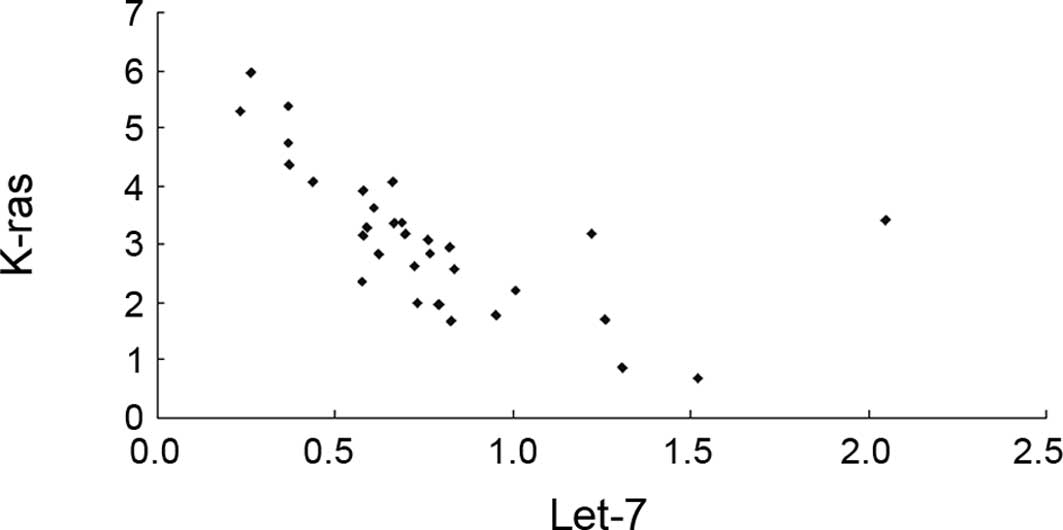
Fig. 1 shows the importance of the corrected values of let-7 and K-ras in the cancer tissues. The results show that the expression of let-7 and K-ras in tumor tissues was closely correlated (r=−0.6336, P<0.05).

Figure 1

Correlation between let-7 and K-ras.

Survival curves associated with let-7 and K-ras expression

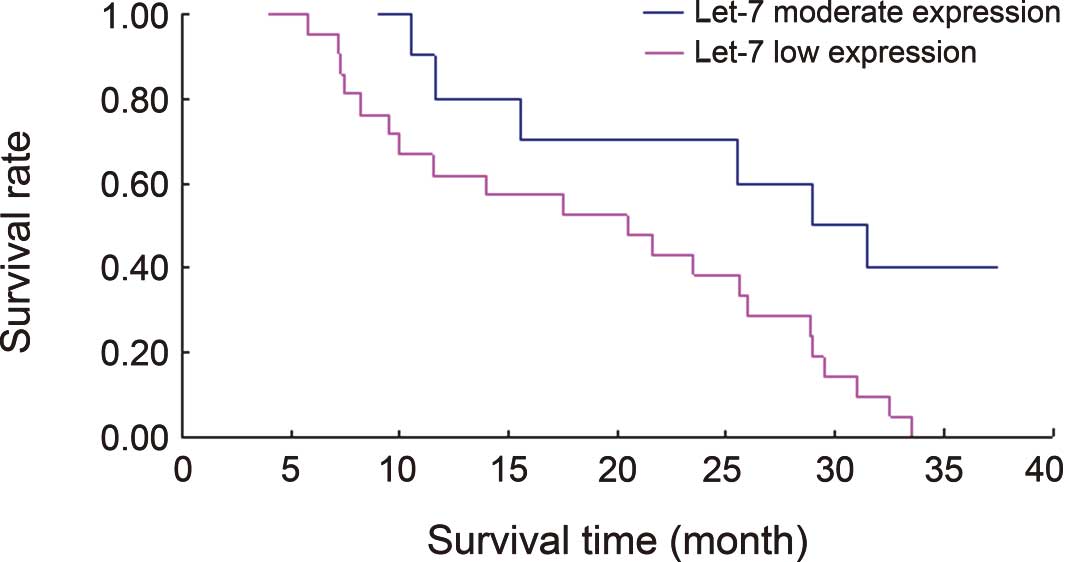
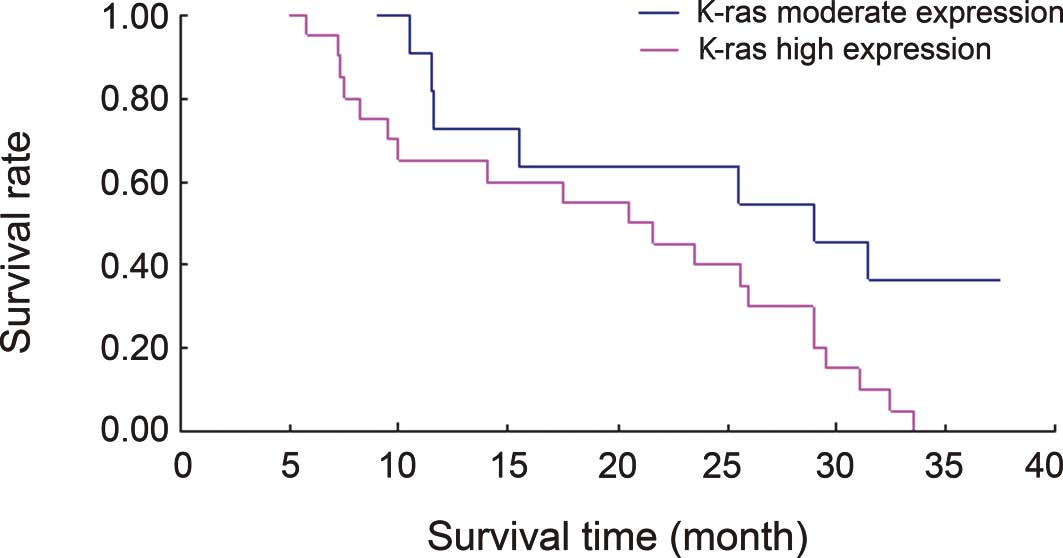
Figs. 2 and 3 show Kaplan Meier survival curves associated with let-7 and K-ras expression in the 31 lung cancer cases. The results from the log-rank differential survival test indicated statistically significant differences in the survival rates between the groups with a low and moderate let-7 expression (χ2=6.1577) and between those with a moderate and high K-ras expression (χ2=5.0152); P<0.05.

Figure 2

Survival curves of the groups with a low and moderate let-7 expression.

Figure 3

Survival curves of the groups with a moderate and high K-ras expression.

Discussion

miRNAs are ubiquitous in eukaryotic genomes. These small RNA molecules bind to specific target mRNAs through base pairing and inhibit translation or negatively regulate gene expression by the degradation of target mRNA. This method of gene expression regulation plays an essential role in development, cell differentiation and apoptosis (4). Let-7 is a member of the miRNA family. It was first found in nematodes and serves as a sequential control factor for cell fate determination (3).

let-7 expression was found to be decreased in human lung cancer, and a low expression was correlated with the postoperative survival time of patients (3,5,6). Takamizawa et al (3) studied 143 NSCLC patients undergoing radical resection, and a COX proportional hazard model analysis was performed to determine the factors that may affect prognosis, such as age, gender, histological type, smoking history, TNM stage and the let-7 expression level. Results of these authors showed that the let-7 expression level was an independent postoperative prognostic factor for NSCLC.

Our results revealed that let-7 expression was significantly lower than normal in 67.74% of the 31 lung cancer patients. Follow-up studies of these patients showed that patients in the low-expression group had a significantly lower survival rate than those in the median-expression group. The results show that let-7 expression is low in lung cancer and that patients with a low let-7 expression have a short survival time.

Ras is an important human oncogene. H-ras, K-ras and N-ras, three closely related members of the ras family, are the most common oncogenes in human cancer. K-ras is associated with lung cancer. Slebos et al (7) found a marked decrease in the survival rate of patients with a K-ras mutation. Nemunaitis et al (8) studied K-ras mutations and the expression of ras and c-erbB-2 proteins, and found that K-ras is a significant prognostic factor for lung adenocarcinoma. In our study, K-ras expression was high in 64.52% of the lung cancer patients, and the postoperative survival rate of these patients was significantly lower than that of the patients in the median-expression group. These results show that K-ras plays an important role in the pathogenesis of lung cancer.

Eder and Scherr (9) found that the let-7 expression declined as the K-ras expression increased in NSCLC, suggesting their significance. Johnson et al (10) found that the 3′-UTR of ras mRNA contains a number of complementary binding sites for let-7 and inferred that let-7 may regulate the expression of ras. These authors reported that the target of let-7 is the K-ras oncogene and that a decrease in let-7 expression resulted in an increase in ras expression or the promotion of tumor growth. Tam (11) reported that a decrease in let-7 expression caused an approximately 70% increase in the level of the ras protein expression in transfected HeLa cells.

In the present study, Pearson's correlation analysis revealed a negative correlation between the corrected values of let-7 and K-ras in the NSCLC tissues (r=−0.6336). This result suggests that during the pathogenesis of NSCLC, a decrease in the level of let-7 expression may lead to an enhanced expression of K-ras. Furthermore, our results showed that a polygene was involved in the pathogenesis and progression of NSCLC and that these genes act in synergy with each other, thus promoting the pathogenesis and progression of lung cancer and worsening patient prognosis.

References

1 

Ambros V: microRNAs: tiny regulators with great potential. Cell. 107:823–826. 2001. View Article : Google Scholar : PubMed/NCBI

2 

Calin GA, Sevignani C, Dumitru CD, et al: Human microRNA genes are frequently located at fragile sites and genomic regions involved in cancers. Proc Natl Acad Sci USA. 101:2999–3004. 2004. View Article : Google Scholar : PubMed/NCBI

3 

Takamizawa J, Konishi H, Yanagisawa K, et al: Reduced expression of the let-7 microRNAs in human lung cancers in association with shortened postoperative survival. Cancer Res. 64:3753–3756. 2004. View Article : Google Scholar : PubMed/NCBI

4 

Abrahante JE, Daul AL, Li M, Volk ML, Tennessen JM, Miller EA and Rougvie AE: The Caenorhabditis elegans hunchback-like gene lin-57/hbl-1 controls developmental time and is regulated by microRNAs. Dev Cell. 4:625–637. 2003.

5 

Yanaihara N, Caplen N, Bowman E, et al: Unique microRNA molecular profiles in lung cancer diagnosis and prognosis. Cancer Cell. 9:189–198. 2006. View Article : Google Scholar : PubMed/NCBI

6 

Shell S, Park SM, Radjabi AR, et al: Let-7 expression defines two differentiation stages of cancer. Proc Natl Acad Sci USA. 104:11400–11405. 2007. View Article : Google Scholar : PubMed/NCBI

7 

Slebos RJ, Kibbelaar RE, Dalesio O, et al: K-ras oncogene activation as a prognostic marker in adenocarcinoma of the lung. N Engl J Med. 323:561–565. 1990. View Article : Google Scholar : PubMed/NCBI

8 

Nemunaitis J, Klemow S, Tong A, et al: Prognostic value of K-ras mutations, ras oncoprotein, and c-erb B-2 oncoprotein expression in adenocarcinoma of the lung. Am J Clin Oncol. 21:155–160. 1998. View Article : Google Scholar : PubMed/NCBI

9 

Eder M and Scherr M: MicroRNA and lung cancer. N Engl J Med. 352:2446–2448. 2005. View Article : Google Scholar : PubMed/NCBI

10 

Johnson SM, Grosshans H, Shingara J, et al: RAS is regulated by the let-7 microRNA family. Cell. 120:635–647. 2005. View Article : Google Scholar : PubMed/NCBI

11 

Tam W: Identification and characterization of human BIC, a gene on chromosome 21 that encodes a noncoding RNA. Gene. 274:157–167. 2001. View Article : Google Scholar : PubMed/NCBI

Related Articles

  • Abstract
  • View
  • Download
  • Twitter
Copy and paste a formatted citation
Spandidos Publications style
Xia X, Jin W, Shi R, Zhang Y and Chen J: Clinical significance and the correlation of expression between Let-7 and K-ras in non-small cell lung cancer. Oncol Lett 1: 1045-1048, 2010.
APA
Xia, X., Jin, W., Shi, R., Zhang, Y., & Chen, J. (2010). Clinical significance and the correlation of expression between Let-7 and K-ras in non-small cell lung cancer. Oncology Letters, 1, 1045-1048. https://doi.org/10.3892/ol.2010.164
MLA
Xia, X., Jin, W., Shi, R., Zhang, Y., Chen, J."Clinical significance and the correlation of expression between Let-7 and K-ras in non-small cell lung cancer". Oncology Letters 1.6 (2010): 1045-1048.
Chicago
Xia, X., Jin, W., Shi, R., Zhang, Y., Chen, J."Clinical significance and the correlation of expression between Let-7 and K-ras in non-small cell lung cancer". Oncology Letters 1, no. 6 (2010): 1045-1048. https://doi.org/10.3892/ol.2010.164
Copy and paste a formatted citation
x
Spandidos Publications style
Xia X, Jin W, Shi R, Zhang Y and Chen J: Clinical significance and the correlation of expression between Let-7 and K-ras in non-small cell lung cancer. Oncol Lett 1: 1045-1048, 2010.
APA
Xia, X., Jin, W., Shi, R., Zhang, Y., & Chen, J. (2010). Clinical significance and the correlation of expression between Let-7 and K-ras in non-small cell lung cancer. Oncology Letters, 1, 1045-1048. https://doi.org/10.3892/ol.2010.164
MLA
Xia, X., Jin, W., Shi, R., Zhang, Y., Chen, J."Clinical significance and the correlation of expression between Let-7 and K-ras in non-small cell lung cancer". Oncology Letters 1.6 (2010): 1045-1048.
Chicago
Xia, X., Jin, W., Shi, R., Zhang, Y., Chen, J."Clinical significance and the correlation of expression between Let-7 and K-ras in non-small cell lung cancer". Oncology Letters 1, no. 6 (2010): 1045-1048. https://doi.org/10.3892/ol.2010.164
Follow us
  • Twitter
  • LinkedIn
  • Facebook
About
  • Spandidos Publications
  • Careers
  • Cookie Policy
  • Privacy Policy
How can we help?
  • Help
  • Live Chat
  • Contact
  • Email to our Support Team