Spandidos Publications Logo
  • About
    • About Spandidos
    • Aims and Scopes
    • Abstracting and Indexing
    • Editorial Policies
    • Reprints and Permissions
    • Job Opportunities
    • Terms and Conditions
    • Contact
  • Journals
    • All Journals
    • Oncology Letters
      • Oncology Letters
      • Information for Authors
      • Editorial Policies
      • Editorial Board
      • Aims and Scope
      • Abstracting and Indexing
      • Bibliographic Information
      • Archive
    • International Journal of Oncology
      • International Journal of Oncology
      • Information for Authors
      • Editorial Policies
      • Editorial Board
      • Aims and Scope
      • Abstracting and Indexing
      • Bibliographic Information
      • Archive
    • Molecular and Clinical Oncology
      • Molecular and Clinical Oncology
      • Information for Authors
      • Editorial Policies
      • Editorial Board
      • Aims and Scope
      • Abstracting and Indexing
      • Bibliographic Information
      • Archive
    • Experimental and Therapeutic Medicine
      • Experimental and Therapeutic Medicine
      • Information for Authors
      • Editorial Policies
      • Editorial Board
      • Aims and Scope
      • Abstracting and Indexing
      • Bibliographic Information
      • Archive
    • International Journal of Molecular Medicine
      • International Journal of Molecular Medicine
      • Information for Authors
      • Editorial Policies
      • Editorial Board
      • Aims and Scope
      • Abstracting and Indexing
      • Bibliographic Information
      • Archive
    • Biomedical Reports
      • Biomedical Reports
      • Information for Authors
      • Editorial Policies
      • Editorial Board
      • Aims and Scope
      • Abstracting and Indexing
      • Bibliographic Information
      • Archive
    • Oncology Reports
      • Oncology Reports
      • Information for Authors
      • Editorial Policies
      • Editorial Board
      • Aims and Scope
      • Abstracting and Indexing
      • Bibliographic Information
      • Archive
    • Molecular Medicine Reports
      • Molecular Medicine Reports
      • Information for Authors
      • Editorial Policies
      • Editorial Board
      • Aims and Scope
      • Abstracting and Indexing
      • Bibliographic Information
      • Archive
    • World Academy of Sciences Journal
      • World Academy of Sciences Journal
      • Information for Authors
      • Editorial Policies
      • Editorial Board
      • Aims and Scope
      • Abstracting and Indexing
      • Bibliographic Information
      • Archive
    • International Journal of Functional Nutrition
      • International Journal of Functional Nutrition
      • Information for Authors
      • Editorial Policies
      • Editorial Board
      • Aims and Scope
      • Abstracting and Indexing
      • Bibliographic Information
      • Archive
    • International Journal of Epigenetics
      • International Journal of Epigenetics
      • Information for Authors
      • Editorial Policies
      • Editorial Board
      • Aims and Scope
      • Abstracting and Indexing
      • Bibliographic Information
      • Archive
    • Medicine International
      • Medicine International
      • Information for Authors
      • Editorial Policies
      • Editorial Board
      • Aims and Scope
      • Abstracting and Indexing
      • Bibliographic Information
      • Archive
  • Articles
  • Information
    • Information for Authors
    • Information for Reviewers
    • Information for Librarians
    • Information for Advertisers
    • Conferences
  • Language Editing
Spandidos Publications Logo
  • About
    • About Spandidos
    • Aims and Scopes
    • Abstracting and Indexing
    • Editorial Policies
    • Reprints and Permissions
    • Job Opportunities
    • Terms and Conditions
    • Contact
  • Journals
    • All Journals
    • Biomedical Reports
      • Information for Authors
      • Editorial Policies
      • Editorial Board
      • Aims and Scope
      • Abstracting and Indexing
      • Bibliographic Information
      • Archive
    • Experimental and Therapeutic Medicine
      • Information for Authors
      • Editorial Policies
      • Editorial Board
      • Aims and Scope
      • Abstracting and Indexing
      • Bibliographic Information
      • Archive
    • International Journal of Epigenetics
      • Information for Authors
      • Editorial Policies
      • Editorial Board
      • Aims and Scope
      • Abstracting and Indexing
      • Bibliographic Information
      • Archive
    • International Journal of Functional Nutrition
      • Information for Authors
      • Editorial Policies
      • Editorial Board
      • Aims and Scope
      • Abstracting and Indexing
      • Bibliographic Information
      • Archive
    • International Journal of Molecular Medicine
      • Information for Authors
      • Editorial Policies
      • Editorial Board
      • Aims and Scope
      • Abstracting and Indexing
      • Bibliographic Information
      • Archive
    • International Journal of Oncology
      • Information for Authors
      • Editorial Policies
      • Editorial Board
      • Aims and Scope
      • Abstracting and Indexing
      • Bibliographic Information
      • Archive
    • Medicine International
      • Information for Authors
      • Editorial Policies
      • Editorial Board
      • Aims and Scope
      • Abstracting and Indexing
      • Bibliographic Information
      • Archive
    • Molecular and Clinical Oncology
      • Information for Authors
      • Editorial Policies
      • Editorial Board
      • Aims and Scope
      • Abstracting and Indexing
      • Bibliographic Information
      • Archive
    • Molecular Medicine Reports
      • Information for Authors
      • Editorial Policies
      • Editorial Board
      • Aims and Scope
      • Abstracting and Indexing
      • Bibliographic Information
      • Archive
    • Oncology Letters
      • Information for Authors
      • Editorial Policies
      • Editorial Board
      • Aims and Scope
      • Abstracting and Indexing
      • Bibliographic Information
      • Archive
    • Oncology Reports
      • Information for Authors
      • Editorial Policies
      • Editorial Board
      • Aims and Scope
      • Abstracting and Indexing
      • Bibliographic Information
      • Archive
    • World Academy of Sciences Journal
      • Information for Authors
      • Editorial Policies
      • Editorial Board
      • Aims and Scope
      • Abstracting and Indexing
      • Bibliographic Information
      • Archive
  • Articles
  • Information
    • For Authors
    • For Reviewers
    • For Librarians
    • For Advertisers
    • Conferences
  • Language Editing
Login Register Submit
  • This site uses cookies
  • You can change your cookie settings at any time by following the instructions in our Cookie Policy. To find out more, you may read our Privacy Policy.

    I agree
Search articles by DOI, keyword, author or affiliation
Search
Advanced Search
presentation
Oncology Letters
Join Editorial Board Propose a Special Issue
Print ISSN: 1792-1074 Online ISSN: 1792-1082
Journal Cover
March 2012 Volume 3 Issue 3

Full Size Image

Sign up for eToc alerts
Recommend to Library

Journals

International Journal of Molecular Medicine

International Journal of Molecular Medicine

International Journal of Molecular Medicine is an international journal devoted to molecular mechanisms of human disease.

International Journal of Oncology

International Journal of Oncology

International Journal of Oncology is an international journal devoted to oncology research and cancer treatment.

Molecular Medicine Reports

Molecular Medicine Reports

Covers molecular medicine topics such as pharmacology, pathology, genetics, neuroscience, infectious diseases, molecular cardiology, and molecular surgery.

Oncology Reports

Oncology Reports

Oncology Reports is an international journal devoted to fundamental and applied research in Oncology.

Experimental and Therapeutic Medicine

Experimental and Therapeutic Medicine

Experimental and Therapeutic Medicine is an international journal devoted to laboratory and clinical medicine.

Oncology Letters

Oncology Letters

Oncology Letters is an international journal devoted to Experimental and Clinical Oncology.

Biomedical Reports

Biomedical Reports

Explores a wide range of biological and medical fields, including pharmacology, genetics, microbiology, neuroscience, and molecular cardiology.

Molecular and Clinical Oncology

Molecular and Clinical Oncology

International journal addressing all aspects of oncology research, from tumorigenesis and oncogenes to chemotherapy and metastasis.

World Academy of Sciences Journal

World Academy of Sciences Journal

Multidisciplinary open-access journal spanning biochemistry, genetics, neuroscience, environmental health, and synthetic biology.

International Journal of Functional Nutrition

International Journal of Functional Nutrition

Open-access journal combining biochemistry, pharmacology, immunology, and genetics to advance health through functional nutrition.

International Journal of Epigenetics

International Journal of Epigenetics

Publishes open-access research on using epigenetics to advance understanding and treatment of human disease.

Medicine International

Medicine International

An International Open Access Journal Devoted to General Medicine.

Journal Cover
March 2012 Volume 3 Issue 3

Full Size Image

Sign up for eToc alerts
Recommend to Library

  • Article
  • Citations
    • Cite This Article
    • Download Citation
    • Create Citation Alert
    • Remove Citation Alert
    • Cited By
  • Similar Articles
    • Related Articles (in Spandidos Publications)
    • Similar Articles (Google Scholar)
    • Similar Articles (PubMed)
  • Download PDF
  • Download XML
  • View XML
Article

Nucleolar organizer regions in a chronic stress and oral cancer model

  • Authors:
    • Ivonne Andrea Muñoz Ruz
    • Daniel Andrés Droguett Ossa
    • Wendy Karina Donoso Torres
    • Ulrike Kemmerling
    • Bernardo Arturo Venegas Rojas
    • César Andrés Rivera Martínez
  • View Affiliations / Copyright

    Affiliations: Department of Stomatology, Faculty of Health Sciences, University of Talca, Talca, Chile, Department of Basic Biomedical Sciences, Faculty of Health Sciences, University of Talca, Talca, Chile
  • Pages: 541-544
    |
    Published online on: December 6, 2011
       https://doi.org/10.3892/ol.2011.514
  • Expand metrics +
Metrics: Total Views: 0 (Spandidos Publications: | PMC Statistics: )
Metrics: Total PDF Downloads: 0 (Spandidos Publications: | PMC Statistics: )
Cited By (CrossRef): 0 citations Loading Articles...

This article is mentioned in:


Abstract

This study aimed to examine the role of chronic restraint stress (RS) on oral squamous cell carcinomas induced by 4-nitroquinoline-1-oxide (4-NQO) in CF-1 mouse tongues, measured by the expression of argyrophilic staining of nucleolar organizer regions (AgNOR). Thirty one samples of lingual epithelial tissue of CF-1 mice with a diagnosis of oral squamous cell carcinoma (OSSC) were assigned to two experimental groups: the RS/4-NQO group, where animals received RS and induction of oral chemical carcinogenesis (n=17); and the 4-NQO group, where animals received induction of chemical carcinogenesis without restraint stress (n=14). The mean number and distribution pattern of AgNOR were recorded. The mean AgNOR number per cell was found to be slightly higher in the 4-NQO group. AgNOR in the RS/4-NQO group revealed a higher tendency to be arranged in a clumped distribution compared to the 4-NQO group. No statistically significant difference was found between the groups. In conclusion, the induction of chronic restraint stress in CF-1 mice does not increase the number or affect the distribution pattern of AgNORs in OSSC induced by 4-NQO.

Introduction

A number of studies have demonstrated a positive association between stress and cancer (1,2). However, using conventional microscopy analysis, we recently showed that this correlation does not appear to apply to chronic stress and oral squamous cell carcinoma (OSCC) (3).

The initial changes that occur at the cell nucleus are not detected by the conventional H&E staining technique (4). Changes in the cell nucleus can be detected early through analysis of the nucleolar organizer regions (NORs) by silver staining, used to evaluate proliferative and malignant activities. In this manner, benign tumors are distinguished from malignant ones, and tumor grade and prognosis are determined (5–8). NORs are loops of DNA occurring within nucleoli that encode for ribosomal RNA. NORs are closely associated with non-histone proteins, known as argyrophilic staining of nucleolar organizer regions (AgNOR), which may be visualized by a histochemical technique relying on their argyrophilic properties.

The AgNOR number is directly proportional to the speed of the cell cycle. For this reason, cell proliferation has a prognostic value, since high proliferative activity is associated with poor prognosis (9). Various AgNOR parameters have been established to objectively evaluate the variations that occur between one tissue condition and another. These include number and distribution pattern (the most commonly used parameters), as well as mean nucleus area, size, shape and AgNOR location, which have proven to be significant factors in previous studies on oral mucosa lesions (10).

The number of AgNORs per nucleus has been widely used and described in the literature (6); this parameter varies in the nucleoli according to the transcriptional activity of ribosomal RNA (11). Various studies have linked higher levels in the number of AgNORs with the degree of malignancy of the lesions (4,8,12,13) and with poor prognosis (13).

In terms of their distribution pattern, AgNORs have been suggested to form groups or clusters of malignant lesions when compared with benign tumors (8,13,14). Two distribution parameters have been established: clustered and dispersed. When AgNORs have points that are in contact, they are considered to be clustered, whereas those that have no points of contact are classified as dispersed (8).

The aim of this study was to analyze the number and distribution pattern of NORs using the AgNOR staining technique on samples collected in a previous study by Rivera et al (3) that combined a model of chronic stress and chemical carcinogenesis in CF-1 mouse tongues.

Materials and methods

A retrospective study design was used to conduct this investigation. The independent variable was stress exposure; the dependent variables were the number and distribution of NORs.

Samples

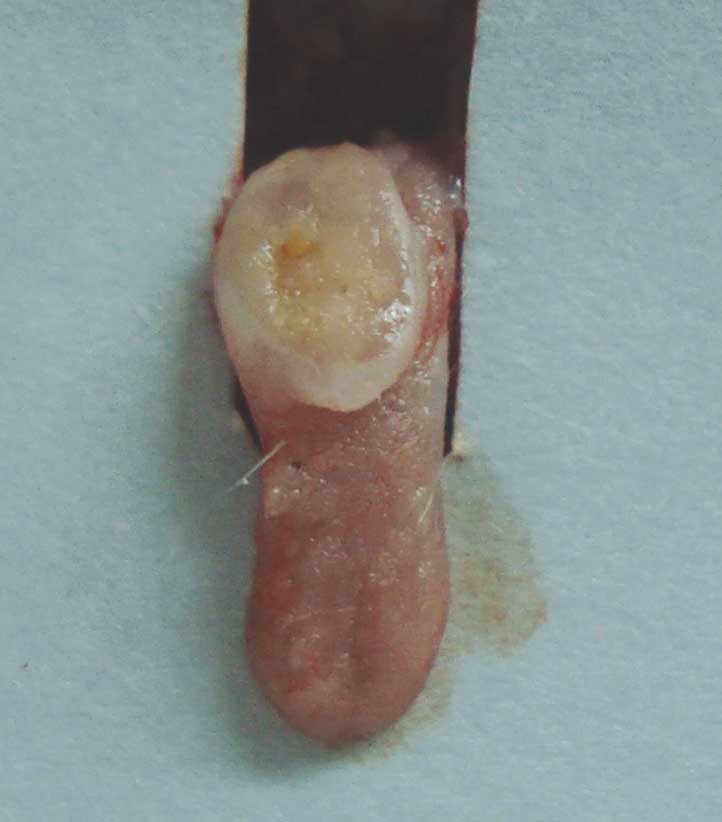
This study involved 31 cases from a previous investigation (3), which examined the role of chronic restraint stress on the incidence and severity of lingual SCC induced by 4-nitroquinoline-1-oxide (4-NQO) in CF-1 mice (Fig. 1). The study was approved by the Bioethics Committee of the University of Talca.

Figure 1

(A) Mouse tongue lesions induced by 4-NQO (4-nitroquinoline-1-oxide). (B) Oral squamous cell carcinoma induced by 4-NQO.

The samples belonged to two experimental groups. The RS/4-NQO group (n=17) received two treatments: restraint stress and induction of chemical carcinogenesis. The 4-NQO group (n=14) received induction of chemical carcinogenesis without restraint stress. In all cases, we evaluated NORs in tumor cells (AgNOR count and distribution) using a semi-quantitative method.

AgNOR staining

The AgNOR staining technique was applied to all paraffin-embedded specimens, with some modifications to the method reported by Ploton et al (15). The working solution consisted of two parts 50% silver nitrate solution and one part mixture of 2% gelatin and 1% formic acid, prepared immediately prior to the staining procedure. Sections were hydrated in decreasing concentrations of alcohol, rinsed in distilled water and subsequently incubated in freshly prepared working solution for 30 min at room temperature in the dark. Sections were then washed in distilled water for 1 min, dehydrated in increasing concentrations of alcohol, cleaned and mounted in Disterine Plastiser Xylene (DPX) medium. NORs were counted in tumor cells, appearing as brownish black intranuclear dots on a pale yellow background.

Number and distribution of AgNORs

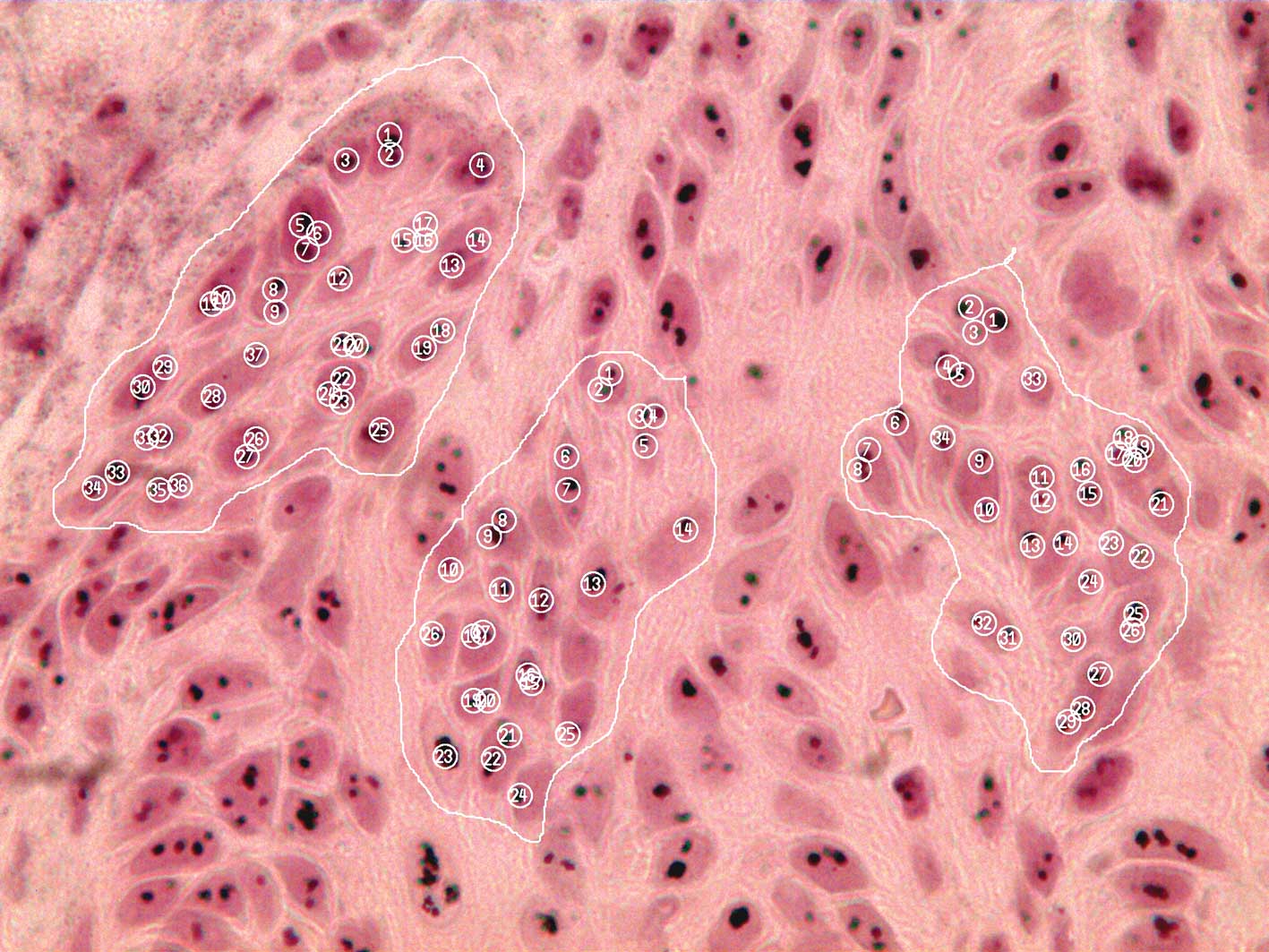
In the areas of squamous cell carcinomas, the plates were photographed at a magnification of ×100, using a Micrometrics® camera (Micrometrics® 122CU 1.3-megapixel 1/2′) attached to an optical microscope. Individual microphotographs were morphometrically evaluated using a semi-automatic electronic image analyzer (Microscope Software AxioVision LE), for which measurements were performed in 2 fields of 100 cells each to record the mean number of AgNORs per cell and the distribution pattern of AgNORs. Fig. 2 shows how the counting was performed manually using the software.

Figure 2

Example of manual counting of AgNORs (argyrophilic staining of nucleolar organizer regions) using the software.

Analyses were performed by an oral pathologist (B.V.) from the University of Talca. The observer was unaware of the group to which the study samples belonged (single-blinded). We determined the number and distribution pattern of AgNORs per cell, according to the categories used in a previous study (8): clustered, AgNORs in contact; and dispersed, no AgNORs in contact.

Statistical analysis

Qualitative data were analyzed using the Chi-square statistical test with Pearson’s correlation. Quantitative data were studied using the Mann-Whitney U test. P≤0.05 was considered to be statistically significant for all tests.

Results

Severity of invasive carcinoma according to the analysis of AgNORs

Restraint stress did not increase the severity according to the number of AgNORs per cell of 4-NQO-induced OSCC tongue lesions in CF-1 mice. Table I shows that the two groups of mice demonstrated similar results for the number of AgNORs per cell. The RS/4-NQO group had a mean of 2.44 AgNORs per cell, compared to 2.41 for the 4-NQO group. The Mann-Whitney U test was used to evaluate the difference between the groups. No statistically significant differences were found between the groups (p=0.97).

Table I

AgNOR analysis in OSCC tongue lesions induced by 4-NQO.

Table I

AgNOR analysis in OSCC tongue lesions induced by 4-NQO.

TreatmentSamplesAgNORs in OSCC

AgNOR number by cell (mean ± SD)AgNOR distribution pattern

ClusteredDispersed
RS/4-NQO142.41±0.4595
4-NQO172.44±0.56710

[i] RS, restraint stress; 4-NQO, 4-nitroquinoline 1-oxide; OSCC, oral squamous cell carcinoma; AgNOR, argyrophilic staining of nucleolar organizer regions.

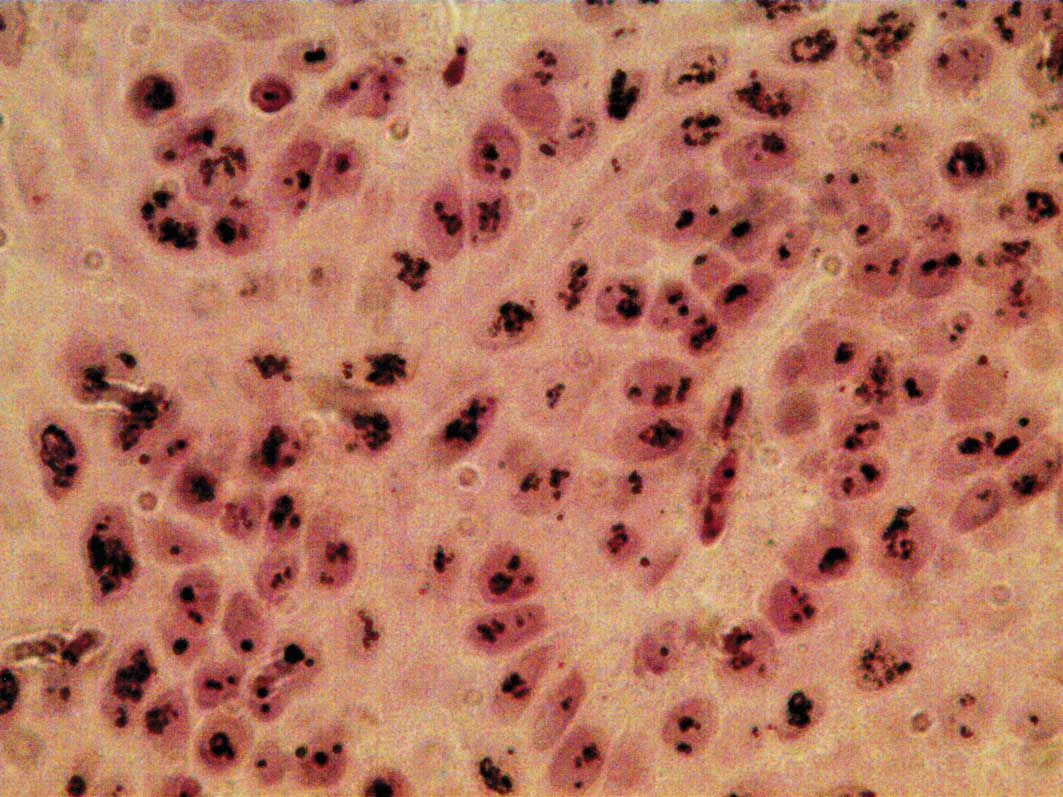
Restraint stress did not increase the severity according to the distribution pattern of AgNORs of 4-NQO-induced OSCC tongue lesions in CF-1 mice. Fig. 3 shows the distribution pattern prevailing in each group. The RS/4-NQO group revealed 9 (64.3%) AgNOR cases with a clustered distribution pattern and 5 (35.7%) dispersed ones. The 4-NQO group had 7 (41.2%) clustered and 10 (58.8%) dispersed cases (Table I). The Chi-square test with Pearson’s correlation revealed that the difference between the two groups was not statistically significant (p=0.2).

Figure 3

AgNOR distribution pattern. (A) RS/4-NQO group, predominantly clustered pattern. (B) 4-NQO group, mostly dispersed pattern. No significant difference was observed between mice in the RS/4-NQO and 4-NQO groups. RS, restraint stress; 4-NQO, 4-nitroquinoline 1-oxide; AgNOR, argyrophilic staining of nucleolar organizer regions.

Discussion

The histochemical technique with silver staining has been used in a number of investigations since the early 1980s (16) for the purpose of visualizing NORs found in acrocentric chromosomes. Since its beginnings, this technique has undergone various changes under the enhanced expression of AgNORs, in an attempt to eliminate or reduce those artifacts that may interfere with viewing them.

The application of morphological methods to study cell proliferation is affected by various factors that can escape any observer (13). During the observation of samples in this study, background staining was detected that hindered to a certain extent the process of analysis and identification of AgNORs, which is consistent with observations described by Lindner et al (17).

It has been reported that the number of AgNORs per cell increased, and this increase is associated with significant changes in the tissue (6).

In a similar study conducted by Venegas et al (18), the mean number of AgNORs per cell in the tongue epithelium of healthy CF-1 mice was found to be 2.1. Our values were slightly higher, with a mean of 2.44 for mice in the 4-NQO group and 2.41 in the RS/4-NQO group.

Notably, although a higher number of AgNORs per cell was expected in plaques of mice with cancer and stress, the results demonstrated otherwise. This finding may be correlated with the distribution adopted by the AgNORs, as there was a greater tendency for the AgNORs to cluster and overlap, and after counting, one unit of a group of AgNORs could not be individually identified.

The second parameter used in this study was the pattern of AgNOR distribution, for which a classification was selected due to its simplicity and easy application (8). According to this analysis, the clustered distribution corresponded to 64.3% in the RS/4-NQO group. In mice in the 4-NQO group there was a predilection for the dispersed distribution pattern, observed in 58.8% of all specimens in this group. However, in spite of this finding, and although there was a slightly higher trend towards a grouped distribution in the cancer group receiving stress treatment, no statistically significant difference was noted when comparing the distribution patterns between the two groups of mice.

Although the AgNOR technique is described by certain authors as being simple, cost-effective and easy to perform (12,13,19), it should also be taken into account that this technique is sensitive to various factors, including the thickness of histological sections, the reaction temperature of the solutions, the concentration of silver nitrate, incubation times and even the use of glass that is not perfectly clean (9). Such factors may hinder the identification of the AgNORs. Furthermore, the interpretations of these data are less reliable if not supported by a computational method, which is a limitation of the research protocol.

The findings, in our view, indicate that the AgNOR procedure is not a technique sufficiently sensitive to measure the biological functions, at least related to the methods of our research.

The methodology used in this study demonstrates that chronic restraint stress has no involvement in the severity of lingual carcinomas of CF-1 mice, according to the parameters analyzed, consistent with our previous report (3). However, of note is that more sensitive markers were analyzed by immunohistochemistry and molecular biology methods.

Acknowledgements

This study was supported by grant CONICYT-PBCT Anillo ACT 112, Chile.

References

1 

Saul A, Oberyszyn T, Daugherty C, Kusewitt D, Jones S, Jewell S, et al: Chronic stress and susceptibility to skin cancer. J Natl Cancer Inst. 97:1760–1767. 2005. View Article : Google Scholar : PubMed/NCBI

2 

Thaker P, Han L, Kamat A, Arevalo J, Takahashi R, Lu C, et al: Chronic stress promotes tumor growth and angiogenesis in a mouse model of ovarian carcinoma. Nat Med. 12:939–944. 2006. View Article : Google Scholar : PubMed/NCBI

3 

Rivera C, Droguett D, Kemmerling U and Venegas B: Chronic restraint stress in oral squamous cell carcinoma. J Dent Res. 90:799–803. 2011. View Article : Google Scholar : PubMed/NCBI

4 

Cano L, Álvarez G, Valencia W, Ramírez J and Prada C: Análisis del marcador tisular AgNOR en leucoplasia y carcinoma escamocelular oral. Medicina Oral. 7:17–25. 2002.

5 

Kanitakis J, Hoyo E, Hermier C, Chouvet B and Thivolet J: Nucleolar organizer region enumeration in keratoacanthomas and squamous cell carcinomas of the skin. Cancer. 69:2937–2941. 1992. View Article : Google Scholar : PubMed/NCBI

6 

Schwint A, Gomez E, Itoiz M and Cabrini R: Nucleolar organizer regions as markers of incipient cellular alterations in squamous epithelium. J Dent Res. 72:1233–1236. 1993. View Article : Google Scholar : PubMed/NCBI

7 

Korneyev I, Mamaev N, Kozlov V and Rybakova M: Interphase argyrophilic nucleolar organizer regions and nucleolar counts in transitional cell bladder tumors. Mol Pathol. 53:129–132. 2000. View Article : Google Scholar : PubMed/NCBI

8 

Palomo-González M, Pérez-Requena J, Rego-González M, López-Nieto M and Cañizares C: Evaluación de regiones organizadoras nucleolares argirófilas (AgNORs) en neoplasias foliculares tiroideas. Rev Esp Patol. 35:95–100. 2002.PubMed/NCBI

9 

Pich A, Chiusa L and Navone R: Prognostic relevance of cell proliferation in head and neck tumors. Ann Oncol. 15:1319–1329. 2004. View Article : Google Scholar : PubMed/NCBI

10 

Cabrini R, Schwint A, Mendez A, Femopase F, Lanfranchi H and Itoiz M: Morphometric study of nucleolar organizer regions inchuman oral normal mucosa, papilloma and squamous cell carcinoma. Oral Pathol Med. 21:275–279. 1992. View Article : Google Scholar : PubMed/NCBI

11 

Derenzini M: The AgNORs. Micron. 31:117–120. 2000. View Article : Google Scholar

12 

Leyva Huerta E, Vega E, Ramìrez M and Zárate A: Marcador de regiones de organizadores nucleolares en lesiones epiteliales de cavidad bucal. Rev Esp Patol. 37:287–293. 2004.

13 

López-Muñiz A, Triviño A, Hernández L and Herrero A: Valoración de las regiones organizadoras nucleares en lesiones melánicas benignas y malignas de piel. Rev Cubana Med. 40:17–23. 2001.PubMed/NCBI

14 

Wozniak Z, Usson Y, Parazza F, Champelovier P, Leroux D and Seigneurin D: Quantitative analysis of three-dimensional distribution of AgNOR proteins during interphase in leukemic cells. Cytometry. 24:14–26. 1996. View Article : Google Scholar : PubMed/NCBI

15 

Ploton D, Menager M, Jeanneson P, Himber G, Piegon F and Adent JJ: Improvement in the staining and in the visualization of argyrophilic proteins of the nucleolar organizer region at the optical level. Histochem J. 18:5–14. 1986. View Article : Google Scholar : PubMed/NCBI

16 

Warnakulasuriya K and Johnson N: Nucleolar organiser region (NOR) distribution as a diagnostic marker in oral keratosis, dysplasia and squamous cell carcinoma. J Oral Pathol Med. 22:77–81. 1993. View Article : Google Scholar : PubMed/NCBI

17 

Lindner L: Improvements in the silver-staining technique for nucleolar organizer regions (AgNOR). J Histochem Cytochem. 41:439–445. 1993. View Article : Google Scholar : PubMed/NCBI

18 

Venegas B, Vildósola M and Droguett D: AgNORs expression in experimental carcinogenesis. J Dent Res. 89(Spec Iss B): pp. 1916(www.dentalresearch.orgurisimplewww.dentalresearch.org). 2010

19 

Rocher E, Blanco A and Palaoro L: Utilidad de la técnica de AgNOR en la interpretación de los derrames de cavidades serosas. Rev Med Chil. 128:963–968. 2000.

Related Articles

  • Abstract
  • View
  • Download
  • Twitter
Copy and paste a formatted citation
Spandidos Publications style
Muñoz Ruz IA, Droguett Ossa DA, Donoso Torres WK, Kemmerling U, Venegas Rojas BA and Rivera Martínez CA: Nucleolar organizer regions in a chronic stress and oral cancer model. Oncol Lett 3: 541-544, 2012.
APA
Muñoz Ruz, I.A., Droguett Ossa, D.A., Donoso Torres, W.K., Kemmerling, U., Venegas Rojas, B.A., & Rivera Martínez, C.A. (2012). Nucleolar organizer regions in a chronic stress and oral cancer model. Oncology Letters, 3, 541-544. https://doi.org/10.3892/ol.2011.514
MLA
Muñoz Ruz, I. A., Droguett Ossa, D. A., Donoso Torres, W. K., Kemmerling, U., Venegas Rojas, B. A., Rivera Martínez, C. A."Nucleolar organizer regions in a chronic stress and oral cancer model". Oncology Letters 3.3 (2012): 541-544.
Chicago
Muñoz Ruz, I. A., Droguett Ossa, D. A., Donoso Torres, W. K., Kemmerling, U., Venegas Rojas, B. A., Rivera Martínez, C. A."Nucleolar organizer regions in a chronic stress and oral cancer model". Oncology Letters 3, no. 3 (2012): 541-544. https://doi.org/10.3892/ol.2011.514
Copy and paste a formatted citation
x
Spandidos Publications style
Muñoz Ruz IA, Droguett Ossa DA, Donoso Torres WK, Kemmerling U, Venegas Rojas BA and Rivera Martínez CA: Nucleolar organizer regions in a chronic stress and oral cancer model. Oncol Lett 3: 541-544, 2012.
APA
Muñoz Ruz, I.A., Droguett Ossa, D.A., Donoso Torres, W.K., Kemmerling, U., Venegas Rojas, B.A., & Rivera Martínez, C.A. (2012). Nucleolar organizer regions in a chronic stress and oral cancer model. Oncology Letters, 3, 541-544. https://doi.org/10.3892/ol.2011.514
MLA
Muñoz Ruz, I. A., Droguett Ossa, D. A., Donoso Torres, W. K., Kemmerling, U., Venegas Rojas, B. A., Rivera Martínez, C. A."Nucleolar organizer regions in a chronic stress and oral cancer model". Oncology Letters 3.3 (2012): 541-544.
Chicago
Muñoz Ruz, I. A., Droguett Ossa, D. A., Donoso Torres, W. K., Kemmerling, U., Venegas Rojas, B. A., Rivera Martínez, C. A."Nucleolar organizer regions in a chronic stress and oral cancer model". Oncology Letters 3, no. 3 (2012): 541-544. https://doi.org/10.3892/ol.2011.514
Follow us
  • Twitter
  • LinkedIn
  • Facebook
About
  • Spandidos Publications
  • Careers
  • Cookie Policy
  • Privacy Policy
How can we help?
  • Help
  • Live Chat
  • Contact
  • Email to our Support Team